
 100% FREE ACCESS
11th Standard Syllabus & Materials
11th Standard
TN 11th Tamil இயற்கை வேளாண்மை,சுற்றுச்சூழல் -செய்யுள் - மனோன்மணீயம் Important Questions And Answers Study Material - QB365 Set A
NEW11th Standard
TN 11th Tamil என்னுயிர் என்பேன் -துணைப்பாடம் - இசைத்தமிழர் இருவர் Important Questions And Answers Study Material - QB365 Set A
NEW11th Standard
TN 11th Tamil மொழி கலை -செய்யுள் - ஒவ்வொரு புல்லையும் Important Questions And Answers Study Material - QB365 Set A
NEW11th Standard
TN 11th Tamil பீடு பெற நில் - இலக்கணம் - பகுபத உறுப்புகள் Important Questions And Answers Study Material - QB365 Set A
NEW11th Standard
TN 11th Tamil பீடு பெற நில் - துணைப்பாடம் - வாடிவாசல் Important Questions And Answers Study Material - QB365 Set A
NEW11th Standard
TN 11th Tamil பீடு பெற நில் - செய்யுள் - குறுந்தொகை Important Questions And Answers Study Material - QB365 Set A

Published on: 19/09/2019
Motion of System of Particles and Rigid Bodies
Download Tamil Nadu 11th Standard Physics question papers, model tests, one-mark questions, important questions, and public exam papers in PDF format. Free study materials and answer keys for TN State Board students.
Questions + Answers key
Take MCQ Physics Test1.
A solid sphere of mass 20 kg and radius 0.25 m rotates about an axis passing through the center. What is the angular momentum if the angular velocity is 5 rad s-1.
2.
An electron of mass 9\(\times\)10-31 kg revolves around a nucleus in a circular orbit of radius 0.53 \(\overset { 0}{ A } \). What is the angular momentum of the electron? (Velocity of electron is, v = 2.2 \(\times\)106 ms-1)
3.
When an object will have precession? Give one example.
4.
What is a rigid body?
5.
The distance between the centres of carbon and oxygen atoms in the carbon monoxide gas molecule is 1.13 \(\mathring{A}\) . Locate the centre of mass of the gas molecule relative to the carbon atom.
6.
Give examples where the centre of mass coincides with the geometrical centre of the body.
7.
Four bodies of masses 5 kg, 2 kg, 3 kg and 4 kg are respectively placed at position (0, 0, 0), (2, 0, 0) (0, 3, 0) and (-2, -2, 0) calculate the moment of inertia about x-axis, y-axis and z-axis.
8.
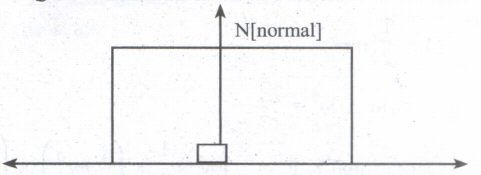
A rectangle block rests on a horizontal table. A horizontal force is applied on the block at a height h above the table to move the block. Does the line of action of the normal force N exerted by the table on the block depend on h?
9.
Give an example to show that the following statement is false. 'any two forces acting on a body can be combined into single force that would have same effect'.
10.
Why does a porter bend forward while carrying a sack of rice on his back?
11.
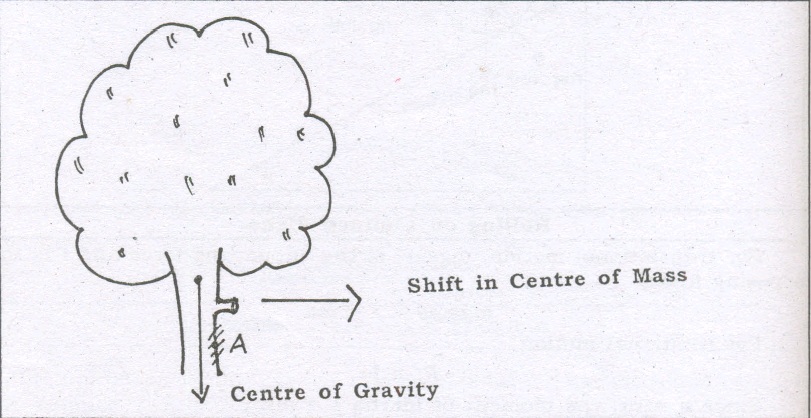
When a tree is cut, the cut is made on the side facing the direction in which the tree is required to fall. Why?
12.
State law of Conservation of angular momentum.
13.
State the torque about an axis is independent of the origin.
14.
State the rule which is used to find the direction of torque.
15.
What is point mass?
1.
Mass of the sphere, m = 20 kg
Radius r = 0.25 m
Angular velocity 0 = 5 rad s-1
Angular momentum \(L=I\omega =\frac{2}{5} mr^{2}\omega\)
\(=\frac{2}{5}\times 20 \times (0.25)^{2}\times 5 = 40 \times (0.0625)=2.5\)
L = 2.5 kg m2 s-1.
2.
Mass of the electron, m = 9 \(\times\)10-31 kg
Radius of the electron, r = 0.53 \(\overset { 0}{ A } \) = 0.53 \(\times\)10-10 m
Velocity of the electron, v = 2.2 \(\times\)106 ms-1
Angular momentum of electron is, L = I\(\omega\)
Electron is considered as a point mass. Hence, its moment of inertia is, I= mr2
The relation, \(\omega=\frac{v}{r}\)could be used.
Angular momentum, \(L=mr^{2}\times \frac{v}{r}=mvr\)
=\(9.1 \times 10^{-31}\times 2.2 \times 10^{6}\times 0.53\times 10^{-10}\)
\(L=1.06\times 10^{-34}\)kg m2 s-1.
3.
The torque about the axis will rotate the object about it and the torque perpendicular to the axis will turn the axis of rotation when both exist simultaneously on a rigid body the body will have a precession.
4.
A rigid body is the one which maintains its definite and fixed shape even when an external force acts on it.
5.
\({x}_{CM}={m_1+m_2+m_2x_2\over m_1+m_2}={12\times0+16\times1.13 \over 12+16}=0.6457\ \mathring{A}\)
6.
For symmetrically shaped bodies of uniform composition (Eg: spheres, cylinders, rectangular solids), the centre of mass is located at the geometrical centre of the body.
7.
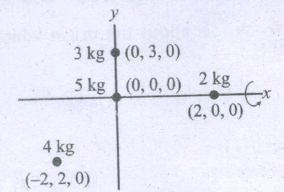
Ix = 3 \(\times\) (3)2 + 4 \(\times\) (2)2 = 43 unit
Iy = 2\(\times\) (2)2 + 4 \(\times\) (2)2 = 24 unit
Iz = 2 \(\times\) (2)2 + 3 \(\times\) (3)2 + 4 \(\times\) (\(\sqrt { 2 } \))2
= 8 + 27 + 32 = 67 unit
8.
The line of action of normal force N exerted by the table on the block does not depend on h because the reactionary force N exerted by the table which is directed vertically upward and passes through its centre of gravity. Since the block is in equilibrium, N=mg.
Friction is always perpendicular to the normal force N acting between the surfaces. It acts tangential to the surface of contact.
9.
Lifting a table from the floor by two persons. Pushing the car by two persons.
10.
Due to the added weight of rice sack, centre of gravity of the combined body weight and the carrying weight shifted to new position. Once he bends, the Centre of gravity realigns as with the body's axis making his body balanced.
11.
The weight of tree exerts a torque about the point where the cut is made. This causes rotation of the tree about the cut has to be made at say point A to weaken the tree trunk and to shift the centre of mass to the right and eventually move towards the ground on the right.
12.
In the absence of external torque, the angular momentum of the rigid body or system of particles is conserved.
If \(\tau\) = 0 then, \(\frac { dL }{ dt } =0\) ; L= constant
13.
(i) The torque of a force about an axis is independent of the choice of the origin as long as it is chosen on that axis itself.
(ii) Let O be the origin on the axis AB, which is the rotational axis of a rigid body. F is the force acting at the point P. Now, choose another point O' anywhere on the axis.
(iii) The torque of F about O' is,
\(\overset { \rightarrow }{ O'P } \times \overset { \rightarrow }{ F } =(\overset { \rightarrow }{ O'O } +\overset { \rightarrow }{ OP } )\times \overset { \rightarrow }{ F } \)
=\((\overset { \rightarrow }{ O'O } \times \overset { \rightarrow }{ F } )+(\overset { \rightarrow }{ OP } \times \overset { \rightarrow }{ F } )\)
(iv) As \(\overset { \rightarrow }{ O'O } \times \overset { \rightarrow }{ F } \) is perpendicular to \(\overset { \rightarrow }{ O'O } \) this term will not have a component along AB. Thus, the component of \(\overset { \rightarrow }{ O'P } \times \overset { \rightarrow }{ F } \) is equal to that of \(\overset { \rightarrow }{ OP } \times \overset { \rightarrow }{ F } \).
14.
The direction of torque is found using right hand rule. This rule says that if fingers of right hand are kept along the position vector with palm facing the direction of the force and when the fingers are curled the thumb points to the direction of the torque.
15.
A point mass is a hypothetical point particle which has nonzero mass and no size or shape.

11th Standard Syllabus & Materials
11th Standard
TN 11th Tamil பீடு பெற நில் - செய்யுள் - காவடிச்சிந்து Important Questions And Answers Study Material - QB365 Set A
NEW11th Standard
TN 11th Tamil பீடு பெற நில் - உரைநடை - மலை இடப்பெயர்கள் : ஓர் ஆய்வு Important Questions And Answers Study Material - QB365 Set A
NEW11th Standard
TN 11th Tamil மாமழை போற்றுதும் - துணைப்பாடம் - யானை டாக்டர் Important Questions And Answers Study Material - QB365 Set A
NEW11th Standard
TN 11th Tamil மாமழை போற்றுதும் - செய்யுள் - ஐங்குறுநூறு Important Questions And Answers Study Material - QB365 Set A



Tamilnadu Stateboard 11th Standard Subjects

Maths

Commerce

Economics

Biology

Business Maths and Statistics

Accountancy

Computer Science
Physics

Chemistry
Maths
Biology
Economics
Physics
Chemistry

History
Business Maths and Statistics

Computer Science
Accountancy

Computer Applications
History
Computer Technology
Commerce
Computer Applications
Computer Technology

Tamil

English

French
Tamilnadu Stateboard Standards

