
 100% FREE ACCESS
11th Standard Syllabus & Materials
11th Standard
TN 11th Tamil இயற்கை வேளாண்மை,சுற்றுச்சூழல் -செய்யுள் - மனோன்மணீயம் Important Questions And Answers Study Material - QB365 Set A
NEW11th Standard
TN 11th Tamil என்னுயிர் என்பேன் -துணைப்பாடம் - இசைத்தமிழர் இருவர் Important Questions And Answers Study Material - QB365 Set A
NEW11th Standard
TN 11th Tamil மொழி கலை -செய்யுள் - ஒவ்வொரு புல்லையும் Important Questions And Answers Study Material - QB365 Set A
NEW11th Standard
TN 11th Tamil பீடு பெற நில் - இலக்கணம் - பகுபத உறுப்புகள் Important Questions And Answers Study Material - QB365 Set A
NEW11th Standard
TN 11th Tamil பீடு பெற நில் - துணைப்பாடம் - வாடிவாசல் Important Questions And Answers Study Material - QB365 Set A
NEW11th Standard
TN 11th Tamil பீடு பெற நில் - செய்யுள் - குறுந்தொகை Important Questions And Answers Study Material - QB365 Set A

Published on: 05/12/2018
Using the model question papers, every student can get an idea about the exam questions in a subject wise and collect more information to score high marks on the board.
One mark questions are quick and easy to score. Here are the most important one mark questions from the Samacheer syllabus for 11th physics. Students can practice with this question paper to score more. In this question paper, one marks are questions are taken based on the book back, creative questions and repeatedly asked questions.
The question paper is created based on the state board syllabus. It is a very useful question paper for Matriculation and state board students for their exam preparation. Usually, one mark questions are very simple but asked in a tricky way. By practicing repeatedly you will get the idea of answering the questions and this improves the speed of answering. This will save the time and you can complete all the questions without any last our tension.
Our aim is to bring out the best scores on board exams. By practicing with this important model question paper student can gain more knowledge and confidence to crack the exams. With this model objective questions, you can get good scores by practicing.
Download Tamil Nadu 11th Standard Physics question papers, model tests, one-mark questions, important questions, and public exam papers in PDF format. Free study materials and answer keys for TN State Board students.
Questions + Answers key
Take MCQ Physics Test1.
Universal gas constant is _________________.
Cp/Cv
Cp - Cv
Cp + Cv
Cv/Cp
2.
Two drops of equal radius coalesce to form a bigger drop. What is ratio of surface energy of bigger drop to smaller one?
21/2:1
1:1
22/3:1
none of these
3.
A satellite is orbiting the earth close to its surface. A particle is to be projected from the satellite to just escape from the earth the escape speed from the earth is Ve its speed with respect to the satellite________________.
will be less than Ve
will be more than Ve
will be equal to Ve
will depend on direction of projection
4.
At which of the following temperature would be molecules of gas have twice the average K.E they have at 20°C?
40°C
80°C
586°C
313°C
5.
An organ pipe open at one end is vibrating in first overtone and is in resonance with another pipe open at both ends and vibrating in thrid harmonic. The ratio of length of 2 pipes is _____________.
1: 2
4: 1
8: 3
3: 8
6.
The damping force on an oscillator is directly proportional to the velocity. The units of the constant of proportionality are
kgms−1
kgms−2
kgs−1
kgs
7.
8.
An ideal spring of spring constant k, is suspended from the ceiling of a room and a block of mass M is fastened to its lower end. If the block is released when the spring is un-stretched, then the maximum extension in the spring is
4\(\frac { Mg }{ k } \)
\(\frac { Mg }{ k } \)
2\(\frac { Mg }{ k } \)
\(\frac { Mg }{ 2k } \)
9.
A simple pendulum has a time period T1. When its point of suspension is moved vertically upwards according as y = k t2, where y is vertical distance covered and k = 1 ms−2, its time period becomes T2. Then, \(\frac { { T }_{ 1 }^{ 2 } }{ { T }_{ 2 }^{ 2 } } \) is (g = 10 m s−2).
\(\frac{5}{6}\)
\(\frac{11}{10}\)
\(\frac{6}{5}\)
\(\frac{5}{4}\)
10.
In a simple harmonic oscillation, the acceleration against displacement for one complete oscillation will be
an ellipse
a circle
a parabola
a straight line
11.
If sP and sV denote the specific heats of nitrogen gas per unit mass at constant pressure and constant volume respectively, then
sP - sV = 28R
sP - sV = R/28
sP - sV = R/14
sP - sV = R
12.
The ratio \(\gamma =\frac { { C }_{ p } }{ { C }_{ V } } \) for a gas mixture consisting of 8 g of helium and 16 g of oxygen is
23/15
15/23
27/11
17/27
13.
The efficiency of a heat engine working between the freezing point and boiling point of water is
6.25%
20%
26.8%
12.5%
14.
Copper of fixed volume V is drawn into a wire of length l. When this wire is subjected to a constant force F, the extension produced in the wire is Δl. If Y represents the Young’s modulus, then which of the following graphs is a straight line?
\(\Delta\)l verses V
\(\Delta\)l verses Y
\(\Delta\)l verses F
\(\Delta\)l verses \(\frac{1}{l}\)
15.
Two wires are made of the same material and have the same volume. The area of cross sections of the first and the second wires are A and 2A respectively. If the length of the first wire is increased by Δl on applying a force F, how much force is needed to stretch the second wire by the same amount?
2 F
4 F
8 F
16 F
16.
A small sphere of radius 2cm falls from rest in a viscous liquid. Heat is produced due to viscous force. The rate of production of heat when the sphere attains its terminal velocity is proportional to
22
23
24
25
17.
The kinetic energies of a planet in an elliptical orbit about the Sun, at positions A, B and C are KA, KB and KC respectively. AC is the major axis and SB is perpendicular to AC at the position of the Sun S as shown in the figure. Then
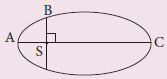
KA > KB >KC
KB < KA < KC
KA < KB < KC
KB > KA > KC
18.
A planet moving along an elliptical orbit is closest to the Sun at distance r1 and farthest away at a distance of r2. If v1 and v2 are linear speeds at these points respectively. Then the ratio \({v_1\over v_2}\) is
\({r_2\over r_1}\)
\(({r_2\over r_1})^2\)
\({r_1\over r_2}\)
\(({r_1\over r_2})^2\)
19.
In a two particle system, one particle lies at origin another one lies at a distance of X. Then the position of center of mass of these particles of equal mass is ______________.
\(\frac{m_2 X_2}{m_1+m_2}\)
\(\frac{X}{2}\)
\(\frac{mX}{m_1+m_2}\)
\(\frac{m_1+m_2}{mX}\)
20.
In perfect inelastic collision, the relative velocity of the bodies _____________.
before impact is zero
before impact is equal to that after impact
after impact is zero
None of the above is true
21.
Relative velocity of A with respect to B when A and B are in the opposite direction is ______________
\(\vec{V}_{A}-\vec{V}_{B}\)
\(\vec{V}_{B}-\vec{V}_{A}\)
\(\vec{V}_{A}+\vec{V}_{B}\)
\(\sqrt{V_A^2+2V_B^2+2V_AV_Bcos\theta}\)
22.
Which of the following force tends to stopthe moving object?
Frictional force
Magnetic force
Gravitational force
Electric force
23.
The branch of physics deals with the relation between space, time and energy are _______________.
astrophysics
relativity
acoustics
atomic physics
24.
Three identical spherical shells, each of mass m and radius r are placed as shown in figure. Consider an axis xx1 which is touching to two shells and passing through diameter of third shell. M.I of the system consisting of these three spherical shells about xx1 axis is ________________.
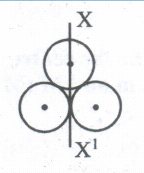
3mr2
4mr2
16/5mr2
11/5 mr2
25.
A round object of mass M and radius R rolls down without slipping along an inclined plane. The frictional force,
dissipates kinetic energy as heat
decreases the rotational motion
decreases the rotational and transnational motion
converts transnational energy into rotational energy
26.
Two discs of same moment of inertia rotating about their regular axes passing through center and perpendicular to the plane of the disc with angular velocities ω1 and ω1. They are brought in to contact face to face coinciding with the axis of rotation. The expression for loss of energy during this process is
\(\frac{1}{4}\)\(I(\omega _{1}-\omega _{2})^2\)
\(I(\omega _{ 1 }-\omega _{ 2 })^{ 2 }\)
\(\frac{1}{8}\)\(I(\omega _{1}-\omega _{2})^2\)
\(\frac{1}{2}I\)\((\omega _{1}-\omega _{2})^2\)
27.
The speed of the center of a wheel rolling on a horizontal surface is vo. A point on the rim in level with the center will be moving at a speed of,
zero
vo
\(\sqrt{2}\)vo
2vo
28.
The ratio of the acceleration for a solid sphere (mass m and radius R) rolling down an incline of angle \(\theta\) without slipping and slipping down the incline without rolling is,
5: 7
2: 3
2: 5
7: 5
29.
From a disc of radius R a mass M, a circular hole of diameter R, whose rim passes through the center is cut. What is the moment of inertia of the remaining part of the disc about a perpendicular axis passing through it
15MR2/32
13MR2/32
11MR2/32
9MR2/32
30.
A disc of the moment of inertia Ia is rotating in a horizontal plane about its symmetry axis with a constant angular speed \(\omega\). Another disc initially at rest of moment of inertia Ib is dropped coaxially on to the rotating disc. Then, both the discs rotate with the same constant angular speed. The loss of kinetic energy due to friction in this process is,
\(\frac { 1 }{ 2 } \frac { { I }_{ b }^{ 2 } }{ 2({ I }_{ a }+{ I }_{ b }) } { \omega }^{ 2 }\)
\(\frac { { I }_{ b }^{ 2 } }{ ({ I }_{ a }+{ I }_{ b }) } { \omega }^{ 2 }\)
\(\frac { { ({ I }_{ b }-{ I }_{ a }) }^{ 2 } }{ ({ I }_{ a }+{ I }_{ b }) } { \omega }^{ 2 }\)
\(\frac { 1 }{ 2 } \frac { { { I }_{ b }{ I }_{ b } } }{ ({ I }_{ a }+{ I }_{ b }) } { \omega }^{ 2 }\)
31.
A particle which is constrained to move along x-axis, is subjected to a force in the same direction which varies with the distance x of the particle from the origin as F(x) = kx + ax3. Here, k and a are positive constants. For x ≥ 0, the functional form of the potential, energy U(x) of the particles
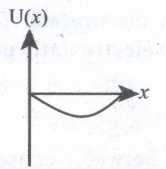
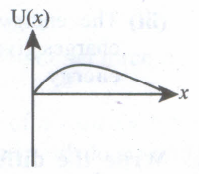
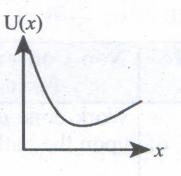
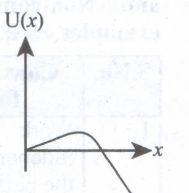
32.
A particle is placed at the origin and a force F = kx is acting on it (where k is a positive constant). If U (0) = 0, the graph of U(x) versus x will be (where U, is the potential , energy function)
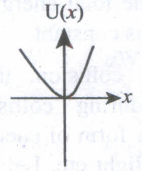
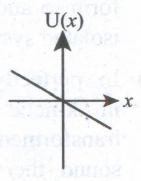
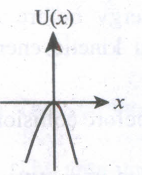
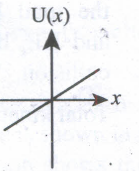
33.
34.
A rigid body rotates with an angular momentum L. If its kinetic energy is halved, the angular momentum becomes,
L
L/2
2L
L/\(\sqrt{2}\)
35.
A body of mass 4 m is lying in xy-plane at rest. It suddenly explodes into three pieces. Two pieces each of mass m move perpendicular to each other with equal speed v. The total kinetic energy generated due to explosion is
mv2
\(\frac{3}{2}\)mv2
2mv2
4mv2
36.
A body of mass 1 kg is thrown upwards with a velocity 20 ms-1. It momentarily comes to rest after attaining a height of 18 m. How much energy is lost due to air friction?(Take g = 10 ms-2)
20 J
30 J
40 J
10 J
37.
A ball of mass 1 kg and another of mass 2 kg are dropped from a tall building whose height is 80 m. After, a fall of 40 m each towards Earth, their respective kinetic energies will be in the ratio of
\(\sqrt2:1\)
\(1:\sqrt2\)
2:1
1:2
38.
A uniform force of (2\(\hat { i }\)+\(\hat { j }\)) N acts on a particle of mass 1 kg. The particle displaces from position (3\(\hat { j }\)+\(\hat { k }\)) m to (5\(\hat { i }\)+3\(\hat { j }\)) m. The work done by the force on the particle is
9 J
6 J
10 J
12 J
39.
Two blocks of masses m and 2m are placed on a smooth horizontal surface as shown. In the first case only a force F1 is applied from the left. Later only a force F2 is applied from the right. If the force acting at the interface of the two blocks in the two cases is same, then F1 :F2 is
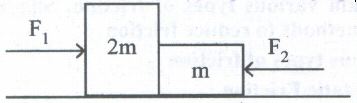
1:1
1:2
2:1
1:3
40.
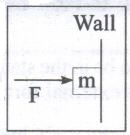
An object of mass m held against a vertical wall by applying horizontal force F as shown in the figure.The minimum value of the force F is
Less than mg
Equal to mg
Greater than mg
Cannot determine
41.
When a car takes a sudden left turn in the curved road, passengers are pushed towards the right due to
inertia of direction
inertia of motion
inertia of rest
absence of inertia
42.
If a particle executes uniform circular motion, choose the correct statement
The velocity and speed are constant
The acceleration and speed are constant.
The velocity and acceleration are constant.
The speed and magnitude of acceleration are constant.
43.
A ball is projected vertically upwards with a velocity v. It comes back to ground in time t. Which v-t graph shows the motion correctly?
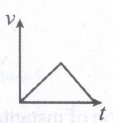
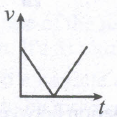
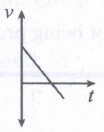
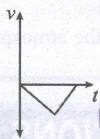
44.
Two objects of masses m1 and m2 fall from the heights h1 and h2 respectively. The ratio of the magnitude of their momenta when they hit the ground is
\(\sqrt { \frac { { h }_{ 1 } }{ { h }_{ 2 } } } \)
\(\sqrt { \frac { { { m }_{ 1 }h }_{ 1 } }{ { { m }_{ 2 }h }_{ 2 } } } \)
\(\frac { { m }_{ 1 } }{ { m }_{ 2 } } \sqrt { \frac { { h }_{ 1 } }{ { h }_{ 2 } } } \)
\(\frac { { m }_{ 1 } }{ { m }_{ 2 } } \)
45.
Planck's constant (h), speed of light in vacuum (c) and Newton's gravitational constant (G) are taken as three fundamental constants. Which of the following combinations of these has the dimension of length?
\({{\sqrt{hG}}\over{{c}^{{{3}\over{2}}}}}\)
\({{\sqrt{hG}}\over{{c}^{{{5}\over{2}}}}}\)
\(\sqrt{{{hc}\over{G}}}\)
\(\sqrt{{{Gc}\over{{h}^{{{3}\over{2}}}}}}\)
46.
The dimension of \({\left( {\mu}_{0}{\epsilon}_{0} \right)}^{{{1}\over{2}}}\) is
length
time
velocity
force
47.
If the force is proportional to square of velocity, then the dimension of proportionality constant is
[MLT0]
[MLT-1]
[MLT-2T]
[MLT-1T0]
48.
The dimensional formula for gravitational constant G is
[ML3T-2]
[M-1L3T-2]
[M-1L-3T-2]
[ML-3T2]
49.
The dimensional formula of Planck's constant h is
[ML2T-1]
[ML2T3]
[MLT-1]
[ML3T-3]
50.
If the length and time period of an oscillating pendulum have errors of 1% and 3% respectively then the error in measurement of acceleration due to gravity is
4%
5%
6%
7%
1.
(b)
Cp - Cv
2.
(d)
none of these
3.
(d)
will depend on direction of projection
4.
(d)
313°C
5.
(a)
1: 2
6.
\(\mathrm{F}_{\mathrm{d}} \propto \mathrm{v} \)
\(\mathrm{F}_{\mathrm{d}}=-\mathrm{bv} ; \quad \mathrm{F}_{\mathrm{d}}=\mathrm{kv} \)
\(\therefore \mathrm{k}=\frac{F_{d}}{v} \)
\(\text { Units of } k=\frac{k g m s^{-2}}{m s^{-1}}\)
\(\mathrm{k}=\mathrm{kg} \mathrm{s}^{-1}\)
7.
(d)
8.
\(\mathrm{F} =-\mathrm{kx} \)
\(\therefore \mathrm{x} =\left|-\frac{F}{k^{\prime}}\right|=\frac{F}{k^{\prime}} \)
\(\mathrm{F} =\mathrm{Mg} \text { and } k^{\prime}=\frac{k}{2} \)
\(\therefore \mathrm{x} =\frac{M g}{\frac{k}{2}} \)
\(=\frac{2 M g}{k} \)
9.
\(\mathrm{T}= \mathrm{T}_{1}=2 \pi \sqrt{\frac{l}{g}} \)
\(T_{1}^{2}=4 \pi^{2} \frac{l}{g} \)
\(\mathrm{y}=\mathrm{kt}^{2} \quad \mathrm{k}=1 \mathrm{~m} \mathrm{~s}^{-2} \)
\(\therefore \mathrm{y}=\mathrm{t}^{2} \quad \mathrm{y} \propto \mathrm{t}^{2} \)
\(\frac{y_{1}}{y_{2}}=\frac{t_{1}^{2}}{t_{2}^{2}} \)
\(\frac{T_{1}^{2}}{T_{2}^{2}}=\frac{y_{1}}{y_{2}}=\frac{6}{5} \)
10.
The sketch between cause (magnitude of acceleration) and effect (magnitude of displacement) is a straight line.
11.
\(C_{p}-C_{v}=R\)
For diatomic gas (N2) No of degrees of freedom = 5
\(\therefore S_{p}-S_{v}=R / 28\)
12.
\(\gamma=\frac{27}{17}\)
Number of moles of helium
\(\mathrm{n}=\frac{8}{4}=2\)
Number of moles of oxygen
\(n^{\prime}=\frac{16}{32}=\frac{1}{2}\)
For mono atomic Helium gas
\(\mathrm{f} =3 \)
\(\mathrm{C}_{\mathrm{V}} =\frac{f}{2} R \)
\(=\frac{3}{2} R \)
For diatomic oxygen gas
f = 5
\(\mathrm{C}_{\mathrm{V}} =\frac{f}{2} R \)
\(=\frac{5}{2} R \)
\(\mathrm{C}_{\mathrm{V}} \text { mixture } =\frac{n c_{v}+n^{\prime} C_{v}^{\prime}}{n+n^{\prime}} \)
\(=\frac{2 \times \frac{3}{2} R+\frac{1}{2} \times \frac{5}{2} R}{2+\frac{1}{2}} \)
\(C_{V} =\frac{3 R+\frac{5}{4} R}{\frac{5}{2}} \)
\(=\frac{17 R}{10} \)
\(\gamma =\frac{C_{p}}{C_{v}} \)
\(=1+\frac{R}{C_{V}} \)
\(=1+\frac{R}{\frac{17 R} {10}}\)
\(=1+\frac{10}{17} \)
\(=\frac{27}{17} \)
13.
\(\mathrm{T}_{2} =0^{\circ} \mathrm{C}+273=273 \mathrm{~K} \)
\(\mathrm{~T}_{1}=100^{\circ} \mathrm{C}=100+273=373 \mathrm{~K} \)
\(\eta =1-\frac{T_{2}}{T_{1}} \)
\(=1-\frac{273}{373} \)
\(=\frac{373-273}{373} \)
\(=\frac{100}{373}=0.26809 \times 100 \)
\(=26.809 \% \)
14.
\(\Delta l \text { verses } \mathrm{E}\)
\(\text { Strain } \propto \text { Stress }\)
Hooke's law is followed
15.
\(\frac{F}{A}=Y \frac{\Delta l}{l} \quad F=Y \frac{\Delta l}{l} \times A\)
\(A_{1}=\mathrm{A} \quad \mathrm{A}_{2}=2 \mathrm{~A}\)
\(\therefore F \propto \Delta l \times A\)
\(\mathrm{F} \propto \Delta l_{1} A_{1}\)
\(\mathrm{F}_{1} \propto 2 \Delta l_{2} \times A_{2}\)
\(\frac{F}{F_{1}}=\frac{\Delta l A}{2 \Delta l \times 2 A}\)
\(\therefore F_{1}=4 \mathrm{~F}\)
16.
Rate of heat production
\(=\frac{\text { Work done }}{\text { Timetaken }}\)
Terminal velocity
\(v=\frac{2}{a} \frac{r^{2}(f-\sigma)}{\eta} g \)
\(v \propto r^{2} \)
\(\text { Work } \propto \text { Force } \times \text { distance }\)
\(\propto r^{2} \times r \Rightarrow 2^{5}\)
17.
(a)
KA > KB >KC
18.
(a)
\({r_2\over r_1}\)
19.
(b)
\(\frac{X}{2}\)
20.
(c)
after impact is zero
21.
(b)
\(\vec{V}_{B}-\vec{V}_{A}\)
22.
(a)
Frictional force
23.
(b)
relativity
24.
(b)
4mr2
25.
(d)
converts transnational energy into rotational energy
26.
Moment of inertia of a disc passing through
\(\text { centre } I=\frac{1}{2} M R^{2}\)
\(\text { Energy of the first disc }=\frac{1}{4} I \omega_{1}^{2}\)
\(\text { Energy of the second disc }=\frac{1}{4} I \omega_{2}^{2}\)
\(\text { Loss of energy }=\frac{1}{4} I\left(\omega_{1}-\omega_{2}\right)^{2}\)
27.
\(v_{0}=r \omega ; \quad \therefore v_{0} \alpha r\)
For a wheel (uniform ring) the distance of a point on the rim in level with the center
\(\text { [i.e., radius] is } \sqrt{2} r\)
\(\therefore \text { The speed of the center is } \sqrt{2} v_{0}\)
28.
Acceleration of the solid sphere while rolling down without slipping
\(a_{1}=\frac{g \sin \theta}{1+\frac{k^{2}}{r^{2}}}\)
Acceleration developed while slipping down \(a_{2}=g \sin \theta\)
\(\text { Required ratio } \frac{a_{1}}{a_{2}}=\frac{g \sin \theta}{1+\frac{k^{2}}{r^{2}}} / g \sin \theta\)
\(\frac{a_{1}}{a_{2}}=\frac{1}{1+\frac{k^{2}}{r^{2}}}\)
\(\text { For a solid sphere } \frac{k^{2}}{r^{2}}=\frac{2}{5}\)
\(\therefore \text { Ratio of accelerations } \frac{a_{1}}{a_{2}}=\frac{1}{1+\frac{2}{5}}\)
\(=\frac{1}{5+\frac{2}{5}}=\frac{1}{\frac{7}{5}}=\frac{5}{7}\)
\(\therefore a_{1}: a_{2}=5: 7 \)
29.
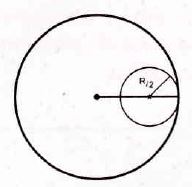
Moment of inertia of a disc
\(\mathrm{I}_{1}=\frac{M R^{2}}{2}\)
\(\text { Mass of small disc }=\frac{M}{\pi R^{2}} \times \pi \times\left(\frac{R}{2}\right)^{2}\)
\(=\frac{M}{\pi R^{2}} \times \frac{\pi R^{2}}{4}=\frac{M}{4}\)
By the theorem of parallel axis, the moment of inertia of the small disc. About an axis passing through 0 is
\(I_{2} =\frac{1}{2} \times \frac{M}{4}\left(\frac{R}{2}\right)^{2}+\frac{M}{4}\left(\frac{R}{2}\right)^{2} \)
\(=\frac{M}{8} \times \frac{R^{2}}{4}+\frac{M}{4} \times \frac{R^{2}}{4} \)
\(=\frac{M R^{2}}{32}+\frac{M R^{2}}{16}=\frac{M R^{2}+2 M R^{2}}{32} \)
\(I_{2} =\frac{3 M R^{2}}{32} \)
Moment of inertia of the remaining part is I= I1 - I2
\(=\frac{M R^{2}}{2}-\frac{3 M R^{2}}{32} \)
\(=\frac{16 M R^{2}-3 M R^{2}}{32}=\frac{13 M R^{2}}{32}\)
\(I =\frac{13 M R^{2}}{32} \)
30.
The moments of inertia of two discs are Ia and Ib respectively The angular velocity of the disc A is \(\omega\).
The sum of kinetic energies of two discs before coming in contact is \(k_{1}=\frac{1}{2} I_{a} \omega_{1}^{2}+\frac{1}{2} I_{b} \omega_{2}^{2}\)
\(\text { But angular velocity of the disc be is } \omega_{2}=0 \ \text {(rest)}\)
\(\therefore k_{1}=\frac{1}{2} I_{a} \omega_{1}^{2}\)
The final kinetic energy of the two discs system \(k_{2}=\frac{1}{2} \frac{I_{a}^{2} \omega_{1}^{2}}{I_{a}+I_{b}}\)
The loss of kinetic energy is
\(k_{1}-k_{2} =\frac{1}{2} I_{a} \omega^{2}-\frac{1}{2}\left[\frac{I a^{2} \omega_{1}^{2}}{I_{a}+I_{2 b}}\right] \)
\(=\frac{1}{2} \frac{\left[I_{1}\left(I_{a}+I_{b}\right) \omega^{2}-I_{a}^{2} \omega^{2}\right]}{I_{a}+I_{b}} \)
\(k_{1}-k_{2} =\frac{1}{2} \frac{I_{a} b}{\left(I_{a}+I_{b}\right)} \omega^{2} \)
31.
\(F=-\frac{d u}{d x} \quad F(x) =k x+a x^{3} \)
\(d u =-F d x \)
\(u(x) =-\int_{0}^{x}\left(-k x+a x^{3}\right) d x \)
\(=\int_{0}^{x} k x d x-a \int_{0}^{x} x^{3} d x \)
\(=\frac{k x^{2}}{2}-\frac{a x^{4}}{2} \)
\(U(x) =\frac{x^{2}}{2}\left(k-\frac{a x^{2}}{2}\right) \)
\(u(x)=0 \text { at } x=0 \text { and }\)
\(U(x) =0 ; k-\frac{a x^{2}}{2}=0 \)
\(=\frac{a}{2} x^{2}=-k \)
\(x^{2} =\frac{2 k}{a} \)
\(\therefore x =\sqrt{\frac{2 k}{a}} \)
\(\text { Clearly } u(x)=0 \text { at } x=0 \text { and }\)
\(x=\sqrt{\frac{2 k}{a}}\)
\(\text { For } x>\sqrt{\frac{2 k}{a}} U(x) \text { will be negative. } \)
\(\text { At } x=0 ; F=\frac{-d u}{d x}=0\)
(i.e.,) Slope of V - x graph is zero at x = 0
Hence the most appropriate answer is d.
32.
For a conservative force
\(F=-\frac{d v}{d t} \)
\(\int_{0}^{u(x)} d v=-\int_{0}^{x} F d x=-\int_{0}^{x} k x d x \)
\(\text { As } v(0)=0\)
\(U(x)=-\frac{k x^{2}}{2}\)
Thus, the graph of U(x) versus (x) will be a parabola, symmetric about U - ax is bying below x - ax is with its vertex at the origin. Hence the correct answer is C
33.
(a)
34.
\(K \cdot E=\frac{1}{2} I \omega^{2} ; \quad L=I \omega ; \quad K \cdot E=\frac{2^{2}}{2^{2}} \)
\(\therefore K \cdot E \alpha L^{2} \quad E_{1} \alpha L_{1}^{2} \quad E_{2} \alpha L_{2}^{2}\)
\(\frac{E_{1}}{E_{2}}=\left(\frac{L_{1}}{L_{2}}\right)^{2} \)
\(\text { Here } E_{1}=E \quad E_{2}=\frac{E}{2} \)
\(L_{1}=L \quad \quad L_{2}=? \)
\(\frac{E}{\frac{E}{2}}=\left(\frac{L}{L_{2}}\right)^{2} \)
\(\frac{2 E}{E}=\left(\frac{L}{L_{2}}\right)^{2}\left(\frac{L_{1}}{L_{2}}\right)^{2}=2 \)
\(\therefore \frac{L}{L_{2}}=\sqrt{2} \)
\(L_{2}=\frac{L}{\sqrt{2}} \)
35.
Using law of conservation of momentum,
\(2 m v =\sqrt{m^{2} v^{2}+m^{2} v^{2}} \)
\(=\sqrt{2 m^{2} v^{2}} \)
\(v =\frac{\sqrt{2} m v}{2 m}=\frac{v}{\sqrt{2}} \)
Energy released in explosion = \(2 \times \frac{1}{2} m v^{2} +\frac{1}{2} \times 2 m \times\left(\frac{v^{2}}{\sqrt{2}}\right)^{2} \)
\(=m v^{2}+m \times \frac{v^{2}}{2} \)
\(=\frac{3}{2} m v^{2} \)
36.
Mass = 1kg
Velocity v = 20m/s
Height h = 18 m
\(g=10 \mathrm{~m} / \mathrm{s}^{2}\)
\(\text { Potential energy } P . E=m g h\)
\(=1 \times 10 \times 18 =180 \mathrm{~J} \)
\(\text { Kinetic energy } K . E=\frac{1}{2} m v^{2}\)
\(K . E=\frac{1}{2} \times 1(20)^{2}\)
\(=\frac{1}{2} \times 20 \times 20=200 J\)
\(\text { Loss of energy due to air friction }= K.E - P.E\)
\(=200-180=20 \mathrm{~J}\)
37.
\(m_{1} =1, \quad m_{2}=2 \)
\(K . E . =m g(h-x) \)
\(\text { For both balls }(h-x)\)
\(=40 \text { i.e.) Same }\)
\(g=\text { constant }\)
\(\therefore K \cdot E_{1}=m_{1} g(h-x)=m_{1} g \times 40 \)
\(K \cdot E_{2}=m_{2} g(h-x)=m_{2} g \times 40 \)
\(\therefore \frac{K \cdot E_{1}}{K \cdot E_{2}}=\frac{m_{1} g \times 40}{m_{2} g \times 40}=\frac{m_{1}}{m_{2}} \)
\( \therefore K \cdot E_{1}: K \cdot E_{2}=1: 2 \)
38.
\(\text { Force } \overrightarrow{\mathbf{F}}=(2 i+\vec{j}) N\)
\(\text { Displacement } d=(5 \vec{i}+3 \vec{j})-(3 \vec{j}+\vec{k})\)
\(=(5 i-k) m\)
\(\text { Work done } W=F . d\)
\(=(2 \vec{i}+\vec{j})(5 i-k)\)
\(=10-0-0=10 J \)
39.
(c)
2:1
40.
(c)
Greater than mg
41.
(a)
inertia of direction
42.
It is a uniform circular motion. So the direction of velocity changes but not the magnitude. Therefore speed in considered constant. Again magnitude of acceleration does not change.
43.
Initially velocity has maximum value and at maximum height velocity becomes zero. After that the velocity becomes negative
44.
For freely falling body, velocity while the body, hit the ground \(v=\sqrt{2 g h}\)
\(v_{1}=\sqrt{2 g h_{1}} \text { and } v_{2}=\sqrt{2 g h_{2}} \)
\(\therefore \frac{m_{1} v_{1}}{m_{2} v_{2}}=\frac{m_{1} \sqrt{h_{1}}}{m_{2} \sqrt{h_{2}}}=\frac{m_{1}}{m_{2}} \sqrt{\frac{h_{1}}{h_{2}}}\)
45.
Dimension of Planck's constant is \(\left[\mathrm{ML}^{2} \mathrm{~T}^{-1}\right]\)
Dimension of Gravitational constant is \(\left[\mathrm{M}^{-1} \mathrm{~L}^{+3} \mathrm{~T}^{-1}\right]\)
Dimension of Velocity constant is LT-1
Dimension of Length is L
\(\therefore \text { Dimension of } \frac{\sqrt{h G}}{C^{\frac{3}{2}}}\)
\(=\frac{\sqrt{\left(\mathrm{ML}^{2} \mathrm{~T}^{-1}\right)\left(\mathrm{M}^{-1} \mathrm{~L}^{3} \mathrm{~T}^{-2}\right)}}{\left(\mathrm{LT}^{-1}\right)^{3 / 2}} \)
\(=\frac{\sqrt{\mathrm{L}^{5} \mathrm{~T}^{-3}}}{\mathrm{~L}^{3 / 2} \mathrm{~T}^{-3 / 2}} \)
\(=\frac{\mathrm{L}^{5 / 2} \mathrm{~T}^{-3 / 2}}{\mathrm{~L}^{3 / 2} \mathrm{~T}^{-3 / 2}} \)
\(=\mathrm{L}^{5 / 2-3 / 2} \mathrm{~T}^{3 / 2+3 / 2}=\mathrm{L}^{1} \mathrm{~T}^{0}=\mathrm{L}\)
Dimension of length = L
46.
\(\text { Velocity of light } c=\frac{1}{\sqrt{\mu_{0} \varepsilon_{0}}}\)
\(c=\left(\mu_{0} \varepsilon_{0}\right)^{-\frac{1}{2}}\)
\(\text { Hence dimension }\left(\mu_{0} \varepsilon_{0}\right)^{-\frac{1}{2}} \text { is that of velocity. }\)
47.
F = kv2
Dimensional of k
\(=\frac{\text { Dimension of } \mathrm{F}}{\text { Dimension of }(v)^{2}}\)
\(=\frac{\mathrm{MLT}^{-2}}{\left(\mathrm{LT}^{-1}\right)^{2}}=\frac{\mathrm{MLT}^{-2}}{\mathrm{~L}^{2} \mathrm{~T}^{-2}} \)
\(=\left[\mathrm{ML}^{-1-2} \mathrm{~T}^{-2+2}\right] \)
Dimension of proportionality constant \(=\left[\mathrm{ML}^{-1} \mathrm{~T}^{0}\right]\)
48.
\(\text { Gravitational constant } G=\frac{F r^{2}}{m_{l} m_{2}}\)
\(\text { Dimensional formula of } \mathrm{G}=\frac{\left[\mathrm{MLT}^{-2}\right]\left[\mathrm{L}^{2}\right]}{[\mathrm{M}][\mathrm{M}]}\)
\(=\frac{\mathrm{ML}^{3} \mathrm{~T}^{-2}}{\mathrm{M}^{2}}=\mathrm{M}^{-1} \mathrm{~L}^{3} \mathrm{~T}^{-2}\)
49.
Dimensional formula of Planck's
\(\text { constant }=\frac{\text { Energy }}{\text { Frequency }}=\frac{\mathrm{ML}^{2} \mathrm{~T}^{-2}}{\mathrm{~T}^{-1}}\)
\(=M L^{2} T^{-2+1}=M L^{2} T^{-1}\)
50.
\(T =2 \pi \sqrt{\frac{l}{g}} \)
\(g =4 \pi^{2} l / T^{2} \)
\(\frac{d g}{g} =\frac{d l}{l}-\frac{2 d T}{T} \)
\(\frac{d g}{g} \% =\left(\frac{d l}{l}\right) \%-2\left(\frac{d T}{T}\right) \% \)
\(=1 \%-2 \times(-3 \%) \)
\(=1+6=7 \% \)

11th Standard Syllabus & Materials
11th Standard
TN 11th Tamil பீடு பெற நில் - செய்யுள் - காவடிச்சிந்து Important Questions And Answers Study Material - QB365 Set A
NEW11th Standard
TN 11th Tamil பீடு பெற நில் - உரைநடை - மலை இடப்பெயர்கள் : ஓர் ஆய்வு Important Questions And Answers Study Material - QB365 Set A
NEW11th Standard
TN 11th Tamil மாமழை போற்றுதும் - துணைப்பாடம் - யானை டாக்டர் Important Questions And Answers Study Material - QB365 Set A
NEW11th Standard
TN 11th Tamil மாமழை போற்றுதும் - செய்யுள் - ஐங்குறுநூறு Important Questions And Answers Study Material - QB365 Set A



Tamilnadu Stateboard 11th Standard Subjects

Maths

Commerce

Economics

Biology

Business Maths and Statistics

Accountancy

Computer Science
Physics

Chemistry
Maths
Biology
Economics
Physics
Chemistry

History
Business Maths and Statistics

Computer Science
Accountancy

Computer Applications
History
Computer Technology
Commerce
Computer Applications
Computer Technology

Tamil

English

French
Tamilnadu Stateboard Standards

