
 100% FREE ACCESS
11th Standard Syllabus & Materials
11th Standard
TN 11th Tamil இயற்கை வேளாண்மை,சுற்றுச்சூழல் -செய்யுள் - மனோன்மணீயம் Important Questions And Answers Study Material - QB365 Set A
NEW11th Standard
TN 11th Tamil என்னுயிர் என்பேன் -துணைப்பாடம் - இசைத்தமிழர் இருவர் Important Questions And Answers Study Material - QB365 Set A
NEW11th Standard
TN 11th Tamil மொழி கலை -செய்யுள் - ஒவ்வொரு புல்லையும் Important Questions And Answers Study Material - QB365 Set A
NEW11th Standard
TN 11th Tamil பீடு பெற நில் - இலக்கணம் - பகுபத உறுப்புகள் Important Questions And Answers Study Material - QB365 Set A
NEW11th Standard
TN 11th Tamil பீடு பெற நில் - துணைப்பாடம் - வாடிவாசல் Important Questions And Answers Study Material - QB365 Set A
NEW11th Standard
TN 11th Tamil பீடு பெற நில் - செய்யுள் - குறுந்தொகை Important Questions And Answers Study Material - QB365 Set A

Published on: 06/09/2019
Oscillations
Download Tamil Nadu 11th Standard Physics question papers, model tests, one-mark questions, important questions, and public exam papers in PDF format. Free study materials and answer keys for TN State Board students.
Questions + Answers key
Take MCQ Physics Test1.
Show that for a simple harmonic motion, the phase difference between
a. displacement and velocity is \(\frac{\pi}{2}\) radian or 90°.
b. velocity and acceleration is \(\frac{\pi}{2}\) radian or 90°.
c. displacement and acceleration is \(\pi\) radian or 180°.
2.
A piece of wood of mass m is floating erect in a liquid whose density is ρ. If it is slightly pressed down and released, then executes simple harmonic motion. Show that its time period of oscillation is \(T=2 \pi \sqrt{\frac{m}{A g \rho}}\)
3.
What is meant by force constant of a spring?
4.
Compute the position of an oscillating particle when its kinetic energy and potential energy are equal.
5.
Write down the kinetic energy and total energy expressions in terms of linear momentum, For one-dimensional case.
6.
If the length of the simple pendulum is increased by 44% from its original length, calculate the percentage increase in time period of the pendulum.
7.
Consider two springs with force constants 1 N m−1 and 2 N m−1 connected in parallel. Calculate the effective spring constant (kp) and comment on kp.
8.
A hollow sphere is filled with water. It is hung by a long thread. As the water flows out of a hole at the bottom, the period of oscillation will
first increase and then decrease
first decrease and then increase
increase continuously
decrease continuously
9.
An ideal spring of spring constant k, is suspended from the ceiling of a room and a block of mass M is fastened to its lower end. If the block is released when the spring is un-stretched, then the maximum extension in the spring is
4\(\frac { Mg }{ k } \)
\(\frac { Mg }{ k } \)
2\(\frac { Mg }{ k } \)
\(\frac { Mg }{ 2k } \)
10.
A spring is connected to a mass m suspended from it and its time period for vertical oscillation is T. The spring is now cut into two equal halves and the same mass is suspended from one of the halves. The period of vertical oscillation is
T'= \(\sqrt{2}\)T
\(T'=\frac { T }{ \sqrt { 2 } } \)
T'=\(\sqrt{2T}\)
\(T'=\sqrt { \frac { T }{ 2 } } \)
11.
A simple pendulum is suspended from the roof of a school bus which moves in a horizontal direction with an acceleration a, then the time period is
\(T\propto \frac { 1 }{ { g }^{ 2 }+{ a }^{ 2 } } \)
\(T\propto \frac { 1 }{ \sqrt { { g }^{ 2 }+{ a }^{ 2 } } } \)
\(T\propto \sqrt { { g }^{ 2 }+{ a }^{ 2 } } \)
\(T\propto \left( { g }^{ 2 }+{ a }^{ 2 } \right) \)
12.
In a simple harmonic oscillation, the acceleration against displacement for one complete oscillation will be
an ellipse
a circle
a parabola
a straight line
13.
Explain in detail the four different types of oscillations.
1.
a. The displacement of the particle executing simple harmonic motion
y = A sin\(\omega t\)
Velocity of the particle is
v = A \(\omega\) cos \(\omega t\) = A \(\omega\) sin\(\left( \omega t+\frac { \pi }{ 2 } \right) \)
The phase difference between displacement and velocity is \(\frac{\pi}{2}\)
b. The velocity of the particle is
v = A \(\omega\) cos \(\omega t\)
Acceleration of the particle is
a = -A\({ \omega t }^{ 2 }\) sin \(\omega t\) = A \({ \omega }^{ 2 }\)cos \(\left( \omega t+\frac { \pi }{ 2 } \right) \)
The phase difference between velocity and acceleration is\(\frac{\pi}{2}\)
c. The displacement of the particle is
y = A sin\(\omega t\)
Acceleration of the particle is
a = − A \({ \omega }^{ 2 }\) sin ωt = A \({ \omega }^{ 2 }\) sin(\(\omega t\) + \(\pi\))
The phase difference between displacement and acceleration is \(\pi\) radian.
2.
When a piece of wood is pressed and released,
\(\mathrm{F}=\mathrm{ma}, \quad \mathrm{m} =\text { volume } \times \text { density }=\mathrm{A} \times \rho
\)
\(\text { Change in force } =\mathrm{mg}=\mathrm{A} \times \rho \mathrm{g}
\)
\(\therefore \text { Acceleration a } =\frac{F}{m}
\)
\(a =\left(\frac{A \rho g}{m}\right) x
\) .....(1)
For SHM, \(a =\omega^{2} x\) .....(2)
From equation (1) & (2) we get
\(\omega^{2}=\frac{A \rho g}{m} \quad \therefore \omega=\sqrt{\frac{A \rho g}{m}}\)
Time period \(\mathrm{T}=\sqrt{\frac{2 \pi}{\omega}} \quad \therefore \mathrm{T}=2 \pi \sqrt{\frac{m}{A \rho g}}\)
3.
Force constant of a spring is defined as the restoring force per unit length.
4.
Since the kinetic energy and potential energy of the oscillating particle are equal,
\(\frac { 1 }{ 2 } m{ \omega }^{ 2 }\left( { A }^{ 2 }-{ x }^{ 2 } \right) =\frac { 1 }{ 2 } { m\omega ^{ 2 }x }_{ }^{ 2 }\)
A2 − x2 = x2
2x2 = A2
\(\Rightarrow x=\pm \frac { A }{ \sqrt { 2 } } \)
5.
Kinetic energy is KE\(=\frac { 1 }{ 2 } { mv }_{ x }^{ 2 }\)
Multiply numerator and denominator by m
\(KE=\frac { 1 }{ 2m } { m^{ 2 }v }_{ x }^{ 2 }=\frac { 1 }{ 2m } \left( { mv }_{ x } \right) ^{ 2 }=\frac { 1 }{ 2m } { P }_{ x }^{ 2 }\)
where, Px is the linear momentum of the particle executing simple harmonic motion.
Total energy can be written as sum of kinetic energy and potential energy, therefore, from equation (10.73) and also from equation (10.75), we get
E = KE + U(x) \(=\frac { 1 }{ 2m } { P }_{ x }^{ 2 }+\frac { 1 }{ 2m } { m\omega ^{ 2 }v }_{ x }^{ 2 }\) = constant
6.
Since, \(T=\propto \sqrt { l } \)
Therefore,
T = constant\(\sqrt{l}\)
\(\frac { { T }_{ f } }{ { T }_{ i } } =\sqrt { \frac { l+\frac { 44 }{ 100 } l }{ l } } =\sqrt { 1.44 } =1.2\)
Therefore, Tf = 1.2 Ti = Ti + 20% Ti
7.
k1 = 1 N m−1, k2 = 2 N m−1
kp = k1 + k2 N m−1
kp = 1 + 2 = 3 N m−1
kp > k1 and kp > k2
Therefore, the effective spring constant is greater than both k1 and k2.
8.
Initially when the sphere in completely filled with water, its centre of gravity (C.G) lies at its centre. As water flows out, the centre of gravity begins to shift below the centre of the sphere. The effective length of the pendulum increases and hence the time period increases. When the sphere is half empty C.G begins to rise up. As the length of pendulum decreases T decreases.
9.
\(\mathrm{F} =-\mathrm{kx} \)
\(\therefore \mathrm{x} =\left|-\frac{F}{k^{\prime}}\right|=\frac{F}{k^{\prime}} \)
\(\mathrm{F} =\mathrm{Mg} \text { and } k^{\prime}=\frac{k}{2} \)
\(\therefore \mathrm{x} =\frac{M g}{\frac{k}{2}} \)
\(=\frac{2 M g}{k} \)
10.
\(\mathrm{T}=2 \pi \sqrt{\frac{m}{k}}\)
when the spring is cut into two equal halves, than the force constant of each part is 2k. When the mass is suspended from one of the halves, new time period is \(T^{\prime}=2 \pi \sqrt{\frac{m}{2 k}}=\frac{T}{\sqrt{2}}\)
11.
\(T=2 \pi \sqrt{\frac{\ell}{g}}\)
\(\text { when a bus is moving } g^{\prime} \sqrt{g^{2}+a^{2}}\)
\(\therefore T \propto \frac{1}{\sqrt{g^{2}+a^{2}}}\)
12.
The sketch between cause (magnitude of acceleration) and effect (magnitude of displacement) is a straight line.
13.
Types of Oscillation:
Free oscillations
When the oscillator is allowed to oscillate by displacing its position from equilibrium position, it oscillates with a frequency which is equal to the natural frequency of the oscillator. Such an oscillation or vibration is known as free oscillation or free vibration. In this case, the amplitude, frequency and the energy of the vibrating object remains constant.
Examples:
(i) Vibration of a tuning fork.
(ii) Vibration in a stretched string.
(iii) Oscillation of a simple pendulum
(iv) Oscillations of a spring-mass system.
Damped oscillations
(i) During the oscillation of a simple pendulum (in previous case), we have assumed that the amplitude of the oscillation is constant and also the total energy of the oscillator is constant.
(ii) But in reality, in a medium, due to the presence of friction and air drag, the amplitude of oscillation decreases as time progresses.
(iii) It implies that the oscillation is not sustained and the energy of the SHM decreases gradually indicating the loss of energy.
(iv) The energy lost is absorbed by the surrounding medium. This type of oscillatory motion is known as damped oscillation.
(v) If an oscillator moves in a resistive medium, its amplitude goes on decreasing and the energy of the oscillator is used to do work against the resistive medium.
(vi) The motion of the oscillator is said to be damped and in this case, the resistive force (or damping force) is proportional to the velocity of the oscillator.
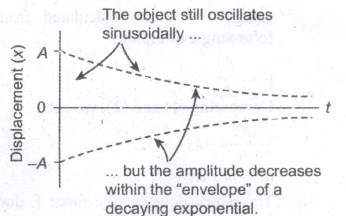
Examples:
(i) The oscillations of a pendulum (including air friction) or pendulum oscillating inside an oil filled container.
(ii) Electromagnetic oscillations in a tank circuit.
(iii) Oscillations in a dead beat and ballistic galvanometers.
Maintained oscillations:
(i) While playing in swing, the oscillations will stop after a few cycles, this is due to damping.
(ii) To avoid damping we have to supply a push to sustain oscillations. By supplying energy from an external source, the amplitude of the oscillation can be made constant.
(iii) Such vibrations are known as maintained vibrations.
Example:
The vibration of a tuning fork getting energy from a battery or from external power supply.
Forced oscillations:
(i) Any oscillator driven by an external periodic agency to overcome the damping is known as forced oscillator or driven oscillator.
(ii) In this type of vibration, the body executing vibration initially vibrates with its natural frequency and due to the presence of external periodic force, the body later vibrates with the frequency of the applied periodic force.
(iii) Such vibrations are known as forced vibrations.
Example:
Sound boards of stringed instruments.

11th Standard Syllabus & Materials
11th Standard
TN 11th Tamil பீடு பெற நில் - செய்யுள் - காவடிச்சிந்து Important Questions And Answers Study Material - QB365 Set A
NEW11th Standard
TN 11th Tamil பீடு பெற நில் - உரைநடை - மலை இடப்பெயர்கள் : ஓர் ஆய்வு Important Questions And Answers Study Material - QB365 Set A
NEW11th Standard
TN 11th Tamil மாமழை போற்றுதும் - துணைப்பாடம் - யானை டாக்டர் Important Questions And Answers Study Material - QB365 Set A
NEW11th Standard
TN 11th Tamil மாமழை போற்றுதும் - செய்யுள் - ஐங்குறுநூறு Important Questions And Answers Study Material - QB365 Set A



Tamilnadu Stateboard 11th Standard Subjects

Maths

Commerce

Economics

Biology

Business Maths and Statistics

Accountancy

Computer Science
Physics

Chemistry
Maths
Biology
Economics
Physics
Chemistry

History
Business Maths and Statistics

Computer Science
Accountancy

Computer Applications
History
Computer Technology
Commerce
Computer Applications
Computer Technology

Tamil

English

French
Tamilnadu Stateboard Standards

