
 100% FREE ACCESS
11th Standard Syllabus & Materials
11th Standard
TN 11th Tamil இயற்கை வேளாண்மை,சுற்றுச்சூழல் -செய்யுள் - மனோன்மணீயம் Important Questions And Answers Study Material - QB365 Set A
NEW11th Standard
TN 11th Tamil என்னுயிர் என்பேன் -துணைப்பாடம் - இசைத்தமிழர் இருவர் Important Questions And Answers Study Material - QB365 Set A
NEW11th Standard
TN 11th Tamil மொழி கலை -செய்யுள் - ஒவ்வொரு புல்லையும் Important Questions And Answers Study Material - QB365 Set A
NEW11th Standard
TN 11th Tamil பீடு பெற நில் - இலக்கணம் - பகுபத உறுப்புகள் Important Questions And Answers Study Material - QB365 Set A
NEW11th Standard
TN 11th Tamil பீடு பெற நில் - துணைப்பாடம் - வாடிவாசல் Important Questions And Answers Study Material - QB365 Set A
NEW11th Standard
TN 11th Tamil பீடு பெற நில் - செய்யுள் - குறுந்தொகை Important Questions And Answers Study Material - QB365 Set A

Published on: 09/10/2019
Oscillations
Download Tamil Nadu 11th Standard Physics question papers, model tests, one-mark questions, important questions, and public exam papers in PDF format. Free study materials and answer keys for TN State Board students.
Questions + Answers key
Take MCQ Physics Test1.
Write down the kinetic energy and total energy expressions in terms of linear momentum, For one-dimensional case.
2.
If the length of the simple pendulum is increased by 44% from its original length, calculate the percentage increase in time period of the pendulum.
3.
Consider two springs with force constants 1 N m−1 and 2 N m−1 connected in parallel. Calculate the effective spring constant (kp) and comment on kp.
4.
A nurse measured the average heart beats of a patient and reported to the doctor in terms of time period as 0.8 s. Express the heart beat of the patient in terms of number of beats measured per minute.
5.
Derive the expression for resultant spring constant when two springs having constant k1 and k2 are connected in parallel.
6.
The bob of a simple pendulum is a hollow sphere filled with water. How will the period of oscillation change if the water begins to drain out of the hollow sphere from a fine hole at its bottom?
7.
The maximum velocity of a particle, executing simple harmonic motion with an amplitude of 7mm is 4.4ms-1. What is the period of oscillation?
8.
What is the ratio, between the potential energy the total energy of a particle executing S.H.M, when its displacement is half of its amplitude?
9.
Alcohol in a U tube executes S.H.M of time period T. Now, alcohol is replaced by water upto the same height in the U-tube. What will be the effect on the time period?
10.
A spring balance has a scale which ranges from 0 to 25 kg and the length of the scale is 0.25m. It is taken to an unknown planet X where the acceleration due to gravity is 11.5 m s−1. Suppose a body of mass M kg is suspended in this spring and made to oscillate with a period of 0.50 s. Compute the gravitational force acting on the body.
1.
Kinetic energy is KE\(=\frac { 1 }{ 2 } { mv }_{ x }^{ 2 }\)
Multiply numerator and denominator by m
\(KE=\frac { 1 }{ 2m } { m^{ 2 }v }_{ x }^{ 2 }=\frac { 1 }{ 2m } \left( { mv }_{ x } \right) ^{ 2 }=\frac { 1 }{ 2m } { P }_{ x }^{ 2 }\)
where, Px is the linear momentum of the particle executing simple harmonic motion.
Total energy can be written as sum of kinetic energy and potential energy, therefore, from equation (10.73) and also from equation (10.75), we get
E = KE + U(x) \(=\frac { 1 }{ 2m } { P }_{ x }^{ 2 }+\frac { 1 }{ 2m } { m\omega ^{ 2 }v }_{ x }^{ 2 }\) = constant
2.
Since, \(T=\propto \sqrt { l } \)
Therefore,
T = constant\(\sqrt{l}\)
\(\frac { { T }_{ f } }{ { T }_{ i } } =\sqrt { \frac { l+\frac { 44 }{ 100 } l }{ l } } =\sqrt { 1.44 } =1.2\)
Therefore, Tf = 1.2 Ti = Ti + 20% Ti
3.
k1 = 1 N m−1, k2 = 2 N m−1
kp = k1 + k2 N m−1
kp = 1 + 2 = 3 N m−1
kp > k1 and kp > k2
Therefore, the effective spring constant is greater than both k1 and k2.
4.
Let the number of heart beats measured be f. Since the time period is inversely proportional to the heart beat, then
\(f=\frac { 1 }{ T } =\frac { 1 }{ 0.8 } ={ 1.25 }s^{ -1 }\)
One minute is 60 second,
(1 second = \(\frac{1}{60}\) minute \(\Rightarrow\) 1 s−1 = 60 min−1)
f =1.25 s−1 \(\Rightarrow\) f = 1.25\(\times\)60 min−1 = 75 beats per minute
5.
k1 and k2 attached to a mass m as shown in figure. The results can be generalized to any number of springs in parallel.
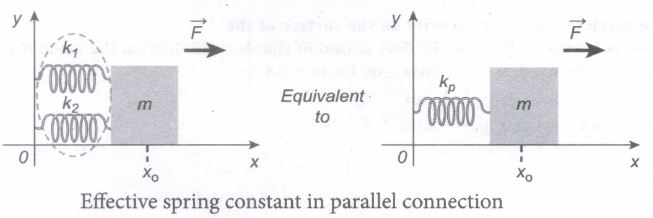
Let the force F be applied towards right as shown in figure. In this case, both the springs elongate or compress by the same amount of displacement. Therefore, net force for the displacement of mass m is
F = - kpx ..(1)
where kp is called effective spring constant.
Let the first spring be elongated by a displacement x due to force F1 and second spring be elongated by the same displacement x due to force F2' then the net force
F = - k1x - k2x ...(2)
Equating equations (2) and (1), we get
kp= k1 + k2 ...(3)
Generalizing, for n springs connected in parallel
\({ k }_{ P }=\sum _{ i=1 }^{ n }{ { k }_{ i } } \) ....(4)
If all spring constants are identical i.e.,k1 = k2 = ... = kn = k then
kp = n k ...(5)
This implies that the effective spring constant increases by a factor n. Hence, for the springs in parallel connection, the effective spring constant is greater than individual spring constant.
6.
T=2\(\pi \sqrt { \frac { l }{ g } } \)
(i) As the water flows out of the sphere, the times period first increases and then decreases.
(ii) Initially when the sphere is completely filled with water, its C.G lies at its center.
(iii) As water flows out, the C.G begins to shift below the centre of the sphere the effective length of the pendulum increases & hence its time period increase when the sphere becomes more than half empty, its C.G begins to rise up the effective length of the pendulum increases and true period T decreases.
(iv) When the entire water is drained out of the sphere, the C.G is once again shifted to centre of the sphere and the time period T attains its initial value.
7.
Vmax= \({ \omega }_{ A }=\frac { 2\pi }{ T } A\)
T=\(\frac { 2\pi A }{ { V }_{ max } } =\frac { 2\times 22\times 7\times { 10 }^{ -3 } }{ 7\times 4.4 } \)
= 0.01s
8.
\(\frac{potential \ energy}{Total \ energy}=\frac { \frac { 1 }{ 2 } m{ \omega }^{ 2 }{ y }^{ 2 } }{ \frac { 1 }{ 2 } m{ \omega }^{ 2 }{ a }^{ 2 } } \)
\(\frac { { y }^{ 2 } }{ { a }^{ 2 } } =\frac { \left( \frac { a }{ 2 } \right) }{ a } =\frac { 1 }{ 4 } \)
=1:4
9.
Time period T remains same, this is cos the period of oscillation of a liquid in a U-tube does not depend on the density of the liquid.
10.
Let us first calculate the stiffness constant of the spring balance by using equation (10.29),
\(K=\frac { mg }{ l } =\frac { 25\times 11.5 }{ 0.25 } ={ 1150 }Nm^{ -1 }\)
The time period of oscillations is given by
\(T=2\pi \sqrt { \frac { M }{ k } } \)where M is the mass of the body.
Since, M is unknown, rearranging, we get
\(M=\frac { k{ T }^{ 2 } }{ { 4\pi }^{ 2 } } =\frac { \left( 1150 \right) { \left( 0.5 \right) }^{ 2 } }{ { 4\pi }^{ 2 } } =7.3kg\)
The gravitational force acting on the body is W = Mg = 7.3\(\times\)11.5 = 83.95 N ≈ 84 N

11th Standard Syllabus & Materials
11th Standard
TN 11th Tamil பீடு பெற நில் - செய்யுள் - காவடிச்சிந்து Important Questions And Answers Study Material - QB365 Set A
NEW11th Standard
TN 11th Tamil பீடு பெற நில் - உரைநடை - மலை இடப்பெயர்கள் : ஓர் ஆய்வு Important Questions And Answers Study Material - QB365 Set A
NEW11th Standard
TN 11th Tamil மாமழை போற்றுதும் - துணைப்பாடம் - யானை டாக்டர் Important Questions And Answers Study Material - QB365 Set A
NEW11th Standard
TN 11th Tamil மாமழை போற்றுதும் - செய்யுள் - ஐங்குறுநூறு Important Questions And Answers Study Material - QB365 Set A



Tamilnadu Stateboard 11th Standard Subjects

Maths

Commerce

Economics

Biology

Business Maths and Statistics

Accountancy

Computer Science
Physics

Chemistry
Maths
Biology
Economics
Physics
Chemistry

History
Business Maths and Statistics

Computer Science
Accountancy

Computer Applications
History
Computer Technology
Commerce
Computer Applications
Computer Technology

Tamil

English

French
Tamilnadu Stateboard Standards

