
 100% FREE ACCESS
11th Standard Syllabus & Materials
11th Standard
TN 11th Tamil இயற்கை வேளாண்மை,சுற்றுச்சூழல் -செய்யுள் - மனோன்மணீயம் Important Questions And Answers Study Material - QB365 Set A
NEW11th Standard
TN 11th Tamil என்னுயிர் என்பேன் -துணைப்பாடம் - இசைத்தமிழர் இருவர் Important Questions And Answers Study Material - QB365 Set A
NEW11th Standard
TN 11th Tamil மொழி கலை -செய்யுள் - ஒவ்வொரு புல்லையும் Important Questions And Answers Study Material - QB365 Set A
NEW11th Standard
TN 11th Tamil பீடு பெற நில் - இலக்கணம் - பகுபத உறுப்புகள் Important Questions And Answers Study Material - QB365 Set A
NEW11th Standard
TN 11th Tamil பீடு பெற நில் - துணைப்பாடம் - வாடிவாசல் Important Questions And Answers Study Material - QB365 Set A
NEW11th Standard
TN 11th Tamil பீடு பெற நில் - செய்யுள் - குறுந்தொகை Important Questions And Answers Study Material - QB365 Set A

Published on: 17/01/2020
Download Tamil Nadu 11th Standard Physics question papers, model tests, one-mark questions, important questions, and public exam papers in PDF format. Free study materials and answer keys for TN State Board students.
Questions + Answers key
Take MCQ Physics Test1.
The mean translational K.E. of a perfect gas molecule at absolute temperature T is _____________ (K is Boltzmann constant)
\(\frac{1}{2}\)kT
kT
\(\frac{3}{2}\)kT
\(\frac{5}{2}\)kT
2.
Which of the following statement about the gravitational constant is true?
It is a force
It has same value in all system of unit
It has not unit
It depends on the value of the masses
3.
A mono atomic gas is suddenly compressed to \(\left( \frac { 1 }{ 8 } \right) ^{ th }\) its initial volume adiabatically the ratio of its final pressure to the intial pressure is ______________ (Given: the ratio of the speclfier heats of the given gas to be 5/3)
32
\(\frac { 40 }{ 3 } \)
\(\frac { 24 }{ 5 } \)
8
4.
Compare the velocities of the wave forms given below, and choose the correct option.
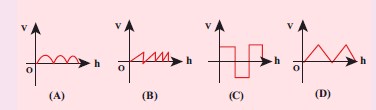
where, vA, vB, vC and vD are velocities given in (A), (B), (C) and (D), respectively.
vA > vB > vD > vC
vA< vB < vD < vC
vA = vB = vD = vC
vA > vB = vD > vC
5.
A particle executes simple harmonic motion and displacement y at time t0, 2t0 and 3t0 are A, B and C, respectively. Then the value of \(\frac{A+C}{2B}\) is
cos ωt0
cos 2ωt0
cos 3ωt0
1
6.
A certain number of spherical drops of a liquid of radius R coalesce to form a single drop of radius R and volume V. If T is the surface tension of the liquid, then
energy = 4 V T \(\left( \frac { 1 }{ r } -\frac { 1 }{ R } \right) \)is released
energy = 3 V T \(\left( \frac { 1 }{ r } +\frac { 1 }{ R } \right) \)is absorbed
energy = 3 V T \(\left( \frac { 1 }{ r } -\frac { 1 }{ R } \right) \)is released
energy is neither released nor absorbed
7.
The time period of a satellite orbiting Earth in a cirular orbit is independent of
Radius of the orbit
The mass of the satellite
Both the mass and radius of the orbit
Neither the mass nor the radius of its orbit
8.
A circular disc is rolling down in an inclined plane without slipping. The percentage of rotational energy in its total energy is ______________.
66.61%
33.33%
22.22%
50%
9.
\(\hat i\times \hat j\) is ______________.
\(\hat i\)
\(\hat j\)
\(\hat k\)
\(\vec z\)
10.
If kinetic energy of a body is increased by 300% then percentage change in momentum will be ___________.
100%
150%
265%
73.2%.
11.
An explosion breaks a rock into three parts in a horizontal plane. Two of them go off at right angles to each other. The first part of mass 1 kg moves with a speed of 12 ms-1 and the second part of mass 2 kg moves with 8 ms-1 speed. If the third part flies off with 4 ms-1 speed, then its mass is ____________.
7 kg
17 kg
3 kg
5 kg
12.
How many AU present in one light year?
6.30\(\times\)104m
9.46\(\times\)1015m
6.2\(\times\)102m
9.4\(\times\)1016m
13.
The ratio of the acceleration for a solid sphere (mass m and radius R) rolling down an incline of angle \(\theta\) without slipping and slipping down the incline without rolling is,
5: 7
2: 3
2: 5
7: 5
14.
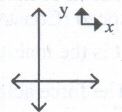
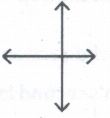
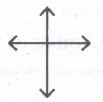
Choose appropriate free body diagram for the particle experiencing net acceleration along negative y direction. (Each arrow mark represents the force acting on the system).
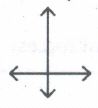
15.
Two objects of masses m1 and m2 fall from the heights h1 and h2 respectively. The ratio of the magnitude of their momenta when they hit the ground is
\(\sqrt { \frac { { h }_{ 1 } }{ { h }_{ 2 } } } \)
\(\sqrt { \frac { { { m }_{ 1 }h }_{ 1 } }{ { { m }_{ 2 }h }_{ 2 } } } \)
\(\frac { { m }_{ 1 } }{ { m }_{ 2 } } \sqrt { \frac { { h }_{ 1 } }{ { h }_{ 2 } } } \)
\(\frac { { m }_{ 1 } }{ { m }_{ 2 } } \)
16.
A transverse harmonic wave on a string is described by y(x, t) = 5.0 sin (48t + 0.0264x + ), where x and y are in cm and t in sec. The positive direction of x is from left to right.
(a) What are its amplitude and frequency?
(b) What is the least distance between two success in crests in the wave?
17.
Distinguish between isothermal and adiabatic process.
18.
Derive the expression of pressure exerted by the gas on the walls of the container.
19.
State Hooke’s law and verify it with the help of an experiment?
20.
Derive the expression for gravitational potential energy.
21.
Show that the work done by the conservative force is independent of the path. Consider the following cases
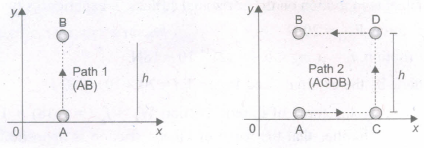
22.
A three storey building of height 100m is located on Earth and a similar building is also located on Moon. If two people jump from the top of these buildings on Earth and Moon simultaneously, when will they reach the ground and at what speed? (g = 10m s-2)
23.
The moment of inertia of a thin rod of mass 'M' and length 'I' about an axis passing through its centre is \(\frac { M{ l }^{ 2 } }{ 12 } \). Calculate the moment of inertia about a parallel axis through end of rod.
24.
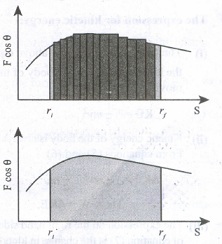
Explain with graphs the difference between work done by a constant force and by a variable force.
25.
Briefly explain the origin of friction. Show that in an inclined plane, angle of friction is equal to angle of repose
26.
Derive the Equation of a plane progressive wave.
27.
Stress - Strain curve for two wires of material A and B are as shown in figure.
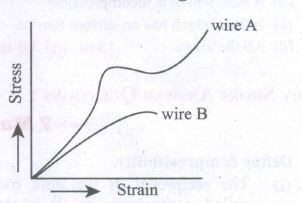
(a) Which material in more ductile?
(b) Which material has greater value of young's modulus?
(c) Which of the two is stronger material?
(d) Which material is more brittle?
28.
Show that for a simple harmonic motion, the phase difference between
a. displacement and velocity is \(\frac{\pi}{2}\) radian or 90°.
b. velocity and acceleration is \(\frac{\pi}{2}\) radian or 90°.
c. displacement and acceleration is \(\pi\) radian or 180°.
29.
The following photographs are taken from the recent lunar eclipse which occurred on January 31, 2018. Is it possible to prove that Earth is a sphere from these photographs?
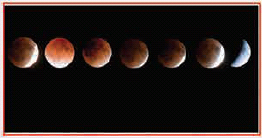
30.
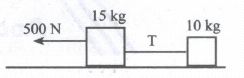
Two bodies of masses 15 kg and 10 kg are connected with light string kept on a smooth surface. A horizontal force F = 500 N is applied to a 15 kg as shown in the figure. Calculate the tension acting in the string.
31.
Find the moment of inertia of a uniform rod about an axis which is perpendicular to the rod and touches anyone end of the rod.
32.
When a cricket player catches the ball, he pulls his hands gradually in the direction of the ball's motion. Why?
33.
The fundamental frequency in an open organ pipe is equal to the 3rd harmonic of a closed organ pipe. If the length of the closed organ pipe is 20 cm. What is the length of the open organ pipe.
34.
What is meant by conduction?
35.
What are the physical states of matter?
36.
State the theory of geocentric model of solar system? And by whom this was proposed.
37.
Classify the following motions as periodic and non-periodic motions?
a. Motion of Halley’s comet.
b. Motion of clouds.
c. Moon revolving around the Earth
38.
Calculate the mean free path of air molecules at STP. The diameter of N2 and O2 is about 3\(\times\)10-10 m
39.
Ten particles are moving at the speed of 2, 3, 4, 5, 5, 5, 6, 6, 7 and 9 m s-1. Calculate rms speed, average speed and most probable speed.
40.
500 g of water is heated from 30°C to 60°C. Ignoring the slight expansion of water, calculate the change in internal energy of the water? (specific heat of water 4184 J/kg.K)
41.
A particle moves along the x-axis in such a way that its coordinates x varies with time 't' according to the equation x = 2 - 5t + 6t2. What is the initial velocity of the particle?
42.
Define one second.
43.
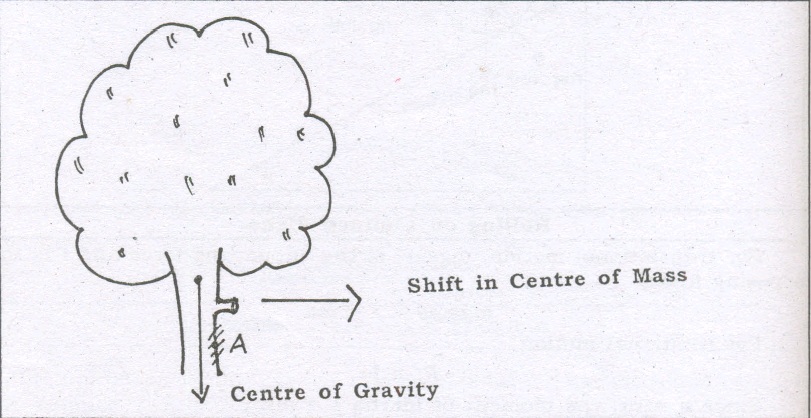
When a tree is cut, the cut is made on the side facing the direction in which the tree is required to fall. Why?
1.
(c)
\(\frac{3}{2}\)kT
2.
(a)
It is a force
3.
(a)
32
4.
The amplitude of the velocity wave is same in all four cases
5.
(a)
cos ωt0
6.
\(n \times \frac{4}{3} \pi r^{3}=\frac{4}{3} \pi R^{3}\)
\(\therefore \text { Energy }=3 V T\left(\frac{1}{r}-\frac{1}{R}\right) \text { is released }\)
7.
Time period T = \(\frac{2\pi}{\sqrt GM_E} (R_E+ h)^\frac{3}{2}\)
\(\therefore\) It is independemt of mass
8.
(b)
33.33%
9.
(c)
\(\hat k\)
10.
(a)
100%
11.
(d)
5 kg
12.
(a)
6.30\(\times\)104m
13.
Acceleration of the solid sphere while rolling down without slipping
\(a_{1}=\frac{g \sin \theta}{1+\frac{k^{2}}{r^{2}}}\)
Acceleration developed while slipping down \(a_{2}=g \sin \theta\)
\(\text { Required ratio } \frac{a_{1}}{a_{2}}=\frac{g \sin \theta}{1+\frac{k^{2}}{r^{2}}} / g \sin \theta\)
\(\frac{a_{1}}{a_{2}}=\frac{1}{1+\frac{k^{2}}{r^{2}}}\)
\(\text { For a solid sphere } \frac{k^{2}}{r^{2}}=\frac{2}{5}\)
\(\therefore \text { Ratio of accelerations } \frac{a_{1}}{a_{2}}=\frac{1}{1+\frac{2}{5}}\)
\(=\frac{1}{5+\frac{2}{5}}=\frac{1}{\frac{7}{5}}=\frac{5}{7}\)
\(\therefore a_{1}: a_{2}=5: 7 \)
14.
(c)
15.
For freely falling body, velocity while the body, hit the ground \(v=\sqrt{2 g h}\)
\(v_{1}=\sqrt{2 g h_{1}} \text { and } v_{2}=\sqrt{2 g h_{2}} \)
\(\therefore \frac{m_{1} v_{1}}{m_{2} v_{2}}=\frac{m_{1} \sqrt{h_{1}}}{m_{2} \sqrt{h_{2}}}=\frac{m_{1}}{m_{2}} \sqrt{\frac{h_{1}}{h_{2}}}\)
16.
Here,
y(x, t) = 5.0 sin (48t + 0.0264x + \(\pi\over 6\))
The general equation of a plane progressive wave is,
v(x,t) = a Sin\(\left[{2\pi\over \lambda}(vt+x)+\phi\right]\)
It is observed that the given equation represent a travelling waveform right to left.
Velocity \(V={48\over 0.0264}=1818.18cms^{-1}, r=5cm\)
(a) Amplitude and frequency:
Amplitude,
\({2\pi\over \lambda}=0.0264\)
or
\(\lambda={2\pi\over 0.0264}cm={2\times3.14\over 0.0264}={6.28\over 0.0264}=237.8cm\)
frequency,
From the equation
v = ⋋v,
\(v={v\over \lambda}={1818.18\over 2\pi}\times0.0264\)
\(={1818.18\over 2\times3.14}\times0.0264\)
= 289.51 x 0.0264
= 7.64 Hz
b) To find least distance between two successive crests in the wave.
\(\lambda={2\pi\over 0.0264 }={2\times3.14\over 0.0264}={6.28\over0.0264}\)
= 237.8 em = 2.38 m
(c) When \(x={\lambda\over 4}\)
\(\phi={2\pi\over \lambda}\times{\lambda\over 4}={\pi\over 2}rad\)
17.
| S.No | Isothermal | Adiabatic |
|---|---|---|
| 1. | Temperature remains constant \(\triangle\)T =0 | Heat content remains constant \(\triangle\)Q |
| 2 | Walls of the container is perfectly conductivity. | All walls and piston are perfectly an insulating. |
| 3. | The changes occur slowly i.e. slow process. | The changes occur suddenly i.e. a fast process. |
| 4. | Internal energy remains constant, i.e \(\triangle\)U = 0 | internal energy changes \(\triangle\)U \(\neq \) 0 |
| 5. | Pv = constant | \({ P }_{ v }^{ \gamma }\) constant |
| 6 | Slope of isothermal curve on pv dig. \(\frac { -P }{ v } =\frac { dp }{ dv } \) |
Slope is \(\frac { -\gamma p }{ v } \) \(\gamma >1\) Slope of adiabatic greater than isothermal. |
18.
A molecule of mass m moving with a velocity \(\vec{v}\) having components \(\left(v_{x}, v_{y}, v_{z}\right)\) hits the right side wall. Since we have assumed that the collision is elastic, the particle rebounds with same speed and its x-component is reversed. The components of velocity of the molecule after collision are \(\left(-v_{x}, v_{y}, v_{z}\right)\)
The x-component of momentum of the molecule before collision = mvx
The x-component of momentum of the molecule after collision = mvx
The change in momentum of the molecule in x direction
= Final momentum - initial momentum
= \(-\mathrm{mv}_{\mathrm{x}}-\mathrm{mv}_{\mathrm{x}} \)
= \(-2 \mathrm{mv}_{\mathrm{x}}\)
According to law of conservation of linear momentum, the change in momentum of the wall \(=2 \mathrm{mv}_{\mathrm{x}}\)
The number of molecules hitting the right side wall in a small interval of time ∆t is calculated as follows.
The molecules within the distance of vx∆t from the right side wall and moving towards the right will hit the wall in the time interval ∆t. The number of
molecules that will hit the right side wall in a time interval ∆t is equal to the product of volume \(\left(\mathrm{Av}_{x} \Delta t\right)\)and number density of the molecules (n). Here A is area of the wall and n is number of molecules per unit volume \(\left(\frac{N}{V}\right)\). We have assumed that the number density is the same throughout the cube.
Not all the n molecules will move to the right, therefore on an average only half of the n molecules move to the right and the other half moves towards left side. The number of molecules that hit the right side wall in a time interval
\(\Delta t=\frac{n}{2} A v_{x} \Delta t\) .....(1)
In the same interval of time ∆t, the total momentum transferred by the molecules.
\(\Delta \dot{p} =\frac{n}{2} A v_{x} \Delta t \times 2 m v_{x} \)
\(=A v_{x}^{2} m n \Delta t\) ....(2)
From Newton's second law, the change in momentum in a small interval of time gives rise to force.
The force exerted by the molecules on the wall (in magnitude)
.JPG)
\(\mathrm{F} =\frac{\Delta p}{\Delta t} \)
\(=n m A v_{x}^{2} \) ...(3)
Pressure, P = force divided by the area of the wall.
.JPG)
\(\mathrm{P} =\frac{F}{A} \)
\(=n m v_{x}{ }^{2}\)
Since all the molecules are moving completely in random manner, they do not have same speed. So we can replace the term vx2 by the average \(\overline{v_{x}^{2}}\)
\(\mathrm{P}=\frac{F}{A}=n m v_{x}^{2} \)
\(\mathrm{P}=n m \overline{v_{x}^{2}}\)
Since the gas is assumed to move in random direction, it has no preferred direction of motion. (the effect of gravity on the molecules is neglected). It implies that the molecule has same average speed in all the three direction. So.\( \overline{v_{x}^{2}}=\overline{v_{y}^{2}}=\overline{v_{x}^{2}}\).
The mean square speed is written as
\(\overline{v^{2}}=\overline{v_{\dot{x}}^{2}}+\overline{v_{y}^{2}}+\overline{v_{z}^{2}}=\overline{3 v_{x}^{2}} \)
\(\overline{v_{x}^{2}}=\frac{1}{3} \overline{v^{2}} \)
\(\mathrm{P}=n m \overline{v_{x}^{2}} \)
\(\mathrm{P}=\frac{1}{3} n m \overline{v^{2}} \text { or } P \frac{1}{3} \frac{N}{V} m \overline{v^{2}} \quad \text { as }\left[n=\frac{N}{V}\right]\)
19.
Hooke's law states that within the elastic limit, the strain produced in a body is directly proportional to the stress applied.
It can be verified in a simple way by stretching a thin straight wire (stretches like spring) of length L and uniform cross-sectional area A suspended from a fixed point O. A pan and a pointer are attached at the free end of the wire as shown in Figure. The extension produced on the wire is measured using a vernier scale arrangement. The experiment shows that for a given load, the corresponding stretching force is F and the elongation produced on the wire is ΔL. It is directly proportional to the original length L and inversely proportional to the area of cross section A. A graph is plotted using F on the X-axis and ΔL on the Y-axis. This graph is a straight line passing through the origin as shown in Figure.
.JPG)
.JPG)
Therefore,
ΔL = (slope)F
Multiplying and dividing by volume,
V = AL,
F (slope) = \(\frac{AL}{AL} \Delta L\)
Rearranging, we get
\(\frac{F}{A}=[\frac{L}{A(Slope)}]\frac{\Delta L}{L}\)
Therefore, \(\frac{F}{A} \alpha [\frac{\Delta L}{L}]\)
Comparing with equations stress and strain \(\sigma=\frac{\text { Force }}{\text { Area }}=\frac{F}{A}, \varepsilon=\frac{\text { Change in size }}{\text { Original size }}=\frac{\Delta l}{l}\),
we get volume strain, \(\varepsilon_{v}=\frac{\Delta V}{V}\) equation as
\(\sigma \propto \varepsilon\)
i.e., the stress is proportional to the strain in the elastic limit.
20.
Consider the Earth and mass system, with r, the distance between the mass m and the Earth's centre. Then the gravitational potential energy,
\(\mathrm{U}=-\frac{G M_{e} m}{r}\) ......(1)
Here r = Re + h, where Re is the radius of the Earth. h is the height above the Earth's surface.
\(\mathrm{U}_{\mathrm{c}}=-G \frac{M_{e} m}{\left(R_{e}+h\right)}\) .......(2)
If h << Re, equation can be modified as
\(\mathrm{U} =-G \frac{M_{e} m}{\mathrm{R}_{e}\left(1+h / R_{e}\right)}
\)
\(\mathrm{U} =-G \frac{M_{e} m}{\mathrm{R}_{e}}\left(1+h / R_{e}\right)^{-1}\) .......(3)
By using Binomial expansion and neglecting the higher order terms, we get
\(\mathrm{U}=-G \frac{M_{e} m}{\mathrm{R}_{e}}\left(1-\frac{h}{R_{e}}\right)\) ........(4)
We know that, for a mass m on the Earth's surface,
\(G \frac{M_{e} m}{\mathrm{R}_{e}}=m g \mathrm{R}_{e}\) ........(5)
Substituting equation (5) in (4) we get
\(\mathrm{U}=-\mathrm{mg} \mathrm{R}_{e}+\mathrm{mgh}\) .......(6)
It is clear that the first term in the above expression is independent of the height h. For example, if the object is taken from height h1 to h2 then the potential energy at h1 is
\(\mathrm{U}\left(\mathrm{h}_{1}\right)=-\mathrm{mg} \mathrm{} \mathrm{R}_{\mathrm{e}}+\mathrm{mgh}_{1}\) .......(7)
and the potential energy at h2 is
\(\mathrm{U}\left(\mathrm{h}_{2}\right)=-\mathrm{mg} \mathrm{} \mathrm{R}_{\mathrm{e}}+\mathrm{mgh}_{2}\) .....(8)
The potential energy difference between h1 and h2 is
\(U\left(h_{2}\right)-U\left(h_{1}\right)=m g\left(h_{1}-h_{2}\right)\) .......(9)
21.
Force \(\overrightarrow { F } =mg\left( -\hat { j } \right) =-mg\hat { j } \)
Displacement vector \(d\vec{r}\) = dx\(\hat { i } \) + dy \(\hat { j } \)
(As the displacement is in two dimension; unit vectors \(\hat { j } \) and \(\hat { i } \) are used)
(a) Since the motion is only vertical, horizontal displacement component dx s zero. Hence, work done by the force along path 1 (of distance h).
\({ W }_{ push\ \ 1 }=\int _{ A }^{ B }{ \overrightarrow { F } .d\overrightarrow { r } =\int _{ A }^{ B }{ (-mg\hat { j } ).(dy\hat{j})=-mg\int _{ 0 }^{ h }{ dy=-mgh } } } \)
Total work done for path 2 is
\({ W }_{ push\ \ 2 }=\int _{ A }^{ B }{ \overrightarrow { F } .d\overrightarrow { r } =\int _{ A }^{ C }{ \overrightarrow { F } .d\overrightarrow { r } +\int _{ C }^{ D }{ \overrightarrow { F } .d\overrightarrow { r } +\int _{ D }^{ B }{ \overrightarrow { F } .d\overrightarrow { r } } } } } \)
But \(\int _{ A }^{ C }{ \overrightarrow { F } .d\overrightarrow { r } =\int _{ A }^{ B }{ (-mg\hat { j } ).(dx\hat { i } )=0 } } \)
\(\int _{ A }^{ D }{ \overrightarrow { F } .d\overrightarrow { r } =\int _{ C }^{ D }{ (-mg\hat { j } ).(dy\hat { j } )=-mg\int _{ 0 }^{ h }{ dy } =-mgh } } \)
\(\int _{ D }^{ B }{ \overrightarrow { F } .d\overrightarrow { r } =\int _{ A }^{ B }{ (-mg\hat { j } ).(dx\hat { i } )=0 } } \)
Therefore, the total work done by the force along the path 2 is
\({ W }_{ push\ \ 2 }=\int _{ A }^{ B }{ \vec { F } } .d\overrightarrow { r } =-mgh\)
Note that the work done by the conservative force is independent of the path.
22.
.png)
For both persons, the Kinematic equations are the same, with u=0,ac =g and amoon =\(g\over 6\)
ae = g and am =\(g\over 6\)
For a person on earth, Vearth = \(\sqrt{2gh}=\sqrt{2\times 10\times 100}\)
Hence, Vearth =\(\sqrt{2000} ms^{-1}\) gives the velocity at the ground, on earth.
Similarly, for a person on the moon,
Vearth =\(\sqrt{2gh\over6}={\sqrt{2000}\over \sqrt{6}}ms^{-1}\)
The person on earth reaches ground with greater velocity than the person on the moon.
23.
According to parallel axis theorem,
I = I0 + mx2
=\(\frac { M{ l }^{ 2 } }{ 12 } +M\left( \frac { l }{ 2 } \right) ^{ 2 }\)
=\(\frac { { Ml }^{ 2 } }{ 12 } +\frac { Ml^{ 2 } }{ 4 } ={ Ml }^{ 2 }\left[ \frac { 1 }{ 12 } +\frac { 1 }{ 4 } \right] \)
=\({ Ml }^{ 2 }\left[ \frac { 1 }{ 3 } \right] \)
I=\(\frac { { Ml }^{ 2 } }{ 3 } \) .
24.
Work done by a constant force:
(i) When a constant force F acts on a body, the small work done (dW) by the force in producing a small displacement dr is given by the relation,
dW= (F cos\(\theta\) ) dr
(ii) The total work done in producing a displacement from initial position ri to final position rf is,
\(W=\overset { { r }_{ f } }{ \underset { { r }_{ i } }{ \int } } dw\)
\(W=\overset { { r }_{ f } }{ \underset { { r }_{ i } }{ \int } } \left( F\cos { \theta } \right) dr=\left( F\cos { \theta } \right) \)\(\overset { { r }_{ f } }{ \underset { { r }_{ i } }{ \int } } dr=\left( F\cos { \theta } \right) \left( { r }_{ f }-{ r }_{ i } \right) \)
(iii) The graphical representation of the work done by a constant force is shown in Figure. The area under the graph shows the work done by the constant force.
.jpg)
Work done by a variable force:
(i) When the component of a variable force F acts on a body, the small work done (dW) by the force in producing a small displacement dr is given by the relation
dw = (F cos\(\theta\)) dr
[F cos\(\theta\) is the component of the variable force F]
where, F and \(\theta\) are variables. The total work done for a displacement from initial position ri to final position rf is given by the relation,
\(W=\overset { { r }_{ f } }{ \underset { { r }_{ i } }{ \int } } dw=\overset { { r }_{ f } }{ \underset { { r }_{ i } }{ \int } } F\cos { \theta } dr\)
(ii) A graphical representation of the work done by a variable force is shown in Figure. The area under the graph is the work done by the variable force.
25.
The force which always opposes the relative motion between an object and the surface where it is placed is called frictional force. Frictional force always acts on the object parallel to the surface on which the object is placed. During the time of Newton and Galileo, frictional force was considered as one of the natural forces like gravitational force. But now it is understood that frictional force is the electromagnetic force between the atoms on the two surfaces. Because of this even a well polished surfaces have frictional force. Frictional force is independent of surface area but depends on the normal force acting on it.
Angle of friction:
The angle of friction is defined as the angle between the normal force (N) and the resultant force (R) of normal force and maximum friction force (fsmax). from the figure, tan ፀ \(=\frac{f_s^{max}}{N}\)
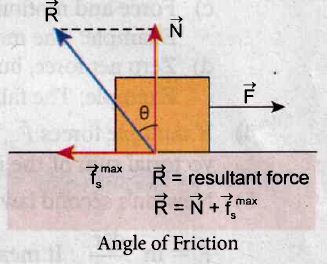
But fsmax = μs N where us is the coefficient of static friction.
∴ μs = tan ፀ
To show that angle of friction is equal to angle of repose
.JPG)
26.
A jerk is given on a stretched string at time t = 0 s. Assume that the wave pulse created during this disturbance moves along positive x direction with constant speed v as shown in Figure (a).
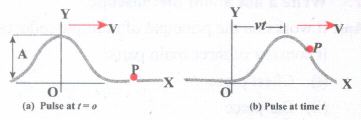
Represent the shape of the wave pulse, mathematically as y = y(x, 0) = j(x) at time t = 0s. Assume that the shape of the wave pulse remains the same during the propagation. After some time t, the pulse moving towards the right and any point on it can be represented by x' (read it as x prime) as shown in Figure (b). Then
y(x, t) =j(x') =j(x - vt)
Similarly, if the wave pulse moves towards left with constant speed v, then y =j(x + vt). Both waves y =j(x + v!) and y =j(x - vt) will satisfy the following one dimensional differential equation known as the wave equation
\({∂^2y\over ∂x^2}={1\over4 v^2}{∂^2y\over ∂t^2}\)
where the symbol p represent partial derivative (read \({∂y\over ∂x}\) as partial y by partial x). Not all the solutions satisfying this differential equation can represent waves, because any physical acceptable wave must take finite values for all values of x and t. But if the function represents a wave then it must satisfy the differential equation. Since, in one dimension (one independent variable), the partial derivative with respect to x is the same as total derivative in coordinate x, we write So it can be written as
\({d^2y\over dx^2}={1\over v^2}{d^2y\over dt^2}\)
27.
(i) In the two wires, the wire A is more ductile. Because, the material of wire A have large plastic range of extension than the wire B.
(ii) In the two wires, the slope of graph in wire A is greater than the slope of graph in wire B, so wire A has greater young's modulus.
(iii) Wire A is stronger than wire B because it can withstand more load without breaking. For Wire A, the breakeven point is higher.
(iv) WireB is more brittle. Because the material of wire B have small range of extension than the wire A.
28.
a. The displacement of the particle executing simple harmonic motion
y = A sin\(\omega t\)
Velocity of the particle is
v = A \(\omega\) cos \(\omega t\) = A \(\omega\) sin\(\left( \omega t+\frac { \pi }{ 2 } \right) \)
The phase difference between displacement and velocity is \(\frac{\pi}{2}\)
b. The velocity of the particle is
v = A \(\omega\) cos \(\omega t\)
Acceleration of the particle is
a = -A\({ \omega t }^{ 2 }\) sin \(\omega t\) = A \({ \omega }^{ 2 }\)cos \(\left( \omega t+\frac { \pi }{ 2 } \right) \)
The phase difference between velocity and acceleration is\(\frac{\pi}{2}\)
c. The displacement of the particle is
y = A sin\(\omega t\)
Acceleration of the particle is
a = − A \({ \omega }^{ 2 }\) sin ωt = A \({ \omega }^{ 2 }\) sin(\(\omega t\) + \(\pi\))
The phase difference between displacement and acceleration is \(\pi\) radian.
29.
From the shadows it is revealed that Earth has spherical shape with bulging along equator and flat at poles.
30.
\(F-T =m_{1} a \ \& \ T=m_{2} a
\)
\(a =\frac{F}{m_{1}+m_{2}} \ \& \ T=\frac{m_{2} F}{m_{1}+m_{2}}
\)
\(T =\frac{10 k g \times 500 N}{(10 k g+15 k g)}
\)
\(T =\frac{5000}{25} N
\)
\(T =200 \mathrm{~N}\)
31.
The concepts to form the integrand to find the moment of inertia are to be followed. Now, the origin is fixed to the left 'end of the rod and the limits are to be taken from 0 to l.
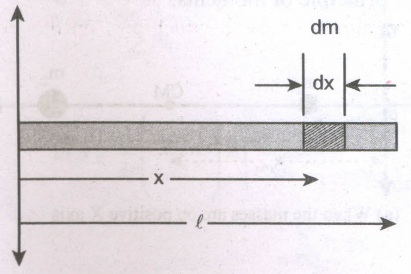
I = \(\frac { M }{ l } \int _{ 0 }^{ l }{ { x }^{ 2 }dx } =\frac { M }{ l } \left[ \frac { { x }^{ 3 } }{ 3 } \right] _{ 0 }^{ l }=\frac { M }{ l } \left[ \frac { { l }^{ 3 } }{ 3 } \right] \)
I = \(\frac { 1 }{ 3 } \)Ml2
32.
(i) If he stops his hands soon after catching the ball, the ball comes to rest very quickly. It means that the momentum of the ball is brought to rest very quickly.
(ii) So the average force acting on the body will be very large.
(iii) Due to this large average force, the hands will get hurt.
(iv) To avoid getting hurt, the player brings the ball to rest slowly
33.
For closed organ pipe, 3rd harmonics = \(\cfrac { 3v }{ 4l } \)
For open organ pipe, fundamental frequency,=\(\cfrac { v }{ 2l } \)
Given,\(\cfrac { 3v }{ 4l } =\cfrac { v }{ 2l } \)
\(l'=\cfrac { 4l }{ 3\times 2 } =\cfrac { 4l }{ 6 } \)
l = 20 cm \(l'=\cfrac { 4\times 20 }{ 6 } \)
l'=13.33 cm
34.
Conduction is the process of direct transfer of heat through matter due to temperature difference. When two objects are in direct contact with one another, heat will be transferred from the hotter object to the colder one. The objects which allow heat to travel easily through them are called conductors.
35.
Solid, liquid, gas, plasma, Bose-Einstein condensates, quark-gluon plasmas and hot plasma these are the physical states of matter.
36.
Geocentric Model of Solar System:
In the second century, Claudius Ptolemy, a famous Greco-Roman astronomer, developed a theory to explain the motion of celestial objects like the Sun, the Moon, Mars, Jupiter etc. This theory was called the geocentric model. According to the geocentric model, the Earth is at the center of the universe and all celestial objects including the Sun, the Moon, and other planets orbit the Earth.
37.
a. Periodic motion
b. Non-periodic motion
c. Periodic motion
38.
One mole of an ideal gas at S.T.P occupies a volume of \(22.4 \times 10^{-3} \mathrm{~m}^{3}\)
∴ Number of moles \(/ \mathrm{m}^{3}=\mathrm{n}=\frac{6.023 \times 10^{23}}{22.4 \times 10^{-3}}\)
\(\therefore n=2.69 \times 10^{25} \mathrm{moles} / \mathrm{m}^{3}\)
In terms of number of molecules and radius the mean free path at S.T.P can be written as
\(\lambda =\frac{1}{4 \pi \sqrt{2} r^{2} n}
\)
\(\text {Radius } r =\frac{3 \times 10^{-10}}{2}=1.5 \times 10^{-6} \mathrm{~m}\)
∴ Mean free path, \(\quad \lambda=\frac{1}{4 \times 3.14 \times 1.414 \times\left(1.5 \times 10^{-10}\right)^{2} \times 2.69 \times 10^{25}}\)
\(\lambda=0.0931 \times 10^{-6}=9.31 \times 10^{-8} \mathrm{~m}\)
Mean free path, \(\lambda \approx 9 \times 10^{-8} \mathrm{~m}\)
39.
The average speed
\(\overset { - }{ v } =\frac { 2+3+4+5+5+5+6+6+7+9 }{ 10 } =5.2{ ms }^{ -1 }\)
To find the rms speed, first calculate the mean square speed \(\overset { - }{ { v }^{ 2 } } \)
\(\overset { - }{ { v }^{ 2 } } =\frac { { 2 }^{ 2 }+{ 3 }^{ 2 }+{ 4 }^{ 2 }+{ 5 }^{ 2 }+{ 5 }^{ 2 }+{ 5 }^{ 2 }+6^{ 2 }+{ 6 }^{ 2 }+{ 7 }^{ 2 }+{ 9 }^{ 2 } }{ 10 } \)
= 30.6ms2s-2
The rms speed
\({ v }_{ rms }\sqrt { \overset { - }{ { v }^{ 2 } } } =\sqrt { 30.6 } =5.53{ ms }^{ -1 }\)
The most probable speed is 5 m s-1 because three of the particles have that speed.
40.
When the water is heated from 30°C to 60°C, there is only a slight change in its volume. So we can treat this process as isochoric. In an isochoric process the work done by the system is zero. The given heat supplied is used to increase only the internal energy.
ΔU = Q = msv ΔT
The mass of water = 500 g = 0.5 kg
The change in temperature = 30K
The heat Q = 0.5\(\times\)4184\(\times\)30 = 62.76 kJ
41.
x = 2 - 5t + 6t2
Velocity, v = \(\frac { dx }{ dt } =\frac { d }{ dt } \) (2-5t+6t2) or v = -5+12t
For initial velocity, t = 0
∴ Initial velocity = -5ms-1
The negative sign implies that at t = 0 the velocity of the particle is along negative x direction.
42.
One second is the duration of 9,192,631,770 periods of radiation corresponding to the transition between the two hyperfine levels of the ground state of Cesium-133 atom.
43.
The weight of tree exerts a torque about the point where the cut is made. This causes rotation of the tree about the cut has to be made at say point A to weaken the tree trunk and to shift the centre of mass to the right and eventually move towards the ground on the right.

11th Standard Syllabus & Materials
11th Standard
TN 11th Tamil பீடு பெற நில் - செய்யுள் - காவடிச்சிந்து Important Questions And Answers Study Material - QB365 Set A
NEW11th Standard
TN 11th Tamil பீடு பெற நில் - உரைநடை - மலை இடப்பெயர்கள் : ஓர் ஆய்வு Important Questions And Answers Study Material - QB365 Set A
NEW11th Standard
TN 11th Tamil மாமழை போற்றுதும் - துணைப்பாடம் - யானை டாக்டர் Important Questions And Answers Study Material - QB365 Set A
NEW11th Standard
TN 11th Tamil மாமழை போற்றுதும் - செய்யுள் - ஐங்குறுநூறு Important Questions And Answers Study Material - QB365 Set A



Tamilnadu Stateboard 11th Standard Subjects

Maths

Commerce

Economics

Biology

Business Maths and Statistics

Accountancy

Computer Science
Physics

Chemistry
Maths
Biology
Economics
Physics
Chemistry

History
Business Maths and Statistics

Computer Science
Accountancy

Computer Applications
History
Computer Technology
Commerce
Computer Applications
Computer Technology

Tamil

English

French
Tamilnadu Stateboard Standards

