
 100% FREE ACCESS
11th Standard Syllabus & Materials
11th Standard
TN 11th Tamil இயற்கை வேளாண்மை,சுற்றுச்சூழல் -செய்யுள் - மனோன்மணீயம் Important Questions And Answers Study Material - QB365 Set A
NEW11th Standard
TN 11th Tamil என்னுயிர் என்பேன் -துணைப்பாடம் - இசைத்தமிழர் இருவர் Important Questions And Answers Study Material - QB365 Set A
NEW11th Standard
TN 11th Tamil மொழி கலை -செய்யுள் - ஒவ்வொரு புல்லையும் Important Questions And Answers Study Material - QB365 Set A
NEW11th Standard
TN 11th Tamil பீடு பெற நில் - இலக்கணம் - பகுபத உறுப்புகள் Important Questions And Answers Study Material - QB365 Set A
NEW11th Standard
TN 11th Tamil பீடு பெற நில் - துணைப்பாடம் - வாடிவாசல் Important Questions And Answers Study Material - QB365 Set A
NEW11th Standard
TN 11th Tamil பீடு பெற நில் - செய்யுள் - குறுந்தொகை Important Questions And Answers Study Material - QB365 Set A

Published on: 13/09/2019
Download Tamil Nadu 11th Standard Physics question papers, model tests, one-mark questions, important questions, and public exam papers in PDF format. Free study materials and answer keys for TN State Board students.
Questions + Answers key
Take MCQ Physics Test1.
Moment of inertia of a body is a ______________.
variable quantity
invariable quantity
constant quantity
measure of torque
2.
Infinitesimal quantity means _____________.
collective particles
extremely small
nothing
extremely larger
3.
The radius of gyration of a solid sphere of radius r about a certain axis is r. The distance of that axis from the centre of the sphere is ___________.
\(\frac { 2 }{ 5 } \)r
\(\sqrt { \frac { 2 }{ 5 } } \)r
\(\sqrt { 0.6 } \)r
\(\sqrt { \frac { 5 }{ 3 } } \)r
4.
The centripetal force is ______________.
\(\frac { { mv }^{ 2 } }{ r } \)
\(r{ \omega }^{ 2 }\)
both (a) and (b)
none
5.
The product of mass and velocity is _____________.
force
impulse
momentum
acceleration
6.
If a gymnast sitting on a rotating stool, with his arms out stretched, suddenly lowers his hands ___________.
the angular velocity decreases
his moment of Inertia decreases
the angular velocity stays constant
the angular momentum increases
7.
In the arrangement shown in figure coefficient of friction between the two blocks is \(\mu =\frac { 1 }{ 2 } \) The force of friction acting between the two blocks is _______________.
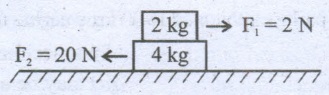
8 N
10 N
6 N
4 N
8.
When a mass is rotating in a plane about a fixed point its angular momentum is directed along ______________.
A line perpendicular to the plane of rotation
The radius
The tangent to the circle
An angle of 45° to the plane of rotation
9.
A particle is projected at an angle of 60° to the horizontal with a kinetic energy E. The kinetic energy at the highest point is _____________.
E
\(\frac{E}{2}\)
\(\frac{E}{4}\)
zero
10.
A heavy iron rod of weight W is having its one end on the ground and the other on the shoulder of a man. The rod makes an angle ፀ with the horizontal. What is the weight experienced by the man?
W sin ፀ
W cos ፀ
W
\(\frac { W }{ 2 } \)
11.
A book is at rest on the table which exerts a normal force on the book. If this force is considered as reaction force, what is the action force according to Newton's third law?
Gravitational force exerted by Earth on the book
Gravitational force exerted by the book on Earth
Normal force exerted by the book on the table
None of the above
12.
One parallactic second is ______________
3.08 \(\times\)1016 m
1.49 \(\times\)1011 m
9.46 \(\times\) 1015 m
1.66 \(\times\) 10-27 m
13.
Which is deals with the study of materials of an intermediate length scale?
Macro physics
Macroscopic physics
Microscopic physics
All the above
14.
Which one of the following Cartesian coordinate systems is not followed in physics?
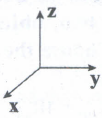
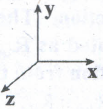
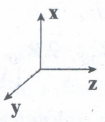
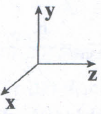
15.
One of the combinations from the fundamental physical constants is \({{hc}\over{G}},\) The unit of this expression is
Kg2
m3
S-1
m
16.
A small particle of mass m is projected with an initial velocity v at an angle \(\theta\) with x-axis in X-Y plane as shown in Figure.
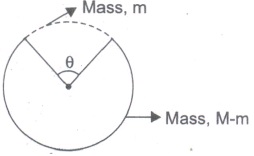
Find the angular momentum of the particle.
17.
Consider two masses of 10 g and 1 kg moving with the same speed 10 ms-1. Calculate the magnitude of the momentum.
18.
Calculate the displacement vector if \(\vec { { r }_{ 1 } } ={ x }_{ 1 }\vec { i } +{ y }_{ 1 }\vec { j } +{ z }_{ 1 }\vec { k } ,\vec { { r }_{ 2 } } ={ x }_{ 2 }\vec { i } +{ y }_{ 2 }\vec { j } +{ z }_{ 2 }\vec { k } \)
19.
How to verify Newton's third law, using spring balances?
20.
Define unit of a physical quantity?
21.
Show that a screw gauge of pitch 1mm and 100 divisions is more precise than a vernier caliper with 20 divisions on the sliding scale.
22.
Give the physical significance of moment of inertia. Explain the need of fly wheel in Engine.
23.
Convert a velocity of 72 kmh-1 into ms-1 with the help of dimensional analysis.
24.
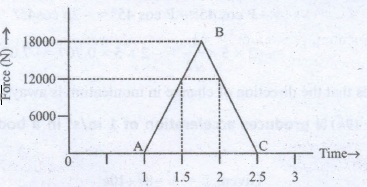
The diagram shows an estimated force-time graph for a baseball struck by a bat. Then find
(i) Impulse
(ii) Force
(iii) Maximum force
25.
Mention any two physical significance of moment of inertia?
26.
How will you measure the work done? When
(i) the force acts along the direction of motion of the body and,
(ii) the force is inclined to the direction of motion of the body?
27.
A particle is projected at an angle of θ with respect to the horizontal direction. Match the following for the above motion.
(a) vx - decreases and increases
(b) vy - remains constant
(c) Acceleration - varies
(d) Position vector - remains downward
28.
Derive an expression for kinetic energy in rotation and establish the relation between rotational kinetic energy and angular momentum.
29.
The parallal x of a heavenly body measured from two points diametrically opposite on equator of earth is 2'. Calculate the distance of the heavenly body. [Given radius of the earth = 6400 km] [1" = 4.85\(\times\)10-6 rad]
30.
The value Gin CGS system is 6.67\(\times\)10-8 dyne cm2 g-2. Calculate the value in SI units.
31.
Describe Galileo's experiments concerning motion of objects on inclined planes?
32.
Explain with graphs the difference between work done by a constant force and by a variable force.
1.
(a)
variable quantity
2.
(b)
extremely small
3.
(c)
\(\sqrt { 0.6 } \)r
4.
(c)
both (a) and (b)
5.
(c)
momentum
6.
(b)
his moment of Inertia decreases
7.
(a)
8 N
8.
(a)
A line perpendicular to the plane of rotation
9.
(c)
\(\frac{E}{4}\)
10.
(d)
\(\frac { W }{ 2 } \)
11.
(c)
Normal force exerted by the book on the table
12.
(a)
3.08 \(\times\)1016 m
13.
(a)
Macro physics
14.
Answers (a), (b) and (c) are all anticlockwiseand answer (d) alone is in the clockwise direction
15.
Unit of a (Planck's constant) - Js
Unit of c (Velocity of light) - ms-1
Unit of G (Gravitational Constant) - \(\frac{\mathrm{Nm}^{2}}{\mathrm{Kg}^{2}}\)
\(\therefore \text { Unit of } \frac{h c}{G} \text { is }=\frac{J s \times m s^{-1}}{N m^{2} / k g^{2}} \)
\(=\frac{N m s \times m s^{-1} \times k g^{2}}{N m^{2}}[J=N m] =\mathrm{kg}^{2}\)
16.
Let the particle of mass m cross a horizontal distance x in time t.
Angular momentum \(\overrightarrow{L}=\int{\overrightarrow{\tau}}{dt}\)
But \(\overrightarrow{\tau}=\overrightarrow{r}\times \overrightarrow{F}\)
\(\overrightarrow{r}=x\hat { i } +y\hat { j} \) and \(\hat { F }=-mg \hat { j } \)
\(\therefore \overrightarrow { \tau }=(x\hat { i }+y\hat { j } ) \times (-mg \hat { j } )\)
\(\overrightarrow { \tau } =-mgx(\hat { i } \times \hat { j } )=-mgx\hat { k } \)
\(\overrightarrow { L } = -mg \int{(xdt)}\hat {k} =-gv\ cos\theta (\int t dt)\hat { k } \)
Let initial time t = 0 and final time t = tf
\(\overrightarrow {L}=-mg \cos \theta \left( ^{ t }\int _{ 0 }^{ f }{ tdt } \right) \hat k = -\frac{1}{2}mgv\ cos \theta\ t^{2}_{f} \hat{k}\)
Negative sign indicates, \(\overrightarrow {L}\) point inwards.
17.
We use p = mv
For the mass of 10 g, m = 0.01 kg
p = 0.01\(\times\)10 = 0.1 kg m s-1
For the mass of 1 kg
p = 1\(\times\)10 = 0.1 kg m s-1
Thus even though both the masses have the same speed, the momentum of the heavier mass is. 100 times greater than that of the lighter mass.
18.
Consider a particle moving from a point P1 having position vector \(\vec { { r }_{ 1 } } ={ x }_{ 1 }\vec { i } +{ y }_{ 1 }\vec { j } +{ z }_{ 1 }\vec { k } \) to a point P2 where its position vector is \(\vec { { r }_{ 2 } } ={ x }_{ 2 }\vec { i } +{ y }_{ 2 }\vec { j } +{ z }_{ 2 }\vec { k } \)
The displacement vector is given b y \(\Delta\vec{r}=\vec{{r}_{2}}-\vec{{r}_{1}}\)
= \((x_2-x_1)\vec{i}+(y_2-y_1)\vec{j}+(z_2-z_1)\vec{k}\)
19.
(i) Two spring balances are attached.
(ii) One end is fixed with rigid support and the other free end pulled by the force.
(iii) Pull one end with same force and note the readings on both the balances.
(iv) Repeat it. We can notice same reading in both balances.
20.
Unit of a physical quantity is defined as the established standard used for comparison of the given physical quantity. It is classified into fundamental and derived unit.
21.
Least count of screw gauge
\(={{Pitch}\over{No. of\ divisions}}\)
\(={{1}\over{100}}=0.01\ mm\) (or) 0.001 cm
Least count of vernier calipers
\(=1MSD-1-1VSD=(1-19/20)MSD\)
\(={{1}\over{20}}\) = 0.05 cm.
So screw gauge is more precise than vernier.
22.
It plays the same role in rotatory motion as the mass does in translatory motion.
23.
n1 = 72 kmh-1 n2 =? ms-1
L1 = 1 km L2 = 1m
T1=1h T2=1s
\(n_2=n_1[\frac{L_1}{L_2}]^a[\frac{T_1}{T_2}]^b\)
The dimensional formula for velocity is [LT-1]
a = 1 b =-1
\(n_2=72[\frac{1\ km}{1\ m}][\frac{1\ h}{1\ s}]^{-1}\)
\(=72[\frac{1000\ m}{1\ m}]^1[\frac{3600\ s}{1\ s}]^{-1}=72\times1000\times\frac{1}{3600}=20ms^{-1}\)
72km h-1 = 20ms-1
24.
Formula:
(i) Impulse = Area ABC
= \(\frac { 1 }{ 2 } \) \(\times\)18000\(\times\)(2.5 -1)
=1.35\(\times\)104 kg ms-1
(ii) Force = \(\frac { impulsw }{ time } =\frac { 1.35\times { 10 }^{ 4 } }{ (2.5-1) } \) = 9000 N
(iii) Maximum force = 18000 N
25.
1. Greater the mass concentrated away from the axis, greater the moment of inertia.
2. Moment of inertia of a body about an axis of rotation resists a change in it. In rotational motion, moment of inertia increases with increase in torque to change it's rotation.
26.
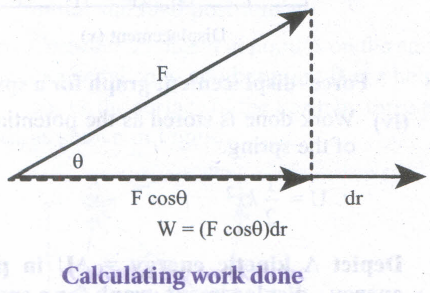
(i) Consider a force \(\vec {(F)}\) acting on a body which moves displacement in some direction\(\vec{(dr)}\) as shown in figure.
work done = force\(\times\)displacement, W = Fs
(ii) When force and displacement are inclined in each other, the expression for work done (W) by the force on the body is mathematically written as, \(W=\vec{F}=\vec{dr}\)
Here, the product \(\vec{F}.\vec{dr}\) is a scalar product (or dot product). Thus, work done is a scalar quantity.
w=F dr cosθ
where, θ is the angle between applied force and the displacement of the body.
The work done by the force depends on the force (F), displacement (dr) and the angle (θ) between them.
27.
(a) vx - remains constant
(b) vy - decreases and increases
(c) a - remains downward
(d) r - varies
28.
Let us consider a rigid body rotating with angular velocity \(\omega\) about an axis as shown in figure. Every particle of the body will have the same angular velocity \(\omega\) and different tangential velocities v based on its positions from the axis of rotation.
Let us choose a particle of mass mi situated at distance ri from the axis of rotation. It has a tangential velocity vi given by the relation, vi = ri \(\omega\). The kinetic energy KEi of the particle is,
KEi = \(\frac { 1 }{ 2 } { m }_{ i }{ v }_{ i }^{ 2 }\)
Writing the expression with the angular velocity,
\(KE=\frac { 1 }{ 2 } { m }_{ i }\left( { r }_{ i }\omega \right) ^{ 2 }=\frac { 1 }{ 2 } \left( { m }_{ i }{ r }_{ i }^{ 2 } \right) \omega ^{ 2 }\)
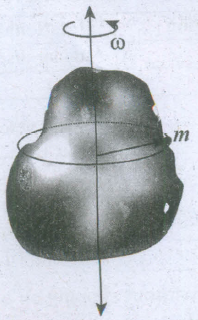
For the kinetic energy of the whole body, which is made up of large number of such particles, the equation is written with summation as,
\(KE=\frac { 1 }{ 2 } \left( \sum { { m }_{ i }{ r }_{ i }^{ 2 } } \right) \omega ^{ 2 }\)
where, the term \(\sum { { m }_{ i }{ r }_{ i }^{ 2 } } \) is the moment of interiaI of the whole body. \(\sum { { m }_{ i }{ r }_{ i }^{ 2 } } \)
Hence, the expression for KE of the rigid body in rotational motion is,
KE = \(\frac{1}{2}\)I\(\omega^2\)
This is analogous to the expression for kinetic energy in translational motion.
KE = \(\frac{1}{2}\)Mv2
Relation between rotational kinetic energy and angular momentum
Let a rigid body of moment of inertia \(\omega\) rotate with angular velocity \(\omega\).
The angular momentum of a rigid body is, L = I\(\omega\)
The rotational kinetic energy of the rigid body is, KE = \(\frac{1}{2}I\omega^2\)
By multiplying the numerator and denominator of the above equation with I, we get a relation between Land KE as,
KE = \(\frac{1}{2}\)\(\frac { I^{ 2 }\omega ^{ 2 } }{ I } =\frac { 1 }{ 2 } \frac { \left( I\omega \right) ^{ 2 } }{ I } \)
\(KE=\frac { { L }^{ 2 } }{ 2I } \)
29.
Angle \(\theta\) = 2' = 2\(\times\)60" = 120" = 120\(\times\)4.85\(\times\)10-6 rad
\(\theta\) = 5.82\(\times\)10-4 rad;
d = 2 x r
d = 2 x 6400 = 12800 x 103 m
The distance of heavenly body
\(D=\frac{d}{\theta}=\frac{12800\times10^3}{5.82\times10^{-4}}\)
D = 2.19\(\times\)1010m.
30.
As F \(=G{m_1m_2\over r^2}\)
\(G={F.r^2\over m_1m_2}\)
\([G]={{MLT}^{-2}.L^2\over MM}={M}^{-1}L^3{T}^{-2}\)
\(\therefore\) a = -1, b ~ 3, c = -2
| CGS units | SI units |
|---|---|
| n1 = 6.67\(\times\) 10-8 | n2 =?, |
| m1=1g | m2 = 1 kg=1000 g |
| L1 = 1cm | L2 = 1 cm = 100cm |
| T1=1s | T2=1s |
\(\therefore\) \(n_2=n_1{\left[ {M_1 \over M_2} \right]}^{a}{\left[ {L_1 \over L_2} \right]}^{b}{\left[ {T_1 \over T_2} \right]}^{c}\)
\(=6.67\times{10}^{-8}{\left[ {{1\over 1000}} \right]}^{-1}{\left[ {{1\over 100}} \right]}^{3}\left[ {1\over 1} \right]^{-2}=6.67\times{10}^{}-11\)
Hence in SI units, G = 6.67\(\times\)10-11Nm2 kg-2
31.
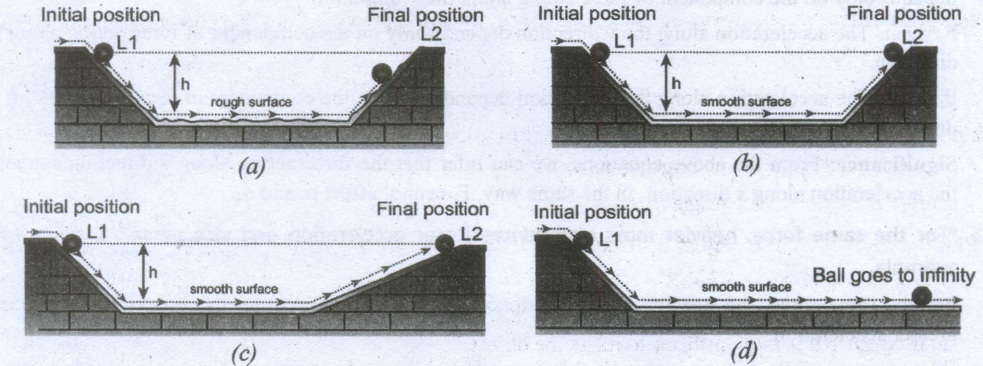
Galileo's experiment with. the second plane (a) at same inclination angle Cisthe first (b) with increased smoothness (c) with reduced angle of inclination (d) with zero angle of inclination
When a ball rolls from the top of an inclined plane to its bottom, after reaching the ground it moves some distance and continues to move on to another inclined plane of same angle of inclination as shown in the Figure (a). By increasing the smoothness of both the inclined planes, the ball reach almost the same height (h) from where it was released (L1) in the second plane (L2) [figure (b)]. The motion of the ball is then observed by varying the angle of inclination of the second plane keeping the same smoothness. If the angle of inclination is reduced, the ball travels longer distance in the second plane to reach the same height [figure (c)). When the angle of inclination is made zero, the ball moves forever in the horizontal direction [figure (d)]. If the Aristotelian idea were true, the ball would not have moved in the second plane even if its smoothness is made maximum since no force acted on it in the horizontal direction.
32.
Work done by a constant force:
(i) When a constant force F acts on a body, the small work done (dW) by the force in producing a small displacement dr is given by the relation,
dW= (F cos\(\theta\) ) dr
(ii) The total work done in producing a displacement from initial position ri to final position rf is,
\(W=\overset { { r }_{ f } }{ \underset { { r }_{ i } }{ \int } } dw\)
\(W=\overset { { r }_{ f } }{ \underset { { r }_{ i } }{ \int } } \left( F\cos { \theta } \right) dr=\left( F\cos { \theta } \right) \)\(\overset { { r }_{ f } }{ \underset { { r }_{ i } }{ \int } } dr=\left( F\cos { \theta } \right) \left( { r }_{ f }-{ r }_{ i } \right) \)
(iii) The graphical representation of the work done by a constant force is shown in Figure. The area under the graph shows the work done by the constant force.
.jpg)
Work done by a variable force:
(i) When the component of a variable force F acts on a body, the small work done (dW) by the force in producing a small displacement dr is given by the relation
dw = (F cos\(\theta\)) dr
[F cos\(\theta\) is the component of the variable force F]
where, F and \(\theta\) are variables. The total work done for a displacement from initial position ri to final position rf is given by the relation,
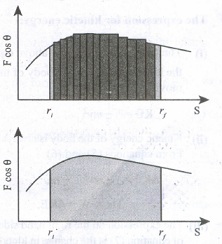
\(W=\overset { { r }_{ f } }{ \underset { { r }_{ i } }{ \int } } dw=\overset { { r }_{ f } }{ \underset { { r }_{ i } }{ \int } } F\cos { \theta } dr\)
(ii) A graphical representation of the work done by a variable force is shown in Figure. The area under the graph is the work done by the variable force.

11th Standard Syllabus & Materials
11th Standard
TN 11th Tamil பீடு பெற நில் - செய்யுள் - காவடிச்சிந்து Important Questions And Answers Study Material - QB365 Set A
NEW11th Standard
TN 11th Tamil பீடு பெற நில் - உரைநடை - மலை இடப்பெயர்கள் : ஓர் ஆய்வு Important Questions And Answers Study Material - QB365 Set A
NEW11th Standard
TN 11th Tamil மாமழை போற்றுதும் - துணைப்பாடம் - யானை டாக்டர் Important Questions And Answers Study Material - QB365 Set A
NEW11th Standard
TN 11th Tamil மாமழை போற்றுதும் - செய்யுள் - ஐங்குறுநூறு Important Questions And Answers Study Material - QB365 Set A



Tamilnadu Stateboard 11th Standard Subjects

Maths

Commerce

Economics

Biology

Business Maths and Statistics

Accountancy

Computer Science
Physics

Chemistry
Maths
Biology
Economics
Physics
Chemistry

History
Business Maths and Statistics

Computer Science
Accountancy

Computer Applications
History
Computer Technology
Commerce
Computer Applications
Computer Technology

Tamil

English

French
Tamilnadu Stateboard Standards

