
 100% FREE ACCESS
11th Standard Syllabus & Materials
11th Standard
TN 11th Tamil இயற்கை வேளாண்மை,சுற்றுச்சூழல் -செய்யுள் - மனோன்மணீயம் Important Questions And Answers Study Material - QB365 Set A
NEW11th Standard
TN 11th Tamil என்னுயிர் என்பேன் -துணைப்பாடம் - இசைத்தமிழர் இருவர் Important Questions And Answers Study Material - QB365 Set A
NEW11th Standard
TN 11th Tamil மொழி கலை -செய்யுள் - ஒவ்வொரு புல்லையும் Important Questions And Answers Study Material - QB365 Set A
NEW11th Standard
TN 11th Tamil பீடு பெற நில் - இலக்கணம் - பகுபத உறுப்புகள் Important Questions And Answers Study Material - QB365 Set A
NEW11th Standard
TN 11th Tamil பீடு பெற நில் - துணைப்பாடம் - வாடிவாசல் Important Questions And Answers Study Material - QB365 Set A
NEW11th Standard
TN 11th Tamil பீடு பெற நில் - செய்யுள் - குறுந்தொகை Important Questions And Answers Study Material - QB365 Set A

Published on: 17/01/2020
Download Tamil Nadu 11th Standard Physics question papers, model tests, one-mark questions, important questions, and public exam papers in PDF format. Free study materials and answer keys for TN State Board students.
Questions + Answers key
Take MCQ Physics Test1.
The average translational KE. of O2(molar mass 32) molecules at a particular temperature is 0.048 eV. The translational KE. of N2(molar mass 28) molecules in eV at the same temperature is ________
0.0015
0.003
0.048
0.768
2.
Escape velocity of a body of 1 kg. On a planet is 100 ms-1. Gravitational potential energy of the body at the planet is _______.
-5000 J
- 1000 J
- 2400
4000 J
3.
1 mole of a gas with \(\gamma =\frac { 7 }{ 5 } \) is mixed with 1 mole of gas with \(\gamma =\frac { 5 }{ 3 } \) then value of g of the resulting mixture is ____________.
\(\frac { 7 }{ 5 } \)
\(\frac { 2 }{ 5 } \)
\(\frac { 3 }{ 2 } \)
\(\frac { 12 }{ 7 } \)
4.
An organ pipe A closed at one end is allowed to vibrate in its first harmonic and another pipe B open at both ends is allowed to vibrate in its third harmonic. Both A and B are in resonance with a given tuning fork. The ratio of the length of A and B is
\(\frac{8}{3}\)
\(\frac{3}{8}\)
\(\frac{1}{6}\)
\(\frac{1}{3}\)
5.
6.
With an increase in temperature, the viscosity of liquid and gas, respectively will
increase and increase
increase and decrease
decrease and increase
decrease and decrease
7.
The kinetic energy of the satellite orbiting around the Earth is
equal to potential energy
less than potential energy
greater than kinetic energy
zero
8.
The position vector of a particle is \(\vec r=4t^2\hat i+2t\hat j+3t\hat k\) . The acceleration of a particle is having only ___________.
X-component
Y-component
Z-component
X-Y component
9.
Dimensions [M L-1T-1] are related to_____________
torque
work
energy
Coefficient of viscosity
10.
A particle moves from a point \((-2\vec i+5\vec j)\) to \((4\vec j+3\vec k)\) when a force of \((4\vec i+3\vec j)N\) is applied. How much work has been done by the force?
8 J
11 J
5 J
2 J
11.
No force is required for ____________.
an object moving in circular motion.
an object moving in straight line with constant velocity.
an object moving with constant acceleration.
an object moving in elliptical pattern
12.
Two blocks of masses 20 kg and 5 kg are connected by a spring of negligible mass and placed on a frictionless horizontal surface. An impulse gives a velocity of 15 m/s to the heavier block in the direction of lighter block. The velocity of centre of mass is _____________.
22 ms-1
30 ms-1
12 ms-1
15 ms-1
13.
From a disc of radius R a mass M, a circular hole of diameter R, whose rim passes through the center is cut. What is the moment of inertia of the remaining part of the disc about a perpendicular axis passing through it
15MR2/32
13MR2/32
11MR2/32
9MR2/32
14.
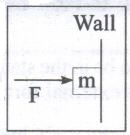
An object of mass m held against a vertical wall by applying horizontal force F as shown in the figure.The minimum value of the force F is
Less than mg
Equal to mg
Greater than mg
Cannot determine
15.
Which one of the following physical quantities cannot be represented by a scalar?
Mass
length
momentum
magnitude of acceleration
16.
A transverse harmonic wave on a string is described by y(x, t) = 5.0 sin (48t + 0.0264x + ), where x and y are in cm and t in sec. The positive direction of x is from left to right.
(a) What are its amplitude and frequency?
(b) What is the least distance between two success in crests in the wave?
17.
Distinguish between isothermal and adiabatic process.
18.
Discuss in detail the energy in simple harmonic motion.
19.
20.
Find the adiabatic exponent \(\gamma\) for mixture of μ1 moles of monoatomic gas and μ2 moles of a diatomic gas at normal temperature (27°C).
21.
Obtain an expression for the excess of pressure inside a
i) liquid drop
ii) liquid bubble
iii) air bubble.
22.
Derive the expression for gravitational potential energy.
23.
Define Torque and derive its expression.
24.
What is inelastic collision? In which way it is different from elastic collision. Mention few examples in day to day life for inelastic collision.
25.
State Newton's three laws and discuss their significance.
26.
Derive the kinematic equations of motion for constant acceleration.
27.
What do you mean by phase of a wave?
28.
Two steel wires of lengths 1 m and 2 m have diameters 1 mm and 2 mm respectively. If they are stretched by forces of 40 N and 80 N respectively, find the ratio of their elongations
29.
A particle of mass 10g is kept on the surface of a uniform sphere of mass 100 kg and radius 10 cm, Find the work to done against the gravitational force between them to take the particle is away from the sphere.
30.
Define molar specific heat capacities.
31.
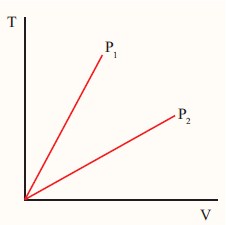
The following graph shows a V-T graph for isobaric processes at two different pressures. Identify which one occurs at higher pressure.
32.
Consider an object of mass 2 kg moved by an external force 20 N in a surface having coefficient of kinetic friction 0.9 to a distance 10 m. What is the work done by the external force and kinetic friction? Comment on the result. (Assume g = 10 ms-2)
33.
Suppose two trains A and B are moving with uniform velocities along parallel tracks but in opposite directions. Let the velocity of train A be 40 km h-1 due east and that of train B be 40 km h-1 due west. Calculate the relative velocities of the trains.
34.
Why is it much easier to balance a meter scale on your finger tip than balancing on a match stick?
35.
Name three units to measure extremely large distances.
36.
Derive the relation between Intensity and loudness
37.
Explain why:
(a) a body with large reflectivity is a poor emitter.
(b) a brass tumbler feels much colder than wooden tray on a chilly day.
38.
Write down the equation of time period for linear harmonic oscillator.
39.
Deduce Avogadro’s law based on kinetic theory.
40.
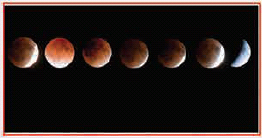
The following photographs are taken from the recent lunar eclipse which occurred on January 31, 2018. Is it possible to prove that Earth is a sphere from these photographs?
41.
A body of 3.5 kg in acted upon by two forces of magnitudes 3N and 5N making an angle of 90° with each other. Calculate the magnitude if net acceleration experience by the body is?
42.
Derive an expression for work done by Torque?
43.
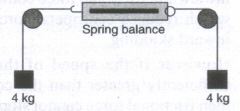
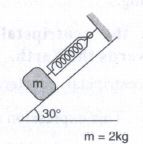
What is the reading shown in spring balance?
1.
(c)
0.048
2.
(a)
-5000 J
3.
(c)
\(\frac { 3 }{ 2 } \)
4.
First harmonic of a closed organ pipe
\(\mathrm{L}_{\mathrm{c}}=\frac{\lambda}{4}\)
Third harmonic of an open organ pipe
\(\mathrm{L}_{\mathrm{o}} =\frac{3 \lambda}{2} \)
\(\frac{L_{c}}{L_{o}} =\frac{\lambda}{4} \times \frac{2}{3 \lambda} \)
\(\frac{L_{c}}{L_{o}} =, \frac{1}{6} \)
5.
(d)
6.
(c)
decrease and increase
7.
Escape speed ve = \(\sqrt 2g R\)
if g' = 4g
then \(v'_e\) = \(\sqrt (4g) R\)
= \(\sqrt 2g R \) \(\times\)2
= 2ve
8.
(a)
X-component
9.
(d)
Coefficient of viscosity
10.
(c)
5 J
11.
(b)
an object moving in straight line with constant velocity.
12.
(c)
12 ms-1
13.
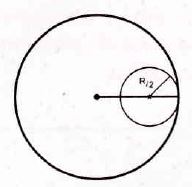
Moment of inertia of a disc
\(\mathrm{I}_{1}=\frac{M R^{2}}{2}\)
\(\text { Mass of small disc }=\frac{M}{\pi R^{2}} \times \pi \times\left(\frac{R}{2}\right)^{2}\)
\(=\frac{M}{\pi R^{2}} \times \frac{\pi R^{2}}{4}=\frac{M}{4}\)
By the theorem of parallel axis, the moment of inertia of the small disc. About an axis passing through 0 is
\(I_{2} =\frac{1}{2} \times \frac{M}{4}\left(\frac{R}{2}\right)^{2}+\frac{M}{4}\left(\frac{R}{2}\right)^{2} \)
\(=\frac{M}{8} \times \frac{R^{2}}{4}+\frac{M}{4} \times \frac{R^{2}}{4} \)
\(=\frac{M R^{2}}{32}+\frac{M R^{2}}{16}=\frac{M R^{2}+2 M R^{2}}{32} \)
\(I_{2} =\frac{3 M R^{2}}{32} \)
Moment of inertia of the remaining part is I= I1 - I2
\(=\frac{M R^{2}}{2}-\frac{3 M R^{2}}{32} \)
\(=\frac{16 M R^{2}-3 M R^{2}}{32}=\frac{13 M R^{2}}{32}\)
\(I =\frac{13 M R^{2}}{32} \)
14.
(c)
Greater than mg
15.
Mass, length are scalars. Acceleration is a vector but magnitude of acceleration is a scalar
16.
Here,
y(x, t) = 5.0 sin (48t + 0.0264x + \(\pi\over 6\))
The general equation of a plane progressive wave is,
v(x,t) = a Sin\(\left[{2\pi\over \lambda}(vt+x)+\phi\right]\)
It is observed that the given equation represent a travelling waveform right to left.
Velocity \(V={48\over 0.0264}=1818.18cms^{-1}, r=5cm\)
(a) Amplitude and frequency:
Amplitude,
\({2\pi\over \lambda}=0.0264\)
or
\(\lambda={2\pi\over 0.0264}cm={2\times3.14\over 0.0264}={6.28\over 0.0264}=237.8cm\)
frequency,
From the equation
v = ⋋v,
\(v={v\over \lambda}={1818.18\over 2\pi}\times0.0264\)
\(={1818.18\over 2\times3.14}\times0.0264\)
= 289.51 x 0.0264
= 7.64 Hz
b) To find least distance between two successive crests in the wave.
\(\lambda={2\pi\over 0.0264 }={2\times3.14\over 0.0264}={6.28\over0.0264}\)
= 237.8 em = 2.38 m
(c) When \(x={\lambda\over 4}\)
\(\phi={2\pi\over \lambda}\times{\lambda\over 4}={\pi\over 2}rad\)
17.
| S.No | Isothermal | Adiabatic |
|---|---|---|
| 1. | Temperature remains constant \(\triangle\)T =0 | Heat content remains constant \(\triangle\)Q |
| 2 | Walls of the container is perfectly conductivity. | All walls and piston are perfectly an insulating. |
| 3. | The changes occur slowly i.e. slow process. | The changes occur suddenly i.e. a fast process. |
| 4. | Internal energy remains constant, i.e \(\triangle\)U = 0 | internal energy changes \(\triangle\)U \(\neq \) 0 |
| 5. | Pv = constant | \({ P }_{ v }^{ \gamma }\) constant |
| 6 | Slope of isothermal curve on pv dig. \(\frac { -P }{ v } =\frac { dp }{ dv } \) |
Slope is \(\frac { -\gamma p }{ v } \) \(\gamma >1\) Slope of adiabatic greater than isothermal. |
18.
a. Expression for Potential Energy For the simple harmonic motion, the force and the displacement are related by Hooke's law
\(\vec { F } =-k\vec { r } \)
(i) Since force is a vector quantity, in three dimensions it has three components. Further, the force in the above equation is a conservative force field; such a force can be derived from a scalar function which has only one component. In one dimensional case
F = -kx .....(i)
(ii) As we have discussed in unit 4 of volume I, the work done by the conservative force field is independent of path. The potential energy U can be calculated from the following expression.
F = \(\frac { dU }{ dx } \) .......(2)
Comparing (1) and (2). we get
-\(\frac { dU }{ dx } \) = -kx
dU = kxdx
(iii) This work done by the force F during a small displacement dx stores as potential energy
U(x)=\(\int _{ 0 }^{ x }{ kx'dx=\frac { 1 }{ 2 } (x')^{ 2 }{ |_{ 0 }^{ x } } } =\frac { 1 }{ 2 } kx^{ 2 }\) ....(3)
From equation \(\sqrt { \frac { k }{ m } } \) , we can substitute the value of force constant k=ω2 in equation (3)
where ω is the natural frequency of the oscillating system. For the particle executing simple harmonic motion from equation y =A sin ωt,
we get x =A sin ωt
U(t)=\(\frac { 1 }{ 2 } mv_{ x }^{ 2 }=\frac { 1 }{ 2 } m\left( \frac { dx }{ dty } \right) ^{ 2 }\) ......(4)
This variation of U is shown below.
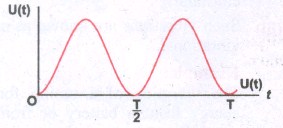
Variation of potential energy with time t
b. Expression for Kinetic Energy
KE = \(\frac { 1 }{ 2 } mv_{ x }^{ 2 }=\frac { 1 }{ 2 } m\left( \frac { dx }{ dy } \right) ^{ 2 }\)
(i) Since the particle is executing simple harmonic motion, from equation
y =A sin ωt
x =A sin ωt
Therefore, velocity is
vx =\(\frac { dx }{ dt } \)Aω cosωt
\(A\omega \sqrt { 1-\left( \frac { x }{ A } \right) ^{ 2 } } \)
vx = \(\omega \sqrt { { A }^{ 2 }-{ x }^{ 2 } } \) ....(5)
Hence
KE = \(\frac { 1 }{ 2 } mv_{ x }^{ 2 }=\frac { 1 }{ 2 } m{ \omega }^{ 2 }({ A }^{ 2 }-{ x }^{ 2 })\) ...(6)
KE = \(\frac { 1 }{ 2 } m{ \omega }^{ 2 }A^{ 2 }cos^{ 2 }\omega t\) ....(7)
This variation with time is shown below.
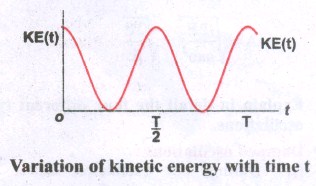
c. Expression for Total Energy
(i) Total energy is the sum of kinetic energy and potential energy
E = KE+U ..............(8)
E = \(\frac { 1 }{ 2 } m{ \omega }^{ 2 }=\frac { 1 }{ 2 } m{ \omega }^{ 2 }({ A }^{ 2 }-{ x }^{ 2 })\)
Hence excelling x2 term,
E = \(\frac { 1 }{ 2 } m{ \omega }^{ 2 }A^{ 2 }\) = constant .....(9)
(ii) Alternatively, from equation (4), and equation (7), we get the total energy as
E =\(\frac { 1 }{ 2 } m{ \omega }^{ 2 }A^{ 2 }sin^{ 2 }\omega t+\frac { 1 }{ 2 } m{ \omega }^{ 2 }A^{ 2 }cos^{ 2 }\omega t\)
= \(\frac { 1 }{ 2 } m{ \omega }^{ 2 }A^{ 2 }(sin^{ 2 }\omega t+cos^{ 2 }\omega t)\)
(iii) From trigonometry identity,
sin2ωt+cos2ωt_=1
E = \(\frac { 1 }{ 2 } m{ \omega }^{ 2 }A^{ 2 }\) = constant
which gives the law of conservation of total energy. This is depicted.
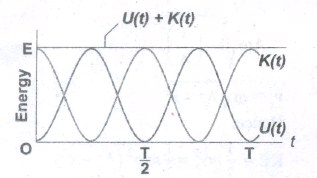
(iv) Thus the amplitude of simple harmonic oscillator, can be expressed in terms of total energy.
A =\(\sqrt { \frac { 2E }{ m{ \omega }^{ 2 } } } =\sqrt { \frac { 2E }{ k } } \) .
19.
20.
The specific heat of one mole of a monoatomic gas CV = \(\frac{3}{2}\)R
For \(\mu\)1 mole , CV = \(\frac{3}{2}\)\(\mu\)1R Cp = \(\frac{5}{2}\)\(\mu\)1 R
The specific heat of one mole of a diatomic gas
Cv = \(\frac{5}{2}\)R
For μ2 mole, CV = \(\frac{5}{2}\)μ2 R CP = \(\frac{7}{2}\)μ2 R
The specific heat of the mixture at constant volume CV = \(\frac{3}{2}\)\(\mu\)1R +\(\frac{5}{2}\)\(\mu\)2 R
The specific heat of the mixture at constant pressure CP = \(\frac{5}{2}\)\(\mu\)1 R + = \(\frac{7}{2}\)\(\mu\)2 R
The adiabatic exponent \(\gamma =\frac { { C }_{ p } }{ { C }_{ V } } =\frac { 5{ \mu }_{ 1 }+{ 7\mu }_{ 2 } }{ 3{ \mu }_{ 1 }+{ 5\mu }_{ 2 } } \)
21.
(1) Excess of pressure inside air bubble in a liquid.
Consider an air bubble of radius R inside a liquid having surface tension T as shown in Figure. Let P1 and P2 be the pressures outside and inside the air bubble, respectively. Now, the, excess pressure inside the air bubble is
\(\Delta P=P_{1}-P_{2}.\)
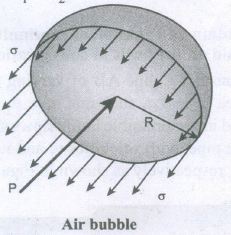
In order to find the excess pressure inside the air bubble, let us consider the forces acting on the air bubble. For the hemispherical portion of the bubble, considering the forces acting on it, we get,
(i) The force due to surface tension acting towards right around the rim of length \(2 \pi \mathrm{R} \ is \ \mathrm{F}_{\mathrm{T}}=2 \pi \mathrm{RT}\)
(ii) The force due to outside pressure P1 is to the right acting across a cross sectional area of \(\pi \mathrm{R}^{2} \ is \ F_{P_{1}}=P_{1} \pi R^{2}\)
(iii) The force due to pressure P2 inside the bubble, acting to the left is \(F_{P_{2}}=P_{2} \pi R^{2}\).
As the air bubble is in equilibrium under the action of these forces, \(F_{P_{2}}=F_{T}+F_{P_{1}}\)
\(\mathrm{P}_{2} \pi \mathrm{R}^{2} =2 \pi \mathrm{RT}+\mathrm{P}_{1} \pi \mathrm{R}^{2}
\)
\(\Rightarrow\left(\mathrm{P}_{2}-\mathrm{P}_{1}\right) \pi \mathrm{R}^{2} =2 \pi \mathrm{RT}\)
Excess pressure is \(\Delta \mathrm{P}=P_{2}-P_{1}=\frac{2 T}{R}\)
(2) Excess pressure inside a soap bubble
Consider a soap bubble of radius R and the surface tension of the soap bubble be T. A soap bubble has two liquid surfaces in contact with air, one inside the bubble and other outside the bubble. Hence, the force on the soap bubble due to surface tension is \(2 \times 2 \pi\) RT. The various forces acting on the soap bubble are,
(i) Force due to surface tension \(F_{T}=4 \pi R T\) towards right
(ii) Force due to outside pressure, \(F_{P_{1}}=P_{1} \pi R^{2}\) towards right
(iii) Force due to inside pressure, \(F_{P_{2}}=P_{2} \pi R^{2}\) towards left
As the bubble is in equilibrium, \(F_{P_{2}}=F_{T}+F_{P_{1}}\)
\(\mathrm{P}_{2} \pi \mathrm{R}^{2} =4 \pi \mathrm{RT}+\mathrm{P}_{1} \pi \mathrm{R}^{2}
\)
\(\Rightarrow\left(\mathrm{P}_{2}-\mathrm{P}_{1}\right) =\pi \mathrm{R}^{2}=4 \pi \mathrm{RT} \pi \mathrm{R}^{2}
\)
\(\text {Excess pressure is } \Delta \mathrm{P} =\mathrm{P}_{2}-\mathrm{P}_{1}=\frac{4 T}{R}\)
(3) Excess pressure inside the liquid drop
Consider a liquid drop of radius R and the surface tension of the liquid is T.
The various forces acting on the liquid drop are,
(i) Force due to surface tension \(F_{T}=2 \pi R T\) towards right
(ii) Force due to outside pressure, \(F_{P_{1}}=P_{1} \pi R^{2}\) towards right
(iii) Force due to inside pressure, \(F_{P_{2}}=P_{2} \pi R^{2}\) towards left
As the bubble is in equilibrium, \(F_{P_{2}}=F_{T}+F_{P_{1}}\)
\(\mathrm{P}_{2} \pi \mathrm{R}^{2} =2 \pi \mathrm{RT}+\mathrm{P}_{1} \pi \mathrm{R}^{2}
\)
\(\Rightarrow\left(\mathrm{P}_{2}-\mathrm{P}_{1}\right) \pi \mathrm{R}^{2}=2 \pi \mathrm{RT}
\)
\(\text {Excess pressure is } \Delta \mathrm{P} =\mathrm{P}_{2}-\mathrm{P}_{1}=\frac{2 T}{R}\)
22.
Consider the Earth and mass system, with r, the distance between the mass m and the Earth's centre. Then the gravitational potential energy,
\(\mathrm{U}=-\frac{G M_{e} m}{r}\) ......(1)
Here r = Re + h, where Re is the radius of the Earth. h is the height above the Earth's surface.
\(\mathrm{U}_{\mathrm{c}}=-G \frac{M_{e} m}{\left(R_{e}+h\right)}\) .......(2)
If h << Re, equation can be modified as
\(\mathrm{U} =-G \frac{M_{e} m}{\mathrm{R}_{e}\left(1+h / R_{e}\right)}
\)
\(\mathrm{U} =-G \frac{M_{e} m}{\mathrm{R}_{e}}\left(1+h / R_{e}\right)^{-1}\) .......(3)
By using Binomial expansion and neglecting the higher order terms, we get
\(\mathrm{U}=-G \frac{M_{e} m}{\mathrm{R}_{e}}\left(1-\frac{h}{R_{e}}\right)\) ........(4)
We know that, for a mass m on the Earth's surface,
\(G \frac{M_{e} m}{\mathrm{R}_{e}}=m g \mathrm{R}_{e}\) ........(5)
Substituting equation (5) in (4) we get
\(\mathrm{U}=-\mathrm{mg} \mathrm{R}_{e}+\mathrm{mgh}\) .......(6)
It is clear that the first term in the above expression is independent of the height h. For example, if the object is taken from height h1 to h2 then the potential energy at h1 is
\(\mathrm{U}\left(\mathrm{h}_{1}\right)=-\mathrm{mg} \mathrm{} \mathrm{R}_{\mathrm{e}}+\mathrm{mgh}_{1}\) .......(7)
and the potential energy at h2 is
\(\mathrm{U}\left(\mathrm{h}_{2}\right)=-\mathrm{mg} \mathrm{} \mathrm{R}_{\mathrm{e}}+\mathrm{mgh}_{2}\) .....(8)
The potential energy difference between h1 and h2 is
\(U\left(h_{2}\right)-U\left(h_{1}\right)=m g\left(h_{1}-h_{2}\right)\) .......(9)
23.
(i) Torque is defined as the moment of the external applied force about a point or axis of rotation.
(ii) \(\overset { \rightarrow }{ \tau } =\overset { \rightarrow }{ r } \times \overset { \rightarrow }{ F } \)
where, \(\overset { \rightarrow }{ r } \) is the position vector of the point where the force \(\overset { \rightarrow }{ F } \) is acting on the body as shown in Figure.
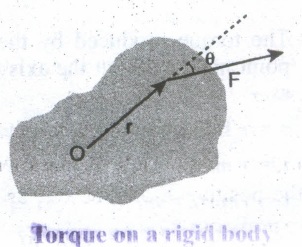
(iii) Here, the product of \(\overset { \rightarrow }{ r } \) and \(\overset { \rightarrow }{ F } \) is called the vector product or cross product. The vector product of two vectors results in another vector that is perpendicular to both the vectors. Hence, torque (\(\overset { \rightarrow }{ \tau } \)) is a vector quantity.
(iv) Torque has a magnitude (r F sinፀ) and direction perpendicular to \(\overset { \rightarrow }{ r } \) and \(\overset { \rightarrow }{ F } \). Its unit is N m.
\(\overset { \rightarrow }{ \tau } =(r\ F\sin\theta )\hat { n } \)
(v) Here, \(\theta\) is the angle between \(\overset { \rightarrow }{ r } \) and \(\overset { \rightarrow }{ F } \) and \(\hat { n } \) is the unit vector in the direction of \(\overset { \rightarrow }{ \tau } \).
24.
If there is a loss of kinetic energy during a collision, then it is called as an inelastic collision
In the case of inelastic collision,
(i) Total kinetic energy is not conserved.
(ii) Some or all of the forces involved are non-conservative.
(iii) A part of the mechanical energy is transformed into heat, sound, light etc.
Examples for inelastic collision:
(i) Collision between ball and floor
(ii) Collision between two vehicles
Examples for perfectly inelastic collision:
(i) Mud thrown on a wall and sticking to it
(ii) a man jumping into a moving trolley
(iii) a bullet fired into a wooden block and remaining embedded in it.
25.
i. Every object continues to be in the state of rest or of uniform motion unless there is external force acting on it.
ii. The force acting on an object is equal to the rate of change of its momentum.
iii. For every action there is an equal and opposite reaction.
Discussion:
i) Newton's laws are vector laws. The equation \(\vec{F}=\mathrm{m} \vec{a}\) can be written in cartesian coordinates as
\(\mathrm{F}_{x} \hat{\mathrm{i}}+\mathrm{f}_{\mathrm{y}} \hat{\mathrm{j}}+\mathrm{F}_{z} \hat{\mathrm{k}}=\operatorname{ma}_{x} \hat{\mathrm{i}}+\operatorname{ma}_{\mathrm{y}} \hat{\mathrm{j}}+\operatorname{ma}_{\mathrm{z}} \hat{\mathrm{k}}\)
On comparing both sides,
\(\mathrm{F}_{x}=m \mathrm{~m}_{x} \)
\(\mathrm{F}_{\mathrm{y}}=m \mathrm{ma}_{\mathrm{y}} \)
\(\mathrm{F}_{\mathrm{z}}=m \mathrm{ma}_{\mathrm{z}}\)
From the above equations, we can infer that the force acting along y direction cannot alter the acceleration along n direction. In the same way, F2 can not affect ay and an
ii) The acceleration experienced by the body at a time t depends on the force which acts on the body at that instant of time. Thus, \(\vec{F}(\mathrm{t})=\mathrm{m} \vec{a}(\mathrm{t})\)
when a bowler throws the ball to a batsman the acceleration of the ball is determined by the gravitational and air frictional forces and not by the speed which it is thrown.
iii) The direction of force may be different from the direction of force. The following motions are possible.
a) Force and motion in the same direction.
Example: Falling of an apple from the tree.
b) Force and motion are not in the same direction.
Example: The Moon experiences a force towards the Earth but Moon moves in the elliptical path.
c) Force and motion are in the opposite direction.
Example: The motion of a body thrown vertically upward.
d) Zero net force, but there is motion.
Example: The falling of rain drops.
4) If multiple forces \(\vec{F}_{1}, \vec{F}_{2}, \vec{F}_{3} \ldots\) act on the same body then total force is equal to the vectorial sum of the individual forces \(\vec{F}_{\text {net }}=\vec{F}_{1}+\vec{F}_{2}+\vec{F}_{3}+\ldots\)
5) Newton's second law can be written in the second derivative of position vector as \(\vec{F}=\mathrm{m} \frac{\mathrm{d}^{2}\overrightarrow{\mathrm{r}}}{\mathrm{dt}^{2}}\). It means that whenever the second derivative of position vector is not zero, there must be a force acting on the body.
6) If no force acts on the body then \(m \frac{d \vec{v}}{\mathrm{dt}}=0\). It implies that \(\vec{v}\) is constant. Thus second law is consistent with the first law even though they are independent to each other.
7) Newton's second law is cause and effect relation force is the cause and acceleration is effect.
26.
Consider an object moving in a straight line with uniform or constant acceleration 'a'. Let u be the velocity of the object at time I = 0, and v be velocity of the body at a later time t.
Velocity - time relation
(i) The acceleration of the body at any instant is given by the first derivative of the velocity with respect to time, \(a={{dv}\over{dt}}or\ dv=a.dt\)
Integrating both sides with the condition that as time changes from 0 to I, the velocity changes from u to v. For the constant acceleration,
\(\int _{ u }^{ v }{ dv } =\int _{ 0 }^{ v }{ a\ dt } =a\int _{ u }^{ v }{ dt } \Rightarrow{[v]}^{v}_{u}=a{[t]}_{0}^{t}\)
v - u = a (or) v = u + at
Displacement - time relation
(ii) The velocity of the body is given by the first derivative of the displacement with respect to time.
\(v={{ds}\over{dt}}\) or ds = vdr
and since v = u + at,
We get ds = (u + at) dt
Assume that initially at time 1=0, the particle started from the origin. At a later time t, the particle displacement is s. Further assuming that acceleration is time - independent, we have
\(\int _{ 0 }^{ s }{ ds } =\int _{ 0 }^{ t }{ u\ dt } +\int _{ 0 }^{ t }{ at } \ dt\) (or) s = ut + \({{1}\over{2}}{at}^{2}\)
Velocity - displacement relation
(iii) The acceleration is given by the first derivative of velocity with respect to time.
\(a={{dv}\over{dt}}={{dv}\over{ds}}{{ds}\over{dt}}={{dv}\over{ds}}v\)
[since dsl dt = v] where s is distance traversed]
This is rewritten as a \(={{1}\over{2}}{{{dv}^{2}}\over{ds}}\)
or ds \(={{1}\over{2a}}d({v}^{2})\)
Integrating the above equation, using the fact when the velocity changes from u2 to v2, displacement changes from 0 to s, we get
\(\int _{ 0 }^{ s }{ ds } =\int _{ u }^{ v }{{{1}\over{}2a} (v^2) } \)
\(\therefore s\ ={{1}\over{2a}}(v^2-u^2)\)
\(\therefore v^2=u^2+2as\) ............(3)
We can also derive the displacement's f in terms of initial velocity 'u' and final velocity v.
From equation 1, we can write
at = v - u
Substitute this in equation 2, we get
\(s=ut+{{1}\over{2}}(v-u)t\)
\(s={{(u+v)t}\over{2}}\) .....................(4)
The equations 1, 2, 3 and 4 are called kinematic equations of motion, and have a wide variety of practical applications.
Kinematic equations
v = u+at
\(s=ut+{{1}\over{2}}{at}^{2}\)
v2=u2+2as
\(s={{(u+v)t}\over{2}}\)
27.
The phase of a harmonic is a quantity that gives complete information of the wave at any time and at any position.
28.
We know that \(Y=\cfrac { Fl }{ { \pi r }^{ 2 }\Delta l } \Rightarrow \cfrac { Fl }{ { \pi r }^{ 2 }Y } \)
Therefore, for the two wires,
\(\left( \Delta l \right) _{ 1 }=\cfrac { { F }_{ 1 }{ l }_{ 1 } }{ { \pi r }^{ 2 }\Delta l } \Rightarrow \Delta l=\cfrac { F_{ 2 }l_{ 2 } }{ { \pi r }^{ 2 }Y } \)
The ratio of their elongations
\(\cfrac { \left( \Delta l \right) _{ 1 } }{ \left( \Delta l \right) _{ 2 } } =\cfrac { { F }_{ 1 }{ l }_{ 1 }{ r }_{ 2 }^{ 2 } }{ { F }_{ 2 }{ l }_{ 2 }{ r }_{ 1 }^{ 2 } } =\cfrac { 40 }{ 80 } \times \cfrac { 1 }{ 2 } \times \left( \cfrac { 2 }{ 1 } \right) ^{ 2 }\)
\(\cfrac { \left( \Delta l \right) _{ 1 } }{ \left( \Delta l \right) _{ 2 } } =\cfrac { 1 }{ 1 } \)
\(\left( \Delta l \right) _{ 1 }:\left( \Delta l \right) _{ 2 }=1:1\)
29.
\(\\ U=\cfrac { -GMm }{ R } =\cfrac { -6.67\times { 10 }^{ -11 }\times 100\times 10\times { 10 }^{ -3 } }{ 10\times { 10 }^{ -2 } } \)
U = 6.67\(\times\)10-10 J
So, the amount of work done to take the particle upto infinite will be 6.67\(\times\)10-10 J
30.
(i) The amount of heat required to raise the temperature of one mole of a substance by 1K Dr 1°C at constant volume is called molar specific heat capacity at constant volume (Cv).
(ii) If a pressure is kept constant, it is called molar specific heat capacity at constant pressure (Cp)
31.
From the ideal gas equation, \(V=\left( \frac { \mu R }{ P } \right) T\)
V-T graph is a straight line passing the origin.
The slope = \(\frac { \mu R }{ P } \)
The slope of V-T graph is inversely proportional to the pressure. If the slope is greater, lower is the pressure.
Here P1 has larger slope than P2. So P2 > P1.
32.
m = 2 kg, d = 10 m, Fext = 20 N, \(\mu\)k = 0.9.
when an object is in motion on he horizontal surface, it experiences two forces.
(a) External force, Fext = 20 N
(b) Kinetic friction,
fk = \(\mu\)k mg = 0.9 \(\times\) (2) \(\times\) 10 = 18N
The work done by the external force Wext = Fd = 20 x 10 = 200J
The work done by the force of kinetic friction Wk = fkd = (-18) \(\times\) 10 = -180 J. Here the negative sign implies that the force of kinetic friction is opposite to the direction of displacement.
The total work done on the object Wtotal = Wext + Wk = 200 J - 180 J = 20 J.
Since the friction is a non-conservative force, out of 200 J given by the external force, the 180 J is lost and it can not be recovered.
33.
Relative velocity of A with respect to B, \( { v } _{ AB }\)= 80 km h-1 due east
Thus to a passenger in train B, the train A will appear to move east with a velocity of 80 km h-1.The relative velocity of B with respect to A, VBA = 80 km h-1 due west.
To a passenger in train A, the train B will appear to move westwards with a velocity of 80 km h-1
34.
Meter scale is longer and larger than a match stick. Meter scale's centre of gravity is higher but match stick has centre of gravity much lower as compared to scale. Higher the centre of gravity easier it is to balance.
35.
Units used to measure extremely large distances are,
(i) Astronomical Unit:
It is the mean distances of the earth from the sun. 1 AU = 1.496\(\times\)1011m.
(ii) Lightyear:
It is the distance travelled by light in vacuum in one year. 1 Iy = 9.46\(\times\)1015m
(iii) Parallactic second:
It is the distance at which an arc of length 1 astronomical unit subtends an angle of 1 second of arc.1 parsec = 3.084\(\times\)1016m = 3.261y.
36.
According to Weber-Fechner's law, "loudness (L) is proportional to the logarithm of the actual intensity (1) measured with an accurate nonhuman instrument". This means that
L ∝ 1n I|
L = k 1n I
where k is a constant, which depends on the unit of measurement. The difference between two loudnesses, L1 and Lo measures the relative loudness between two precisely measured intensities and is called as sound intensity level. Mathematically, sound intensity level is
ΔL = L1-Lo = k In I1- k In I0 = k In \(\left[I_1\over I_0\right]\)
If k = 1, then sound intensity level is measured in bel, Therefore,
\(ΔL=In\)\(\left[I_1\over I_0\right]\)bel
However, this to express smaller unit, decibel. Thus, [decibel = \(1\over10\)bel] by multiplying and dividing by 10
\(ΔL=10\left(In\left[I_1\over I_0\right]\right){1\over 10}bel\)
\(ΔL=10In\left[I_1\over I_0\right]\)decibel with k = 10
For practical purposes,
\(ΔL=10log_{10}\left[I_1\over I_0\right]\)decibel.
37.
(i) This is because a body with large reflectivity is poor absorber of heat, and poor aborbers of heat are emitters.
(ii) When we touch a brass tumber on a chilly day, heat flows from our body to the tumbler quickly (as thermal conductivity of brass is very high) and as a result, it appears colder.
(iii) On the other hand, as the wood a bad conductor, heat does not flow to the wooden tray from our body, on touching it.
38.
Time period of a simple harmonic oscillator
\(T=2\pi \sqrt { \frac { m }{ k } } \)
m - mass k - force constant
39.
This law states that at constant temperature and pressure, equal volumes of all gases contain same number of molecules. For two different gases at the same temperature and pressure, according to kinetic theory of gases. We get
\(\mathrm{P}=\frac{1}{3} n m \overline{v^{2}} \ or \ \mathrm{P}=\frac{1}{3} \frac{N}{V} m \overline{v^{2}}\)
\(\mathrm{P}=\frac{1}{3} \frac{N_{1}}{V} m_{1} v_{1}^{2}
\)
\(=\frac{1}{3} \frac{N_{2}}{V} m_{2} v_{2}^{2}\) ......(1)
where \(\overline{v_{1}^{2}} \ and \ \overline{v_{2}^{2}}\) are the mean square speed for two gases and \(\mathrm{N}_{1} \ and \ \mathrm{N}_{2}\) are the number of gas molecules in two different gases.
At the same temperature, average kinetic energy per molecule is the same for two gases.
\(\frac{1}{2} m_{1} \overline{v_{1}^{2}}=\frac{1}{2} m_{2} \overline{v_{2}^{2}}\) ........(2)
Dividing the equation (1) by (2) we get
N1 = N2
40.
From the shadows it is revealed that Earth has spherical shape with bulging along equator and flat at poles.
41.
Mass of a body m = 2 kg
Magnitude of the two force, F1= 3N and F2 =5N,
Angle (\(\theta\) ) = 90°
Resultant force on the body =
F = \(\sqrt { { F }_{ 1 }^{ 2 }={ F }_{ 2 }^{ 2 }+2{ F }_{ 1 }{ F }_{ 2 }cos\theta } \)
= \(\sqrt { { 3 }^{ 2 }+{ 5 }^{ 2 }+2\times 3\times 5\times cos90° } \)
= \(\sqrt { 9+25+2\times 3\times 5\times 0 } \) \(\left[ \because \cos90°=0 \right] \)
= \(\sqrt { 9+25 } \)
F = \(\sqrt { 34 } \)
Net acceleration experienced by the body
a =\(\frac { F }{ m } \)
= \(\frac { \sqrt { 34 } }{ 3.5 } \) = 1.66 ms-2
42.
(i) Consider a rigid body rotating about a fixed axis. A point the body rotating about an axis perpendicular to the plane of the page. A tangential force F is applied on the body.
(ii) It produces a small displacement ds on the body. The work done (dw) by the force is,
dw=Fds
(iii) As the distance ds, the angle of rotation d\(\theta\) and radius r are related by the expression
ds=r d\(\theta\)
The expression for work done now becomes,
dw=F ds; dw=F r d\(\theta\)
(iv) The term (Fr) is the torque ፒ produced by the force on the body.
dw=\(\tau\)d\(\theta\)
This expression gives the work done by the external torque ፒ, which acts on the body rotating about a fixed axis through an angle d\(\theta\).
43.
1. Equal mass balancing each side so reading shows Zero.
2. Mass of string acting downward direction in the inclined plane.
mg sin θ = T
T = 2kg x 9.8m/s2 x sin(30o)
T = 9.8N

11th Standard Syllabus & Materials
11th Standard
TN 11th Tamil பீடு பெற நில் - செய்யுள் - காவடிச்சிந்து Important Questions And Answers Study Material - QB365 Set A
NEW11th Standard
TN 11th Tamil பீடு பெற நில் - உரைநடை - மலை இடப்பெயர்கள் : ஓர் ஆய்வு Important Questions And Answers Study Material - QB365 Set A
NEW11th Standard
TN 11th Tamil மாமழை போற்றுதும் - துணைப்பாடம் - யானை டாக்டர் Important Questions And Answers Study Material - QB365 Set A
NEW11th Standard
TN 11th Tamil மாமழை போற்றுதும் - செய்யுள் - ஐங்குறுநூறு Important Questions And Answers Study Material - QB365 Set A



Tamilnadu Stateboard 11th Standard Subjects

Maths

Commerce

Economics

Biology

Business Maths and Statistics

Accountancy

Computer Science
Physics

Chemistry
Maths
Biology
Economics
Physics
Chemistry

History
Business Maths and Statistics

Computer Science
Accountancy

Computer Applications
History
Computer Technology
Commerce
Computer Applications
Computer Technology

Tamil

English

French
Tamilnadu Stateboard Standards

