
 100% FREE ACCESS
11th Standard Syllabus & Materials
11th Standard
TN 11th Tamil இயற்கை வேளாண்மை,சுற்றுச்சூழல் -செய்யுள் - மனோன்மணீயம் Important Questions And Answers Study Material - QB365 Set A
NEW11th Standard
TN 11th Tamil என்னுயிர் என்பேன் -துணைப்பாடம் - இசைத்தமிழர் இருவர் Important Questions And Answers Study Material - QB365 Set A
NEW11th Standard
TN 11th Tamil மொழி கலை -செய்யுள் - ஒவ்வொரு புல்லையும் Important Questions And Answers Study Material - QB365 Set A
NEW11th Standard
TN 11th Tamil பீடு பெற நில் - இலக்கணம் - பகுபத உறுப்புகள் Important Questions And Answers Study Material - QB365 Set A
NEW11th Standard
TN 11th Tamil பீடு பெற நில் - துணைப்பாடம் - வாடிவாசல் Important Questions And Answers Study Material - QB365 Set A
NEW11th Standard
TN 11th Tamil பீடு பெற நில் - செய்யுள் - குறுந்தொகை Important Questions And Answers Study Material - QB365 Set A

Published on: 16/09/2019
Download Tamil Nadu 11th Standard Physics question papers, model tests, one-mark questions, important questions, and public exam papers in PDF format. Free study materials and answer keys for TN State Board students.
Questions + Answers key
Take MCQ Physics Test1.
Consider a thin uniform circular ring rolling down in an inclined plane without slipping. Compute the linear acceleration along the inclined plane if the angle of inclination is \(45 ^{0}\).
2.
A three storey building of height 100m is located on Earth and a similar building is also located on Moon. If two people jump from the top of these buildings on Earth and Moon simultaneously, when will they reach the ground and at what speed? (g = 10m s-2)
3.
State and prove parallel axis theorem.
4.
State and explain work energy principle. Mention any three examples for it.
5.
Briefly explain rolling friction.
6.
Discuss the properties of scalar and vector products.
7.
8.
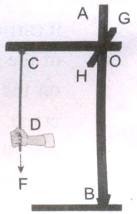
Three mutually perpendicular beams AB, OC, GH are fixed to form a structure which is fixed to the ground firmly as shown in the Figure. One string is tied to the point C and its free end D is pulled with a force F. Find the magnitude and direction of the torque produced by the force,
(i) about the points D, C, O and B
(ii) about the axis CD, OC, AB and GH.
9.
What are concurrent forces? State Lami's theorem.
10.
Convert 76 cm of mercury pressure into Nm-2 using the method of dimensions.
1.
The linear acceleration along the inclined plane can be computed by
\(a=\frac{g sin\theta}{1+\frac{K^{2}}{R^{2}}}\)
For a thin uniform circular ring, axis passing through its center is I = MR2.
\(\therefore K^{2}=R^{2} \Rightarrow \frac{K^{2}}{R^{2}}=1\)
And the angle of inclination, \(\theta=45 ^{0}\)
\(\Rightarrow (sin 45^{0}=\frac{1}{\sqrt{2}})\)
Hence, \(a=\frac{g+\frac{1}{\sqrt{2}}}{1+1}\)
\(a=\frac{g}{2\sqrt{2}}\)ms-2.
2.
.png)
For both persons, the Kinematic equations are the same, with u=0,ac =g and amoon =\(g\over 6\)
ae = g and am =\(g\over 6\)
For a person on earth, Vearth = \(\sqrt{2gh}=\sqrt{2\times 10\times 100}\)
Hence, Vearth =\(\sqrt{2000} ms^{-1}\) gives the velocity at the ground, on earth.
Similarly, for a person on the moon,
Vearth =\(\sqrt{2gh\over6}={\sqrt{2000}\over \sqrt{6}}ms^{-1}\)
The person on earth reaches ground with greater velocity than the person on the moon.
3.
(i) Parallel axis theorem states that the moment of inertia of a body about any axis is equal to the sum of its moment of inertia about a parallel axis through its center of mass and the product of the mass of the body and the square of the perpendicular distance between the two axes.
(ii) If IC is the moment of inertia of the body of mass M about an axis passing through the center of mass, then the moment of inertia I about a parallel axis at a distance d from it is given by the relation,
I = IC + Md2
(iii) Let us consider a rigid body as shown in Figure. Its moment of inertia about an axis AB passing through the center of mass is IC DE is another axis parallel to AB at a perpendicular distance d from AB. The moment of inertia of the body about DE is I. We attempt to get an expression for I in terms of IC For this, let us consider a point mass m on the body at position x from its center of mass.
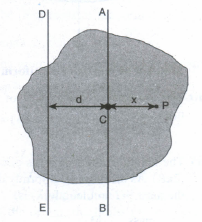
(iv) The moment of inertia of the point mass about the axis DE is, m(x + d)2. The moment of inertia I of the whole body about DE is the summation of the above expression.
\(I=\sum { m\left( x+d \right) ^{ 2 } } \)
This equation could further be written as,
\(I=\sum { m\left( { x }^{ 2 }+{ d }^{ 2 }+2xd \right) } \)
\(I=\sum { \left( { mx }^{ 2 }+m{ d }^{ 2 }+2dmx \right) } \)
\(I=\sum { { mx }^{ 2 }+\sum { m{ d }^{ 2 } } +2d\sum { mx } } \)
(v) Here, \(\sum { mx^{ 2 } } \) is the moment of inertia of the body about the center of mass. Hence,
IC = \(\sum { mx= } 0\) because, x can take positive and negative values with respect to the axis AB. The summation \(\left( \sum { mx } \right) \) will be zero.
Thus, I = Ic + \(\sum { md^{ 2 } } \) = IC + \(\left( \sum { m } \right) d^{ 2 }\)
(vi) Here, \(\sum { m } \) is the entire mass M of the object \(\left( \sum { m=M } \right) \)
I = IC + Md2
Hence the parallel axis theorem is proved.
4.
Work-Kinetic Energy Theorem
Work and energy are equivalents. This is true in the case of kinetic energy also. To prove this, let us consider a body of mass m at rest on a frictionless horizontal surface.
The work (W) done by the constant force (F) for a displacement (s) in the same direction is,
W = Fs
The constant force is given by the equation,
F = ma
The third equation of motion can be written as,
\(v^{2} =u^{2}+2 a s \)
\(a =\frac{v^{2}-u^{2}}{2 s}\)
Substituting for a in equation (2),
\(F=m\left(\frac{v^{2}-u^{2}}{2 s}\right)\)
Substituting equation (2), (1)
\(w=m\left(\frac{v^{2}}{2 s} s\right)-m\left(\frac{u^{2}}{2 s} s\right) \)
\(w=\frac{1}{2} m v^{2}-\frac{1}{2} m u^{2}\)
The expression for kinetic energy:
The term \(\left(\frac{1}{2} m v^{2}\right)\) in the above equation is the kinetic energy of the body of mass (m) moving with velocity(v).
\(K E=\frac{1}{2} m v^{2}\)
Kinetic energy of the body is always positive. From equations (4) and (5)
\(\Delta K E =\frac{1}{2} m v^{2}-\frac{1}{2} m u^{2} \)
\(\text {Thus, } W =\Delta K E\)
The expression on the right hand side (RHS) of equation (6) is the change in kinetic energy (\(\Delta\)KE) of the body.
This implies that the work done by the force on the body changes the kinetic energy of the body, This is called work-kinetic energy theorem.
The work-kinetic energy theorem implies the following.
1. If the work done by the force on the body is positive then its kinetic energy increases.
2. If the work done by the force on the body is negative then its kinetic energy decreases.
3. If there is no work done by the force on the body then there is no change in its kinetic energy, which means that the body has moved at constant speed provided its mass remains constant.
5.
(i) One of the important applications is suitcases with rolling on coasters. Rolling wheels makes it easier than carrying luggage.
(ii) When an object moves on a surface, essentially it is sliding on it. But wheels move on the -surface through rolling motion.
(iii) In rolling motion when a wheel moves on a surface, the point of contact with surface is always at rest.
(iv) Since the point of contact is at rest, there is no relative motion between the wheel and surface. Hence the frictional force is very less. At the same time if an object moves without a wheel, there is a relative motion between the object and the surface.
(v) As a result frictional force is larger. This makes it difficult to move the object.
(vi) Ideally in pure rolling, motion of the point of contact with the surface should be at rest, but in practice it is not so.
(vii) Due to the elastic nature of the surface at the point of contact there will be some deformation on the object at this point on the wheel or surface.
(viii) Due to this deformation, there will be minimal friction between wheel and surface. It is called 'rolling friction'. In fact, 'rolling friction' is much smaller than kinetic friction.
6.
Scalar product:
Scalar product or dot product of two vectors in defined as the product of the magnitudes of both the vectors and the cosine of the angle between them.
If \(\vec{A}\) and \(\vec{B}\) are two vector having an angle \(\theta\) between them, then \(\vec{A} \vec{B}=A B \cos \theta\) where A and B are magnitudes of \(\vec{A}\) and \(\vec{B}\) .
Example: work, energy and electric flux.
Properties:
1. \(\vec{A}\).\(\vec{B}\) is always a scalar. It is positive if \(\theta\)<90 and it is negative if \(90^{\circ}<\theta<180^{\circ}\)
2. When the vectors are parallel, \(\theta=0^{\circ} \ and \ \cos 0^{\circ}=1 \therefore(\vec{A} \cdot \vec{B})_{\text {mat }}=A B\).
3. When the vectors are anti-parallel, \(\theta=180^{\circ}\ and \ \cos 180^{\circ}=-1 \therefore(\vec{A} \cdot \vec{B})_{\min }=-A B\)
4. When the vectors are perpendicular to each other, \(\theta=90^{\circ}\ and \ \cos 90^{\circ}=0\therefore \vec{A} \vec{B}=0\).
5. Scalar product is commutative i.e, \(\vec{A} \cdot \vec{B}=\vec{B} \cdot \vec{A}\)
6. It obeys distributive law i.e., \(\vec{A} \cdot(\vec{B}+\vec{C})=\vec{A} \cdot \vec{B}+\vec{A} \cdot \vec{C}\)
7. Self dot product is given by \(\vec{A} \cdot \vec{A}=A A \cos \theta=A^{2}, \ here\ \theta=0^{\circ}\). The magnitude of the vector \(\vec{A}\ is \ (\vec{A})=A=\sqrt{\vec{A} \cdot \vec{A}}\)
8. In the case of orthogonal unit vectors \(\vec{i}, \vec{j} \ and \ \vec{k}\)
\(\hat{i} \hat{j}=\hat{j} \hat{j}=\hat{k} \cdot \hat{k}=1 \text { and } \)
\(\vec{i} \cdot \vec{j}=\hat{j} \hat{k}=\hat{k} \hat{i}=0\)
9. The angle between the vectors \(\theta=\cos ^{-1}\left[\frac{\vec{A} \cdot \vec{B}}{A B}\right]\)
10. In terms of components,
\(\vec{A} \cdot \vec{B} =\left(A_{x} \hat{i}+\mathrm{A}_{y} \hat{j}+A_{z} \hat{k}\right)\left(B_{x} \hat{i}+\mathrm{B}_{y} \hat{j}+B_{z} \hat{k}\right) \)
\(=A_{x} B_{x}+A_{y} B_{y}+A_{i} B_{z} \text {, with all other terms zero. }\)
The magnitude of A is given by \(|\vec{A}|=A=\sqrt{A_{x}^{2}+A_{y}^{2}+A_{2}^{2}}\) and \(|\vec{B}|=B=\sqrt{B_{x}^{2}+B_{y}^{2}+B_{2}^{2}}\) Vector product:
The vector product or cross product of two vectors is defined as another vector having a magnitude equal to the product of the magnitudes of two vectors and the sine of the angle between them.
If \(\vec{A}\) and \(\vec{B}\) are two vectors, then \(\vec{A} \times \vec{B}=\vec{C}=(A B \sin \theta) \hat{n}\).
The direction \(\hat{n}\ of \ \vec{A} \times \vec{B}\) is perpendicular to the plane containing the vectors \(\vec{A}\) and \(\vec{B}\) and is determined by the right hand screw rule or right hand thumb rule.
Example: Torque \(\tau=\vec{r} \times \vec{F}\) and Angular momentum \(\vec{L}=\vec{r} \times \vec{p}\)
Properties:
1. The resultant of the vector product is always another vector whose direction is perpendicular to the plane containing these two vectors \(\vec{A}\) and \(\vec{B}\) even though the vectors \(\vec{A}\) and \(\vec{B}\) may or may not be mutually orthogonal.
2. It is not commutative. \(\vec{A} \times \vec{B} \neq \vec{B} \times \vec{A}\). But \(\vec{A} \times \vec{B}=-[\vec{B} \times \vec{A}]\)
3. When the vectors \(\vec{A}\) and \(\vec{B}\) are orthogonal to each other the vector product will have maximum magnitude as \(\theta=90^{\circ}\ and \ \sin \theta=1\).
\((\vec{A} \times \vec{B})_{\max }=A B \hat{n}\)
4. The vector product of two non-zero vectors will be minimum when (sin \(\theta\))=0, i.e., \(\theta=0^{\circ} \ or \ 180^{\circ}(\vec{A} \times \vec{B})_{\min }=0\).
It means that the vector product of two non-zero vectors vanishes if the vectors are parallel or anti parallel.
5. The self-cross product is a null vector. \(\vec{A} \times \vec{A}=A A \sin 0^{\circ} \hat{n}=\overrightarrow{0}\)
6. The self-vector products of unit vectors are then zero \(\hat{i} \times \hat{i}=\hat{j} \times \hat{j}=\hat{k} \times \hat{k}=0\).
7. In the case of orthogonal unit vectors, \(\vec{i}, \vec{j} \ and \ \hat{k}\)
\(\hat{i} \times \hat{j}=\hat{k}, \hat{j} \times \hat{k}=\hat{i} \ and \ \hat{k} \times \hat{i}=\hat{j}\) and
\(\hat{j} \times \hat{i}=-\hat{k}, \hat{k} \times \hat{j}=-\hat{i} \ and \ \hat{i} \times \hat{k}=-\hat{j}\)
8. In terms of components,
\(\vec{A} \times \vec{B}=\left|\begin{array}{ccc}
\hat{i} & \hat{j} & \hat{k} \\
A_{x} & A_{y} & A_{z} \\
B_{x} & B_{y} & B_{z}
\end{array}\right|=\begin{array}{r}
+\hat{i}\left(A_{y} B_{z}-A_{z} B_{y}\right) \\
+\hat{j}\left(A_{z} B_{x}-A_{x} B_{z}\right) \\
+\hat{k}\left(A_{0} B_{y}-A_{z} B_{x}\right)
\end{array}\)
9. If two vectors \(\vec{A}\) and \(\vec{B}\) form adjacent sides of a parallelogram, then magnitude \((\vec{A} \times \vec{B})\) is equal to the area of the parallelogram.
10. If two vectors \(\vec{A}\) and \(\vec{B}\) are represented by the two sides of a triangle taken in order, then the area of the triangle is equal to \(\frac{1}{2}|\vec{A} \times \vec{B}|\)
7.
8.
(i) Torque about point D is zero. (as F passes through D).
Torque about point C is zero. (as F passes through C).
Torque about point O is \((\overrightarrow {OC})\times \overrightarrow{F}\) and direction is along GH.
Torque about point B is \((\overrightarrow {BD})\times \overrightarrow{F}\) and direction is along GH.
(The perpendicular distance of \(\overrightarrow {BD}\) with respect to \(\overrightarrow {F}\) is \(\overrightarrow {OC}\).
(ii) Torque about axis CD is zero (as F is parallel to CD).
Torque about axis OC is zero (as F intersects OC).
Torque about axis AB is zero (as F is parallel to AB).
Torque about axis GH is \((\overrightarrow {OC})\times \overrightarrow{F}\) and direction is along GH.
9.
A collection of forces is said to be concurrent, if the lines of forces act at a common point. Concurrent forces need not be in the same plane. If they are in the same plane, they are concurrent as well as coplanar forces.
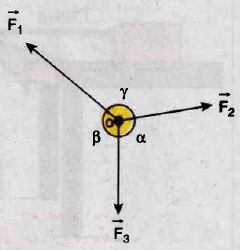
A body, under the action of concurrent forces, is said to be in equilibrium, when there is no change in the state of rest or of uniform motion along a straight line.
The necessary condition for the equilibrium of a body under the action of concurrent forces is that the vector sum of all the forces acting on the body must be zero.
Lami's Theorem: For concurrent forces \(\frac { { F_{ 1 } } }{ sin\ \alpha } =\frac { { F_{ 2 } } }{ sin \ \beta } =\frac { { F_{ 3 } } }{ sin\ \gamma } \). If a system of three concurrent and coplanar forces is in equilibrium, then Lami's theorem states that the magnitude of each force of the system is proportional to sine of the angle between the other two forces. The constant of proportionality is same for all three forces.
10.
In cgs system 76 cm of mercury pressure = 76\(\times\)13.6\(\times\)980 dyne cm-2
The dimensional formula of pressure P is [ML-1T-2]; so P1 [M1a L1b T1c ]= P2[M2a L2bT2c]
We have P2 = P1 \([{M_1\over M_2}]^a[{L_1\over 2}]^b[{T_1\over T_2} ]^c\)
M1 = 1g, M2 =1kg
L1 = 1 cm, L2 = 1m
T1 = 1 s, T2 = 1s
So, a = 1, b = -1, and c =-2
Then, P1 = 76\(\times\)13.6\(\times\)980
\([{1g\over 1kg}]^1[{1cm\over 1m}]^{-1}[{1s\over 1s}]^{-1}=76\times13.6\times980[{10^{-3}kg\over 1kg}]^1[{10^{-2}m\over1m}]^{-1}[{1s\over 1s}]^{-2}\)
= 76\(\times\)13.6\(\times\)980\(\times\)[10-3]\(\times\)102
P2 = 1.01\(\times\)105 Nm-2

11th Standard Syllabus & Materials
11th Standard
TN 11th Tamil பீடு பெற நில் - செய்யுள் - காவடிச்சிந்து Important Questions And Answers Study Material - QB365 Set A
NEW11th Standard
TN 11th Tamil பீடு பெற நில் - உரைநடை - மலை இடப்பெயர்கள் : ஓர் ஆய்வு Important Questions And Answers Study Material - QB365 Set A
NEW11th Standard
TN 11th Tamil மாமழை போற்றுதும் - துணைப்பாடம் - யானை டாக்டர் Important Questions And Answers Study Material - QB365 Set A
NEW11th Standard
TN 11th Tamil மாமழை போற்றுதும் - செய்யுள் - ஐங்குறுநூறு Important Questions And Answers Study Material - QB365 Set A



Tamilnadu Stateboard 11th Standard Subjects

Maths

Commerce

Economics

Biology

Business Maths and Statistics

Accountancy

Computer Science
Physics

Chemistry
Maths
Biology
Economics
Physics
Chemistry

History
Business Maths and Statistics

Computer Science
Accountancy

Computer Applications
History
Computer Technology
Commerce
Computer Applications
Computer Technology

Tamil

English

French
Tamilnadu Stateboard Standards

