
 100% FREE ACCESS
11th Standard Syllabus & Materials
11th Standard
TN 11th Tamil இயற்கை வேளாண்மை,சுற்றுச்சூழல் -செய்யுள் - மனோன்மணீயம் Important Questions And Answers Study Material - QB365 Set A
NEW11th Standard
TN 11th Tamil என்னுயிர் என்பேன் -துணைப்பாடம் - இசைத்தமிழர் இருவர் Important Questions And Answers Study Material - QB365 Set A
NEW11th Standard
TN 11th Tamil மொழி கலை -செய்யுள் - ஒவ்வொரு புல்லையும் Important Questions And Answers Study Material - QB365 Set A
NEW11th Standard
TN 11th Tamil பீடு பெற நில் - இலக்கணம் - பகுபத உறுப்புகள் Important Questions And Answers Study Material - QB365 Set A
NEW11th Standard
TN 11th Tamil பீடு பெற நில் - துணைப்பாடம் - வாடிவாசல் Important Questions And Answers Study Material - QB365 Set A
NEW11th Standard
TN 11th Tamil பீடு பெற நில் - செய்யுள் - குறுந்தொகை Important Questions And Answers Study Material - QB365 Set A

Published on: 21/09/2019
Download Tamil Nadu 11th Standard Physics question papers, model tests, one-mark questions, important questions, and public exam papers in PDF format. Free study materials and answer keys for TN State Board students.
Questions + Answers key
Take MCQ Physics Test1.
The ratio of the acceleration for a solid sphere (mass m and radius R) rolling down an incline of angle \(\theta\) without slipping and slipping down the incline without rolling is,
5: 7
2: 3
2: 5
7: 5
2.
If the linear momentum of the object is increased by 0.1% then the kinetic energy is Increased by
0.1 %
0.2 %
0.4 %
0.01 %
3.
Two masses m1 and m2 are experiencing the same force where m1 < m2.The ratio of their acceleration \(\frac { { a }_{ 1 } }{ { a }_{ 2 } } \) is _____________.
1
less than 1
greater than 1
all the three cases
4.
If a particle has negative velocity and negative acceleration, its speed
increases
decreases
remains same
zero
5.
If the error in the measurement of radius is 2%, then the error in the determination of volume of the sphere will be
8%
2%
4%
6%
6.
A body of mass 10 kg at rest is subjected to a force of 16N. Find the kinetic energy at the end of 10 s.
7.
A lighter particle moving with a speed of 10 ms-1 collides with an object of double its mass moving in the same direction with half its speed. Assume that the collision is a one dimensional elastic collision. What will be the speed of both particles after the collision?
8.
The position vector for a particle is represented be \(\vec r=3t^2\hat i+5t\hat j+6\hat k\), find tht velocity and speed of the particle at t = 3 sec?
9.
The velocity of three particles A, B, C are given below. Which particle travels at the greatest speed?
\(\vec {v_A}=3\hat i+5\hat j+2\hat k\)
\(\vec {V_B}=\hat i+2\hat j+3\hat k\)
\(\vec{V_C}=5\hat i+3\hat j+4\hat k\)
10.
State principle of moments
11.
Write the differences between conservative and Non-conservative forces. Give two examples each.
12.
Convert the vector \(\vec { r } =3\hat { i } +2\hat { j } \) into a unit vector.
13.
What are the limitations of dimensional analysis?
14.
The coefficient of friction between a block and plane is \(\frac { 1 }{ \sqrt { 3 } } \). If the inclination of the plane gradually increases, at what angle will the object begin to slide?
15.
Compare the components of vector equation \(\vec F_1+\vec F_2+\vec F_3=\vec F_4\)
16.
State the number of significant figures in the following 600800
17.
What is the difference between sliding and slipping?
18.
What is meant by Range of time scales.
19.
What are inertial frames?
20.
Why dimensional methods are applicable only up to three quantities?
21.
Define a radian?
22.
Explain the types of equilibrium with suitable examples?
23.
State Newton's three laws and discuss their significance.
24.
1.
Acceleration of the solid sphere while rolling down without slipping
\(a_{1}=\frac{g \sin \theta}{1+\frac{k^{2}}{r^{2}}}\)
Acceleration developed while slipping down \(a_{2}=g \sin \theta\)
\(\text { Required ratio } \frac{a_{1}}{a_{2}}=\frac{g \sin \theta}{1+\frac{k^{2}}{r^{2}}} / g \sin \theta\)
\(\frac{a_{1}}{a_{2}}=\frac{1}{1+\frac{k^{2}}{r^{2}}}\)
\(\text { For a solid sphere } \frac{k^{2}}{r^{2}}=\frac{2}{5}\)
\(\therefore \text { Ratio of accelerations } \frac{a_{1}}{a_{2}}=\frac{1}{1+\frac{2}{5}}\)
\(=\frac{1}{5+\frac{2}{5}}=\frac{1}{\frac{7}{5}}=\frac{5}{7}\)
\(\therefore a_{1}: a_{2}=5: 7 \)
2.
\(\text { Kinetic energy } E_{k}=\frac{p^{2}}{2 m}\)
\(\frac{\Delta E_{k}}{E_{k}}=\frac{2 \Delta p}{p}\)
\(\text {Given that } \frac{\Delta p}{p}=0.1\)
∴ Increase in kinetic energy
\(\frac{\Delta E_{k}}{E_{k}}=2 \frac{\Delta p}{p} \)
\(\frac{\Delta E_{k}}{E_{k}}=2 \times 0.1=0.2 \% \)
3.
(c)
greater than 1
4.
Velocity and acceleration are in the same direction: So speed increases.
5.
\(\text { Error in radius }=2 \%\)
\(\Delta r=\frac{2}{100}=0.02\)
\(\text {Volume of the sphere }=\frac{4}{3} \pi r^{3}\)
\(V =\frac{4}{3} \pi r^{3} \)
\(\frac{d V}{V} =\frac{4}{3} \pi \times 3 r^{2} d r \)
\(=3 d r=3(2 \%)=6 \%\)
6.
Mass m = 10 kg
Force F = 16 N
time t = 10 s
\(a=F/m=\frac { 16N }{ 10 \ kg } =1.6 \ ms^{ -2 }\)
We know that, v = u + at = 0 + 1.6 \(\times\) 10 = 16 ms-1
Kinetic energy K.E = \(\frac { 1 }{ 2 } { mv }^{ 2 }=\frac { 1 }{ 2 } \times 10\times 16\times 16=1280\ J\)
7.
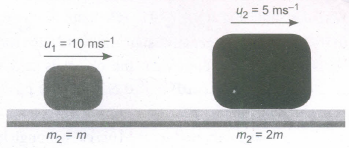
Let the mass of the first body be m which moves with an initial velocity, u1 = 10 m s-1.
Therefore, the mass of second body is 2m and its initial velocity is \({ u }_{ 2 }=\frac { 1 }{ 2 } { u }_{ 1 }=\frac { 1 }{ 2 } (10{ ms }^{ -1 })\)
\({ v }_{ 1 }=\left( \frac { { m }_{ 1 }-{ m }_{ 2 } }{ { m }_{ 1 }+{ m }_{ 2 } } \right) { u }_{ 1 }+\left( \frac { 2m }{ { m }_{ 1 }+{ m }_{ 2 } } \right) { u }_{ 2 }\)
\({ v }_{ 1 }=\left( \frac { { m }_{ 1 }-2m }{ m+2m } \right) +10+\left( \frac { 2\times 2m }{ m+2m } \right) 5\)
\({ v }_{ 1 }=-\left( \frac { 1 }{ 3 } \right) 10+\left( \frac { 4 }{ 3 } \right) 5=\frac { -10+20 }{ 3 } =\frac { 10 }{ 3 } \)
v1 = 3.33 ms-1
\({ v }_{ 2 }=\left( \frac { 2{ m }_{ 1 } }{ { m }_{ 1 }+{ m }_{ 2 } } \right) { u }_{ 1 }+\left( \frac { { m }_{ 2 }-{ m }_{ 1 } }{ { m }_{ 1 }+{ m }_{ 2 } } \right) { u }_{ 2 }\)
\({ v }_{ 2 }=\left( \frac { 2m }{ m+2m } \right) 10+\left( \frac { 2m-m }{ m+2m } \right) 5\)
\({ v }_{ 2 }=\left( \frac { 2 }{ 3 } \right) 10+\left( \frac { 1 }{ 3 } \right) 5=\frac { 20+5 }{ 3 } =\frac { 25 }{ 3 } \)
v2 = 8.33 ms-1
As the two speeds v1 and v2 are positive, they move in the same direction with the velocities 3.33 ms-1 and 8.33 ms-1 respectively.
8.
\(\vec v=\frac{\bar {dr}}{dt}=6t\hat i+5\hat j\)
The velocity at any time 't' is given by \(\vec v=6t\hat i+5\hat j\) . The magnitude of velocity is speed.
The speed at any time 't' is then given by
\(speed=\sqrt {(6t)^2+5^2}=\sqrt {6t^2+25}\)
Now the velocity at t = 3 sec is given by
\(\vec v=6(3)\hat i+5\hat j=18\hat i+5\hat j\)
and speed at t = 3 sec, is given by
\(speed=\sqrt {349}\ m/s\)
9.
We know that speed is the magnitude of the velocity vector. Hence,
Speed of A = \(|\vec{V_A}|=\sqrt{(3)^2+(-5)^2+(2)^2}=\sqrt{9+25+4}=\sqrt{48}ms^{-1}\)
Speed of B = \(\vec{V_B}=\sqrt{(1)^2+(2)^2+(3)^2}=\sqrt{1+4+9}=\sqrt{14}ms^{-1}\)
Spedd of C = \(\vec{V_C}=\sqrt{(5)^2+(3)^2+(4)^2}=\sqrt{25+9+16}=\sqrt{50}ms^{-1}\)
The particle C has the greatest speed.
\(\sqrt{50}>\sqrt{38}>\sqrt{14}\)
10.
Sum of the clockwise moments is equal to sum of the anticlockwise moments when a body is in rotational equilibrium or algebraic sum of moments at any point is zero.
11.
| S.No. | Conservative forces | Non-Conservative forces |
| 1 | Work done is independent of the path | Work done depends upon the path |
| 2 | Work done in a round trip is zero | Work done in a round trip is not zero. |
| 3 | Total energy remains constant | Energy is dissipated as heat energy |
| 4 | Work done is completely recoverable | Work done is not completely recoverable |
| 5 | Force is the negative gradient of potential energy | No such relation exists |
| 6 | Examples: Elastic spring force, electrostatic force, magnetic force, gravitational force, etc. | Eg: Frictional forces, viscous force |
12.
\(\overrightarrow { r } =3\hat { i } +2\hat { j } \)
\(\text { Unit vector } =\frac{\vec{r}}{|\vec{r}|} \)
\(|\vec{r}| =\sqrt{3^{2}+2^{2}}=\sqrt{13} \)
\(\therefore \text { Unit vector } =\frac{3 \hat{i}+2 \hat{j}}{\sqrt{13}}\)
13.
Limitations of Dimensional analysis:
(i) This method gives no information about the dimensionless constants in the formula like 1, 2,................ \(\pi\), e, etc.
(ii) This method cannot decide whether the given quantity is a vector or a scalar.
(iii) This method is not suitable to derive relations involving trigonometric, exponential and logarithmic functions.
(iv) It cannot be applied to an equation involving more than three physical quantities.
(v) It can only check on whether a physical relation is dimensionally correct but not the correctness of the relation.
For example, using dimensional analysis, s = ut + 1/3 at2 is dimensionally correct whereas the correct relation is s = ut+1/2 at2.
14.
Since the coefficient of friction is \(\frac { 1 }{ \sqrt { 3 } } \)
tanθ = \(\frac { 1 }{ \sqrt { 3 } } \) ⇒ θ=300.
15.
We can resolve all the vectors in x, y and z components with respect to Cartesian coordinate system.
Once we resolve the components we can separately equate the x components on both sides, y components on both sides, and z components on both the sides of the equation, we then get
\(F_{1x}+F_{2x}+F_{3x}=F_{4x}\)
\(F_{1y}+F_{2y}+F_{3y}=F_{4y}\)
\(F_{1z}+F_{2z}+F_{3z}=F_{4z}\)
16.
four
17.
| S.No | Sliding | Slipping |
| 1. | In sliding the transitional motion is more than rotational motion. |
In slipping the rotation is more than |
| 2. | It happens when sudden brake is applied in a moving vehicles or when the vehicle enters into a slippery road. |
It happens when we suddenly start the vehicle from rest or the vehicle is stuck in mud. |
18.
Range of time scales: astronomical scales to microscopic scales, 1018 S to 10-22s.
19.
(a) A frame of reference which is at rest or which is moving with a uniform velocity along a straight line is called an inertial frame of reference.
(b) In the inertial frame of reference Newton's laws of motion holds good.
Example: The lift at rest, lift moving (up or down) with constant velocity, car moving with constant velocity on a straight road.
20.
If a quantity depends on more than three factors having dimensional formula cannot be derived. Because on equating the powers of M, L & T on either side of the dimensional equation, three equations can be obtained, from which only three unknown dimensions can be calculated.
21.
One radian is the angle subtended at the center of a circle by an arc that is equal in length to the radius of the circle.
1 rad = \(\frac{180}{\pi}\) degree = 57.295o
22.
A body is said to be in equilibrium if both the linear momentum and angular momentum of the rigid body remain constant with time. Hence for a body in equilibrium, the linear acceleration of its centre of mass would be zero and also the angular acceleration of the rigid body about any axis would be zero.
The different types of equilibrium of a body are
1. Stable equilibrium
2. Unstable equilibrium
3. Neutral equilibrium
Equilibrium is thus stable, unstable neutral according, to whether potential energy is minimum, maximum or instant.

Let us consider the motion of a marble along a curved surface of a bowls.
If a marble M is placed on a curved surface of a bowl S it rolls down and settles in equilibrium at the lowest point A as shown in figure (a).
If the marble is disturbed and displaced at B, its energy increases. When it is released, the marble rolls back at A. Thus the marble at the portion A is said to be in stable equilibrium. In this case, the body possess minimum potential energy.
Suppose, now that bowl S is inverted and the marble is placed at its top point at A as shown in Fig (b).
If the marble is displaced slightly to the point C, its potential energy is lowered and tends to move further away from the equilibrium position to one of lowest energy. Thus the marble is said to be in unstable equilibrium.
Consider that the marble M is placed on the plane surface as shown in figure (c). If it is displaced slightly, its potential energy does not change. In this case, the marble is said to be in neutral equilibrium.
Translational equilibrium:
The resultant of all the external forces acting on the body must be zero.
\(\sum \vec{F}_{ext} =0 \ or \sum F_x=0\sum F_y=0\sum F_2=0\)
\(\sum \vec{F}_{ext} =M\vec{\alpha}_{CM}=M \frac{d\vec{v}_{CM}}{dt}=0\)
or \(\frac{d\vec{v}_{CM}}{dt}\)=0 or \(\vec{v}_{cm}\) = constant
This implies that a body in translational equilibrium, will be either at rest (v = 0) or in uniform motion. If the body is in uniform motion along a straight path, it is in dynamic equilibrium
Rotational equilibrium:
For rotational equilibrium \(\sum \vec{\tau}_{ext}=\sum \vec{r}.x\vec{F}_{ext}=0\)
If the total torque is zero about any point, then it will be zero about any other point when the body is in equilibrium
23.
i. Every object continues to be in the state of rest or of uniform motion unless there is external force acting on it.
ii. The force acting on an object is equal to the rate of change of its momentum.
iii. For every action there is an equal and opposite reaction.
Discussion:
i) Newton's laws are vector laws. The equation \(\vec{F}=\mathrm{m} \vec{a}\) can be written in cartesian coordinates as
\(\mathrm{F}_{x} \hat{\mathrm{i}}+\mathrm{f}_{\mathrm{y}} \hat{\mathrm{j}}+\mathrm{F}_{z} \hat{\mathrm{k}}=\operatorname{ma}_{x} \hat{\mathrm{i}}+\operatorname{ma}_{\mathrm{y}} \hat{\mathrm{j}}+\operatorname{ma}_{\mathrm{z}} \hat{\mathrm{k}}\)
On comparing both sides,
\(\mathrm{F}_{x}=m \mathrm{~m}_{x} \)
\(\mathrm{F}_{\mathrm{y}}=m \mathrm{ma}_{\mathrm{y}} \)
\(\mathrm{F}_{\mathrm{z}}=m \mathrm{ma}_{\mathrm{z}}\)
From the above equations, we can infer that the force acting along y direction cannot alter the acceleration along n direction. In the same way, F2 can not affect ay and an
ii) The acceleration experienced by the body at a time t depends on the force which acts on the body at that instant of time. Thus, \(\vec{F}(\mathrm{t})=\mathrm{m} \vec{a}(\mathrm{t})\)
when a bowler throws the ball to a batsman the acceleration of the ball is determined by the gravitational and air frictional forces and not by the speed which it is thrown.
iii) The direction of force may be different from the direction of force. The following motions are possible.
a) Force and motion in the same direction.
Example: Falling of an apple from the tree.
b) Force and motion are not in the same direction.
Example: The Moon experiences a force towards the Earth but Moon moves in the elliptical path.
c) Force and motion are in the opposite direction.
Example: The motion of a body thrown vertically upward.
d) Zero net force, but there is motion.
Example: The falling of rain drops.
4) If multiple forces \(\vec{F}_{1}, \vec{F}_{2}, \vec{F}_{3} \ldots\) act on the same body then total force is equal to the vectorial sum of the individual forces \(\vec{F}_{\text {net }}=\vec{F}_{1}+\vec{F}_{2}+\vec{F}_{3}+\ldots\)
5) Newton's second law can be written in the second derivative of position vector as \(\vec{F}=\mathrm{m} \frac{\mathrm{d}^{2}\overrightarrow{\mathrm{r}}}{\mathrm{dt}^{2}}\). It means that whenever the second derivative of position vector is not zero, there must be a force acting on the body.
6) If no force acts on the body then \(m \frac{d \vec{v}}{\mathrm{dt}}=0\). It implies that \(\vec{v}\) is constant. Thus second law is consistent with the first law even though they are independent to each other.
7) Newton's second law is cause and effect relation force is the cause and acceleration is effect.
24.

11th Standard Syllabus & Materials
11th Standard
TN 11th Tamil பீடு பெற நில் - செய்யுள் - காவடிச்சிந்து Important Questions And Answers Study Material - QB365 Set A
NEW11th Standard
TN 11th Tamil பீடு பெற நில் - உரைநடை - மலை இடப்பெயர்கள் : ஓர் ஆய்வு Important Questions And Answers Study Material - QB365 Set A
NEW11th Standard
TN 11th Tamil மாமழை போற்றுதும் - துணைப்பாடம் - யானை டாக்டர் Important Questions And Answers Study Material - QB365 Set A
NEW11th Standard
TN 11th Tamil மாமழை போற்றுதும் - செய்யுள் - ஐங்குறுநூறு Important Questions And Answers Study Material - QB365 Set A



Tamilnadu Stateboard 11th Standard Subjects

Maths

Commerce

Economics

Biology

Business Maths and Statistics

Accountancy

Computer Science
Physics

Chemistry
Maths
Biology
Economics
Physics
Chemistry

History
Business Maths and Statistics

Computer Science
Accountancy

Computer Applications
History
Computer Technology
Commerce
Computer Applications
Computer Technology

Tamil

English

French
Tamilnadu Stateboard Standards

