
 100% FREE ACCESS
11th Standard Syllabus & Materials
11th Standard
TN 11th Tamil இயற்கை வேளாண்மை,சுற்றுச்சூழல் -செய்யுள் - மனோன்மணீயம் Important Questions And Answers Study Material - QB365 Set A
NEW11th Standard
TN 11th Tamil என்னுயிர் என்பேன் -துணைப்பாடம் - இசைத்தமிழர் இருவர் Important Questions And Answers Study Material - QB365 Set A
NEW11th Standard
TN 11th Tamil மொழி கலை -செய்யுள் - ஒவ்வொரு புல்லையும் Important Questions And Answers Study Material - QB365 Set A
NEW11th Standard
TN 11th Tamil பீடு பெற நில் - இலக்கணம் - பகுபத உறுப்புகள் Important Questions And Answers Study Material - QB365 Set A
NEW11th Standard
TN 11th Tamil பீடு பெற நில் - துணைப்பாடம் - வாடிவாசல் Important Questions And Answers Study Material - QB365 Set A
NEW11th Standard
TN 11th Tamil பீடு பெற நில் - செய்யுள் - குறுந்தொகை Important Questions And Answers Study Material - QB365 Set A

Published on: 12/08/2019
Motion of System of Particles and Rigid Bodies
Download Tamil Nadu 11th Standard Physics question papers, model tests, one-mark questions, important questions, and public exam papers in PDF format. Free study materials and answer keys for TN State Board students.
Questions + Answers key
Take MCQ Physics Test1.
A particle undergoes uniform circular motion. About which point on the circle, will the angular momentum of the particle remain conserved?
Centre of the circle
On the circumference of the circle
Inside the circle
Outside the circle
2.
If a solid sphere and solid cylinder of same mass and radius rotate about their own axis the M.I. will be greater for _______________.
Solid sphere
Solid cylinder
Both (a) and (b)
Equal both
3.
If there is change of angular momentum from J to 4J in 4S, then the torque is _____________.
3/4 J
1J
5/4 J
4/3 J
4.
Moment of force is called _______________.
angular momentum
torque
couple
none
5.
Where will be the centre of mass on combining two masses m and M (M > m)?
Towards m
Towards M
Between m & M
away from m & M
6.
A round object of mass M and radius R rolls down without slipping along an inclined plane. The frictional force,
dissipates kinetic energy as heat
decreases the rotational motion
decreases the rotational and transnational motion
converts transnational energy into rotational energy
7.
The speed of the center of a wheel rolling on a horizontal surface is vo. A point on the rim in level with the center will be moving at a speed of,
zero
vo
\(\sqrt{2}\)vo
2vo
8.
From a disc of radius R a mass M, a circular hole of diameter R, whose rim passes through the center is cut. What is the moment of inertia of the remaining part of the disc about a perpendicular axis passing through it
15MR2/32
13MR2/32
11MR2/32
9MR2/32
9.
A rigid body rotates with an angular momentum L. If its kinetic energy is halved, the angular momentum becomes,
L
L/2
2L
L/\(\sqrt{2}\)
10.
A rope is wound around a hollow cylinder of mass 3 kg and radius 40 cm. What is the angular acceleration of the cylinder if the rope is pulled with a force 30 N?
0.25 rad s-2
25 rad s-2
5 ms-2
25 ms-2
11.
A solid sphere of mass 20 kg and radius 0.25 m rotates about an axis passing through the center. What is the angular momentum if the angular velocity is 5 rad s-1.
12.
Give an example to show that the following statement is false. 'any two forces acting on a body can be combined into single force that would have same effect'.
13.
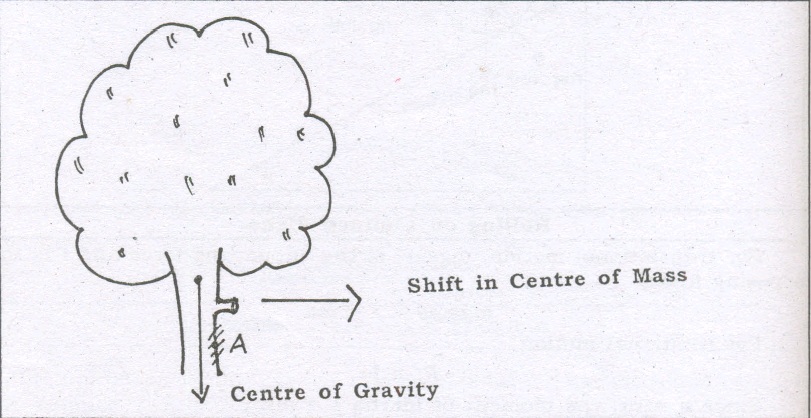
When a tree is cut, the cut is made on the side facing the direction in which the tree is required to fall. Why?
14.
Define centre of mass.
15.
What is the effect of Torque on Rigid Bodies.
16.
How will you find the direction of rotation using the direction of torque?
17.
Derive an expression for work done by Torque?
18.
Find the expression for radius of gyration?
19.
Mention any two physical significance of moment of inertia?
20.
How do you distinguish between stable and unstable equilibrium?
21.
Write an expression for the kinetic energy of a body in pure rolling.
22.
Derive the expression for moment of inertia of a uniform disc about an axis passing through the center and perpendicular to the plane.
23.
Derive the expression for moment of inertia of a rod about its center and perpendicular to the rod?
1.
(a)
Centre of the circle
2.
(b)
Solid cylinder
3.
(a)
3/4 J
4.
(b)
torque
5.
(b)
Towards M
6.
(d)
converts transnational energy into rotational energy
7.
\(v_{0}=r \omega ; \quad \therefore v_{0} \alpha r\)
For a wheel (uniform ring) the distance of a point on the rim in level with the center
\(\text { [i.e., radius] is } \sqrt{2} r\)
\(\therefore \text { The speed of the center is } \sqrt{2} v_{0}\)
8.
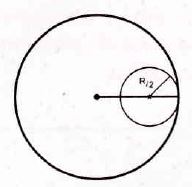
Moment of inertia of a disc
\(\mathrm{I}_{1}=\frac{M R^{2}}{2}\)
\(\text { Mass of small disc }=\frac{M}{\pi R^{2}} \times \pi \times\left(\frac{R}{2}\right)^{2}\)
\(=\frac{M}{\pi R^{2}} \times \frac{\pi R^{2}}{4}=\frac{M}{4}\)
By the theorem of parallel axis, the moment of inertia of the small disc. About an axis passing through 0 is
\(I_{2} =\frac{1}{2} \times \frac{M}{4}\left(\frac{R}{2}\right)^{2}+\frac{M}{4}\left(\frac{R}{2}\right)^{2} \)
\(=\frac{M}{8} \times \frac{R^{2}}{4}+\frac{M}{4} \times \frac{R^{2}}{4} \)
\(=\frac{M R^{2}}{32}+\frac{M R^{2}}{16}=\frac{M R^{2}+2 M R^{2}}{32} \)
\(I_{2} =\frac{3 M R^{2}}{32} \)
Moment of inertia of the remaining part is I= I1 - I2
\(=\frac{M R^{2}}{2}-\frac{3 M R^{2}}{32} \)
\(=\frac{16 M R^{2}-3 M R^{2}}{32}=\frac{13 M R^{2}}{32}\)
\(I =\frac{13 M R^{2}}{32} \)
9.
\(K \cdot E=\frac{1}{2} I \omega^{2} ; \quad L=I \omega ; \quad K \cdot E=\frac{2^{2}}{2^{2}} \)
\(\therefore K \cdot E \alpha L^{2} \quad E_{1} \alpha L_{1}^{2} \quad E_{2} \alpha L_{2}^{2}\)
\(\frac{E_{1}}{E_{2}}=\left(\frac{L_{1}}{L_{2}}\right)^{2} \)
\(\text { Here } E_{1}=E \quad E_{2}=\frac{E}{2} \)
\(L_{1}=L \quad \quad L_{2}=? \)
\(\frac{E}{\frac{E}{2}}=\left(\frac{L}{L_{2}}\right)^{2} \)
\(\frac{2 E}{E}=\left(\frac{L}{L_{2}}\right)^{2}\left(\frac{L_{1}}{L_{2}}\right)^{2}=2 \)
\(\therefore \frac{L}{L_{2}}=\sqrt{2} \)
\(L_{2}=\frac{L}{\sqrt{2}} \)
10.
\(m=3 \mathrm{~kg} \quad r=40 \times 10^{-2} \mathrm{~m}=0.4 \mathrm{~m}\)
\(\text { Force }=30 N\)
Moment of inertia of a hollow-cylinder I= MR2
\(=3 \times\left(40 \times 10^{-2}\right)^{2} \)
\(=3 \times 0.4 \times 0.4=0.48 \mathrm{kgm}^{2} \)
\( F R =I \alpha \)
\(30 \times 40 \times 10^{-2}=0.48 d \)
\(d=\frac{12}{0.48}=\frac{1200}{48}=25 \mathrm{rad} \mathrm{s}^{-2} \)
\(\alpha=25 \mathrm{rad} \mathrm{s}^{-2} \)
11.
Mass of the sphere, m = 20 kg
Radius r = 0.25 m
Angular velocity 0 = 5 rad s-1
Angular momentum \(L=I\omega =\frac{2}{5} mr^{2}\omega\)
\(=\frac{2}{5}\times 20 \times (0.25)^{2}\times 5 = 40 \times (0.0625)=2.5\)
L = 2.5 kg m2 s-1.
12.
Lifting a table from the floor by two persons. Pushing the car by two persons.
13.
The weight of tree exerts a torque about the point where the cut is made. This causes rotation of the tree about the cut has to be made at say point A to weaken the tree trunk and to shift the centre of mass to the right and eventually move towards the ground on the right.
14.
The centre of mass of a body is defined as a point where the entire mass of the body appears to be concentrated.
15.
(i) A rigid body which has non-zero. external torque (ፒ) about the axis of rotation would have an angular acceleration (α) about that axis.
(ii) The scalar relation between the torque and angular acceleration is,
ፒ=Iα
where, I is the moment of inertia of the rigid body. The torque in rotational motion is equivalent to the force in linear motion.
16.
The direction of torque helps us to find the type of rotation caused by the torque. For example, if the direction of torque is out of the paper, then the rotation produced by the torque is anticlockwise. On the other hand, if the direction of the torque is into the paper, then the rotation is clockwise.
17.
(i) Consider a rigid body rotating about a fixed axis. A point the body rotating about an axis perpendicular to the plane of the page. A tangential force F is applied on the body.
(ii) It produces a small displacement ds on the body. The work done (dw) by the force is,
dw=Fds
(iii) As the distance ds, the angle of rotation d\(\theta\) and radius r are related by the expression
ds=r d\(\theta\)
The expression for work done now becomes,
dw=F ds; dw=F r d\(\theta\)
(iv) The term (Fr) is the torque ፒ produced by the force on the body.
dw=\(\tau\)d\(\theta\)
This expression gives the work done by the external torque ፒ, which acts on the body rotating about a fixed axis through an angle d\(\theta\).
18.
(i) A rotating rigid body with respect to any axis, is considered to be made up of point masses m1, m2, m3, ... mn at perpendicular distances (or positions) r1, r2, r3....rn respectively.
(ii) The moment of inertia of that object can be written as,
I=\(\sum { { m }_{ i }{ r }_{ i }^{ 2 } } ={ m }_{ 1 }{ r }_{ 1 }^{ 2 }+{ m }_{ 2 }{ r }_{ 2 }^{ 2 }+{ m }_{ 3 }{ r }_{ 3 }^{ 2 }+....+{ m }_{ n }{ r }_{ n }^{ 2 }\)
If all the n number of individual masses to be equal,
m=m1=m2=m3=....=mn
then,
I=\({ mr }_{ 1 }^{ 2 }+{ mr }_{ 2 }^{ 2 }+{ mr }_{ 3 }^{ 2 }+...+{ mr }_{ n }^{ 2 }\)
=\(m({ r }_{ 1 }^{ 2 }+{ r }_{ 2 }^{ 2 }+{ r }_{ 3 }^{ 2 }+...+{ r }_{ n }^{ 2 })\)
=\(nm\left( \frac { { r }_{ 1 }^{ 2 }+{ r }_{ 2 }^{ 2 }+{ r }_{ 3 }^{ 2 }+...+r_{ n }^{ 2 } }{ n } \right) \)
I=MK2
where, nm is the total mass M of the body and K is the radius of gyration.
K=\(\sqrt { \frac { { r }_{ 1 }^{ 2 }+{ r }_{ 2 }^{ 2 }+{ r }_{ 3 }^{ 2 }+...+{ r }_{ n }^{ 2 } }{ n } } \)
(iii) The expression for radius of gyration indicates that it is the root mean square (rms) distance of the particles of the body from the axis of rotation.
19.
1. Greater the mass concentrated away from the axis, greater the moment of inertia.
2. Moment of inertia of a body about an axis of rotation resists a change in it. In rotational motion, moment of inertia increases with increase in torque to change it's rotation.
20.
| Stable equilibrium | Unstable equilibrium |
| The body tries to come back to equilibrium if slightly disturbed and released. | The body cannot come back to equilibrium if slightly disturbed and released. |
| The center of mass of the body shifts slightly higher if disturbed from equilibrium. | The center of mass of the body shifts slightly lower if disturbed from equilibrium. |
| Potential energy of the body is minimum and it increases if disturbed. | Potential energy of the body is not minimum and it decreases if disturbed. |
21.
(i) The total kinetic energy (KE) can be written as the sum of kinetic energy due to translational motion (KETRANS) and kinetic energy due to rotational motion (KEROT)
KE = KETRANS + KEROT
(ii) If the mass of the rolling object is M, the velocity of center of mass is vCM its moment of inertia about center of mass is ICM and angular velocity is ω, then
KE = \(\frac { 1 }{ 2 } Mv^{ 2 }_{ CM }+\frac { 1 }{ 2 } { I }_{ CM }\omega ^{ 2 }\)
(iii) With center of mass as reference:
The moment of inertia (lCM) of a rolling object about the center of mass is,
ICM= MK2 and vCM= Rω. Here, K is radius of gyration.
\(KE=\frac { 1 }{ 2 } Mv^{ 2 }_{ CM }+\frac { 1 }{ 2 } \left( MK^{ 2 } \right) \frac { v^{ 2 }_{ CM } }{ R^{ 2 } } \\ \\ \)
\(KE=\frac { 1 }{ 2 } Mv^{ 2 }_{ CM }+\frac { 1 }{ 2 } Mv^{ 2 }_{ CM }\left( \frac { { K }^{ 2 } }{ R^{ 2 } } \right) \)
\(KE=\frac { 1 }{ 2 } Mv^{ 2 }_{ CM }\left( 1+\frac { K^{ 2 } }{ R^{ 2 } } \right) \)
(iv) With point of contact as reference: We can also arrive at the same expression by taking the momentary rotation happening with respect to the point of contact (another approach to rolling). if we take the point of contact as 0, then,
\(KE=\frac { 1 }{ 2 } { I }_{ 0 }\omega ^{ 2 }\)
Here, Io is the moment of inertia of the object about the point of contact. By parallel axis theorem, Io = ICM+ MR2. Further we can write, Io = MK2 + MR2. With vCM= Rω or
\(\omega =\frac { { v }_{ CM } }{ R } \)
\(KE=\frac { 1 }{ 2 } \left( MK^{ 2 }+MR^{ 2 } \right) \frac { v^{ 2 }_{ CM } }{ { R }^{ 2 } } \)
\(KE=\frac { 1 }{ 2 } Mv^{ 2 }_{ CM }\left( 1+\frac { { K }^{ 2 } }{ R^{ 2 } } \right) \)
(vi) K.E. in pure rolling can be determined by anyone of the following two cases.
(a) The combination of translational motion and rotational motion about the center of mass. (or)
(b) The momentary rotational motion about the point of contact.
22.
Consider a disc of mass M and radius R. This disc is made up of many infinitesimally small rings as shown in Figure. Consider one such ring of mass (dm) and thickness (dr) and radius (r). The moment of inertia (dI) of this small ring is,
dI = (dm)r2
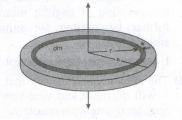
Moment of inertia of a uniform disc
As the mass is uniformly distributed, the mass per unit area (\(\alpha\)) is, \(\alpha=\frac{mass}{area}=\frac{M}{\pi R^2}\)
(iii) The mass of the infinitesimally small ring is,
dm = \(\alpha\)2\(\pi\)rdr = \(\frac { M }{ \pi R^{ 2 } } \) 2\(\pi\)rdr
where, the term (2\(\pi\)rdr) is the area of this elemental ring (2\(\pi\)r is the length and dr is the thickness) dm = \(\frac{2M}{R^2}rdr\)
dI = \(\frac{2M}{R^2}r^3dr\)
The moment of inertia (I) of the entire disc is,
\(I=\int { dI } \)
\(I=\int _{ 0 }^{ R }{ \frac { 2M }{ { R }^{ 2 } } } { r }^{ 3 }dr=\frac { 2M }{ R^{ 2 } } \int _{ 0 }^{ R }{ r^{ 3 }dr } \)
\(I=\frac { 2M }{ R^{ 2 } } \left[ \frac { { r }^{ 4 } }{ 4 } \right] ^{ R }_{ 0 }=\frac { 2M }{ R^{ 2 } } \left[ \frac { { R }^{ 4 } }{ 4 } -0 \right] \)
\(I=\frac { 1 }{ 2 } MR^{ 2 }\)
23.
Let us consider a uniform rod of mass (M) and length (1) as shown in Figure. Let us find an expression for moment of inertia of this rod about an axis that passes through the center of mass and perpendicular to the rod. First an origin is to be fixed for the coordinate system so that it coincides with the center of mass, which is also the geometric center of the rod. The rod is now along the x axis. We take an infinitesimally small mass (dm) at a distance (x) from the origin. The moment of inertia (dI) of this mass (dm) about the axis is,
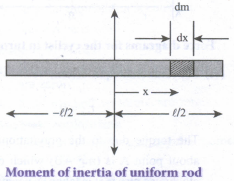
dI = (dm) x2
As the mass is uniformly distributed, the mass per unit length (λ) of the rod is, \(\lambda =\frac { M }{ l } \)
The (dm) mass of the infinitesimally small length as, dm = λ dx = \(\frac { M }{ l } dx\)
The moment of inertia (I) of the entire rod can be found by integrating dI,
\(I=\int { dI } =\int { \left( dm \right) { x }^{ 2 } } =\int { \left( \frac { M }{ l } dx \right) { x }^{ 2 } } \)
\(I=\frac { M }{ l } \int { { x }^{ 2 }dx } \)
As the mass is distributed on either side of the origin, the limits for integration are taken from -1/2 to 1/2.
\(I=\frac { M }{ l } \int _{ -t/2 }^{ t/2 }{ { x }^{ 2 }dx=\frac { M }{ l } } \left[ \frac { { x }^{ 3 } }{ 3 } \right] ^{ t/2 }_{ -t/2 }\)
\(I=\frac { M }{ l } \left[ \frac { { l }^{ 3 } }{ 24 } -\left( -\frac { { l }^{ 3 } }{ 24 } \right) \right] =\frac { M }{ l } \left[ \frac { { l }^{ 3 } }{ 24 } +\frac { { l }^{ 3 } }{ 24 } \right] \)
\(I=\frac { M }{ l } \left[ 2\left( \frac { { l }^{ 3 } }{ 24 } \right) \right] \)
I = \(\frac { 1 }{ 12 } \) ml2

11th Standard Syllabus & Materials
11th Standard
TN 11th Tamil பீடு பெற நில் - செய்யுள் - காவடிச்சிந்து Important Questions And Answers Study Material - QB365 Set A
NEW11th Standard
TN 11th Tamil பீடு பெற நில் - உரைநடை - மலை இடப்பெயர்கள் : ஓர் ஆய்வு Important Questions And Answers Study Material - QB365 Set A
NEW11th Standard
TN 11th Tamil மாமழை போற்றுதும் - துணைப்பாடம் - யானை டாக்டர் Important Questions And Answers Study Material - QB365 Set A
NEW11th Standard
TN 11th Tamil மாமழை போற்றுதும் - செய்யுள் - ஐங்குறுநூறு Important Questions And Answers Study Material - QB365 Set A



Tamilnadu Stateboard 11th Standard Subjects

Maths

Commerce

Economics

Biology

Business Maths and Statistics

Accountancy

Computer Science
Physics

Chemistry
Maths
Biology
Economics
Physics
Chemistry

History
Business Maths and Statistics

Computer Science
Accountancy

Computer Applications
History
Computer Technology
Commerce
Computer Applications
Computer Technology

Tamil

English

French
Tamilnadu Stateboard Standards

