
 100% FREE ACCESS
11th Standard Syllabus & Materials
11th Standard
TN 11th Tamil இயற்கை வேளாண்மை,சுற்றுச்சூழல் -செய்யுள் - மனோன்மணீயம் Important Questions And Answers Study Material - QB365 Set A
NEW11th Standard
TN 11th Tamil என்னுயிர் என்பேன் -துணைப்பாடம் - இசைத்தமிழர் இருவர் Important Questions And Answers Study Material - QB365 Set A
NEW11th Standard
TN 11th Tamil மொழி கலை -செய்யுள் - ஒவ்வொரு புல்லையும் Important Questions And Answers Study Material - QB365 Set A
NEW11th Standard
TN 11th Tamil பீடு பெற நில் - இலக்கணம் - பகுபத உறுப்புகள் Important Questions And Answers Study Material - QB365 Set A
NEW11th Standard
TN 11th Tamil பீடு பெற நில் - துணைப்பாடம் - வாடிவாசல் Important Questions And Answers Study Material - QB365 Set A
NEW11th Standard
TN 11th Tamil பீடு பெற நில் - செய்யுள் - குறுந்தொகை Important Questions And Answers Study Material - QB365 Set A

Published on: 06/09/2019
Waves
Download Tamil Nadu 11th Standard Physics question papers, model tests, one-mark questions, important questions, and public exam papers in PDF format. Free study materials and answer keys for TN State Board students.
Questions + Answers key
Take MCQ Physics Test1.
Consider two organ pipes of same length in which one organ pipe is closed and another organ pipe is open. If the fundamental frequency of closed pipe is 250 Hz. Calculate the fundamental frequency of the open pipe.
2.
A baby cries on seeing a dog and the cry is detected at a distance of 3.0 m such that the intensity of sound at this distance is 10-2 W m-2. Calculate the intensity of the baby’s cry at a distance 6.0 m.
3.
A mobile phone tower transmits a wave signal of frequency 900MHz. Calculate the length of the waves transmitted from the mobile phone tower.
4.
Sketch y = x −a for different values of a.
5.
The average range of frequencies at which human beings can hear sound waves varies from 20 Hz to 20 kHz. Calculate the wavelength of the sound wave in these limits. (Assume the speed of sound to be 340 m s-1.
6.
Briefly explain the concept of superposition principle.
7.
Consider a string in a guitar whose length is 80 cm and a mass of 0.32 g with tension 80 N is plucked. Compute the first four lowest frequencies produced when it is plucked.
8.
An organ pipe A closed at one end is allowed to vibrate in its first harmonic and another pipe B open at both ends is allowed to vibrate in its third harmonic. Both A and B are in resonance with a given tuning fork. The ratio of the length of A and B is
\(\frac{8}{3}\)
\(\frac{3}{8}\)
\(\frac{1}{6}\)
\(\frac{1}{3}\)
9.
Let y = \(\frac{1}{1+x^2}\) at t = 0 s be the amplitude of the wave propagating in the positive x-direction. At t = 2 s, the amplitude of the wave propagating becomes \(y=\frac{1}{1+(x-2)^{2}}. \) Assume that the shape of the wave does not change during propagation. The velocity of the wave is
0.5m s-1
1.0m s-1
1.5m s-1
2.0m s-1
10.
Consider two uniform wires vibrating simultaneously in their fundamental notes. The tensions, densities, lengths and diameter of the two wires are in the ratio 8 : 1, 1 : 2, x : y and 4 : 1 respectively. If the note of the higher pitch has a frequency of 360 Hz and the number of beats produced per second is 10, then the value of x : y is
36 : 35
35 : 36
1 : 1
1 : 2
11.
A sound wave whose frequency is 5000 Hz travels in air and then hits the water surface. The ratio of its wavelengths in water and air is
4.30
0.23
5.30
1.23
12.
A transverse wave moves from a medium A to a medium B. In medium A, the velocity of the transverse wave is 500 ms-1 and the wavelength is 5 m. The frequency and the wavelength of the wave in medium B when its velocity is 600 ms-1, respectively are
120 Hz and 5 m
100 Hz and 5 m
120 Hz and 6 m
100 Hz and 6 m
13.
N tuning forks are arranged in order of increasing frequency and any two successive tuning forks give n beats per second when sounded together. If the last fork gives double the frequency of the first (called as octave), Show that the frequency of the first tuning fork is f = (N−1)n.
1.
For a closed organ Pipe
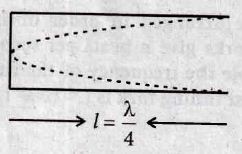
\(\ell=\frac{\lambda}{4}
\)
\(\therefore \lambda=4 \ell\)
For a open organ pipe \(L=\frac{\lambda}{2} \quad \therefore \lambda=2 L\)
Fundamental frequency of a closed pipe
\(f_{c} =250 \mathrm{~Hz}
\)
\(f_{0} =\frac{V}{\lambda}
\)
\(=\frac{V}{2 L}\)
Fundamental frequency of open organ pipe
\(f_{o} =2\left(\frac{V}{4 L}\right)
\)
\(=2 \times f_{c}
\)
\(=2 \times 250=500 \mathrm{~Hz}\)
∴ Frequency of open organ pipe =500 Hz.
2.
I1 is the intensity of sound detected at a distance 3.0 m and it is given as 10-2 W m-2. Let I2 be the intensity of sound detected at a distance 6.0 m. Then,
r1 = 3.0 m, r2 = 6.0 m
and since, I\(\propto \frac { 1 }{ { r }^{ 2 } } \)
the power output does not depend on the observer and depends on the baby. Therefore
\(\frac { { I }_{ 1 } }{ { I }_{ 2 } } =\frac { { r }_{ 2 }^{ 2 } }{ { r }_{ 1 }^{ 2 } } \)
\({ I }_{ 2 }{ =I }_{ 1 }\frac { { r }_{ 2 }^{ 2 } }{ { r }_{ 1 }^{ 2 } } \)
I2 = 0.25\(\times\)10-2 W m-2
3.
Frequency, f = 900 MHz = 900\(\times\)106 Hz
The speed of wave is c = 3\(\times\)108 m s−1
\(\lambda =\frac { v }{ f } =\frac { 3\times { 10 }^{ 8 } }{ { 900\times 10 }^{ 6 } } =0.33m\)
4.
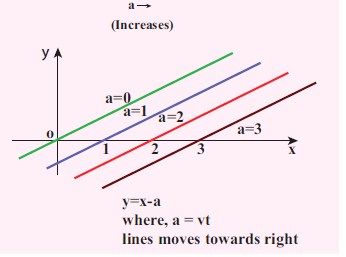
This implies, when increasing the value of a, the line shifts towards right side. For a = vt, y = x − vt satisfies the differential equation. Though this function satisfies the differential equation, it is not finite for all values of x and t. Hence, it does not represent a wave.
5.
\({ \lambda }_{ 1 }=\frac { v }{ { f }_{ 1 } } =\frac { 340 }{ 20 } =17m\)
\({ \lambda }_{ 2 }=\frac { v }{ { f }_{ 2 } } =\frac { 340 }{ 20\times { 10 }^{ 3 } } =0.017m\)
Therefore, the audible wavelength region is from 0.017 m to 17 m when the velocity of sound in that region is 340 m s -1.
6.
When a jerk is given to a stretched string which is tied at one end, a wave pulse is produced and the pulse travels along the string. Suppose two persons holding the stretched string on either side give a jerk simultaneously, then these two wave pulses move towards each other, meet at some point and move away from each other with their original identity. Their behaviour is very different only at the crossing/meeting points; this behaviour depends on whether the two pulses have the same or different shape as shown in Figure.
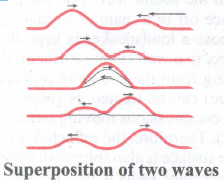
When the pulses have the same shape, at the crossing, the total displacement is the algebraic sum of their individual displacements and hence its net amplitude is higher than the amplitudes of the individual pulses. Whereas, if the two pulses have same amplitude but shapes are 1800 out of phase at the crossing point, the net amplitude vanishes at that point and the pulses will recover their identities after crossing. Only waves can possess such a peculiar property and It is called superposition of waves. This means that the principle of superposition explains the net behaviour of the waves when they overlap. Generalizing to any number of waves i.e, if two or more waves in a medium move simultaneously, when they overlap, their total displacement is the vector sum of the individual displacements.
To express mathematically, consider two functions which characterize the displacement of the waves, for example,
Y1 = A1 sin(kx - \(\omega t\))
and
Y2 = A2 cos(kx - \(\omega t\))
Since, both Y1 and Y2 satisfy the wave equation (solutions of wave equation) then their algebraic sum
Y = Y1 + Y2
also satisfies the wave equation. This means, the displacements are additive. Suppose we multiply Y1 and y2 with some constant then their amplitude is scaled by that constant Further, if C1 and C2 are used to multiply the displacernents y1 andY2 respectively, then, their net displacement Y is
Y = C1Y1 + C2Y2
This can be generalized to any number of waves. In the case of n such waves in more than one dimension the displacements are written using vector notation.
Here, the net displacement \(\vec y\) is
\(\vec { y } =\overset { n }{ \underset { i=1 }{ \Sigma } } { C }_{ i }\vec { { y }_{ i } } \)
The principle of superposition can explain the following:
(a) Space (or spatial) Interference (also known as Interference)
(b) Time (or Temporal) Interference (also known as Beats)
(c) Concept of stationary waves
Waves that obey principle of superposition are called linear waves (amplitude is much smaller than their wavelengths). In general, if the amplitude of the wave is not small then they are called non-linear waves.
7.
The velocity of the wave
\(v=\sqrt { \frac { T }{ \mu } } \)
The length of the string, L = 80 cm=0.8 m
The mass of the string, m = 0.32 g =0.32 × 10⁻³kg
Therefore, the linear mass density,
\(\mu =\frac { 0.32\times { 10 }^{ -3 } }{ 0.8 } =0.4\times { 10 }^{ -3 }{ kg\quad m }^{ -1 }\)
The tension in the string, T = 80 N
\(v=\sqrt { \frac { 80 }{ 0.4\times { 10 }^{ -3 } } } =447.2{ ms }^{ -1 }\)
The wavelength corresponding to the fundamental frequency f1 is λ1 = 2L = 2 × 0.8 = 1.6 m
The fundamental frequency f1 corresponding to the wavelength λ1
\({ f }_{ 1 }=\frac { v }{ { \lambda }_{ 1 } } =\frac { 447.2 }{ 1.6 } =279.5Hz\)
Similarly, the frequency corresponding to the second harmonics, third harmonics and fourth harmonics are
f2 = 2f1 = 559 Hz
f3 = 3f1 = 838.5 Hz
f4 = 4f1 = 1118 Hz
8.
First harmonic of a closed organ pipe
\(\mathrm{L}_{\mathrm{c}}=\frac{\lambda}{4}\)
Third harmonic of an open organ pipe
\(\mathrm{L}_{\mathrm{o}} =\frac{3 \lambda}{2} \)
\(\frac{L_{c}}{L_{o}} =\frac{\lambda}{4} \times \frac{2}{3 \lambda} \)
\(\frac{L_{c}}{L_{o}} =, \frac{1}{6} \)
9.
Factual information
\(\text { At } \mathrm{t}=0 \text { amplitude } \mathrm{y}=\frac{1}{1+x^{2}}\)
\(\text { At } \mathrm{t}=2 \text { amplitude } \mathrm{y}=\frac{1}{1+(x-2)^{2}}\)
\(\therefore v=\frac{\Delta y}{\Delta t} =\frac{2}{2} =1.0 \mathrm{~ms}^{-1} \)
10.
No. of beats = 10
Frequency of pitch in the first wire
\(f_{1}=360 \mathrm{~Hz}\)
\(\therefore \text { Frequency of pitch in the second wire}\)
\(f_{2} =360-10=350 \mathrm{~Hz} \)
\(\text { Ratio of length }=x: y\)
\(l \propto f\)
\(\therefore \mathrm{x}: \mathrm{y} =\mathrm{f}_{1}: \mathrm{f}_{2} \)
\(=360: 350 =36: 35 \)
11.
Frequency = 5000 Hz
Speed of sound in air = 332 m/s
Speed of sound in water = 1450 m/s
Wavelength of sound in air \(=\frac{332}{5000}\)
\(=66.4 \times 10^{-3}\)
\(\text { Wavelength of sound water } \lambda_{\text {water }}\)
\(=\frac{1450}{5000} =290 \times 10^{-3} \mathrm{~m} \)
\(\therefore \frac{\lambda_{\text {water }}}{\lambda_{\text {air }}} =\frac{290 \times 10^{3}}{66.4 \times 10^{-3}} =4.367 \)
12.
\(v_{\mathrm{A}}=500 \mathrm{~ms}^{-1} \quad \lambda_{A}=5 \mathrm{~m}\)
Frequency in medium B
\(\mathrm{f}_{\mathrm{B}}=\frac{v_{A}}{\lambda_{A}}=\frac{500}{5}=100 \mathrm{~Hz}\)
Wavelength in medium B
\(\lambda_{B}=\frac{v_{s}}{f_{s}}=\frac{600}{100}=6 \mathrm{~Hz}\)
13.
In an Octane, let the frequencies of be f, (f + n), (f + 2n), ......f + (N - 7)n
∴ Sum of two frequencies = 2f
f + (N - 1) n = 2f
(N - 1)n = 2f - f = f
∴ f = n(N - 1)

11th Standard Syllabus & Materials
11th Standard
TN 11th Tamil பீடு பெற நில் - செய்யுள் - காவடிச்சிந்து Important Questions And Answers Study Material - QB365 Set A
NEW11th Standard
TN 11th Tamil பீடு பெற நில் - உரைநடை - மலை இடப்பெயர்கள் : ஓர் ஆய்வு Important Questions And Answers Study Material - QB365 Set A
NEW11th Standard
TN 11th Tamil மாமழை போற்றுதும் - துணைப்பாடம் - யானை டாக்டர் Important Questions And Answers Study Material - QB365 Set A
NEW11th Standard
TN 11th Tamil மாமழை போற்றுதும் - செய்யுள் - ஐங்குறுநூறு Important Questions And Answers Study Material - QB365 Set A



Tamilnadu Stateboard 11th Standard Subjects

Maths

Commerce

Economics

Biology

Business Maths and Statistics

Accountancy

Computer Science
Physics

Chemistry
Maths
Biology
Economics
Physics
Chemistry

History
Business Maths and Statistics

Computer Science
Accountancy

Computer Applications
History
Computer Technology
Commerce
Computer Applications
Computer Technology

Tamil

English

French
Tamilnadu Stateboard Standards

