
 100% FREE ACCESS
11th Standard Syllabus & Materials
11th Standard
TN 11th Tamil இயற்கை வேளாண்மை,சுற்றுச்சூழல் -செய்யுள் - மனோன்மணீயம் Important Questions And Answers Study Material - QB365 Set A
NEW11th Standard
TN 11th Tamil என்னுயிர் என்பேன் -துணைப்பாடம் - இசைத்தமிழர் இருவர் Important Questions And Answers Study Material - QB365 Set A
NEW11th Standard
TN 11th Tamil மொழி கலை -செய்யுள் - ஒவ்வொரு புல்லையும் Important Questions And Answers Study Material - QB365 Set A
NEW11th Standard
TN 11th Tamil பீடு பெற நில் - இலக்கணம் - பகுபத உறுப்புகள் Important Questions And Answers Study Material - QB365 Set A
NEW11th Standard
TN 11th Tamil பீடு பெற நில் - துணைப்பாடம் - வாடிவாசல் Important Questions And Answers Study Material - QB365 Set A
NEW11th Standard
TN 11th Tamil பீடு பெற நில் - செய்யுள் - குறுந்தொகை Important Questions And Answers Study Material - QB365 Set A

Published on: 27/11/2019
Work, Energy and Power
Download Tamil Nadu 11th Standard Physics question papers, model tests, one-mark questions, important questions, and public exam papers in PDF format. Free study materials and answer keys for TN State Board students.
Questions + Answers key
Take MCQ Physics Test1.
A cricket ball falls from a height of 40 m. What is the velocity with which the ball hits the ground?
40 m/s
20 m/s
16 m/s
28 m/s
2.
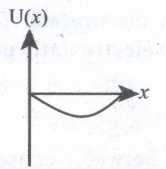
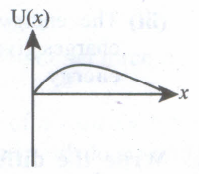
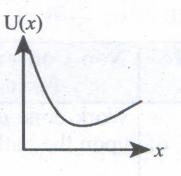
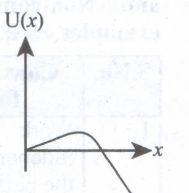
A particle which is constrained to move along x-axis, is subjected to a force in the same direction which varies with the distance x of the particle from the origin as F(x) = kx + ax3. Here, k and a are positive constants. For x ≥ 0, the functional form of the potential, energy U(x) of the particles
3.
What is the minimum velocity with which a body of mass m must enter a vertical loop of radius R so that it can complete the loop?
\(\sqrt{2gR}\)
\(\sqrt{3gR}\)
\(\sqrt{5gR}\)
\(\sqrt{gR}\)
4.
The coefficient of restitution e for a perfectly elastic collision is ______________.
1
0
\(\alpha\)
-1
5.
A ball of mass 1 kg and another of mass 2 kg are dropped from a tall building whose height is 80 m. After, a fall of 40 m each towards Earth, their respective kinetic energies will be in the ratio of
\(\sqrt2:1\)
\(1:\sqrt2\)
2:1
1:2
6.
Is whole of the kinetic energy lost in any perfectly inelastic collision?
7.
A bullet of mass 20 g strikes a pendulum of mass 5 kg. The centre of mass of pendulum rises a vertical distance of 10 cm. If the bullet gets embedded into the pendulum, calculate its initial speed?
8.
Calculate the work done by a force of 30 N in lifting a load of 2kg to a height of 10m (g = 10ms-2).
9.
10.
Define gravitational potential energy.
11.
A lighter particle moving with a speed of 10 ms-1 collides with an object of double its mass moving in the same direction with half its speed. Assume that the collision is a one dimensional elastic collision. What will be the speed of both particles after the collision?
12.
Let the two springs A and B be such that kA > kB, On which spring will more work has to be done if they are stretched by the same force?
13.
An object of mass 2 kg is taken to a height 5 m from the ground (g = 10 ms-2).
(a) Calculate the potential energy stored in the object.
(b) Where does this potential energy come from?
(c) What external force must act to bring the mass to that height?
(d) What is the net force that acts on the object while the object is taken to the height 'h'?
14.
Arrive at an expression for power and velocity. Give some examples for the same.
15.
State total linear momentum is conserved in all collisions.
16.
Depict Δ kinetic energy = ΔU in potential energy - displacement graph for a spring.
17.
A body of mass of 3 kg initially at rest makes under the action of an applied horizontal force of 10 N on a table with co-efficient of kinetic friction = 0.3, then what is the work done by the applied force in 10s:
18.
Derive an expression for the potential energy of a body near the surface of the Earth.
19.
What is inelastic collision? In which way it is different from elastic collision. Mention few examples in day to day life for inelastic collision.
1.
(d)
28 m/s
2.
\(F=-\frac{d u}{d x} \quad F(x) =k x+a x^{3} \)
\(d u =-F d x \)
\(u(x) =-\int_{0}^{x}\left(-k x+a x^{3}\right) d x \)
\(=\int_{0}^{x} k x d x-a \int_{0}^{x} x^{3} d x \)
\(=\frac{k x^{2}}{2}-\frac{a x^{4}}{2} \)
\(U(x) =\frac{x^{2}}{2}\left(k-\frac{a x^{2}}{2}\right) \)
\(u(x)=0 \text { at } x=0 \text { and }\)
\(U(x) =0 ; k-\frac{a x^{2}}{2}=0 \)
\(=\frac{a}{2} x^{2}=-k \)
\(x^{2} =\frac{2 k}{a} \)
\(\therefore x =\sqrt{\frac{2 k}{a}} \)
\(\text { Clearly } u(x)=0 \text { at } x=0 \text { and }\)
\(x=\sqrt{\frac{2 k}{a}}\)
\(\text { For } x>\sqrt{\frac{2 k}{a}} U(x) \text { will be negative. } \)
\(\text { At } x=0 ; F=\frac{-d u}{d x}=0\)
(i.e.,) Slope of V - x graph is zero at x = 0
Hence the most appropriate answer is d.
3.
Radius =R
\(v_{1}^{2}-v_{2}^{2}=4 g R\)
\(\text { Tension } T_{2}=\frac{m v_{2}^{2}}{R_{2}}-m g\)
\(\text {To find minimum speed, let } T_{2}=0\)
\(0 =\frac{m v_{2}^{2}}{R}-m g \)
\(\frac{m v^{2}}{R} =m g \)
\(v_{2}^{2}=R g \ v_{2} =\sqrt{g R} \)
\(\text { sub (2) in the eqn (1) we get }\)
\(v_{1}^{2}-(\sqrt{g R})^{2} =4 g R \)
\(v_{1}^{2}-g R =4 g R \)
\(v_{1}^{2} =4 g R+g R \)
\(=5 g R \)
\(v_{1} =\sqrt{5 g R} \)
4.
For a perfectly elastic collision
\(\left|v_{1}-v_{2}\right|=\left|u_{1}-u_{2}\right| \)
\(v_{e}=\frac{\left|v_{1}-v_{2}\right|}{\left|u_{1}-u_{2}\right|}=1
\)
5.
\(m_{1} =1, \quad m_{2}=2 \)
\(K . E . =m g(h-x) \)
\(\text { For both balls }(h-x)\)
\(=40 \text { i.e.) Same }\)
\(g=\text { constant }\)
\(\therefore K \cdot E_{1}=m_{1} g(h-x)=m_{1} g \times 40 \)
\(K \cdot E_{2}=m_{2} g(h-x)=m_{2} g \times 40 \)
\(\therefore \frac{K \cdot E_{1}}{K \cdot E_{2}}=\frac{m_{1} g \times 40}{m_{2} g \times 40}=\frac{m_{1}}{m_{2}} \)
\( \therefore K \cdot E_{1}: K \cdot E_{2}=1: 2 \)
6.
No, only that much amount of kinetic energy is lost as is necessary for the conservation of momentum.
7.
\(\text {Mass of a bullet } m=20 g=20 \times 10^{-3} \mathrm{~kg} =0.02 \mathrm{~kg} \)
\(\text {Mass of a pendulum } M =5 \mathrm{~kg} \)
\(\text {Height } \mathrm{h} =10 \mathrm{~cm} \)
\(=10 \times 10^{-2} \)
\(=0.1 \mathrm{~m} \)
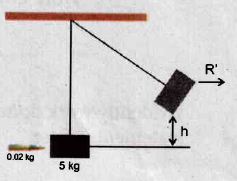
\(\text { K.E. of the block } =\text { P.E. of the block } \)
\(\frac{1}{2} M v^{2} =M g h \)
\(\therefore v^{2} =\sqrt{2 g h} \)
\(=\sqrt{2 \times 9.8 \times 0.1}=\sqrt{1.96}=1.4 \mathrm{~m} / \mathrm{s} \)
\(\therefore \text { Final speed } v =1.4 \mathrm{~m} / \mathrm{s} \)
\(\text {Final speed } v =\frac{m_{1} u_{1}+m_{2} u_{2}}{\left(m_{1}+m_{2}\right)} \)
\(v_{1} =\frac{0.02 u_{1}+5 \times 0}{(0.02+5)}=\frac{0.02}{5.02} u_{1} \)
\(\text { But } v =1.4 \)
\(\therefore 1.4 =\frac{0.02}{5.02} u_{1} \)
\(u_{1}=\frac{1.4 \times 5.02}{0.02}=\frac{7.028}{0.02}=351.4 \mathrm{~m} / \mathrm{s}\)
\(\therefore \text { Initial speed } =351.4 \mathrm{~m} / \mathrm{s}\)
8.
Given:
Force mg = 30 N; height = 10 m
Work done to lift a load W = ?
W = F.S (or) mgh
= 30 \(\times\) 10
W = 300J
9.
10.
The gravitational potential energy (U) at some height h is equal to the amount of work required to take the object from ground to that height h with constant velocity.
11.
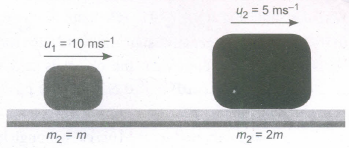
Let the mass of the first body be m which moves with an initial velocity, u1 = 10 m s-1.
Therefore, the mass of second body is 2m and its initial velocity is \({ u }_{ 2 }=\frac { 1 }{ 2 } { u }_{ 1 }=\frac { 1 }{ 2 } (10{ ms }^{ -1 })\)
\({ v }_{ 1 }=\left( \frac { { m }_{ 1 }-{ m }_{ 2 } }{ { m }_{ 1 }+{ m }_{ 2 } } \right) { u }_{ 1 }+\left( \frac { 2m }{ { m }_{ 1 }+{ m }_{ 2 } } \right) { u }_{ 2 }\)
\({ v }_{ 1 }=\left( \frac { { m }_{ 1 }-2m }{ m+2m } \right) +10+\left( \frac { 2\times 2m }{ m+2m } \right) 5\)
\({ v }_{ 1 }=-\left( \frac { 1 }{ 3 } \right) 10+\left( \frac { 4 }{ 3 } \right) 5=\frac { -10+20 }{ 3 } =\frac { 10 }{ 3 } \)
v1 = 3.33 ms-1
\({ v }_{ 2 }=\left( \frac { 2{ m }_{ 1 } }{ { m }_{ 1 }+{ m }_{ 2 } } \right) { u }_{ 1 }+\left( \frac { { m }_{ 2 }-{ m }_{ 1 } }{ { m }_{ 1 }+{ m }_{ 2 } } \right) { u }_{ 2 }\)
\({ v }_{ 2 }=\left( \frac { 2m }{ m+2m } \right) 10+\left( \frac { 2m-m }{ m+2m } \right) 5\)
\({ v }_{ 2 }=\left( \frac { 2 }{ 3 } \right) 10+\left( \frac { 1 }{ 3 } \right) 5=\frac { 20+5 }{ 3 } =\frac { 25 }{ 3 } \)
v2 = 8.33 ms-1
As the two speeds v1 and v2 are positive, they move in the same direction with the velocities 3.33 ms-1 and 8.33 ms-1 respectively.
12.
F = kAxA = kBxB
\({ x }_{ A }=\frac { F }{ { k }_{ A } } ,{ x }_{ B }=\frac { F }{ { k }_{ B } } \)
The work done on the springs are stored as potential energy in the springs.
\({ U }_{ A }=\frac { 1 }{ 2 } { k }_{ A }{ x }_{ A }^{ 2 };\quad { U }_{ B }=\frac { 1 }{ 2 } { k }_{ B }{ x }_{ B }^{ 2 }\)
\(\frac { { U }_{ A } }{ { U }_{ B } } =\frac { { k }_{ A }{ x }_{ A }^{ 2 } }{ { k }_{ B }{ x }_{ B }^{ 2 } } =\frac { { { k }_{ A }\left( \frac { F }{ { k }_{ A } } \right) }^{ 2 } }{ { { k }_{ B }\left( \frac { F }{ { k }_{ B } } \right) }^{ 2 } } =\frac { \frac { 1 }{ { k }_{ A } } }{ \frac { 1 }{ { k }_{ B } } } \)
\(\frac { { U }_{ A } }{ { U }_{ B } } =\frac { { k }_{ B } }{ { k }_{ A } } \)
kA > kB implies that UB > UA.Thus, more work is done on B than A.
13.
(a) The potential energy U = mgh = 2 \(\times\) 10 \(\times\) 5 = 100 J
Here the positive sign implies that the energy is stored on the mass.
(b) This potential energy is transferred from external agency which applies the force on the mass.
(c) The external applied force \(\overrightarrow { { F }_{ a } } \) which takes the object to the height 5 m is \(\overrightarrow { { F }_{ a } } =-\overrightarrow { { F }_{ g } } \)
\(\overrightarrow { { F }_{ a } } =-(-mg\hat { j } )=mg\hat { j } \)
where, \(\hat { j } \) represents unit vector vertical upward direction.
(d) From the definition of potential energy, the object must be moved at constant velocity. So the net force acting on the object is zero.
\(\overrightarrow { { F }_{ g } } +\overrightarrow { { F }_{ a } } =0\)
14.
Relation between power and velocity
The work done by a force \(\overrightarrow{\mathbf{F}}\) for a displacement \(d \vec{r}\) is
\(W=\int \overrightarrow{\mathrm{F}} \cdot d \vec{r}\) ......(1)
Left hand side of the equation (1) can be written as
\(W=\int d W=\int \frac{d W}{d t} d t\)
(multiplied and divided by dt) (2)
Since, velocity is \(\vec{v}=\frac{d \vec{r}}{d t} ; \overrightarrow{d r}=\vec{v} d t.\) Right hand side of the equation (1) can be written as
\(\int \overrightarrow{\mathrm{F}} \cdot d \vec{r}=\int\left(\overrightarrow{\mathrm{F}}, \frac{d \vec{r}}{d t}\right) d t=\int(\overrightarrow{\mathrm{F}} \cdot \vec{v}) d t\left[v=\frac{d \vec{r}}{d t}\right] \ldots \ldots\) (3)
Substituting equation (2) and equation (3) in equation (1), we get
\(\int \frac{d W}{d t} d t=\int(\overrightarrow{\mathrm{F}} \cdot \vec{v}) d t\)
Or
\(\int\left(\frac{d W}{d t}-\overrightarrow{\mathrm{F}} \cdot \vec{v}\right) d t=0\)
This relation is true for any arbitrary value of dt. This implies that the term within the bracket must be equal to zero, i.e.,
\(\frac{d W}{d t}-\overrightarrow{\mathrm{F}} \cdot \vec{v} =0 \)
\(\frac{d W}{d t} =\overrightarrow{\mathbf{F}} \vec{v}\)
Examples: Motors, Engines and Automobiles
A vehicle of mass 1250 kg is driven with an acceleration 0.2 ms-2 along a straight level road against an external resistive force 500 N. Calculate the power delivered by the vehicle's engine if the velocity of the vehicle is 30 ms-1.
Solution
The vehicle's engine has to do work against resistive force and make vehicle to move with an acceleration. Therefore, power delivered by the vehicle engine is
\(P =(\text { resistive force }+\text { mass } \times \text { acceleration }) \text { (velocity) } \)
\(P =\overrightarrow{\mathbf{F}}_{-\mathrm{ma}} \vec{v}=\left(F_{\text {reistie }}+F\right) \vec{v} \)
\(P =\overrightarrow{\mathbf{F}}_{\text {tot }} \vec{v}=\left(F_{\text {reithie }}+m a\right) \vec{v} \)
\(=500 \mathrm{~N}+\left((1250 \mathrm{~kg}) \times\left(0.2 \mathrm{~ms}^{-2}\right)\right)\left(30 \mathrm{~ms}^{-1}\right)=22.5 \mathrm{kw}\)
15.
(i) Linear momentum is conserved in all dollision processes. When two bodies . collide, the mutual impulsive forces acting between them during the collision time (\(\Delta\)t) produces a change in their respective momenta.
(ii) That is, the first body exerts a force \(\overline { { F }_{ 12 } } \) on the second body. From Newton's third law, the second body exerts a force \(\overline { { F }_{ 21 } } \) on the first body. This caus~s a, change in momentum \(\Delta \overrightarrow { { p }_{ 1 } } \) and \(\Delta \overrightarrow { { p }_{ 2 } } \) of the first body and second body respectively. Now, the relations could be written as,
\(\Delta \overrightarrow { { p }_{ 1 } } \) = \(\overline { { F }_{ 12 } } \) \(\Delta\)t ......(1)
\(\Delta \overrightarrow { { p }_{ 2 } } \) = \(\overline { { F }_{ 21 } } \) \(\Delta\)t ......(2)
(iii) Adding equation (1) and equation (2), we get
\(\Delta \overrightarrow { { p }_{ 1 } } \) + \(\Delta \overrightarrow { { p }_{ 2 } } \) = \(\overline { { F }_{ 12 } } \) \(\Delta\)t + \(\overline { { F }_{ 21 } } \) \(\Delta\)t = \(\left( \overrightarrow { { F }_{ 12 } } +\overrightarrow { { F }_{ 21 } } \right) \Delta t\)
According to Newton's third law \(\overline { { F }_{ 12 } } \) = - \(\overline { { F }_{ 21 } } \)
\(\Delta \overrightarrow { { p }_{ 1 } } \) + \(\Delta \overrightarrow { { p }_{ 2 } } \) = 0
\(\Delta( \overrightarrow { { p }_{ 1 } } + \overrightarrow { { p }_{ 2 } } )\) = 0
(iv) Dividing both sides by \(\Delta\)t and taking limit \(\Delta\)t \(\rightarrow\) 0 we get
\(\lim _{ \Delta t\rightarrow 0 }{ \frac { \Delta \left( \overrightarrow { { p }_{ 1 } } +\overrightarrow { { p }_{ 2 } } \right) }{ \Delta t } } =\frac { \Delta \left( \overrightarrow { { p }_{ 1 } } +\overrightarrow { { p }_{ 2 } } \right) }{ dt } =0\)
\(\therefore\) p1 + p2 = constant
(v) The above expression implies that the total linear momentum is a conserved quantity.
16.
(i) A compressed or extended spring will transfer its stored potential energy into, kinetic energy of the mass attached to the spring.
(ii) The potential energy-displacement graph is shown in Figure.
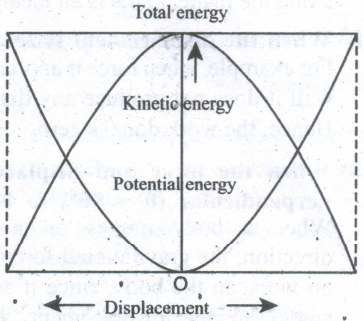
Potential energy-displacement graph for a spring-mass system
(iii) In a frictionless environment, the energy gets transferred from kinetic to potential and potential to kinetic repeatedly such that the total energy of the system remains constant. At the mean position, ΔKE = ΔU
17.
Applied force = 10 N
Opposing friction forcej= Mk. N = Mk·mg.
= 0.3\(\times\)3\(\times\)9.8 = 8.82 N.
Net accelerating forceF - f = 10N - 8.82N
=1.18N
Acceleration a =\(\frac{force}{mass}\)=\(\frac{8.82N}{3Kg}=2.94 ms^{-2}\)
Distance covered in 10s (assuming w = 0)
\(s=0+\frac{1}{2}at^{2}=\frac{1}{2}\times2.94\times(10^{2}) = 147 m\)
there force workdone by a applied force,
W = Fs = 10\(\times\)147
W = 1470 J
18.
(i) The gravitational potential energy (U) at some height h is equal to the amount of work required to take the object from ground to that height h with constant velocity.
(ii) Consider a body of mass m being moved from ground to the height h against the gravitational force as shown in Figure.
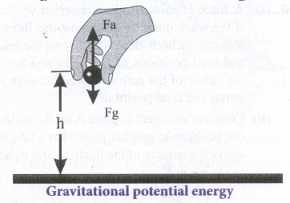
iii) The gravitational force \({ \overrightarrow { F } }_{ g }\) acting on the body is, \({ \overrightarrow { F } }_{ g }=-mg\hat { j } \) (as the force is' in y-direction, unit vector is used). Here, negative sign implies that the force is acting vertically downwards. In order to move the body without acceleration (or with constant velocity), an external applied force \({ \overrightarrow { F } }_{ a }\) equal in magnitude but opposite to that of gravitational force \({ \overrightarrow { F } }_{ a }-{ \overrightarrow { F } }_{ g }\) . This implies that \({ \overrightarrow { F } }_{ a }=-mg\hat { j } \)
(iv) The positive sign implies that the applied force is in vertically upward direction. Hence, when the body is lifted up its velocity remains unchanged and thus its kinetic energy also remains constant.
(v) The gravitational potential energy (U) at some height h is equal to the amount of work required to take the object from the ground to that height h.
\(U=\int \overrightarrow { { F }_{ a } } .d\overrightarrow { r } =\int \left| \overrightarrow { { F }_{ a } } \right| \left| d\overrightarrow { r } \right| \cos { \theta } \)
(vi) Since the displacement and the applied force are in the same upward direction, the angle between them, \(\theta ={ 0 }^{ o }\)
Hence, \(\cos { { \theta }^{ o } } =1\) and \(\left| \overrightarrow { { F }_{ a } } \right| =mg\) and
\(=\left| d\overrightarrow { r } \right| dr.\)
\(U=\overset { h }{ \underset { 0 }{ \int } } dr\)
\(U=mg{ \left[ r \right] }_{ 0 }^{ h }\) = mgh.
19.
If there is a loss of kinetic energy during a collision, then it is called as an inelastic collision
In the case of inelastic collision,
(i) Total kinetic energy is not conserved.
(ii) Some or all of the forces involved are non-conservative.
(iii) A part of the mechanical energy is transformed into heat, sound, light etc.
Examples for inelastic collision:
(i) Collision between ball and floor
(ii) Collision between two vehicles
Examples for perfectly inelastic collision:
(i) Mud thrown on a wall and sticking to it
(ii) a man jumping into a moving trolley
(iii) a bullet fired into a wooden block and remaining embedded in it.

11th Standard Syllabus & Materials
11th Standard
TN 11th Tamil பீடு பெற நில் - செய்யுள் - காவடிச்சிந்து Important Questions And Answers Study Material - QB365 Set A
NEW11th Standard
TN 11th Tamil பீடு பெற நில் - உரைநடை - மலை இடப்பெயர்கள் : ஓர் ஆய்வு Important Questions And Answers Study Material - QB365 Set A
NEW11th Standard
TN 11th Tamil மாமழை போற்றுதும் - துணைப்பாடம் - யானை டாக்டர் Important Questions And Answers Study Material - QB365 Set A
NEW11th Standard
TN 11th Tamil மாமழை போற்றுதும் - செய்யுள் - ஐங்குறுநூறு Important Questions And Answers Study Material - QB365 Set A



Tamilnadu Stateboard 11th Standard Subjects

Maths

Commerce

Economics

Biology

Business Maths and Statistics

Accountancy

Computer Science
Physics

Chemistry
Maths
Biology
Economics
Physics
Chemistry

History
Business Maths and Statistics

Computer Science
Accountancy

Computer Applications
History
Computer Technology
Commerce
Computer Applications
Computer Technology

Tamil

English

French
Tamilnadu Stateboard Standards

