
 100% FREE ACCESS
11th Standard Syllabus & Materials
11th Standard
TN 11th Tamil இயற்கை வேளாண்மை,சுற்றுச்சூழல் -செய்யுள் - மனோன்மணீயம் Important Questions And Answers Study Material - QB365 Set A
NEW11th Standard
TN 11th Tamil என்னுயிர் என்பேன் -துணைப்பாடம் - இசைத்தமிழர் இருவர் Important Questions And Answers Study Material - QB365 Set A
NEW11th Standard
TN 11th Tamil மொழி கலை -செய்யுள் - ஒவ்வொரு புல்லையும் Important Questions And Answers Study Material - QB365 Set A
NEW11th Standard
TN 11th Tamil பீடு பெற நில் - இலக்கணம் - பகுபத உறுப்புகள் Important Questions And Answers Study Material - QB365 Set A
NEW11th Standard
TN 11th Tamil பீடு பெற நில் - துணைப்பாடம் - வாடிவாசல் Important Questions And Answers Study Material - QB365 Set A
NEW11th Standard
TN 11th Tamil பீடு பெற நில் - செய்யுள் - குறுந்தொகை Important Questions And Answers Study Material - QB365 Set A

Published on: 12/03/2019
11th Public Exam March 2019 Important 5 Marks Questions
Download Tamil Nadu 11th Standard Maths question papers, model tests, one-mark questions, important questions, and public exam papers in PDF format. Free study materials and answer keys for TN State Board students.
Questions + Answers key
Take MCQ Maths Test1.
If \(sin x=\frac{4}{5}\) (in I quadrant) and \(cos\ y=\frac{-12}{13}\) (in II quadrant), then find
(i) sin (x - y)
2.
Let f = {(1, 2), (3, 4), (2, 2)} and g = {(2, 1), (3, 1), (4, 2)}. Find g o f and f o g.
3.
Find the equations of straight lines which are perpendicular to the line 3x + 4y - 6 = 0 and are at a distance of 4 units from (2, 1).
4.
If θ is a parameter, find the equation of the locus of a moving point, whose coordinates are x = a cos3 θ, y = a sin3 θ.
5.
If a2+b2 = 7ab. Show that log \(\ \frac { a+b }{ 3 } =\frac { 1 }{ 2 } \) (log a + log b)
6.
Prove that \(\frac { sinx+sin3x+sin5x+sin7x }{ cosx+cos3x+cos5x+cos7x } =tan4x\)
7.
Show that \(\frac { sin8x\ cosx-sin6x\ cos3x }{ cos2x\ cosx-sin3x\ sin4x } =tan2x\)
8.
A factory has two machines I and II. Machine I produces 40% of items of the output and Machine II produces 60% of the items. Further 4% of items produced by Machine I are defective and 5% produced by Machine II are defective. An item is drawn at random. If the drawn item is defective, find the probability that it was produced by Machine II. (See the previous example, compare the questions).
9.
Integrate the following functions with respect to x : \(x+1\over (x+2)(x+3)\)
10.
If y = etan-1 x, Show that (1 + x2) y" + (2x - 1) y' = 0.
11.
Evaluate the following limits :\(lim_{x\rightarrow 0}{sin \ x(1-cos \ x)\over x^3}\)
12.
Evaluate the following limits :\(lim_{x\rightarrow0}{e^x-e^{-x}\over sin x}\)
13.
Check if \(lim_{x\rightarrow-58}f(x)\)exists or not, where \(f(x)=\left\{\begin{array}{cc} \frac{|x+5|}{x+5} & , \text { for } x \neq-5 \\ 0, & \text { for } x=-5 \end{array}\right.\)
14.
The position vectors of the vertices of a triangle are \(\hat{i}+2\hat{j}+3\hat{k};3\hat{i}-4\hat{j}+5\hat{k}\) and\(-2\hat{i}+3\hat{j}-7\hat{k}\).Find the perimeter of the triangle.
15.
If ABCD is a quadrilateral and E and F are the midpoints of AC and BD respectively, then prove that \(\overrightarrow{AB}\) + \(\overrightarrow{AD}\) + \(\overrightarrow{CB}\) +\(\overrightarrow{CD}\) = 4 \(\overrightarrow{EF}\).
16.
Without expanding the determinants, show that | B | = 2| A |.
Where B =\(\begin{bmatrix} b+c & c+a & a+b \\ c+a & a+b &b+c \\a+b & b+c & c+a \end{bmatrix}\)and A =\(\begin{bmatrix} a& b & c \\ b & c & a \\ c & a & b \end{bmatrix}\)
17.
If A = \(\begin{bmatrix} 1 & 2 & 2 \\ 2 & 1 & -2 \\ x & 2 & y \end{bmatrix}\) is a matrix such that AAT = 9I, find the values of x and y.
18.
Express the matrix A =\(\begin{bmatrix} 1 & 3 & 5 \\ -6 & 8 & 3 \\ -4 & 6 & 5 \end{bmatrix}\)as the sum of a symmetric and a skew-symmetric matrices.
19.
Prove that \(\frac{2cos2\theta+1}{2cos2\theta-1}=tan(60°+\theta)(tan60°-\theta)\)
20.
Find the sum of the first 20-terms of the arithmetic progression having the sum of first 10 terms as 52 and the sum of the first 15 terms as 77.
21.
Find the equation of the line through the intersection of the lines 3x + 2y + 5 = 0 and 3x - 4y + 6 = 0 and the point (1, 1).
22.
In a \(\triangle\) ABC, prove that \(({B-C\over 2})={b-c\over a} cos {A\over 2}\)
23.
By the principle of mathematical induction, prove that, for all integers n ≥ 1,
12 + 22 + 32+...n2 = \(\frac { n(n+1)(2n+1) }{ 6 } \).
24.
Solve \(\sqrt{3}tan^2\theta+(\sqrt{3}-1)tan\theta-1=0\)
25.
If P and p1 be the perpendicular from the origin upon the straight lines \(x\sec\theta+y cosec\theta=a\)and \(x\cos\theta-y\sin\theta=a\cos2\theta\) , prove that 4p2 +p1 = a2
26.
Find p and q, if the following equation represents a pair of perpendicular lines 6x2 + 5xy - py2 + 7x + qy - 5 = 0.
27.
If \(\alpha ,\beta \)are the roots of the equation x2-px + q = 0, then prove that \(\log { (1+px+q{ x }^{ 2 }) } =(\alpha +\beta )x=\frac { { \alpha }^{ 2 }+{ \beta }^{ 2 } }{ 2 } { x }^{ 2 }+\frac { { \alpha }^{ 2 }+{ \beta }^{ 2 } }{ 3 } { x }^{ 3 }-....\infty \)
28.
Show that the equation 2x2 - xy - 3y2 - 6x + 19y - 20 = 0 represents a pair of intersecting lines. Show further that the angle between them is \(\tan ^{ -1 }{ \left( 5 \right) } \)
29.
Find the value of \(\sum _{ n=1 }^{ \infty }{ \frac { 1 }{ { 2 }^{ n-1 } } \left( \frac { 1 }{ { 9 }^{ n-1 } } +\frac { 1 }{ { 9 }^{ 2n-1 } } \right) } \)
30.
Find the value of n if the sum to n terms of the series \(\sqrt { 3 } +\sqrt { 75 } +\sqrt { 243 } +....is\quad 435\sqrt { 3 } .\)
31.
Compute the sum of first n terms of the following series 8 + 88 + 888 + .......
32.
By the principle of mathematical induction, prove that for n > 1,
\(1^2 + 3^2 + 5^2 + ... + (2n-1)^2 = {n(2n-1)(2n+1)\over 3}\)
33.
How many strings can be formed using the letters of the word LOTUS if the word
(i) either starts with L or ends with S?
(ii) neither starts with L nor ends with S?
34.
Resolve the following rational expressions into partial fractions.
\({{6x^2-x+1}\over{x^3+x^2+x+1}}\)
35.
Resolve the following rational expressions into partial fractions.
\({{1}\over{x^4-1}}\)
36.
In \(\triangle\)ABC, Prove the following a (cos B + cos C) = 2 (b+c)sin2 \(\frac { A }{ 2 } \)
37.
Find all pairs of consecutive odd natural numbers both of which are larger than 10 and their sum is less than 40.
38.
If A + B + C = \(\frac { \pi }{ 2 } \), prove the following sin 2A + sin 2B + sin 2C = 4 cos A cos B cos C
39.
Let A = {a, b, c, d}, B = {a, c, e}, C = {a, e}.
Show that A ∩ (B ∩ C) = (A ∩ B) ∩ C
40.
Solve: \(\sqrt{x+5}+\sqrt{x+21}=\sqrt{6x+40}\)
41.
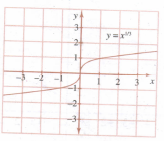
For the given curve, \(y=x^{1\over 3}\)given in figure draw
(i) \(y=-x^{ \left( \frac { 1 }{ 3 } \right) }\)
(ii) \(y=x^{ \left( \frac { 1 }{ 3 } \right) }+1\)
(iii) \(y=x^{ \left( \frac { 1 }{ 3 } \right) }-1\)
(iv) \(y=(x+1)^{1\over 3}\)
42.
A simple cipher takes a number and codes it, using the function f(x) = 3x - 4. Find the inverse of this function, determine whether the inverse is also a function and verify the symmetrical property about the line y = x(by drawing the lines)
43.
The function for exchanging American dollars for Singapore Dollar on a given day is f(x) = 1.23x, where x represents the number of American dollars. On the same day function for exchanging Singapore dollar to Indian Rupee is g(y) = 50.50y, Where y represents the number of Singapore dollars. Write a function which will give the exchange rate of American dollars in terms of Indian rupee
44.
If P(A) = 0.5, P(B) = 0.8 and P(B/A) = 0.8, find P(A/B) and P(A\(\cup \)B)
45.
Integrate the following with respect to x : \(\left(1-x^2\right)^{-\frac{1}{2}}\)
46.
Differentiate the following: \(y=\frac{e^{3 x}}{1+e^x}\)
47.
Evaluate the following limits :
\(lim_{x\rightarrow0}{\sqrt{1-x}-1\over x^2}\)
48.
Check whether the following functions are one-to-one and onto.
(i) \(f:N\rightarrow N\) defined by f(n) = n + 2.
(ii) \(f: \mathbb{N} \cup\{-1,0\} \rightarrow \mathbb{N}\) defined by \(f(n)=n+2\)
49.
Express each of the following as a product.
cos 35o - cos 75o
50.
Discuss the following relations for reflexivity, symmetricity and transitivity:
Let P denote the set of all straight lines in a plane. The relation R defined by "lRm if l is perpendicular to m".
1.
Given that \(sin x=\frac{4}{5}\).
cos2x + sin2x = 1 gives \(cos\ x=\pm\sqrt{1-sin^2x}=\pm\sqrt{1-\frac{16}{25}}=\pm\frac{3}{5}\)
In the first quadrant, cos x is always positive. Thus \(cos\ x=\frac{3}{5}\)
Also, given that cos \(y=-\frac{12}{13}\) in the II quadrant. We have
\(sin\ y=\pm\sqrt{1-cos^2y}=\pm\sqrt{1-\frac{144}{169}}=\pm\frac{5}{13}\)
In the second quadrant, sin y is always positive, Thus sin \(y=\frac{5}{13}\)
(i) sin(x - y) = sin x cos y - cos x sin y = \(\frac{4}{5}(\frac{-12}{13})-\frac{3}{5}(\frac{5}{13})=-\frac{63}{65}\)
2.
To check whether compositions can be defined, let us find the domain and range of these functions.
Domain of f = {1, 2, 3}, Range of f = {2, 4}, Domain of g = {2, 3, 4} and Range of g = {1, 2}. Since the range of f is contained in the domain of g we can define g o f, so as to find the image of 1 under g o f, we first find the image of 1 under f and then its image under g. The image of 1 under f is 2 and its image under g is 1. So (g o f) (1) = g(f(1)) = g(2) = 1.
Similarly we find that (g o f) (2) = 1 and (g o f) (3) = 2. So g o f = {(1, 1), (2, 1), (3, 2)}.
Similarly f o g = {(2, 2), (3, 2), (4, 2)}.
3.
Given equation of line is 3x + 4y - 6 = 0.
Any line perpendicular to 3x + 4y - 6 = 0 will be of the form 4x - 3y + k = 0 ....(1)
Given perpendicular distance is 4 units from (2,1) to line (1)
\(\therefore\)4 = \(\pm \frac { (4(2)-3(1)+k) }{ \sqrt { { 4 }^{ 2 }+{ \left( -3 \right) }^{ 2 } } } \)
\(\Rightarrow\) 4 = \(\pm \left( \frac { 8-3+k }{ \sqrt { 16+9 } } \right) \)
\(\Rightarrow\) 4 = \(\pm \left( \frac { 5+k }{ 5 } \right) \)
\(\therefore\) 20 = +(5 + k) or 20 = -(5+ k)
\(\Rightarrow\) k = 20 - 5 or k = -(20 + 5)
\(\Rightarrow\) k = 15 or k = -25
\(\therefore\) Required equation of the lines are 4x - 3y + 15 = 0 and 4x - 3y - 25 = 0.
4.
Given x = a cos3 \(\theta\) , y = a sin3 \(\theta\)
\(\Rightarrow \quad \frac { x }{ a } ={ cos }^{ 3 }\theta \quad and\quad \frac { y }{ a } ={ sin }^{ 3 }\quad \theta \)
Taking power \(\left( \frac { 2 }{ 3 } \right) \)for both the equations, we get
\({ \left( \frac { x }{ a } \right) }^{ \frac { 2 }{ 3 } }={ \left( { cos }^{ 3 }\theta \right) }^{ \frac { 2 }{ 3 } }and\)
\({ \left( \frac { y }{ a } \right) }^{ \frac { 2 }{ 3 } }={ { (sin }^{ 3 }\theta })^{ \frac { 2 }{ 3 } }\)
\({ \left( \frac { x }{ a } \right) }^{ \frac { 2 }{ 3 } }={ cos }^{ 2 }\theta \quad and\quad { \left( \frac { y }{ a } \right) }^{ \frac { 2 }{ 3 } }={ sin }^{ 2 }\theta \)
We know that cos2 \(\theta\) + sin2 \(\theta\) = 1
\(\therefore { \left( \frac { x }{ a } \right) }^{ \frac { 2 }{ 3 } }+{ \left( \frac { y }{ a } \right) }^{ \frac { 2 }{ 3 } }=1\)
\(\Rightarrow \quad \frac { { x }^{ \frac { 2 }{ 3 } } }{ { x }^{ \frac { 2 }{ 3 } } } +\frac { { x }^{ \frac { 2 }{ 3 } } }{ { x }^{ \frac { 2 }{ 3 } } } =1\)
\(\Rightarrow \quad \frac { { x }^{ \frac { 2 }{ 3 } }+{ y }^{ \frac { 2 }{ 3 } } }{ { a }^{ \frac { 2 }{ 3 } } } =1\)
\(\Rightarrow \quad { x }^{ \frac { 2 }{ 3 } }+{ y }^{ \frac { 2 }{ 3 } }={ a }^{ \frac { 2 }{ 3 } }\)
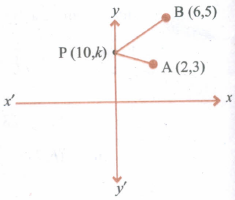
\(\therefore \) The required point is (0, 12)
5.
Given a2+ b2 = 7ab
Adding 2ab both sides we get,
a2+b2+2ab = 7ab + 2ab
⇒ (a+b)2 = 9ab
⇒ \(\frac { (a+b)^{ 2 } }{ 9 } \) = ab
⇒ \(\left( \frac { a+b^{ 2 } }{ 9 } \right) ^{ 2 }\) = ab
Taking square root,we get
\(\frac { a+b }{ 3 } \) = ab
\(log\left( \frac { a+b }{ 3 } \right) =log(ab)^{ \frac { 1 }{ 2 } }\)
= \(\frac { 1 }{ 2 } \) log (ab)
log \(\left( \frac { a+b }{ 3 } \right) \) = \(\frac { 1 }{ 2 } \) [log a + log b]
Hence proved.
6.
\(LHS=\frac { sinx+sin3x+sin5x+sin7x }{ cosx+cos3x+cos5x+cos7x } \)
\(=\frac { 2sin\left( \frac { x+3x }{ 2 } \right) cos\left( \frac { x-3x }{ 2 } \right) +2sin\left( \frac { 7x+5x }{ 2 } \right) cos\left( \frac { 7x-5x }{ 2 } \right) }{ 2cos\left( \frac { 3x+x }{ 2 } \right) cos\left( \frac { 3x-x }{ 2 } \right) +2cos\left( \frac { 7x+5x }{ 2 } \right) cos\left( \frac { 7x-5x }{ 2 } \right) } \)
\(=\frac { sin2xcos(x)+sin6xcosx }{ cos2xcox+cos6xcosx } \)
\(=\frac { cosx(sin2x+sin6x) }{ cosx(cos2x+cos6x) } =\frac { sin4x.cos2x }{ cos4x.cos2x } \)
= tan 4x = RHS
7.
\(LHS=\frac { sin8x\quad cosx-sin6x\quad cos3x }{ cos2x\quad cosx-sin3x\quad sin4x } \)
\(=\frac { \frac { 1 }{ 2 } \left[ sin9x+sin(7x) \right] -\frac { 1 }{ 2 } \left[ sin9x+sin3x \right] }{ \frac { 1 }{ 2 } \left[ cos\quad 3x+cos\quad x) \right] -\frac { 1 }{ 2 } \left[ cos\quad (x)-cos7x) \right] } \quad \left[ \therefore sinAcosB=\frac { 1 }{ 2 } (sin(A+B)+sin(A-B)) \right] \)
\(=\frac { \frac { 1 }{ 2 } \left[ sin9x+sin7x-sin9x-sin3x \right] }{ \frac { 1 }{ 2 } \left[ cos3x+cosx-cosx+cos7x \right] } =\frac { sin7x-sin3x }{ cos3x+cos7x } \)
\(=\frac { 2cos\left( \frac { 7x+3x }{ 2 } \right) sin\left( \frac { 7x-3x }{ 2 } \right) }{ 2cos\left( \frac { 7x+3x }{ 2 } \right) .cos\left( \frac { 7x-3x }{ 2 } \right) } =\frac { 2cos5x.sin2x }{ 2cos5x.cos2x } \)
\(\left[ \because sinC-sinD=2cos\left( \frac { C+D }{ 2 } \right) sins\left( \frac { C-D }{ 2 } \right) andcosC+cosD=2cos\left( \frac { C+D }{ 2 } \right) coss\left( \frac { C-D }{ 2 } \right) \right] \)
= tan 2x = RHS
8.
Let A1 be the event that the items are produced by Machine-I, A2 be the event that items are produced by Machine-II. Let B be the event of drawing a defective item. Now we are asked to find the conditional probability P (A2/B). Since A1, A2 are mutually exclusive and exhaustive events, by Bayes’ theorem,

P(A2/B) \(={P(A_2)P(B/A_2)\over P(A_1)P(B\ A_1)+P(A_2)P(B/A_2)}\)
We have, P(A1) = 0.40,P(B/A1) = 0.04
P(A2) = 0.60,P(B/A2) = 0.05
P(A2/B) \(={P(A_2)P(B/A_2)\over P(A_1)P(B\ A_1)+P(A_2)P(B/A_2)}\)
P(A2/B) \(={(0.60)(0.05)\over(0.40)(0.04)+(0.60)(00.05)}={15\over23}\)
9.
Let \(\frac{x+1}{(x+2)(x+3)}=\frac{A}{x+2}+\frac{B}{x+3}\)
Multiplying both sides by (x + 2)(x + 3)
x + 1 = A(x + 3) + B(x + 2) ............(1)
Putting x = -2 in (1)
-2 + 1 = A(-2 + 3) + 0
-1 = A(1) ⇒ A = -1
Putting x = -3 in (1)
-3 +1 = 0 + B(-3 + 2)
-2 = B(-1) ⇒ B = 2
\(\therefore \frac{x+1}{(x+2)(x+3)}=\frac{-1}{x+2}+\frac{2}{x+3}\)
\(\therefore \int \frac{x+1}{(x+2)(x+3)} d x=\int\left[\frac{-1}{x+2}+\frac{2}{x+3}\right] d x\)
\( =-\int \frac{1}{x+2} d x+2 \int \frac{1}{x+3} d x\)
\(=-\log |x+2|+2 \log |x+3|+c \)
\(=2 \log |x+3|-\log |x+2|+c \)
10.
y = etan-1 x ...........(1)
⇒ y'=\({ e }^{ tan^{ -1 }x }(\frac { 1 }{ 1+{ x }^{ 2 } }) \)
\(\left(1+x^2\right) y^{\prime}=e^{\tan ^{-1} x} \)
\(\left(1+x^2\right) y^{\prime}=y\) (using (1))
Again Diff w. r. to x.
(1 + x2) y" + y' (2x) = y'
(1 + x2) y" + y' (2x) - y' = 0
(1 + x2) y" + (2x - 1) y' = 0
Hence proved.
11.
\(lim_{x\rightarrow 0}{sin \ x(1-cos \ x)\over x^3}\)\(=lim_{x\rightarrow 0}{sin \ x \times (2sin^2{x\over2})\over x^3}\)
\(=2[lim_{x\rightarrow0}{sin \ x\over x}]\times lim_{x\rightarrow0}{sin^2{x\over 2}\over x^2}=2(1)\times lim _{{x\over 2}\rightarrow 0}{sin^2{x\over2}\over {x^2\over 4}\times 4}\)
\(2\times [lim_{{x\over 2}\rightarrow 0}{sin^2{x\over 2}\over {x^2\over 4}}]\times {1\over4}=2\times 1\times {1\over4}={1\over2}\)
\(\therefore lim_{x\rightarrow 0}{sin \ x(1-cos \ x)\over x^3}={1\over2}\)
12.
\(lim_{x\rightarrow0}{e^x-e^{-x}\over sin x}\)\(=lim_{x\rightarrow0}{e^x-1-e^{-x}+1\over {sin x\over x}\times x}\)
\(=lim_{x\rightarrow0}{{e^x-1\over x}-{(e^{-x}+1)\over x}\over {sin x\over x}}\)
\(={(lim_{x\rightarrow 0}{e^x-1\over x})-(lim_{x\rightarrow 0}{e^{-x}-1\over x})\over (lim_{x\rightarrow 0}{sin x\over x})}\) \((\because lim_{x\rightarrow 0}{e^x-1\over x})=1\)
\({1-(-1)\over 1}={2\over1}=2\)
13.
(i) f(-5-)
For x < - 5, |x + 5| = - (x + 5)
Thus f(-5-) = \(lim_{x\rightarrow-5^- {-(x+5)\over (x+5)}}=-1\)
(ii) f(-5+)
For x > - 5, |x + 5| = (x + 5)
Thus f(-5+) = \(lim_{x\rightarrow-5^+{(x+5)\over (x+5)}}=1\)
Note that f( -5-) ≠ f( -5+). Hence the limit does not exist.
14.
Let the vertices of the triangle be A, B, C.
Then, given \(\overrightarrow { OA } =\hat { i } +2\hat { j } +3\hat { k } ,\overrightarrow { OB } =3\hat { i } -4\hat { j } +5\hat { k } \) and \(\overrightarrow { OC } =-2\hat { i } +3\hat { j } -7\hat { k } \)
\(\overrightarrow { AB } =\overrightarrow { OB } -\overrightarrow { OA } =(3\hat { i } -4\hat { j } +5\hat { k } )-(\hat { i } +2\hat { j } +3\hat { k } )=2\hat { i } -6\hat { j } +2\hat { k } \)
\(|\overrightarrow { AB } |=\sqrt { { 2 }^{ 2 }+{ (-6 })^{ 2 }+{ 2 }^{ 2 } } =\sqrt { 4+36+4 } =\sqrt { 44 } \)
\(\overrightarrow { BC } =\overrightarrow { OC } -\overrightarrow { OB } =(-2\hat { i } +3\hat { j } -7\hat { k } )-(3\hat { i } -4\hat { j } +5\hat { k } )=-5\hat { i } +7\hat { j } -12\hat { k } \)
\(|\overrightarrow { BC } |=\overrightarrow { OC } -\overrightarrow { OB } =(-2\hat { i } +3\hat { j } -7\hat { k } )-(3\hat { i } -4\hat { j } +5\hat { k } )=-5\hat { i } +7\hat { j } -12\hat { k } \)
\(|\overrightarrow { BC } |=\sqrt { { (-5) }^{ 2 }+{ 7 }^{ 2 }+{ (-12) }^{ 2 } } =\sqrt { 25+49+144 } =\sqrt { 218 } \)
\(\overrightarrow { CA } =\overrightarrow { OA } -\overrightarrow { OC } =(\hat { i } +2\hat { j } +3\hat { k } )-(-2\hat { i } +3\hat { j } -7\hat { k } )=3\hat { i } -\hat { j } +10\hat { k } \)
\(|\overrightarrow { CA } |=\sqrt { { 3 }^{ 2 }+{ (-1) }^{ 2 }+{ 1 }0^{ 2 } } =\sqrt { 9+1+100 } =\sqrt { 110 } \)
\(\therefore\) Perimeter of \(\Delta ABC,\)
\(|\overrightarrow { AB } |+|\overrightarrow { BC } |+|\overrightarrow { CA } |=\left( \sqrt { 44 } +\sqrt { 218 } +\sqrt { 110 } \right) \) units
15.
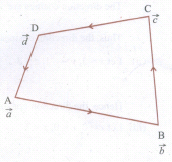
Let the position vector of the vertices of the quadrilateral ABCD be \(\overrightarrow{a},\overrightarrow{b},\overrightarrow{c}\)and\(\overrightarrow{d}\) respectively.
\(\therefore \overrightarrow{OA}=\overrightarrow{a}, \overrightarrow{OB}=\overrightarrow{b},\overrightarrow{OC}=\overrightarrow{c}\) and \(\overrightarrow{OD}=\overrightarrow{d}.\)
Since E and F are the mid-points of AC and BD respectively, we have
\(\overrightarrow{OE}={\overrightarrow{a}+\overrightarrow{c}\over 2}\) and \(\overrightarrow{OF}={\overrightarrow{b}+\overrightarrow{d}\over 2}\)
To prove that \(\overrightarrow{AB}+\overrightarrow{AD}+\overrightarrow{CB}+\overrightarrow{CD}=4\overrightarrow{EF}\)
\(LHS=\overrightarrow{AB}+\overrightarrow{AD}+\overrightarrow{CB}+\overrightarrow{CD}\)
\(=\overrightarrow{OB}-\overrightarrow{OA}+\overrightarrow{OD}-\overrightarrow{OA}+\overrightarrow{OB}-\overrightarrow{OC}+\overrightarrow{OD}-\overrightarrow{OC}\)
\(=\overrightarrow{b}-\overrightarrow{a}+\overrightarrow{d}-\overrightarrow{a}+\overrightarrow{b}-\overrightarrow{c}+\overrightarrow{d}-\overrightarrow{c}\)
\(=-2\overrightarrow{a}+2\overrightarrow{b}-2\overrightarrow{c}+2\overrightarrow{d}\)
\(=2[(\overrightarrow{b}+\overrightarrow{d})-(\overrightarrow{a}+\overrightarrow{c})]\)
\(=2[2\overrightarrow{OF}+2\overrightarrow{OE})\) [From (1)]
\(=4[\overrightarrow{OF}-\overrightarrow{OE}]=4.\overrightarrow{EF}=RHS\)
Hence proved.
16.
We have |B| = \(\begin{vmatrix} 2(a+b+c) & 2(a+b+c) &2(a+b+c) \\ c+a & a+b &b+c \\ a+b & b+c & c+a \end{vmatrix}\)\((R_1 \rightarrow R_1+R_2+R_3)\)
= 2\(\begin{vmatrix} a+b+c & a+b+c & a+b+c \\ c+a & a+b &b+c \\ a+b & b+c & c+a \end{vmatrix}\)
= 2\(\begin{vmatrix} a+b+c & a+b+c & a+b+c \\ -b & -c &-a \\ -c & -a & -b \end{vmatrix}\)\((R_2 \rightarrow R_2-R_1andR_3\rightarrow R_3-R_1)\)
= 2\(\begin{vmatrix}a &b &c \\ -b & -c & -a \\ -c & -a & -b \end{vmatrix}\)\((R_1 \rightarrow R_1+R_2+R_3)\)
= 2(-1)2 \(\begin{vmatrix}a &b &c \\b &c & a \\ c & a & b \end{vmatrix}\)
= 2| A |.
17.
\(Given A=\left[\begin{array}{ccc}1 & 2 & 2 \\ 2 & 1 & -2 \\ x & 2 & y\end{array}\right]\)
\(A^T=\left[\begin{array}{ccc} 1 & 2 & x \\ 2 & 1 & 2 \\ 2 & -2 & y \end{array}\right]\)
\(A A^T=9 I\)
\(\left[\begin{array}{ccc} 1 & 2 & 2 \\ 2 & 1 & -2 \\ x & 2 & y \end{array}\right]\left[\begin{array}{ccc} 1 & 2 & x \\ 2 & 1 & 2 \\ 2 & -2 & y \end{array}\right]=9\left[\begin{array}{lll} 1 & 0 & 0 \\ 0 & 1 & 0 \\ 0 & 0 & 1 \end{array}\right]\)
\(\left[\begin{array}{ccc} 1+4+4 & 2+2-4 & x+4+2 y \\ 2+2-4 & 4+1+4 & 2 x+2-2 y \\ x+4+2 y & 2 x+2-2 y & x^2+4+y^2 \end{array}\right]=\left[\begin{array}{lll} 9 & 0 & 0 \\ 0 & 9 & 0 \\ 0 & 0 & 9 \end{array}\right]\)
\(\left[\begin{array}{ccc} 9 & 0 & x+2 y+4 \\ 0 & 9 & 2 x-2 y+2 \\ x+4+2 y & 2 x+2-2 y & x^2+4+y^2 \end{array}\right]=\left[\begin{array}{lll} 9 & 0 & 0 \\ 0 & 9 & 0 \\ 0 & 0 & 9 \end{array}\right]\)
\(x+2 y+4=0 \Rightarrow x+2 y=-4 ....(1)\)
\(2 x-2 y+2=0 \Rightarrow 2 x-2 y=-2 ....(2)\)
\(\begin{aligned} &\text { Add (1) & (2) } \Rightarrow 3 x=-6 \\ &x=-2 \end{aligned}\)
\(\text { Put } x=-2 \text { in }(1) \Rightarrow-2+2 y=-4\)
\(-2+4=-2 y\)
\(2=-2 y\)
\(y=-1\)
\(\therefore x=-2\)
18.
\(A=\left[\begin{array}{ccc} 1 & 3 & 5 \\ -6 & 8 & 3 \\ -4 & 6 & 5 \end{array}\right] \Rightarrow A^T=\left[\begin{array}{ccc} 1 & -6 & -4 \\ 3 & 8 & 6 \\ 5 & 3 & 5 \end{array}\right]\)
\( Let \ P=\frac{1}{2}\left(A+A^T\right)=\frac{1}{2}\left[\begin{array}{ccc}2 & -3 & 1 \\ -3 & 16 & 9 \\ 1 & 9 & 10\end{array}\right] \)
\(Now \ P^T=\frac{1}{2}\left[\begin{array}{ccc}2 & -3 & 1 \\ -3 & 16 & 9 \\ 1 & 9 & 10\end{array}\right]=P\)
\(\text { Thus, } P=\frac{1}{2}\left(A+A^T\right)\) is a symmetric matrix.
\(\text { Let } Q=\frac{1}{2}\left(A-A^T\right)\)
\(=\frac{1}{2}\left[\begin{array}{ccc} 0 & 9 & 9 \\ -9 & 0 & -3 \\ -9 & 3 & 0 \end{array}\right]\)
\(\text { Then } Q^T=\frac{1}{2}\left[\begin{array}{ccc} 0 & -9 & -9 \\ 9 & 0 & 3 \\ 9 & -3 & 0 \end{array}\right]=-Q\)
\(\text { Thus } Q=\frac{1}{2}\left(A-A^T\right)\) is a skew-symmetric matrix.
\(A=P+Q=\frac{1}{2}\left[\begin{array}{ccc} 2 & -3 & 1 \\ -3 & 16 & 9 \\ 1 & 9 & 10 \end{array}\right]+\frac{1}{2}\left[\begin{array}{ccc} 0 & 9 & 9 \\ -9 & 0 & -3 \\ -9 & 3 & 0 \end{array}\right]\)
Thus A is expressed as the sum of symmetric and skew-symmetric matrices.
19.
RHS = tan (60° + \(\theta\)) tan (60° - \(\theta\))
Let 60° + \(\theta\) = \(\alpha\) and 60° - \(\theta\) = \(\beta\)
RHS = \(tan\ \alpha\ tan\ \beta=\frac{sin\alpha\ sin\beta}{cos\alpha\ cos\beta}\)
\(=\frac{2sin\alpha\ sin\beta}{2cos\alpha\ cos\beta}=\frac{cos(\alpha-\beta)-cos(\alpha+\beta)}{cos(\alpha+\beta)+cos(\alpha-\beta)}\)
\(=\frac{cos2\theta-cos120°}{cos120°+cos20\theta}=\frac{cos2\theta-(-\frac{1}{2})}{-\frac{1}{2}+cos2\theta}\)
[\(\because\)cos 120° = cos (90° + 30°) = - sin 30° = \(-\frac{1}{2}\)]
\(=\frac{2cos2\theta+1}{2cos2\theta-1}=LHS\)
20.
S10 = 52, S15 = 77, S20 =?
\({S}_{10}={10\over 2}(2a(10-1)d)=52\)
= 5 (2a + 9d) = 52
\(2a+9d={52\over 5}\)
\({S}_{15}={15\over 2}(a+(15-1)d)=77\)
\(={15\over 2}(2a+14d)=77\)
\(2a+14d={154\over 15}\)
\(2a+9d={52\over 2}\)
(2)-(1) \(\Rightarrow\) \({2a+14d={154\over 15}\over 5d={154\over 15}-{52\over 2}={154-156\over 15}}\)
\(5d={-2\over 15}\Rightarrow d={-2 \over 75}\)
substituting in (1) \(\Rightarrow\) \(2a-{18\over 75}={52\over 5}\)
\(2a={52\over 5}+{18\over 75}={780+18\over 75}\)
\(2a={798\over 75}\Rightarrow a={399\over 75}={133 \over 25}\)
\({S}_{20}={20 \over 2}\left[ \left( {798 \over 75} \right)+19\left( {-2\over 75} \right) \right]\)
\(=10{(798-38)\over 75}=10\left( {760\over 75} \right)\)
\(={1520\over 15}={304\over 3}\)
21.
The family of equations of straight lines through the point of intersection of the lines is of the form
\((a_1x+b_1y+c_1)+\lambda(a_2x+b_2y+c_2)=0\)
That is, \((3x+2y+5)+\lambda(3x-4y+6)=0\)
Since the required equation passes through the point (1, 1), the point satisfies the above equation.
Therefore {3 + 2(1) + 5} + λ {3(1) - 4(1) + 6} = 0 ⇒ λ= -2
Substituting λ = -2 in the above equation we get the required equation as 3x - 10y + 7 = 0 (verify the above problem by using two points form)
22.
The sine formula is, \(({a\over sin A})=({b\over sin B})=({c\over sin C})=2R\)
Now, \({b-c\over a}cos {A\over2}={2Rsin B-2R sin C\over 2Rsin A}cos {A\over2}\)
\(={2sin({B-C\over2})cos({B+C\over 2})\over 2sin {A\over2}cos{A\over2}}cos{A\over 2}\)
\(={sin({B-C\over2})cos(90^o-{A\over2})\over sin {A\over2}}\)
\(={sin({B-C\over2}) sin {A\over2}\over sin {A\over2}}=sin ({B-C\over2})\)
23.
Let, P(n) = 12 + 22 + 32 +...+k2 = \(\frac { n(n+1)(2n+1) }{ 6 } \)
Substituting n = 1 in the statement we get, P(1) = \(\frac { 1(1+1)(2(1)+1) }{ 6 } \) = 1.
Hence, P(1) is true. Let us assume that the statement is true for n = k. Then
P(k) = 12 + 22 + 32+...+k2 = \(\frac { k(k+1)(2K+1) }{ 6 } \)
We need to show that P(k + 1) is true. Consider
\(P(k+1) =\underbrace{1^2+2^2+3^3+...k^2}+(k+1)^2\)
= P(k) + (k+1)2
= \(\frac { k(k+1)(2K+1) }{ 6 } +(k+1)^2\)
= \(\frac { k(k+1)(2k+1)+6(k+1)^{ 2 } }{ 6 } =\frac { (k+1)(k(2k+1)+6(k+1) }{ 6 } \)
= \(\frac { (k+1)(2k^{ 2 }+7k+6) }{ 6 } =\frac { (k+1)[(k+2)(2k+3)] }{ 6 } \)
= \(\frac { (k+1)[(k+1)+1)(2(k+1)+1)] }{ 6 } \)
That is, P(k+1) = \(\frac { (k+1)((k+1)+1)(2(k+1)+1) }{ 6 } \)
This implies P(k + 1) is true. The validity of P(k + 1) follows from that of P(k). Therefore by the principle of mathematical induction,
12 +22 + 32+...n2 = \(\frac { n(n+1)(2n+1) }{ 6 } \), for all n ≥ 1.
24.
\(\sqrt{3}tan^2\theta+(\sqrt{3}-1)tan\theta-1=0\)
\(\sqrt{3}tan^2\theta+\sqrt{3}tan\theta-tan\theta-1=0\)
\((\sqrt{3}tan\theta-1)(tan\theta+1)=0\)
Thus, either \(\sqrt{3}tan\theta-1=0(or)tan\theta+1=0\)
| If\(\sqrt{3}tan\theta-1=0, \ then\) \(tan\theta={1\over\sqrt{3}}=tan {\pi\over 6}\) \(\Rightarrow \theta =n\pi+{\pi\over6},n \in Z ....(i)\) |
If \(tan\theta+1=0 \ then\) \(tan\theta=-1=tan ({-\pi\over 4})\) \(\Rightarrow \theta =n\pi-{\pi\over4},n \in Z ....(ii)\) |
From (i) and (ii) we have the general solution.
25.
Given p = length of perpendicular from (0, 0) to \(x\sec { \theta } +y{ cosec }{ \theta }=a\)
\(\Rightarrow p=\left| \frac { 0\left( \sec { \theta } \right) +0\left( cosec{ \theta } \right) -a }{ \sqrt { \sec ^{ 2 }{ \theta } +{ cosec }^{ 2 }{ \theta } } } \right| \)
\(\Rightarrow p=\frac { a }{ \sqrt { \frac { 1 }{ \cos ^{ 2 }{ \theta } } +\frac { 1 }{ \sin ^{ 2 }{ \theta } } } } =\frac { a }{ \sqrt { \frac { \sin ^{ 2 }{ \theta } +\cos ^{ 2 }{ \theta } }{ \sin ^{ 2 }{ \theta } \cos { \theta } } } } \)
\(\Rightarrow p=\frac { a\sin { \theta } \cos { \theta } }{ \sqrt { \sin ^{ 2 }{ \theta } +\cos ^{ 2 }{ \theta } } } =\frac { a\sin { \theta } \cos { \theta } }{ 1 } \)
\(\Rightarrow p=a\sin { \theta } \cos { \theta } \)
Also, it is given that p1 = length of perpendicular from (0, 0) to \(x\cos { \theta } -y\sin { \theta } =a\cos { 2\theta } \)
\(\Rightarrow { p }^{ 1 }=\left| \frac { 0\left( \cos { \theta } \right) -0\left( \sin { \theta } \right) -a\cos { \theta } }{ \sqrt { \cos ^{ 2 }{ \theta } +{ \left( -\sin { \theta } \right) }^{ 2 } } } \right| \)
\(=\frac { a\cos { 2\theta } }{ 1 } \)
\(\Rightarrow { p }^{ 1 }=a\cos { 2\theta } \)
LHS = 4p2 + (p1)2
= 4 (a cos \(\theta\) cos \(\theta\))2 + (a cos 2\(\theta\))2
= a2 (2 sin \(\theta\) cos \(\theta\))2 + a2 (cos 2\(\theta\))2
= a2 ((sin 2\(\theta\))2 + (cos 2\(\theta\))2) = a2 (sin2 2\(\theta\) + cos2 2\(\theta\))
= a2 (1) Hence Proved.
26.
Given equation of pair of lines is 6x2 + 5xy - py2 + 7x + qy - 5 = 0.
6x2+ 5xy - py2+ 7x + qy - 5 = 0
Here a = 6, b = -p, 2h = 5, 2g = 7, 2f = q
h = \(\frac { 5 }{ 2 } \) g = \(\frac { 7 }{ 2 } \) f = \(\frac { q }{ 2 } ,\) c = -5
The condition to represent perpendicular lines is a + b = 0 \(\Rightarrow\) 6 - p = 0 \(\Rightarrow\) p = 6
The condition to represent pair of lines is abc + 2fgh - af2- bg2- ch2 = 0
\(\Rightarrow \ 6-(-6)(-5)+\left( \frac { 7 }{ 2 } \right) \left( \frac { 5 }{ 2 } \right) -6\left( \frac { { q }^{ 2 } }{ 4 } \right) +6\left( \frac { 4q }{ 4 } \right) +5\left( \frac { 25 }{ 4 } \right) =0\)
Multiplying by 4 throughout we get,
720 + 35q - 6q2+294 + 125 = 0
\(\Rightarrow \quad 35q-6q^{ 2 }+1139=0\)
\(\Rightarrow \quad q=\frac { 35\pm \sqrt { { (-35) }^{ 2 }-4(6)(1139) } }{ 2\times 6 } \)
\(\Rightarrow \quad q=\frac { 35\pm \sqrt { 1225+27336 } }{ 12 } \)
\(\Rightarrow \quad q=\frac { 35\pm \sqrt { 28561 } }{ 12 } =\frac { 35\pm 169 }{ 12 } \)
\(\Rightarrow \quad q=\frac { 204 }{ 12 } or-\frac { 134 }{ 12 } \)
\(\Rightarrow \quad q=17\quad or\quad -\frac { 67 }{ 6 } \)
Hence p = 6, q = 17 or \(-\frac{67}{6}\)
27.
Since \(\alpha ,\beta \) are the roots of the equation \({ x }^{ 2 }-px+q=0\),we have
\(\alpha +\beta =-\frac { \left( -p \right) }{ 1 } =p\quad and\quad \alpha \beta =\frac { q }{ 1 } q\)
\(\therefore \log { (1+px+q{ x }^{ 2 }) } =\log { \left[ 1+(\alpha +\beta )x+\alpha \beta { x }^{ 2 } \right] } \)
\(=\log { \left[ (1+\alpha x)(1+\beta x) \right] } \)
\(=\log { (1+\alpha x)+log(1+\beta x) } \)
\(=\left( \alpha x-\frac { { \alpha }^{ 2 } }{ 2 } { x }^{ 2 }+\frac { { \alpha }^{ 3 } }{ 2 } { x }^{ 3 }+......+\infty \right) +\left( \beta x-\frac { { \beta }^{ 2 }{ x }^{ 2 } }{ 2 } +\frac { { \beta }^{ 3 }{ x }^{ 3 } }{ 3 } +.....\infty \right) \)
\(=(\alpha +\beta )x-\frac { { (\alpha }^{ 2 }+\beta ^{ 2 }) }{ 2 } { x }^{ 2 }+\frac { { (\alpha }^{ 3 }+\beta ^{ 3 }) }{ 3 } { x }^{ 3 }-...\infty \)
Hence proved.
28.
Given equation is 2x2 - xy - 3y2 - 6x + 19y - 20 = 0
Consider 2x2 - xy - 3y2 = (2x - 3y)(x + y) (By factorising)
\(\therefore\) (2x2 - xy - 3y2- 6x + 19y - 20) = (2x-3y+1)(x + y + m)
Equating the co-efficients of x and y both sides we get,
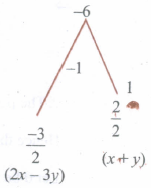
-6 = 2m + l ......(1)
- + -
19 = -3m + l ......(2)
__________________
-25 = 5m
\(\Rightarrow\) m = -5
Substituting m = -5 in (1) we get,
-6 = -10 + l \(\Rightarrow\) -6 + 10 = l
\(\Rightarrow\) l = 4
Hence the separate equations are 2x - 3y + 4 = 0 ......(3)
and x + y - 5 = 0 .....(4)
To get the point of intersection solve (3) and (4)
(3) \(\rightarrow\) 2x - 3y + 4 = 0
- - +
(4) \(\rightarrow\) \(\times\)2\(\Rightarrow\) 2x + 2y - 10 = 0
______________
-5y+ 14 = 0
\(\Rightarrow\) -5y = -14
\(\Rightarrow\) \(y=\frac { -14 }{ -5 } \)
\(\Rightarrow\) \(y=\frac { 14 }{ 5 } \)
Substituting y = \(\frac { 14 }{ 5 } \) in (3) we get
\(2x-3\left( \frac { 14 }{ 5 } \right) +4=0\)
\(\Rightarrow \quad 2x-\frac { 42 }{ 5 } +4=0\)
\(2x=\frac { 42 }{ 5 } -4\)
\(\Rightarrow \quad 2x=\frac { 42-20 }{ 5 } =\frac { 22 }{ 5 } \)
\(\Rightarrow \quad x=\frac { 11 }{ 5 } \)
\(\therefore\) The point of intersection is \(\left( \frac { 11 }{ 5 } ,\frac { 14 }{ 5 } \right) \)
Hence the given lines are intersecting lines.
Let \(\theta\) be the angle between the given lines.
Then tan \(\theta\) = \(\pm \frac { 2\sqrt { { h }^{ 2 }-ab } }{ a+b } \)
\(=\pm \frac { 2\sqrt { { \left( -\frac { 1 }{ 2 } \right) }^{ 2 } } -2(-3) }{ 2-3 } \begin{bmatrix} \because \quad a=2,\quad 2h=-1\quad b=-3 & \\ \quad \quad \quad \quad \quad \quad h=\frac { 1 }{ 2 } , & \\ & \end{bmatrix}\)
\(=\pm \frac { 2\sqrt { \frac { 1 }{ 4 } +6 } }{ -1 } =2\sqrt { \frac { 25 }{ 4 } } =2\left( \frac { 5 }{ 2 } \right) =5\)
\(\because \quad \theta ={ tan }^{ -1 }(5).\)
29.
Given series is \(\sum_{n=1}^{\infty}{1\over 2^{n-1}}\left({1\over 9^{n-1}}+{1\over9^{2n-1}}\right)\)
\(S_\infty=1\left(1+{1\over9}\right)+{1\over2}\left( {1\over9}+{{1\over9^3}} \right)+{1\over 2^2}\left( {1\over9^2}+{1\over9^5} \right)+...\)
\(=\left( 1+{1\over9} \right)+{1\over2}\left( {1\over9}+{1\over 9^3} \right)+{1\over2^2}\left( {1\over2^2}+{1\over 9^5} \right)+..\)
Separating the first term and second term from each bracket, we get
\(=\left[ 1+{1\over 2}+{1\over 9}+{1\over 2^2}\left( {1\over 9^2}\right)+..\right]+\left[ {1\over9}+{1\over2}\left( {1\over 9^5} \right)+...\right]\)
\(=\left[1+{1\over2}\left(1\over 9\right)+{1\over 2^2}\left( {1\over 9^2} \right)+...\right]+{1\over9}\left[1+{1\over2}\left( {1\over 9^2}\right) +{1\over2^2} \left( {1\over 9^4} \right)+...\right]\)
Now consider \({1+{1\over2}}\left(1\over9\right)+{1\over 2^2}\left(1\over 9^2\right)+...\)
Here a = 1, \(r={1\over 18}\)
\(∴\ S_\infty={a\over 1-r}={1\over 1-{1\over 8}}={18\over 17}\)
In \(1+{1\over2}\left(1\over9^2\right)+{1\over 2^2}\left(1\over 9^4\right)+...\)
\(a=1,r={1\over 81\times2}={1\over162}\)
\(∴\ S_\infty =1, r={a\over 1-r}={1\over 1-{1\over 162}}={162\over 161}\)
Substituting these values in (1) we get
\(S_\infty={18\over 17}+{1\over 9}\times{162\over161}={18\over17}+{162\over 1449}={26082+2754\over 17\times1499}={28836\over 24633}\)
\({ S }_{ \infty }=1.170\)
30.
Given series is \(\sqrt { 3 } +\sqrt { 75 } +\sqrt { 243 } +.... .\) and \(S_n =435\sqrt { 3 }\)
Given series is \(1(\sqrt3)+5(\sqrt3)+9(\sqrt3)+...\)
Here a = √3, d = 4√3
∴ The given series an arithmetic progression
\(∴\ S_n={n\over2}[2a+(n-1)d]\)
\(435\sqrt3={n\over2}[2\sqrt3 +(n -1)4\sqrt3]\) [∵ given Sn = 435√3J]
\(435\sqrt3={n\over2}[2\sqrt3+4n\sqrt3-4\sqrt4]\)
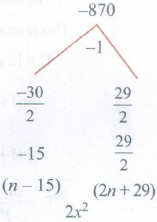
\(⇒\ 435\sqrt3={n\over2}[4n\sqrt3-2\sqrt3]\)
\(⇒\ 435\sqrt3=2{\sqrt3.n\over2}[2n-1]\)
⇒ 435 = 2n2-n
⇒ 2n2- n - 435 = 0
⇒ (n = 15)(2n + 29) = 0
⇒ \(n-15\ or\ n={-29\over2}\) which is not possible
⇒ n = 15
31.
Let Sn = 8 + 88 + 888 + 8888 + .... upto n terms
= 8 (1 + 11 + 111 + 1111 + ....) upto n terms
\(={8\over9}(9 + 99 + 999 + ...)\)
\({ S }_{ n }=\frac { 8 }{ 81 } \left[ \left( { 10 }^{ n }-1 \right) -9n \right] \) [multiplying and dividing by 9]
\(={8\over9}[10 -1) + (100 -1) + (1000 -1) + ...]\)
\(S_n={8\over 9}[(10^1 +10^2 +10^3 + ... +10^n)-(1+1+1+ ... +1n\ terms)]\)
In 10 + 102 + 103 + ... + 10n, a = 10, r= 10, and it forms a G.P.
\(∴\ S_n={a(r^n-1)\over r-1}=10{(10^n-1)\over 10-1}={10\over 9}(10^n)-1\) and 1 + 1 + 1 ... + upto n terms = n
Substituting these values in (1) we get
\(S_n={8\over 9}\left[ 10(10^n-1)n\over 9\right]\)
\(S_n={8\over 81}[(10^n-1)-9n]\)
32.
Let p(n) denote the statement
\(1^2+3^2+5^2+...+(2n-1)^2={n(2n-1)(2n+1)\over 3}\)
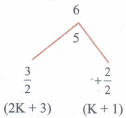
Step1: Putting n = 1
\(1^2={1(2-1)(2+1)\over3}={3\over 3}=1\)
∵ p(1) is true
Step 2: Let us assume that p(K) is true
i.e. \(1^2+3^2+5^2+..+(2K-1)^2={K(2K-1)\over3}\)
To prove that p(K + 1) is true
\(∵\ 1^2+3^2 +5^2 + ..+ (2K-1)^2 + [2(K + 1)-1]^2={(K+1)(2(K+1)-1)(2(K+1)+1)\over 3}\)
i.e. to P.T. \(1^2 + 3^2 + 5^2 + ... + (2K -1)^2(2K + 1)^2 ={(K+1)(2K+1)(2K+3)\over 3}\)
LHS = 12+ 32 + 52 + ... + (2K - 1)2 + (2K + 1)2
\(={K(2K-1)(2K+1)\over3}+(2K+1)^2\)
\(=(2K+1)\left[{K(2K-1)\over 3}+2K+1\right]\)
\(=(2K+)\left[2K^2-K+6K+3\over3\right]={(2K+1)(2K^2+5K+3)\over3}\)
\(={(2K+1)(2K^2+5K+3)\over3}\)=RHS
∵ p(K+1) is true
∵ By mathematical induction, P(n) is true for all values of n.
33.
(i) Either starts with L or ends with S.
| 1 | 4 | 3 | 2 | 1 |
| L |
Since the words starts with L, the remaining 4 boxes can be filled in 4 x 3 x 2 x 1 ways by the remaining letters o, T, U, S.
∴ Number of words starting with L
= 1 \(\times\) 4 \(\times\) 3 \(\times\) 2 \(\times\) 1 = 24.
| 1 | 2 | 3 | 4 | 1 |
| S |
Here also, the remaining 4 boxes can be filled in 4 \(\times\) 3 \(\times\) 2 \(\times\) 1 ways = 24.......(1)
Number of words ending with S = 24 ....(2)
Number of words starting with L and end with S are 3 \(\times\) 2 \(\times\) 1 = 6...(3)
∴ By fundamental principle of addition, number of words either starts with L nor ends with S = 24 + 24 - 6 = 48 - 6 = 42
| 3 | 2 | 1 | ||
| F | S |
(ii) Neither starts with L nor ends with S.
Total number of words formed by the letters of the word LOTUS is 5 \(\times\) 4 \(\times\) 3 \(\times\) 2\(\times\) 1 = 120.
Now, number of words neither starts with L nor end with S.
= (Total number of words) - (Number of words starts with either L nor ends with S)
= 120 - 42
= 78.
34.
\({{6x^2-x+1}\over{x^3+x^2+x+1}}={6x^2-x+1\over x^2(x+1)+1(x+1)}={6x^2-x+1\over (x^2+1)(x+1)}\)
⇒ \({6x^2-x+1\over (x^2+1)}={Ax+B\over x^2+1}+{C\over x+1}\)
⇒ 6x2-x+1 = (Ax+B)(x+1)+C(x2+1)
Putting x=-1 in (1) we get
6 + 1 + 1 = C(1 + 1) ⇒ 8 = 2C ⇒ C = 4
Equating the Co-efficient of x2 in (1) we get,
6 = A + C ⇒ 6 = A + 4 ⇒ A = 6 - 4
⇒ A = 2
Putting x=0 in (1) we get
1 = B + C ⇒ 1 = B + 4 ⇒ 1 - 4 = B
⇒ B = -3
\(\therefore\ {{6x^2-x+1}\over{x^3+x^2+x+1}}={{2x-3}\over{x^2+1}}+{{4}\over{x+1}}\)
35.
\({1\over x^4-1}={1\over (x^2+1)(x^2-1)}={1\over (x^2+1)(x+1)(x-1)}\)
\({1\over x^4-1}={Ax+B\over x^2+1}+{C\over x+1}+{D\over x-1}\)
\(⇒ {1\over x^2-1}={(Ax+B)(x+1)(x-1)+C(x^2+1)(x-1)+D(x^2+1)(x+1)\over (x^2+1)(x^2+1)}\)
⇒ 1= (Ax + B)(x + 1)(x - 1) + C(x2 + 1) (x - 1) + D(x2 + 1) (x + 1)
Putting x=1 in (1) we get
1 = D (2) (2) ⇒ \(D={1\over 4}\)
Putting x = -1 in (1) we get
1 = C(2)(-2) ⇒ \(C=-{1\over 4}\)
Equating the coefficient of x3 we get
0 = A + C + D ⇒ A = - C - D
⇒ \(A={1\over 4}-{1\over 4}=0\)
⇒ A = 0
Putting x = 0 in (1) we get
1 = -B - C +D
⇒\(1=-B+{1\over 4}+{1\over 4}\)
⇒ \(B=-1+{1\over 2}⇒B=-{1\over 2}\)
\(∴\ \ {1\over x^4-1}={0x-{1\over2}\over x^2+1}+{-{1\over 4}\over x+1}+{{1\over 4}\over x-1}\)
\(\Rightarrow\) \({{1}\over{x^4-1}}={{-{{1}\over{2}}}\over{x^2+1}}-{{{{1}\over{4}}}\over{x+1}}+{{{{1}\over{4}}}\over{x-1}}=-{{1}\over{2(x^2+1)}}-{{1}\over{}4(x+1)}+{{1}\over{4(x-1)}}\)
36.
LHS = a(cos B + cos C)
= \(a\left( \frac { { c }^{ 2 }+{ a }^{ 2 }-{ b }^{ 2 } }{ 2ac } +\frac { { a }^{ 2 }+{ b }^{ 2 }-{ c }^{ 2 } }{ 2ab } \right) \)
\(\frac { 1 }{ 2 } \left[ \frac { { c }^{ 2 }+{ a }^{ 2 }-{ b }^{ 2 } }{ c } +\frac { { a }^{ 2 }+{ b }^{ 2 }-{ c }^{ 2 } }{ b } \right] \)
= \(\frac { 1 }{ 2bc } \left[ { bc }^{ 2 }+{ a }^{ 2 }b-{ b }^{ 3 }+{ a }^{ 2 }c+{ b }^{ 2 }c-{ c }^{ 3 } \right] \)
= \(\frac { 1 }{ 2bc } \left[ -\left( { b }^{ 3 }+{ c }^{ 3 } \right) +\left( { a }^{ 2 }b+{ a }^{ 2 }c \right) +{ bc }^{ 2 }+{ b }^{ 2 }c \right] \)
= \(\frac { b+c }{ 2bc } \left[ -{ b }^{ 2 }+bc-{ c }^{ 2 }+{ a }^{ 2 }+bc \right] \)
= \(\frac { b+c }{ 2bc } \left[ { a }^{ 2 }-{ b }^{ 2 }-{ c }^{ 2 }+2bc \right] \)
= \(\left( \frac { b+c }{ 2bc } \right) \left[ \left( a+b-c \right) +\left( a-b+c \right) \right] \)
= \(\left( \frac { b+c }{ 2bc } \right) \left( a+b+c-2c \right) \left( a+b+c-2b \right) \)
= \(\left( \frac { b+c }{ 2bc } \right) \left[ \left( 2s-2c \right) \left( 2s-2b \right) \right] \)
= \(\frac { b+c\left( 4 \right) }{ 2bc } \left[ \left( s-c \right) \left( s-b \right) \right] =2\left( b+c \right) \left[ \frac { \left( s-b \right) \left( s-c \right) }{ bc } \right] \)
= \(2\left( b+c \right) { sin }^{ 2 }\frac { A }{ 2 } \)
= RHS
Hence proved.
37.
Let x be the smaller of two positive odd integers so that the other one is x + 2
Given x > 10,.....(1) and x + 2 > 10.
\(\Rightarrow\) x > 10-2
\(\Rightarrow\) x > 8.....(2)
And (x) + (x + 2) < 40 .....(3)
From (1) and (2) we get, x > 10.....(4)
From (3) we get
2x+2 <40
\(\Rightarrow\) 2x < 40 -2
\(\Rightarrow\) 2x < 38
\(\Rightarrow\) x < \(\frac { 38 }{ 2 } \)
\(\Rightarrow\) x = 19....(5)
From (4) and (5) we get,
10 < x < 19.
Since x is an odd natural number, x can take the values 11, 13, 15, 17.
Hence the required possible consecutive pairs will be (11, 13), (13, 15), (15, 17)
38.
LHS = sin 2A + sin 2B + sin 2C
= 2sin \(\left( \frac { 2A+2B }{ 2 } \right) \)cos\(\left( \frac { 2A-2B }{ 2 } \right) \) + 2sin C cos C.
= 2sin(A+B) cos(A-B) + 2sin C cos C
= 2sin\(\left( \frac { \pi }{ 2 } -C \right) \)cos(A-B) + 2sin C cos C
= 2cos C cos(A-B) + 2sin C cos C
= 2 cos C\(\left[ cos(A-B)+sin\left( \frac { \pi }{ 2 } (A+B) \right) \right] \)
= 2cos C 2cos A cos B
= 4cos A cos B cos C = RHS
39.
Given A = {a, b, c, d}, B = {a, c, e}, C = {a, e}
B∩C = {a, c}
A∩(B∩C) = {a}
A ∩ B = {a, e}
(A ∩ B) ∩ C = {a}
From (1) and (2), it is clear that A ∩ (B ∩ C) = (A ∩ B) ∩ C.
40.
Given \(\sqrt{x+5}+\sqrt{x+21}=\sqrt{6x+40}\)
Squaring both sides we get
\((\sqrt{x+5}+\sqrt {x+21})^2=(\sqrt{6x+40})^2\)
⇒ \(z+5+z+21+2\sqrt{(x+5)(x+21)}=6x+40\)
⇒ \( 2x+26+2\sqrt{(x+5)(x+21)}=6x+40\)
⇒ \(2\sqrt{(x+5)(x+21)}=6x+40-2x-26\)
⇒ \(2\sqrt{(x+5)(x+21)}=4x+14\)
\(\sqrt{(x+5)(x+21)}=2x+7\)
Squaring again we get
(x + 5)(x + 21) = (2x + 7)2
⇒ x2 + 21x + 5x + 105 = 4x2+ 49 + 28x
⇒ x2 + 26x + 105 = 4x2 +49 + 28x
⇒ 3x2 + 2x- 56 = 0
\(x = {-2 \pm \sqrt{4-4(3)(-56)} \over 6}\)
\(x = {-2 \pm \sqrt{4+672)} \over 6}\)
\(x={-2\pm26\over 6}⇒x=4,{-14\over 3}\)
⇒ When x = 4
Case (i) :
\(\sqrt{4+5}+\sqrt{4+21}=\sqrt{6(4)}+40\)
\(\sqrt9+\sqrt{25}=\sqrt{64}\)
3 + 5 = 8
8 = 8 which is true ⇒ x = 4 is a root
Case (ii) : When x = \(-14\over 3\)
\(\sqrt{{1-\over3}+5}+\sqrt{{-14\over 3}+21}=\sqrt{+6\left(-14\over 3\right)+40}\)
\(\sqrt{1\over 3}+\sqrt{49\over 3}=\sqrt{12}\) which is not true
\(\therefore\) x \(={{-14}\over{3}}\) is not a root.
41.
(i) \(y=-x^{ \left( \frac { 1 }{ 3 } \right) }\)
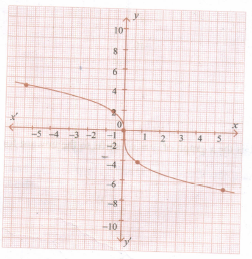
\(Let \ y=-x^{ ^{ \frac { 1 }{ 3 } } }\)
\(Then \ y=-x^{ ^{ \frac { 1 }{ 3 } } }\) is the reflection of the graph of \(y=x^{ ^{ \frac { 1 }{ 3 } } }\) about the x-axis.
(ii) \(y=x^{1\over 3}+1\)
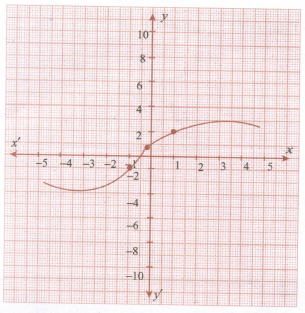
Let \(y=x^{ ^{ \frac { 1 }{ 3 } } }\)
Then \(y=x^{ ^{ \frac { 1 }{ 3 } } }+1\) is the x graph of \(y=x^{ ^{ \frac { 1 }{ 3 } } }\) shifts to the upward for one unit
(iii) \(y=x^{1\over 3}-1\)
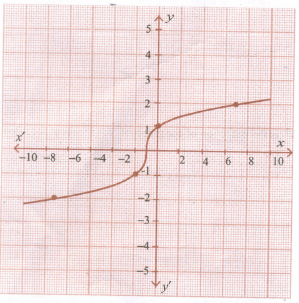
Let \(y=x^{1\over 3}\)
Then \(y=x^{1\over 3}\)-1 is the graph of \(x^{ ^{ \frac { 1 }{ 3 } } }\) shifts to the downward for one unit.
(iv) \(y=(x+1)^{1\over 3}\)
| x | 0 | 1 | 7 | -9 |
| y | 1 | 1 | 2 | -2 |
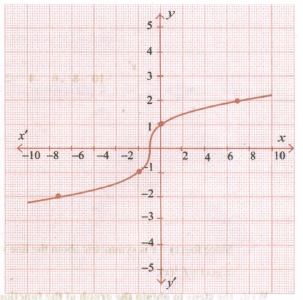
\(y=(x+1)^{1\over 3}\) causes the graph of \({x}^{\frac{1}{3}}\), shifts to the left for one unit.
42.
Given f(x) = 3x - 4
Let y = 3x - 4 ⇒ y + 4 = 3x
\(⇒ x={y+4\over 3}\)
Let g(y) = \(y+4\over 3\)
Now gof(n) = g(f(n)) = g(3\(\times\) -4) = \({3x-4+4\over 3}={3x\over 3}=x\)
and fog(y) = f(g(y)) = \(f\left(y+4\over 4\right)=3\left(y+4\over 3\right)-4=y+4-4=y\)
Thus, gof(x) = Ix and fog (y) = Iy
This implies that f and g are bijections and inverses to each other
Hence f is bijection and \(f^{-1} (x)={y+4\over 3}\)
Replacing y by x, we get f-1 (x) = \(\frac { x+4 }{ 3 } \)
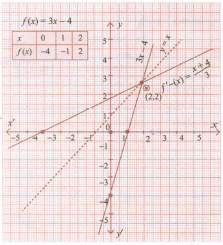
Hence, the graph of y = f-1(x) is the reflection of the graph of f in y = x
43.
Given f(x) = 1.23x where x represents the number of American dollars.
and g(y) = 50.50y where y represents the number of Singapore dollars.
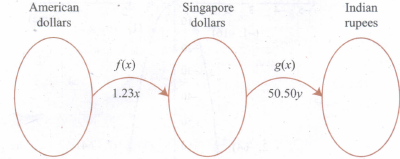
To convert American dollars to Indian rupees, we have to find out go f(x)
∴ go f(x) = g(f(x))
= g(1.23x)
= 50.50[1.23x]
= 62.115x
∴ The function for exchange rate of American dollars in terms of Indian rupee is g o f (x) = 62.115x.
44.
Given P(A) = 0.5, P(B) = 0.8
⇒ P(B/A) = 0.8
We kmow P(B/A) = \(\frac{P(A\cap B)}{P(A)}\)
⇒ 0.8 = \(\frac{P(A\cap B)}{0.5}\)
⇒ \(P(A\cap B)=(0.8)(0.5)=0.4\)
(i) Now P(A./B) = \(\frac{P(A\cap B)}{P(B)}=\frac{0.4}{0.8} =\frac{1}{2}=0.5\)
(ii) \(P(A\cup B)=P(A)+P(B)-P(A\cap B)\)
= 0.5 + 0.8 - 0.4 = 1.3 - 0.4
= 0.9
45.
\(
\int\left(1-x^2\right)^{-\frac{1}{2}} d x =\int \frac{1}{\left(1-x^2\right)^{1 / 2}} d x \)
\(=\int \frac{1}{\sqrt{1-x^2}} d x=\sin ^{-1} x+c\)
46.
\(y={e^{3x}\over 1+e^x}\)
\(\frac { dy }{ dx } =\frac { (1+{ e }^{ x }).\frac { d }{ dx } ({ e }^{ 3x })-{ e }^{ 3x }.\frac { d }{ dx } (1+{ e }^{ x }) }{ (1+{ e }^{ x })^{ 2 } } =\frac { (1+{ e }^{ x }).{ e }^{ 3x }.3-{ e }^{ 3x }(0+{ e }^{ x }) }{ (1+{ e }^{ x })^{ 2 } } \)
=\(\frac { 3{ e }^{ 3x }+3{ e }^{ 4x }-{ e }^{ 4x } }{ (1+{ e }^{ x })^{ 2 } } =\frac { 3e^{ 3x }+2e^{ 4x } }{ (1+{ e }^{ x })2 } \) .
47.
\(lim_{x\rightarrow0}{\sqrt{1-x}-1\over x^2}\)
Multiplying and dividing by \((\sqrt{1-x}+1)\)we get,
\(lim_{x\rightarrow0}{\sqrt{1-x}-1\over x^2}\times {\sqrt{1-x}+1\over \sqrt{1-x}+1}\)\(=lim_{x\rightarrow0}{({1+x})-1\over x^2[\sqrt{1-x}+1]}\)
\(=lim_{x\rightarrow0}{{-x}\over x^2[\sqrt{1-x}+1]}= lim_{x\rightarrow0}{{-1}\over x[\sqrt{1-x}+1]} =-\infty\)
Since f(x) -\(\infty\) as x \(\rightarrow\) 0, the limit of the given function does not exist.
48.
(i) If f(n) = f(m), then n + 2 = m + 2 and hence m = n. Thus f is one-to-one. As 1 has no pre-image, this function is not onto.
(ii) As above, this function is one-to-one. If m is in the co-domain, then m − 2 is in the domain and f(m − 2) = (m − 2) + 2 = m; thus m has a pre-image and hence this function is onto.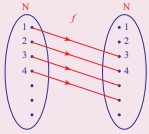
49.
cos 35o - cos 75o = \(2\sin { \left( \frac { 35+75 }{ 2 } \right) } .\sin { \left( \frac { 75-35 }{ 2 } \right) } \)
= 2 sin 55o sin 20o
50.
Let l, m, n ∈ p.
Reflexivity: We cannot say l is perpendicular to l itself.
∴ l R l \(\Rightarrow \) R is not reflexive.
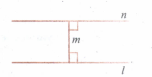
Symmetry: lRm ≠ mRl
l is perpendicular to m ⇒ m is perpendicular to l
∴ R is symmetric
Transitive: lRm and mRn ≠ lRn.
l is perpendicular to m and m is perpendicular to n.
⇒ l is perpendicular to n.
∴ R is not transitive.
⇒ R is only symmetric.

11th Standard Syllabus & Materials
11th Standard
TN 11th Tamil பீடு பெற நில் - செய்யுள் - காவடிச்சிந்து Important Questions And Answers Study Material - QB365 Set A
NEW11th Standard
TN 11th Tamil பீடு பெற நில் - உரைநடை - மலை இடப்பெயர்கள் : ஓர் ஆய்வு Important Questions And Answers Study Material - QB365 Set A
NEW11th Standard
TN 11th Tamil மாமழை போற்றுதும் - துணைப்பாடம் - யானை டாக்டர் Important Questions And Answers Study Material - QB365 Set A
NEW11th Standard
TN 11th Tamil மாமழை போற்றுதும் - செய்யுள் - ஐங்குறுநூறு Important Questions And Answers Study Material - QB365 Set A



Tamilnadu Stateboard 11th Standard Subjects
Maths

Commerce

Economics

Biology

Business Maths and Statistics

Accountancy

Computer Science

Physics

Chemistry
Maths
Biology
Economics
Physics
Chemistry

History
Business Maths and Statistics

Computer Science
Accountancy

Computer Applications
History
Computer Technology
Commerce
Computer Applications
Computer Technology

Tamil

English

French
Tamilnadu Stateboard Standards

