
 100% FREE ACCESS
11th Standard Syllabus & Materials
11th Standard
TN 11th Tamil இயற்கை வேளாண்மை,சுற்றுச்சூழல் -செய்யுள் - மனோன்மணீயம் Important Questions And Answers Study Material - QB365 Set A
NEW11th Standard
TN 11th Tamil என்னுயிர் என்பேன் -துணைப்பாடம் - இசைத்தமிழர் இருவர் Important Questions And Answers Study Material - QB365 Set A
NEW11th Standard
TN 11th Tamil மொழி கலை -செய்யுள் - ஒவ்வொரு புல்லையும் Important Questions And Answers Study Material - QB365 Set A
NEW11th Standard
TN 11th Tamil பீடு பெற நில் - இலக்கணம் - பகுபத உறுப்புகள் Important Questions And Answers Study Material - QB365 Set A
NEW11th Standard
TN 11th Tamil பீடு பெற நில் - துணைப்பாடம் - வாடிவாசல் Important Questions And Answers Study Material - QB365 Set A
NEW11th Standard
TN 11th Tamil பீடு பெற நில் - செய்யுள் - குறுந்தொகை Important Questions And Answers Study Material - QB365 Set A

Published on: 12/03/2019
11th Public Exam March 2019 Important 5 Marks Questions
Download Tamil Nadu 11th Standard Physics question papers, model tests, one-mark questions, important questions, and public exam papers in PDF format. Free study materials and answer keys for TN State Board students.
Questions + Answers key
Take MCQ Physics Test1.
A simple pendulum has time period T, the point of suspension is now moved upward acceleration to the relation Y= kt2 (k = 1 ms-2) where Y is the verticle displacement the time period now becomes T2. What is the ratio \(\frac { { T }_{ 1 }^{ 2 } }{ { T }_{ 2 }^{ 2 } } \)? Given g=10 ms-2.
2.
For the travelling : harmonic wave y(x, t) = 2.0 cos 2π [St - 0.0060x + 0.27], where x and yare in cm and t in s.
Calculate the phase difference between oscillatory motion of two points separated by a distance of,
(a) 300 cm
(b) 0.75 m (c)\(\lambda\over 4\)
3.
Write the applications of reflection of sound waves.
4.
Speed of an atom in an argon gas cylinder equal to the rms speed of a helium gas atom at -20°C? [Atomic mass of Ar =39.90, He =4.04]
5.
What is meant by coefficient of linear expansion superficial & cubical expansion?
6.
Show that the projection of uniform circular motion on a diameter is SHM.
7.
Write the applications of surface tension?
8.
Briefly explain the concept of superposition principle.
9.
Consider a string in a guitar whose length is 80 cm and a mass of 0.32 g with tension 80 N is plucked. Compute the first four lowest frequencies produced when it is plucked.
10.
Discuss in detail the energy in simple harmonic motion.
11.
Find the adiabatic exponent \(\gamma\) for mixture of μ1 moles of monoatomic gas and μ2 moles of a diatomic gas at normal temperature (27°C).
12.
13.
Explain in detail the thermal expansion.
14.
What is capillarity? Obtain an expression for the surface tension of a liquid by capillary rise method.
15.
Explain the different types of modulus of elasticity?
16.
Derive the time period of satellite orbiting the Earth.
17.
Explain how Newton arrived at his law of gravitation from Kepler’s third law.
18.
Discuss the important features of the law of gravitation.
19.
A solid cylinder when dropped from a height of 2 m acquires a velocity while reaching the ground. If the same cylinder is rolled down from the top of an inclined plane to reach the ground with same velocity, what must be the height of the inclined plane? Also compute the velocity.
20.
Explain the principle of homogeniety of dimensions. What are its uses? Give example
21.
Write an expression for the KE of a body rolling without slipping with centre of mass as reference.
22.
If a particle elastically collides obliquely with a particle of same mass at rest then show that they move perpendicular to each other after collision.
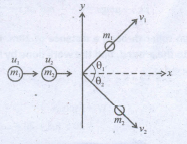
23.
Two particles move along x axis. The position of particle is given by x = 6.0 t2 + 4.0 t + 2.0, acceleration of particle 2 is given by a = -6.0 t and t =0, its velocity is 30 m/s, When the velocities of the particles match, find their velocities.
24.
Explain the subtraction of vectors.
25.
A uniform disc of mass 100g has a diameter of 10 cm, Calculate the total energy of the disc when rolling along a horizontal table with a velocity of 20 cms-1. (take the surface of table as reference).
26.
On the edge of a wall, we build a brick tower that only holds because of the bricks own weight. Our goal is to build a stable 1 tower whose overhang d is greater than the length l of a single brick. What is the minimum number of bricks you need?
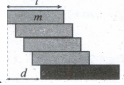
27.
A spherical solid ball of 1 kg mass and radius 3 cm is rotating about an axis passing through its centre with an angular velocity of 50 rad/s. Calculate the kinetic energy of rotation.
28.
Derive an expression for the Center of Mass of Two Point Masses.
29.
State and prove parallel axis theorem.
30.
Derive the expression for moment of inertia of a rod about its center and perpendicular to the rod?
31.
Explain the types of equilibrium with suitable examples?
32.
Explain propagation of errors in the difference of two quantities and also in the division of two quantities.
33.
Deduce the relation between momentum and kinetic energy.
34.
What is inelastic collision? In which way it is different from elastic collision. Mention few examples in day to day life for inelastic collision.
35.
How will you confirm Newton's third law by the way of two Bodies in Contact on a Horizontal Surface?
36.
Describe the method of measuring angle of repose.
37.
Briefly explain 'centrifugal force' with suitable examples.
38.
39.
Discuss the properties of scalar and vector products.
40.
(i) Explain the use of screw gauge and vernier caliper in measuring smaller distances.
(ii) Write a note on triangulation method and radar method to measure larger distances
41.
Calculate the equivalent spring constant for the following systems and also compute if all the spring constants are equal:
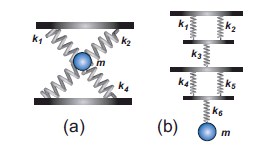
42.
Show that for a simple harmonic motion, the phase difference between
a. displacement and velocity is \(\frac{\pi}{2}\) radian or 90°.
b. velocity and acceleration is \(\frac{\pi}{2}\) radian or 90°.
c. displacement and acceleration is \(\pi\) radian or 180°.
43.
State and prove Archimedes principle.
44.
A block of mass m slides down the plane inclined at an angle 60° with an acceleration \(\frac { g }{ 2 } \). Find the coefficient of kinetic friction.
45.
Two vectors \(\vec A\) and \(\vec B\) of magnitude 5 units and 7 units respectively make an angle 60° with each other as shown below. Find the magnitude of the resultant vector and its direction with respect to 7 unit the vector \(\vec A\).
.png)
46.
Arrive at an expression for power and velocity. Give some examples for the same.
47.
What are concurrent forces? State Lami's theorem.
48.
A hot water cools from 92°C to 84°C in 3 minutes when the room temperature is 27°C. How long will it take for it to cool from 65°C to 60°C?
49.
Calculate the volume of one mole of any gas at STP and at room temperature (300K) with the same pressure 1 atm.
50.
Check the correctness of the equation\(\frac { 1 }{ 2 } \)mv2 = mgh using dimensional analysis method.
1.
In first case
T1=\(2\pi \sqrt { \frac { l }{ g } } \)
in second case, displacement y = kt2
upward velocity, v =\(\frac{dy}{dt}\)=2 kt.
upward acceleration a = 2,
k = 2\(\times\)1 ms-2 = 2 ms-2
T2= \(2\pi \sqrt { \frac { l }{ g+a } } =2\pi \sqrt { \frac { l }{ g+2 } } \)
Hence \(\frac { { T }_{ 1 }^{ 2 } }{ { T }_{ 2 }^{ 2 } } =\frac { 4{ \pi }^{ 2 }l }{ g } \times \frac { g+2 }{ 4{ \pi }^{ 2 }l } \)
=\(\frac { g+2 }{ g } =\frac { 10+2 }{ 10 } =\frac { 6 }{ 5 } \)
2.
Here,
y = 2.0 cos 2π(8t - 0.0060x + 0.27)
= 2.0 cos [2π (8t - 0.0060x) + 2π(0.27)]
Standard equation for a travelling wave is,
\(y=r\ cos\left[ {2\pi\over \lambda}(vt-x)+\phi\right]\)
Here
\(\phi={2\pi\over \lambda}x=2\pi\times0.006x\)
\({2\pi\over \lambda}=0.006\)
(a) When x = 300 em,
ψ= 2π\(\times\) 0.006\(\times\)300
=3.6π rad.
(b) When x = 0.75 m = 75 em,
ψ = 2π\(\times\)0.006\(\times\)75
= 0.9π rad
(c) When \(x={{\lambda}\over 4}\)
\(\phi={2\pi\over \lambda}\times{\lambda\over4}={\lambda \over 2}rad\)
3.
(a) Stethoscope: It works on the, principle of multiple reflections.
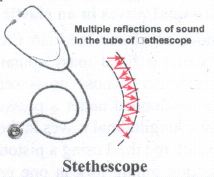
It consists of three main parts:
(i) Chest piece
(ii) Ear piece
(iii) Rubber tube
(i) Chest piece: It consists of a small disc-shaped resonator (diaphragm) which is very sensitive to sound and amplifies the sound it detects.
(ii) Ear piece: It is rnade up of metal tubes which are used to hear sounds detected by the chest piece.
(iii) Rubber tube: This tube connects both chest piece and ear piece. It is used to transmit the sound signal detected by the diaphragm, to the ear piece. The sound of heart beats (or lungs) or any sound produced by internal organs can be detected, and it reaches the ear piece through this tube by multiple reflections.
(b) Echo: An echo is a repetition of sound produced by the reflection of sound waves from a wall, mountain or other obstructing surfaces. The speed of sound in air at 20°C is 344 ms-1 If we shout at a wall which is, at 344 m away, then the sound will take 1 second to reach the wall. After reflection, the sound will take one more second to reach us. Therefore, we hear the echo after, two seconds.
Scientists have estimated that we can hear two sounds properly if the time gap or time \(\left(1\over 10\right)^{th}\) of a second (persistence of hearing) i.e., 0.1 s
Then,
\(velocity={Distance\ travelled\over time\ taken}=2d\)
2d= 344\(\times\)0.1 = 34.4 m
d= 17.2 m.
The minimum distance from a sound reflecting wall to hear an echo at 20°C is 17.2 meter.
(c) SONAR: Sound Navigation and Ranging. Sonar systems make use of reflections of sound waves in water to locate the position or motion of an object. Similarly, dolphins and bats use the sonar principle to find their way in the darkness
(d) Reverberation: In a closed room the sound is repeatedly reflected from the walls and it is even heard long after the sound source ceases to function. The residual sound remaining in an enclosure and the phenomenon of multiple reflections of sound is called reverberation. The duration for which the sound persists is called reverberation time. It should be noted that the reverberation time greatly affects the quality of sound heard in a hall. Therefore, halls are constructed with some optimum reverberation time.
4.
temperature of the helium atom,
THe= -20oC = 273 - 20 = 253 K.
Atomic mass of argon, MAr = 39.90,
Atomic mass of helium, MHe= 4.04.
Let, (Vrm) Ar be the rms speed of argon,
Let, (Vrms) He be the rms speed of Helium.
The rms speed of argon is given by:
(Vrms)Ar=\(\sqrt { \frac { { 3RT }_{ AR } }{ { M }_{ Ar } } } \) ............ (1)
(Vrms)He=\(\sqrt { \frac { { 3RT }_{ He } }{ { M }_{ He } } } \) ............ (2)
It is given that:
(Vrms) Ar = (Vrms)He
\(\sqrt { \frac { { 3RT }_{ AR } }{ { M }_{ Ar } } } \)=\(\sqrt { \frac { { 3RT }_{ He } }{ { M }_{ He } } } \)
\(\frac { { T }_{ AR } }{ { M }_{ Ar } } =\frac { { T }_{ He } }{ { M }_{ He } } \)
\({ T }_{ Ar }=\frac { { T }_{ He } }{ { M }_{ He } } \times { M }_{ Ar }\)
\(=\frac { 253 }{ 4 } \times 39.9\)
= 2523.675 = 2.52\(\times\)103K.
Therefore, the temperature of the argon atom is 2.52\(\times\)103 K.
5.
Linear:
When a: solid rod of initial length I is heated through a temperature \(\triangle\)T, its final length (increased) is given by
L1 = L + \(\triangle\)L = L (1 + \(\alpha\)\(\triangle\)T)
Where
\(\alpha\) is coefficient of linear expansion, It is given by
\(\alpha =\frac { \triangle L }{ L } \times \frac { 1 }{ \triangle T } \)
\(\alpha\) is defined as the increase in length per unit length per degree rise in temperature.
Superficial expansion:
When a solid, sheet of initial surface area A is heated through a temperature J). T, its final area (increased) is given by
A1 = A + \(\triangle\)A = A (1 + \(\beta\)\(\triangle\)T)
\(\beta\) - coefficient of superficial expansion. It is given by
\(\beta\) = \(\beta =\frac { \triangle A }{ A } \times \frac { 1 }{ \triangle T } \)
It is defined as the increase in surface area per unit area per degree rise in temperature.
Cubical expansion:
When a solid of initial volume V is heated through a temperature. J). T, its final volume is given by
V1 = V + \(\triangle\)V = V (1 + \(\gamma \)\(\triangle\)T)
\(\gamma \) - coefficient of cubical expansion and it is defined as the increase in volume per unit volume per degree rise in temperature.
\(\gamma =\frac { \triangle V }{ V } \times \frac { 1 }{ \triangle T } \)
6.
Consider a particle moving along the y circumference of a circle of radius a and NP centre 0, with uniform speed v, in anticlockwise direction.
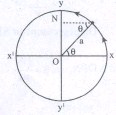
Let xx1 and yy1 be the two perpendicular x diameters. Suppose the particle is at p after a time t. If w is the angular velocity then the angular displacement θ in time t is given by θ = -wt.
From p draw pN perpendicular to yy1. As the particles moves from x to y, foot of the perpendicular N moves from 0 to y. As it moves further from y to x1, then from x1 to y1 and back again to x, the point N moves from y to 0, from 0 to y1 and back again to O. When the particle completers one revolution along the circumference, the point N completes one vibration about the mean position O. The motion of the point N along the diameter yy1 is simple harmonic.
Hence the projection of a uniform circular motion on a diameter of side in simple harmonic motion.
7.
(i) Mosquitoes lay their eggs on the surface of water. To reduce the surface tension of water, a small amount of oil is poured. This breaks the elastic film of water surface and eggs are killed by drowning.
(ii) Chemical engineers must finely adjust the surface tension. of the liquid, so it forms droplets of designed size and so it adheres to the surface without smearing. This is used in desktop printing, to paint automobiles and decorative items.
(iii) Specks of dirt get removed when detergents are added to hot water while washing clothes because surface tension is reduced.
(iv) A fabric can be made waterproof, by adding suitable waterproof material (wax) to the fabric. This increases the angle of contact.
8.
When a jerk is given to a stretched string which is tied at one end, a wave pulse is produced and the pulse travels along the string. Suppose two persons holding the stretched string on either side give a jerk simultaneously, then these two wave pulses move towards each other, meet at some point and move away from each other with their original identity. Their behaviour is very different only at the crossing/meeting points; this behaviour depends on whether the two pulses have the same or different shape as shown in Figure.
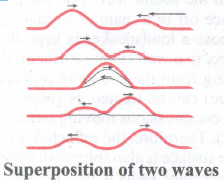
When the pulses have the same shape, at the crossing, the total displacement is the algebraic sum of their individual displacements and hence its net amplitude is higher than the amplitudes of the individual pulses. Whereas, if the two pulses have same amplitude but shapes are 1800 out of phase at the crossing point, the net amplitude vanishes at that point and the pulses will recover their identities after crossing. Only waves can possess such a peculiar property and It is called superposition of waves. This means that the principle of superposition explains the net behaviour of the waves when they overlap. Generalizing to any number of waves i.e, if two or more waves in a medium move simultaneously, when they overlap, their total displacement is the vector sum of the individual displacements.
To express mathematically, consider two functions which characterize the displacement of the waves, for example,
Y1 = A1 sin(kx - \(\omega t\))
and
Y2 = A2 cos(kx - \(\omega t\))
Since, both Y1 and Y2 satisfy the wave equation (solutions of wave equation) then their algebraic sum
Y = Y1 + Y2
also satisfies the wave equation. This means, the displacements are additive. Suppose we multiply Y1 and y2 with some constant then their amplitude is scaled by that constant Further, if C1 and C2 are used to multiply the displacernents y1 andY2 respectively, then, their net displacement Y is
Y = C1Y1 + C2Y2
This can be generalized to any number of waves. In the case of n such waves in more than one dimension the displacements are written using vector notation.
Here, the net displacement \(\vec y\) is
\(\vec { y } =\overset { n }{ \underset { i=1 }{ \Sigma } } { C }_{ i }\vec { { y }_{ i } } \)
The principle of superposition can explain the following:
(a) Space (or spatial) Interference (also known as Interference)
(b) Time (or Temporal) Interference (also known as Beats)
(c) Concept of stationary waves
Waves that obey principle of superposition are called linear waves (amplitude is much smaller than their wavelengths). In general, if the amplitude of the wave is not small then they are called non-linear waves.
9.
The velocity of the wave
\(v=\sqrt { \frac { T }{ \mu } } \)
The length of the string, L = 80 cm=0.8 m
The mass of the string, m = 0.32 g =0.32 × 10⁻³kg
Therefore, the linear mass density,
\(\mu =\frac { 0.32\times { 10 }^{ -3 } }{ 0.8 } =0.4\times { 10 }^{ -3 }{ kg\quad m }^{ -1 }\)
The tension in the string, T = 80 N
\(v=\sqrt { \frac { 80 }{ 0.4\times { 10 }^{ -3 } } } =447.2{ ms }^{ -1 }\)
The wavelength corresponding to the fundamental frequency f1 is λ1 = 2L = 2 × 0.8 = 1.6 m
The fundamental frequency f1 corresponding to the wavelength λ1
\({ f }_{ 1 }=\frac { v }{ { \lambda }_{ 1 } } =\frac { 447.2 }{ 1.6 } =279.5Hz\)
Similarly, the frequency corresponding to the second harmonics, third harmonics and fourth harmonics are
f2 = 2f1 = 559 Hz
f3 = 3f1 = 838.5 Hz
f4 = 4f1 = 1118 Hz
10.
a. Expression for Potential Energy For the simple harmonic motion, the force and the displacement are related by Hooke's law
\(\vec { F } =-k\vec { r } \)
(i) Since force is a vector quantity, in three dimensions it has three components. Further, the force in the above equation is a conservative force field; such a force can be derived from a scalar function which has only one component. In one dimensional case
F = -kx .....(i)
(ii) As we have discussed in unit 4 of volume I, the work done by the conservative force field is independent of path. The potential energy U can be calculated from the following expression.
F = \(\frac { dU }{ dx } \) .......(2)
Comparing (1) and (2). we get
-\(\frac { dU }{ dx } \) = -kx
dU = kxdx
(iii) This work done by the force F during a small displacement dx stores as potential energy
U(x)=\(\int _{ 0 }^{ x }{ kx'dx=\frac { 1 }{ 2 } (x')^{ 2 }{ |_{ 0 }^{ x } } } =\frac { 1 }{ 2 } kx^{ 2 }\) ....(3)
From equation \(\sqrt { \frac { k }{ m } } \) , we can substitute the value of force constant k=ω2 in equation (3)
where ω is the natural frequency of the oscillating system. For the particle executing simple harmonic motion from equation y =A sin ωt,
we get x =A sin ωt
U(t)=\(\frac { 1 }{ 2 } mv_{ x }^{ 2 }=\frac { 1 }{ 2 } m\left( \frac { dx }{ dty } \right) ^{ 2 }\) ......(4)
This variation of U is shown below.
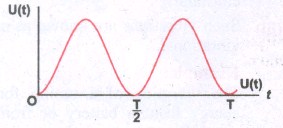
Variation of potential energy with time t
b. Expression for Kinetic Energy
KE = \(\frac { 1 }{ 2 } mv_{ x }^{ 2 }=\frac { 1 }{ 2 } m\left( \frac { dx }{ dy } \right) ^{ 2 }\)
(i) Since the particle is executing simple harmonic motion, from equation
y =A sin ωt
x =A sin ωt
Therefore, velocity is
vx =\(\frac { dx }{ dt } \)Aω cosωt
\(A\omega \sqrt { 1-\left( \frac { x }{ A } \right) ^{ 2 } } \)
vx = \(\omega \sqrt { { A }^{ 2 }-{ x }^{ 2 } } \) ....(5)
Hence
KE = \(\frac { 1 }{ 2 } mv_{ x }^{ 2 }=\frac { 1 }{ 2 } m{ \omega }^{ 2 }({ A }^{ 2 }-{ x }^{ 2 })\) ...(6)
KE = \(\frac { 1 }{ 2 } m{ \omega }^{ 2 }A^{ 2 }cos^{ 2 }\omega t\) ....(7)
This variation with time is shown below.
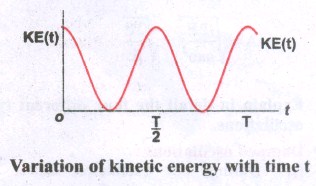
c. Expression for Total Energy
(i) Total energy is the sum of kinetic energy and potential energy
E = KE+U ..............(8)
E = \(\frac { 1 }{ 2 } m{ \omega }^{ 2 }=\frac { 1 }{ 2 } m{ \omega }^{ 2 }({ A }^{ 2 }-{ x }^{ 2 })\)
Hence excelling x2 term,
E = \(\frac { 1 }{ 2 } m{ \omega }^{ 2 }A^{ 2 }\) = constant .....(9)
(ii) Alternatively, from equation (4), and equation (7), we get the total energy as
E =\(\frac { 1 }{ 2 } m{ \omega }^{ 2 }A^{ 2 }sin^{ 2 }\omega t+\frac { 1 }{ 2 } m{ \omega }^{ 2 }A^{ 2 }cos^{ 2 }\omega t\)
= \(\frac { 1 }{ 2 } m{ \omega }^{ 2 }A^{ 2 }(sin^{ 2 }\omega t+cos^{ 2 }\omega t)\)
(iii) From trigonometry identity,
sin2ωt+cos2ωt_=1
E = \(\frac { 1 }{ 2 } m{ \omega }^{ 2 }A^{ 2 }\) = constant
which gives the law of conservation of total energy. This is depicted.
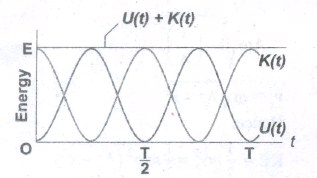
(iv) Thus the amplitude of simple harmonic oscillator, can be expressed in terms of total energy.
A =\(\sqrt { \frac { 2E }{ m{ \omega }^{ 2 } } } =\sqrt { \frac { 2E }{ k } } \) .
11.
The specific heat of one mole of a monoatomic gas CV = \(\frac{3}{2}\)R
For \(\mu\)1 mole , CV = \(\frac{3}{2}\)\(\mu\)1R Cp = \(\frac{5}{2}\)\(\mu\)1 R
The specific heat of one mole of a diatomic gas
Cv = \(\frac{5}{2}\)R
For μ2 mole, CV = \(\frac{5}{2}\)μ2 R CP = \(\frac{7}{2}\)μ2 R
The specific heat of the mixture at constant volume CV = \(\frac{3}{2}\)\(\mu\)1R +\(\frac{5}{2}\)\(\mu\)2 R
The specific heat of the mixture at constant pressure CP = \(\frac{5}{2}\)\(\mu\)1 R + = \(\frac{7}{2}\)\(\mu\)2 R
The adiabatic exponent \(\gamma =\frac { { C }_{ p } }{ { C }_{ V } } =\frac { 5{ \mu }_{ 1 }+{ 7\mu }_{ 2 } }{ 3{ \mu }_{ 1 }+{ 5\mu }_{ 2 } } \)
12.
13.
(i) Thermal expansion is the tendency of matter to change in shape, area, and volume due to a change in temperature.
(ii) All three states of matter (solid, liquid and gas) expand when heated. When a solid is heated, its atoms vibrate with higher amplitude about their fixed points. The relative change in the size of solids is small. Railway tracks are given small gaps so that in the summer, the tracks expand and do not buckle. Railroad tracks and bridges have expansion joints to allow them to expand and contract freely with temperature changes.
(iii) Liquids, have less intermolecular forces than solids and hence they expand more than solids. This is the principle behind the mercury thermometers.
(iv) In the case of gas molecules, the intermolecular forces are almost negligible and hence they expand much more than solids. For example in hot air balloons when gas particles get heated, they expand and take up more space.
(v) The increase in dimension of a body due to the increase in its temperature is called thermal expansion.
The expansion in length is called linear expansion. Similarly the expansion in area is termed as area expansion and the expansion in volume is termed as volume expansion. It is shown in Figure.
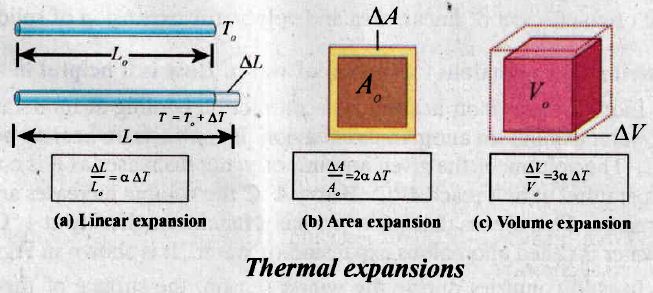
Linear Expansion:
In solids, for a small change in temperature \(\triangle\)T, the fractional change in length \(\left( \frac { \triangle L }{ L } \right) \) is directly proportional to \(\triangle\)T
\(\left( \frac { \triangle L }{ L } \right) ={ \alpha }_{ L }\triangle T\)
Therefore, \({ \alpha }_{ L }=\frac { \triangle L }{ L\triangle T } \)
Where, αL = coefficient of linear expansion.
\(\triangle\) L = Change in length
L = Original length
\(\triangle\)T = Change in temperature
Area Expansion:
For a small change in temperature the fractional change in area \([\frac { \triangle A }{ A }]\) of a substance is directly proportional to ΔT and it can be written as
\(\frac { \triangle A }{ A } { =\alpha }_{ A }\triangle T\)
Therefore \({ \alpha }_{ A }=\frac { \triangle A }{ A\triangle T } \)
Where, αA = coefficient of area expansion.
\(\triangle\) A = Change in area
A = Original area
\(\triangle\)T = Change in temperature
Volume Expansion:
For a small change in temperature \(\triangle\)T the fractional change in volume \(\left( \frac { \triangle V }{ V } \right) \) of a substance is directly proportional to \(\triangle\)T.
\(\left( \frac { \triangle V }{ V } \right) ={ \alpha }_{ V }\triangle T\)
Therefore, \({ \alpha }_{ A }=\frac { \triangle L }{ V\triangle T } \)
Where, \({ \alpha }_{ V }\) = coefficient of volume expansion.
\(\triangle\)V = Change in volume
V = Original volume
\(\triangle\)T = Change in temperature
Unit of coefficient of linear, area and volumetric expansion of solids is oC-1 or K-1
14.
Consider a capillary tube which is held vertically in a beaker containing water; the water rises in the capillary tube to a height h due to surface tension.
The surface tension force FT, acts along the tangent at the point of contact .downwards and its reaction force upwards. Surface tension T, is resolved into two 'components
(i) Horizontal component T sinθ and
(ii) Vertical component T cosθ acting upwards, all along the whole circumference of the meniscus. Total upward force = (T cosθ) (2πr) = 2πrT cosθ where S is the angle of contact, r is the radius of the tube. Let p be the density of water and h be the height to which the liquid rises inside the tube. Then,
(the volume of liquid column in the tube, V = (Volume of the liquid column of radius r height h)+
(Volume of liquid of radius r and height r - Volume of the hemisphere of radius r)
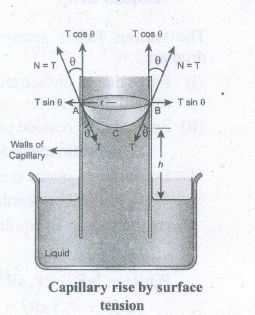
The upward force supports the weight of the liquid column above the free surface, therefore,
\(2\pi rT cos\theta=\pi r^{2} (h+\frac{1}{3}r)\rho g \Rightarrow T= \frac{r(h+\frac{1}{3}r)\rho g}{2 cos \theta}\)
If the capillary is a very fine tube of radius (i.e., radius is very small) then \(\frac{r}{3}\) can be neglected3
when it is compared to the height h. Therefore,
\(T=\frac{r\rho gh}{2 cos \theta}\)
15.
There are three types of elastic modulus.
(a) Young's modulus
(b) Rigidity modulus (or Shear modulus)
(c) Bulk modulus
(a) Young's modulus:
When a wire is stretched or compressed, then the ratio between tensile stress (or compressive stress) and tensile strain (or compressive strain) is defined as Young's modulus. Young modulus of a material =\(\frac{Tensile \ stress \ or \ compressive \ stress}{Tensile \ strain\ or\ compressive\ strain}\)
\(Y=\frac{\sigma_{t}}{\epsilon_{t}} \ or \ Y=\frac{\sigma_{c}}{\epsilon_{c}}\)
The unit for Young modulus has the same unit of stress because, strain has no unit. So, S.I. unit of Young modulus is Nm-2 or pascal.
(b) Bulk modulus:
Bulk modulus is defined as the ratio of volume stress to the volume strain.
Bulk modulus, K = \(\frac{Normal\ (perpendicular)\ stress\ or\ pressure}{Volume \ strain}\)
The normal stress or pressure is
\(\sigma_{n}=\frac{F_{n}}{\Delta A}=\Delta p\)
The volume strain is \(\epsilon_{v}= \frac{\Delta V}{V}\)
Therefore, Bulk modulus is
\(K= - \frac{\sigma_{n}}{\epsilon_{v}}= - \frac{\Delta p}{\frac{\Delta V}{V}}\)
The negative sign in the equation means that when pressure is applied on the body, its volume decreases. Further, the equation implies that a material can be easily compressed if it has a small value of bulk modulus. In other words, bulk modulus measures the resistance of solids to change in their volume.
(c) The rigidity modulus or shear modulus:
The rigidity modulus is defined as Rigidity modulus or Shear modulus,
\(\eta_{R}=\frac{shearing \ stress}{angle\ of \ shear \ or \ shearing \ strain}\)
The shearing stress is \(\sigma _{s}=\frac{trangential \ force}{area\ over\ which\ it\ is\ applied}=\frac{F_{t}}{\Delta A}\)
The angle of shear or shearing strain
\(\epsilon_{s}=\frac{x}{h}=\theta\)
Therefore, Rigidity modulus is
\(\eta = \frac{\sigma_{s}}{\epsilon_{s}}=\frac{\frac{F_{t}}{\Delta A}}{\frac{x}{h}}=\frac{\frac{F_{t}}{\Delta A}}{\theta}\)
Further, the equation implies, that a material can be easily twisted if it has small value of rigidity modulus.
16.
The distance covered by the satellite during one rotation in its orbit is equal to 2\(\pi\)(RE + h) and time taken for it, is the time period, T. Then
\(\text{speed v} =\frac { Distance \ travelled }{ Time \ taken } =\frac { 2\pi ({ R }_{ E }+h) }{ T } \)
From equation
\(\sqrt { \frac { { GM }_{ E } }{ ({ R }_{ E }+h) } } =\frac { 2\pi ({ R }_{ E }+h) }{ T } \) ...(1)
T = \(\frac { 2\pi }{ \sqrt { G{ M }_{ E } } } \)(RE + h)3/2 ....(2)
Squaring both sides of the equation (2), we get
T2 = \(\frac { 4\pi ^{ 2 } }{ { GM }_{ E } } \) = (RE + h)3
\(\frac { 4\pi ^{ 2 } }{ { GM }_{ E } } \) = constant say c
T2 = T2 = c(RE + h)3 ...(3)
Equation (3) implies that a satellite orbiting the Earth has the same relation between time and distance as that of Kepler's law of planetary motion. For a satellite orbiting near the surface of the Earth, h is negligible compared to the radius of the Earth RE Then,
T2 = \(\frac { 4\pi ^{ 2 } }{ { GM }_{ E } } \) = RE2
T2 = \(\frac { 4\pi ^{ 2 } }{ { { GM }_{ E } }/{ { R }_{ E }^{ 2 } } } R_E\)
T2 = \(\frac { { 4\pi }^{ 2 } }{ g } \)RE
Since\(\frac { { GM }_{ E } }{ { R }_{ E }^{ 2 } } \) = g
T = \(2\pi \sqrt { \frac { { R }_{ E } }{ g } } \) ......(4)
By substituting the values of RE = 6.4 x 10⁶ m and g = 9.8 ms-2, the orbital time period is obtained as T ≅ 85 minutes.
17.
Newton's inverse square Law:
Newton considered the orbits of the planets as circular. For circular orbit of radius r,' the centripetal acceleration towards the center is
\(a=\frac { { V }^{ 2 } }{ r } \) ...(1)
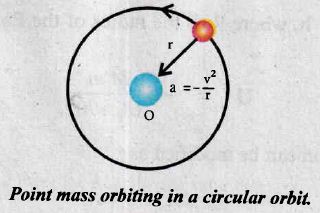
Here v is the velocity and r, the distance of the planet from the center of the orbit.
The velocity in terms of known quantities r and T, is
v = \(\frac { 2\pi r }{ T } \) ...(2)
Here T is the time period of revolution of the planet. Substituting this value of v in equation we get,
a = \(\frac { \left( \frac { 2\pi }{ T } \right) ^{ 2 } }{ r } =-\frac { 4\pi ^{ 2 }t }{ { T }^{ 2 } } \) ...(3)
Substituting the value of 'a' from (3) in Newton's second law, F = ma, where 'm' is the mass of the planet
F = \(\frac { 4\pi mr }{ { T }^{ 2 } } \) ...(4)
From Kepler's third law
\(\frac { r^{ 3 } }{ { T }^{ 2 } } \) = k(constant) ...(5)
\(\frac { r }{ { T }^{ 2 } } =\frac { k }{ { r }^{ 2 } } \) ....(6)
By substituting equation (6) in the force expression, we can arrive at the law of gravitation
\(F=\frac { 4\pi ^{ 2 }mk }{ { r }^{ 2 } } \) ...(7)
Here negative sign implies that the force is attractive arid it acts towards the center. In equation (7), mass of the planet 'm'. comes explicitly. But Newton strongly felt that according to his third law, if Earth is attracted by the Sun, then the Sun must also be attracted by the Earth with the same magnitude of force. So he felt that the Sun's mass (M) should also occur explicitly in the expression for force. From this insight, he equated the constant 4π2k to GM which turned out to be the law of gravitation
F = \(-\frac { GMm }{ { r }^{ 2 } } \)
Again the negative sign in the above equation implies that the gravitational force is attractive.
18.
As the distance between two masses increases, the strength of the force tends to decrease because of inverse dependence on r2. Physically it implies that the planet Uranus experiences less gravitational force from the Sun than the Earth since Uranus is at larger distance from the Sun compared to the Earth.
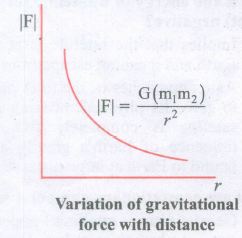
The gravitational forces between two particles always constitute an action reaction pair. It implies that the gravitational force exerted by the Sun on the Earth is always towards the Sun. The reaction-force is exerted by the Earth on the Sun. The direction of this reaction force is towards Earth.
The torque experienced by the Earth due to the gravitational force of the Sum is zero given by
\(\vec { \tau } =\vec { r } \times \vec { F } =\vec { r } \times \left( -\frac { { GM }_{ s }{ M }_{ E } }{ { r }^{ 2 } } \hat { r } \right) =0\)
Since \(\vec { r } =r\hat { r } ,(\hat { r } \times \hat { r } )=0\)
So, \(\hat { \tau } =\frac { d\vec { L } }{ dt } =0\)
It implies that angular momentum \(\vec{L}\) is a constant vector. The angular momentum of the Earth about the Sun is constant throughout the motion. It is true for all the planets. In fact, this constancy of angular momentum leads to the Kepler's second law.
The expression \(\vec{F}=-\frac{G M_{1} M_{2}}{r^{2}} \hat{r}\) has one inherent assumption that both M1 and M2 are treated as point masses. When it is said that Earth orbits around the Sun due to Sun's gravitational force, we assumed Earth and Sun to be point masses. This assumption is a good approximation because the distance between the two bodies is very much larger than their diameters. For some irregular and extended objects separated by a small distance, we cannot directly use the equation. Instead, we have to invoke separate mathematical treatment which will be brought forth in higher classes.
However, this assumption about point masses holds even for small distance for one special case. To calculate force of attraction between a hollow sphere of mass M with uniform density and point mass m kept outside the hollow sphere, we can replace the hollow sphere of mass M as equivalent to a point mass M located at the center of the hollow sphere. The force of attraction between the hollow sphere of mass M and point mass m can be calculated by treating the hollow sphere also as another point the center of the hollow sphere. It is shown in the Figure.
There is also another interesting result. Consider a hollow sphere of mass M. If we place another object of mass 'm' inside this hollow sphere as in Figure, the force experienced by this mass 'm' will be zero.
The triumph of the law of gravitation is that it concludes that the mango that is falling down and the Moon orbiting the Earth are due to the same gravitational force.
19.
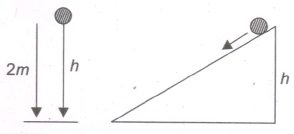
In the first case,
potential energy = kinetic energy
\(mgh=\frac{1}{2}mv^{2}\)
\(mg\times 2 =\frac{1}{2} mv^{2}\) ........... (1)
In second case,
potential energy = translational kinetic energy + rotational kinetic energy
\(mgh^{'}=\frac{1}{2}mv^{2}+\frac{1}{2} I\omega^{2}\)
\(mgh{'}=\frac{1}{2}mv^{2}+\frac{1}{2}(\frac{mr^{2}}{2})(\frac{v^{2}}{r^{2}})\)
\(\therefore mgh^{'}=\frac{3}{4} mv^{2}\) --- (2)
Dividing (2) by (1),
\(\frac{mgh^{'}}{mg\times 2}=\frac{\frac{3}{4}mv^{2}}{\frac{1}{2}mv^{2}}=\frac{3}{4}\times \frac{2}{1}=\frac{3}{2}\)
h'=3 m
From equation (1), 2 mg =\(\frac{1}{2}mv^{2}\)
\(v=\sqrt{4g}=2\sqrt{g}\)
\(v=2\times \sqrt{9.81}\)
\(v=6.3 ms^{-1}\)
20.
The principle of homogeneity of dimensions states that the dimensions of all the terms in a physical expression should be the same. For example, in the physical expression v2= u2 + 2as, the dimensions of v2, u2 and 2 as are the same and equal to [L2T-2].
This method is used to
(i) Convert a physical quantity from one system of units to another.
(ii) Check the dimensional correctness of a given physical equation.
(iii) Establish relations among various physical quantities.
(i) To convert a physical quantity from one system of units to another: This is based on the fact that the product of the numerical values (n) and its corresponding unit (u) is a constant. i.e, n1[u1] = constant (or) n, n1[u1 ] = n2[u2].
Consider a physical quantity which has dimension 'a' in mass, 'b' in length and 'c' in time.
If the fundamental units in one system are M1, L1 and T1 and the other system are M2, L2, and T2 respectively, then we can write, n1 [M1a L1b T1c] = n2 [ M 2a L2b T2c]
We have thus converted the numerical value of physical quantity from one system of units into the other system.
Example: Convert 76 cm of mercury pressure into Nm-2 using the method of dimensions.
Solution: In cgs system 76 cm of mercury pressure =76\(\times\)13.6\(\times\)980 dyne cm-2
The dimensional formula of pressure P is [ML-1T-2]
\(P_{1}\left[M_{1}^{a} L_{1}^{b} T_{1}^{c}\right]=P_{2}\left[M_{2}^{a} L_{2}^{b} T_{2}^{c}\right]\)
We have
\(P_{2} =\left[\frac{\mathrm{M}_{1}}{\mathrm{M}_{2}}\right]^{a}\left[\frac{\mathrm{L}_{1}}{\mathrm{~L}_{2}}\right]^{b}\left[\frac{\mathrm{T}_{1}}{\mathrm{~T}_{2}}\right]^{c} \)
\(M_{1} =1 \mathrm{~g}, \mathrm{M}_{2}=1 \mathrm{~kg}\)
\(L_{1}=1 \mathrm{~cm}, \mathrm{~L}_{2}=1 \mathrm{~m}
\)
\(T_{1}=1 \mathrm{~s}, T_{2}=1 \mathrm{~s}\)
So a=1, b=1 and c=-2
Then
\(P_{2} =76 \times 13.6 \times 980\left[\frac{\mathrm{g}}{1 \mathrm{~kg}}\right]^{1}\left[\frac{\mathrm{cm}}{1 \mathrm{~m}}\right]^{-1}\left[\frac{1 \mathrm{~s}}{1 \mathrm{~s}}\right]^{-2} \)
\(=76 \times 13.6 \times 980\left[\frac{10^{-3} \mathrm{~kg}}{1 \mathrm{~kg}}\right]^{1}\left[\frac{10^{-2} \mathrm{~m}}{1 \mathrm{~m}}\right]^{-1}\left[\frac{1 \mathrm{~s}}{1 \mathrm{~s}}\right]^{-2} \)
\(=76 \times 13.6 \times 980 \times\left[10^{-3}\right] \times 10^{2} \)
\(P_{2} =1.01 \times 10^{5} \mathrm{Nm}^{-2}\)
(ii) To check the dimensional correctness of a given physical equation:
Example: The equation \(1\over 2\) mv2 = mgh can be checked by using this method as follows.
Solution: Dimensional formula for
\(\boxed{{1\over 2}mv^2=[M][LT^{-1}]^2=[ML^2T^{-2}]}\)
Dimensional formula for
\(\boxed {mgh=[M][LT^{-2}][L]=[ML^{2}T^{-2}] \\ [ML^{2}T^{2}]=[ML^{2}T^{-2}]}\)
Both sides are dimensionally the same, hence the equations\(1\over 2\) mv2 = mgh is dimensionally correct.
(iii) To establish the relation among various physical quantities:
If the physical quantity Q depends upon the quantities Q1, Q2 and Q3 ie. Q is proportional to Q1, Q2 and Q3.
Then,
\(Q \alpha Q_{1}^{a} Q_{2}^{b} Q_{3}^{c}
\)
\(Q=k Q_{1}^{a} Q_{2}^{b} Q_{3}^{c}\)
where k is a dimensionless constant. When the dimensional formula of Q1, Q2 and Q3 are substituted, then according to the principle of homogeneity, the powers of M, L, T are made equal on both sides of the equation. From this, we get the values of a, b, c.
Example:
Obtain an expression for the time period T of a simple pendulum. The time period T depend upon (i) mass 'm' of the bob (ii) length 'l' of the pendulum and (iii) acceleration due to gravity g at the place where the pendulum is suspended. (Constant k=2π ) i.e
Solution:
\(\boxed{T \alpha m^a l^b g^c \\ T=k.m^al^bg^c}\)
Here k is the dimensionless constant. Rewriting the above equation with dimensions.
\(\boxed{[T^1]=[M^a][L^b][LT^{-2}]^c\\ [M^oL^oT^1]=[M^aL^{b+c}T^{-2c}]}\)
Comparing the powers of M, L and T on both sides, a = 0, b + C = 0, -2c = 1
Solving for a, b and c a = 0, b = 1/2, and c = -1/2
From the above equation
T = k. mo l1/2 g-1/2
T=\(k{1\over g}^{1\over 2}=k\sqrt{1\over g}\)
Experimentally k = 2\(\pi\) , hence \(T=2\pi \sqrt{l\over g}\)
21.
The total kinetic energy (KE) as the sum of kinetic energy due to translational motion (KETRANS) and kinetic energy due to rotational motion (KEROT).
KE = KETRANS+ KEROT
If the mass of the rolling object is M, the velocity of center of mass is VCM, its moment of inertia about center of mass is ICM and angular velocity is \(\omega\) , then
\(KE=\frac { 1 }{ 2 } { Mv }_{ CM }^{ 2 }+\frac { 1 }{ 2 } { I }_{ CM }{ \omega }^{ 2 }\)
With center of mass as reference: The moment of inertia (ICM)of a rolling object about the center of mass is, ICM= MK2 and VCM = R\(\omega\) . Here, K is radius of gyration.
\(KE=\frac { 1 }{ 2 } { Mv }_{ CM }^{ 2 }+\frac { 1 }{ 2 } \left( { MK }^{ 2 } \right) \frac { { v }_{ CM }^{ 2 } }{ { R }^{ 2 } } \)
\(KE=\frac { 1 }{ 2 } { Mv }_{ CM }^{ 2 }+\frac { 1 }{ 2 } { Mv }_{ CM }^{ 2 }\left( \frac { { K }^{ 2 } }{ { R }^{ 2 } } \right) \)
\(\frac { 1 }{ 2 } { Mv }_{ CM }^{ 2 }\left( 1+\frac { { K }^{ 2 } }{ { R }^{ 2 } } \right) \)
22.
From law of conservation of momentum, along x-axis,
\(mu_1+0=mv_1\cos\theta_1+mv_2\cos\theta_2\)
\(u_1=v_1\cos\theta_1+v_2\cos\theta_2\) ....(1)
along y-axis, \(0=v_1\sin\theta_1-v_2\sin\theta_2\) ....(2)
From energy of conservation,
\({1\over2}{mu}_{1}^{2}={1\over2}{mv}_{1}^{2}+{1\over 2}{mv}_{2}^{2}\)
\({u}_{1}^{2}={v}_{1}^{2}+{v}_{2}^{2}\) ...(3)
By using equation (1) and (2) in equation (3) we get,
\(2v_1 v_2\cos(\theta_1+\theta_2)=0\)
\(\cos(\theta_1+\theta_2)=\cos{\pi \over 2}\)
\(\theta_1+\theta_2={\pi \over 2}\)
\(\therefore\) This shows that the particle move perpendicular to each other after collision.
23.
List all information about particle 1 and particle 2 For particle 1,
x1 = 6.0 t2 + 4.0 t +2.0
For particle 2,
a2 = -6.01
v2 =30ms-1 at t=0
Velocity v(t) \(={{dx}\over{dt}}\)
\(v(t)={{dx}\over{dt}}={{d}\over{dt}}(6.0t^2+4.0t+2.0)\)
Differentiate with respect to 't'
v (1) = 121 + 4 + 0
= 12.1+ 4
For particle, 2 is
\(\int{a}(tdt=v(t)\)
Integrating with respect to 't'
\(v(t)\int{-6tdt=-6}\int{tdt={{-6t^2}\over{2}}}+c\)
v(t) = -3t2 + c \(\left[ \because {fx}^{n} ={{{x}^{n+1}}\over{n+1}}\right]\)
If v(f) = 30 m/s and 1= 0 seconds, then,
30 mls = -3 (0)2 + c
30 = 0 + c
c=30
So,
v2 (I) = -3 t2 + 30 [ \(\because\) c is constant ]
Since the particles velocities have to match, you have to set the two equations equal to each other.
v1 (t) = v2 (t)
12/+4=-3t2+30
3t2 + 12t - 26 = 0
Since, y = 3t + 12t - 26 = 0.
Using the quadratic formula;
\(= {-b \pm \sqrt{b^2-4ac} \over 2a}\)
a=3, b=12, c=-26
\(t=-12\pm{{\sqrt{{(12)}^{2}-4\times4(3)\times(-26)}}\over{2\times 3}}\)
\(=-12\pm{{\sqrt{144-(12)\times(-26)}}\over{2\times3}}\)
\(=-12\pm{{\sqrt{144-(12)\times(-26)}}\over{6}}\)
\(=-12\pm{{\sqrt{144+312}}\over{6}}\)
\(=-12\pm{{\sqrt{456}}\over{6}}\)
\(=-12\pm{{\sqrt{456}}\over{6}}\)
\(={{-12\pm21.3}\over{6}}\)
t = -5.55 s (or) t = 1.55 s
As time cannot be negative, 1= 1.55 s.
The velocities of different particles.
v (t1) = 12 (1.55) + 4 = 18.6 + 4
v (t2) = -3 (1.55) + 30 = 4.65 + 30
v (t1) = 122.6 m/s
v (t2) = 34.65 m/s.
24.
(i) For two non-zero vectors \(\overrightarrow{A}\) and \(\overrightarrow{B}\) which are inclined to each other at an angle 0, the difference \(\overrightarrow{A}-\overrightarrow{B}\) is obtained as follows. First obtain - B as in Figure. The angle between A and -B is 180 - \(\theta.\)
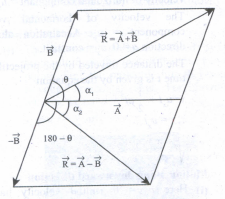
(ii) The difference A - B is the same as the resultant of A and - B
We can write \(\overrightarrow{A}-\overrightarrow{B}=\overrightarrow{A}+(-\overrightarrow{B})\) and using the equation
\(|\overrightarrow{A}+\overrightarrow{B}|=\sqrt{{A}^{2}+{B}^{2}+2AB\cos\theta,}\) we have
\(|\overrightarrow{A}-\overrightarrow{B}|=\sqrt{{A}^{2}+{B}^{2}+2AB\cos(180-\theta)}\)
(iii) Since, cos (180 - \(\theta\)) = - cos\(\theta\), we get Magnitude of vector
\(\Rightarrow |\overrightarrow{A}-\overrightarrow{B}|=\sqrt{A^2+B^2+2AB\cos\theta}\)
(iv) Again from the Figure and using an equation similar to equation
\(\tan \alpha{{B\sin\theta}\over{A+B\sin\theta}}\)
we have
\(\tan{\alpha}_{2}={{B\sin(180°-\theta)}\over{A+B\cos180°-\theta}}\)
(v) But \(\sin(180°-\theta)=\sin\ \theta,\) hence we get
\(\Rightarrow\) \(\tan{\alpha}_{2}-{{B\sin\theta}\over{A-B\cos\theta}}\)
25.
Mass of the disc m = 100 g = 6.1 kg.
Diameter of the disc d = 10 cm.
Radius of the disc r = 5 cm = 0.05m
Rolling with a velocity v = 20 cms-1 = 0.20 ms-1
Total energy of the disc ETot = ?
ETot = Translational K energy + rotational K.E
M.I of the disc about its own axis,
\(I=\frac { 1 }{ 2 } { mr }^{ 2 }\)
\(v=r\omega \ \therefore { \omega }^{ 2 }=\frac { { v }^{ 2 } }{ { r }^{ 2 } } \)
Rotational K.E = \(I=\frac { 1 }{ 2 } I{ \omega }^{ 2 }=\frac { 1 }{ 2 } \times \left( \frac { 1 }{ 2 } { mr }^{ 2 } \right) \times \left( \frac { { v }^{ 2 } }{ { r }^{ 2 } } \right) \)
\(=\frac { 1 }{ 4 } { mv }^{ 2 }\)
T.E. \(=\frac { 1 }{ 2 } { mv }^{ 2 }+\frac { 1 }{ 4 } { mv }^{ 2 }=\frac { 3 }{ 4 } { mv }^{ 2 }\)
T.E. of the disc ETot = \(\frac{3}{4}\) \(\times\) 0.1 \(\times\) 0.20 \(\times\) 0.20
= 0.003 J
26.
Since the blocks are identical, the centre of mass of each block is located at its midpoint. Let us take the origin to be at the midpoint [or centre of mass ] of block at the bottom and find out the shift in the position of centre of mass of the stack on the addition of the block of the block each time.
The stack will not fall over till the shift in the position of its centre of mass is less than 1/2 cm. When the stack contains two blocks: if Δx1 and Δx2 are the shifts in the positions of the centre, of the mass of the blocks with respect to origin, then shift in the position of the centre of mass of the stack
\(\Delta X=\frac { M\Delta x_{ 1 }+M\Delta x_{ 2 } }{ M+M } \)
\(=\frac { M\left[ \Delta x_{ 1 }+\Delta x_{ 2 } \right] }{ 2M } \)
\(\Delta X=\frac { \Delta x_{ 1 }+\Delta x_{ 2 } }{ M+M } \)
Here Δx1= 0 and Δx2= d cm
Therefore, ΔX = 0+\(\frac{d}{2}\) = \(\frac{d}{2}\) cm
Here, If \(\frac{d}{2}\) cm < \(\frac{1}{2}\) cm
Then the stack will not fall over.
In the above way, Suppose that let the maximum n block can be stacked before the stack falls over. If Δx1, Δx2, Δx3 .......,Δxn are the shifts in the position of the n blocks then shift in the position of the centre of mass of the stack
ΔX = Δx1 + Δx2 + Δx3 + .... + Δxn
So that the stack does not fall
Δx1 + Δx2 + Δx3 + .... + Δ\(\frac {x^n}{n}\) < \(\frac{1}{2}\)
Sn = Δx1 + Δx2 + Δx3 + ..... + Δxn
Then the above condition becomes,
\(\frac { S_{ n } }{ n }<\frac{1}{2}\)
27.
E=\(\frac { 1 }{ 2 } I{ \omega }^{ 2 }\)
=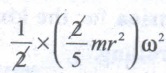
E=\(\frac { 1 }{ 5 } { mr }^{ 2 }{ \omega }^{ 2 }\)
E=\(\frac { 1 }{ 5 } \times 1\times (3\times 10^{ -2 })^{ 2 }(50)^{ 2 }\)
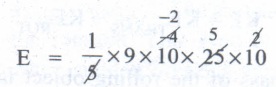
E=45 \(\times\) 10-2
E=0.45 J
28.
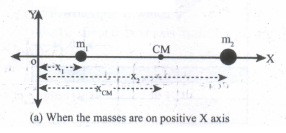
Let the center of mass of two point masses m1 and m2, which are at positions x1 and x2 respectively on the X-axis. For this case, we can express the position of center of mass in the following three ways based on the choice of the coordinate system.
(i) When the masses are on positive X-axis: The origin is taken arbitrarily so that the masses m1 and m2 are at positions x1 and x2 on the positive X-axis as shown in Figure. The center of mass will also be on the positive X-axis at xCM as given by the expression,
\({ x }_{ CM }=\frac { { m }_{ 1 }x_{ 1 }+{ m }_{ 2 }x_{ 2 } }{ { m }_{ 1 }+{ m }_{ 2 } } \)
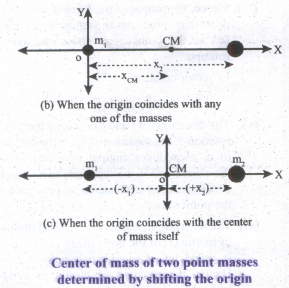
(ii) When the origin coincides with any one of the masses: The calculation could be minimised if the origin of the coordinate system is made to. coincide with any one of the masses as shown in Figure. When the origin coincides with the point mass m1 its position x1 is zero, (i.e. x1 = 0). Then,
\({ x }_{ CM }=\frac { { m }_{ 1 }\left( 0 \right) +{ m }_{ 2 }x_{ 2 } }{ { m }_{ 1 }+{ m }_{ 2 } } \)
The equation further simplifies as,
\({ x }_{ CM }=\frac { { m }_{ 2 }x_{ 2 } }{ { m }_{ 1 }+{ m }_{ 2 } } \)
(iii) When the origin coincides with the center of mass itself:
If the origin of the coordinate system is made to coincide with the center of mass, then, xCM =0 and the mass m1 is found to be on the negative X-axis as shown in Figure. Hence, its position x1 is negative, (i.e. -x1).
\(0=\frac { { m }_{ 1 }\left( -{ x }_{ 1 } \right) +{ m }_{ 2 }{ x }_{ 2 } }{ { m }_{ 1 }+{ m }_{ 2 } } \)
0 = m1(-x1) + m2x2
m1x1 = m2x2
The expression given above is known as principle of moments.
29.
(i) Parallel axis theorem states that the moment of inertia of a body about any axis is equal to the sum of its moment of inertia about a parallel axis through its center of mass and the product of the mass of the body and the square of the perpendicular distance between the two axes.
(ii) If IC is the moment of inertia of the body of mass M about an axis passing through the center of mass, then the moment of inertia I about a parallel axis at a distance d from it is given by the relation,
I = IC + Md2
(iii) Let us consider a rigid body as shown in Figure. Its moment of inertia about an axis AB passing through the center of mass is IC DE is another axis parallel to AB at a perpendicular distance d from AB. The moment of inertia of the body about DE is I. We attempt to get an expression for I in terms of IC For this, let us consider a point mass m on the body at position x from its center of mass.
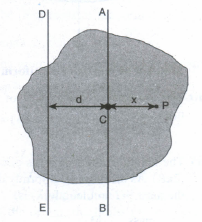
(iv) The moment of inertia of the point mass about the axis DE is, m(x + d)2. The moment of inertia I of the whole body about DE is the summation of the above expression.
\(I=\sum { m\left( x+d \right) ^{ 2 } } \)
This equation could further be written as,
\(I=\sum { m\left( { x }^{ 2 }+{ d }^{ 2 }+2xd \right) } \)
\(I=\sum { \left( { mx }^{ 2 }+m{ d }^{ 2 }+2dmx \right) } \)
\(I=\sum { { mx }^{ 2 }+\sum { m{ d }^{ 2 } } +2d\sum { mx } } \)
(v) Here, \(\sum { mx^{ 2 } } \) is the moment of inertia of the body about the center of mass. Hence,
IC = \(\sum { mx= } 0\) because, x can take positive and negative values with respect to the axis AB. The summation \(\left( \sum { mx } \right) \) will be zero.
Thus, I = Ic + \(\sum { md^{ 2 } } \) = IC + \(\left( \sum { m } \right) d^{ 2 }\)
(vi) Here, \(\sum { m } \) is the entire mass M of the object \(\left( \sum { m=M } \right) \)
I = IC + Md2
Hence the parallel axis theorem is proved.
30.
Let us consider a uniform rod of mass (M) and length (1) as shown in Figure. Let us find an expression for moment of inertia of this rod about an axis that passes through the center of mass and perpendicular to the rod. First an origin is to be fixed for the coordinate system so that it coincides with the center of mass, which is also the geometric center of the rod. The rod is now along the x axis. We take an infinitesimally small mass (dm) at a distance (x) from the origin. The moment of inertia (dI) of this mass (dm) about the axis is,
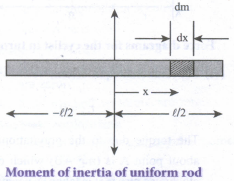
dI = (dm) x2
As the mass is uniformly distributed, the mass per unit length (λ) of the rod is, \(\lambda =\frac { M }{ l } \)
The (dm) mass of the infinitesimally small length as, dm = λ dx = \(\frac { M }{ l } dx\)
The moment of inertia (I) of the entire rod can be found by integrating dI,
\(I=\int { dI } =\int { \left( dm \right) { x }^{ 2 } } =\int { \left( \frac { M }{ l } dx \right) { x }^{ 2 } } \)
\(I=\frac { M }{ l } \int { { x }^{ 2 }dx } \)
As the mass is distributed on either side of the origin, the limits for integration are taken from -1/2 to 1/2.
\(I=\frac { M }{ l } \int _{ -t/2 }^{ t/2 }{ { x }^{ 2 }dx=\frac { M }{ l } } \left[ \frac { { x }^{ 3 } }{ 3 } \right] ^{ t/2 }_{ -t/2 }\)
\(I=\frac { M }{ l } \left[ \frac { { l }^{ 3 } }{ 24 } -\left( -\frac { { l }^{ 3 } }{ 24 } \right) \right] =\frac { M }{ l } \left[ \frac { { l }^{ 3 } }{ 24 } +\frac { { l }^{ 3 } }{ 24 } \right] \)
\(I=\frac { M }{ l } \left[ 2\left( \frac { { l }^{ 3 } }{ 24 } \right) \right] \)
I = \(\frac { 1 }{ 12 } \) ml2
31.
A body is said to be in equilibrium if both the linear momentum and angular momentum of the rigid body remain constant with time. Hence for a body in equilibrium, the linear acceleration of its centre of mass would be zero and also the angular acceleration of the rigid body about any axis would be zero.
The different types of equilibrium of a body are
1. Stable equilibrium
2. Unstable equilibrium
3. Neutral equilibrium
Equilibrium is thus stable, unstable neutral according, to whether potential energy is minimum, maximum or instant.

Let us consider the motion of a marble along a curved surface of a bowls.
If a marble M is placed on a curved surface of a bowl S it rolls down and settles in equilibrium at the lowest point A as shown in figure (a).
If the marble is disturbed and displaced at B, its energy increases. When it is released, the marble rolls back at A. Thus the marble at the portion A is said to be in stable equilibrium. In this case, the body possess minimum potential energy.
Suppose, now that bowl S is inverted and the marble is placed at its top point at A as shown in Fig (b).
If the marble is displaced slightly to the point C, its potential energy is lowered and tends to move further away from the equilibrium position to one of lowest energy. Thus the marble is said to be in unstable equilibrium.
Consider that the marble M is placed on the plane surface as shown in figure (c). If it is displaced slightly, its potential energy does not change. In this case, the marble is said to be in neutral equilibrium.
Translational equilibrium:
The resultant of all the external forces acting on the body must be zero.
\(\sum \vec{F}_{ext} =0 \ or \sum F_x=0\sum F_y=0\sum F_2=0\)
\(\sum \vec{F}_{ext} =M\vec{\alpha}_{CM}=M \frac{d\vec{v}_{CM}}{dt}=0\)
or \(\frac{d\vec{v}_{CM}}{dt}\)=0 or \(\vec{v}_{cm}\) = constant
This implies that a body in translational equilibrium, will be either at rest (v = 0) or in uniform motion. If the body is in uniform motion along a straight path, it is in dynamic equilibrium
Rotational equilibrium:
For rotational equilibrium \(\sum \vec{\tau}_{ext}=\sum \vec{r}.x\vec{F}_{ext}=0\)
If the total torque is zero about any point, then it will be zero about any other point when the body is in equilibrium
32.
Errors in the difference of two quantities.
Let \(\triangle A\) and \(\triangle B\) be the absolute errors in the two quantities, A and B, respectively. Then,
Measured value of \(A=A\pm\triangle A\)
Measured value of \(B=B\pm\triangle B\)
Consider the difference, Z =A - B
The error \(\triangle Z\) in Z is the given by
\(Z\pm \triangle Z=(A+\triangle A)-(B\pm \triangle B)\)
\(=(A-B)\pm(\triangle A+\triangle B)\)
\(=Z\pm(\triangle A+\triangle B)\)
(or) \(\triangle Z=\triangle A+\triangle B\)
The maximum error in difference of two quantities is equal to the sum of the absolute errors in the individual quantities. Error in the division or quotient of two quantities
Let \(\triangle A\) and \(\triangle B\) be the absolute errors in the two quantities A and B respectively.
Consider the quotient, \(Z={{A}\over{B}}\)
The error \(\triangle Z\) in Z is given by
\(Z\pm Z={{A\pm \triangle A}\over{B+\triangle B}}={{A\left(1\pm{{{\triangle A}\over{A}}} \right)}\over{B\left( 1\pm{{\triangle B}\over{B}} \right)}}\)
\(={{A}\over{B}} \left( 1\pm{{\triangle A}\over{A}} \right)\left( 1\pm{{\triangle B}\over{B}} \right)^{-1}\)
or \(Z\pm \triangle Z=Z\left( 1\pm{{\triangle A}\over{A}} \right)\left( 1\mp{{\triangle B}\over{B}} \right)\)
[ using (1+x)n \(\approx\) 1 + nx, when x<<1]
Dividing both sides by Z, we get
\(1\pm{{\triangle Z}\over{Z}}=\left( 1\pm{{\triangle A}\over{A}} \right)\left( 1\mp {{\triangle B}\over{B}} \right)\)
\(=1\pm{{\triangle A}\over{A}}\mp{{\triangle B}\over{B}}\pm{{\triangle A}\over{A}}.{{\triangle B}\over{B}}\)
As the terms \(\triangle A/A\) and \(\triangle B/B\) are small, their product term can be neglected.
The maximum fractional error in Z is given by
\({{\triangle Z}\over{Z}}=\left( {{\triangle A}\over{A}} +{{\triangle B}\over{B}}\right)\)
The maximum fractional error in the quotient of two quantities is equal to the sum of their individual fractional errors.
33.
(i) Consider an object of mass m moving with a velocity \(\vec{v}\). Then its linear momentum is \(\vec{p}=m\vec{v}\) and Its kinetic energy, KE \(\frac{1}{2}mv^{2}\)
\(KE=\frac{1}{2}mv^{2}=\frac{1}{2}m(\vec{v}.\vec{v})\) --- (1)
(ii) Multiplying both the numerator and denominator of equation (1) by mass, m
\(KE=\frac{1}{2}\frac{m^{2}(\vec{v}.\vec{v})}{m}\)
=\(\frac{1}{2}\frac{(m\vec{v}).(m\vec{v})}{m}[\vec{p}=m\vec{v}]\)
=\(\frac{1}{2}\frac{\vec{p}.\vec{p}}{m}\) =\(\frac{\vec{p}^{2}}{2m}\)
KE = \(\frac{p^{2}}{2m}\) ......(2)
(ii) where \(|\vec{p}|\) is the magnitude of the momentum. The magnitude of the linear momentum can be obtained by
\(|\vec{p}|\) = p = \(\sqrt{2m(KE)}\) .....(3)
(iv) Note that if kinetic energy and mass are given, only the magnitude of the momentum can be calculated but not the direction of momentum. It is because the kinetic energy and mass are scalars.
34.
If there is a loss of kinetic energy during a collision, then it is called as an inelastic collision
In the case of inelastic collision,
(i) Total kinetic energy is not conserved.
(ii) Some or all of the forces involved are non-conservative.
(iii) A part of the mechanical energy is transformed into heat, sound, light etc.
Examples for inelastic collision:
(i) Collision between ball and floor
(ii) Collision between two vehicles
Examples for perfectly inelastic collision:
(i) Mud thrown on a wall and sticking to it
(ii) a man jumping into a moving trolley
(iii) a bullet fired into a wooden block and remaining embedded in it.
35.
(i) Consider two blocks of masses m1 and m2 (m1 > m2) kept in contact with each other on a smooth, horizontal frictionless surface as shown in Figure.
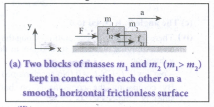
(ii) By the application of a horizontal force F, both the blocks are set into motion with acceleration 'a' simultaneously in the direction of the force F.
(iii) To find the acceleration \(\overrightarrow{a}\) , Newton's second law has to be applied to the system I (combined mass m = m1 + m2)
\(\overrightarrow{F}= m\overrightarrow{a}\)
If we choose the motion of the two masses\ along the positive x direction,
\(F\hat{i}=ma\hat{i}\)
By comparing components on both sides of the above equation
F = ma where m = m1 + m2
The acceleration of the system is given by
\(\therefore a = {{F}\over{m_1+m_2}}\) ........(1)
(iv) The force exerted by the block m1 on m2 due to its motion is called force of contact \(({\overrightarrow{f}}_{21}).\) According to Newton's third law, the block m2 will exert an equivalent opposite reaction force \(({\overrightarrow{f}}_{12})\) on block m1.
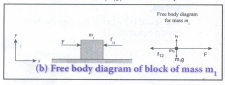
\(\therefore F\hat{j}-{f}_{12}^{\hat{i}}=m_1a\hat{i}\)(
By comparing the components on both sides of the above equation, we get
\(F-{f}_{12}={m}_{1}a\) ..............(2)
Substituting the value of acceleration from equation (1) in (2) we get
\({f}_{12}=F-m_1\left({{F}\over{m_1+m_2}} \right)\)
\({f}_{12}=F\left[ 1-{m_1\over m_1+m_2} \right]\)
\({f}_{12}={Fm_1 \over m_1+m_2}\) .......(3)
(v) Equation (3) shows that the magnitude of contact force depends on mass m2 which provides the reaction force. Note that this force is acting along the negative x direction.
In vector notation, the reaction force on mass m1 is given by \({\overrightarrow{f}}_{12\hat{i}}={Fm_2 \over m_1+m_2}\hat{i}\)
(vi) For mass m2 there is only one force acting on it in the \(\times\) direction and it is denoted by \({\overrightarrow{f}}_{21}.\)
This force is exerted by mass m1. The free body diagram for mass m2.
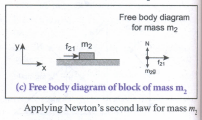
\({f}_{21}\hat{i}=m_2a\hat{i}\)
By comparing the components on both sides of the above equation
\({f}_{21}\hat{i}=m_2a\) ....(4)
(vii) Substituting for acceleration from equation
(1) In equation (4), we get \({f}_{21}={Fm_2 \over m_1+m_2}\)
(viii)In this case the magnitude of the contact force is
\({f}_{21}={Fm_1 \over m_1+m_2}\) The direction of this force is along the positive x directions.
(ix) In vector notation, the force acting on mass m2 exerted by mass m1 is\({\overrightarrow{f}}_{21}={ Fm_2 \over m_1+m_2}\hat{i}\)
Note \({\overrightarrow{f}}_{12}=-{\overrightarrow{f}}_{21}\) which confirms Newton's third law.
36.
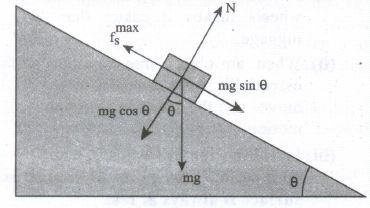
Consider an inclined plane on which an object is placed as shown in the figure, Let the angle which this plane makes with the horizontal be ፀ. For small angle of ፀ, the object may not slide down. As ፀ is increased, for a particular value of ፀ, the object begins to slide down. This value is called angle of repose. Hence, the angle of repose is the angle of the inclined plane with the horizontal such that an object placed on it begins to slide.
37.
(i) Consider the case of a whirling motion of a stone tied to a string. Assume that the stone has angular velocity ω in the inertial frame (at rest).
(ii) If the motion of the stone is observed from a frame which is also rotating along with the stone with same angular velocity ω then, the stone appears to be at rest.
(iii) This implies that in addition to the inward centripetal force - mω2r there must be an equal and opposite force that acts on the stone outward with value + mω2r.
(iv) So the total force acting on the stone in a rotating frame is equal to zero (-mω2r + mω2r=0).
(v) This outward force + mω2r is called the centrifugal force.
38.
39.
Scalar product:
Scalar product or dot product of two vectors in defined as the product of the magnitudes of both the vectors and the cosine of the angle between them.
If \(\vec{A}\) and \(\vec{B}\) are two vector having an angle \(\theta\) between them, then \(\vec{A} \vec{B}=A B \cos \theta\) where A and B are magnitudes of \(\vec{A}\) and \(\vec{B}\) .
Example: work, energy and electric flux.
Properties:
1. \(\vec{A}\).\(\vec{B}\) is always a scalar. It is positive if \(\theta\)<90 and it is negative if \(90^{\circ}<\theta<180^{\circ}\)
2. When the vectors are parallel, \(\theta=0^{\circ} \ and \ \cos 0^{\circ}=1 \therefore(\vec{A} \cdot \vec{B})_{\text {mat }}=A B\).
3. When the vectors are anti-parallel, \(\theta=180^{\circ}\ and \ \cos 180^{\circ}=-1 \therefore(\vec{A} \cdot \vec{B})_{\min }=-A B\)
4. When the vectors are perpendicular to each other, \(\theta=90^{\circ}\ and \ \cos 90^{\circ}=0\therefore \vec{A} \vec{B}=0\).
5. Scalar product is commutative i.e, \(\vec{A} \cdot \vec{B}=\vec{B} \cdot \vec{A}\)
6. It obeys distributive law i.e., \(\vec{A} \cdot(\vec{B}+\vec{C})=\vec{A} \cdot \vec{B}+\vec{A} \cdot \vec{C}\)
7. Self dot product is given by \(\vec{A} \cdot \vec{A}=A A \cos \theta=A^{2}, \ here\ \theta=0^{\circ}\). The magnitude of the vector \(\vec{A}\ is \ (\vec{A})=A=\sqrt{\vec{A} \cdot \vec{A}}\)
8. In the case of orthogonal unit vectors \(\vec{i}, \vec{j} \ and \ \vec{k}\)
\(\hat{i} \hat{j}=\hat{j} \hat{j}=\hat{k} \cdot \hat{k}=1 \text { and } \)
\(\vec{i} \cdot \vec{j}=\hat{j} \hat{k}=\hat{k} \hat{i}=0\)
9. The angle between the vectors \(\theta=\cos ^{-1}\left[\frac{\vec{A} \cdot \vec{B}}{A B}\right]\)
10. In terms of components,
\(\vec{A} \cdot \vec{B} =\left(A_{x} \hat{i}+\mathrm{A}_{y} \hat{j}+A_{z} \hat{k}\right)\left(B_{x} \hat{i}+\mathrm{B}_{y} \hat{j}+B_{z} \hat{k}\right) \)
\(=A_{x} B_{x}+A_{y} B_{y}+A_{i} B_{z} \text {, with all other terms zero. }\)
The magnitude of A is given by \(|\vec{A}|=A=\sqrt{A_{x}^{2}+A_{y}^{2}+A_{2}^{2}}\) and \(|\vec{B}|=B=\sqrt{B_{x}^{2}+B_{y}^{2}+B_{2}^{2}}\) Vector product:
The vector product or cross product of two vectors is defined as another vector having a magnitude equal to the product of the magnitudes of two vectors and the sine of the angle between them.
If \(\vec{A}\) and \(\vec{B}\) are two vectors, then \(\vec{A} \times \vec{B}=\vec{C}=(A B \sin \theta) \hat{n}\).
The direction \(\hat{n}\ of \ \vec{A} \times \vec{B}\) is perpendicular to the plane containing the vectors \(\vec{A}\) and \(\vec{B}\) and is determined by the right hand screw rule or right hand thumb rule.
Example: Torque \(\tau=\vec{r} \times \vec{F}\) and Angular momentum \(\vec{L}=\vec{r} \times \vec{p}\)
Properties:
1. The resultant of the vector product is always another vector whose direction is perpendicular to the plane containing these two vectors \(\vec{A}\) and \(\vec{B}\) even though the vectors \(\vec{A}\) and \(\vec{B}\) may or may not be mutually orthogonal.
2. It is not commutative. \(\vec{A} \times \vec{B} \neq \vec{B} \times \vec{A}\). But \(\vec{A} \times \vec{B}=-[\vec{B} \times \vec{A}]\)
3. When the vectors \(\vec{A}\) and \(\vec{B}\) are orthogonal to each other the vector product will have maximum magnitude as \(\theta=90^{\circ}\ and \ \sin \theta=1\).
\((\vec{A} \times \vec{B})_{\max }=A B \hat{n}\)
4. The vector product of two non-zero vectors will be minimum when (sin \(\theta\))=0, i.e., \(\theta=0^{\circ} \ or \ 180^{\circ}(\vec{A} \times \vec{B})_{\min }=0\).
It means that the vector product of two non-zero vectors vanishes if the vectors are parallel or anti parallel.
5. The self-cross product is a null vector. \(\vec{A} \times \vec{A}=A A \sin 0^{\circ} \hat{n}=\overrightarrow{0}\)
6. The self-vector products of unit vectors are then zero \(\hat{i} \times \hat{i}=\hat{j} \times \hat{j}=\hat{k} \times \hat{k}=0\).
7. In the case of orthogonal unit vectors, \(\vec{i}, \vec{j} \ and \ \hat{k}\)
\(\hat{i} \times \hat{j}=\hat{k}, \hat{j} \times \hat{k}=\hat{i} \ and \ \hat{k} \times \hat{i}=\hat{j}\) and
\(\hat{j} \times \hat{i}=-\hat{k}, \hat{k} \times \hat{j}=-\hat{i} \ and \ \hat{i} \times \hat{k}=-\hat{j}\)
8. In terms of components,
\(\vec{A} \times \vec{B}=\left|\begin{array}{ccc}
\hat{i} & \hat{j} & \hat{k} \\
A_{x} & A_{y} & A_{z} \\
B_{x} & B_{y} & B_{z}
\end{array}\right|=\begin{array}{r}
+\hat{i}\left(A_{y} B_{z}-A_{z} B_{y}\right) \\
+\hat{j}\left(A_{z} B_{x}-A_{x} B_{z}\right) \\
+\hat{k}\left(A_{0} B_{y}-A_{z} B_{x}\right)
\end{array}\)
9. If two vectors \(\vec{A}\) and \(\vec{B}\) form adjacent sides of a parallelogram, then magnitude \((\vec{A} \times \vec{B})\) is equal to the area of the parallelogram.
10. If two vectors \(\vec{A}\) and \(\vec{B}\) are represented by the two sides of a triangle taken in order, then the area of the triangle is equal to \(\frac{1}{2}|\vec{A} \times \vec{B}|\)
40.
Use of screw gauge in measuring radius of a thin wire in the range of 10-5 m
The wire whose diameter is to be determined should be clamped between the jaws of the screw gauge. The reading on pitch scale (P.S.R) is noted. Then the reading of the reading of the head scale coinciding with the pitch scale is noted (A.S.C.) The zero correction is applied to head scale incidence. (C.H.S.S.).
The total reading is given by
T.R = P.S.R + (C.H.S.C. X L.C)
The procedure is repeated for at least six different positions of the wire. The mean of the reading taken gives the diameter of the wire. Half of this gives radius of the wire 'r' in the range of 10-5 m.
Use of vernier caliper in measuring smaller distances in the range of 10-4 m
The sphere is kept between the two jaws. The main scale reading (MSR) is noted (i.e), the main scale division immediately before the zero of the vernier scale. Then the vernier scale division which coincides with some main scale division (VSD) is noted. Zero correction made with this VSD gives VSR. Multiply this VSR by least count and add with MSR. This will give the diameter of the sphere. Observations for different positions of the sphere is hence forth recorded. The mean of the readings taken gives the diameter of the sphere. Half of this gives the diameter of the sphere. Half of this gives radius in the range of 10-4 am
(ii) Write a note on triangulation method and radar method to measure larger distances.
Triangulation method for the height of an accessible object
Let AB = h be the height of the tree or tower to be measured. Let C be the point of observation at distance x from B. Place a range finder at C and measure the angle of elevation, ∠ACB = θ as shown in Figure
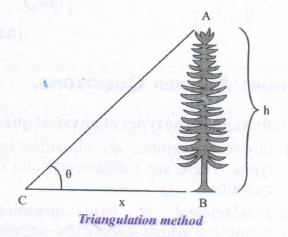
From right angled triangle ABC,
\(\tan \theta=\frac{A B}{B C}=\frac{h}{x}\)
(or) height h = x tan θ
Knowing the distance x, the height h can be determined.
Radar Method: In Radar method radio waves are sent from transmitters which, after reflection from the planet, are detected by the receiver. By measuring, the time interval (r) between the instants the radio waves are sent and received, the distance of the planet can be determined as to get the actual distance of the object. This method can also be used to determine the height, at which an aeroplane flies from the ground.
\(Speed =\frac{\text { Distance travelled }}{\text { Time taken }} \) (Speed is explained in unit 2 )
Distance (d)= Speed of radio waves x Time taken
\(d=\frac{v \times t}{2}\)
where v is the speed of the radio wave. As the time taken (r) is for the distance covered during the forward and backward path of the radio waves, it is divided by 2 to get the actual distance of the object. This method can also be used to determine the height, at which an aeroplane flies from the ground.
41.
a. Since k1 and k2 are parallel, ku = k1 + k2 Similarly, k3 and k4 are parallel, therefore, kd = k3 + k4 But ku and kd are in series,
therefore, \({ k }_{ eq }=\frac { { k }_{ u }{ k }_{ d } }{ { k }_{ u }+{ k }_{ d } } \)
If all the spring constants are equal then, k1 = k2 = k3 = k4 = k
Which means, ku = 2k and kd = 2k
Hence, \({ k }_{ eq }=\frac { { 4k }^{ 2 } }{ 4k } =k\)
b. Since k1 and k2 are parallel, kA = k1 + k2 Similarly, k4 and k5 are parallel,
therefore, kB = k4 + k5
But kA, k3, kB, and k6 are in series,
therefore, \(\frac { 1 }{ { k }_{ eq } } =\frac { 1 }{ { K }_{ A } } +\frac { 1 }{ { K }_{ 3 } } +\frac { 1 }{ { K }_{ B } } +\frac { 1 }{ { K }_{ 6 } } \)
If all the spring constants are equal
then, k1 = k2 = k3 = k4 = k5 = k6 = k
which means, kA = 2k and kB = 2k
\(\frac { 1 }{ { k }_{ eq } } =\frac { 1 }{ { 2K } } +\frac { 1 }{ { K } } +\frac { 1 }{ { 2K } } +\frac { 1 }{ { K } } =\frac { 3 }{ { K } } \)
\({ k }_{ eq }=\frac { k }{ 3 } \)
42.
a. The displacement of the particle executing simple harmonic motion
y = A sin\(\omega t\)
Velocity of the particle is
v = A \(\omega\) cos \(\omega t\) = A \(\omega\) sin\(\left( \omega t+\frac { \pi }{ 2 } \right) \)
The phase difference between displacement and velocity is \(\frac{\pi}{2}\)
b. The velocity of the particle is
v = A \(\omega\) cos \(\omega t\)
Acceleration of the particle is
a = -A\({ \omega t }^{ 2 }\) sin \(\omega t\) = A \({ \omega }^{ 2 }\)cos \(\left( \omega t+\frac { \pi }{ 2 } \right) \)
The phase difference between velocity and acceleration is\(\frac{\pi}{2}\)
c. The displacement of the particle is
y = A sin\(\omega t\)
Acceleration of the particle is
a = − A \({ \omega }^{ 2 }\) sin ωt = A \({ \omega }^{ 2 }\) sin(\(\omega t\) + \(\pi\))
The phase difference between displacement and acceleration is \(\pi\) radian.
43.
It states that when a body is partially or wholly immersed in a fluid, it experiences an upward thrust equal to the weight of the fluid displaced by it and its upthrust acts through the centre of gravity of the liquid displaced.
upthrust or buoyant force = weight of liquid displaced
Proof:
Consider a body of height h lying inside a liquid of density ρ at a depth x below the free surface of the liquid.
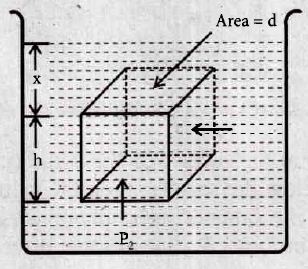
Let the area of cross section be a.
The forces on the sides of the body cancel out. Pressure at the upper face of the body
\(\mathrm{P}_{1}=x \rho g\)
Pressure at the lower surface of the body
\(\mathrm{P}_{2}=(x+h) \rho g\)
Thrust acting on the upper face of the body is
\(\mathrm{F}_{1}=\mathrm{P}_{1} \mathrm{a}=x \rho g a\)
acting vertically downwards.
Thrust acting on the lower face of the body is
\(\mathrm{F}_{2}=\mathrm{P}_{2} \mathrm{a}=(x+h) \rho g a\)
acting vertically upwards.
The resultant force \(\left(\mathrm{F}_{2}-\mathrm{F}_{1}\right)\) is acting on the body is the upward direction and is called upthrust (U)
\(\therefore \mathrm{U} =\mathrm{F}_{2}-\mathrm{F}_{1}=(x+h) \rho g a-x \rho g a \)
\(=\mathrm{a} \rho g h
\)
\(\text {But ah } =\mathrm{V}=\text { Volume of the body }
\)
\(=\text {Volume of the displaced liquid }
\)
\(\mathrm{U} =\mathrm{V} \rho \mathrm{g}=\mathrm{Mg}\)
\(\because M=V \rho=\) mass of liquid displaced i.e., upthrust or buoyant force = Weight of liquid displaced.
This proves the Archimedes principle.
44.
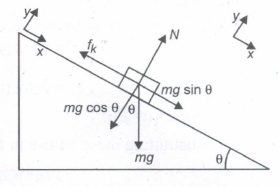
Kinetic friction comes to playas the block is moving on the surface.
The forces acting on the mass are the normal force perpendicular to surface, downward gravitational force and kinetic friction fk along the surface.
mg sinθ - fk = ma
But a = g/2
mg sin 600 - fk = mg/2
\(\frac { \sqrt { 3 } }{ 2 } \)mg - fk = mg/2
fk = mg\(\left( \frac { \sqrt { 3 } }{ 2 } -\frac { 1 }{ 2 } \right) \)
fk =\(\left( \frac { \sqrt { 3 } -1 }{ 2 } \right) mg\)
There is no motion along the y-direction as normal force is exactly balanced by the mg cos θ
mg cosθ = N = mg/2
fk = μkN = μk mg/2
μk = \(\frac { \left( \frac { \sqrt { 3 } -1 }{ 2 } \right) mg }{ \frac { mg }{ 2 } } \)
uk = \(\sqrt { 3 } \)-1
45.
By following the law of triangular addition, the resultant vector is given by \(\vec R\) = \(\vec A\) + \(\vec B\) as illustrated below.
The magnitude of the resultant vector \(\vec R\) is given by
\(R=|\vec R|=\sqrt{5^2+7^2+2\times 5\times 7\cos 60^o}\)
\(R=\sqrt{25+49+\frac{70\times 1}{2}}=\sqrt{109}\) units
i.png)
The angle \(\alpha\) between \(\vec R\) and \(\vec A\) is given by
\(\tan\alpha=\frac{B\sin\theta}{A+B\cos\theta}\)
\(\tan\alpha=\frac{7\times\sin60^o}{5+7\cos60^o}=\frac{7\sqrt{3}}{10+7}=\frac{7\sqrt{3}}{17}\) = 0.713
\(\therefore\alpha=35^o\)
ii.png)
46.
Relation between power and velocity
The work done by a force \(\overrightarrow{\mathbf{F}}\) for a displacement \(d \vec{r}\) is
\(W=\int \overrightarrow{\mathrm{F}} \cdot d \vec{r}\) ......(1)
Left hand side of the equation (1) can be written as
\(W=\int d W=\int \frac{d W}{d t} d t\)
(multiplied and divided by dt) (2)
Since, velocity is \(\vec{v}=\frac{d \vec{r}}{d t} ; \overrightarrow{d r}=\vec{v} d t.\) Right hand side of the equation (1) can be written as
\(\int \overrightarrow{\mathrm{F}} \cdot d \vec{r}=\int\left(\overrightarrow{\mathrm{F}}, \frac{d \vec{r}}{d t}\right) d t=\int(\overrightarrow{\mathrm{F}} \cdot \vec{v}) d t\left[v=\frac{d \vec{r}}{d t}\right] \ldots \ldots\) (3)
Substituting equation (2) and equation (3) in equation (1), we get
\(\int \frac{d W}{d t} d t=\int(\overrightarrow{\mathrm{F}} \cdot \vec{v}) d t\)
Or
\(\int\left(\frac{d W}{d t}-\overrightarrow{\mathrm{F}} \cdot \vec{v}\right) d t=0\)
This relation is true for any arbitrary value of dt. This implies that the term within the bracket must be equal to zero, i.e.,
\(\frac{d W}{d t}-\overrightarrow{\mathrm{F}} \cdot \vec{v} =0 \)
\(\frac{d W}{d t} =\overrightarrow{\mathbf{F}} \vec{v}\)
Examples: Motors, Engines and Automobiles
A vehicle of mass 1250 kg is driven with an acceleration 0.2 ms-2 along a straight level road against an external resistive force 500 N. Calculate the power delivered by the vehicle's engine if the velocity of the vehicle is 30 ms-1.
Solution
The vehicle's engine has to do work against resistive force and make vehicle to move with an acceleration. Therefore, power delivered by the vehicle engine is
\(P =(\text { resistive force }+\text { mass } \times \text { acceleration }) \text { (velocity) } \)
\(P =\overrightarrow{\mathbf{F}}_{-\mathrm{ma}} \vec{v}=\left(F_{\text {reistie }}+F\right) \vec{v} \)
\(P =\overrightarrow{\mathbf{F}}_{\text {tot }} \vec{v}=\left(F_{\text {reithie }}+m a\right) \vec{v} \)
\(=500 \mathrm{~N}+\left((1250 \mathrm{~kg}) \times\left(0.2 \mathrm{~ms}^{-2}\right)\right)\left(30 \mathrm{~ms}^{-1}\right)=22.5 \mathrm{kw}\)
47.
A collection of forces is said to be concurrent, if the lines of forces act at a common point. Concurrent forces need not be in the same plane. If they are in the same plane, they are concurrent as well as coplanar forces.
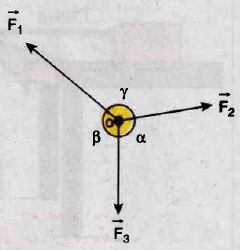
A body, under the action of concurrent forces, is said to be in equilibrium, when there is no change in the state of rest or of uniform motion along a straight line.
The necessary condition for the equilibrium of a body under the action of concurrent forces is that the vector sum of all the forces acting on the body must be zero.
Lami's Theorem: For concurrent forces \(\frac { { F_{ 1 } } }{ sin\ \alpha } =\frac { { F_{ 2 } } }{ sin \ \beta } =\frac { { F_{ 3 } } }{ sin\ \gamma } \). If a system of three concurrent and coplanar forces is in equilibrium, then Lami's theorem states that the magnitude of each force of the system is proportional to sine of the angle between the other two forces. The constant of proportionality is same for all three forces.
48.
The hot water cools 8°C in 3 minutes. The average temperature of 92°C and 84°C is 88°C. This average temperature is 61°C above room temperature. Using equation
\(\frac { dT }{ T-{ T }_{ s } } =-\frac { a }{ ms } dt\ or\ =\frac { dT }{ dt } =-\frac { a }{ ms } \left( T-{ T }_{ s } \right) \)
\(\frac { { 8 }^{ 0 }C }{ 3 \ min } =-\frac { a }{ ms } \left( { 61 }^{ o }C \right) \)
Similarly the average temperature of 65°C and 60°C is 62.5°C. The average temperature is 35.5°C above the room temperature. Then we can write
\(\frac { { 5 }^{ o }C }{ dt } =-\frac { a }{ ms } \left( { 35.5 }^{ o }C \right) \)
By diving both the equation, we get
\(\frac { \frac { { 8 }^{ o }C }{ 3 \ min } }{ \frac { { 5 }^{ o }C }{ dt } } =\frac { -\frac { a }{ ms } \left( { 61 }^{ o }C \right) }{ -\frac { a }{ ms } \left( { 35.5 }^{ o }C \right) } \)
\(\frac { 8\times dt }{ 3\times 5 } =\frac { 61 }{ 35.5 } \)
\(dt=\frac { 61\times 15 }{ 35.5\times 8 } =\frac { 915 }{ 284 } =3.22min\\ \)
49.
Here STP means standard temperature (T=273K or 0°C) and Pressure (P=1 atm or 101.3 kPa)
We can use ideal gas equation V = \(\frac { \mu RT }{ P } \)
Here \(\mu\) = 1 mol and R =8.314 J/mol.K.
By substituting the values
V=\(\frac { (1mol)\left( 8.134\frac { J }{ mol } K \right) (273K) }{ 1.013\times { 10 }^{ 5 }{ Nm }^{ -2 } } \)
= 22.4\(\times\)10-3 m3
We know that 1 Litre (L) = 10-3m3. So we can conclude that 1 mole of any ideal gas has volume 22.4 L.
By multiplying 22.4L by \(\frac{300K}{273K}\) we get the volume of one mole of gas at room temperature. It is 24.6 L.
50.
Dimension formula for
\(\frac { 1 }{ 2 } \)mv2 = [M][LT-1]2 = [ML2T-2]
Dimension formula for
mgh = [M][LT-2][L] = [ML2T-2]
[ML2T-2] = [ML2T-2]
Both sides are dimensionally the same, hence the equations \(\frac { 1 }{ 2 } \)mv2 = mgh is dimensionally correct

11th Standard Syllabus & Materials
11th Standard
TN 11th Tamil பீடு பெற நில் - செய்யுள் - காவடிச்சிந்து Important Questions And Answers Study Material - QB365 Set A
NEW11th Standard
TN 11th Tamil பீடு பெற நில் - உரைநடை - மலை இடப்பெயர்கள் : ஓர் ஆய்வு Important Questions And Answers Study Material - QB365 Set A
NEW11th Standard
TN 11th Tamil மாமழை போற்றுதும் - துணைப்பாடம் - யானை டாக்டர் Important Questions And Answers Study Material - QB365 Set A
NEW11th Standard
TN 11th Tamil மாமழை போற்றுதும் - செய்யுள் - ஐங்குறுநூறு Important Questions And Answers Study Material - QB365 Set A



Tamilnadu Stateboard 11th Standard Subjects

Maths

Commerce

Economics

Biology

Business Maths and Statistics

Accountancy

Computer Science
Physics

Chemistry
Maths
Biology
Economics
Physics
Chemistry

History
Business Maths and Statistics

Computer Science
Accountancy

Computer Applications
History
Computer Technology
Commerce
Computer Applications
Computer Technology

Tamil

English

French
Tamilnadu Stateboard Standards

