
 100% FREE ACCESS
11th Standard Syllabus & Materials
11th Standard
TN 11th Tamil இயற்கை வேளாண்மை,சுற்றுச்சூழல் -செய்யுள் - மனோன்மணீயம் Important Questions And Answers Study Material - QB365 Set A
NEW11th Standard
TN 11th Tamil என்னுயிர் என்பேன் -துணைப்பாடம் - இசைத்தமிழர் இருவர் Important Questions And Answers Study Material - QB365 Set A
NEW11th Standard
TN 11th Tamil மொழி கலை -செய்யுள் - ஒவ்வொரு புல்லையும் Important Questions And Answers Study Material - QB365 Set A
NEW11th Standard
TN 11th Tamil பீடு பெற நில் - இலக்கணம் - பகுபத உறுப்புகள் Important Questions And Answers Study Material - QB365 Set A
NEW11th Standard
TN 11th Tamil பீடு பெற நில் - துணைப்பாடம் - வாடிவாசல் Important Questions And Answers Study Material - QB365 Set A
NEW11th Standard
TN 11th Tamil பீடு பெற நில் - செய்யுள் - குறுந்தொகை Important Questions And Answers Study Material - QB365 Set A

Published on: 16/03/2019
+1 Public Exam March 2019 Important Creative 3 Mark Questions and Answers
Download Tamil Nadu 11th Standard Accountancy question papers, model tests, one-mark questions, important questions, and public exam papers in PDF format. Free study materials and answer keys for TN State Board students.
Questions + Answers key
Take MCQ Accountancy Test
1.
What purpose does an analytical petty cash book serve?
2.
Explain the purpose of journal proper with examples.
3.
Explain the purposes of various subsidiary books.
4.
Write notes on closing entries.
5.
What is Accounting Standards in the words of Kohler?
6.
Briefly explain the relationship among accounting, accountancy and book-keeping.
7.
What is Suspense Account? When is it opened?
8.
Explain the features of trial balance.
9.
Explain the need for preparing trial balance.
10.
Bring out the advantages and the limitations of journal.
11.
Explain the meaning of Accounting Equation.
12.
Explain the meaning of source documents
13.
Explain the features of double entry system.
14.
Evolution of accounting results in modern accounting approach - explain.
15.
Describe the cash basis and accrual basis of accounting.
16.
Explain the importance of Human resource accounting and social responsibility accounting in business.
17.
Describe the various steps involved in accounting process?
18.
Explain the external users of accounting.
19.
Explain the posting of a compound journal entry with an example.
20.
Explain the significance of debit and credit balances of various types of accounts.
21.
Opening stock Rs. 30,000, Purchases Rs. 54,600, Expenses Rs. 6,000, Sales Rs.90,000, Expenses on sales Rs. 3,000, Closing stock Rs. 36,000. Calculate Cost of goods sold and Gross profit.
22.
The following Balances are taken from the books of M/s. Riya Ltd. Prepar Profit and Loss Account for the year ended 31st march 2005.
| Particulars | Rs. | Particulars | Rs. |
|---|---|---|---|
| Gross profit | 5,25,000 | Salaries & Wages | 1,00,000 |
| Rent | 10,000 | Depreciation | 5,000 |
| Interest on Loan | 5,000 | Office expenses | 1,500 |
| Distribution Charges | 2,500 | Salesman salary | 8,000 |
| Bad debts | 2,200 | Stationery and printing | 500 |
| Commission received | 3,000 | Discount received | 2,000 |
| Interest received | 5,000 | Advertising | 9,000 |
| Taxes and Insurance | 2,000 |
23.
What are the difference between trial balance and balance sheet.
24.
Explain the types. of liabilities.
25.
Sunil & company purchased a fixed asset on 1.4.2002 for Rs. 5,00,000. Depreciation is to be provided @ 15% per annum according to straight line method. The books are closed on 31st March every year. Prepare fixed asset account and depreciation account for three years.
26.
Akbar & Co. purchased a Plant for Rs. 80,000 on 01-04-2001. It is Depreciated at 10% p.a. on reducing Balance method for three years. Accounts are closed on 31st March every year. Pass the Journal Entries.
27.
What are the characteristics of balance sheet?
28.
What are the need for preparation of trading account?
29.
What are the Factors determining the amount of depreciation?
30.
Write a short note on Machine hour rate method.
31.
Write a short note on - Insurance Policy Method
32.
Pass necessary Adjusting entries for the following adjustments:
a) Interest on loan outstanding Rs.5,000
b) Depreciation @ 5% on furniture Rs.50,000
c) Write off bad and doubtful debts Rs.3,000
d) Provide provision for bad and doubtful debts @ 5% on sundry debtors Rs.4,00,000
f) Provide provision for discount on creditors @ 2% on sundry creditors Rs.3,50,000
33.
Explain the codification of accounts.
34.
Explain the three types of Procedures.
35.
Explain the types of People Interact.
36.
Give the Block diagram of computer.
37.
From the following particulars prepare a Balance sheet of Mr. X for the year ended 31st March, 2015.
| Capital | Rs.2,00,000 | Sundry debtors | Rs.80,000 |
| Drawings | Rs.40,000 | Land and building | Rs.50,000 |
| Cash in hand | Rs.15,000 | Plant and machinery | Rs.80,000 |
| Loan from bank | Rs.40,000 | Investment | Rs.20,000 |
| Sundry creditors | Rs.40,000 | Bills receivable | Rs.10,000 |
| Bills payable | Rs.20,0.00 | Cash at bank | Rs.25,000 |
| Goodwill | Rs.60,000 |
The following adjustments are made at the time of preparing Final accounts.
(i) Outstanding Liabilities for Salaries Rs.10,000; Wages Rs. 20,000; Interest on Bank overdraft Rs. 3,000; and Interest on bank loan Rs. 6,000.
(ii) Provide Interest on capital @ 10% p.a
(iii) Depreciation on plant and machinery by 10% p.a.
(iv) Bad debts amounted to Rs. 10,000 and make a provision for Bad debts @ 10% on sundry debtors.
(v) Closing stock amounted to Rs. 1,20,000.
Net Profit for the year amounted to Rs. 96,000 after considering all the above adjustments.
38.
The Trial balance shows the followings:
Capital as on 31-03-2013 Rs.6,00,000 .
Drawings as on 31-03-2013 Rs.50,000
Charge interest on drawings @ 5% pass adjusting entry. Show how this item appear in the final accounts.
39.
What is Credit balance?
40.
Explain the concept of Matching Principle.
41.
Pass the journal entries rectifying the following errors:
(i) Purchases of office furniture of Rs. 10,000 was recorded in Purchases book.
(ii) Office rent of Rs. 15,000 was debited to the personal account of the landlord.
(iii) Old machine was sold for Rs. 5,000 was credited to Sales account.
42.
Rectify the following errors.
(i) The Sales book of December was added short by Rs. 500.
(ii) A periodical total of the Purchases book was short by Rs. 5,000.
(iii) The total of Purchases return Book has been undercast by Rs. 1,500.
(iv) The Sales return book is added Rs. 200 short.
43.
In the following illustration, what will be the bank statement balance if the cash book balance is unfavourable?
| Particulars | Rs | |
|---|---|---|
| (i) | Cheques deposited but not yet collected by the bank | 500 |
| (ii) | Cheque issued but not yet presented for-payment | 1000 |
| (iii) | Bank interest charged | 100 |
| (iv) | Rent paid by bank as per standing instruction | 200 |
| (v) | Cash book balance | 300 |
44.
Visit some business units in your area. Find out the books maintained by them. Do they maintain special subsidiary books? If not, discuss with them the need and guide them on maintaining the special subsidiary books.
45.
Write the narration with reference to the following journal entries
| Date | Particulars | L.F | Debit Rs | Credit Rs |
|---|---|---|---|---|
| 2018 | ||||
| April 1 | Cash A/c Dr | 3,00,000 | ||
| To Shyam's Capital A/c | 3,00,000 | |||
| (...........................................) | ||||
| 2 | Bank A/c Dr | 2,70,000 | ||
| To Cash A/c | 2,70,000 | |||
| (...........................................) |
46.
Think: A customer has returned the goods to his supplier along with a debit note. But, the supplier does not agree with the customer's claim that the goods are damaged. Can the customer consider his debit note as a valid source document and enter the purchases returns?
47.
Observe the above format. Why the withdrawals are shown as debit and deposits are shown as credit in a bank statement?
48.
When his business becomes large, what other books will he be maintaining?
49.
What are the features of book-keeping?
50.
What is the difference between voucher and invoice?
51.
What is the difference between cash transaction and credit transactions?
52.
Write a note on (a) purchases, (b) sales.
53.
What are the causes of difference between bank column of the cash book and bank statement?
54.
Explain any three advantages of subsidiary books.
55.
Explain the various methods of preparing trial balance.
56.
Write short notes on accrual basis of accounting.
57.
Write short notes on cash basis of accounting.
58.
State the nature of account and show which account will be debited and which account will be credited? (1) Rent received, (2) building purchased, (3) Machinery sold, (4) Discount allowed, (5) Discount received.
59.
What are the advantages of Journal?
60.
What are the different types of Journal entries?
61.
Enter the following transactions in Cash book with Cash and Discount column of Mr. Nandakumar.
| 2016 Feb 1 | Cash in hand | Rs.60,000 |
| 3 | Bought goods from Premnath | Rs.10,000 |
| 4 | Opened a current account with bank | Rs.15,000 |
| 7 | Withdrew from bank | Rs.5,000 |
| 8 | Sold goods to Kandan for Rs.10,000 credit on terms 2% cash discount if payable within two weeks | |
| 10 | Paid cash to Premnath, less 1% C.D. | |
| 14 | Received a cheque from Arul Rs.3,400, allowed him discount Rs.100 | |
| 15 | Kandan settled his account |
62.
Write the transactions from the Journal Entries.
Drawings A/c Dr
To Purchases
63.
Write the transactions from the Journal Entries.
Cash A/c Dr
To Bad debts recovered A/c
64.
Write the transactions from the Journal Entries
Cash A/c Dr.
Discount Alc Dr.
To Aravind A/c
65.
Write the transactions from the Journal Entries
Cash A/c Dr.
To Bank A/c
66.
Transactions of Sunil for the month of April are given below Journalise them.
| 2018 January | Rs | |
|---|---|---|
| 1 | Sumy started business with cash | 3,00,000 |
| 3 | Bought goods for cash | 15,000 |
| 13 | Sold goods to Abisha | 4,500 |
| 20 | Bought goods from Sumy | 6,750 |
| 24 | Received from Abisha | 4,500 |
| 28 | Paid cash to Sumy | 6,450 |
| 30 | Cash Sales for the month | 24,000 |
| 30 | Paid salary to Ram | 9,000 |
| 30 | Goods were returned to Karthick | 10,000 |
67.
List the five items having the effect of higher balance in the Cash book.
68.
What is the need for bank reconciliation Statement?
69.
Radhika Traders started Business with the following on pt April 2017.
Assets: Cash Rs.8,000; Bank Rs.7,000; Stock Rs.30,000; Debtors Rs.40,000;
(Mono Rs.25,000 and Suman Rs.15,000) Furniture Rs.5,000 and Building Rs.25,000
Liabilities: Creditors Rs.18,000 (Suresh Rs.10,000 and Ramesh Rs.8,000) Pass the Journal Entry.
70.
Supply the missing amounts on the basis of accounting equation.
| Assets | = | Liabilities + Capital |
|---|---|---|
| ? | = | Rs.5,000 + Rs.10,000 |
71.
State the different approaches in recording business transactions.
72.
Write Short notes on
(i) Renewal of a bill
(ii) Retiring of a Bill.
73.
Write a note on
(i) Bills Receivable Book
(ii) Bills Payable Book.
74.
What are the features of a bill of exchange?
75.
What are the difference between Cash Discount and Trade Discount?
76.
The following balances are extracted from the books of Mr. Saran, as on 31.03.2017. Prepare trial balance transfer the different if any to suspense account.
| Rs | Rs | ||
| Discount allowed | 350 | Loan borrowed | 12,000 |
| Cash in hand | 4,100 | Commission paid | 3,000 |
| Capital | 45,000 | Purchases | 29,050 |
| Salaries | 10,000 | Sales | 35,000 |
| Furniture | 9,500 |
77.
The following balances extracted from the books of Mr. Murali, as on 30.03.2016. Prepare trial balance.
| Rs | Rs | ||
| Sales | 35,000 | Audit Fees | 1,000 |
| Interest paid | 350 | Octroi duty | 8,000 |
| Returns inward | 2,500 | Land | 90,000 |
| Depreciation | 2,400 | Capital | 60,000 |
| Office rent | 2,000 | Bank overdraft | 11,250 |
78.
'Ledger is a principal Book of a Business' - Explain.
79.
What are the importance of cash book?
80.
Prepare the trial balance from the following balances of Ms Chitra as on 31.03.2015.
| Rs | Rs | ||
| Capital | 2,50,000 | Bank | 2,75,000 |
| Bills payable | 50,000 | Debtors | 1,00,000 |
| Opening Stock | 75,000 | Discount received | 5,000 |
| Loan | 1,50,000 | Sales | 50,000 |
| Salaries | 10,000 | Purchases | 45,000 |
81.
How does matching principle apply to depreciation?
82.
Which value is reflected in the Accounting standards issued by ICAI?
83.
Do you think that the principle of conservatism results in creating of secret reserve?
84.
What are the features of trial balance?
85.
What is the need for preparing trial balance?
86.
What is the need for accounting standards?
87.
What are the objectives of book-keeping?
88.
Explain the process of Accounting cycle.
89.
What do you mean by IFRS?
90.
What are the limitations of Book-keeping
91.
'Accounting information should be comparable'. Do you agree with this statement? Give two reasons.
92.
Is accounting an art or a Science?
93.
Non-monetary transactions are not recorded in the books of accounts. Give reason and explain
94.
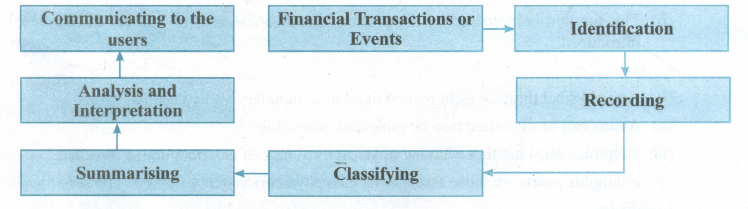
What is the process of accounting?
95.
Explain the objectives of Accounting?
96.
What are the informational needs of internal users?
97.
Write short notes on
a) Capital
b) Assets
c) Liabilities
98.
Briefly explain the following terms
a) Account
b) Voucher
c) Invoice
99.
Explain the term transactions
1.
Analytical petty cash book: The petty cash book has debit side and credit side. The debit side is smaller and the credit side is bigger and it has many columns. For each important petty expense, there is a separate column and therefore 'columnar cash book' is another name for this petty cash book. In this book, each petty payments is first entered in the total payments column and then recorded in the respective analytical column so that:
(i) the total amount spent on each expenses for a particular period can be easily ascertained by adding up the respective column.
(ii) only the periodical total of each column is posted to ledger. It saves labour and time.
(iii) the total petty payment for any period can be easily ascertained from the total payment column.
2.
The purpose of journal proper: The journal proper is used to record the following entries.
(i) Opening entries: They are used at the beginning of the financial year to open the books by recording the assets and liabilities and capital appearing in the Balance Sheet of the previous year.
Example: On 1st January 2014, Mr. Ramesh commenced his business with the following items. Cash Rs. 30,000; Furniture Rs. 3,000; Stock Rs. 15,000; Creditors Rs. 10,000
The opening entries in the journal proper is:
| Date | Particulars | L.F. | Debit Rs. | Credit Rs. | |
|---|---|---|---|---|---|
| 1.1.14 | Cash A/c | Dr. | 30,000 | ||
| Stock A/c | Dr. | 15,000 | |||
| Furniture A/c | Dr. | 3,000 | |||
| To Creditors A/c | 1,50,000 | ||||
| To Ramesh's Capital A/c | 2,47,000 | ||||
| (Commenced business with Assets & Liabilities) |
(ii) Closing entries are recorded at the end of the accounting year for closing the accounts relating to expenses and revenues. The accounts are closed by transferring the balances to the Trading A/c and Profit and Loss A/c.
(iii) Adjusting entries: To arrive at a correct profit or loss at the time of preparing final accounts certain accounts require some adjustments. Entries for making such adjustments are called
adjusting entries
Example: On 31st December 2013, it is decided to provide depreciation @ 10% p.a. on furniture.
Furniture value is Rs. 1,00,000.
The adjusting entry is:
| Date | Particulars | L.F. | Debit Rs. | Credit Rs. | |
|---|---|---|---|---|---|
| 31.12.13 | Depreciation A/c | Dr. | 10,000 | ||
| To Furniture A/c | 10,000 | ||||
| (Depreciation provided) |
(iv) Transfer entries: They are passed in the journal proper for transferring an item entered in one account to another account.
Example: When the proprietor takes goods for Rs. 5,000 for personal use, the drawing A/c is transferred to purchases A/c. The entry is,
| Date | Particulars | L.F. | Debit Rs. | Credit Rs. | |
|---|---|---|---|---|---|
| 31.12.13 | Drawings A/c | Dr. | 5,000 | ||
| To Purchases A/c | 5,000 | ||||
| (Goods withdrawn for personal use) |
(v)Rectifying entries are passed for rectifying the errors which might have committed in the books of accounts.
Example: Purchase of furniture for Rs. 10,000 was wrongly debited in Purchases A/c. To rectify the error the following entry is to be passed.
| Date | Particulars | L.F. | Debit Rs. | Credit Rs. | |
|---|---|---|---|---|---|
| 31.12.13 | Furniture A/c | Dr. | 10,000 | ||
| To Purchases A/c | 10,000 | ||||
| (Wrong debit of purchases Alc rectified) |
(vi) Miscellaneous entries or Entries of casual nature: These are entries which do not occur so frequently.
Examples of such transactions:
(a) Credit purchases and credit sales of assets which cannot be recorded in purchases or sales book.
(b) Endorsement, renewal and dishonour of bills which cannot be recorded in bills book.
(c) Other adjustments like interest on capital, interest on loan, bad debts, reserves, etc., ,
3.
Purposes of subsidiary books:
(i) Purchases Book: It records only credit purchases of goods by the trader.
(ii) Sales Book: It records only credit sale of goods by the trader.
(iii) Purchases Returns Book: It records the goods returned by the trader to the suppliers.
(iv) Sales Return Book: It records the goods returned by the customers.
(v) Bills Receivable Book: It records the receipt of bills from customers.
(vi) Bills Payable Book: It records the bills accepted by the trader.
(vii) Cash Book: It records all the cash transactions of the business. (i.e.,) the receipts and payments of cash.
(viii) Journal Proper: It is the journal which records entries which cannot be entered in any of the subsidiary books.
4.
Closing entries are recorded at the end of the accounting year for closing the accounts relating to expenses and revenues. The accounts are closed by transferring the balances to the Trading Alc and Profit and Loss A/c.
Example: On 31.12.2013 salaries account shows Rs. 15,000 - the closing entry is,
| Date | Particulars | L.F. | Debit Rs. | Credit Rs. | |
|---|---|---|---|---|---|
| 31.12.13 | Profit and Loss A/c | Dr. | 15,000 | ||
| To Salaries A/c | 15,000 | ||||
| (Closing entry for the salaries A/c) |
5.
"Accounting standards are codes of conduct imposed by customs, law or professional bodies for the benefit of public accountants and accountants generally".
From the above statement, Accounting Standards are written policy documents issued by the expert accounting body or by government or other regulatory body.
6.
Book-keeping is part of Accounting. It is the primary stage in accounting. It is the process of recording transactions in the books of accounts.
Accounting is part of Accountancy. Accounting is the process of recording, classifying, analysing and interpreting of financial data. Accountancy is the systematic knowledge of accounting process and contains the standards, principles, policies and procedures to be followed in accounting.
7.
Suspense Account: The errors which affect one account will affect the agreement of trial balance. Ifit is difficult to locate the error before preparing the final accounts, the difference in the trial balance is transferred to newly opened imaginary and temporary account called' Suspense Account'. It is prepared to avoid the delay in the preparation of final accounts. If the total debit balances of the trial balance exceeds the total credit balances, the difference is transferred to the credit side of the suspense account. On the other hand, if the total credit balances of the trial balances exceeds the total debit balances, the difference is transferred to the debit side of the suspense account.
When all the errors affecting the trial balance are located and rectified, the suspense account automatically gets closed.
Suspense account is continued in the books until the errors are located and rectified. Such balance will be shown in the balance sheet. The debit balance will be shown on the assets side and the credit balance will be shown on the liabilities side.
8.
Features of trial balance:
(i) Trial balance contains the balances of all ledger accounts.
(ii) It is prepared oil a specific date. That is why, the word, "as on ... " is used at the top.
(iii) When double entry system is followed, the totals of the debit and the credit columns of the trial balance must be equal.
(iv) If there is a difference between the totals of debit column and credit column of the trial balance, it.is an indication of errors being committed somewhere.
(v) If both the debit column and the credit column of the trial balance have the same total, it does not mean that there is no mistake in accounting, since some errors are not disclosed by the trial balance.
9.
Need for preparing trial balance:
(i) Trial balance helps to check the arithmetical accuracy of entries made in the accounting records.
(ii) Trial balance serves as a lubricant for the smooth movement and completion of the accounting cycle.
(iii) Trial balance helps in discovering errors which may have been committed in the accounting records.
10.
Advantages of the journal.
(i) It reduces the possibility of errors.
(ii) It provides an explanation of the transaction.
(iii) It provides a chronological (day-to-day) record of all transactions.
Limitations of the journal.
(i) It will be too long, if all transactions are recorded here.
(ii) It is difficult to ascertain the balance each account.
11.
Accounting Equation is based on dual aspect concept (Debit and Credit). It emphasizes on the fact that every transaction has a two sided effect (i.e.,) on the assets and claims on assets. Always the total claims (those of outsiders and of the proprietors) will be equal to the total assets of the business concern. The claims are also known as equities, are of two types:
(i) Owners equity (capital) and (ii) Outsider's equity (liabilities).
Assets =Equities
Assets =Capital+ Liabilities (A = C + L)
Capital =Assets - Liabilities (C = A - L)
Liabilities =Assets - Capital (L =A - C)
12.
Source Documents: Source documents are the evidence of business transactions which provide information about the nature of the transaction, the date, the. amount and the parties involved in it Transactions are recorded in the books of accounts when they actually take place and they are duly supported by source documents.
According to the verifiable objective evidence principle of accounting, each transaction recorded in the books of accounts should have adequate proof to support it These supporting documents are the written and authentic proof of the correctness of the recorded transactions. These documents are required for audit and tax assessment They also serve as the legal evidence in case of a dispute.
Examples: Cash memos, invoices, bills, receipts, vouchers, bills receivable, bills payable, wage sheets, salary pay acquittance, c~rresp<?ndence, etc.,
13.
Features of double entry system: The following are the features of double entry system.
(i) Every business transaction affects two accounts.
(ii) Each transaction has two aspects (i.e.,) debit and credit.
(Ui) It is based upon accounting assumptions, concepts and principles.
(iv) Helps in preparing trial balance which is a test of arithmetical accuracy in accounting.
(v) Preparation of final accounts will be made easy with the help of trial balance.
14.
In India, 23 centuries ago, Chandragupta Maurya's. Minister Kautilya wrote a book named 'Arthashastra', wherein some references can be traced regarding the way of maintaining accounting records.
In the earliest days of civilisation, accounting was done by Stewards who managed the properties of wealthy people. They rendered accounts periodically to the owners of property.
In 1494, Luca Pacioli an Italian developed double-entry book-keeping system which paved way to modem accounting approach later. Finally during 18th and 19th centuries, large scale operations by joint stock companies which paved way for development of comprehensive financial accounting information system.
15.
(i) Cash basis: Under cash basis of accounting, actual cash receipts and actual cash payments are recorded. In this basis, revenue is recognised when cash is received and expenses are recognised when cash is paid. Under this basis,
(a) Any income received
(b) Any expenditure paid
(c) Any asset purchased for which cash is paid
(d) Any liability paid during the accounting period whether related to the past, present or future is taken into account.
(ii) Accrual (or) mercantile basis: Under accrual basis of accounting, the revenue whether received or not, but has been earned or accrued during the accounting period and expenses incurred whether paid or not are recorded. Under this basis,
(a) Any income earned whether received or not
(b) Any expenditure incurred whether paid or not
(c) Any asset purchased whether cash is paid or not
(d) Any liability incurred whether paid or not during the accounting period is recorded.
16.
The importance of Human resource accounting and social responsibility accounting in business are:
(I) Human Resource Accounting: It is concerned with identification, quantification and reporting of investments made in human resources of an enterprise. It helps in recruitment and selection of personnel in any organisation.
(ii) Social Responsibility Accounting: It is concerned in presentation of accounting information by business entities and other organisations from the point of view of the society by showing the social costs incurred such as environmental pollution by the enterprise and social benefits such as infrastructure development and employment opportunities created by them.
17.
The various steps involved in accounting process are:
(i) Identifying the transactions and journaiising: The first step in the accounting process is identifying the financial transactions of a business. All the monetary transactions are recorded in the books of original entry called journals. Recording the transactions in the journal is called journalising. Entries are made journals.
(ii) Posting and balancing: Transferring the entries from the journal to the ledger is called posting. In ledger, entries are made in each account after classifying them under common heads. Finding out the difference between the total of the debit column and credit column of all the ledger accounts is called balancing.
(iii) Preparation of trial balance: The list of ledger balances namely trial balance is prepared as the next step. On the basis of ledger balances the financial statements are prepared.
(iv) Preparation of trading account: Next step is preparation of trading account for a particular accounting period. All the direct revenues and direct expenses are transferred to trading account. The balance in the trading account is the gross profit or gross loss.
(v) Preparation of profit and loss account: Profit and loss account is prepared next for a particular accounting period. All the indirect revenues. and indirect expenses along with gross profit or gross loss are transferred to profit and loss account. The balance in the profit and loss account is the net profit or net loss.
(vi) Preparation of balance sheet: A statement showing the balances of assets and liabilities namely balance sheet is prepared as the final step in the accounting process. It is prepared on a particular date, normally, on the last day of the accounting period.
18.
The external users of accounting are:
(i) Creditors and financial institutions: Suppliers of goods and services, commercial banks, public deposit holders and debenture holders are included in this category. They are interested in knowing the liquidity position and repaying capacity of the business enterprise.
(ii) Investors: Persons who are interested in investing their funds in an organisation should know about the financial condition of a business unit while making their investment decisions.
(iii) Customers: Customers who buy and use the products and services of business enterprises are interested in knowing the details of the products and the prices charged to them.
(iv) Tax authorities and other regulatory bodies: Accounting information helps the tax authorities in computing income tax and taxes on goods and services and other taxes to be collected from business units. Other regulatory bodies also require information about revenues, expenses and other financial aspects of business to ensure that the enterprises comply with statutory requirements.
(v) Government: The scarce resources of the country are used by business enterprises. Information about performance of business units in, different industries helps the government in policy formulation for development of trade and industry, allocation of scarce resources, grant of subsidy, etc., Government also administers prices of certain commodities. In such cases, government agencies have to ensure that the guidelines for pricing are followed.
(vi) Researchers: Researchers to carry out their research can use accounting information and make use of the published financial statements, for analysis and evaluation.
(vii) General public: From accounting information, the general public at large can get a view of the earning capacity and stability of the enterprise as well as the social responsibility measures undertaken by the enterprise, particularly in its area of operation and also the employment opportunities provided to the local people.
19.
Posting of a Compound Journal Entry: Compound or Combined journal entry is one where more than one transactions are recorded by passing only one journal entry instead of passing several journal entries. Since every debit must have the corresponding equal amount of credit, special care must be taken in posting the compound journal entry, where there may be only one debit aspect but many corresponding credit aspects of equal value or vice versa.
Example: Jan. 15,2018, Cash Sales Rs. 10,000 cash received from Kannan Rs. 5,000 and commission earned Rs. 2,500.
| Date | Particulars | L.F. | Debit Rs. | Credit Rs. | |
|---|---|---|---|---|---|
| 15.1.18 | Cash A/c | Dr. | 17,500 | ||
| To Sales A/c | 10,000 | ||||
| To Kannan A/c | 5,000 | ||||
| To Commission A/c | 2,500 | ||||
| (Received cash for sale, from Kannan & as commission) |
| Date | Particulars | J.F. | Amount Rs. | Date | Particulars | J.F. | Amount Rs. |
|---|---|---|---|---|---|---|---|
| 15.1.18 | To Sales A/c | 10,000 | 31.1.18 | By Balance c/d | 17,500 | ||
| To Kannan A/c | 5,000 | ||||||
| To Commission A/c | 2,500 | ||||||
| 17,500 | 17,500 | ||||||
| 1,2,18 | To Balance b/d | 4,000 |
| Date | Particulars | J.F. | Amount Rs | Date | Particulars | J.F. | Amount Rs |
|---|---|---|---|---|---|---|---|
| 31.1.18 | To Balance c/d | 10,000 | 15.1.18 | By Cash A/c | 10,000 | ||
| 10,000 | 10,000 | ||||||
| 1.2.18 | By Balance b/d | 10,000 |
| Date | Particulars | J.F. | Amount Rs. | Date | Particulars | J.F. | Amount Rs. |
|---|---|---|---|---|---|---|---|
| 31.1.18 | To Balance c/d | 5,000 | 15.1.18 | By Cash A/c | 5,000 | ||
| 5,000 | 5,000 | ||||||
| 1.2.18 | By Balance b/d | 5,000 |
| Date | Particulars | J.F. | Amount Rs. | Date | Particulars | J.F. | Amount Rs. |
|---|---|---|---|---|---|---|---|
| 31.1.18 | To Balance c/d | 2,500 | 15.1.18 | By Cash A/c | 2,500 | ||
| 2,500 | 2,500 | ||||||
| 1.2.18 | By Balance b/d | 2,500 |
20.
Significance of debit and credit balances of various types of accounts: There are three possibilities while balancing an account during a given period. It may be a debit balance or a credit balance or a nil balance depending upon the debit total and the credit total.
(i) Debit Balance: The excess of debit total over the credit total is called the debit balance.
(ii) Credit Balance: The excess of credit total over the debit total is called the credit balance.
(iii) Nil Balance: When the total of debits and credits are equal, it is closed by merely writing the total on both the sides. It indicates the equality of benefits received and given by that account.
Balancing of different accounts: Balancing is done periodically, (i.e.,) weekly, monthly, quarterly, half-yearly or yearly, depending on the requirements of the business.
(i) Personal Accounts: These accounts are generally balanced regularly to know the amounts due to the persons (creditors) or due from the persons (debtors).
(ii) Real Accounts: These accounts are generally balanced at the end of the financial year, when final accounts are being prepared. However, cash account is frequently balanced to know the cash on hand. A debit balance in an asset account indicated the value of the asset owned by the business. Assets accounts always show debit balances.
(iii) Nominal Accounts: These accounts are in fact, not to be balanced as they are to be closed by transfer to final accounts. A debit balance in a nominal account indicates that it is an expense or loss. A credit balance in a nominal account indicates that it is an income or gain.
All such balances in personal and real accounts are shown in the Balance Sheet and the balances in nominal accounts are taken to the Profit and Loss Account.
21.
Cost of Goods sold Opening stock + Purchases + Expenses on purchases - Closing stock
= Rs.30,000 + Rs. 54,600 + Rs. 6,000 -Rs. 36,600
= Rs. 54,000
Gross profit Net Sales - Cost of Goods sold
= Rs. 90,000 - Rs. 54,000
= Rs. 36,000
22.
| Particulars | Rs. | Particulars | Rs. |
|---|---|---|---|
| To Rent | 15,000 | By Gross profit | 5,25,000 |
| To Interest on Loan | 5,000 | By. Commission received | 3,000 |
| To Distribution charges | 2,500 | By Interest received | 5,000 |
| To Bad debts | 2,200 | By Discount received | 2,000 |
| To Taxes no insurance | 2,200 | ||
| To Salaries and wages | 1,00,000 | ||
| To Depreciation | 5,000 | ||
| To Office expenses | 1,500 | ||
| To Salesman salary | 8,000 | ||
| To Stationery and printing | 500 | ||
| To Advertising | 9,000 | ||
| To Net profit | 3,89,300 | ||
| (Transferred to Capital A/c) | |||
| 5,35,000 | 5,35,000 |
23.
The following are the differences between trial balance and balance sheet.
| Basis | Trial Balance | Balance Sheet |
| 1. Nature | Trial-Balance is a list of ledger balances on a particular date | Balance sheet is a statement showing the position of assets and liabilities on a particular date. |
| 2. Purpose | Trial Balance is prepared to check the arithmetical accuracy of the Accounting entries made. | Balance sheet is prepared to ascertain the financial position of a business |
| 3. Format | The trial balances contains debit balances and credit balances. | The- items are grouped as assets and liabilities. |
| 4. Stage | It is prepared before the preparation of final accounts. | It is prepared after preparing trial balance and trading and profit and loss account. |
| 5. Order | Balances shown in the trial balance need not be in order | Balances shown in the balance sheet must be in order. |
| 6. Compulsion | Preparation of trial balance is not compulsory. | Preparation of the balance sheet is compulsory in certain cases. |
24.
Liabilities may be classified according to their nature as follows:
a) Fixed or long-term liabilities:
The Liabilities which are to be repaid after one year or more are termed as long-term liabilities. These include public deposits, long-tern loans, etc.
b) Current or short-term liabilities:
(i) The liabilities which are expected to be paid within the normal operating cycle or one year are termed as current or short-term liabilities.
(ii) These include bank overdraft, creditors, bills payable, outstanding expenses, etc.
c) Contingent Liabilities:
(i) These are the liabilities which are not certain at the time of preparation of balance sheet. These Liabilities mayor may not occur.
(ii) These are the liabilities which will become payable only on the happening of some specific. event which itself is not certain, otherwise these need not be paid
25.
| Date | Particulars | Amount Rs |
Date | Particulars | Amount Rs |
|---|---|---|---|---|---|
| 2002 Apr 01 | To Bank A/c | 5,00,000 | 2003 Mar 31 | By Depreciation A/c | 75,000 |
| By Balance c/d | 4,25,000 | ||||
| 5,00,000 | 5,00,000 | ||||
| 2003 Apr 01 | To Balance b/d | 4,25,000 | 2004 Mar 31 | By Depreciation A/c | 75,000 |
| ''' | By Balance c/d | 3,50,000 | |||
| 4,25,000 | 4,25,000 | ||||
| 2004 Apr 01 | To Balance b/d | 3,50,000 | 2005 Mar 31 | By Depreciation A/c | 75,000 |
| '' | By Balance c/d | 2,75,0000 | |||
| 3,50,000 | 3,50,000 | ||||
| 2005 Apr 01 | To Balance b/d | 2,75,000 |
| Date | Particulars | Amount Rs |
Date | Particulars | Amount Rs |
|---|---|---|---|---|---|
| 2003 Mar 31 | To Fixed Asset A/c | 75,000 | 2003 Mar 31 | By Profit & Loss A/c | 75,000 |
| 75,000 | 75,000 | ||||
| 2004 Mar 31 | To Fixed Asset A/c | 75,000 | 2004 Mar 31 | By Profit & Loss A/c | 75,000 |
| 75,000 | 75,000 | ||||
| 2004 Mar 01 | To Fixed Asset A/c | 75,000 | 2005 Mar 31 | By Profit & Loss A/c | 75,000 |
| 75,000 | 75,000 |
26.
| Date | Particulars | L.F | Debit Rs |
Credit Rs |
|
|---|---|---|---|---|---|
| 2001 Apr 01 | Plant A/c | Dr | 80,000 | ||
| To Bank A/c | 80,000 | ||||
| (Being the Plant purchased) | |||||
| 2002 Mar 31 | Depreciation A/c | Dr | 8,000 | ||
| To Plant A/c | 8,000 | ||||
| (Being Depreciation @ 10% provided) | |||||
| 2002 Mar 31 | Profit and Loss A/c | Dr | 8,000 | ||
| To Depreciation A/c | 8,000 | ||||
| (Being the closure of Depreciation Account) | |||||
| 2003 Mar 31 | Depreciation A/c | Dr | 7,200 | ||
| To Plant A/c | 7,200 | ||||
| (Being Depreciation @ 10% provided) | |||||
| 2003 Mar 31 | Profit and Loss A/c | Dr | 7,200 | ||
| To Depreciation A/c | 7,200 | ||||
| (Being the closure of'Depreciation Account) | |||||
| 2004 Mar 31 | Depreciation A/c | Dr | 6,480 | ||
| To Plant A/c | 6,480 | ||||
| (Being Depreciation @ 10% provided) | |||||
| 2004 Mar 31 | Profit and Loss A/c | Dr | 6,480 | ||
| To Depreciation A/c | 6,480 | ||||
| (Being the closure of Depreciation Account) |
27.
The following are the characteristics of a balance sheet.
(i) A balance sheet is a part of the final accounts. However, the balance sheet is a statement and not an account
(ii) A balance sheet is a summary of the personal and real accounts, which have balances. Personal and real accounts having debit balances are shown on the right hand side known as asset side, where as personal and real accounts having credit balances are shown on the left hand side known as liabilities side.
(iii) The totals of the two sides of the balance sheet must be equal. If the totals are not equal, it indicates existence of error.
(iv) Balance sheet is prepared on a particular date and not for a fixed period. It gives the balances only for the date on which it is prepared.
(v) It shows the financial position of the business according to the going concern concept.
28.
Preparation of trading account serves the following purposes:
(i) Provides information about gross profit or gross loss:
(a) It shows the gross profit or gross loss of the business for an accounting year.
(b) This helps the business persons to find out gross profit ratio by expressing the gross profit as a percentage of sales It helps to compare and analyse with the ratios of the previous years.
(ii) Provides an opportunity to safeguard against possible losses:
If the ratio of gross profit has decreased in comparison to the preceding years, effective measures can be taken to safeguard against future losses.
(iii) Provides information about direct expenses and direct incomes:
(a) All the expenses incurred on the purchase of goods are direct expenses. They are recorded in the trading account.
(b) With the help of trading account, percentage of such expenses on sales revenue can be calculated and compared with similar ratios of the previous years.
29.
There are different factors that determine the amount of depreciation to be provided on a fixed asset. They are as follows:
(i) Original cost of the asset :
(a) It means the amount incurred in acquiring the asset. It includes all those expenses incurred on the asset till it is put into use.
(b) Purchase price of the asset, freight, loading charges, unloading charges, erection cost, setting up cost and expenses of trial run are part of the original cost.
(ii) Estimated useful life of the asset:
(a) The time period for which an asset can be used in the enterprise is known as estimated useful life of an asset.
(b) In the case of leased assets, the period of lease is taken as its useful life. In the case of intellectual properties like patents and copyrights, their legal life is taken as their estimated useful life.
(iii) Scrap value of an asset:
(a) The amount which is expected to be realised at the end of the estimated useful life life of an asset is known as scrap value of the asset.
(b) In determining the scrap value, costs to be incurred for removal and sale of the asset should be deducted from the estimated gross realisable value.
(iv) Other factors:
Besides above mentioned factors, estimated running hours, production capacity, and other factors also determine the amount of depreciation.
30.
Machine hour rate Method:
(i) Under this method, depreciation per machine hour is calculated.
(ii) The cost of the machinery after deducting, the residual value, if any, is divided by the estimated working hours of the machine to find the depreciation per hour.
(iii)The actual depreciation for any given period depends upon the working hours during that year.
The following formula is used to determine the rate of depreciation:
Rate of Depreciation per Machine Hour = \(\frac { Original\quad cost-Estimated\quad Scrap\quad value }{ Life\quad of\quad the\quad asset\quad in\quad hours } \)
31.
(i) Under this method, an insurance policy is taken for an amount equal to the cost of replacement of the asset.
(ii) The amount of depreciation is paid by way of in surance premium every year to the insurance company.
(iii) On maturity of the policy, the policy amount is received from the insurance company and it is used for the purchase of new asset.
32.
| Date | Particulars | L.F. | Debit Rs. | Credit Rs. | |
|---|---|---|---|---|---|
| (a) | Interest on loan A/c | Dr. | 5,000 | ||
| To Interest on loan outstanding A/c (Interest on loan outstanding) |
5,000 | ||||
| (b) | Depreciation A/c | Dr. | 2,500 | ||
| To Furniture A/c (Depreciation on furniture 50,000 x 5/100) |
2,500 | ||||
| (c) | Bad debts A/c | Dr. | 3,000 | ||
| To Sundry debtors A/c (Being write off Bad debts) |
3,000 | ||||
| (d) | Profit and Loss A/c | Dr. | 20,000 | ||
| To Provision for bad and doubtful debts A/c (Provision for Bad and doubtful debts 49,000 x 5/100) |
20,000 | ||||
| (e) | Provision for discount on creditor A/c | Dr. | 7,000 | ||
| To Profit 'and loss A/c (Provision for discount on creditors 3,50,000 x 2/100) |
7,000 |
33.
(i) Codification of accounts is needed where there are numerous accounts heads in an organisation.
(ii) There is a hierarchical relationship between the groups and its components.
(ii) In order to maintain the hierarchical, relationships between a group and its sub-groups, proper codification is required.
34.
(a) Hardware oriented procedure:
It defines the working of a hardware component.
(b) Software oriented procedure:
It is a set of detailed instructions for using the software .
(c) Internal Procedure:
It maintains the overall working of each part of a computer system by directing the flow of information.
35.
(a) System Analysts :
People who design the operation and processing of the system.
(b) System Programmers :
People who write codes and programs to implement.the working of the system.
(c) System Operators :
People who operate the system and use it for different purposes. They are also called as end users.
36.
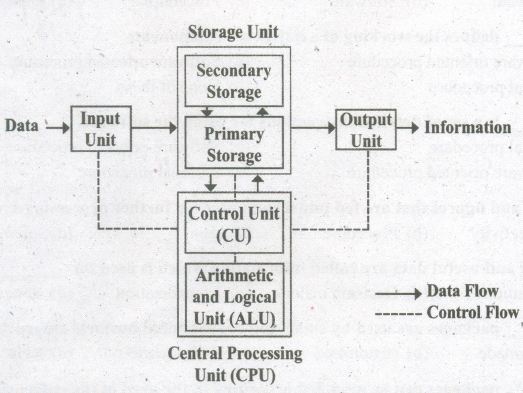
37.
| Liabilities | Amount Rs. | Amount Rs. | Assets | Amount Rs. | Amount Rs. |
|---|---|---|---|---|---|
| Capital | 2,00,000 | Goodwill | 60,000 | ||
| Add:interest on Capital |
|
.Land arid Building | 50,000 | ||
| @10% | 20,000 | Plant and Machinery | 80,000 | ||
| 2,20,000 | Less: Depreciation @ 10% | 8,000 | 72,000 | ||
| Add: Net profit | 96,000 | Investment | 20,000 | ||
| 3,16,000 | Closing stock | 1,20,000 | |||
| ,Less : Drawings | 40,000 | 2,76,000 | Sundry debtors | 80,000 | |
| Bank overdraft | 20,000 | Less: Bad debts | 10,000 | ||
| Add: Outstanding Interest | 3,000 | 23,000 | 70,000 | ||
| Bank loan | 40,000 | Less: Provision for bad | |||
| Add: Outstanding Interest | 6,000 | 46,000 | debts @ 10% | 7,000 | 63,000 |
| Sundry creditors | 40,000 | Bills receivable | 10,000 | ||
| Bills payable | 20,000 | Cash at Bank | 25,000 | ||
| Outstanding liabilities: | Cash in hand | 15,000 | |||
| Salaries | 10,000 | ||||
| Wages | 20,000 | 30,000 | |||
| 4,35,000 | 4,35,000 |
38.
| Date | Particulars | L.F. | Debit Rs. | Credit Rs. | |
|---|---|---|---|---|---|
| 2013 Mar 31 | Capital A/c | Dr. | 2,500 | ||
| To Interest on drawings Al/c (Interest on drawings charged) |
2,500 |
| Particulars | Amount Rs. | Amount Rs. | Particulars | Amount Rs. | Amount Rs. |
|---|---|---|---|---|---|
| By Interest on drawings | 2,500 | ||||
| 2500 |
| Liabilities | Amount Rs. | Amount Rs. | Assets | Amount. Rs. | Amount Rs. |
|---|---|---|---|---|---|
| Capital | 6,00,000 | ||||
| Less: Drawings | 50,000 | ||||
| 5,50,000 | |||||
| Less: Interest on drawings | 2,500 | ||||
| 5,47,500 |
39.
(i) The excess of credit total over the debit total is called the Credit balance.
(ii) When there is only Credit Entries in an Account, the amount itself is the balance of that Account, i.e., the Credit balance.
40.
(i) Matching Principle demands that expenses incurred to earn the revenue should be properly matched.
(ii) The expenses and incomes for the current accounting period whether they have been paid or not received or not must be included.
(iii) Similarly, expenses and incomes which do not pertain to current accounting period must be excluded.
41.
| S.No. | Particulars | L.F. | Debit Rs | Credit Rs | |
|---|---|---|---|---|---|
| (i) | Furniture A/c | Dr. | 10,000 | ||
| To Purchases A/c | 10,000 | ||||
| (Being Purchase of office furniture was recorded in purchase book, now rectified) | |||||
| (ii) | Rent A/c | Dr. | 15,000 | ||
| To Landlord's A/c | 15,000 | ||||
| (Being office rent of Rs. 15,000 was debited to landlord's Personal account, now rectified) | |||||
| (iii) | Sales A/c | Dr. | 5,000 | ||
| To Machinery A/c | 5,000 | ||||
| (Being sale of machinery costing Rs. 5,000 was credited to sales A/c, now rectified) |
42.
| S.No. | Particulars | L.F. | Debit Rs | Credit Rs | |
|---|---|---|---|---|---|
| (i) | Suspense A/c | Dr. | 500 | ||
| To Sales A/c | 500 | ||||
| (Being sales book was added short, now rectified) | |||||
| (ii) | Purchases A/c | Dr. | 5,000 | ||
| To Suspense A/c | 5,000 | ||||
| (Being purchases book was undercast, now rectified) | |||||
| (iii) | Suspense A/c | Dr. | 1,500 | ||
| To Purchases return A/c | 1,500 | ||||
| (Being purchases return book was cast short, now rectified) | |||||
| (iv) | Sales return A/c | Dr. | 200 | ||
| To Suspense A/c | 200 | ||||
| (Being sales return book was undercast, now rectified) |
43.
| Particulars | Amount Rs | Amount Rs |
| Overdraft as per cash book | 300 | |
| Add: Cheque deposited but not yet collected by the bank | 500 | |
| Bank interest charged but not entered in the cash book | 100 | |
| Rent paid by bank as per standing instruction | 200 | 800 |
| 1,100 | ||
| Cheques issued but not yet presented for payment | 1,000 | 1000 |
| Overdue as per bank statement | 100 |
44.
I visited some business units in my area. I found out the books maintained by them. They are not using special subsidiary books.
They are maintaining cash book, single entry system. They do not have proper accounts. I guided them about the need and use of the following special books.
1. Purchase book - All credit purchase can be recorded. So, no need to give repeated transaction in the journal.
2. Sales book - All credit sales can be recorded. So, no need to give more and repeated Journal for credit sales.
3. Purchase Return book - The damaged and returned goods to supplier can be recorded then they can pay the balance amount to creditors.
4. Sales Return book - The damaged and returned goods from customer can be recorded. Then the balance can easily pay.
45.
| Date | Particulars | L.F | Debit Rs | Credit Rs |
|---|---|---|---|---|
| 2018 | ||||
| April 1 | Cash A/c Dr | 3,00,000 | ||
| To Shyam's Capital A/c | 3,00,000 | |||
| (Shyam commenced business with capital of Rs 3,00,000) | ||||
| 2 | Bank A/c Dr | 2,70,000 | ||
| To Cash A/c | 2,70,000 | |||
| (Cash Deposited into Bank) |
46.
Yes, the customer can consider his debit note as a valid source document.
| Date | Particulars | L.F | Debit Rs | Credir Rs |
|---|---|---|---|---|
| Creditor Ale (Supplier) Dr | xxxx | |||
| To Purchase Return A/c | xxxxxx | |||
| (Damaged goods returned to supplier) |
47.
The credit balance in the bank pass book represents the debit balance as per the cash book and vice-versa. This is because bank is a debtor for the business and business unit (customer to the bank) is a creditor for the bank when there is a favourable balance in the bank. When money is deposited by the business into the bank, customers account is credited in the bank sbook, as this is the amount owed by the bank to its customer. Similarly, when the money is withdrawn or taken out of the bank by the business, customer's account is debited as this decreases the amount owed by the bank to the customer. As a result of this, favourable balance, as per-bank statement (bank pass book), will appear as a credit balance and overdrawn balance as a debit balance.
48.
He will be maintaining the following other books to be maintained:
1. Triple column each book.
2. Petty cash book (Analytical).
3. Purchase book for credit purchase
4. Sales book for credit sales.
5. Purchase returns book.
6. Sales returns book.
7. Business book account (i.e. current account to the maintained).
8. Proper journal for other assets maintaining:
(i) All cash transactions book recorded is cash book.
(ii) All petty expenses are to the recorded is analytical petty cash book.
(iii) All credit transactions to the recorded is special purpose books (i.e. purchase book, sales book, purchase return book and sales return book and proper journal.
49.
The main features of book-keeping are:
1. It is the process of recording transactions in the books of accounts.
2. Monetary transactions only are recorded in the accounts.
3. Book-keeping is the primary stage in the accounting process.
4. Book-keeping includes journalising and ledger processing.
50.
| Voucher | Invoice |
|---|---|
| Any written or printed document in support of business transaction is called a voucher. Examples: cash receipts, bank pay-in-slip, etc. | It is a statement prepared by a seller of goods to be sent to the buyer. It shows details of quantity, price, value, etc., of the goods and any discount given, finally showing the net amount payable by the buyer. |
51.
| Cash transaction | Credit transaction |
|---|---|
| It is a transaction which involves immediate cash receipt or immediate cash payment. | It is a transaction in which cash is not received or paid immediately but will be received or paid later. |
52.
(a) Purchases: Buying of goods with the intention of resale is called purchase.
(b) Sales: When goods meant for resale are sold, it is called sales.
53.
Difference between these two records are as follows:
(i) Timing differences:
(a) Cheque issued but not presented for payment.
(b) Cheque deposited into bank but not yet credited.
(c) Bank charges and interest on loan/overdraft
(d) Interest and dividends collected by the bank.
(e) Dishonour of cheques and bills.
(f) Amount paid by the parties directly into the bank
(g) Payment made directly by the bank to others.
(h) Bills collected by the bank on behalf of its customers.
(ii) Error in casting:
(a) Errors committed in recording the transactions by the business in the cash book.
(b) Errors committed in recording the transactions by the bank.
54.
(i) Division of work: As journal is sub-divided, the work will be subdivided and different persons can work on different books at the same time and the work can be speedily completed.
(ii) Efficiency: The sub-division of work gives same work is done by a person repeatedly, the person becomes efficient in handling it. Thus, specialization leads to efficiency in accounting work.
(iii) Prevents errors and frauds: Internal check becomes more effective as the work can be divided in such a manner that the work of one person is automatically checked by another person. With the use of internal check, the possibility of occurrence of errors or fraud may be avoided or minimised.
(iv) Saving in time: As there are many subsidiary books, work of entering can be done simultaneously by many person. Thus it saves time and accounting work can be completed quickly.
(v) Detailed informations available: As all transactions relating to a particular item are entered in a subsidiary book, it gives detailed information. It is easy to arrive at monthly or quarterly totals.
55.
A trial balance can be prepared in the following methods.
(i) Balance method: In this method, the balance of every ledger account either debit or credit, as the case may be, is recorded in the trial balance against the respective accounts. This method is widely used.
(ii) Total method: Under this method, the total amounts on the debit side of the ledger accounts and the total amounts on the credit side of the ledger accounts are ascertained and recorded in the trial balance. This is not commonly used.
(iii) Total and balance method: This method is a combination of both total method and balance method. Under this method, four columns are provided namely (a) total of debit side of the ledger accounts (b) total of credit side of the ledger accounts (c) debit balances of ledger accounts and (d) credit balances of ledger accounts. This method is not in practice.
56.
Under the accrual basis of accounting, the revenue whether received or not, but has been earned or accrued during the accounting period and expenses incurred whether paid or not are recorded. In other words, revenue is recognised, when it is earned or accrued and expenses are recognised when these are incurred. Under this basis,
a) Any income earned whether received or not
b) Any expenditure incurred whether paid or not
c) Any asset is purchased when cash is paid or not
d) Any liability incurred whether paid or not during the accounting period is recorded.
57.
Under cash basis of accounting, actual cash receipts and actual cash payments are recorded. In this basis, revenue is recognised when cash is received and expenses are recognised when cash is paid. credit transactions are not recorded till cash is actually received or paid. Under this basis,
a) Any income received
b) Any expenditure paid
c) Any asset purchased for which cash is paid
d) Any liability paid during the accounting period whether related to the past, present or future is taken into account.
58.
| SI.No. | Transactions | Accounts involved | Nature of Accounts | Debit/Credit |
|---|---|---|---|---|
| 1. | Rent Received | Cash A/c Rent Received A/c |
Rent A/c Nominal A/c |
Debit Credit |
| 2. | Building Purchased | Building A/c Cash A/c |
Real A/c Real A/c |
Debit Credit |
| 3. | Machinery Sold | Cash A/c Machinery A/c |
Real A/c Real A/c |
Debit Credit |
| 4. | Discount Allowed | Discount Allowed A/c Nominal A/c |
Nominal A/c Personal A/c |
Debit Credit |
| 5. | Discount Received | Sundry Creditor A/c Discount Received Alc |
Personal A/c Nominal A/c |
Debit Credit |
59.
Following are the advantages of Journal:
i) Complete information about the business transaction can be obtained on time basis as the transaction are recorded in chronological order.
ii) Correctness of the entry can be checked through narration.
iii) Journal forms. the basis for posting the entries in the ledger.
60.
The journal entries may be of the following types:
1) Single entry
2) Compound entry
3) Opening entry
4) Closing entry
1) Single entry: Single entry is an entry in which only two accounts are involved, one account is debited and another is credited.
2) Compound entry: Compound entry is an entry in which more than two accounts are involved. Either more than one account is debited or more than one account is credited or both.
3) Opening entry: Through opening entry- the balances of assets and liabilities at the end of the previous accounting year are brought forward to the current accounting year.
4) Closing entry: At the 'end of the accounting period, the nominal accounts are closed by transferring to trading account or profit and loss account. All direct expenses and direct revenues are transferred to Trading Account. All indirect expenses and indirect revenues are transferred to Profit and Loss Account.
5) Rectifying entry: Rectifying entries are passed to make correction of errors in accounting.
6) Adjusting entry: Adjusting entry is the made for die transactions which remain unrecorded or require adjustment after closing the accounts for the accounting year.
7) Transfer entry: Transfer entry is the entry through which amount is transferred from one account to another account.
61.
| Date | Receipts | R.N. | L.F. | Amount | Date | Payments | V.N. | L.F. | Amount | ||
|---|---|---|---|---|---|---|---|---|---|---|---|
| Discount allowed(Rs.) | Cash(Rs.) | Discount received(Rs.) | Cash(Rs.) | ||||||||
| 2016 Feb | To Balance b/d | 60,000 | 2016 Feb 4 | By Bank A/c | 15,000 | ||||||
| 1 | To Bank A/c | 5,000 | 10 | By Premnath's A/c | 100 | 9,900 | |||||
| 7 | To Arul's A/c | 100 | 3,400 | 29 | By Balance c/d | 53,300 | |||||
| 14 | To Kandan's A/c | 200 | 9,800 | ||||||||
| 15 | 300 | 78,200 | 100 | 78,200 | |||||||
| Mar 1 | To Balance b/d | 53,300 | |||||||||
62.
Goods used for Personal use.
63.
Cash received and Bad debts recovered.
64.
Aravind settled his Account
65.
Amount drawn from bank for office use.
66.
| Date | Particulars | L.F. | Debit Rs. | Credit Rs. |
|---|---|---|---|---|
| 2018 Jan. 1 | Cash A/c Dr. To Capital A/c (Being the amount invested by Sumy in the business as Capital) |
3,00,000 | 3,00,000 | |
| 3 | Purchases A/c Dr. To Cash A/c (Being the goods purchased for Cash) |
15,000 | 15,000 | |
| 13 | Abisha A/c Dr. To Sales A/c (Being the goods sold on credit) |
4,500 | 4,500 | |
| 20 | Purchases A/c Dr. To Sumy A/c (Being the goods bought from Sumy on Credit) |
6,750 | 6,750 | |
| 24 | Cash A/c Dr. To Abisha A/c (Being the cash received from Abisha) |
4,500 | 4,500 | |
| 28 | Sumy A/c Dr. To Cash A/c (Being the amount paid by Sumy) |
6,450 | 6,450 | |
| 30 | Cash A/c Dr. To Sales A/c (Being the goods sold for cash) |
24,000 | 24,000 | |
| 30 | Salaries A/c Dr. To Cash A/c (Being the amount paid for salary) |
9,000 | 9,000 | |
| 30 | Karthick A/c Dr. To Purchases return A/c (Being the goods return to Karthick) |
10,000 | 10,000 |
67.
The items having the effect of Higher balance in the cash book.
(i) Cheques issued but not presented for payment.
(ii) Interest credited by the bank but not recorded in cash book.
(iii) Debtors directly paid into bank but not recorded in cash book.
(iv) Wrong Credit by the banker.
(v) Collections by banker as per customer's standing instructions
68.
The needs for bank reconciliation statement are:
a) To identify the reasons for the differences between the bank balance as per the cash book and bank balance as per bank statement
b) To identify the delay in the clearance of cheques
c) To ascertain the correct balance of bank column of cash book
d) To discourage the accountants of the business as well as bank from misusing funds.
69.
| Particulars | Rs | Rs |
|---|---|---|
| Assets Taken over: | ||
| Stock | 30,000 | |
| Cash | 8,000 | |
| Bank | 7,000 | |
| Debtors | 40,000 | |
| Furniture | 5,000 | |
| Building | 25,000 | 1,15,000 |
| Less: Liabilities taken over | ||
| Creditors | 18,000 | |
| Net Assets (Capital) | 97,000 |
| Date | Particulars | L.F | Debit Rs | Credit Rs | |
|---|---|---|---|---|---|
| 2017 April 01 | Stock A/c | Dr | 30,000 | ||
| Cash A/c | Dr | 8,000 | |||
| Bank A/c | Dr | 7,000 | |||
| Debtors A/c | Dr | 40,000 | |||
| Furniture A/c | Dr | 5,000 | |||
| Building A/c | Dr | 25,000 | |||
| To Creditors A/c | 18,000 | ||||
| To Capital A/c | 97,000 | ||||
| (Being the amount of assets and liabilities acquired from Radhika Traders) |
70.
| Assets | = | Liabilities + Capital |
|---|---|---|
| Liabilities | = | Capital- Assets |
| Rs.5,000 | = | Rs.10,000 = Rs.15,000 |
| Capital | = | Rs.15,000 |
71.
There are two approaches for recording business transactions, namely,
i) Accounting equation approach and
ii) Traditional approach
(i) Accounting Equation approach :
(a) The relationship of assets with that of liabilities to outsiders and to owners in the equation form is known as accounting equation.
(b) Under the Double entry system of book keeping, every transaction has two fold effects, which causes the changes in assets and liabilities or capital in such a way that an accounting equation is completed and equated
Equity + Liabilities =Assets
(ii) Traditional approach :
(a) Under this approach, the two fold aspects (Debit and Credit) in each transaction are recorded in the journal under double entry system.
(b) For the purpose of recording, the transactions are classified into three categories as
i) Transactions relating to persons,
ii) Transactions relating to assets, properties and liabilities and
iii) Transactions relating to expenses, losses, incomes and gains.
72.
(i) Renewal of a Bill :
(a) When the acceptor of a bill knows in advance that he/she will not be able to meet the bill on its due date, he may request the drawer for extension of time for payment.
(b) The drawer of the bill may agree to cancel the original bill and draw a new bill for the amount due with interest thereon. This is referred to as renewal.
(ii) Retiring of a Bill :
(a) An acceptor may make the payment of a bill before its due date and may discharge the liability on the bill. It is called as retirement of a bill.
(b) Usually, the holder of the bill allows a concession called rebate to the drawee for the unexpired period of the bill.
73.
(i) Bills Receivable Book :
(a) Bills receivable refers to Bills drawn, the payment for which has to be received.
(b) Such bills are drawn on debtor for a specified amount payable at sign on or after specified period.
(c) Bills receivable book contains the details of bills drawn and its disposal.
(ii) Bills Payable Book:
(a) Details recorded in the bills payable book are the names of the parties whose bills are accepted, date of the bills payable, due date, amount, etc.
(b) The individual accounts of the parties whose bills are accepted will be debited with the corresponding amount in the bills payable book.
74.
The important features of a bill of exchange are as follows :
(i) It is a written document.
(ii) It is an unconditional order.
(iii) It is an order to pay a certain sum of money.
(iv) It is signed by the drawer.
(v) It bears stamp or it is drafted on a stamp paper.
(vi) It is to be accepted by the acceptor.
(vii) The amount of the bill is paid to the drawer or the endorsee.
75.
| S.No | Basis of Distinction | Trade Discount | Cash Discount |
| 1 | Parties | It is a reduction granted by a manufacturer/supplier. | It is a reduction granted by a wholesaler to the Buyer. |
| 2 | Purpose | To help the retailer to earn some profit. | To encourage prompt payment within a stipulated period. |
| 3 | Time when allowed | It is allowed on the purchase of goods. | It is allowed when payment is made within the specified period |
| 4 | Disclosure | It is shown by way of deduction in the invoice itself. | It is not shown in the invoice. |
| 5 | Ledger Account | A separate account is not opened in the Ledger. | A separate account. is opened in the Ledger for discount received and discount allowed. |
76.
| S.No | Name of account | L.F | Debit balance Rs |
Credit balance Rs |
| 1 | Discount allowed | 350 | ||
| 2 | Cash in hand | 4,100 | ||
| 3 | Capital | 45,000 | ||
| 4 | Salaries | 10,000 | ||
| 5 | Furniture | 9,500 | ||
| 6 | Loan borrowed | 12,000 | ||
| 7 | Commission paid | 3,000 | ||
| 8 | Purchases | 29,050 | ||
| 9 | Sales | 35,000 | ||
| 10 | Suspense Account | 36,000 | ||
| Total | 92,000 | 92,000 |
77.
| S.No | Name of account | L.F | Debit balance Rs |
Credit balance Rs |
| 1 | Sales | 35,000 | ||
| 2 | Interest paid | 350 | ||
| 3 | Returns inward | 2,500 | ||
| 4 | Depreciation | 2,400 | ||
| 5 | Office rent | 2,000 | ||
| 6 | Audit Fees | 1,000 | ||
| 7 | Octroi duty | 8,000 | ||
| 8 | Land | 90,000 | ||
| 9 | Capital | 60,000 | ||
| 10 | Bank overdraft | 11,250 | ||
| Total | 1,06,250 | 1,06,250 |
78.
(i) Ledger is known as the principal book of accounts because it is very useful for a business enterprise.
(ii) It is a book which contains all sets of accounts, namely, personal, real and nominal accounts.
(iii) Account-wise Balance can be determined from the Ledger.
(iv) The Ledger Accounts are opened or maintained based on journal entries passed.
(v) The balances in the ledger accounts show the net effect of transactions during a particular period in various accounts.
(vi) The personal accounts give the net amount due to creditors and the net amount due from debtors, real accounts show the values of assets and nominal accounts will show sources of incomes and expenses.
(vii) The financial statements can be prepared from the ledger balances.
79.
Importance of cash book is discussed below:
(i) Serves as both journal and ledger: When cash book is maintained; it is not necessary to open a separate cash account in the ledger. Thus, cash book serves the purpose of a journal and a ledger.
(ii) Saves time and labour: When cash transactions are recorded through journal entries, a lot of time and labour will be involved. To avoid this, all cash transactions are straightaway recorded in the cash book, which saves time and labour.
(iii) Shows the cash and bank balance: It helps to know the cash and bank balance at any point of time by comparing the total cash receipts and cash payments.
(iv) Benefit of division of labour: As cash book is a separate subsidiary book, an independent person can maintain it. Hence, the business can get the benefit of division of labour.
80.
| S.No | Name of account | L.F | Debit balance Rs |
Credit balance Rs |
| 1 | Capital | 2,50,000 | ||
| 2 | Bills payable | 50,000 | ||
| 3 | Opening Stock | 75,000 | ||
| 4 | Loan | 1,50,000 | ||
| 5 | Salaries | 10,000 | ||
| 6 | Bank | 2,75,000 | ||
| 7 | Debtors | 1,00,000 | ||
| 8 | Discount received | 5,000 | ||
| 9 | Sales | 50,000 | ||
| 10 | Purchases | 45,000 | ||
| Total | 5,05,000 | 5,05,000 |
81.
(i) Matching principle states that the expenses of an accounting period are matched with the related revenue for correct determination of profit.
(ii) According to the matching principle, the purchase price of fixed asset is not related to the accounting period because the benefit derived from its use will be spread over a number of years.
(iii) Therefore, only depreciation related to the accounting period is considered for determination of profit
82.
Value of consistency is reflected by the accounting standards issued by ICAI as following consistent set of standards, enables comparability of financial statements.
83.
Yes, principle of conservatism has two effects.
(I) Profit and loss account discloses lower profit in comparison to the actual profits.
(ii) Balance sheet will disclose understatement of assets and overstatement of liabilities.
84.
Following are the features of trial balance:
(i) Trial balance contains the balances of all ledger accounts.
(ii) It is prepared on a specific date.
(iii) Trial balance helps to check the arithmetic accuracy of entries made in the books of accounts.
(iv) If there is a difference between the totals of debit column and credit column of the trial balance, it is an indication of errors being committed somewhere.
(v) If both the debit column and the credit column of the trial balance have the same total, it does not mean that there is no mistake in accounting.
85.
(i) Trial balance helps to check the arithmetical accuracy of entries made in the accounting records.
(ii) Trial balance serves as a lubricant for the smooth movement and completion of the accounting cycle.
(iii) The trial balance helps in discovering errors which may have been committed in the accounting records.
(iv) However, in computerised Accounting system, once the transactions are recorded in the journals, all the other records are made simultaneously, i.e. ledger postings, trial balance and final accounts.
86.
The need for accounting standards is as follows:
1. To promote better understanding of financial statements.
2. To help accountants to follow uniform policies and practices.
3. To facilitate meaningful comparison of financial statements of two or more entities.
4. To enhance reliability of financial statements.
5. To meet the legal requirements effectively.
87.
Following are the objectives of book-keeping :
(i) To have a complete and permanent record of all business transactions in chronological order and under appropriate headings.
(ii) To facilitate ascertainment of the profit or loss of the business during a specific period.
(iii) To facilitate ascertainment of financial position.
(iv) To know the progress of the business.
(v) To find out the tax liabilities.
(vi) To fulfill the legal requirements
88.
Process of Accounting cycle
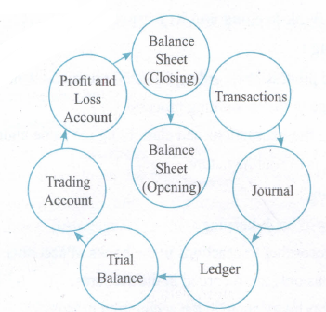
(i) When a businessman starts his business activities, he records the day-to-day transactions in the journal.
(ii) From the journal the transactions move further to the ledger where accounts are written up.
(iii) Preparation of trading and profit and loss account is the next step.
(iv) The balancing of profit and loss account gives the net result of the business transactions.
(v) Thus this cyclic movement of the transactions through the books of accounts (accounting cycle) is a continuous process.
89.
(i) International Financial Reporting Standards are issued by the International Accounting Standards Board (IASB).
(ii) IFRS is a set of International accounting standards stating how particular types of transactions and other events should be reported in financial statements.
(iii) IASB initially adopted the accounting standards issued by IASC to be replaced by IFRS upon their issuance.
(iv) The objective behind setting up the IASC and later IASB was to develop accounting standards that would be acceptable worldwide and to improve financial reporting internationally
90.
Book-keeping has the following limitations.
(i) Only monetary transactions are recorded in the books of accounts.
(ii) Effect of price level changes is not considered.
(iii) Financial data recorded are historical in nature, i.e., only past data are recorded.
91.
Yes, Accounting information should be comparable because,
i) It helps to make inter-firm comparisons, i.e., to find out how a firm has performed as compared to the other firms.
ii) It helps to make inter-period comparisons, i.e., to find out how it has performed as compared to the previous years.
92.
Accounting is both an art as well as Science.
(i) Art:
1. Art is the technique of achieving some predetermined objectives.
2. And accounting is also an art of recording, classifying and summarising financial transactions
(ii) Science:
1. Science is an organised knowledge based on certain basic principles.
2. Therefore, Accounting is also a Science as it is an organised knowledge based on certain principles.
93.
Accounting records only those transactions and events which can be expressed in terms of money such as sale or purchase of goods, salary paid etc.
(ii) Non-monetary transactions i.e. those transactions which cannot be expressed in terms of money are not recorded in the books of accounts.
(iii) Example of such transactions are value of human resources, appointment of a new managing director, etc.
(iv) These transactions may be important for the business but these are not recorded in the books of accounts. Because these cannot be measured in monetary terms.
94.
(i) Accounting process starts with identifying financial transactions, involves recording, classifying, and summarising and ends with interpreting accounting information to various concerned parties.
(ii) Accounting process can be explained with the help of the diagram given below.
95.
Following are the objectives of accounting:
(i) To keep a systematic record of financial transactions and events
(ii) To ascertain the profit or loss of the business enterprise
(iii) To ascertain the financial position or status of the enterprise
(iv) To provide information to various stakeholders for their requirements
(v) To protect the properties of an enterprise and
(vi) To ascertain the solvency and liquidity position of an enterprise
96.
The internal users comprise of owners, management and employees who are within the organisation.
(i) Owners:
1. The owners of a business furnish capital to be used for the purpose of business.
2. They are interested to know whether the business has earned a profit or loss during a particular period and also its financial position on a particular date.
(ii) Management:
1. Accounting data are the basis for most of the decisions made by the management.
2. The trends in sales and purchases, relationship of expenses to the turnover, productivity of workers, comparative profitability of different products and divisions etc.
(iii) Employees:
1. The employees are interested in the profit earning capacity of the business which will affect their salary, bonus, incentives and working conditions.
2. Labour unions use the accounting data in their bargaining strategies with the management.
97.
a) Capital:
(i) Capital is the amount invested by the owner in an organisation.
(ii) This amount is increased by the profit of the business and the amount of additional capital introduced.
b) Assets:
(i) Any physical thing or right owned that has a monetary value is called assets.
(ii) Assets can be classified into tangible and intangible.
(iii) Tangible assets are those having physical existence. It can be seen and touched.
(iv) Intangible assets are those assets having no physical existence. It cannot be seen and touched.
c) Liabilities:
(i) Liabilities refers to the financial obligations of a business.
(ii) For example, loans from banks or other persons, creditors for goods supplied, bills payable, outstanding expenses, bank overdraft etc
98.
a) Account:
(i) An Account is the basic unit of accounting.
(ii) Transactions are recorded into various accounts.
(iii) In other words, an account is a summary of transactions under some common head.
b) Voucher:
(i) Any written document in support of a business transaction is called a voucher.
(ii) Example: Cash receipt, invoice, cash memo, bank pay-in slip etc.
c) Invoice:
(i) It is a statement prepared by a seller of goods to be sent to the buyer.
(ii) It shows details of quantity, price, value etc., of the goods and any discount given, finally showing the net amount payable by the buyer.
99.
(i) Transactions are those activities of a business, which involve transfer of money or goods or services between two persons, or two accounts.
(ii) For example, purchase of goods, sale of goods, lending of money, salaries paid, rent paid, commission received and dividend received.
(iii) Transactions are of two types, namely cash and credit transactions.
1. Cash transaction :
It is a transaction in which cash receipt or cash payment is involved.
2. Credit transaction:
It is a transaction in which cash is not received or paid immediately but will be paid or received later

11th Standard Syllabus & Materials
11th Standard
TN 11th Tamil பீடு பெற நில் - செய்யுள் - காவடிச்சிந்து Important Questions And Answers Study Material - QB365 Set A
NEW11th Standard
TN 11th Tamil பீடு பெற நில் - உரைநடை - மலை இடப்பெயர்கள் : ஓர் ஆய்வு Important Questions And Answers Study Material - QB365 Set A
NEW11th Standard
TN 11th Tamil மாமழை போற்றுதும் - துணைப்பாடம் - யானை டாக்டர் Important Questions And Answers Study Material - QB365 Set A
NEW11th Standard
TN 11th Tamil மாமழை போற்றுதும் - செய்யுள் - ஐங்குறுநூறு Important Questions And Answers Study Material - QB365 Set A



Tamilnadu Stateboard 11th Standard Subjects

Maths

Commerce

Economics

Biology

Business Maths and Statistics
Accountancy

Computer Science

Physics

Chemistry
Maths
Biology
Economics
Physics
Chemistry

History
Business Maths and Statistics

Computer Science
Accountancy

Computer Applications
History
Computer Technology
Commerce
Computer Applications
Computer Technology

Tamil

English

French
Tamilnadu Stateboard Standards
