
 100% FREE ACCESS
11th Standard Syllabus & Materials
11th Standard
TN 11th Tamil இயற்கை வேளாண்மை,சுற்றுச்சூழல் -செய்யுள் - மனோன்மணீயம் Important Questions And Answers Study Material - QB365 Set A
NEW11th Standard
TN 11th Tamil என்னுயிர் என்பேன் -துணைப்பாடம் - இசைத்தமிழர் இருவர் Important Questions And Answers Study Material - QB365 Set A
NEW11th Standard
TN 11th Tamil மொழி கலை -செய்யுள் - ஒவ்வொரு புல்லையும் Important Questions And Answers Study Material - QB365 Set A
NEW11th Standard
TN 11th Tamil பீடு பெற நில் - இலக்கணம் - பகுபத உறுப்புகள் Important Questions And Answers Study Material - QB365 Set A
NEW11th Standard
TN 11th Tamil பீடு பெற நில் - துணைப்பாடம் - வாடிவாசல் Important Questions And Answers Study Material - QB365 Set A
NEW11th Standard
TN 11th Tamil பீடு பெற நில் - செய்யுள் - குறுந்தொகை Important Questions And Answers Study Material - QB365 Set A

Published on: 09/10/2019
Subsidiary Books - I
Download Tamil Nadu 11th Standard Accountancy question papers, model tests, one-mark questions, important questions, and public exam papers in PDF format. Free study materials and answer keys for TN State Board students.
Questions + Answers key
Take MCQ Accountancy Test
1.
Give specimens of the following:
(a) Purchases book,
(b) Sales book,
(c) Purchases return book,
(d) Sales return book.
2.
Explain the purpose of journal proper with examples.
3.
Explain the purposes of various subsidiary books.
4.
Write notes on rectifying entries.
5.
What are the various types of subsidiary books?
6.
Visit some business units in your area. Find out the books maintained by them. Do they maintain special subsidiary books? If not, discuss with them the need and guide them on maintaining the special subsidiary books.
7.
Write short notes on :
(a) Endorsement of a bill and
(b) Discounting of a bill
8.
What are the advantages of subsidiary books?
9.
Mention the subsidiary books in which the following transactions are recorded.
(i) Sale of goods for cash
(ii) Sale of goods on credit
(iii) Purchases of goods on credit
(iv) When the proprietor takes goods for personal use
(v) Goods returned to suppliers for which cash is not received immediately
(vi) Asset purchased as credit.
10.
Give the format of purchases book.
1.
(a) Specimen of Purchases book:
| Date | Particulars | Invoice No. | L.F. | Amount Rs. | |
|---|---|---|---|---|---|
| Details | Total | ||||
(b) Specimen of Sales book:
| Date | Particulars | Invoice No. | L.F. | Amount Rs. | |
|---|---|---|---|---|---|
| Details | Total | ||||
(c) Specimen of Purchases returns book:
| Date | Particulars | Debit Note No. |
L.F. | Amount Rs. | |
|---|---|---|---|---|---|
| Details | Total | ||||
(d) Specimen of Sales returns book:
| Date | Particulars | Credit Note No. |
L.F. | Amount Rs. | |
|---|---|---|---|---|---|
| Details | Total | ||||
2.
The purpose of journal proper: The journal proper is used to record the following entries.
(i) Opening entries: They are used at the beginning of the financial year to open the books by recording the assets and liabilities and capital appearing in the Balance Sheet of the previous year.
Example: On 1st January 2014, Mr. Ramesh commenced his business with the following items. Cash Rs. 30,000; Furniture Rs. 3,000; Stock Rs. 15,000; Creditors Rs. 10,000
The opening entries in the journal proper is:
| Date | Particulars | L.F. | Debit Rs. | Credit Rs. | |
|---|---|---|---|---|---|
| 1.1.14 | Cash A/c | Dr. | 30,000 | ||
| Stock A/c | Dr. | 15,000 | |||
| Furniture A/c | Dr. | 3,000 | |||
| To Creditors A/c | 1,50,000 | ||||
| To Ramesh's Capital A/c | 2,47,000 | ||||
| (Commenced business with Assets & Liabilities) |
(ii) Closing entries are recorded at the end of the accounting year for closing the accounts relating to expenses and revenues. The accounts are closed by transferring the balances to the Trading A/c and Profit and Loss A/c.
(iii) Adjusting entries: To arrive at a correct profit or loss at the time of preparing final accounts certain accounts require some adjustments. Entries for making such adjustments are called
adjusting entries
Example: On 31st December 2013, it is decided to provide depreciation @ 10% p.a. on furniture.
Furniture value is Rs. 1,00,000.
The adjusting entry is:
| Date | Particulars | L.F. | Debit Rs. | Credit Rs. | |
|---|---|---|---|---|---|
| 31.12.13 | Depreciation A/c | Dr. | 10,000 | ||
| To Furniture A/c | 10,000 | ||||
| (Depreciation provided) |
(iv) Transfer entries: They are passed in the journal proper for transferring an item entered in one account to another account.
Example: When the proprietor takes goods for Rs. 5,000 for personal use, the drawing A/c is transferred to purchases A/c. The entry is,
| Date | Particulars | L.F. | Debit Rs. | Credit Rs. | |
|---|---|---|---|---|---|
| 31.12.13 | Drawings A/c | Dr. | 5,000 | ||
| To Purchases A/c | 5,000 | ||||
| (Goods withdrawn for personal use) |
(v)Rectifying entries are passed for rectifying the errors which might have committed in the books of accounts.
Example: Purchase of furniture for Rs. 10,000 was wrongly debited in Purchases A/c. To rectify the error the following entry is to be passed.
| Date | Particulars | L.F. | Debit Rs. | Credit Rs. | |
|---|---|---|---|---|---|
| 31.12.13 | Furniture A/c | Dr. | 10,000 | ||
| To Purchases A/c | 10,000 | ||||
| (Wrong debit of purchases Alc rectified) |
(vi) Miscellaneous entries or Entries of casual nature: These are entries which do not occur so frequently.
Examples of such transactions:
(a) Credit purchases and credit sales of assets which cannot be recorded in purchases or sales book.
(b) Endorsement, renewal and dishonour of bills which cannot be recorded in bills book.
(c) Other adjustments like interest on capital, interest on loan, bad debts, reserves, etc., ,
3.
Purposes of subsidiary books:
(i) Purchases Book: It records only credit purchases of goods by the trader.
(ii) Sales Book: It records only credit sale of goods by the trader.
(iii) Purchases Returns Book: It records the goods returned by the trader to the suppliers.
(iv) Sales Return Book: It records the goods returned by the customers.
(v) Bills Receivable Book: It records the receipt of bills from customers.
(vi) Bills Payable Book: It records the bills accepted by the trader.
(vii) Cash Book: It records all the cash transactions of the business. (i.e.,) the receipts and payments of cash.
(viii) Journal Proper: It is the journal which records entries which cannot be entered in any of the subsidiary books.
4.
Rectifying entries are passed for rectifying the errors which might have committed in the books of accounts.
Example: Purchase of furniture for Rs. 10,000 was wrongly debited in Purchases A/c. To rectify the error the following entry is to be passed.
| Date | Particulars | L.F. | Debit Rs. | Credit Rs. | |
|---|---|---|---|---|---|
| 31.12.13 | Furniture A/c | Dr. | 10,000 | ||
| To Purchases A/c | 10,000 | ||||
| (Wrong debit of purchases Alc rectified) |
5.
The number of subsidiary books may vary according to the requirements of each business. Based on the nature of business and the volume of transactions, the following subsidiary books are maintained:
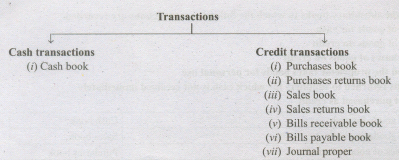
6.
I visited some business units in my area. I found out the books maintained by them. They are not using special subsidiary books.
They are maintaining cash book, single entry system. They do not have proper accounts. I guided them about the need and use of the following special books.
1. Purchase book - All credit purchase can be recorded. So, no need to give repeated transaction in the journal.
2. Sales book - All credit sales can be recorded. So, no need to give more and repeated Journal for credit sales.
3. Purchase Return book - The damaged and returned goods to supplier can be recorded then they can pay the balance amount to creditors.
4. Sales Return book - The damaged and returned goods from customer can be recorded. Then the balance can easily pay.
7.
(a) Endorsement of a bill :
(i) Endorsement means signing on the face or back of a bill for the purpose of transferring the title of the bill to another person. The person who endorses is called the "Endorser".
(ii) The person to whom a bill is endorsed is called the "Endorsee". The Endorsee is entitled to collect the money.
(b) Discounting of a bill :
(i) When the holder of a bill is in need of money before the due date of a bill, he can convert it into cash by discounting the bill with his banker. This process is referred to as the discounting of bill.
(i) The banker deducts a small amount of the bill which is called discount and pays the balance in cash immediately to the holder of the bill.
8.
The advantages of maintaining subsidiary books can be summarised as under :
(i) Proper and systematic record of the business transactions : All the business transactions are classified and grouped conveniently as cash and non cash transactions, which are further classified as credit purchases, credit sales and returns etc.
(ii) Convenient posting: All the transactions of a particular nature are recorded at one place, i.e., in one of the subsidiary books. For Example: All credit purchases of goods are recorded in the purchases book and all credit sales of goods are recorded in the sales book.
(iii) Division of work: As journals are sub-divided, the work will be sub-divided and different persons can work on different books at the same time and the work can be speedily completed.
(iv) Efficiency: The sub-division of work gives the advantage of specialisation. Thus specialisation leads to efficiency in accounting work.
(v) Helpful in decision making: Subsidiary books provide complete details about every type of transactions separately. Hence the management can use the information as the basis for deciding its future actions.
(vi) Prevents errors and frauds: Internal check becomes more effective as the work can be divided in such a manner that the work of one person is automatically checked by another person. With the use of internal check, the possibility of occurrence of errors or fraud may be avoided or minimised.
(vii) Availability of requisite information at a glance : The maintenance of subsidiary books helps in obtaining the necessary information at a glance.
9.
(i) Sales of goods for cash - These transactions are not recorded in the sales book.
(ii) Sale of goods on Credit - These transactions are recorded in sales book.
(iii) Purchases of goods on Credit - These transactions are recorded in purchases book.
(iv) When the proprietor takes goods for personal use - These transactions recorded in Transfer entry.
(v) Goods returned to Suppliers for which cash is not received immediately - These transactions are recorded in sales returns book.
(vi) Asset purchased as credit. These transactions are not recorded in the purchases book.
10.
| Date | Particulars (Name of the suppliers and details of goods purchased) |
Invoice No. | L.F | Amount | ||
| Details | Total | |||||
| (i) | (ii) | (iii) | (iv) | (v) | (vi) | |
| Purchase A/c | Dr. | |||||

11th Standard Syllabus & Materials
11th Standard
TN 11th Tamil பீடு பெற நில் - செய்யுள் - காவடிச்சிந்து Important Questions And Answers Study Material - QB365 Set A
NEW11th Standard
TN 11th Tamil பீடு பெற நில் - உரைநடை - மலை இடப்பெயர்கள் : ஓர் ஆய்வு Important Questions And Answers Study Material - QB365 Set A
NEW11th Standard
TN 11th Tamil மாமழை போற்றுதும் - துணைப்பாடம் - யானை டாக்டர் Important Questions And Answers Study Material - QB365 Set A
NEW11th Standard
TN 11th Tamil மாமழை போற்றுதும் - செய்யுள் - ஐங்குறுநூறு Important Questions And Answers Study Material - QB365 Set A



Tamilnadu Stateboard 11th Standard Subjects

Maths

Commerce

Economics

Biology

Business Maths and Statistics
Accountancy

Computer Science

Physics

Chemistry
Maths
Biology
Economics
Physics
Chemistry

History
Business Maths and Statistics

Computer Science
Accountancy

Computer Applications
History
Computer Technology
Commerce
Computer Applications
Computer Technology

Tamil

English

French
Tamilnadu Stateboard Standards
