
 100% FREE ACCESS
11th Standard Syllabus & Materials
11th Standard
TN 11th Tamil இயற்கை வேளாண்மை,சுற்றுச்சூழல் -செய்யுள் - மனோன்மணீயம் Important Questions And Answers Study Material - QB365 Set A
NEW11th Standard
TN 11th Tamil என்னுயிர் என்பேன் -துணைப்பாடம் - இசைத்தமிழர் இருவர் Important Questions And Answers Study Material - QB365 Set A
NEW11th Standard
TN 11th Tamil மொழி கலை -செய்யுள் - ஒவ்வொரு புல்லையும் Important Questions And Answers Study Material - QB365 Set A
NEW11th Standard
TN 11th Tamil பீடு பெற நில் - இலக்கணம் - பகுபத உறுப்புகள் Important Questions And Answers Study Material - QB365 Set A
NEW11th Standard
TN 11th Tamil பீடு பெற நில் - துணைப்பாடம் - வாடிவாசல் Important Questions And Answers Study Material - QB365 Set A
NEW11th Standard
TN 11th Tamil பீடு பெற நில் - செய்யுள் - குறுந்தொகை Important Questions And Answers Study Material - QB365 Set A

Published on: 19/10/2019
Bio - Botany - Respiration
Download Tamil Nadu 11th Standard Biology question papers, model tests, one-mark questions, important questions, and public exam papers in PDF format. Free study materials and answer keys for TN State Board students.
Questions + Answers key
Take MCQ Biology Test1.
The number of O2 molecules required for breaking down of one molecule of glucose forglycolysis _________
2
4
5
6
2.
Succinate dehydrogenase enzyme is found in mitochondrial __________
inner membrane
outer membrane
matrix
all the above
3.
In Pulses RQ will be __________
One
less than one
more than one
zero
4.
The compound which links glycolysis and Krebs cycle is _______.
Succinic acid
Pyruvic acid
Acetyl CoA
Citric acid
5.
The number of ATP molecules formed by complete oxidation of one molecule of pyruvic acid is _______.
12
13
14
15
6.
What is Respiratory quotient?
7.
What does 'climacteric' refer to?
8.
What is EMP Pathway?
9.
How did Blackman classify respiration?
10.
Draw the structure of energy currency of cell.
11.
12.
Write the importance of direct oxidative pathway.
13.
What is the significance of Kreb's cycle?
14.
What is Enolation?
15.
What is the significance of RQ?
16.
What is compensation point?
17.
Respiratory quotient is zero in succulent plants. Why?
18.
Differentiate aerobic respiration from anaerobic respiration.
19.
What is the name of alternate way of glucose breakdown? Explain the process involved in it?
20.
Explain the reactions taking place in mitochondrial inner membrane.
1.
(d)
6
2.
(a)
inner membrane
3.
(c)
more than one
4.
(c)
Acetyl CoA
5.
(c)
14
6.
The ratio of volume of carbon dioxide given out and volume of oxygen taken in during respiration is called Respiratory Quotient or Respiratory ratio.
7.
Abnormal rise in respiratory rate during ripening in fruits is called climacteric. Eg: Banana, Mango.
8.
The first pathway of respiration Glycolysis was worked out by three scientists. Embden, Meyerhoff and pamas. Hence it is also called EMP pathway.
9.
Floating Respiration and Protoplasmic respiration based upon the nature of respiratory substrate.
10.
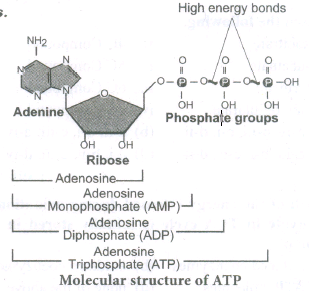
11.
12.
Significance of pentose phosphate pathway:
1) HMP shunt is associated with the generation of two important products,NADPH and pentose sugars, which play a vital role in anabolic reactions.
2) Coenzyme NADPH generated is used for reductive biosynthesis and counter damaging the effects of oxygen free radicals
3) Ribose 5 phosphate and its derivatives are used in the synthesis of DNA, RNA, ATP, NAD+, FAD and coenzyme A.
4) Erythrose is used for synthesis of anthocyanin, lignin and other aromatic compounds.
5) It is characterized by the production of CO2 and it is used for Carbon fixation in photosynthesis
13.
Significance of Krebs cycle:
1) TCA cycle is to provide energy in the form of ATP for metabolism in plants.
2) It provides carbon skeleton or raw material for various anabolic processes.
3) Many intermediates of TCA cycle are further metabolized to produce amino acids, proteins and nucleic acids.
4) Succinyl CoA is raw material for formation of chlorophylls, cytochrome, phytochrome and other pyrrole substances.
5) a-ketoglutarate and oxaloacetate undergo reductive amination and produce amino acids.
6) It acts as metabolic sink which plays a central role in intermediary metabolism.
14.
During the Glycolytic pathway of respiration, 2, phospho glycerate is converted to phospho enol pyruvate. During this process, a molecule of water is removed by the enzyme enolase. This is called Enolation.
15.
1) RQ value indicates which type of respiration occurs in living cells, either aerobic or anaerobic.
2) It also helps to know which type of respiratory substrate is involved.
16.
The point at which CO2 released in respiration is exactly compensated by CO2 fixed in photosynthesis that means no net gaseous exchange takes place, it is called compensation point.
17.
Because carbohydrates are partially oxidised to organic acid, particularly malic acid without corresponding release of CO2 but O2 is consumed. Hence the RQ value will be zero.
\(\underset { Glucose }{ 2{ C }_{ 6 }{ H }_{ 12 }{ O }_{ 6 }+3{ O }_{ 2 }\rightarrow } \underset { malic\quad acid }{ 3{ C }_{ 4 }{ H }_{ 6 }{ O }_{ 5 }+3{ H }_{ 2 }O+Energy } \)
RQ of glucose in succulents = \(\frac { Zero \ molecule \ of \ { CO }_{ 2 } }{ 3 \ molecules \ of \ { CO }_{ 2 } } \) = 0 (Zero)
18.
| S.No. | Aerobic respiration | Anacrobic Respiration |
| 1 | It occurs in all living cells of higher organisms. | It occurs yeast and some bacteria. |
| 2 | It requires oxygen for breaking the respiratory substrate. | Oxygen is not required for breaking the respiratory substrate. |
| 3 | The end products are CO2 and H2O | The end products are alcohol, and CO2 (or) lactic acid . |
| 4 | Oxidation of one molecule of glucose produces 36 ATP molecules. | Only 2ATP molecules are produced. |
| 5 | It consists of four stages-glycolysis, link reaction, TCA cycle and electron transport chain | It consists of two stages-glycolysis and fermentation. |
| 6 | It occurs in cytoplasm and mitochondria. | It occurs only in cytoplasm. |
19.
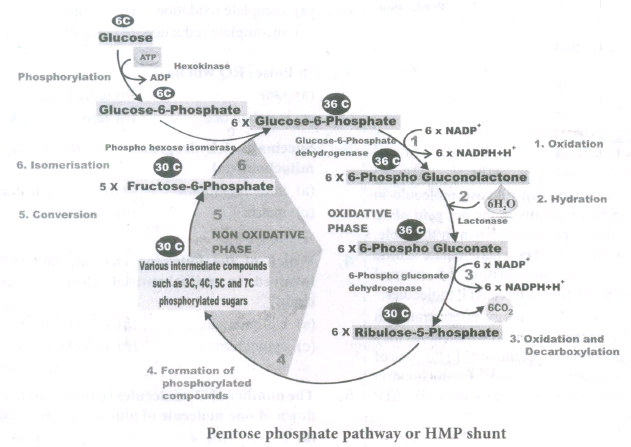
Pentose Phosphate pathway:
(i) It was described by Warburg, Dickens and Lipmann. Hence, it is also called Warburg - Dickens - Lipmann pathway.
(ii) It takes place in cytoplasm of mature plant cells.
(iii) It is an alternate way for breakdown of glucose.
(iv) It is also known as Hexose monophosphate shunt (HMP shunt) or Direct oxidative pathway.
(v) It consists of two phases, Oxidative Phase and non oxidative Phase
Oxidative Events:
(vi) 6 molecules of 6 carbon Glucose - 6 phosphate to 6 molecules of 5 carbon sugar Ribulose - 5 phosphate with loss of 6CO2 molecules and generation of 12 \(\mathrm{NADPH}+\mathrm{H}^{+}\)
Non-Oxidative Pathway:
(i) Convert Ribulose - 5 - phosphate molecules to various intermediates such as ribose 5 - phosphate (5C), Xylulose - 5 - phosphate (5C), Glyceraldehyde - 3 phosphate (3C), sedoheptulose - 7 - phosphate (7C) and Erythrose 4 - phosphate (4C). Finally 5 molecules of glucose - 6 - phosphate is regenerated.
(ii) The net result of complete oxidation of one glucose - 6 - phosphate yield 6CO2 and 12 NADPH + H+.
(iii) The oxidative pentose phosphate pathway is controlled by glucose - 6 - phosphate dehydrogenase enzyme which is inhibited by high ratio of NADPH to NADP+.
The over all reaction is:

20.
Electron Transport Chain (ETC) (Terminal oxidation)
(i) During glycolysis, link reaction and Krebs cycle the respiratory substrates are oxidized at several steps and as a result many reduced coenzymes NADH + H+ and FADH2 are produced.
(ii) These reduced coenzymes are transported to inner membrane of mitochondria and are converted back to their oxidized forms produce electrons and protons.
(iii) In mitochondria, the inner membrane is folded in the form of finger projections towards the matrix called cristae.
(iv) In cristae many oxysomes (F1 particles) are present which have electron transport carriers are present.
(v) According to Peter Mitchell's Chemiosmotic theory this electron transport is coupled to ATP synthesis. Electron and hydrogen(proton) transport takes place across four multiprotein complexes(I-IV). They are:
a) Complex-I (NADH dehydrogenase)
(i) It contains a flavoprotein(FMN) and associated with non-heme iron Sulphur protein (Fe-S). This complex is responsible for passing electrons and protons from mitochondrial NADH (Internal) to Ubiquinone(UQ).
\(\mathrm{NADH}+\mathrm{H}^{+}+\mathrm{UQ} \rightleftharpoons \mathrm{NAD}^{+}+\mathrm{UQH}_{2}\)
(ii) In plants, an additional NADH dehydrogenase (External) complex is present on the outer surface of inner membrane of mitochondria which can oxidise cytosolic NADH + H+.
(iii) Because mitochondrial inner membrane cannot allow NADH molecules directly in to the matrix. Ubiquinone (UQ) or Coenzyme Quinone (CoQ) is a small, lipid soluble electron, proton carrier located within the inner membrane of mitochondria.
b) Complex-II (Succinic dehydrogenase)
(i) It contains FAD flavoprotein is associated with non-heme iron Sulphur (Fe-S) protein.
(ii) This complex receives electrons and protons from succinate in Krebs cycle and is converted into fumarate and passes to ubiquinone.

c) Complex-III (Cytochrome bc1 complex)
(i) This complex oxidises reduced ubiquinone (ubiquinol) and transfers the electrons through Cytochrome bc1 Complex (Iron Sulphur center bc1 complex) to cytochrome c.
(ii) Cytochrome c is a small protein attached to the outer surface of inner membrane and act as a mobile carrier to transfer electrons between complex III to complex IV.
\(\mathrm{UQH}_{2}+2 \mathrm{CytC}_{\text {oxidised }} \rightleftharpoons \mathrm{UQ}+2 \mathrm{Cytc}_{\text {reduced }}+2 \mathrm{H}^{+}\)
d) Complex IV (Cytochrome c oxidase)
(i) This complex contains two copper centers (A and B) and cytochromes a and a3. Complex IV is the terminal oxidase and brings about the reduction of 1/2 O2 to H2O.Two protons are needed to form a molecule of H2O (terminal oxidation).
\(2 \mathrm{CytC}_{\text {oxidised }}+2 \mathrm{H}^{+}+1 / 2 \mathrm{O}_{2} \rightleftharpoons 2 \mathrm{CytC}_{\text {reduced }}+\mathrm{H}_{2} \mathrm{O}\)
(ii) The transfer of electrons from reduced coenzyme NADH to oxygen via complexes I to IV is coupled to the synthesis of ATP from ADP and inorganic phosphate (Pi) which is called Oxidative phosphorylation.
(iii) The F0F1- ATP synthase (also called complex V) consists of F0 and F1. F1 converts ADP and Pi to ATP and is attached to the matrix side of the inner membrane.
(iv) F0 is present in inner membrane and acts as a channel through which protons come into matrix.

11th Standard Syllabus & Materials
11th Standard
TN 11th Tamil பீடு பெற நில் - செய்யுள் - காவடிச்சிந்து Important Questions And Answers Study Material - QB365 Set A
NEW11th Standard
TN 11th Tamil பீடு பெற நில் - உரைநடை - மலை இடப்பெயர்கள் : ஓர் ஆய்வு Important Questions And Answers Study Material - QB365 Set A
NEW11th Standard
TN 11th Tamil மாமழை போற்றுதும் - துணைப்பாடம் - யானை டாக்டர் Important Questions And Answers Study Material - QB365 Set A
NEW11th Standard
TN 11th Tamil மாமழை போற்றுதும் - செய்யுள் - ஐங்குறுநூறு Important Questions And Answers Study Material - QB365 Set A



Tamilnadu Stateboard 11th Standard Subjects

Maths

Commerce

Economics
Biology

Business Maths and Statistics

Accountancy

Computer Science

Physics

Chemistry
Maths
Biology
Economics
Physics
Chemistry

History
Business Maths and Statistics

Computer Science
Accountancy

Computer Applications
History
Computer Technology
Commerce
Computer Applications
Computer Technology

Tamil

English

French
Tamilnadu Stateboard Standards

