
 100% FREE ACCESS
11th Standard Syllabus & Materials
11th Standard
TN 11th Tamil இயற்கை வேளாண்மை,சுற்றுச்சூழல் -செய்யுள் - மனோன்மணீயம் Important Questions And Answers Study Material - QB365 Set A
NEW11th Standard
TN 11th Tamil என்னுயிர் என்பேன் -துணைப்பாடம் - இசைத்தமிழர் இருவர் Important Questions And Answers Study Material - QB365 Set A
NEW11th Standard
TN 11th Tamil மொழி கலை -செய்யுள் - ஒவ்வொரு புல்லையும் Important Questions And Answers Study Material - QB365 Set A
NEW11th Standard
TN 11th Tamil பீடு பெற நில் - இலக்கணம் - பகுபத உறுப்புகள் Important Questions And Answers Study Material - QB365 Set A
NEW11th Standard
TN 11th Tamil பீடு பெற நில் - துணைப்பாடம் - வாடிவாசல் Important Questions And Answers Study Material - QB365 Set A
NEW11th Standard
TN 11th Tamil பீடு பெற நில் - செய்யுள் - குறுந்தொகை Important Questions And Answers Study Material - QB365 Set A

Published on: 26/02/2019
11th Third Revision Exam Question Paper 2019
Download Tamil Nadu 11th Standard Biology question papers, model tests, one-mark questions, important questions, and public exam papers in PDF format. Free study materials and answer keys for TN State Board students.
Questions + Answers key
Take MCQ Biology Test1.
Differentiate sieve cells and sieve tubes
2.
What is critical day length?
3.
What are pseudocoelomates? Give examples
4.
What you know about Imperfect or unisexual flower?
5.
Name any three odoured plastids
6.
Plant A in a nutrient medium shows whiptail disease. Plant B in a nutrient medium shows a little leaf disease. Identify mineral deficiency of plant A and B?
7.
8.
Give the economic importance of prawn fishery
9.
Which is the only jointless bone in human body?
10.
What vessels carry blood to the kidneys? Is this blood arterial or venous?
11.
Which part of the autonomic nervous system is involved in micturition process?
12.
What are basophils?
13.
Head of cockroach is called hypognathous. Why?
14.
How does the male frog attract the female for mating?
15.
16.
Dicarboxylic Acid pathway refers to __________
C3 pathway
C4 pathway
C2 pathway
CAM
17.
Cobalt chloride strips are used to find ___________
Presence of stomata in leaf
Rate of transpiration
Guttation
All the above
18.
The minute pores on the body of sponges are called _________
oseuliem
ostia
choanocytes
spongocoel
19.
Arrangement of sepals and petals in flower bud is called ________.
adhesion
aestivation
placentation
cohesion
20.
Lysosomes release their enzymes outer side the cell to digest other cells _________________
Autolysis
Phagocytosis
Exocytosis
Peroxisomes
21.
How many organisms in the list below are autotrophs?
1. Lactobacillus, Nostoc, Chara, Nitrosomonas, Nitrobacter, Streptomyces, Saccharomyces,
2. Trypanosoma, Porphyra, Wolffia.
Four
Five
Six
Three
22.
Select the wrong statement from the following:
Formative phase of the cells retain the capability of cell division.
In elongation phase development of central vacuole takes place.
In maturation phase thickening and differentiation takes place.
In maturation phase, the cells grow further.
23.
In Gymnosperms, the activity of sieve cells are controlled by _____.
Nearby sieve tube members
Phloem parenchyma cells
Nucleus of companion cells
Nucleus of albuminous cells
24.
__________ is a mixed nerve.
Hypoglossal
Optic
Olfactory
Facial
25.
Which of the given option shows all wrong statements for thyroid gland.
Statement
(i) It inhibits process of RBC formation
(ii) It helps in maintenance of water and electrolytes
(iii) Its more secretion can reduce blood pressure
(iv) It Stimulates osteoblast
(i) and (ii)
(iii) and (iv)
(i) and (iv)
(i) and (iii)
26.
Say True or False.
A worker bee feeding on Royal Jelly becomes queen bee __________
True
False
27.
CO2 is transported through blood to lungs as _____.
carbonic acid
oxyhaemoglobin
carbamino haemoglobin
carboxy haemoglobin
28.
A person who is on a long hunger strike and is surviving only on water, will have
Less amino acids in his urine
Macula densa cells
Less urea in his urine
More sodium in his urine
29.
The head region of Cockroach, _______ pairs of _____ and shaped eyes occur.
One pair, sessile compound and kidney shaped
Two pairs, stalked compound and round shaped
Many pairs, sessile simple and kidney shaped
Many pairs, stalked compound and kidney shaped
30.
31.
Example for negatively geotropic roots __________
Ipomoea, Dahlia
Asparagus, Ruellia
Vitis, Portulaca
Avicennia, Rhizophora
32.
List the types of Senescence.
33.
Mention two important products obtained from bark.
34.
Write a note on assimilation
35.
Mention the role of Inhibitors of Enzyme.
36.
Write the characters of living things.
37.
Define the two phases involved in transmission of nervous impulses
38.
Identify the biological term
Excretion, glomerulus, urinary bladder, glomerular filtrate, ureters,urine, Bowman’s capsule, urinary system, reabsorption, micturition, osmosis, proteins.
a. A liquid which gathers in the bladder.
b. Produced when blood is filtered in a Bowman’s capsule.
c. Temporary storage of urine.
d. A ball of intertwined capillaries.
e. Removal of unwanted substances from the body.
f. Each contains a glomerulus.
g. Carry urine from the kidneys to the bladder.
h. Scientific term for urination.
i. Regulation of water and dissolved substances in blood and tissue fluid.
j. Consists of the kidneys, ureters and bladder.
k. Removal of useful substances from glomerular filtrate.
l. What solute the blood contains that are not present in the glomerular filtrate?
39.
Differentiate between aggregate fruit with multiple fruit.
40.
Differentiate photosynthesis in plants and Bacterial photosynthesis.
41.
Write the Botanical Description of Allium cepa.
42.
What is erythroblastosis foetalis? How is it caused? Can it be treated?
43.
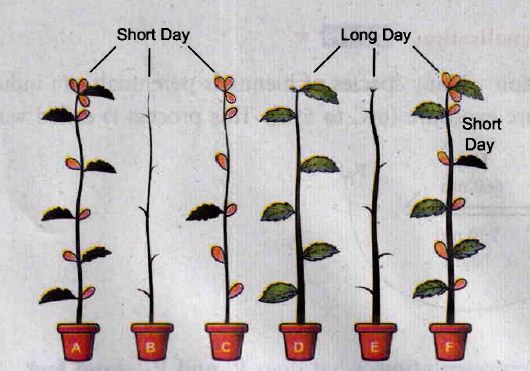
Describe the mechanism of photoperiodic induction of flowering.
44.
Briefly explain the structure of thyroid gland.
45.
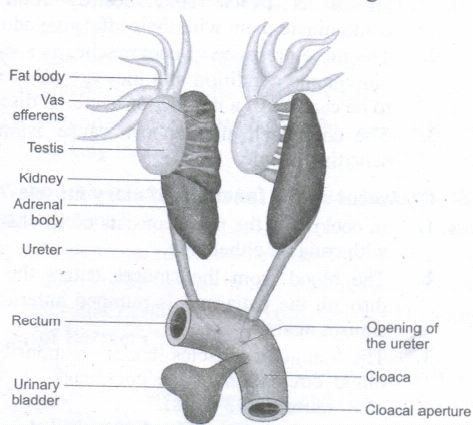
Explain the excretory system of frog.
46.
Give the salient features of the class Deuteromycetes.
1.
| Sieve Cells | Sieve Tubes |
|---|---|
| Have no companion cells | Have companion cells always |
| The sieve areas do not form sieve plates | The sieve areas are confined to sieve plates |
2.
The photoperiod required to induce flowering is called critical day length
3.
(i) Nematodes of phylum nematode are triploblastic and bilaterians.
(ii) Coelom of these animals is loosely found with mesenchyme.
(iii) So coelom appears to be false hence it is called as pseudocoelom.
(iv) Eg: Ascaris (Round worm)
Anchylostoma (Hook worm)
Enterobious (Pin/sear worm)
Wucheraria (Filarial worm)
4.
1. When the flower, contains only one of the essential whorls is called Imperfect flower
2. It is of two types:
i) Staminate flowers: Flowers only with androecium alone are called staminate flowers.
ii) Pistillate flowers: Flowers with only gynoecium are called pistillate flowers.
5.
The three odoured plastids are Chloroplast, Phaeoplast, Rhodoplast.
6.
(i) Mineral deficiency of plant A is due to Molybdenum
(ii) Mineral deficiency of plant B is due to Zinc
7.
8.
Economic importance of prawn:
(i) Prawn is a very tasty proteinaceous food.
(ii) Economic growth can be achieved by prawn at a low cost.
(iii) It is profitable to cultivate prawns in fresh water at a low cost.
(iv) By Exporting prawns can also bring a lot of foreign currency to the country.
9.
Skull bones.
10.
Renal artery supplies (arterial) oxygenated blood and renal vein carries out deoxygenated blood (venous) from kidneys.
11.
Sensory neurons of the parasympathetic autonomic nervous system.
12.
They are a type of WBC (granulocytes).
1. Basophils secrete substances such as heparin, serotonin, and histamines.
2. They are also involved in inflammatory reactions.
13.
(i) The head is small, triangular and lies at right angle to the longitudinal axis of the body.
(ii) The mouth parts are directed downwards so it is hypognathous.
14.
Male frog attracts female frog by amplifying its croaking sound during breeding season.
15.
16.
(b)
C4 pathway
17.
(b)
Rate of transpiration
18.
(b)
ostia
19.
(b)
aestivation
20.
(c)
Exocytosis
21.
(c)
Six
22.
(d)
In maturation phase, the cells grow further.
23.
(c)
Nucleus of companion cells
24.
(d)
Facial
25.
(d)
(i) and (iii)
26.
(a)
True
27.
(c)
carbamino haemoglobin
28.
(c)
Less urea in his urine
29.
(a)
One pair, sessile compound and kidney shaped
30.
(a)
31.
(d)
Avicennia, Rhizophora
32.
Leopold (1961) has recognised four types of senescence:
1. Overall senescence
2. Top senescence
3. Deciduous senescence
4. Progressive senescence
33.
(a) Cinnamon - Spice got from the bark of the tree. Eg: Cinnamomum.
(b) Rubber - Got from the latex vessels of the inner bark of Hevea brasiliensis.
34.
Absorbed substances are transported through blood and lymph to the liver through the hepatic portal system. From the liver, nutrients are transported to all other regions of the body for utilization. All the body tissues utilize the absorbed substance for their activities and incorporate into their protoplasm, this process is called assimilation.
35.
Certain substances present in the cells may react with the enzyme and lower the rate of reaction. These substances are called inhibitors. It is of two types competitive and non-competitive
36.
1. Presence of nucleic acid and protein.
2. Capable of mutation
3. Ability to multiply within living cells.
4. Able to infect and cause diseases in living beings.
5. Show irritability.
6. Host -specific
37.
The transmission of impulse involves two main phases; Resting membrane potential and Action membrane potential.
Resting membrane Potential: The electrical potential difference across the plasma membrane of a resting neuron is called the resting potential during which the interior of the cell is negative due to greater efflux of K+ outside the cell than Na+ influx into the cell.
Action membrane potential: An action potential occurs when a neuron sends information down an axon, away from the cell body. It includes following phases, depolarization, repolarisation and hypo polarization.
38.
(a) Urine
(b) Glomerular filtrate
(c) Urinary bladder
(d) afferent and efferent arterioles and venules of renel artery and renel vein.
(e) Excretion
(f) Bowman's capsule
(g) Ureters
(h) Micturition
(i) Balance of electrolytes minerals and organics
(j) excretory system
(k) micturition
(l) glucose, amino acid and liquids
39.
| S.No. | Aggregate fruit | Multiple fruit |
| 1 | Aggregate fruits develop from a single flower having an apocarpous pistil. Each of the free carpel develops into a simple fruitlet. A collection of simple fruitlets makes an Aggregate fruit. An individual ovary develops into a drupe, achene, follicle or berry | A Multiple or composite fruit develops from the whole inflorescence along with its peduncle on which they are borne |
| 2 | Eg: Polyalthia | Eg: Pineapple |
40.
| Photosynthesis in Plants | Bacterial Photosynthesis | |
| 1. | Cyclic and Non-Cyclic phosphorylation takes place | Only Cyclic Phosphorylation takes place |
| 2. | Photosystem I and II involved | Photosystem I only involved |
| 3. | The electron donor is water | The electron donor is H2S |
| 4. | Oxygen is evolved | Oxygen is not evolved |
| 5. | Reaction centers are P700 and P680 | The reaction center is P890 |
| 6. | The reducing agent is NADPH + H+ | The reducing agent is NADH + H+ |
| 7. | PAR is 400 to 700 nm | PAR is above 700 nm |
| 8. | Chlorophyll, Carotenoid, and Xanthophyll | Bacteria chlorophyll and Bacteria viridin |
| 9. | Photosynthetic apparatus - chloroplast | It is chlorophyll and chromatophores. |
41.
Habit:
Perennial herb with bulb.
Root:
Fibrous adventitious root system
Stem:
Underground bulb
Leaf:
a cluster of radical leaves emerges from the underground bulb, cylindrical and fleshy having sheathy leaf bases with parallel venation.
Inflorescence:
Scapigerousi.e. the inflorescence axis (peduncle) arising from the ground bearing a cluster of flowers at its apex. Pedicels are of equal length, arising from the apex of the peduncle which brings all flowers at the same level.
Flower:
Small, white, bracteate, ebrcteolate, pedicellate, complete, trimerous, actinomorphic and hypogynous. Flowers are protandrous.
Perianth:
Tepals 6, white,arranged in two whorls of three each, syntepalous showing valvate aestivation.
Androecium:
Stamens 6, arranged in two whorls of three each, epitepalous, apostamenous free and opposite to tepals. Anthers dithecous, basifixed, introse, and dehiscing longitudinally.
Gynoecium: Tricarpeltary and syncarpous. Ovary superior, trilocular with two ovules in each locule on axile placentation. Style simple, slender with simple stigma.
Fruit:
A loculicidal capsule.
Seed:
Endospermous
Floral Formula:

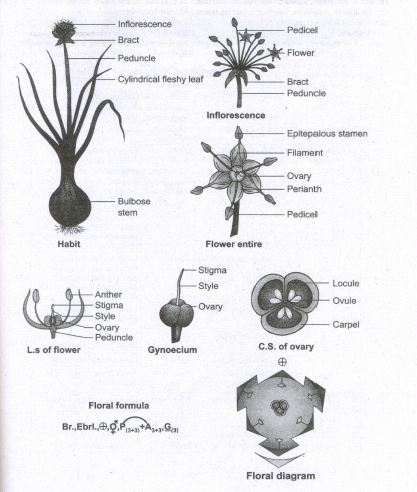
42.
Rh factor compatibility is also checked before blood transfusion. When a pregnant women is Rh- and the foetus is Rh+ incompatibility (mismatch) is observed. During the first pregnancy, the Rh- antigens of the foetus does not get exposed to the mother's blood as both their blood are separated by placenta. However, small amount of the foetal antigen becomes exposed to the mother's blood during the birth of the first child. The mother's blood starts to synthesize D antibodies. But during subsequent pregnancies the Rh antibodies from the mother (Rh-) enters the foetal circulation and destroys the foetal RBCs. This becomes fatal to the foetus because the child suffers from anaemia and jaundice. This condition is called erythroblastosis foetalis. This condition can be avoided by administration of anti D antibodies (Rhocum) to the mother immediately after the first child birth.
43.
Photoperiodic induction
1) An appropriate photoperiod in 24 hours cycle constitutes one inductive cycle. Plants may require one or more inductive cycles for flowering.
2) The phenomenon of conversion of leaf primordia into flower primordia under the influence of suitable inductive cycles is called photoperiodic induction.
Example: Xanthium (SDP) - 1 inductive cycle and Plantago (LDP)- 25 inductive cycles.
Site of Photoinductive perception
1) Photoperiodic stimulus is perceived by the leaves.
2) Floral hormone is synthesised in leaves and translocated to the apical tip to promote flowering.
3) This can be explained by a simple experiment on Cocklebur (Xanthium pensylvanicum), a short day plant.
4) Usually Xanthium will flower under short day conditions. If the plant is defoliated and kept under short day conditions it will not flower.
5) Flowering will occur even when all the leaves are removed except one leaf.
6) If a cocklebur plant is defoliated and kept under long day conditions, it will not flower.
7) If one of its leaves is exposed to short day condition and rest are in long day condition, flowering will occur.
44.
Structure of thyroid gland:
Thyroid gland is the largest endocrine gland in the body.
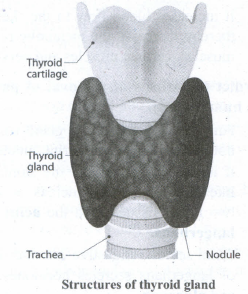
1. It is a butterfly shaped, bilobed gland located below the larynx on either side of upper trachea.
2. The two lateral lobes are connected by a median tissue mass called isthmus.
3. Each lobe is made up of many lobules. The lobules consist of follicles called acini.
4. Each acinus is lined with glandular, cuboidal or squamous epithelial cells. The lumen of acinus is filled with colloid, a thick glycoprotein mixture consisting of thyroglobulin molecules.
5. It secretes two hormones namely tri-iodothyronine [T3] and thyroxine or tetra- iodothyronine [T4].
6. The parafollicular cells or 'C' cells of thyroid gland secrete a hormone called thyrocalcitonin.
7. Iodine is essential for the normal synthesis of thyroid hormone.
8. Thyroid hormones shows a negative feedback effect on the hypothalamus and pituitary.
45.
(i) The process of elimination of nitrogenous wastes, salt and water balance from the body is called excretion.
(ii) This system consists of a paired kidneys, ureters, urinary bladder and cloaca.
(iii) Kidneys are dark red, long, flat organs situated on either sides of the vertebral column.
(iv) Kidneys are mesonephric type.
(v) The functional excretory units of kidneys are nephrons.
(vi) Nephrons separate nitrogenous wastes from the blood and excrete urea so frogs are ureotelic.
(vii) A paired long ureter emerges from the kidneys and opens into the cloaca.
(viii) A thin walled unpaired urinary bladder is present ventral to the rectum.
(ix) Rectum opens into the cloaca.
46.
1. The fungi belonging to this group lack sexual reproduction and are called imperfect fungi.
2. A large number of species live as saprophytes in soil and many are plant and animal parasites.
3. Asexual reproduction takes place by the production of conidia, chlamydospores, budding, oidia etc.,
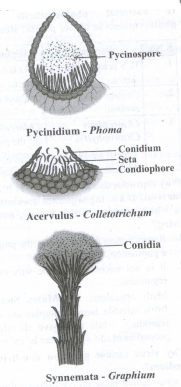
4. Conidia are also produced in special structures called Pycnidium, Acervulus, Sporodochium: and Synnemata.
5. Parasexual cycle operates in this group of fungi. This brings genetic variation among the species.

11th Standard Syllabus & Materials
11th Standard
TN 11th Tamil பீடு பெற நில் - செய்யுள் - காவடிச்சிந்து Important Questions And Answers Study Material - QB365 Set A
NEW11th Standard
TN 11th Tamil பீடு பெற நில் - உரைநடை - மலை இடப்பெயர்கள் : ஓர் ஆய்வு Important Questions And Answers Study Material - QB365 Set A
NEW11th Standard
TN 11th Tamil மாமழை போற்றுதும் - துணைப்பாடம் - யானை டாக்டர் Important Questions And Answers Study Material - QB365 Set A
NEW11th Standard
TN 11th Tamil மாமழை போற்றுதும் - செய்யுள் - ஐங்குறுநூறு Important Questions And Answers Study Material - QB365 Set A



Tamilnadu Stateboard 11th Standard Subjects

Maths

Commerce

Economics
Biology

Business Maths and Statistics

Accountancy

Computer Science

Physics

Chemistry
Maths
Biology
Economics
Physics
Chemistry

History
Business Maths and Statistics

Computer Science
Accountancy

Computer Applications
History
Computer Technology
Commerce
Computer Applications
Computer Technology

Tamil

English

French
Tamilnadu Stateboard Standards

