
 100% FREE ACCESS
11th Standard Syllabus & Materials
11th Standard
TN 11th Tamil இயற்கை வேளாண்மை,சுற்றுச்சூழல் -செய்யுள் - மனோன்மணீயம் Important Questions And Answers Study Material - QB365 Set A
NEW11th Standard
TN 11th Tamil என்னுயிர் என்பேன் -துணைப்பாடம் - இசைத்தமிழர் இருவர் Important Questions And Answers Study Material - QB365 Set A
NEW11th Standard
TN 11th Tamil மொழி கலை -செய்யுள் - ஒவ்வொரு புல்லையும் Important Questions And Answers Study Material - QB365 Set A
NEW11th Standard
TN 11th Tamil பீடு பெற நில் - இலக்கணம் - பகுபத உறுப்புகள் Important Questions And Answers Study Material - QB365 Set A
NEW11th Standard
TN 11th Tamil பீடு பெற நில் - துணைப்பாடம் - வாடிவாசல் Important Questions And Answers Study Material - QB365 Set A
NEW11th Standard
TN 11th Tamil பீடு பெற நில் - செய்யுள் - குறுந்தொகை Important Questions And Answers Study Material - QB365 Set A

Published on: 12/10/2019
Bio - Botany - Transport in Plants
Download Tamil Nadu 11th Standard Biology question papers, model tests, one-mark questions, important questions, and public exam papers in PDF format. Free study materials and answer keys for TN State Board students.
Questions + Answers key
Take MCQ Biology Test1.
According to cytochrome pump theory the anions and cations are transported by _____________
active absorption
passive absorption
active and passive absorption respectively
passive and active absorption respectively
2.
Which of the following physical force is responsible for ascent of sap?
Imbibition
Capillary force
Transpiration pull and cohesion
Root pressure
3.
Munch hypothesis is based on _______.
Translocation of food due to TP gradient and imbibition force
Translocation of food due to TP
Translocation of food due to imbibition force
None of the above
4.
Stomata of a plant open due to _____.
Influx of K+
Efflux of K+
Influx of Cl-
Influx of OH-
5.
What type of transpiration is possible in the xerophyte Opuntia?
Stomatal
Lenticular
Cuticular
All the above
6.
In a fully turgid cell _____.
DPD = 10 atm; OP = 5 atm; TP = 10 atm
DPD = 0 atm; OP = 10 atm; TP = 10 atm
DPD = 0 atm; OP = 5 atm; TP = 10 atm
DPD = 20 atm; OP = 20 atm; TP = 10 atm
7.
Draw a diagram to show the structure of stomata.
8.
Show the K+ transport theory of opening of stomata with diagram.
9.
Define Osmosis
10.
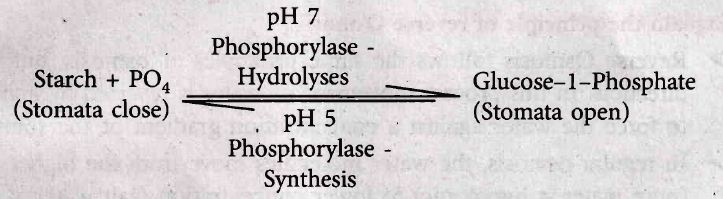
How phosphorylase enzyme open the stomata in starch sugar interconversion theory?
11.
If the concentration of salt in the soil is too high and the plants may wilt even if the field is thoroughly irrigated. Explain
12.
Justify plant cell as an osmotic system
13.
What is transpiration pull?
14.
Define 'Diffusion'.
15.
List out the role of anittranspirants in agriculture.
16.
Explain 'ascent of sap'?
17.
What is DPD?
18.
Differentiate channel protein and carrier protein.
19.
What are the parameters which control water potential?
20.
21.
Explain the uses of Ganongs potometer.
22.
Describe the transpiration pull theory.
1.
(c)
active and passive absorption respectively
2.
(c)
Transpiration pull and cohesion
3.
(b)
Translocation of food due to TP
4.
(a)
Influx of K+
5.
(c)
Cuticular
6.
(b)
DPD = 0 atm; OP = 10 atm; TP = 10 atm
7.
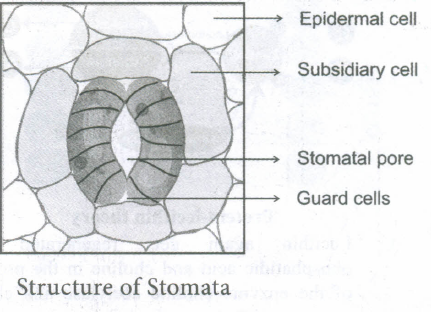
8.
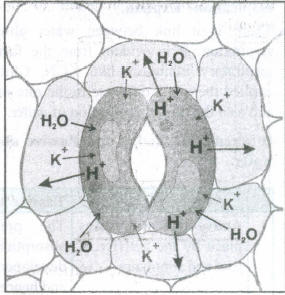
Theory of K+ transport Opening of stomata.
9.
1. Osmosis (Latin: Osmos=impulse, urge) is a special type of diffusion.
2. It represents the movement of water or solvent molecules through a selectively permeable membrane from the place of its higher concentration (high water potential) to the place of its lower concentration (low water potential).
10.
1. The discovery of enzyme phosphorylase in guard cells by Hanes (1940) greatly supports the starch-sugar interconversion theory.
2. The enzyme phosphorylase hydrolyses starch into sugar and high pH followed by endosmosis and the opening of stomata during light. The vice versa takes place during the night.
11.
High concentration of salt in the soil leads to high osmotic potential, which may a result in wilting of plants due to following reasons.
(a) This may be due to osmotic withdrawal of water from a cell or system when it is placed in a hypertonic solution called Exosmosis.
(b) Exosmosis in a plant cell leads to plasmolysis. As a result of water loss in the cell protoplasm shrinks and the cell membrane is pulled away from the cell wall and finally the cell becomes flaccid.
12.
1. A plant cell is bound by cell membrane which is semi permeable which is a requisite for osmosis.
2. The vacuole present in the plant cell has sap which contributes to solute potential.
3. Hence plant cell is a osmotic system.
13.
In ascent of sap the unbroken water column from leaf. to root is just like a rope. If the rope is pulled from the top, the entire rope will move upward. In plants, such a pull is generated by the process of transpiration which is known as transpiration pull.
14.
The net movement of molecules from a region of their higher concentration to a region of their lower concentration along a concentration gradient until an equilibrium is attained.
15.
Uses:
1. Antitranspirants reduce the enormous loss of water by transpiration in crop plants.
2. Useful for seedling transplantations in nurseries
16.
The upward transport of water along with dissolved minerals from roots to the aerial parts of the plant is called ascent of sap.
17.
1. Addition of solute in pure solvent lowers its diffusion pressure.
2. The difference between the diffusion pressure of the solution and its solvent at a particular temperature and atmospheric pressure is called as diffusion pressure deficit CDPD)termed by Meyer (1938).DPD is increased by the addition of solute into a solvent system.
18.
Channel protein and Carrier protein are two types of transport proteins present in cell membrane.
| Channel Protein | Carrier Protein |
| Forms a channel/tunnel in the cell membrane for the easy passage of molecules to enter the cell. Eg: Porin |
Acts as a vehicle to carry molecules from outside of the membrane to inside the cell and vice versa. There are 3 types of carrier protein. |
19.
(1) Water potential \(\left(\Psi_{\mathrm{W}}\right)\) can be determined by,
(i) Solute concentration or Solute Potential \(\left(\Psi_{\mathrm{S}}\right)\)
(ii) Pressure potential \(\left(\Psi_{\mathrm{P}}\right)\)
(2) By correlating two factors, water potential is written as,
(3) Water potential = Solute potential + Pressure potential
(4) \(\Psi_{W}=\Psi_{S}+\Psi_{P}\)
20.
21.
1. Ganongs potometer is used to measure the rate of transpiration indirectly. In this, the amount of water absorbed is measured and assumed that this amount is equal to the amount of water transpired.
2. Apparatus consists of a horizontal graduated tube which is bent in opposite directions at the ends.
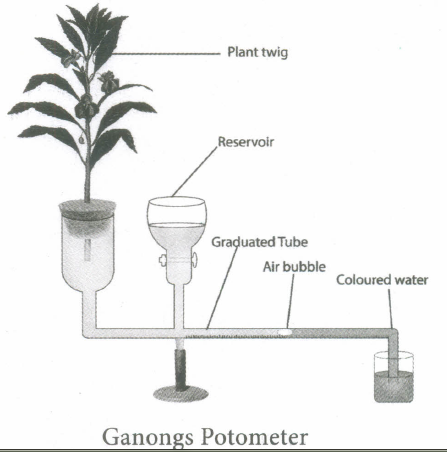
3. One bent end is wide and the other is narrow.
4. A reservoir is fixed to the horizontal tube near the wider end.
5. The reservoir has a stopcock to regulate water flow. The apparatus is filled with water from a reservoir.
6. A twig or a small plant is fixed to the wider arm through a split cock.
7. The other bent end of the horizontal tube is dipped into a beaker containing coloured water.
8. An air bubble is introduced into the graduated tube at the narrow end. Keep this apparatus in bright sunlight and observe
9. As transpiration takes place, the air bubble will move towards the twig. The loss is compensated by water absorption through the xylem portion of the twig. Thus, the rate of water absorption is equal to the rate of transpiration.
22.
Cohesion-tension or Cohesion and transpiration pull theory:
It is a physical force theory to explain ascent of sap. Cohesion-tension theory was originally proposed by Dixon and Jolly and again put forward by Dixon. This theory is based on the following features:
1. Strong cohesive force or tensile strength of water
i) Water molecules have the strong mutual force of attraction called cohesive force due to which they cannot be easily separated from one another.
ii) Further, the attraction between a water molecule and the wall of the xylem element is called adhesion.
iii) These cohesive and adhesive force works together to form an unbroken continuous water column in the xylem.
iv) The magnitude of the cohesive force is much high (350atm) and is more than enough to ascent sap in the tallest trees.
2. Continuity of the water column in the plant
i) An important factor which can break the water column is the introduction of air bubbles in the xylem.
ii) Gas bubbles expanding and displacing water within the xylem element is called cavitation or embolism. However, the overall continuity of the water column remains undisturbed since water diffuses into the adjacent xylem elements for continuing ascent of sap.
3.Transpiration pull or Tension in the unbroken water column
i) The unbroken water column from leaf to root is just like a rope. If the rope is pulled from the top, the entire rope will move upward.
ii) In plants, such a pull is generated by the process of transpiration which is known as transpiration pull.
iii) Water vapour evaporates from mesophyll cells to the intercellular spaces near stomata as a result of active transpiration.
iv)The water vapours are then transpired through the stomatal pores. Loss of water from mesophyll cells causes a decrease in water pot ential.
v) So, water moves as a pull from cell to cell along the water potential gradient. This tension, generated at the top (leaf) of the unbroken water column, is transmitted downwards from petiole, stem and finally reaches the roots.
vi) The cohesion theory is the most accepted among the plant physiologists today.

11th Standard Syllabus & Materials
11th Standard
TN 11th Tamil பீடு பெற நில் - செய்யுள் - காவடிச்சிந்து Important Questions And Answers Study Material - QB365 Set A
NEW11th Standard
TN 11th Tamil பீடு பெற நில் - உரைநடை - மலை இடப்பெயர்கள் : ஓர் ஆய்வு Important Questions And Answers Study Material - QB365 Set A
NEW11th Standard
TN 11th Tamil மாமழை போற்றுதும் - துணைப்பாடம் - யானை டாக்டர் Important Questions And Answers Study Material - QB365 Set A
NEW11th Standard
TN 11th Tamil மாமழை போற்றுதும் - செய்யுள் - ஐங்குறுநூறு Important Questions And Answers Study Material - QB365 Set A



Tamilnadu Stateboard 11th Standard Subjects

Maths

Commerce

Economics
Biology

Business Maths and Statistics

Accountancy

Computer Science

Physics

Chemistry
Maths
Biology
Economics
Physics
Chemistry

History
Business Maths and Statistics

Computer Science
Accountancy

Computer Applications
History
Computer Technology
Commerce
Computer Applications
Computer Technology

Tamil

English

French
Tamilnadu Stateboard Standards

