
 100% FREE ACCESS
11th Standard Syllabus & Materials
11th Standard
TN 11th Tamil இயற்கை வேளாண்மை,சுற்றுச்சூழல் -செய்யுள் - மனோன்மணீயம் Important Questions And Answers Study Material - QB365 Set A
NEW11th Standard
TN 11th Tamil என்னுயிர் என்பேன் -துணைப்பாடம் - இசைத்தமிழர் இருவர் Important Questions And Answers Study Material - QB365 Set A
NEW11th Standard
TN 11th Tamil மொழி கலை -செய்யுள் - ஒவ்வொரு புல்லையும் Important Questions And Answers Study Material - QB365 Set A
NEW11th Standard
TN 11th Tamil பீடு பெற நில் - இலக்கணம் - பகுபத உறுப்புகள் Important Questions And Answers Study Material - QB365 Set A
NEW11th Standard
TN 11th Tamil பீடு பெற நில் - துணைப்பாடம் - வாடிவாசல் Important Questions And Answers Study Material - QB365 Set A
NEW11th Standard
TN 11th Tamil பீடு பெற நில் - செய்யுள் - குறுந்தொகை Important Questions And Answers Study Material - QB365 Set A

Published on: 26/09/2019
Bio - Zoology - Locomotion and Movement
Download Tamil Nadu 11th Standard Biology question papers, model tests, one-mark questions, important questions, and public exam papers in PDF format. Free study materials and answer keys for TN State Board students.
Questions + Answers key
Take MCQ Biology Test1.
Choose the structure made of 8 bones
Cervical region of vertebral column
Tarsal
Cranium
Metacarpals
2.
______________muscles are involved in smiling and ___________ in frowning.
17 and 43
18 and 43
17 and 36
15 and 48
3.
The pointed portion of the elbow is ______.
acromion process
glenoid cavity
olecranon process
symphysis
4.
Inflammation of joints due to accumulation of uric acid crystals is called as _____.
Gout
Myasthenia gravis
Osteoporosis
Osteomalacia
5.
The region between two successive Z-discs is called a ______.
sarcomere
microtubule
myoglobin
actin
6.
7.
Muscles are derived from _____.
ectoderm
mesoderm
endoderm
neuro ectoderm
8.
What are synovial joints?
9.
How does an isotonic contraction take place?
10.
Name the different types of movement
11.
How are joints classified?
12.
What are glycosomes?
13.
Name the following
a)Thigh bone
b) Knee cap
c) Toe bones
d) Ankle.
14.
What is SMGA and what for is it used?
15.
What is myoglobin
16.
List the disorders of the muscular system.
17.
How is rigor mortis happen?
18.
How is tetany caused?
19.
Name the contractile proteins present in the skeletal muscle
20.
Name the filaments present in the sarcomere.
21.
List the three main parts of the axial skeleton.
22.
Name the bones of the skull.
23.
what are the functions of skeletal system.
24.
25.
What are the different types of rib bones that form the rib cage?
1.
(c)
Cranium
2.
(a)
17 and 43
3.
(c)
olecranon process
4.
(a)
Gout
5.
(a)
sarcomere
6.
(a)
7.
(b)
mesoderm
8.
Synovial joints or Diarthroses joints: They are freely movable joints. The articulating bones are separated by a cavity which is filled with synovial fluid. Eg: Pivot joint - Between atlas and axis
9.
Isotonic contraction (iso-same, tonweight/ resistance)
1. In isotonic contraction the length of the muscle changes but the tension remains constant.
2. Here, the force produced is unchanged.
3. Eg: Lifting dumbbells and weight lifting.
10.
Types of movement: The different types of movements that occur in the cells of our body are amoeboid, ciliary, flagellar and muscular movement.
1. Amoeboid movement:
Cells such as macrophages exhibit amoeboid movement for engulfing pathogens by pseudopodia formed by the streaming movement of the cytoplasm.
2. Ciliary movement:
This type of movement occurs in the respiratory passages and genital tracts which are lined by ciliated epithelial cells.
3. Flagellar movement:
This type of movement occurs in the cells which are having flagella or whip-like motile organelle. The sperm cells show flagellar movement.
4. Muscular movement:
The movement of hands, legs, jaws, tongue are caused by the contraction and relaxation of the muscle which is termed as the muscular movement.
11.
Fibrous joints, Cartilaginous joints, Synovial joints.
12.
Glycosomes are the granules of stored glycogen that provide glucose during the period of muscle fibre activity.
13.
a) Thigh bone - Femur
b) Knee cap - Patella
c) Toe bones - Phalanges
d) Ankle - Tarsus
14.
(i) It is the skeletal muscle glycogen analysis.
(ii) It is used to measure in Athlete's sporting performance by taking multiple biopsies.
15.
1. Myoglobin is a red- coloured respiratory pigment of the muscle fibre.
2. It is similar to haemoglobin and contains iron group that has affinity towards oxygen and serves as the reservoir of oxygen.
16.
Myasthenia gravis, Tetany, Muscle pull, Muscle Fatigue, Atrophy, Dystrophy.
17.
The muscle contracts when the myosin shifts. The lack of ATP after death prevents it from relaxing and the muscle remains contracted. Such process occurs in all muscles and the body becomes rigid.
18.
Rapid muscle spasms occur in the muscles due to deficiency of parathyroid hormone resulting in reduced calcium levels in the body.
19.
Actin, myosin, meromyosin, tropomyosin and troponin.
20.
A. I Bands.
21.
1. Vertebral column
2. Sternum
3. Ribs
22.
Cranium, facial bone, Bones of middle, ear, and Hyoid bone.
23.
Functions of skeletal system:
1. Support - It forms a rigid framework and supports the weight of the body against gravity.
2. Shape - It provides and maintains the shape of the body.
3. Protection - It protects the delicate internal organs of the body.
4. Acts as reservoir - It stores minerals such as calcium and phosphate. Fat (Triglyceride) IS stored in yellow bone marrow and represents a source of stored energy for the body.
5. Locomotion - It acts as lever along with the muscles attached to it.
6. Strength - It can withstand heavy weight and absorbs mechanical shock.
7. As a haemopoietic tissue - Red and White blood cells are produced in the bone marrow of the ribs, spongy bones of vertebrae and extremities of long bones.
24.
25.
The Rib cage:
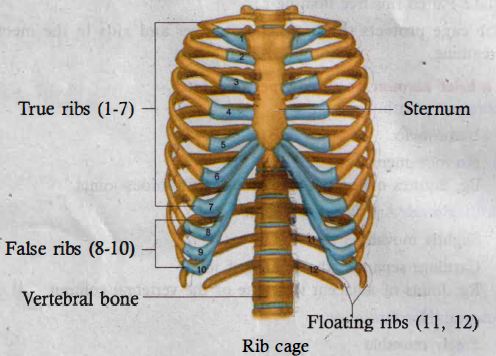
(i) There are 12 pairs of ribs.
(ii) Each rib is a thin flat bone connected dorsally to the vertebral column and ventrally to the sternum.
(iii) It has two articulation surfaces on its dorsal end hence called bicephalic.
(iv) The first seven pairs of ribs are called 'true ribs' or vertebro-sternal ribs.
(v) Dorsally they are attached to the thoracic vertebrae and ventrally connected to the sternum with the help of hyaline cartilages.
(vi) The 8th, 9th and 10th pairs of ribs do not articulate directly with the sternum but joined with the cartilaginous (hyaline cartilage) part of the seventh rib.
(vii) These are called 'false ribs' or vertebrochondral ribs.
(viii) The last 11th and 12th pairs of ribs are not connected ventrally. Therefore, they are called as 'floating ribs' or vertebral ribs.
(ix) Thoracic vertebrae, ribs and sternum together form the ribcage.

11th Standard Syllabus & Materials
11th Standard
TN 11th Tamil பீடு பெற நில் - செய்யுள் - காவடிச்சிந்து Important Questions And Answers Study Material - QB365 Set A
NEW11th Standard
TN 11th Tamil பீடு பெற நில் - உரைநடை - மலை இடப்பெயர்கள் : ஓர் ஆய்வு Important Questions And Answers Study Material - QB365 Set A
NEW11th Standard
TN 11th Tamil மாமழை போற்றுதும் - துணைப்பாடம் - யானை டாக்டர் Important Questions And Answers Study Material - QB365 Set A
NEW11th Standard
TN 11th Tamil மாமழை போற்றுதும் - செய்யுள் - ஐங்குறுநூறு Important Questions And Answers Study Material - QB365 Set A



Tamilnadu Stateboard 11th Standard Subjects

Maths

Commerce

Economics
Biology

Business Maths and Statistics

Accountancy

Computer Science

Physics

Chemistry
Maths
Biology
Economics
Physics
Chemistry

History
Business Maths and Statistics

Computer Science
Accountancy

Computer Applications
History
Computer Technology
Commerce
Computer Applications
Computer Technology

Tamil

English

French
Tamilnadu Stateboard Standards

