
 100% FREE ACCESS
11th Standard Syllabus & Materials
11th Standard
TN 11th Tamil இயற்கை வேளாண்மை,சுற்றுச்சூழல் -செய்யுள் - மனோன்மணீயம் Important Questions And Answers Study Material - QB365 Set A
NEW11th Standard
TN 11th Tamil என்னுயிர் என்பேன் -துணைப்பாடம் - இசைத்தமிழர் இருவர் Important Questions And Answers Study Material - QB365 Set A
NEW11th Standard
TN 11th Tamil மொழி கலை -செய்யுள் - ஒவ்வொரு புல்லையும் Important Questions And Answers Study Material - QB365 Set A
NEW11th Standard
TN 11th Tamil பீடு பெற நில் - இலக்கணம் - பகுபத உறுப்புகள் Important Questions And Answers Study Material - QB365 Set A
NEW11th Standard
TN 11th Tamil பீடு பெற நில் - துணைப்பாடம் - வாடிவாசல் Important Questions And Answers Study Material - QB365 Set A
NEW11th Standard
TN 11th Tamil பீடு பெற நில் - செய்யுள் - குறுந்தொகை Important Questions And Answers Study Material - QB365 Set A

Published on: 19/10/2019
Bio - Botany - Photosynthesis
Download Tamil Nadu 11th Standard Biology question papers, model tests, one-mark questions, important questions, and public exam papers in PDF format. Free study materials and answer keys for TN State Board students.
Questions + Answers key
Take MCQ Biology Test1.
Identify incorrect pair regarding C4 cycle.
Initial carboxylation - mesophyll cells
Primary CO2 acceptor - PEP
First product - OAA
Bundle sheath cells - with granum
2.
Kranz anatomy is one ofthe characteristics of the leaves of _________
Sugarcane
Wheat
Potato
Mustard
3.
Energy needed for ATP synthesis in PS II comes from____________.
Proton gradient
Electron gradient
Reduction of glucose
Oxidation of glucose
4.
A plant growing in a tree as epiphyte accumulates malic acid in dark and cells contains large storage vacuoles. Identify the of type of pathway that takes place in this plant.
C4pathway
Glycolate Metabolic pathway
Di carboxylic acid pathway
CAM pathway
5.
For every CO2 molecule entering the C3 cycle, the number of ATP & NADPH required ________.
2ATP + 2NADPH
2ATP + 3NADPH
3ATP + 2NADPH
3ATP + 3NADPH
6.
7.
What is PAR?
8.
What is DCMI?
9.
Distinguish fluorescence and phosphorescence.
10.
Name the types of phycobilins with example.
11.
What are Quantasomes?
12.
A tree is believed to be releasing oxygen during night time. Do you believe the truthfulness of this statement? Justify your answer by giving reasons?
13.
Two groups (A & B) of bean plants of similar size and same leaf area were placed in identical conditions. Group A was exposed to light of wavelength 400-450nm & Group B to light of wavelength of 500-550nm. Compare the photosynthetic rate of the 2 groups giving reasons.
14.
Explain Non cyclic photophosphorylation?
15.
Differentiate Cyclic and Non-Cyclic photophosphorylation.
16.
Grasses have an adaptive mechanism to compensate photorespiratory losses. Name and describe the mechanism.
17.
What is the significance of C4 cycle?
18.
List out Conclusions of Hill's Reaction
19.
What are Carotenoids?
20.
Differentiate PSI and PSII?
21.
In Botany class, teacher explains, Synthesis of one glucose requires 30 ATPs in C4 plants and only 18 ATPs in C3 plants. The same teacher explains C4 plants are more advantageous than C3 plants. Can you identify the reason for this contradiction?
1.
(d)
Bundle sheath cells - with granum
2.
(a)
Sugarcane
3.
(a)
Proton gradient
4.
(d)
CAM pathway
5.
(c)
3ATP + 2NADPH
6.
(c)
7.
PAR stands for Photsynthetically Active Radition. Which is between 400 - 700 nm Photosynthetic rate is maximum in blue and red light. Green light induces lowest rate of photosynthesis.
8.
DCMI stands for dichloro dimethyl urea. It can inhibit electron flow during light reaction of photosynthesis. Non cyclic photophosphorylation can be inhibited by DCMI.
9.
| Fluorescence | Phosphorescence | |
| 1) | Fluorescence is the immediate emission of absorbed radiations. | Phosphorescence is the delayed emission of absorbed radiations. |
| 2) | Pathway of electron during fluorescence: \(S_1 \rightarrow S_o\) |
Pathway of electron during Phosphorescence: \(S_2 \rightarrow S_1\rightarrow T_1\rightarrow S_o\) |
10.
They are proteinaceous pigments, soluble inwater, and do not contain Mg and Phytol tail. They exist in two forms such as
1. Phycocyanin found in cyanobacteria
2. Phycoerythrin found in rhodophycean algae (Red algae).
11.
Quantasomes are the morphological expression of physiological photosynthetic units, located on the inner membrane of thylakoid lamellae. One quantasome contains about 230 chlorophyll molecules. It constitutes a photosynthetic unit.
12.
(i) No. there is no scientific proof for this statement. During day time photosynthesis takes place oxygen is evolved.
(ii) This reaction requires light hence the above statement is incorrect.
13.
(i) Group A shows maximum photosynthesis. chlorophyll pigments of the spectrum is (400 - 450 nm), hence the photosynthesis is high.
(ii) Group B will show negligible amount of photosynthesis, because chlorophyll does not absorb any light in this region (500 - 550nm). It reflects green.
14.
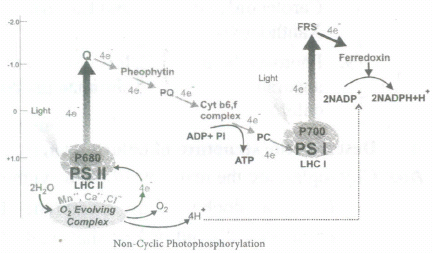
1) When photons are activated reaction centre of Pigment system II(P680), electrons are moved to the high energy level. Electrons from high energy state passes through series of electron carriers like Plastoquinone, Cytochrome complex, Plastocyanin and finally accepted by PSI (P700). During this movement of electrons from PS II to PS I ATP is generated.
2) PS I (P700) is activated by light, electrons are moved to high energy state and accepted by electron acceptor molecule Ferredoxin Reducing Substance (FRS). During the downhill movement through Ferredoxin, electrons are transferred to NADP+ and reduced into NADPH + H+ (H+ formed from splitting of water by light).
3) Electrons released from the Photosystem II are not cycled back. It is used for the reduction NADP+ in to NADPH + H+. During the electron transport it generates ATP and hence this type of photophosphorylation is called Non-Cyclic Photophosphorylation. The electron flow looks like the appearance of letter 'Z' and so known as Z scheme.
4) When there is availability of NADP+ for reduction and when there is splitting of water molecules both PS I and PS II are activated. Non-Cyclic electron transport PS I and PS II both are involved co-operatively to transport electrons from water to NADP+. In oxygenic species Non-cyclic electron transport takes place in three stages:
i) Electron transport from water to P 680: Splitting of water molecule produce electrons, protons and oxygen. Electrons lost by the PS II (P680) are replaced by electrons from splitting of water molecule.
ii) Electron transport from P 680 to P 700: Electron flow starts from P 680 through a series of electron carrier molecules like Plastoquinone (PQ), Cytochrome b6-f Complex, Plastocyanin (PC) and finally reaches P700 (PSI).
iii) Electron transport from P 700 to NADP+: PSI (P700) is excited now and the electrons pass to high energy level. When electron travels downhill through ferredoxin, NADP+ is reduced to NADPH+ H+.
15.
| Cyclic Photophos phorylation | Non-Cyclic Photophos phorylation | |
| 1. | PSI only involved | PSI and PSII involved |
| 2. | Reaction Centre is P 700 | Reaction Centre is P 680 |
| 3. | Electrons released are cycled back | Electron released do not cycle back |
| 4. | Photolysis of water does not take place | Photolysis of water takes place |
| 5. | Only ATP synthesized | ATP and NADPH + H+ are synthesized |
| 6. | Phosphorylation take place at two places | Phosphorylation takes place only in one place |
| 7. | It does not require an external electron donor | Requires external electron donor like H2O or H2S |
| 8. | It is not sensitive to Di Chloro di Methyl Urea (DCMI) | It is sensitive to DCMI & inhibits electron flow. |
16.
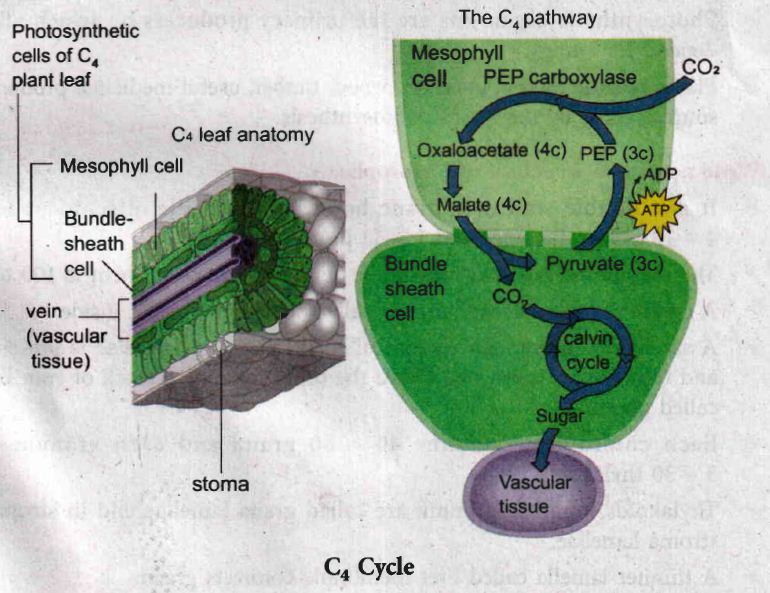
(i) C4 cycle/Di - carboxylic acid pathway/ Di - carboxylation pathway is an adaptive mechanism.
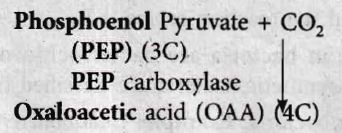
(ii) It takes place in two phases. First phase takes place in stroma of mesophyll cells, where the CO2 acceptor molecule 3-Carbon compound, phosphoenol pyruvate (PEP) to form 4-carbon oxalo acetic acid (OAA). The first product is a 4-carbon and so it is named as C4 cycle. Oxalo acetic acid is a dicarboxylic acid and hence this cycle is also known as dicarboxylic acid pathway.
(iii) Carbondioxide fixation takes place in two places one in mesophyll and another in bundle sheath cell.
(iv) C4 plants requires 5 ATP and 2NADPH + H+ to fix one molecule of CO2.
Stage: I Mesophyll Cells
(i) Oxaloacetic acid (OAA) is converted into malic acid or aspartic acid and is transported to the bundle sheath cells through plasmodesmata.
Stage: II Bundle Sheath Cells
(i) Malic acid undergoes decarboxylation and produces a 3 carbon compound Pyruvic acid and CO2.
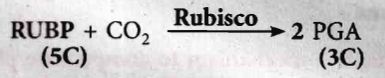
(ii) The released CO2 combines with RUBP and follows the calvin cycle and finally sugar is released to the phloem.
(iii) Pyruvic acid is transported to the mesophyll cells.
17.
1) Plants having C4 cycle are mainly of tropical and sub-tropical regions and are able to survive in environment with low CO2 concentration.
2) C4 plants are partially adapted to drought conditions.
3) Oxygen has no inhibitory effect on C4 cycle since PEP carboxylase is insensitive to O2.
18.
1) During photosynthesis oxygen is evolved from water.
2) Electrons for the reduction of CO2 are obtained from water.
3) Reduced substance produced, later helps to reduce CO2
2H20+ 2A\(\rightarrow\)AH2+O2
19.
Carotenoids are yellow to orange pigments, mostly tetraterpens and these pigments absorb light strongly in the blue to violet region of visible spectrum. These pigments protect chlorophyll from photo-oxidative damage. Hence, they are called as shield pigments.
20.
| Photosystem I | Photosystem II | |
| 1. | The reaction center is P700 | The reaction center is P680 |
| 2. | PS I is involved in both cyclic and non-cyclic. photophosphorylation | PS II participates in Non-cyclic photophosphorylation. |
| 3. | Not involved in the photolysis of water and evolution of oxygen | Photolysis of water and evolution of oxygen takes place. |
21.
C4 plants are more advantageous than C3 plants because increasing the proportion of C4 plants on earth could assist biosequestration of CO2 and represent an important cilmate change avoidance strategy.

11th Standard Syllabus & Materials
11th Standard
TN 11th Tamil பீடு பெற நில் - செய்யுள் - காவடிச்சிந்து Important Questions And Answers Study Material - QB365 Set A
NEW11th Standard
TN 11th Tamil பீடு பெற நில் - உரைநடை - மலை இடப்பெயர்கள் : ஓர் ஆய்வு Important Questions And Answers Study Material - QB365 Set A
NEW11th Standard
TN 11th Tamil மாமழை போற்றுதும் - துணைப்பாடம் - யானை டாக்டர் Important Questions And Answers Study Material - QB365 Set A
NEW11th Standard
TN 11th Tamil மாமழை போற்றுதும் - செய்யுள் - ஐங்குறுநூறு Important Questions And Answers Study Material - QB365 Set A



Tamilnadu Stateboard 11th Standard Subjects

Maths

Commerce

Economics
Biology

Business Maths and Statistics

Accountancy

Computer Science

Physics

Chemistry
Maths
Biology
Economics
Physics
Chemistry

History
Business Maths and Statistics

Computer Science
Accountancy

Computer Applications
History
Computer Technology
Commerce
Computer Applications
Computer Technology

Tamil

English

French
Tamilnadu Stateboard Standards

