
 100% FREE ACCESS
11th Standard Syllabus & Materials
11th Standard
TN 11th Tamil இயற்கை வேளாண்மை,சுற்றுச்சூழல் -செய்யுள் - மனோன்மணீயம் Important Questions And Answers Study Material - QB365 Set A
NEW11th Standard
TN 11th Tamil என்னுயிர் என்பேன் -துணைப்பாடம் - இசைத்தமிழர் இருவர் Important Questions And Answers Study Material - QB365 Set A
NEW11th Standard
TN 11th Tamil மொழி கலை -செய்யுள் - ஒவ்வொரு புல்லையும் Important Questions And Answers Study Material - QB365 Set A
NEW11th Standard
TN 11th Tamil பீடு பெற நில் - இலக்கணம் - பகுபத உறுப்புகள் Important Questions And Answers Study Material - QB365 Set A
NEW11th Standard
TN 11th Tamil பீடு பெற நில் - துணைப்பாடம் - வாடிவாசல் Important Questions And Answers Study Material - QB365 Set A
NEW11th Standard
TN 11th Tamil பீடு பெற நில் - செய்யுள் - குறுந்தொகை Important Questions And Answers Study Material - QB365 Set A

Published on: 08/10/2019
Bio - Botany - Tissue and Tissue System
Download Tamil Nadu 11th Standard Biology question papers, model tests, one-mark questions, important questions, and public exam papers in PDF format. Free study materials and answer keys for TN State Board students.
Questions + Answers key
Take MCQ Biology Test1.
The inactive region in root promeristem is called _____________
Korper zone
Quiescent centre
Kappe zone
Calyptrogen
2.
The term ____________ was coined by Nageli.
Tracheids
Meristem
Histogen
Apical
3.
Ground tissue includes ___________
All tissues external to endodermis
All tissues except epidermis & vascular bundles
Epidermis & cortex
All tissues internal to endodermis
4.
In a vertical section of a typical dicot leaf, the phloem in the mid-vein is situated
Facing the lower epidermis
Facing the upper epidermis
Facing sideways
All around the xylem
5.
Identify the correctly matched pair.
Bicollateral vascular bundles - cucurbita pepo
Amphicribal vascular bundles - dracaena
Amphivasal vascular bundles - prunus
Open vascular bundles - stem of Zea mays
6.
Grafting is successful in dicots but not in monocots because the dicots have _______.
Vascular bundles arranged in a ring
Cambium for secondary growth
Vessels with elements arranged end to end
Cork cambium
7.
In Gymnosperms, the activity of sieve cells are controlled by _____.
Nearby sieve tube members
Phloem parenchyma cells
Nucleus of companion cells
Nucleus of albuminous cells
8.
What is aerenchyma?
9.
Explain open vascular bundle?
10.
What are passage cells?
11.
What are albuminous cells?
12.
What is the function of a guard cell?
13.
How is the study of plant anatomy useful to us?
14.
What makes the pulp of pear gritty?
15.
Why the cells of sclerenchyma and tracheids become dead?
16.
17.
Distinguish the anatomy of dicot root from monocot root.
18.
Explain sclereids with their types.
19.
Differentiate Tracheids and Fibres.
20.
What are Sieve cells?
21.
Differentiate the features of Monocot and Dicot leaf.
22.
Distinguish fibre and sclereids?
1.
(b)
Quiescent centre
2.
(b)
Meristem
3.
(b)
All tissues except epidermis & vascular bundles
4.
(a)
Facing the lower epidermis
5.
(a)
Bicollateral vascular bundles - cucurbita pepo
6.
(b)
Cambium for secondary growth
7.
(c)
Nucleus of companion cells
8.
Parenchyma which contains air in its intercellular spaces. It helps in aeration and buoyancy. Example: Nymphaea and Hydrilla.
9.
In open vascular bundle, Cambium is present between xylem and phloem. (Stems of Dicots and Gymnosperms).
10.
The endodermal cells which are opposite to the protoxylem elements, are thin walled without casparian strips. These cells are called passage cells. Their function is to transport water and dissolved salts from the cortex to the protoxylem.
11.
(i) They are analogous to companion cells of phloem (Angiosperms).
(ii) They have cytoplasm, nucleus and are: parenchymatous, seen with sieve cells (Phloem) of Gymnosperms.
12.
(i) Guard cells contain chloroplast and can photosynthesize.
(ii) They enclose a cavity/opening which forms the stoma. This helps in gaseous exchange for respiration and photosynthesis.
(iii) The guard cells help in closing and opening of the stoma.
13.
(i) The study of Anatomy helps us to understand I the internal structure of higher plants.
(ii) The organisation of cells and different kinds of tissues is understood by the study of Anatomy.
(iii) It helps to compare the anatomy of different organs of the plant and understand the role of different tissues.
(iv) This field finds application in many fields such as systematics, Forensics and Pharmacognosy.
14.
The pulp of pear contains sclereids because of which it is gritty.
15.
The cells of sclerenchyma & tracheids become dead because they lack protoplasm
16.
17.
| S.No. | Characters | Dicot root | Monocot root |
|---|---|---|---|
| 1. | Pericyle | Gives rise to lateral roots, phellogen and a part of vascular cambium. | Gives rise to lateral roots only. |
| 2. | Vascular tissue | Usually limited number of xylem and phloem strips. | Usually more number of xylem and phloem strips. |
| 3. | Conjunctive tissue | Parenchymatous; Its cells are differentiated into vascular cambium. | Mostly sclerenchymatous but sometimes parenchymatous. It is never differentiated in to vascular cambium. |
| 4. | Cambium | It appears as a secondary meristem at the time of secondary growth. | It is altogether absent. |
| 5. | Xylem | Usually tetrach | Usually polyarch |
18.
Sclereids (Stone Cells)
Sclereids are dead cells, usually these are isodiametric but some are elongated too. The cell wall is very thick due to lignification. Lumen is very much reduced. The pits may simple or branched. Sclereids are mechanical in function. They give hard texture to the seed coats, endosperms etc., Sclereids are classified into the folowing types.
Types of Sclereids
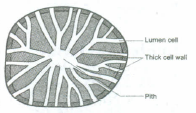
(a) Brachysclereids or Stone cells:
Isodiametric sclereids, with hard cell wall. It is found in bark, pith cortex, hard endosperm and fleshy portion of some fruits. Example: Pulp of Pyrus.
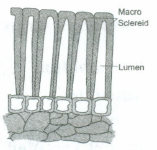
(b) Macrosclereids:
Elongated and rod shaped cells, found in the outer seed coat of leguminous plants. Example: Crotalaria and Pisum sativum.
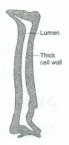
(c) Osteosclereids (Bone cells):
Rod shaped with dilated ends. They occur in leaves and seed coats. Example: seed coat of Pisum and Hakea
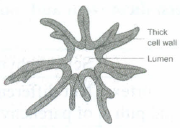
(d) Astrosclereids:
Star cells with lobes or arms diverging form a central body. They occur in petioles and leaves. Ex: Tea, Nymphae and Trochodendron.
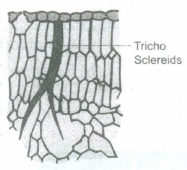
(e) Trichosclereids:
Hair like thin walled sclereids. Numerous small angular crystals are embedded in the wall of these sclereids, present in stems and leaves of hydrophytes. Example: Nymphaea leaf and Aerial roots of Monstera.
19.
| Tracheids | Fibres |
|---|---|
| 1. Not much elongated | Very long cells |
| 2. Possess oblique end walls | Possess tapering end walls |
| 3. Cell walls are not as thick as Fibres | Cell wall are thick and lignified |
| 4. Possess various types of thickenings | Possess only pitted thickenings |
| 5. Responsible for the conduction and also mechanical support | Provide only mechanical support |
20.
These are primitive type of conducting elements found in Pteridophytes and Gymnosperms. Sieve cells have sieve areas on their lateral walls only. They are not associated with companion cells
21.
| Dicot leaf | Monocot leaf |
|---|---|
| Dorsiventral leaf | Isobilateral leaf |
| The mesophyll is differentiated into palisade and spongy parenchyma. | Palisade parenchyma is present on both sides of the leaf and spongy parenchyma lies in the centre. |
| Eg: Sunflower | Eg: Grass. |
22.
| Fibre | Sclereids |
|---|---|
| 1. Long cells | Short cells |
| 2. Narrow, Elongated pointed ends | Usually short and broad |
| 3. Occurs in bundles | Occurs individually or in small groups |
| 4. Commonly unbranched | Maybe branched |
| 5. Derived directly from meristematic tissue | Develops from secondary sclerosis of parenchyma cells |

11th Standard Syllabus & Materials
11th Standard
TN 11th Tamil பீடு பெற நில் - செய்யுள் - காவடிச்சிந்து Important Questions And Answers Study Material - QB365 Set A
NEW11th Standard
TN 11th Tamil பீடு பெற நில் - உரைநடை - மலை இடப்பெயர்கள் : ஓர் ஆய்வு Important Questions And Answers Study Material - QB365 Set A
NEW11th Standard
TN 11th Tamil மாமழை போற்றுதும் - துணைப்பாடம் - யானை டாக்டர் Important Questions And Answers Study Material - QB365 Set A
NEW11th Standard
TN 11th Tamil மாமழை போற்றுதும் - செய்யுள் - ஐங்குறுநூறு Important Questions And Answers Study Material - QB365 Set A



Tamilnadu Stateboard 11th Standard Subjects

Maths

Commerce

Economics
Biology

Business Maths and Statistics

Accountancy

Computer Science

Physics

Chemistry
Maths
Biology
Economics
Physics
Chemistry

History
Business Maths and Statistics

Computer Science
Accountancy

Computer Applications
History
Computer Technology
Commerce
Computer Applications
Computer Technology

Tamil

English

French
Tamilnadu Stateboard Standards

