
 100% FREE ACCESS
11th Standard Syllabus & Materials
11th Standard
TN 11th Tamil இயற்கை வேளாண்மை,சுற்றுச்சூழல் -செய்யுள் - மனோன்மணீயம் Important Questions And Answers Study Material - QB365 Set A
NEW11th Standard
TN 11th Tamil என்னுயிர் என்பேன் -துணைப்பாடம் - இசைத்தமிழர் இருவர் Important Questions And Answers Study Material - QB365 Set A
NEW11th Standard
TN 11th Tamil மொழி கலை -செய்யுள் - ஒவ்வொரு புல்லையும் Important Questions And Answers Study Material - QB365 Set A
NEW11th Standard
TN 11th Tamil பீடு பெற நில் - இலக்கணம் - பகுபத உறுப்புகள் Important Questions And Answers Study Material - QB365 Set A
NEW11th Standard
TN 11th Tamil பீடு பெற நில் - துணைப்பாடம் - வாடிவாசல் Important Questions And Answers Study Material - QB365 Set A
NEW11th Standard
TN 11th Tamil பீடு பெற நில் - செய்யுள் - குறுந்தொகை Important Questions And Answers Study Material - QB365 Set A

Published on: 14/03/2020
11th Standard Biology English Medium All Chapter Book Back and Creative One Marks Questions 2020
Download Tamil Nadu 11th Standard Biology question papers, model tests, one-mark questions, important questions, and public exam papers in PDF format. Free study materials and answer keys for TN State Board students.
Questions + Answers key
Take MCQ Biology Test1.
Jamunapari is a _________breed
cattle
goat
hen
duck
2.
The_________in the body are replaced every 7-10 days.
RBC
Ruffini endings
Taste bud cells
Cone
3.
Which is said to be computer-controlled device?
Auto analyser
Sphygmomanometer
Glucometer
Stethoscope
4.
Name the device used to hear the internal sounds of the human body.
Stethoscope
Sphygmomanometer
Glucometer
Autoanalyser
5.
An example for intermediate day plant is ___________
Potato
Sugarcane
Rye
Night Jasmine
6.
The inactive region in root promeristem is called _____________
Korper zone
Quiescent centre
Kappe zone
Calyptrogen
7.
Select the incorrect statement about casparian strips
These are bands of thickenings along the radial and tangential walls of endodermal cells
They prevent plasmolysis of endodermal cells
These are composed of lignin, suberin and tannins.
It is not found opposite to proto xylem points
8.
_________ is a antiauxin compound.
2,4 - D
2,4,5 -T
TIBA
IPA
9.
The term quantosome was coined by________________.
Emerson
Warburg
Steinman Park
Beggins
10.
Law of limiting factors was proposed by ______________.
Calvin
Huber
Blackman
Von Maye
11.
F1 particles are called______________.
quantosome
cytochromes
oxysome
Osmosomes
12.
The term Hydroponis was coined by ________
Hoagland
Goerick
Knop
Arnon
13.
Kheira disease of Rice is caused due to deficiency of __________
Mo
Zn
B
O
14.
__________ is not linked to protein - lecithin theory.
phosphatidic acid
ATP4
Choline
Dehydrogenase
15.
The number of O2 molecules required for breaking down of one molecule of glucose forglycolysis _________
2
4
5
6
16.
| 1. | J C Bose | (i) | phosphorylase |
| 2. | Strasburger | (i) | Cohesive force |
| 3. | Dixon | (iii) | Crescograph |
| 4. | Hanes | (iv) | Oak tree |
1-iii , 2-iv , 3-i, 4-ii
1-iii, 2-iv, 3-ii, 4-i
1-iv, 2-iii,3-ii, 4- i
1-i , 2-iv , 3-ii ,4-iii
17.
In dicot root, periderm originates from ____________
cortex
pericycle
xylem
medullary rays
18.
Gum Arabic is got from ___________
Acacia
Pinus
Quercus
Hevea
19.
The heart normally beats __________ times per minute in a human adult.
60-62
50-52
70-72
90-92
20.
Which is known as liquid connective tissue?
plasma
blood
serum
Iymph
21.
Maximuin amount 70-75% of carbon dioxide transport occursa __________
Dissolved in plasma
Carbaminohaemoglobin complex
Bicarbonate
None of the above
22.
Crown of teeth is covered by ____________
Dentin
Enamel
A and B both
Non of these
23.
Muscular contraction of alimentary canal are ____________
Circulation
Deglutition
Churning
Peristalsis
24.
Gradual break down of the thin walls of the alveoli decreasing the total surface area of the gaseous exchange is ________
bronchitis
emphysema
asthma
tuberculosis
25.
When the frog is in water respiration occurs.
pulmonary
gill
buccal
cutaneous
26.
Which of the following has cartilagenous endoskeleton with notochord?
Exocoetus
Labeo
Hyla
Scolidon
27.
DNA hybridization is helpful to ___________
Identify an individual from a sample of DNA
Detect difference in homologous DNA sequences
Measure the degree of genetic similarity between pools of DNA sequences
Amplify a specific gene
28.
Number of carbon molecule in glucose is___________________
4
6
8
12
29.
Which of the following microscope produce 3D-image?
Phase contrast
TEM
SEM
Dark field
30.
Heterophylly is mainly seen in________________
xerophytes
mesophytes
lithophytes
hydrophytes
31.
Which of the following organism undergoes regeneration?
Spirogyra
Planaria
Yeast
Aspergillus
32.
No asters or centrioles are formed in ____________ .
Anastral
Amphiastral
Mitosis
Meiosis
33.
Match the following
| A) Follicle | i) Alyssum |
| B) Legume | ii) Lady's finger |
| C) Siliqua | iii) Aristolochia |
| D) Silicula | iv) Pisum |
| E) Septicidal | v) Calotropis |
| F) Loculicidal | vi) Brassica |
A -v), B - iv), C - vi), D -i), E - iii), F - ii)
A - i), B - ii), C - iii), D - iv), E - v), F - vi)
A - iii), B - ii), C - i), D - iv), E- vi), F - v)
A - vi), B - v), C - iv), D - iii), E- ii), F - i)
34.
_________ deaIs with the study of fruits and their cultivation.
Half inferior ovary
Mother axis
Pomology
Pericarp
35.
_________ are the tools for the taxonomic study such as keys, flora, revisions, catalogues, botanical gardens and herbaria.
Cladistics
Cladogram
Taxonomic aids
Classification
36.
Compound microscope was invented by___________________________________
Z. Jansen
Compound microscope
Microscope
Bright field microscope.
37.
Which of the following are found in extreme saline conditions?
Archaebacteria
Eubacteria
Cyanobacteria
Mycobacteria
38.
Development of sporangium from single initial __________.
Leptosporangiate
Eusporangiate
Sporophores
Sporomorph
39.
In Opuntia, the spines represent the modification of __________.
Stem
Leaves
Root
None of the above
40.
The cartilage cells are called _____________
Chondrocytes
Osteocytes
Melanocytes
Lymphocytes
41.
-------is closely attached to skeletal bones.
Smooth muscle
cardiac muscle
Muscle fibers
Striped muscle
42.
According to Aristotle, the animals with red blood cells are called _______
Anaima
chromista
Enaima
Protozoa
43.
Formation of new chemical bonds using ATP as a source of energy is the mode of action of the enzymes.
Hydrolase
Isomerase
Lyase
Ligase
44.
Number of volumes in genera plantorum ____________
two
three
four
five
45.
________ is the powerful growth inhibitor
Ethanol
Cytokinins
ABA
Auxin
46.
Select the wrong statement from the following:
Formative phase of the cells retain the capability of cell division.
In elongation phase development of central vacuole takes place.
In maturation phase thickening and differentiation takes place.
In maturation phase, the cells grow further.
47.
The compound which links glycolysis and Krebs cycle is _______.
Succinic acid
Pyruvic acid
Acetyl CoA
Citric acid
48.
49.
Identify true statement regarding light reaction of photosynthesis.
Splitting of water molecule is associated with PS I.
PS I and PS II involved in the formation of NADPH + H+
The reaction center of PS I is Chlorophyll a with absorption peak at 680 nm.
The reaction center of PS II is Chlorophyll a with absorption peak at 700 nm.
50.
The correct sequence of flow of electrons in the light reaction is _______.
PS II, plastoquinone, cytochrome, PS I, ferredoxin.
PS I, plastoquinone, cytochrome, PS II, ferredoxin.
PS II, ferredoxin, plastoquinone, cytochrome, PS I.
PS II, plastoquinone, cytochrome, PS I, ferredoxin
51.
Identify the correct statement
i. Sulphur is essential for amino acids Cystine and Methionine
ii. Low level of N, K, S and Mo affect the cell division
iii. Non-leguminous plant Alnus which contain bacterium Frankia
iv. Denitrification carried out by nitrosomonas and nitrobacter.
I, II are correct
I, II, III are correct
I only correct
all are correct
52.
Identify correct match.
| 1. Dieback disease of citrus | (i) Mo |
| 2. Whip tail disease | (ii) Zn |
| 3. Brown heart of turnip | (iii) Cu |
| 4. Little leaf | (iv) B |
1(iii) 2 (ii) 3 (iv) 4 (i)
1 (iii) 2 (i) 3 (iv) 4 (ii)
1 (i) 2 (iii) 3 (ii) 4 (iv)
1 (iii) 2 (iv) 3 (ii) 4 (i)
53.
What type of transpiration is possible in the xerophyte Opuntia?
Stomatal
Lenticular
Cuticular
All the above
54.
In a fully turgid cell _____.
DPD = 10 atm; OP = 5 atm; TP = 10 atm
DPD = 0 atm; OP = 10 atm; TP = 10 atm
DPD = 0 atm; OP = 5 atm; TP = 10 atm
DPD = 20 atm; OP = 20 atm; TP = 10 atm
55.
The common bottle cork is a product of ______.
Phellem
Phellogen
Xylem
Vascular cambium
56.
In the diagram of lenticel identify the parts marked as i, ii, iii, iv
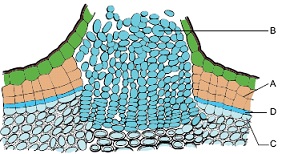
i. phellem, ii. Complementary tissue, iii. Phelloderm, iv. Phellogen.
i. Complementary tissue, ii. Phellem, iii. Phellogen, iv. Phelloderm
i. Phellogen, ii. Phellem, iii. Phelloderm, iv. complementary tissue
i. Phelloderm, ii. Phellem, iii. Complementary tissue, iv. Phellogen
57.
Grafting is successful in dicots but not in monocots because the dicots have _______.
Vascular bundles arranged in a ring
Cambium for secondary growth
Vessels with elements arranged end to end
Cork cambium
58.
Refer to the given figure and select the correct statement.
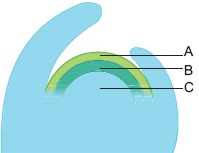
i. A, B, and C are histogen of shoot apex
ii. A Gives rise to medullary rays.
iii. B Gives rise to cortex
iv. C Gives rise to epidermis
i and ii only
ii and iii only
i and iii only
iii and iv only
59.
The normal blood glucose level in fasting is ________________ .
110-140 mg/dl
120-130 mg/dl
70-110 mg/dl
80-130 mg/dl
60.
Choose the correct statement
Mineralocorticoids regulate water and electrolyte balance
Aldosterone stimulates reabsorption of chloride ions
Cortisol is a mineralocorticoid
Laughing increases the adrenaline levels in the body.
61.
Facial nerve is a _________ nerve.
Sensory
Mixed
Motor
Efferent
62.
63.
Which of the following pairings is correct?
Sensory nerve - afferent
Motor nerve - afferent
Sensory nerve - ventral
Motor nerve - dorsal
64.
65.
Which of the following statement about sex hormones is correct?
Testosterone is produced by Leydig cells under the influence of luteinizing hormone.
Progesterone is secreted by corpus luteum and softens pelvic ligaments during childbirth.
Oestrogen is secreted by both Sertoli cells and corpus luteum
Progesterone produced by corpus luteum is biologically different from the one produced by placenta
66.
___________ is known as Brine shrimp.
Chanos
Artemia
Carp
Pearl spot
67.
The bone is covered by_________________
endosteum
metaphysis
periosteum
osteoclast
68.
Match the following
| A. Collar bone | i. Carpals |
| B. Wrist bones | ii. Humerus |
| C. Forearm | iii. Clavicle |
| D. Upper arm | iv. Radius |
| A | B | C | D |
| i | iii | iv | ii |
| A | B | C | D |
| i | ii | iv | iii |
| A | B | C | D |
| iii | i | iv | ii |
| A | B | C | D |
| iii | iv | ii | i |
69.
Prawn belongs to the class ______.
Crustacea
Annelida
Coelenterata
Echinodermata
70.
71.
Acetabulum is located in ______.
collar bone
hip bone
shoulder bone
thigh bone
72.
The functional unit of a muscle fibre is ______.
sarcomere
sarcoplasm
myosin
actin
73.
Assertion (A): The descending limb of Henle's loop is permeable to water.
Reason (R): Aquaporins are the facilitators for water permeability.
A and R are wrong
R does not explain A
R explains A
A is right R is wrong
74.
___________ part of nephron has evolved to form hypertonic urine.
Glomerulus
Loop of Henle
Proximal convoluted tubule
Collecting duct
75.
During inspiration, the diaphragm _____.
expands
unchanged
relaxes to become domed-shaped
contracts and flattens
76.
Intercostal muscles are found between the ______.
vertebral column
sternum
ribs
glottis
77.
Aldosterone acts at the distal convoluted tubule and collecting duct resulting in the absorption of water through _____.
Aquaporins
Spectrins
GLUT
Chloride channels
78.
Podocytes are the cells present on the ______.
Outer wall of Bowman's capsule
Inner wall of Bowman's capsule
Neck of nephron
Wall of glomerular capillaries
79.
Match column I with column II and choose the correct option
| Column I | Column II |
| (P) Small intestine | i) 23 cm |
| (Q) Large intestine | ii) 4 meter |
| (R) Oesophagus | iii) 12.5 cm |
| (S) Pharynx | iv) 1.5 meter |
| P | Q | R | S |
| iv | ii | i | iii |
| P | Q | R | S |
| ii | iv | i | iii |
| P | Q | R | S |
| i | iii | ii | iv |
| P | Q | R | S |
| iii | i | ii | iv |
80.
81.
Identify the feature of frog which is absent in human beings
Aorta is present.
Circulatory system is closed type.
Sinus venosus is a triangular chamber present in the heart.
Blood contains RBC.
82.
An unconscious patient is rushed into the emergency room and needs a fast blood transfusion. Because there is no time to check her medical history or determine her blood type, which type of blood should you as her doctor, give her?
A-
AB
O+
O-
83.
Blood group is due to the presence or absence of surface _______.
Antigens on the surface of WBC
Antibodies on the surface of RBC
Antigens on the surface of RBC
Antibodies on the surface of WBC
84.
Presence of gills in the tadpole of frog indicates that _______.
fishes were amphibious in the past
fishes evolved from frog-like ancestors
frogs will have gills in future
frogs evolved from gilled ancestor
85.
How many abdominal segments are present in male and female Cockroaches?
10, 10
9, 10
8, 10
9, 9
86.
Prevention of substances from leaking across the tissue is provided by ______.
Tight junction
Adhering junction
Gap junction
Elastic junction
87.
What type of fibres are found in connective tissue matrix?
Collagen
Areolar
Cartilage
Tubular
88.
Which of the following statements is incorrect?
Radial symmetry is seen in Echinoderms
Taenia is a endoparasite.
Fasciola is a Eucoelomate
Mesoglea is seen in Jellyfishes
89.
Which of the following is an egg laying mammal?
Delphinus
Macropus
Ornithorhynchus
Equus
90.
In which of the following organisms, self fertilization is seen.
Fish
Round worm
Earthworm
Liver fluke
91.
Cladogram considers the following characters _______.
Physiological and Biochemical
Evolutionary and Phylogenetic
Taxonomic and systematic
None of the above
92.
Which of the following is not present in same rank?
Primata
Orthoptera
Diptera
Insecta
93.
How many times is the genetic material replicated during meiosis?
Twice
Once
Four times
None of the above
94.
Example for negatively geotropic roots __________
Ipomoea, Dahlia
Asparagus, Ruellia
Vitis, Portulaca
Avicennia, Rhizophora
95.
When the root is thick and fleshy, but does not take a definite shape, it said to be _________
Nodulose root
Tuberous root
Moniliform root
Fasciculated root
96.
In an inflorescence where flowers are borne laterally in an acropetal succession the position of the youngest floral bud shall be ______.
Proximal
Distal
Intercalary
Anywhere
97.
Gynoecium with united carpels is termed as ______.
Apocarpous
Multicarpellary
Syncarpous
None of the above
98.
Identify the correctly matched pair.
Actinomycete - Late blight
Mycoplasma - Lumpy jaw
Bacteria - Crown gall
Fungi - Sandal spike
99.
Which one of the following statement about virus is correct?
Possess their own metabolic system
They are facultative parasites
They contain DNA or RNA
Enzymes are present
100.
An example of feedback inhibition is
Cyanide action on cytochrome
Sulpha drug on folic acid synthesizing bacteria
Allosteric inhibition of hexokinase by glucose-6-phosphate
The inhibition of succinic dehydrogenase by malonate
101.
The most basic amino acid is
Arginine
Histidine
Glycine
Glutamine
102.
Match the columns and identify the correct option:
| Column I | Column II | ||
| A | Thylakoids | 1. | Disc-shaped sacs in Golgi apparatus |
| B. | Cristae | 2. | Condensed structure of DNA |
| C. | Cisternae | 3. | Flat membranous sacs in stroma |
| D | Chromatin | 4. | Infoldings in mitochondria |
| A | B | C | D |
| (iii) | (iv) | (ii) | (i) |
| A | B | C | D |
| (iv) | (iii) | (i) | (ii) |
| A | B | C | D |
| (iii) | (iv) | (i) | (ii) |
| A | B | C | D |
| (iii) | (i) | (iv) | (ii) |
103.
The two subunits of ribosomes remain united at critical ion level of _______.
Magnesium
Calcium
Sodium
Ferrous
104.
Perianth is present in_______.
Clitoria ternatea
Datura metel
Allium cepa
Pongamia pinnata
105.
Specimen derived from non-original collection serves as the nomenclature type, when original specimen is missing. It is known as ________ .
Holotype
Neotype
Isotype
Paratype
106.
Colchicine prevents the mitosis of the cells at which of the following stage ______.
Anaphase
Metaphase
Prophase
Interphase
107.
If mitotic division is restricted in G1 phase of the cell cycle then the condition is known as _____.
S Phase
G2 Phase
M Phase
G0 Phase
108.
Algae consist of ____like plant body
hyphae
thallus
coiled
flagella
109.
110.
Which of following represents gametophytic generation in pteridophytes?
Prothallus
Thallus
Cone
Rhizophore
111.
Succus entericus
112.
Lysozyme
113.
Mucus
114.
Nuclease
115.
Diarrhoea
116.
Jaundice
117.
Constipation
118.
Vomiting
119.
B12 Cobalamine
120.
B6 Pyridoxine
121.
B5 Niacin
122.
B1 Thiamine
123.
Bartholin's duct
124.
Piles
125.
Peptic cells
126.
Parietal
127.
Intestinal juice
128.
Protein
129.
Fats
130.
Carbohydrates
131.
Peptic ulcer
132.
Gall stone
133.
Liver cirrhosis
134.
Jaundice
1.
(a)
cattle
2.
(c)
Taste bud cells
3.
(a)
Auto analyser
4.
(a)
Stethoscope
5.
(b)
Sugarcane
6.
(b)
Quiescent centre
7.
(b)
They prevent plasmolysis of endodermal cells
8.
(c)
TIBA
9.
(d)
Beggins
10.
(c)
Blackman
11.
(c)
oxysome
12.
(b)
Goerick
13.
(b)
Zn
14.
(d)
Dehydrogenase
15.
(d)
6
16.
(b)
1-iii, 2-iv, 3-ii, 4-i
17.
(b)
pericycle
18.
(a)
Acacia
19.
(c)
70-72
20.
(b)
blood
21.
(c)
Bicarbonate
22.
(b)
Enamel
23.
(d)
Peristalsis
24.
(b)
emphysema
25.
(d)
cutaneous
26.
(d)
Scolidon
27.
(c)
Measure the degree of genetic similarity between pools of DNA sequences
28.
(b)
6
29.
(c)
SEM
30.
(d)
hydrophytes
31.
(b)
Planaria
32.
(a)
Anastral
33.
(a)
A -v), B - iv), C - vi), D -i), E - iii), F - ii)
34.
(c)
Pomology
35.
(c)
Taxonomic aids
36.
(a)
Z. Jansen
37.
(a)
Archaebacteria
38.
(a)
Leptosporangiate
39.
(b)
Leaves
40.
(a)
Chondrocytes
41.
(d)
Striped muscle
42.
(c)
Enaima
43.
(d)
Ligase
44.
(b)
three
45.
(c)
ABA
46.
(d)
In maturation phase, the cells grow further.
47.
(c)
Acetyl CoA
48.
(b)
49.
(b)
PS I and PS II involved in the formation of NADPH + H+
50.
(a)
PS II, plastoquinone, cytochrome, PS I, ferredoxin.
51.
(b)
I, II, III are correct
52.
(b)
1 (iii) 2 (i) 3 (iv) 4 (ii)
53.
(c)
Cuticular
54.
(b)
DPD = 0 atm; OP = 10 atm; TP = 10 atm
55.
(b)
Phellogen
56.
(a)
i. phellem, ii. Complementary tissue, iii. Phelloderm, iv. Phellogen.
57.
(b)
Cambium for secondary growth
58.
(c)
i and iii only
59.
(c)
70-110 mg/dl
60.
(a)
Mineralocorticoids regulate water and electrolyte balance
61.
(b)
Mixed
62.
(c)
63.
(a)
Sensory nerve - afferent
64.
(d)
65.
(a)
Testosterone is produced by Leydig cells under the influence of luteinizing hormone.
66.
(b)
Artemia
67.
(c)
periosteum
68.
(c)
| A | B | C | D |
| iii | i | iv | ii |
69.
(a)
Crustacea
70.
(c)
71.
(b)
hip bone
72.
(a)
sarcomere
73.
(c)
R explains A
74.
(b)
Loop of Henle
75.
(d)
contracts and flattens
76.
(c)
ribs
77.
(a)
Aquaporins
78.
(b)
Inner wall of Bowman's capsule
79.
(b)
| P | Q | R | S |
| ii | iv | i | iii |
80.
(b)
81.
(c)
Sinus venosus is a triangular chamber present in the heart.
82.
(c)
O+
83.
(c)
Antigens on the surface of RBC
84.
(b)
fishes evolved from frog-like ancestors
85.
(a)
10, 10
86.
(a)
Tight junction
87.
(a)
Collagen
88.
(c)
Fasciola is a Eucoelomate
89.
(c)
Ornithorhynchus
90.
(d)
Liver fluke
91.
(b)
Evolutionary and Phylogenetic
92.
(d)
Insecta
93.
(b)
Once
94.
(d)
Avicennia, Rhizophora
95.
(b)
Tuberous root
96.
(a)
Proximal
97.
(c)
Syncarpous
98.
(c)
Bacteria - Crown gall
99.
(c)
They contain DNA or RNA
100.
(c)
Allosteric inhibition of hexokinase by glucose-6-phosphate
101.
(a)
Arginine
102.
(c)
| A | B | C | D |
| (iii) | (iv) | (i) | (ii) |
103.
(a)
Magnesium
104.
(c)
Allium cepa
105.
(b)
Neotype
106.
(b)
Metaphase
107.
(d)
G0 Phase
108.
(b)
thallus
109.
(b)
110.
(a)
Prothallus
111.
Intestine
112.
Saliva
113.
Goblet cells
114.
Goblet cells
115.
Abnormal frequency of bowel movement and reduced.
116.
Liver is affected and bile pigments deposited in the body
117.
Faeces retains in rectum
118.
Centre in medulla
119.
Pernicious anaemia
120.
Dermatitis
121.
Pellagra
122.
Pernicious anaemia
123.
Duct of rivinis
124.
Haemorrhoids
125.
Oxyntic cells
126.
Zymogen cells
127.
Succus entericus
128.
15% of energy
129.
35% of energy
130.
50% of energy
131.
Asprin
132.
Cholesterol
133.
Viruses
134.
Alcoholism

11th Standard Syllabus & Materials
11th Standard
TN 11th Tamil பீடு பெற நில் - செய்யுள் - காவடிச்சிந்து Important Questions And Answers Study Material - QB365 Set A
NEW11th Standard
TN 11th Tamil பீடு பெற நில் - உரைநடை - மலை இடப்பெயர்கள் : ஓர் ஆய்வு Important Questions And Answers Study Material - QB365 Set A
NEW11th Standard
TN 11th Tamil மாமழை போற்றுதும் - துணைப்பாடம் - யானை டாக்டர் Important Questions And Answers Study Material - QB365 Set A
NEW11th Standard
TN 11th Tamil மாமழை போற்றுதும் - செய்யுள் - ஐங்குறுநூறு Important Questions And Answers Study Material - QB365 Set A



Tamilnadu Stateboard 11th Standard Subjects

Maths

Commerce

Economics
Biology

Business Maths and Statistics

Accountancy

Computer Science

Physics

Chemistry
Maths
Biology
Economics
Physics
Chemistry

History
Business Maths and Statistics

Computer Science
Accountancy

Computer Applications
History
Computer Technology
Commerce
Computer Applications
Computer Technology

Tamil

English

French
Tamilnadu Stateboard Standards

