
 100% FREE ACCESS
11th Standard Syllabus & Materials
11th Standard
TN 11th Tamil இயற்கை வேளாண்மை,சுற்றுச்சூழல் -செய்யுள் - மனோன்மணீயம் Important Questions And Answers Study Material - QB365 Set A
NEW11th Standard
TN 11th Tamil என்னுயிர் என்பேன் -துணைப்பாடம் - இசைத்தமிழர் இருவர் Important Questions And Answers Study Material - QB365 Set A
NEW11th Standard
TN 11th Tamil மொழி கலை -செய்யுள் - ஒவ்வொரு புல்லையும் Important Questions And Answers Study Material - QB365 Set A
NEW11th Standard
TN 11th Tamil பீடு பெற நில் - இலக்கணம் - பகுபத உறுப்புகள் Important Questions And Answers Study Material - QB365 Set A
NEW11th Standard
TN 11th Tamil பீடு பெற நில் - துணைப்பாடம் - வாடிவாசல் Important Questions And Answers Study Material - QB365 Set A
NEW11th Standard
TN 11th Tamil பீடு பெற நில் - செய்யுள் - குறுந்தொகை Important Questions And Answers Study Material - QB365 Set A

Published on: 18/02/2019
11th Public Exam March 2019 Model
Download Tamil Nadu 11th Standard Biology question papers, model tests, one-mark questions, important questions, and public exam papers in PDF format. Free study materials and answer keys for TN State Board students.
Questions + Answers key
Take MCQ Biology Test1.
How are meristerms classified based on function.
2.
How does ABA show Antagonistic effect?
3.
What are ureotelic animals?
4.
What is SAT Chromosome?
5.
Define Perianth. Mention its type.
6.
Name the filaments present in the sarcomere.
7.
Explain the heart’s role in secreting a hormone that regulates renal function? What hormone is this?
8.
What forces promote glomerular filtration? What forces opposes them? What is meant by net filtration pressure?
9.
Name the two sources of blood supply to the liver.
10.
What are the components of blood in frog?
11.
12.
Name the visual units of the compound eyes of cockroach.
13.
What is plectostele? Give example.
14.
PSI is located on _____________
outer thylakoid membrane
inner thylakoid membrane
Stroma
Fret membrane
15.
The theory of K+ transport to explain stomatal opening was proposed by ____________
Steward
Levit
Hanes
Lloyd
16.
Animals which active at night are called __________
diurnal
nocturnal
parasites
nocto-diurnal
17.
Phase plate is a circular component with circular annular etching in___________________________
Phase Contrast Microscope
Micrometry
Ocular Micrometer
Stage Micrometer
18.
Inflorescence developed directly from a woody trunk_____________.
Floriculture
Terminal
Axillary
Cauliflorous
19.
The T4 Phage is ________ shaped,
Tadpole
Rod
Coiled
Spiral
20.
Select the correctly matched one
| A) Human urine | i) Auxin –B |
| B) Corn gram oil | ii) GA3 |
| C) Fungus | iii) Abscisic acid II |
| D) Herring fish sperm | iv) Kinitin |
| E) Unripe maize grains | v) Auxin A |
| F) Young cotton bolls | vi) Zeatin |
| A | B | C | D | E | F |
| iii | iv | v | vi | i | ii |
| A | B | C | D | E | F |
| v | i | ii | iv | vi | iii |
| A | B | C | D | E | F |
| iii | v | vi | i | ii | iv |
| A | B | C | D | E | F |
| ii | iii | v | vi | iv | i |
21.
When a leaf trace extends from a vascular bundle in a dicot stem, what would be the arrangement of vascular tissues in the veins of the leaf?
Xylem would be on top and the phloem on the bottom
Phloem would be on top and the xylem on the bottom
Xylem would encircle the phloem
Phloem would encircle the xylem
22.
The ________________ in the body are replaced every 7-10 days.
RBC
Ruffini endings
Taste bud cells
Cones
23.
Which of the given option shows all wrong statements for thyroid gland.
Statement
(i) It inhibits process of RBC formation
(ii) It helps in maintenance of water and electrolytes
(iii) Its more secretion can reduce blood pressure
(iv) It Stimulates osteoblast
(i) and (ii)
(iii) and (iv)
(i) and (iv)
(i) and (iii)
24.
Choose the wrong statement:
(A) Vermicompost bed must be selected in an elevated level.
(B) The vermibed should be exposed to sunlight.
(C) Water stagnation is necessary for the worms.
(D) The size of a pit for vermiculture can vary.
A and B
A and C
B and C
A and D
25.
Make the correct pairs.
| Column I | Column II | ||
| (P) | IC | i) | Maximum volume of air breathed in after forced inspiration. |
| (Q) | EC | ii) | Volume of air present after expiration in lungs |
| (R) | VC | iii) | Volume of air inhaled after expiration. |
| (S) | FRC | iv) | Volume of air present after inspiration in lungs. |
| P | Q | R | S |
| i | ii | iii | iv |
| P | Q | R | S |
| ii | iii | iv | i |
| P | Q | R | S |
| ii | iii | i | iv |
| P | Q | R | S |
| iii | iv | i | ii |
26.
Podocytes are the cells present on the ______.
Outer wall of Bowman's capsule
Inner wall of Bowman's capsule
Neck of nephron
Wall of glomerular capillaries
27.
28.
Cladogram considers the following characters _______.
Physiological and Biochemical
Evolutionary and Phylogenetic
Taxonimic and systematic
None of the above
29.
Bryophyllum and Dioscorea are examples of ______.
Foliar bud, apical bud
Foliar bud, cauline bud
Cauline bud, apical bud
Cauline bud, foliar bud
30.
What are phytochromes?
31.
What is Tyloses?
32.
What is indigestion?
33.
What is meant by Ammonification? Explain with the bacteria involved in the process.
34.
Write the physiological effects of Cytokinins.
35.
Write the role of nitrogenase enzyme in nitrogen fixation?
36.
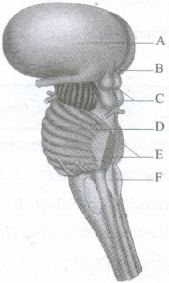
In the diagram given below label any 4 parts.
37.
Mention the advantages of MOET.
38.
List any three common uses of shellac.
39.
Write a short note on Chitin.
40.
Differentiate between aggregate fruit with multiple fruit.
41.
Explain Cyclic photophosphorylation.
42.
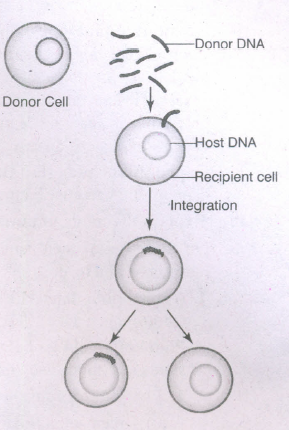
Describe the process of transformation.
43.
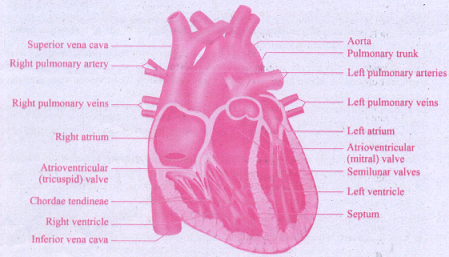
Write an account on the L.S. of heart with simple sketch.
44.
Briefly explain the structure of thyroid gland.
45.
Identify the following structures and explain their significance in renal physiology?
(a) Juxtaglomerular apparatus
(b) Podocytes
(c) Sphincters in the bladder
46.
Write down the economic importance of Family Fabaceae.
1.
Protoderm, Procambium and ground meristerm
2.
1) The effect of two substances in such a way that they have opposite effects on the same process is called Antagonistic effect.
2) One accelerates and other inhibits. Example: ABA and gibberellins during seed or bud dormancy, ABA induces dormancy and gibberellins break it.
3.
The animals which excrete urea are ureotelics. Eg: Earthworm, Cartilaginous fishes, Frogs and Mammals.
4.
A satellite or SAT Chromosome are short chromosomal segment or rounded body separated from main chromosome by a relatively elongated secondary constriction. It is a morphological entity in certain chromosomes.
5.
1. Undifferentiated calyx and corolla in a flower is called perianth. Each member is
2. called tepal.
3. If the tepals are distinct they are called Apotepalous (Polyphyllous). Example: Allium sativum.
4. Fused tepals are called Syntepalous. (Gamophyllous).
5. Example: Allium cepa.
6.
A. I Bands.
7.
Excessive stretch of cardiac atrial cells cause an increase in blood flow to the auricles of the heart and release ANF (Atrial natriuretic peptide or factor) which stimulates the increase Na+ excretion. Chemoreceptors like carotid bodies formed in the heart.
8.
1. Hydrostatic/Hydrostatic / Colloidal osmotic pressure maintains ultrafiltration of glomerulus.
2. The Efferent arteriole pressure opposes them.
3. Net filtration pressure = 55 mmHg - 30 mmHg + 15 mmHg = 10mmHg.
9.
1. The hepatic artery brings oxygenated blood from the heart.
2. The hepatic portal vein brings blood from intestine and other abdominal organs.
10.
(i) Blood consists of 60% of plasma and 40% of blood cells.
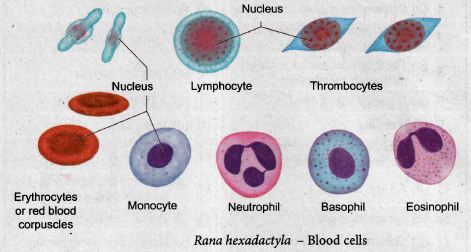
(ii) Red blood cells are nucleated containing haemoglobin (red pigment) and these are oval shaped.
(iii) Leucocytes are nucleated and circular in shape.
11.
12.
(i) Ommatidia are the visual units of compound eyes of cockroach.
(ii) Each ommatidium is functional as an eye unit.
(iii) Photoreceptors are dorsally found.
(iv) Each compound eye consists of 2000 simple eyes called ommatidia.
(v) All the visual images captured by ommatidia are made into a single coherent picture by supra oesophageal ganglion (brain).
13.
Xylem plates alternate with phloem plates. Eg: Lycopodium clavatum.
14.
(a)
outer thylakoid membrane
15.
(b)
Levit
16.
(b)
nocturnal
17.
(a)
Phase Contrast Microscope
18.
(d)
Cauliflorous
19.
(a)
Tadpole
20.
(b)
| A | B | C | D | E | F |
| v | i | ii | iv | vi | iii |
21.
(a)
Xylem would be on top and the phloem on the bottom
22.
(c)
Taste bud cells
23.
(d)
(i) and (iii)
24.
(c)
B and C
25.
(d)
| P | Q | R | S |
| iii | iv | i | ii |
26.
(b)
Inner wall of Bowman's capsule
27.
(d)
28.
(b)
Evolutionary and Phylogenetic
29.
(b)
Foliar bud, cauline bud
30.
Phytochrome is a bluish biliprotein pigment responsible for perception of light in photo physiological process. It was named by Butler et a1 and exists in two inter convertible forms - Pr (red . r light absorbing pigment)' and (Pfr - far red light absorbing pigment).
31.
(i) In many dicot plants, the lumen of the xylem vessels is blocked by many balloonlike ingrowths from the neighbouring parenchymatous cells. These balloon-like structures are called tyloses.
(ii) Usually, these structures are formed in secondary xylem vessels that have lost their function i.e., in heart wood. In fully developed tyloses, starchy crystals, resins, gums, oils, tannins or coloured substances are found.
32.
It is a digestive disorder in which the food is not properly digested leading to a feeling of fullness of stomach. It may be due to inadequate enzyme secretion, anxiety, food poisoning, over eating, and spicy food.
33.
| Bacterial aspects | Bacteria | Role |
| Ammonification | (i) Bacillus ramosus (ii) Bacillus mycoides |
Convert complex proteins in the dead bodies of plants and animals into ammonia which is later converted into ammonium salt |
34.
Physiological effect:
1) Cytokinin promotes cell division in the presence of auxin (IAA).
2) Induces cell enlargement associated with IAA and gibberellins
3) Cytokinin can break the dormancy of certain light-sensitive seeds like tobacco and induces seed germination.
4) Cytokinin promotes the growth of lateral bud in the presence of apical bud.
5) Application of cytokinin delays the process of aging by nutrient mobilization.
6) It is known as Richmond Lang effect.
7) Cytokinin
(i) increases rate protein synthesis
(ii) induces the formation of inter-fascicular cambium
(iii) overcomes apical dominance
(iv) induces formation of new leaves, chloroplast and lateral shoots.
8) Plants accumulate solutes very actively with the help of cytokinins.
35.
(i) Nitrogen fixation process requires Nitrogenase enzyme complex, Minerals (Mo, Fe and S), anaerobic condition, ATP, electron and glucose 6 phosphate as H+ donor.
(ii) Nitrogenase enzyme is active only in anaerobic condition.
(iii) To create this anaerobic condition a pigment known as leghaemoglobin is synthesized in the nodules which acts as oxygen scavenger and removes the oxygen.
36.
Brain stem
A- Thalamus
B- Pineal gland
C- Corpora quadrigemina
D- Pons
E- Cerebral peduncle
F- Medulla oblongata
37.
MOET-Multiple Ovulation embryo transfer technology:
1. Advantage of this technology is to produce high milk yielding females and high-quality meat yielding bulls in a short time.
2. It is applicable in animal husbandry.
3. It is a method of propagation of animals with desirable traits.
4. This method can be applied when the success rate of cross over even in low cost.
38.
1 Lac cut from the host plant is called 'Stick lac'.
2. The lac present on the twig is scraped and collected.
3. After grinding, the unnecessary materials like dusts and fine particles are removed.
4. The resultant lac is called 'seed lac'.
5. The seed lac is sun dried and then melted to produce 'shellac'.
Uses:
1. It is used as sealing wax.
2. It is used as filling material for gold ornaments.
3. It is used in preparation of shoe and leather polishes.
39.
1. Chitin is a homopolysaccharide with amino acids added to form mucopolysaccharide.
2. The basic unit is a nitrogen-containing glucose derivative known as N-acetyl glucosamine.
3. It forms the exoskeleton of insects and other arthropods. It is also present in the cell walls of fungi.
40.
| S.No. | Aggregate fruit | Multiple fruit |
| 1 | Aggregate fruits develop from a single flower having an apocarpous pistil. Each of the free carpel develops into a simple fruitlet. A collection of simple fruitlets makes an Aggregate fruit. An individual ovary develops into a drupe, achene, follicle or berry | A Multiple or composite fruit develops from the whole inflorescence along with its peduncle on which they are borne |
| 2 | Eg: Polyalthia | Eg: Pineapple |
41.
1. Cyclic photophosphorylation refers to the electrons ejected from the pigment system I (photosystem I) and again cycled back to the PS I.
2. When the photons activate P700 reaction centre photosystem II is activated.
3. Electrons are raised to the high energy level.
4. The primary electron acceptor is Ferredoxin Reducing Substance (FRS) which transfers electrons to Ferredoxin (Fd), Plastoquinone (PQ), cytochrome b6-f complex, Plastocyanin (PC) and finally back to chlorophyll P700 (PS I).
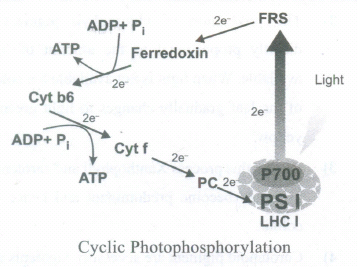
5. During this movement of electrons Adenosine Di Phosphate (ADP) is phosphorylated, by the addition of inorganic phosphate and generates Adenosine Tri Phosphate (ATP).
6. Cyclic electron transport produces only ATP and there is no NADPH + H+ formation.
7. At each step of electron transport, the electron loses potential energy and is used by the transport chain to pump H+ ions across the thylakoid membrane.
8. The proton gradient triggers ATP formation in ATP synthase enzyme situated on the thylakoid membrane.
9. Photosystem I need light of longer wavelength (>P700 nm).
10. It operates under low light intensity, less CO2 and under anaerobic conditions which makes it considered as earlier in evolution.
42.
Transfer of DNA from one bacterium to another is called transformation. In 1928, the bacteriologist Frederick Griffith demonstrated transformation in mice using Diplococcus pneumoniae. Two strains of this bacterium are present. One strain produces smooth colonies and are virulent in nature (S type), in addition another strain produced rough colonies and are avirulent (R type). When S-type of cells were injected into the mouse, the mouse died. When R-type of cells were injected, the mouse survived. He injected heat killed S-type cells into the mouse the mouse did not die. When the mixture of heat killed S-type cells and R-type cells were injected into the mouse. The mouse died. The avirulent rough strain of Diplococcus had been transformed into S-type cells. The hereditary material of heat killed S-type cells had transformed R-type cell into virulent smooth strains. Thus the phenomenon of changing the character of one strain by transferring the DNA of another strain into the former is called transformation.
43.
Heart is divided into four chambers, upper two small auricles or atrium and lower two large ventricles. The two auricles are separated by inter auricular septum and the two ventricles are separated by inter-ventricular septum The separation of chambers avoids mixing of oxygenated and deoxygenated blood. The auricle communicates with the ventricle through an opening called auricle ventricular aperture which is guarded by the auricle ventricular valves. The opening between the right atrium and the right ventricle is guarded by the tricuspid valve (three flaps or cusps), whereas a bicuspid (two flaps or cusps) or mitra1 valve guards the opening between the left atrium and left ventricle. The valves of the heart allows the blood to flow only in one direction, i.e., from the atria to the ventricles and from the ventricles to the pulmonary artery or the aorta. These valves prevent backward flow of blood. The opening of right and left ventricles into the pulmonary artery and aorta are guarded by aortic and pulmonary valves and are called semilunar valves. The opening and closing of the semilunar valves are achieved by the chordae tendinae. The chordae tendinae are attached to the lower end of the heart by papillary muscles.
44.
Structure of thyroid gland:
Thyroid gland is the largest endocrine gland in the body.
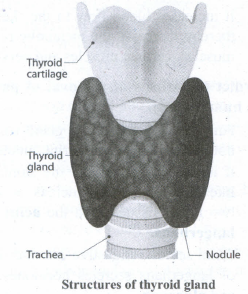
1. It is a butterfly shaped, bilobed gland located below the larynx on either side of upper trachea.
2. The two lateral lobes are connected by a median tissue mass called isthmus.
3. Each lobe is made up of many lobules. The lobules consist of follicles called acini.
4. Each acinus is lined with glandular, cuboidal or squamous epithelial cells. The lumen of acinus is filled with colloid, a thick glycoprotein mixture consisting of thyroglobulin molecules.
5. It secretes two hormones namely tri-iodothyronine [T3] and thyroxine or tetra- iodothyronine [T4].
6. The parafollicular cells or 'C' cells of thyroid gland secrete a hormone called thyrocalcitonin.
7. Iodine is essential for the normal synthesis of thyroid hormone.
8. Thyroid hormones shows a negative feedback effect on the hypothalamus and pituitary.
45.
(a) Some nephrons, have very long loop of Henle that run deep into the medulla are called juxtamedullary nephrons which aid in filtration from glomerulus.
(b) Podocytes are the filtration slits.
(c) Sphincters of urinary bladder are internal paired (involuntary) and external paired (Voluntary) control micturition.
46.
| Economic importance | Binomial | Useful part | Uses |
| Pulses | Cajanus cajan (Pigeon Pea) Phaseolus vulgaris (French bean) |
Seeds | Sources of protein and starch of our food |
| Food plants | Sesbania grandiflora (agathi, vegetable humming bird) Cyamopsis tetragonoloba (cluster bean) |
Leaves Tender fruits |
Greens Vegetable |
| Oil Plants | Arachis hypogaea (Ground nut) Pongamia pinnata (Pungam) |
Seeds Seeds |
Oil extracted from the seeds is edible and used for cooking. |
| Timber Plants | Dalbergia latifolia (rose wood) Pterocarpus santalinus (red sandalwood) |
Timber | Timber is used for making furniture, cabinet articles and as building materials. |
| Medicinal Plants | Crotalaria albida Mucuna pruriens |
Roots Seeds |
Used as purgative Neurological remedy |
| Fibre Plants | Crotalaria juncea (sunhemp), Sesbania aegyptiaca (sesban) | Stem fibres (Bast) | Used for making ropes |
| Dye Plants | Indigofera tinctoria (Avuri) | Leaves | Indigo dye obtained from leaves is used to colour printing and in paints. Blue dye is obtained. |
| Green Manuring | Indigofera tinctoria Tephrosea purpurea Gliricidia sepium |
Entire plant | Used as green manure because of the presence of nitrogen fixing bacteria in the lateral roots. |
| Ornamental Plants | Butea frondosa (Flame of the forest), Clitoria ternatea, Lathyrus odoratus (Sweet pea) and Lupinus hirsutus (Lupin) |
Entire plant | Grown as ornamental plants |

11th Standard Syllabus & Materials
11th Standard
TN 11th Tamil பீடு பெற நில் - செய்யுள் - காவடிச்சிந்து Important Questions And Answers Study Material - QB365 Set A
NEW11th Standard
TN 11th Tamil பீடு பெற நில் - உரைநடை - மலை இடப்பெயர்கள் : ஓர் ஆய்வு Important Questions And Answers Study Material - QB365 Set A
NEW11th Standard
TN 11th Tamil மாமழை போற்றுதும் - துணைப்பாடம் - யானை டாக்டர் Important Questions And Answers Study Material - QB365 Set A
NEW11th Standard
TN 11th Tamil மாமழை போற்றுதும் - செய்யுள் - ஐங்குறுநூறு Important Questions And Answers Study Material - QB365 Set A



Tamilnadu Stateboard 11th Standard Subjects

Maths

Commerce

Economics
Biology

Business Maths and Statistics

Accountancy

Computer Science

Physics

Chemistry
Maths
Biology
Economics
Physics
Chemistry

History
Business Maths and Statistics

Computer Science
Accountancy

Computer Applications
History
Computer Technology
Commerce
Computer Applications
Computer Technology

Tamil

English

French
Tamilnadu Stateboard Standards

