
 100% FREE ACCESS
11th Standard Syllabus & Materials
11th Standard
TN 11th Tamil இயற்கை வேளாண்மை,சுற்றுச்சூழல் -செய்யுள் - மனோன்மணீயம் Important Questions And Answers Study Material - QB365 Set A
NEW11th Standard
TN 11th Tamil என்னுயிர் என்பேன் -துணைப்பாடம் - இசைத்தமிழர் இருவர் Important Questions And Answers Study Material - QB365 Set A
NEW11th Standard
TN 11th Tamil மொழி கலை -செய்யுள் - ஒவ்வொரு புல்லையும் Important Questions And Answers Study Material - QB365 Set A
NEW11th Standard
TN 11th Tamil பீடு பெற நில் - இலக்கணம் - பகுபத உறுப்புகள் Important Questions And Answers Study Material - QB365 Set A
NEW11th Standard
TN 11th Tamil பீடு பெற நில் - துணைப்பாடம் - வாடிவாசல் Important Questions And Answers Study Material - QB365 Set A
NEW11th Standard
TN 11th Tamil பீடு பெற நில் - செய்யுள் - குறுந்தொகை Important Questions And Answers Study Material - QB365 Set A

Published on: 01/10/2019
Bio - Zoology - Chemical Coordination and Integration
Download Tamil Nadu 11th Standard Biology question papers, model tests, one-mark questions, important questions, and public exam papers in PDF format. Free study materials and answer keys for TN State Board students.
Questions + Answers key
Take MCQ Biology Test1.
The normal sleep-wake cycle of human body is regulated by _________________
Melatonin
Melanin
Thyroxine
Growth hormone
2.
ADH refers to _________________
Insulin
Glucagon
Thymosin
Vasopressin
3.
Hypersecretion of GH in children leads to _____.
Cretinism
Gigantism
Graves disease
Tetany
4.
5.
Serum calcium level is regulated by _____.
Thyroxine
FSH
Pancreas
Thyroid and Parathyroid
6.
The maintenance of constant internal environment is referred as ______.
Regulation
Homeostasis
Co-ordination
Hormonal control
7.
8.
What are the symptoms of Tetany?
9.
Mention two functions of cortisol.
10.
Name the hormones produced by Neurohypophysis.
11.
Hormones are known as chemical messengers. Justify.
12.
Write the functions of (CCK) Cholecystokinin.
13.
Specify the symptoms of acromegaly
14.
Comment on homeostasis.
15.
Write a detailed account of gastrointestinal tract hormones.
16.
Predict the effects of removal of pancreas from the human body.
17.
18.
Write the symptoms of cretinism
19.
20.
Name the layers of adrenal cortex and mention their secretions.
21.
Write the causes for diabetes mellitus and diabetes insipidus.
1.
(a)
Melatonin
2.
(d)
Vasopressin
3.
(b)
Gigantism
4.
(c)
5.
(d)
Thyroid and Parathyroid
6.
(b)
Homeostasis
7.
8.
Generalized convulsion, locking of jaws increased heartbeat rate, increased body temperature, muscular spasm are the major symptoms of tetany.
9.
1. Cortisol is a glucocorticoids involved in maintaining cardiovascular and kidney functions.
2. It produces anti-inflammatory reactions and suppresses the immune response
10.
Oxytocin and vasopressin.
11.
(i) The hormones are chemical messengers released into the blood and circulated as chemical signals.
(ii) They influence the metabolic activities of the body by means of hormones.
(iii) Deficiency or excess secretion of hormones will lead to disorders.
(iv) Thus hormones act as chemical messenger and coordinate different physical, physiological mental activities and maintain homeostasis.
12.
(i) CCK is known as Cholecystokinin.
(ii) CCK is secreted by a group of specialized endocrine cells in duodenum in response to the presence of fat and acid in the diet.
(iii) CCK acts on the gall bladder to release bile into duodenum and stimulates the secretion of pancreatic enzymes and its discharges.
13.
Acromegaly is due to excessive secretion of growth hormone in adults.
Symptoms of acromegaly are:
Overgrowth of hand bones, feet bones, jawbones malfunctioning of gonads, enlargement of viscera, tongue, lungs, heart, liver, spleen, and also endocrine glands like thyroid, adrenal etc.
14.
(i) Hormones coordinate different physical, physiological, mental activities and maintain homeostasis.
(ii) Maintenance of constant internal environment of the body by the different coordinating system.
15.
1. A group of specialized endocrine cells present in gastrointestinal tract secretes hormones such as gastrin, cholecystokinin, secretin and gastric inhibitory peptides.
2. Gastrin acts on the gastric glands and stimulates the secrete of HCl and pepsinogen.
3. Cholecystokinin [CCK] is secreted by duodenum in response to the presence of fat and acid in the diet.
4. Secretin acts on acini cells of pancreas to secrete bicarbonate ions and water to neutralize the acidity.
5. Gastric inhibitory peptide [GIP] inhibits gastric secretion and motility.
16.
(i) Pancreas is a dual hormone which performs both the function of exocrine and endocrine glands.
(ii) It is a leaf like structure composed of two major tissues such as acini and islets of Langerhans.
(iii) Insulin is a peptide hormone and play an important role in glucose homeostasis.
(iv) When entire pancreas is removed, the body is left without the cells that produce insulin and hormones that help maintain safe blood sugar level. This leads to diabetes.
17.
18.
Cretinism is due lower secretion of growth hormone in infants; [ie] hypothyroidism.
Symptoms of Cretinism:
In infants, hypothyroidism causes cretinism. A cretin shows
1. Retarded skeletal growth
2. Absence of sexual maturity.
3. Retarded mental ability.
4. Thick wrinkled skin.
5. Protruded enlarged tongue.
6. Bloated face.
7. Thick and short limbs occurs
19.
20.
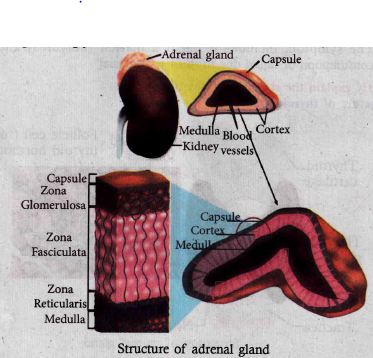
(i) A pair of adrenal glands are located at the anterior end of the kidneys. The outer region is the cortex and the inner region is the medulla.
(ii) The adrenal cortex has three distinct zones, they are 1. Zona glomerulosa 2. Zona fasciculata and 3. Zona reticularis.
(iii) Zona glomerulosa an outer thin layer constitutes about 15% of adrenal cortex and its secretes mineralocorticoids.
(iv) Zona fasciculata, the middle layer constitutes about 75% of adrenal cortex and secretes glucocorticoids such as cortisol, corticosterone and trace amounts of adrenal androgen and oestrogen.
(v) Zona Reticularis, an inner zone of adrenal cortex constitute about 10% of adrenal cortex and secretes the adrenal cortex androgen, trace amount of oestrogen and glucocorticoids.
21.
Diabetes mellitus:
1. It is otherwise known as hyperglycaemia.
2. It is caused due to lower secretion of insulin. By this process blood glucose level is elevated. There are two types of diabetes mellitus. Types I and Type II.
3. Type I diabetes is known Insulin dependent diabetes, caused by the lack of insulin secretion due to illness or some viral infections.
4. Type II diabetes is also known as Non-Insulin dependent diabetes, caused due to lower secretion of insulin.
5. The half-life period of insulin [in plasma] is only 6 minutes.
6. Symptoms of diabetes includes polyuria, polyphagia, polydipsia [excessive consumption of liquid due to thirst] ketosis [Breakdown of fat into glucose result in accumulation of ketone bodies in blood.]
Diabetes insipidus:
1. Diabetes insipidus is caused due to hypo secretion of vasopressin [ADH] from neurohypophysis
2. The symptom includes frequent urination [Polyuria] and excessive consumption of liquid due to thirst [polydipsia]

11th Standard Syllabus & Materials
11th Standard
TN 11th Tamil பீடு பெற நில் - செய்யுள் - காவடிச்சிந்து Important Questions And Answers Study Material - QB365 Set A
NEW11th Standard
TN 11th Tamil பீடு பெற நில் - உரைநடை - மலை இடப்பெயர்கள் : ஓர் ஆய்வு Important Questions And Answers Study Material - QB365 Set A
NEW11th Standard
TN 11th Tamil மாமழை போற்றுதும் - துணைப்பாடம் - யானை டாக்டர் Important Questions And Answers Study Material - QB365 Set A
NEW11th Standard
TN 11th Tamil மாமழை போற்றுதும் - செய்யுள் - ஐங்குறுநூறு Important Questions And Answers Study Material - QB365 Set A



Tamilnadu Stateboard 11th Standard Subjects

Maths

Commerce

Economics
Biology

Business Maths and Statistics

Accountancy

Computer Science

Physics

Chemistry
Maths
Biology
Economics
Physics
Chemistry

History
Business Maths and Statistics

Computer Science
Accountancy

Computer Applications
History
Computer Technology
Commerce
Computer Applications
Computer Technology

Tamil

English

French
Tamilnadu Stateboard Standards

