
 100% FREE ACCESS
11th Standard Syllabus & Materials
11th Standard
TN 11th Tamil இயற்கை வேளாண்மை,சுற்றுச்சூழல் -செய்யுள் - மனோன்மணீயம் Important Questions And Answers Study Material - QB365 Set A
NEW11th Standard
TN 11th Tamil என்னுயிர் என்பேன் -துணைப்பாடம் - இசைத்தமிழர் இருவர் Important Questions And Answers Study Material - QB365 Set A
NEW11th Standard
TN 11th Tamil மொழி கலை -செய்யுள் - ஒவ்வொரு புல்லையும் Important Questions And Answers Study Material - QB365 Set A
NEW11th Standard
TN 11th Tamil பீடு பெற நில் - இலக்கணம் - பகுபத உறுப்புகள் Important Questions And Answers Study Material - QB365 Set A
NEW11th Standard
TN 11th Tamil பீடு பெற நில் - துணைப்பாடம் - வாடிவாசல் Important Questions And Answers Study Material - QB365 Set A
NEW11th Standard
TN 11th Tamil பீடு பெற நில் - செய்யுள் - குறுந்தொகை Important Questions And Answers Study Material - QB365 Set A

Published on: 04/10/2019
Botany - Biomolecules
Download Tamil Nadu 11th Standard Biology question papers, model tests, one-mark questions, important questions, and public exam papers in PDF format. Free study materials and answer keys for TN State Board students.
Questions + Answers key
Take MCQ Biology Test1.
What is Celluloses?
2.
Tabulate the examples for Primary metabolites and Secondary metabolites.
3.
What is Metabolites? its types
4.
What are the three type of chemical bond in protein structure? Explain them With example.
5.
Explain the Michaelis-Menton Constant (km) with graphical representation.
6.
Explain Polysaccharide with an example.
7.
What is Agar?
8.
What is Inulin?
9.
Differentiate Prokaryotic mRNA and Eukaryotic mRNA?
10.
What is mRNA?
1.
Cellulose is a structural polysaccharide made up of thousands of glucose units. In this case, \(\beta\)-glucose units are held together by 1,4 glycosidic linkage, forming long unbranched chains. Cellulose fibres are straight and uncoiled. It has many industrial uses which include cellulose fibres as cotton, nitrocellulose for explosives, cellulose acetate for fibres of multiple uses and cellophane for packing.
2.
| Metabolites | Examples |
|---|---|
| Primary | |
| Enzymes | Protease, lipase, peroxidase |
| Amino acid | Proline, leucine |
| Organic acid | Acetic acid, lactic acid |
| Vitamins | A, B, C |
| Secondary | |
| Pigments | Carotenoids, anthocyanins |
| Alkaloids | Morphine, codeine |
| Essential oil | Lemon grass oil, rose oil |
| Toxins | Abrin, ricin |
| Lectins | Concanavalin A |
| Drugs | Vinblastin, curcumin |
| Polymeric substances | Rubber, gums, cellulose |
3.
Most plants, fungi and other microbes synthesizes a number of organic compounds. These components are called as metabolites which are intermediates and products of metabolism. The term metabolite is usually restricted to small molecules. It can be categorized into two types namely primary and secondary metabolites based on their role in metabolic process.
1.Primary metabolites are those that are required for the basic metabolic processes like photosynthesis, respiration, protein and lipid metabolism of living organisms.
2. Secondary metabolites does not show any direct function in growth and development of organisms.
4.
Hydrogen Bond: It is formed between some hydrogen atoms of oxygen and nitrogen in polypeptide chain. The hydrogen atoms have a small positive charge and oxygen and nitrogen have small negative charge. Opposite charges attract to form hydrogen bonds. Though these bonds are weak, large number of them maintains the molecule in 3D shape.
Ionic Bond: It is formed between any charged groups that are not joined together by peptide bond. It is stronger than hydro.gen bond and can be broken by changes in pH and temperature.
DIsulfide Bond. Some amino acids like cysteine and methionine have sulphur. These form disulphide bridge between sulphur atoms and amino acids.
Hydrophobic Bond This bond helps some protein to maintain structure. When globular proteins are in solution, their hydrophobic groups point inwards away from water.
5.
The rate of reaction is directly proportional to the enzyme concentration.
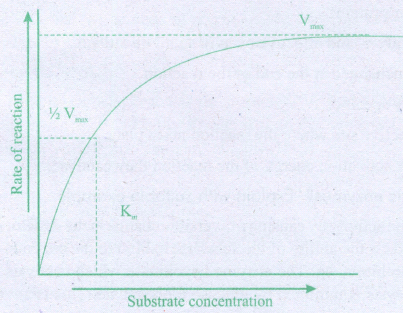
When the initial rate of reaction of an enzyme is measured over a range of substrate concentrations (with a fixed amount or-enzyme) and the results plotted on a graph. With increasing substrate concentration, the velocity increases - rapidly at lower substrate concentration.
6.
(i) These are made of hundreds of monosaccharide units. Polysaccharides also called "Glycans".
(ii) Long chain of branched or unbranched monosaccharides are held together by glycosidic bonds.
(iii) Polysaccharide is an example of giant molecule, a macromolecule and consists of only one type of monomer.
(iv) Polysaccharides are insoluble in water and are sweetless. Cellulose is an example built from repeated units of glucose monomer.
(v) Depending on the function, polysaccharides are of two types: Storage Polysaccharide and structural Polysaccharide.
7.
Agar is a Mucopolysaccharide from red algae. It is Used as solidifying agent in culture medium in laboratory.
8.
Inulin is a Polymer of fructose. It is not metabolised in the human body and is readily filtered through the kidney.
9.
1. Prokaryotic mRNA (Polycistronic) carry coding sequences for many polypeptides.
2. Eukaryotic mRNA (Monocistronic) contains information for only one polypeptide.
10.
Single-stranded, carries a copy of instructions for assembling amino acids into proteins. It is very unstable and comprises 5% of total RNA polymer

11th Standard Syllabus & Materials
11th Standard
TN 11th Tamil பீடு பெற நில் - செய்யுள் - காவடிச்சிந்து Important Questions And Answers Study Material - QB365 Set A
NEW11th Standard
TN 11th Tamil பீடு பெற நில் - உரைநடை - மலை இடப்பெயர்கள் : ஓர் ஆய்வு Important Questions And Answers Study Material - QB365 Set A
NEW11th Standard
TN 11th Tamil மாமழை போற்றுதும் - துணைப்பாடம் - யானை டாக்டர் Important Questions And Answers Study Material - QB365 Set A
NEW11th Standard
TN 11th Tamil மாமழை போற்றுதும் - செய்யுள் - ஐங்குறுநூறு Important Questions And Answers Study Material - QB365 Set A



Tamilnadu Stateboard 11th Standard Subjects

Maths

Commerce

Economics
Biology

Business Maths and Statistics

Accountancy

Computer Science

Physics

Chemistry
Maths
Biology
Economics
Physics
Chemistry

History
Business Maths and Statistics

Computer Science
Accountancy

Computer Applications
History
Computer Technology
Commerce
Computer Applications
Computer Technology

Tamil

English

French
Tamilnadu Stateboard Standards

