
 100% FREE ACCESS
11th Standard Syllabus & Materials
11th Standard
TN 11th Tamil இயற்கை வேளாண்மை,சுற்றுச்சூழல் -செய்யுள் - மனோன்மணீயம் Important Questions And Answers Study Material - QB365 Set A
NEW11th Standard
TN 11th Tamil என்னுயிர் என்பேன் -துணைப்பாடம் - இசைத்தமிழர் இருவர் Important Questions And Answers Study Material - QB365 Set A
NEW11th Standard
TN 11th Tamil மொழி கலை -செய்யுள் - ஒவ்வொரு புல்லையும் Important Questions And Answers Study Material - QB365 Set A
NEW11th Standard
TN 11th Tamil பீடு பெற நில் - இலக்கணம் - பகுபத உறுப்புகள் Important Questions And Answers Study Material - QB365 Set A
NEW11th Standard
TN 11th Tamil பீடு பெற நில் - துணைப்பாடம் - வாடிவாசல் Important Questions And Answers Study Material - QB365 Set A
NEW11th Standard
TN 11th Tamil பீடு பெற நில் - செய்யுள் - குறுந்தொகை Important Questions And Answers Study Material - QB365 Set A

Published on: 04/10/2019
Botany - Cell Cycle
Download Tamil Nadu 11th Standard Biology question papers, model tests, one-mark questions, important questions, and public exam papers in PDF format. Free study materials and answer keys for TN State Board students.
Questions + Answers key
Take MCQ Biology Test1.
What are restriction points? Mention its role in Cell cycle.
2.
What is the role of nucleus in the cell?
3.
Tabulate the history of a cell.
4.
What is Endomitosis? Explain with example.
5.
How do you calculate the length of S period?
6.
Explain G1 phase of cell cycle.
7.
Tabulate the time duration in hours of the different phases of cell cycle
8.
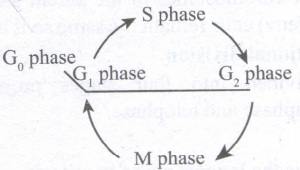
Which is the stage where replication takes place?
9.
Given an account of G0 phase.
10.
Differentiate between mitosis and meiosis.
1.
The checkpoint called the restriction point at the end of G1, it determines a cells fate whether it will continue in the cell cycle and divide or enter a stage called G0 as a quiescent stage and probably as specified cell or die.
2.
1. Control activities of the cell.
2. Genetic information copied from cell to cell while the cell divides.
3. Hereditary characters are passed onto new individuals when gametic cellsfuse together in sexual reproduction.
3.
| Year | Scientist | Events |
| 1665 | Robert Hooke | Coined word "Cell" |
| 1670-74 | Antonie van Leeuwenhoek | First living cells observed in microscope - Structure of bacteria |
| 1831-33 | Robert Brown | Presence of nucleus in cells of orchid roots |
| 1839 | Ian Evangelista Purkyne(J, E. Purkinje) | Coined "protoplasm" |
| 1838-39 | Schleiden & Schwann | Cell theory |
| 1858 | Rudolph Ludwig Carl Virchow | Cell theory 'omnis cellula e cellula' |
| 1873 | Anion Schneider | Described chromosomes (Nuclear filaments) for the first time |
| 1882 | Walther Flemming | Coined the word mitosis; chromosome behaviour |
| 1883 | Edouard Van Beneden | Cell division in round worm |
| 1888 | Theodor Boveri | Centrosome; Chromosome Theory |
4.
The replication of chromosomes in the absence of nuclear division and cytoplasmic division resultirig in numerous copies within each cell is called endomitosis. Chromonema do not separate to form chromosomes, but remain closely associated with each other. Nuclear membrane does not rupture. So no spindle formation. It occurs notably in the salivary glands of Drosophila and other flies. Cells in these tissues contain giant chromosomes (polyteny), each consisting of over thousands of intimately associated, or synapsed, chromatids. eg Polytene chromosome.
5.
A Culture of animal cells in which the cell cycles were asynchronous was incubated with 3H-Thymidine for 10 minutes. Autoradiography showed that 50% of the cells were labelled. If the cell cycle time (generation time) was 16 hrs how long was the S period?
Length of the S period = Fraction of cells in DNA replication x generation time
Length of the S period = 0.5 x 16 hours = 8 hours.
6.
The first gap phase - 2C amount of DNA in cells of G1. The cells become metabolically active and grows by producing proteins, lipids, carbohydrates and cell organelles including mitochondria and endoplasmic reticulum. Many checkpoints control the cell cycle. The checkpoint called the restriction point at the end of G1, determines a cells fate whether it will continue in the cell cycle and divide or enter a stage called Go as a quiescent stage and probably as specified cell or die. Cells are arrested in G1 due to:
(i) Nutrient deprivation.
(ii) Lack of growth factors or density dependent inhibition.
(iii) Undergo metabolic changes and enter into Go state.
Biochemicals inside cells activates the cell division. The proteins called kinases and cyclins activate genes and their proteins to perform cell division. Cyclins act as major checkpoint which operates in G1 to determine whether or not a cell divides.
7.
| Phase | Time duration (in hrs) |
| G1 | 11 |
| S | 8 |
| G2 | 4 |
| M | 1 |
8.
S phase
9.
(i) Some cells exit G1 and enter a quiescent stage called G0, where the cell remain metabolically active without proliferation.
(ii) Cells can exist for long periods in G0 phase. In G0 cells cease growth with reduced rate of RNA and protein synthesis.
(iii) The G0 phase is not permanent. Mature neuron and skeletal muscle cell remain permanently in G0.
(iv) Many cells in animals remain in G0 unless called on to proliferate by appropriate growth factors or other extracellular signals. G0 cells are not dormant.
10.
Difference between Mitosis and Meiosis:
| S.No | Mitosis | Meiosis |
| 1. | One division | Two divisions |
| 2. | Number of Chromosomes remains the same | Number of Chromosomes is halved |
| 3. | Homologous Chromosomes line up separately on the metaphase plate | Homologous Chromosomes line up in pairs at the metaphase plate |
| 4. | Homologous Chromosome do not pair up | Homologous Chromosome pair up to form bivalents |
| 5. | Chiasmata do not form and crossing over never occurs | Chiasmata form and crossing over occurs |
| 6. | Daughter cells are genetically identical | Daughter cells are genetically different from the parent cells |
| 7. | Two daughter cells are formed | Four daughter cells are formed |

11th Standard Syllabus & Materials
11th Standard
TN 11th Tamil பீடு பெற நில் - செய்யுள் - காவடிச்சிந்து Important Questions And Answers Study Material - QB365 Set A
NEW11th Standard
TN 11th Tamil பீடு பெற நில் - உரைநடை - மலை இடப்பெயர்கள் : ஓர் ஆய்வு Important Questions And Answers Study Material - QB365 Set A
NEW11th Standard
TN 11th Tamil மாமழை போற்றுதும் - துணைப்பாடம் - யானை டாக்டர் Important Questions And Answers Study Material - QB365 Set A
NEW11th Standard
TN 11th Tamil மாமழை போற்றுதும் - செய்யுள் - ஐங்குறுநூறு Important Questions And Answers Study Material - QB365 Set A



Tamilnadu Stateboard 11th Standard Subjects

Maths

Commerce

Economics
Biology

Business Maths and Statistics

Accountancy

Computer Science

Physics

Chemistry
Maths
Biology
Economics
Physics
Chemistry

History
Business Maths and Statistics

Computer Science
Accountancy

Computer Applications
History
Computer Technology
Commerce
Computer Applications
Computer Technology

Tamil

English

French
Tamilnadu Stateboard Standards

