
 100% FREE ACCESS
11th Standard Syllabus & Materials
11th Standard
TN 11th Tamil இயற்கை வேளாண்மை,சுற்றுச்சூழல் -செய்யுள் - மனோன்மணீயம் Important Questions And Answers Study Material - QB365 Set A
NEW11th Standard
TN 11th Tamil என்னுயிர் என்பேன் -துணைப்பாடம் - இசைத்தமிழர் இருவர் Important Questions And Answers Study Material - QB365 Set A
NEW11th Standard
TN 11th Tamil மொழி கலை -செய்யுள் - ஒவ்வொரு புல்லையும் Important Questions And Answers Study Material - QB365 Set A
NEW11th Standard
TN 11th Tamil பீடு பெற நில் - இலக்கணம் - பகுபத உறுப்புகள் Important Questions And Answers Study Material - QB365 Set A
NEW11th Standard
TN 11th Tamil பீடு பெற நில் - துணைப்பாடம் - வாடிவாசல் Important Questions And Answers Study Material - QB365 Set A
NEW11th Standard
TN 11th Tamil பீடு பெற நில் - செய்யுள் - குறுந்தொகை Important Questions And Answers Study Material - QB365 Set A

Published on: 04/10/2019
Botany - Reproductive Morphology
Download Tamil Nadu 11th Standard Biology question papers, model tests, one-mark questions, important questions, and public exam papers in PDF format. Free study materials and answer keys for TN State Board students.
Questions + Answers key
Take MCQ Biology Test1.
Provide the significance of seeds.
2.
Describe the term Cycly in flower.
3.
Write a note on Arrangement of whorls in flowers.
4.
Write a note on Flower symmetry.
5.
Write a note on Plant sex.
6.
write a note on Flower sex.
7.
Write a note on Special Inflorescence.
8.
Mention any three functions of seeds.
9.
Differentiate Dicot and Monocot seed.
10.
How are simple fruits classified?
1.
1. The seed encloses and protects the embryo for next generation.
2. It contains food for the development of embryo.
3. It is a means for the dispersal of new individuals of the species.
4. A seed is a means for perpetuation of the species. It may lie dormant during unfavourable conditions but germinates on getting suitable conditions.
5. Seeds of various plants are used as food, both for animals and men.
6. They are the basis of agriculture.
7. Seeds are the products of sexual reproduction so they provide genetic variations and recombinationin a plant.
2.
It explains the number of whorls of floral parts. Perianth cycly is the number of whorls of perianth (sepals, petals) parts.
1. uniseriate-it is a single whorl of accessory(non-essential) floral part. It is less common. Example: Sterculia.
2. Biseriate- It is with two whorls of accessory floral parts. (outer = lower,inner=upper) It is the most common type of perianth cyely. Example: Hibiscus.
3. Multiseriate-More than two whorls of non--essential floral parts. Example: Chrysanthemum.
4. Dichlamydeous-A flower is composed of distinct outer calyx and Inner corolla.
5. Homochlamydeous-Perianth is un- differentiated into calyx and corolla and composed of similar parts called tepals. Most monocots have a homochlamydeous perianth.
6. Achlamydeous-Perianth is absent altogether. Flowers without petals are called apetalous and flowers without sepals are called asepalous.
3.
The position of perianth (sepals, petals, tepals) parts relative to one another is called perianth arrangement.
1. Cyclic or whorled: All the floral parts are arranged in definite whorls. Example: Brassica, Solanum.
2. Acyclic or spiral: The floral parts are arranged in spirals on the elongated fleshy torus. Example: Magnolia.
3. Spirocyclic or hemicyclic: Some parts are in whorls and others parts are in spirals.
Example: Nymphaea, Annona, Polyalthia.
4.
A flower is symmetrical when it is divided into equal halves in any plane running through the center.
Flower symmetry is an important structural adaptation related to pollination systems.
1. Actinomorphic (or) radial or polysymmetric: The flower shows two mirror images when cut in any plane or radius through the centre. Normally there are more than two planes of symmetry. Example: Hibiscus, Datura, water lily.
2. Zygomorphic (bilateral symmetry) or monosymmetric : The flower can be divided into equal halves in only one plane. Zygomorphic flower can efficiently transfer pollen grains to visiting pollinators. Example: Pisum, Bean, Cassia, Gulmohar, Salvia, Ocimum.
3. Asymmetric (amorphic): Flower lacks any plane of symmetry and cannot be divided into equal halves in any plane. Parts of such flowers are twisted. Example: Canna indica.
5.
Plant sex refers to the presence and distribution of flowers with different sexes in an individual plant.
1. Hermaphroditic: All the flowers of the plant are bisexual.
2. Monoecious(mono-one; Oikos-house): Both male and female flowers are present in the same plant Example: Coconut.
3. Dioecious (di-two: Oikos-house): Male and Female flowers are present on separate plants. Example: Papaya, Palmyra.
4. Polygamous: The condition in which bisexual and unisexual (staminate/pistillate) flowers occur in a same plant is called polygamous. It is of several types. see box. Example: Musa, Mangifera.
6.
Flower sex refers to the presence or absence of androecium and gynoecium within a flower.
1.Perfect or bisexual: When a flower contains both androecium and gynoecium is called perfect flower.
2. imperfect or unisexual (diclinous): When the flower contains only one of the essential whorls is called Imperfect flower.
It is of two types:
i) Staminate flowers: Flowers only with androecium alone are called staminate flowers.
ii) Pistillate flowers: Flowers with only gynoecium are called pistillate flowers.
7.
The inflorescences do not show any of the development pattern types are classified under special type of inflorescence.
1.Cyathium:
Cyathium inflorescence consists of small unisexual flowers enclosed by a common involucre which mimics a single flower. Male flowers are organised in a scorpioid manner. Female flower is solitary and centrally located on a long pedicel. Male flower is represented only by stamens and female flower is represented only by pistil. Cyathium may be actinomorphic (Example: Euphorbia) or zygomorphic (Example: Pediianthus.).Nectar is present in involucre.
2. Hypanthodium:
Receptacle is a hollow, globose structure consisting unisexual flowers present on the inner wall of the receptacle. Receptacle is closed except a small opening called ostiole which is covered by a series of bracts. Male flowers are present nearer to the ostiole, female and neutral flowers are found in a mixed manner from middle below. Example: Ficus sp. (Banyan and Pipal).
3. Coenanthium:
Circular disc like fleshy open receptacle that bears pistillate flowers at the center and staminate flowers at the periphery. Example: Dorstenia.
8.
Function of Seeds:
1. The seed encloses and protects the embryo. i.e., the next generation.
2. It contains food for the development of the embryo.
3. It is a means for the dispersal of new individuals of the species.
9.
| S.No | Dicot Seed | Monocot Seed |
| 1 | Dicotyledonous seeds have non-endospermic seed. | Monocotyledonous have endospermic seed. |
| 2 | The seed coat is not fused and is separate from the fruit wall | The seed coat is fused with the fruit wall (Pericarp). |
| 3 | Food is stored in two cotyledons. There is no endosperm. | Food is stored in the endosperm, which covers a large part of the seed. |
| 4 | Eg: Bean, Gram. | Eg: Rice, Wheat |
10.
Simple fruit is classified based on the nature of pericarp as follows:
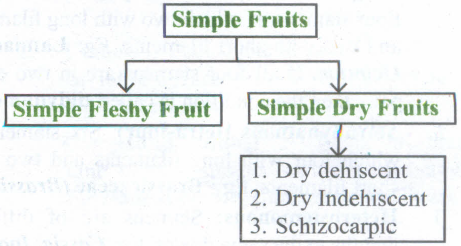
1. Fleshy fruit has fleshy pericarp.
2. Dry fruit has dry pericarp at maturity and may dehisce (Dry dehiscent) or decay (dry indehiscent) to liberate the seeds.
3. Schizocarpic fruit splits into one-seeded parts which remain indehiscent at maturity.

11th Standard Syllabus & Materials
11th Standard
TN 11th Tamil பீடு பெற நில் - செய்யுள் - காவடிச்சிந்து Important Questions And Answers Study Material - QB365 Set A
NEW11th Standard
TN 11th Tamil பீடு பெற நில் - உரைநடை - மலை இடப்பெயர்கள் : ஓர் ஆய்வு Important Questions And Answers Study Material - QB365 Set A
NEW11th Standard
TN 11th Tamil மாமழை போற்றுதும் - துணைப்பாடம் - யானை டாக்டர் Important Questions And Answers Study Material - QB365 Set A
NEW11th Standard
TN 11th Tamil மாமழை போற்றுதும் - செய்யுள் - ஐங்குறுநூறு Important Questions And Answers Study Material - QB365 Set A



Tamilnadu Stateboard 11th Standard Subjects

Maths

Commerce

Economics
Biology

Business Maths and Statistics

Accountancy

Computer Science

Physics

Chemistry
Maths
Biology
Economics
Physics
Chemistry

History
Business Maths and Statistics

Computer Science
Accountancy

Computer Applications
History
Computer Technology
Commerce
Computer Applications
Computer Technology

Tamil

English

French
Tamilnadu Stateboard Standards

