
 100% FREE ACCESS
11th Standard Syllabus & Materials
11th Standard
TN 11th Tamil இயற்கை வேளாண்மை,சுற்றுச்சூழல் -செய்யுள் - மனோன்மணீயம் Important Questions And Answers Study Material - QB365 Set A
NEW11th Standard
TN 11th Tamil என்னுயிர் என்பேன் -துணைப்பாடம் - இசைத்தமிழர் இருவர் Important Questions And Answers Study Material - QB365 Set A
NEW11th Standard
TN 11th Tamil மொழி கலை -செய்யுள் - ஒவ்வொரு புல்லையும் Important Questions And Answers Study Material - QB365 Set A
NEW11th Standard
TN 11th Tamil பீடு பெற நில் - இலக்கணம் - பகுபத உறுப்புகள் Important Questions And Answers Study Material - QB365 Set A
NEW11th Standard
TN 11th Tamil பீடு பெற நில் - துணைப்பாடம் - வாடிவாசல் Important Questions And Answers Study Material - QB365 Set A
NEW11th Standard
TN 11th Tamil பீடு பெற நில் - செய்யுள் - குறுந்தொகை Important Questions And Answers Study Material - QB365 Set A

Published on: 15/10/2019
Botany - Transport in Plants
Download Tamil Nadu 11th Standard Biology question papers, model tests, one-mark questions, important questions, and public exam papers in PDF format. Free study materials and answer keys for TN State Board students.
Questions + Answers key
Take MCQ Biology Test1.
Draw a experimental setup to show osmosis
2.
Draw a model to show munch mass flow hyphothesis.
3.
Draw a Ganong's potometer and label the parts.
4.
Draw a diagram to show the structure of stomata.
5.
What is water potential?
6.
Define Osmosis
7.
What is the principle of reverse osmosis?
8.
What are the steps involved in phloem loading?
9.
Explain the application of exosmosis in food preservation.
10.
Write the role of pressure potential, turgor: pressure and wall pressure for turgidity of plant: cell.
1.
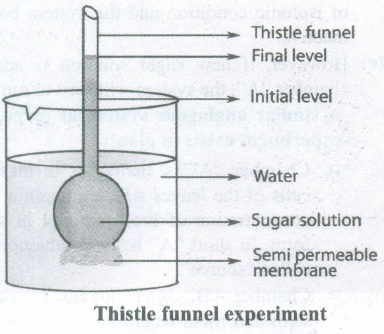
2.
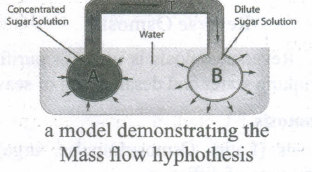
3.
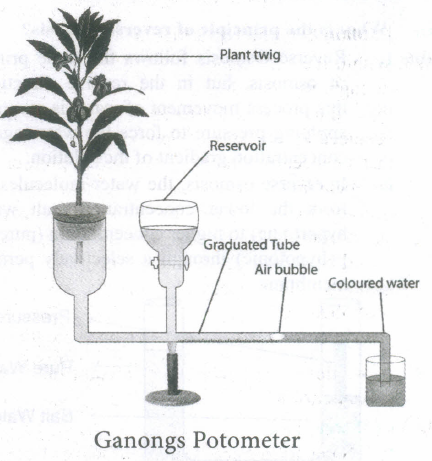
4.
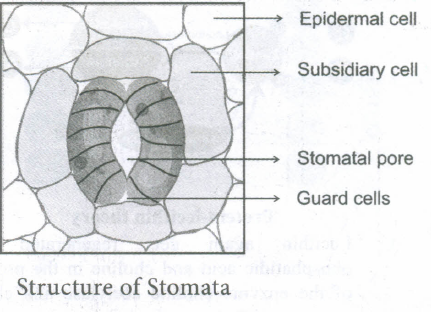
5.
The concept of water potential was introduced in 1960 by Slatyer and Taylor. Water potential is potential energy of water in a system compared to pure water when both temperature and pressure are kept the same. It is also a measure of how freely water molecules can move in a particular environment or system. Water potential is denoted by the Greek symbol \(\Psi \)(psi) and measured in Pascal (pa). At standard temperature, the water potential of pure water is zero.
6.
1. Osmosis (Latin: Osmos=impulse, urge) is a special type of diffusion.
2. It represents the movement of water or solvent molecules through a selectively permeable membrane from the place of its higher concentration (high water potential) to the place of its lower concentration (low water potential).
7.
1. Reverse Osmosis follows the same principles of osmosis, but in the reverse direction, In this process movement of water is reversed by applying pressure to force the water against a concentration gradient of the solution
2. In reverse osmosis, the water molecules move from the lower concentration (salt water = hypertonic) to higher concentration (pure water = hypotonic) through a selectively permeable membrane.
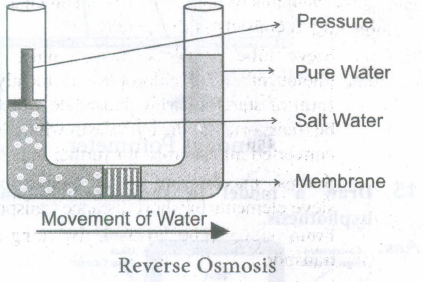
3. Uses: Reverse osmosis is used for purification I of drinking water and desalination of seawater.
8.
Phloem Loading:
The movement of photosynthates (products of photosynthesis) from mesophyll cells to phloem sieve elements of mature leaves is known as phloem loading. It consists of three steps.
1. Sieve tube conducts sucrose only. But the photosynthate in the chloroplast is mostly in the form of starch or trios-phosphate which has to be transported to the cytoplasm where it will be converted into sucrose for further translocation.
2. Sucrose moves from the mesophyll to nearby sieve elements by short-distance transport
3. From sieve tube to sink by long-distance transport.
9.
1. Plasmolysis plays an important role In preservation of meat, jellies and other food stuffs and prevents them from being destroyed by bacteria and fungi.
2. In salting of food stuffs to be preserved, Bacteria and fungi get plasmolysed and killed due to exosmosis.
10.
1. Pressure potential is a mechanical force for. working against the effect of solute potential Increased pressure potential will increase water potential and water enters the cell which becomes turgid. This positive hydrostatic pressure within the cell is called Turgor pressure.
2. In Turgor pressure (TP) the cell membrane exerts pressure towards the cell wall. The cell wall reacts to this Turgor pressure with equal and opposite force. The counter pressure exerted by the cell wall towards cell membrane is wall pressure.
3. Turgar pressure and wall pressure make the cell fully turgid. TP + WP = Turgid

11th Standard Syllabus & Materials
11th Standard
TN 11th Tamil பீடு பெற நில் - செய்யுள் - காவடிச்சிந்து Important Questions And Answers Study Material - QB365 Set A
NEW11th Standard
TN 11th Tamil பீடு பெற நில் - உரைநடை - மலை இடப்பெயர்கள் : ஓர் ஆய்வு Important Questions And Answers Study Material - QB365 Set A
NEW11th Standard
TN 11th Tamil மாமழை போற்றுதும் - துணைப்பாடம் - யானை டாக்டர் Important Questions And Answers Study Material - QB365 Set A
NEW11th Standard
TN 11th Tamil மாமழை போற்றுதும் - செய்யுள் - ஐங்குறுநூறு Important Questions And Answers Study Material - QB365 Set A



Tamilnadu Stateboard 11th Standard Subjects

Maths

Commerce

Economics
Biology

Business Maths and Statistics

Accountancy

Computer Science

Physics

Chemistry
Maths
Biology
Economics
Physics
Chemistry

History
Business Maths and Statistics

Computer Science
Accountancy

Computer Applications
History
Computer Technology
Commerce
Computer Applications
Computer Technology

Tamil

English

French
Tamilnadu Stateboard Standards

