
 100% FREE ACCESS
11th Standard Syllabus & Materials
11th Standard
TN 11th Tamil இயற்கை வேளாண்மை,சுற்றுச்சூழல் -செய்யுள் - மனோன்மணீயம் Important Questions And Answers Study Material - QB365 Set A
NEW11th Standard
TN 11th Tamil என்னுயிர் என்பேன் -துணைப்பாடம் - இசைத்தமிழர் இருவர் Important Questions And Answers Study Material - QB365 Set A
NEW11th Standard
TN 11th Tamil மொழி கலை -செய்யுள் - ஒவ்வொரு புல்லையும் Important Questions And Answers Study Material - QB365 Set A
NEW11th Standard
TN 11th Tamil பீடு பெற நில் - இலக்கணம் - பகுபத உறுப்புகள் Important Questions And Answers Study Material - QB365 Set A
NEW11th Standard
TN 11th Tamil பீடு பெற நில் - துணைப்பாடம் - வாடிவாசல் Important Questions And Answers Study Material - QB365 Set A
NEW11th Standard
TN 11th Tamil பீடு பெற நில் - செய்யுள் - குறுந்தொகை Important Questions And Answers Study Material - QB365 Set A

Published on: 26/07/2019
Botany - Vegetative Morphology
Download Tamil Nadu 11th Standard Biology question papers, model tests, one-mark questions, important questions, and public exam papers in PDF format. Free study materials and answer keys for TN State Board students.
Questions + Answers key
Take MCQ Biology Test1.
Roots that grow from any part of the plant body other than the radicle are called _____
Tap root
Adventitious root
Modified roots
Aerial roots
2.
A phyllode is a modified ___________
branch
stem
root
leaf
3.
Stem modified into a flattened photosynthetic structure _____
Phylloclade
Bulbil
Phyllode
Tendril
4.
Storage leaves are seen in ___
Drosera
Acacia
Nepenthes
Agave
5.
The leaf of Coriandrum is described as _____
bipinnate
unipinnate
decompound
tripinnate
6.
Ternate phyllotaxy is seen in _____
Nerium
Ocimum
Allamanda
Guava
7.
_____ is an example for Lianas.
Bauhinia vahlii
Mango
Vanda
Nepenthes
8.
_____ is a biennial.
Cabbage
Bamboo
Groundnut
Peas
9.
Bryophyllum and Dioscorea are examples of ______.
Foliar bud, apical bud
Foliar bud, cauline bud
Cauline bud, apical bud
Cauline bud, foliar bud
10.
Roots are ______.
Descending, negatively geotrophic, positively phototropic
Descending, positively geotrophic, negatively phototrophic
Ascending, positively geotrophic, negatively phototrophic
Ascending, negatively geotrophic, positively phototrophic
11.
What is primary root?
12.
What are Lianas?
13.
What are geophytes?
14.
How root climbers differ from stem climbers?
15.
Why lateral roots are endogenous?
16.
Write a short note on Venation.
17.
Describe the various sub-aerial stem modifications with suitable example.
18.
Write the similarities and difference between
a. Radicle buds and foliar buds
b. Phylloclade and cladode
19.
How are buds classified?
20.
What are hook climbers?
21.
Mention any four secondary functions of the stem.
22.
Draw a phylloclade and label the parts?
23.
What are buttress roots?
1.
(b)
Adventitious root
2.
(d)
leaf
3.
(a)
Phylloclade
4.
(d)
Agave
5.
(c)
decompound
6.
(a)
Nerium
7.
(a)
Bauhinia vahlii
8.
(a)
Cabbage
9.
(b)
Foliar bud, cauline bud
10.
(b)
Descending, positively geotrophic, negatively phototrophic
11.
Primary root is direct prolongation of the radicle. In most dicots it persists and forms the main root of the plant or tap root forming the tap root system.
12.
They are woody perennial climbers whose stem twines around the stem of tall trees and grows with them for light and support. Eg: Bauhinia vahlii.
13.
Perennial herbs having a bulb, corm, rhizome or tuber as the underground stem are called geophytes. Eg: Phyllanthus amarus, Cleome viscosa.
14.
(i) Root climbers: Plants climbing with the help of adventitious roots (arising from node). Eg: Piper betel, Piper nigrum, Pothos.
(ii) Stem climbers: These climbers lack specialised structure for climbing and the stem itself coils around the support. Eg: Ipomoea, Clitoria, Quisqualis.
15.
Lateral roots develop as extensions of the cells of pericycle in the anatomy of the root. Therefore they are said to be endogenous in origin.
16.
i) The arrangement of veins and veinlets on the leaf blade or lamina is called venation. Internally, the vein contains vascular tissues.
ii) Conventionally venation is classified into two types namely, Reticulate venation and Parallel venation.
Reticulate venation
i) In this type of venation leaf contain a prominent midrib from which several secondary veins arise that branch and anastomose like a network.
ii) This type of venation is common in all dicot leaves. It is of two types.
Pinnately reticulate venation (unicostate):
In this type of venation there is only one midrib in the centre which forms many lateral branches to form a network. Example: Mangifera indica, Ficus religiosa, Nerium.
Palmately reticulate venation (multlcostate):
i) In this type of venation there are two or more principal veins arising from a single point and they proceed outwards or upwards.
ii) The two types of palmate reticulate venation are i.
Divergent type:
When all principal veins originate from the base and diverge from one another towards the margin of the leaf as in Cucurbita, Luffa, Carica papaya, etc.,
ii. Convergent: When the veins converge to the apex of the leaf, as in Indian plum (Zizyphus), bay leaf (Cinnamomum)
Parahel venation
Veins run parallel to each other and do not form a prominent reticulum. It is a characteristic feature of monocot leaves. It is classified into two sub types.
Pinnately Parallel Venation (Unicostate)
When there is a prominent midrib in the center, from, which arise.many veins perpendicularly and run parallel to each other. Example: Musa, Zinger,curcuma, canna.
Palmate Parallel Venation (Multicostate)
i) In this type several veins arise from the tip of the petiole and they all run parallel to each other and unite at the apex, It is of two sub types.
Divergent type:
All principal veins originate from the base and diverge towards the margin, the margin of the leaf as in fan palm (Borassus flabellifer)
Convergent type:
All principal veins run parallel to each other fromthe base of the lamina and join at the apex as in Bamboos, rice, water hyacinth.
17.
Sub aerial stem found in plants with weak stem in which branches lie horizontally on the ground. These are meant for vegetative propagation. They may be sub aerial or partially sub terranean.
Runner: This is a slender, prostrate branch creeping on the ground and rooting at the nodes. eg. Centella (Indian pennywort), Oxalis (wood sorrel), lawn grass (Cynodon dactylon).
Stolon: This is also a slender, lateral branch originating from the base of the stem. But it first grows obliquely above the ground, 'produces a loop and bends down towards the ground. When touches the ground it produces roots and becomes an independent plantlet. eg. Mentha piperita (peppermint), Fragaria indica (wild strawberry).
Sucker: Sucker develops from a underground stem and grows obliquely upwards and gives rise to a separate plantlet or new plant. eg. Chrysanthemum, Musa, Bambusa.
Offset: Offset is similar to runner but found in aquatic plants especially in rosette leaved forms. A short thick lateral branch arises from the lower axil and grows horizontally leafless for a short distance, then it produces a bunch of rosette leaves and root at nodes. eg. Eichhornia (water hyacinth), Pistia (water lettuce).
18.
| a | Radical buds | Foliar buds |
| Differences | Radicle buds arise from the lateral roots. Eg. Sweet potato | Foliar buds develop from veins or from margins of the leaves. Eg. Begonia |
| Similarities | It is a type of adventitious root | It is a type of adventitious root |
| b | Phylloclade | Cladode |
| Differences | Presence of series of nodes and internodes. Eg: Casuarina | Presence of one or two internodes only. Eg: Asparagus |
| Similarities | Phylloclade is a stem modification | Cladode is a stem modification |
19.
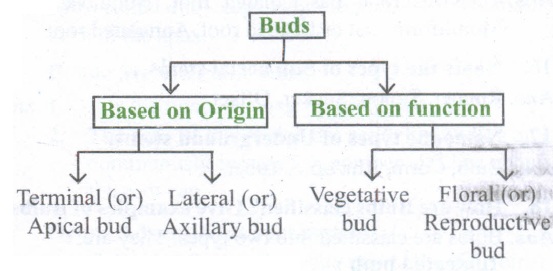
20.
These plants produce specialized hook-like structures which are the modification of various organs of the plant. In Artabotrys inflorescence axis is modified into hook.
21.
1. Food storage- Eg: Solanum tuberosum, Colocasia and Zingiber officinale.
2. Perennation/reproduction - Eg: Zingiber officinale, Curcuma longa.
3. Water storage - Eg: Opuntia.
4. Buoyancy - Eg: Neptunia.
22.
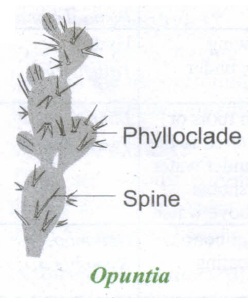
23.
In certain trees broad plank-like outgrowths develop towards the base all around the trunk. They grow obliquely downwards and give support to huge trunks of trees. This is an adaptation for tall rain forest trees. Eg: silk cotton tree (Bombax), White cotton tree (kapok).

11th Standard Syllabus & Materials
11th Standard
TN 11th Tamil பீடு பெற நில் - செய்யுள் - காவடிச்சிந்து Important Questions And Answers Study Material - QB365 Set A
NEW11th Standard
TN 11th Tamil பீடு பெற நில் - உரைநடை - மலை இடப்பெயர்கள் : ஓர் ஆய்வு Important Questions And Answers Study Material - QB365 Set A
NEW11th Standard
TN 11th Tamil மாமழை போற்றுதும் - துணைப்பாடம் - யானை டாக்டர் Important Questions And Answers Study Material - QB365 Set A
NEW11th Standard
TN 11th Tamil மாமழை போற்றுதும் - செய்யுள் - ஐங்குறுநூறு Important Questions And Answers Study Material - QB365 Set A



Tamilnadu Stateboard 11th Standard Subjects

Maths

Commerce

Economics
Biology

Business Maths and Statistics

Accountancy

Computer Science

Physics

Chemistry
Maths
Biology
Economics
Physics
Chemistry

History
Business Maths and Statistics

Computer Science
Accountancy

Computer Applications
History
Computer Technology
Commerce
Computer Applications
Computer Technology

Tamil

English

French
Tamilnadu Stateboard Standards

