
 100% FREE ACCESS
11th Standard Syllabus & Materials
11th Standard
TN 11th Tamil இயற்கை வேளாண்மை,சுற்றுச்சூழல் -செய்யுள் - மனோன்மணீயம் Important Questions And Answers Study Material - QB365 Set A
NEW11th Standard
TN 11th Tamil என்னுயிர் என்பேன் -துணைப்பாடம் - இசைத்தமிழர் இருவர் Important Questions And Answers Study Material - QB365 Set A
NEW11th Standard
TN 11th Tamil மொழி கலை -செய்யுள் - ஒவ்வொரு புல்லையும் Important Questions And Answers Study Material - QB365 Set A
NEW11th Standard
TN 11th Tamil பீடு பெற நில் - இலக்கணம் - பகுபத உறுப்புகள் Important Questions And Answers Study Material - QB365 Set A
NEW11th Standard
TN 11th Tamil பீடு பெற நில் - துணைப்பாடம் - வாடிவாசல் Important Questions And Answers Study Material - QB365 Set A
NEW11th Standard
TN 11th Tamil பீடு பெற நில் - செய்யுள் - குறுந்தொகை Important Questions And Answers Study Material - QB365 Set A

Published on: 14/03/2020
11th Standard Business Mathematics English Medium All Chapter Book Back and Creative Two Marks Questions 2020
Download Tamil Nadu 11th Standard Business Maths and Statistics question papers, model tests, one-mark questions, important questions, and public exam papers in PDF format. Free study materials and answer keys for TN State Board students.
Questions + Answers key
Take MCQ Business Maths and Statistics Test
1.
2.
Evaluate the following tan\(\left(\cos ^{-1} \frac{8}{17}\right)\)
3.
Find the principal value of sin-1(1/2)
4.
Find the equation of the circle when the end points of the diameter are (2, 4) and (3, –2).
5.
Find the locus of the point which is equidistant from (2, –3) and (3, –4).
6.
Show that \(\left[ \begin{matrix} 1 & 2 \\ 2 & 4 \end{matrix} \right] \)is a singular matrix.
7.
A dealer whises to purchase a number of fans and sewing machines. He has only Rs.5760 to invest and has a space for atmost 20 items. A fan costs him Rs.360 and a sewing machine Rs. 240. His expectation is he can sell a fan at a profit of Rs.22 and a sewing machine at a profit of ns. Formulate this as an LPP to maximize his profit?
8.
A producer has 30 and 17 units of labour and capital respectively which he can use to produce two types of goods X and Y. To produce one unit of X, 2 unit of labour and 3 units of capital are required. Similarly, 3 units of labour and 1 unit of capital is required to produce one unit of Y. If X and Yare priced at HOO and H20 per unit respectively, how should the producer use his resources to maximize the total revenue? Formulate the LPP for the above.
9.
If f(x,y) = 3x2 + 4y3 + 6xy - x2y3 + 6. Find fxy(2,1)
10.
If f(x,y) = 3x2 + 4y3 + 6xy - x2y3 + 6. Find fyy(1,1)
11.
Calculate the coefficient of correlation from the following data:
ΣX = 50, ΣY = –30, ΣX2 = 290, ΣY2 = 300, ΣXY = –115, N = 10
12.
A person purchases tomatoes from each of the 4 places at the rate of 1kg., 2kg., 3kg., and 4kg. per rupee respectively. On the average, how many kilograms has he purchased per rupee?
13.
The chairman of a society wishes to award a gold medal to a student getting highest marks in Business Mathematics. If this medal costs Rs. 9,000 every year and the rate of compound interest is 15% what amount is to be deposited now.
14.
A person pays Rs 64,000 per annum for 12 years at the rate of 10% per year. Find the annuity [(1.1)12 = 3.3184]
15.
Find D2 and D6 for the following series 22, 4, 2, 12, 16, 6, 10, 18, 14, 20, 8
16.
From the following data calculate the correlation coefficient Σxy = 120, Σx2 = 90, Σy2 = 640
17.
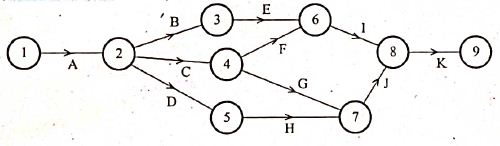
Draw a network diagram for the following activities.
| Activity code | A | B | C | D | E | F | G | H | I | J | K |
| Predecessor activity | - | A | A | A | B | C | C | C,D | E,F | G,H | I,J |
18.
19.
A demand function is given by xpn = k where n and k are constants. Prove that elasticity of demand is always constant.
20.
Find the elasticity of supply for the supply function x = 2p2 - 5p + 1, p > 3.
21.
Find the principal value of \(\cos^{-1}\left(\frac{-1}{\sqrt2}\right)\)
22.
Evaluate : \(\cos\left[\frac{\pi}{3}-\cos^{-1}\left(\frac{1}{2}\right)\right]\)
23.
Show that the function f(x) = 5x -3 is continuous at x = +3
24.
For what value of k, the following function is continuous at x =0?
f(x) = \(\begin{cases} \frac { 1-cos4x }{ 8{ x }^{ 2 } } \quad ifx\neq 0 \\ k\quad \quad \quad ifx=0 \end{cases}\)
25.
Find the angle between the pair of lines represented by the equation 3x2+10xy+8y2+14x+22y+15=0.
26.
Convert the equation of the parabola x2+y=6x-14 into the standard form.
27.
Differentiate the following with respect to x. (x2 - 3x + 2)(x + 1)
28.
In the expansion of \({ \left( x+\frac { 1 }{ x } \right) }^{ 6 }\), find the third term.
29.
Show that 10P3 = 9 P3 + 3. 9P2
30.
Evaluate the following : \(\frac { 7! }{ 6! } \)
31.
Find the values of x if \(\begin{vmatrix} 2 & 4 \\5 & 1 \end{vmatrix}=\begin{vmatrix} 2x & 4\\6 & x \end{vmatrix}.\)
32.
If \(A=\begin{bmatrix} 1 & 2 \\ 4 & 2 \end{bmatrix}\) then show that |2A| = 4 |A|.
33.
Suppose the inter-industry flow of the product of two sectors X and Y are given as under.
| Production Sector |
Consumption Sector |
Domestic demand |
Gross output |
|
|---|---|---|---|---|
| X | Y | |||
| X | 15 | 10 | 10 | 35 |
| Y | 20 | 30 | 15 | 65 |
Find the gross output when the domestic demand changes to 12 for X and 18 for Y.
34.
Resolve into partial fractions for the following : \(\frac{3 x+7}{x^2-3 x+2}\)
1.
2.
Let \(\left(\cos ^{-1} \frac{8}{17}\right)=\theta\)
\(\cos \theta=\frac{8}{17}\)
\(\sin\theta =\sqrt { 1-{ \cos }^{ 2 }\theta } \)
= \(\sqrt { 1-\cfrac { 64 }{ 289 } } \)
= \(\cfrac { 15 }{ 17 } \) ...(2)
From (1) and (2), we get
Now \(\tan\left( \cos\cfrac { 8 }{ 17 } \right) =\tan\theta =\cfrac { \sin\theta }{ \cos\theta } \)
\(=\cfrac { \frac { 15 }{ 17 } }{ \frac { 8 }{ 17 } } =\cfrac { 15 }{ 8 } \)
3.
Let \(\sin ^{-1}(1 / 2)=y\ \text {where }-\frac{\pi}{2} \leq y \leq \frac{\pi}{2}\)
\(\therefore \sin y=(1 / 2)=\sin \left(\frac{\pi}{6}\right)\)
\(y=\frac{\pi}{6}\)
The principal value of \(\sin ^{-1}(1 / 2) \text { is } \frac{\pi}{6}\)
4.
Equation of a circle when the end points of the diameter are given is
\(\left( x-{ x }_{ 1 } \right) \left( x-{ x }_{ 2 } \right) +\left( y-{ y }_{ 1 } \right) \left( y-{ y }_{ 2 } \right) =0\)
Here \(\left( { x }_{ 1 },{ y }_{ 1 } \right) =\left( 2,4 \right) \) and
\(\left( { x }_{ 2 },{ y }_{ 2 } \right) =\left( 3,-2 \right) \)
\(\therefore \left( x-2 \right) \left( x-3 \right) +\left( y-4 \right) \left( y+2 \right) =0\)
\({ x }^{ 2 }+{ y }^{ 2 }-5x-2y-2=0\)
5.
Let A(2, –3) and B (3, –4) be the given points
Let P(x1,y1) be any point on the locus.
Given that PA = PB.
PA2 = PB2
\(\left( { x }_{ 1 }-2 \right) ^{ 2 }+\left( { y }_{ 1 }+3 \right) ^{ 2 }=\left( { x }_{ 1 }-3 \right) ^{ 2 }+\left( { y }_{ 1 }+4 \right) ^{ 2 }\)
\({ x }_{ 1 }^{ 2 }-4{ x }_{ 1 }+4+y_{ 1 }^{ 2 }+6{ y }_{ 1 }+9={ x }_{ 1 }^{ 2 }-6{ x }_{ 1 }+9+{ y }_{ 1 }^{ 2 }+8{ y }_{ 1 }+16\)
\(i.e,{ 2x }_{ 1 }-{ 2y }_{ 1 }-12=0\)
\( i.e.,{ x }_{ 1 }-{ y }_{ 1 }-6=0\)
The locus of \(P({ x }_{ 1 },{ y }_{ 1 })\ is \ x-y-6=0\)
6.
Let A = \(\left[ \begin{matrix} 1 & 2 \\ 2 & 4 \end{matrix} \right] \)
|A| = \(\left| \begin{matrix} 1 & 2 \\ 2 & 4 \end{matrix} \right| \)
= 4 – 4 = 0
\(\therefore\) A is a singular matrix
7.
(i) Variables:
Let x1 and x2 represent the number of fans and sewing machines.
(ii) Objective functions:
Let Z be the profit of the dealer.
∴ Maximize Z = 22x1 + 18x2 is the objective function.
(iii) Constraints:
\({ x }_{ 1 }+{ x }_{ 2 }\le 20\)
\({ 360x }_{ 1 }+{ 240x }_{ 2 }\le 5760\)
(iv) Non-negative restrictions:
Since the number of fans and sewing machine cannot be negative, we have x1, x2 ≥ 0.
Hence, mathematical formulation of the LPP is
Maximize \(Z=22{ x }_{ 1 }+18{ x }_{ 2 }\)
Subject to the constraints
\({ x }_{ 1 }+{ x }_{ 2 }\le 20\)
\({ 360x }_{ 1 }+{ 240x }_{ 2 }\le 5760\)
and x1, x2 ≥ 0.
8.
(i) Variables:
Let x1, x2 represent the number of units of X and Y.
(ii) Constraints:
| Labour | Capital | |
|---|---|---|
| X | 2 | 3 |
| Y | 3 | 1 |
∴ 2x1 + 3x2 ≤ 30 and 3x1 + x2 ≤ 17
(iii) Non-negative restrictions:
Since the number of units of X and Y cannot be negative,x1, x2 ≥ 0.
Hence, the mathematical formulation of the LPP is maximize \(Z=100{ x }_{ 1 }+120{ x }_{ 2 }\)
Subject to the constraints
\( { 2x }_{ 1 }+3{ x }_{ 2 }\le 30\)
\({ 3x }_{ 1 }+{ x }_{ 2 }\le 17\)
and x1, x2 ≥ 0.
9.
Given f(x, y) =3x2+4y3+6xy-x2y3+6
We know that fy(x, y) 12y2 + 6x - 3x2y2
Differentiating again partially w.r.t. 'x' we get,
fxy(x,y) 0 + 6 - 3y2 (2x) = 6 - 6xy2
\(\therefore\)fxy(2, 1) = 6 - 6(2)(1)2 = 6 - 12 = - 6
10.
Given f(x, y) =3x2+4y3+6xy-x2y3+6
Differentiating 'f' partially w.r.t. 'y' we get
fy(x,y) = 0+ 12y2+6x(1)-x2(3y2)+0
=12y2+ 6x - 3x2y2
Differentiating again partially w.r.t. 'y' we get,
fy(x, y) =24y + 0 - 3x2(2y) = 24y - 6x2y
\(\therefore\)fyy(1, 1)= 24(1) - 6(12)(1) = 24 - 6 = 18
11.
\(r =\frac{N \Sigma X Y-(\Sigma X)(\Sigma Y)}{\sqrt{N \Sigma X^2-(\Sigma X)^2} \sqrt{N \Sigma Y^2-(\Sigma Y)^2}} \)
\(=\frac{10(-115)-(50)(-30)}{\sqrt{10(290)-(50)^2} \sqrt{10(300)-(-30)^2}} \)
\(=\frac{-1150+1500}{\sqrt{400 \times 2100}}=\frac{350}{916.52}=0.382\)
12.
Since we are given rate per rupee, harmonic mean will give the correct answer.
\(HM=\frac { n }{ \frac { 1 }{ a } +\frac { 1 }{ b } +\frac { 1 }{ c } +\frac { 1 }{ d } } \)
\(=\frac { 4 }{ \frac { 1 }{ 1 } +\frac { 1 }{ 2 } +\frac { 1 }{ 3 } +\frac { 1 }{ 4 } } \)
\(=\frac { 4\times 12 }{ 25 } \)
= 1.92 kg per rupee.
13.
Here a = 9,000 and i = 0.15
p = \(\frac{a}{i}\)
= \(\frac{9000}{0.15}\)
= \(\frac{9,00,000}{15}\)
= 60,000
Therefore the amount to be deposited is Rs. 60,000.
14.
Here a = 64,000, n = 12 and i = \(\frac{10}{100}=0.1\)
Amount of Ordinary annuity (A) = \(\frac{a}{i}[(1+i)^n-1]\)
= \(\frac{64000}{0.1}[(1+0.1)^{12}-1]\)
= 6,40,000 [(1.1)12 – 1]
= 6,40,000[3.3184 – 1]
= 6,40,000 [2.3184]
= 64 x 23184
∴ A = Rs. 14,83,776.
15.
Here n = 11 observations are arranged into ascending order
2, 4, 6, 8, 10, 12, 14, 16, 18, 20, 22
D2 = size of 2 \(\left( \frac { n+1 }{ 10 } \right) \)th value
D6 = size of 6 \(\left( \frac { n+1 }{ 10 } \right) \)th value
D2 = size of 2.4th value ≈ size of 2nd value = 4
D6 = size of 7.2th value ≈ size of 7th value = 14
16.
Given Σxy = 120, Σx2 = 90, Σy2 = 640
Then r = \(\frac { \Sigma xy }{ \sqrt { \Sigma { x }^{ 2 }\Sigma { y }^{ 2 } } } =\frac { 120 }{ \sqrt { 90(640) } } =\frac { 120 }{ \sqrt { 57600 } } =\frac { 120 }{ 240 } \) = 0.5
17.
Using the precedence relationships and following the rules of network construction, the required diagram is shown in the following figure.
18.
19.
xpn = k ⇒ x = kp-n
\({dx\over dp}=-nkp^{-n-1}\)
Elasticity of demand: \(η_d=-{p\over x}.{dx\over dp}\)
\(=-{p\over kp^{-n}}(-nkp^{-n-1})\) = n, which is a constant.
20.
x = 2p2-5p+1
\({dx\over dp}=4p-5\)
Elasticity of supply: \(η_s={P\over x}.{dx\over dp}\)
\(={p\over 2p^2-5p+1}.(4p-5)\) \(={4p^2-5p\over 2p^2-5p+1}\)
21.
Let \(\cos^{-1}\left(\frac{-1}{\sqrt2}\right)=\theta\)
\(\Rightarrow\cos\theta=-\frac{1}{\sqrt2}\)
We know that the range of principal value of \(\cos^{-1}\)is \([0,\pi]\)
\(\therefore\cos\theta=-\frac{1}{\sqrt2}\Rightarrow-\cos\frac{\pi}{4}=\cos\left(\pi-\frac{\pi}{4}\right)=\cos\frac{3\pi}{4}\)
\(\therefore\cos\theta=\cos\frac{3\pi}{4}\)
\(\Rightarrow\theta=\frac{3\pi}{4}\epsilon[0,\pi]\)
Thus the principal value of \(\cos^{-1}\left(-\frac{1}{\sqrt2}\right)\)is \(\frac{3\pi}{4}\)
22.
Let \(\cos^{-1}(\frac12)=\theta\)
\(\Rightarrow\frac12=\cos\theta\Rightarrow\cos=\frac{\pi}{3}\cos\theta\)
\(\Rightarrow\theta=\frac{\pi}{3}\)
\(\therefore\cos\left[\frac{\pi}{3}-\cos^{-1}(\frac{1}{2})\right]=\cos\left[\frac{\pi}{3}-\frac{\pi}{3}\right]=\cos(0)=1.\)
23.
Given f(x) = 5x - 3
\(L\left[ f\left( x \right) \right] _{ x=3 }\) =\(\underset { x\rightarrow 3 }{ lim } f(x)=\underset { h\rightarrow 0 }{ lim } f(3-h)\)
= \(\underset { h\rightarrow 0 }{ lim } 5(3-h)-3=\underset { h\rightarrow 0 }{ lim } (15-5h-3)\)
= \(\underset { h\rightarrow 0 }{ lim } \) (12-5h) = 12-0=12
\(R\left[ f\left( x \right) \right] _{ x=3 }=\underset { x\rightarrow 3^{ + } }{ lim } f(x)=\underset { h\rightarrow 0 }{ lim } f(3+h)\)
= \(\underset { h\rightarrow 0 }{ lim } 5(3+h)-3=\underset { h\rightarrow 0 }{ lim } 15+5h-3\)
= \(\underset { h\rightarrow 0 }{ lim } 12+5h=12-0=12\)
\(L\left[ f\left( x \right) \right] _{ x=3 }=R\left[ f\left( x \right) \right] _{ x=3 }\)
ஃ f(x) is continuous at x = 3
24.
Given \(f(x) =\begin{cases} \frac { 1-cos4x }{ 8{ x }^{ 2 } } \quad ifx\neq 0 \\ k\quad \quad \quad ifx=0 \end{cases}\)
\(\neq \underset { x\rightarrow 0 }{ lim } \quad f(x)=\underset { x\rightarrow 0 }{ lim } \frac { 1-cos4x }{ { 8x }^{ 2 } } =\underset { x\rightarrow 0 }{ lim } \frac { 2sin^{ 2 }2x }{ { 8x }^{ 2 } } \) [ஃ 1-cos2z =sin2x]
= \(\underset { x\rightarrow 0 }{ lim } \frac { sin^{ 2 }2x }{ { 4x }^{ 2 } } =\underset { x\rightarrow 0 }{ lim } \left( \frac { sin2x }{ 2x } \right) ^{ 2 }\)
= (1)2 ....(1)
Given f(0) = k ...(2)
Since f(x) is continuous at x = 0,
\(\underset { x\rightarrow 0 }{ lim } \) f(x) = f(0)
1 = k [using (1) and (2)
k = 1
25.
Given pair of lines is
3x2+10xy+8y2+14x+22y+15=0
2h=10
Here a=3, h=5, b=8,
Let \(\theta\) be the angle between the pair of lines
Then \(tan\quad \theta =\frac { \pm 2\sqrt { { h }^{ 2 }-ab } }{ a+b } =\frac { \pm 2\sqrt { 25-3(8) } }{ 3+8 } =\frac { \pm 2\sqrt { 1 } }{ 11 } =\frac { \pm 2 }{ 11 } \)
\(\therefore \quad tan\quad \theta =\frac { 2 }{ 11 } \Rightarrow \theta ={ tan }^{ -1 }\left( \frac { 2 }{ 11 } \right) \)
26.
Equation of the parabola is x2+y=6x-14
⇒ x2-6x=-y-14
⇒ x2-6x+9=-y-14+9 (Adding 9 both sides)
⇒ (x-3)2=-y-5
⇒ (x-3)2=-1(y+5)
⇒ x2=-y where X = x - 3, Y = y + 5
27.
Let y = (x2 - 3x + 2)(x + 1)
\(\frac{d y}{d x}=\left(x^2-3 x+2\right)(1)+(x+1)(2 x-3)\)
= (x2 - 3x + 2)(1) + (x + 1)(2x - 3) = x2 - 3x + 2 + 2x2 - 3x + 2x - 3
= 3x2 - 4x - 1
28.
In \({ \left( x+\frac { 1 }{ x } \right) }^{ 6 }\)n = 6,x = x ,a =\(\frac { 1 }{ x } \)
General term is tr+ 1 =nCrxn-rar
tr+1 = 6Crx6-r\({ \left( \frac { 1 }{ x } \right) }^{ r }\)
To find t3, put r =2
∴ t3=6C2x6-2\({ \left( \frac { 1 }{ x } \right) }^{ 2 }\)=\(\frac { 6\times 5 }{ 2\times 1 } \).x4.\(\frac { 1 }{ { x }^{ 2 } } \)=15x2
29.
LHS 10P3 = 10 x 9 x 8 = 720
RHS 9P3 + 3. 9P2 = 9 x 8 x 7 + 3 x 9 x 8
= 9 x 8 (7 + 3) = 72 (10) = 720
LHS= RHS Hence proved.
30.
\(\frac { 7! }{ 6! } =\frac { 7\times 6! }{ 6! } =7\)
31.
Given \(\begin{vmatrix}2 & 4 \\5 & 1 \end{vmatrix}=\begin{vmatrix} 2x & 4 \\ 6 & x \end{vmatrix}\)
\(\Rightarrow\) 2 - 20 = 2x2 - 24
\(\Rightarrow\) -18 = 2x2 - 24
\(\Rightarrow\) -18 + 24 = 2x2
\(\Rightarrow\) 6 = 2x2
\(\Rightarrow\) x2 = 3
\(\Rightarrow\) x = \(\pm\sqrt{3}\)
32.
Given = \(\begin{bmatrix} 1 & 2 \\ 4 & 2\end{bmatrix},\) then 2A = \(\begin{bmatrix} 2 & 4 \\ 8 & 4 \end{bmatrix}\)
\(\therefore\) |2A| = \(\begin{vmatrix}2 & 4 \\8 & 4 \end{vmatrix}\) = 8 - 32 = -24 ...(1)
Also, |A| = \(\begin{vmatrix} 1&2 \\4 & 2 \end{vmatrix}\) = 2 - 8 = -6
\(\therefore\) 4|A| = 4(-6) = -24 ....(2)
From (1) and (2), |2A| = 4.|A|
33.
\(a_{ 11 }=15,\quad { a }_{ 12 }=10,\quad { x }_{ 1 }=35\)
\(a_{ 21 }=20,\quad { a }_{ 22 }=30,\quad { x }_{ 2 }=65\)
\(b_{ 11 }=\frac { { a }_{ 11 } }{ { x }_{ 1 } } =\frac { 15 }{ 35 } =\frac { 3 }{ 7 } ;\quad b_{ 12 }=\frac { { a }_{ 12 } }{ { x }_{ 2 } } =\frac { 10 }{ 65 } =\frac { 2 }{ 13 } \)
\(b_{ 21 }=\frac { { a }_{ 21 } }{ { x }_{ 1 } } =\frac { 20 }{ 35 } =\frac { 4 }{ 7 } ;\quad b_{ 22 }=\frac { { a }_{ 12 } }{ { x }_{ 2 } } =\frac { 30 }{ 65 } =\frac { 6 }{ 13 } \)
B = \(\begin{bmatrix} \frac { 3 }{ 7 } & \frac { 2 }{ 13 } \\ \frac { 4 }{ 7 } & \frac { 6 }{ 13 } \end{bmatrix}\)
\(I-B=\begin{bmatrix} 1 & 0 \\ 0 & 1 \end{bmatrix}-\begin{bmatrix} \frac { 3 }{ 7 } & \frac { 2 }{ 13 } \\ \frac { 4 }{ 7 } & \frac { 6 }{ 13 } \end{bmatrix}=\begin{bmatrix} \frac { 4 }{ 7 } & \frac { -2 }{ 13 } \\ \frac { 4 }{ 7 } & \frac { 7 }{ 13 } \end{bmatrix}\)
\(|I-B|=\frac{4}{7} \times \frac{7}{13}-\left(\frac{2}{13} \times \frac{4}{7}\right)=\frac{28-8}{91}=\frac{20}{91}\)
Since the diagonal elements of I - B are positive and |I - B| is positive the system is available
\((I-B)^{-1}=\frac{1}{|I-B|} \operatorname{adj}(\mathrm{I}-\mathrm{B})=\frac{91}{20}\left(\begin{array}{cc} \frac{7}{13} & \frac{2}{13} \\ \frac{4}{7} & \frac{4}{7} \end{array}\right)\)
Now, X = (I - B)-1 D where D \(=\left[ \begin{matrix} 12 \\ 18 \end{matrix} \right] =\frac { 91 }{ 20 } \begin{bmatrix} \frac { 7 }{ 13 } & \frac { 2 }{ 13 } \\ \frac { 4 }{ 7 } & \frac { 4 }{ 7 } \end{bmatrix}\left[ \begin{matrix} 12 \\ 18 \end{matrix} \right]=\frac{91}{20}\left(\begin{array}{l} \frac{84+36}{13} \\ \frac{48+72}{7} \end{array}\right)\)
\(=\left(\begin{array}{l} 42 \\ 78 \end{array}\right)\)
The gross output for two sectors X and Y are 42 and 78 respectively
34.
\(\frac { 3x+7 }{ { x }^{ 2 }-3x+2 } =\frac { 3x+7 }{ (x-1)(x-2) } =\frac { A }{ x-2 } +\frac { B }{ x-1 } \)
\(\frac{3 x+7}{(x-1)(x-2)}=\frac{A(x-2)+B(x-1)}{(x-1)(x-2)}\)
\(3 x+7=A(x-2)+B(x-1)\) ...(1)
If x = 1
\(3+7=\mathrm{A}(1-2) \Rightarrow \mathrm{A}=-10\)
If x = 2
\(6+7=\mathrm{B}(2-1) \Rightarrow \mathrm{B}=13\)
\(\therefore\)\(\frac { 3x+7 }{ { x }^{ 2 }-3x+2 } \)=\(\frac { -10 }{ x-1 } + \frac { 13 }{ x-2 } \)

11th Standard Syllabus & Materials
11th Standard
TN 11th Tamil பீடு பெற நில் - செய்யுள் - காவடிச்சிந்து Important Questions And Answers Study Material - QB365 Set A
NEW11th Standard
TN 11th Tamil பீடு பெற நில் - உரைநடை - மலை இடப்பெயர்கள் : ஓர் ஆய்வு Important Questions And Answers Study Material - QB365 Set A
NEW11th Standard
TN 11th Tamil மாமழை போற்றுதும் - துணைப்பாடம் - யானை டாக்டர் Important Questions And Answers Study Material - QB365 Set A
NEW11th Standard
TN 11th Tamil மாமழை போற்றுதும் - செய்யுள் - ஐங்குறுநூறு Important Questions And Answers Study Material - QB365 Set A



Tamilnadu Stateboard 11th Standard Subjects

Maths

Commerce

Economics

Biology
Business Maths and Statistics

Accountancy

Computer Science

Physics

Chemistry
Maths
Biology
Economics
Physics
Chemistry

History
Business Maths and Statistics

Computer Science
Accountancy

Computer Applications
History
Computer Technology
Commerce
Computer Applications
Computer Technology

Tamil

English

French
Tamilnadu Stateboard Standards
