
 100% FREE ACCESS
11th Standard Syllabus & Materials
11th Standard
TN 11th Tamil இயற்கை வேளாண்மை,சுற்றுச்சூழல் -செய்யுள் - மனோன்மணீயம் Important Questions And Answers Study Material - QB365 Set A
NEW11th Standard
TN 11th Tamil என்னுயிர் என்பேன் -துணைப்பாடம் - இசைத்தமிழர் இருவர் Important Questions And Answers Study Material - QB365 Set A
NEW11th Standard
TN 11th Tamil மொழி கலை -செய்யுள் - ஒவ்வொரு புல்லையும் Important Questions And Answers Study Material - QB365 Set A
NEW11th Standard
TN 11th Tamil பீடு பெற நில் - இலக்கணம் - பகுபத உறுப்புகள் Important Questions And Answers Study Material - QB365 Set A
NEW11th Standard
TN 11th Tamil பீடு பெற நில் - துணைப்பாடம் - வாடிவாசல் Important Questions And Answers Study Material - QB365 Set A
NEW11th Standard
TN 11th Tamil பீடு பெற நில் - செய்யுள் - குறுந்தொகை Important Questions And Answers Study Material - QB365 Set A

Published on: 26/02/2019
11-STD 3rd Revision Exam Answers 2019
Download Tamil Nadu 11th Standard Business Maths and Statistics question papers, model tests, one-mark questions, important questions, and public exam papers in PDF format. Free study materials and answer keys for TN State Board students.
Questions + Answers key
Take MCQ Business Maths and Statistics Test
1.
If two events A and B are dependent then the conditional probability of P(B/A) is _________.
\(P(A)P(B/A)\)
\(\frac { P(A\cap B) }{ P(B) } \)
\(\frac { P(A\cap B) }{ P(A) } \)
\(P(A)P(A/B)\)
2.
The mean of the values 11,12,13,14 and 15 is _________.
15
11
12.5
13
3.
Rs. 5000 is paid as perpetual annuity every year and the rate of C.I 10 %. Then present value P of immediate annuity is _______.
Rs. 60,000
Rs. 50,000
Rs. 10,000
Rs. 80,000
4.
The annual income on 500 shares of face value Rs.100 at 15% is _______.
Rs. 7,500
Rs. 5,000
Rs. 8,000
Rs. 8,500
5.
The variable whose value is influenced (or) is to be predicted is called ________.
dependent variable
independent variable
regressor
explanatory variable
6.
Example for positive correlation is______.
Income and expenditure
Price and demand
Repayment period and EMI
Weight and Income
7.
The demand function is always _______.
Increasing function
Decreasing function
Non-decreasing function
Undefined function
8.
Marginal revenue of the demand function p = 20–3x is _______.
20–6x
20–3x
20+6x
20+3x
9.
In constructing the network which one of the following statement is false?
Each activity is represented by one and only one arrow. (i.e) only one activity can connect any two nodes
Two activities can be identified by the same head and tail events
Nodes are numbered to identify an activity uniquely. Tail node (starting point) should be lower than the head node (end point) of an activity
Arrows should not cross each other
10.
Maximize: z = 3x1 + 4x2 subject to 2x1 + x2 ≤ 40, 2x1+ 5x2 ≤ 180, x1, x2 ≥ 0. In the LPP, which one of the following is feasible corner point?
x1 = 18, x2 = 24
x1 = 15, x2 = 30
x1 = 2.5, x2 = 35
x1 = 20.5, x2 = 19
11.
\(\frac{d}{dx}(5e^x-2logx)\) is equal to ________.
5ex - \(\frac{2}{x}\)
5ex - 2x
5ex - \(\frac{1}{x}\)
2 log x
12.
If \(f\left( x \right) =\begin{cases} { x }^{ 2 }-4x\quad ifx\ge 2 \\ x+2\quad ifx<2 \end{cases}\), then f(5) is _______.
-1
2
5
7
13.
If \(\alpha\) and \(\beta\) be between 0 and \(\frac{\pi}{2}\) and if \(\cos(\alpha+\beta)=\frac{12}{13}\) and \(\sin(\alpha-\beta)=\frac{3}{5}\) then \(\sin2\alpha\) is _____.
\(\frac{16}{15}\)
0
\(\frac{56}{65}\)
\(\frac{64}{65}\)
14.
The value of sin 15o cos 15o is ______.
1
\(\frac{1}{2}\)
\(\frac{\sqrt3}{2}\)
\(\frac{1}{4}\)
15.
The equation of directrix of the parabola y2 = - x is _______.
4x+ 1 =0
4x - 1 = 0
x - 4=0
x + 4 = 0
16.
The double ordinate passing through the focus is _______.
focal chord
latus rectum
directrix
axis
17.
Number of words with or without meaning that can be formed using letters of the word "EQUATION" , with no repetition of letters is _____.
7!
3!
8!
5!
18.
The possible outcomes when a coin is tossed five times _________.
25
52
10
\(\frac { 5 }{ 2 } \)
19.
The inventor of input-output analysis is ________.
Sir Francis Galton
Fisher
Prof. Wassily W. Leontief
Arthur Cayley
20.
The number of Hawkins-Simon conditions for the viability of an input - output analysis is ________.
1
3
4
2
21.
Find the values of A and B if \(\frac { 1 }{ \left( { x }^{ 2 }-1 \right) } =\frac { A }{ x-1 } +\frac { B }{ x+1 } \)
22.
A producer has 30 and 17 units of labour and capital respectively which he can use to produce two types of goods X and Y. To produce one unit of X, 2 unit of labour and 3 units of capital are required. Similarly, 3 units of labour and 1 unit of capital is required to produce one unit of Y. If X and Yare priced at HOO and H20 per unit respectively, how should the producer use his resources to maximize the total revenue? Formulate the LPP for the above.
23.
What is the amount of perpetual annuity of Rs. 50 at 5% compound interest per year?
24.
25.
Prove that \(\cos18^o-\sin18^o=\sqrt{2}.\sin27^o\)
26.
Differentiate the following with respect to x. \(\left( \sqrt { x } +\frac { 1 }{ \sqrt { x } } \right) ^{ 2 }\)
27.
Find the cartesian equation of the circle whose parametric equations are x = 3 cos\(\theta\), y = 3 sin\(\theta,\) \(0\le \theta \le 2\pi \)
28.
Determine whether the following functions are odd or even?
f(x) = x + x2
29.
Resolve into partial fractions for the following : \(\frac{x-2}{(x+2)(x-1)^2}\)
30.
Draw the graph of f(x) = ax, \(a\ne 1\) and a > 0
31.
Convert the following into the product of trigonometric functions cos75o + cos 45o
32.
Find adjoint of \(A=\left[ \begin{matrix} 1 & -2 & -3 \\ 0 & 1 & 0 \\ -4 & 1 & 0 \end{matrix} \right] \)
33.
Find the minor and cofactor of each element of the determinant\(\left| \begin{matrix} 1 & -2 \\ 4 & 3 \end{matrix} \right| \)
34.
Solve the following LPP graphically. Maximize \(Z={ x }_{ 1 }+{ x }_{ 2 }\)
Subject to the constraints \({ x }_{ 1 }-{ x }_{ 2 }\le -1,{ -x }_{ 1 }+{ x }_{ 2 }\le 0\quad and\quad { x }_{ 1 }+{ x }_{ 2 }\ge 0\)
35.
A man wishes to pay back his depts of Rs.3783 due after 3 years by 3 equal yearly instalments. Find the amount of each instalments,money being worth 5% p.a. compounded annually
36.
Find the regression co-efficient of x on y from the following data. \(\sum\)X=20, \(\sum\)Y=40, \(\sum\)XY=300, \(\sum\)X2=150, \(\sum\)Y2=345, N=5. Find the value of x when y=5
37.
The price of a commodity increased by 5% from 2004 to 2005, 8% from 2005 to 2006 and 77% from 2006 to 2007. Calculate the average increase from 2004 to 2007?
38.
Calculate GM for the following table gives the weight of 31 persons in sample survey.
| Weight (lbs): | 130 | 135 | 140 | 145 | 146 | 148 | 149 | 150 | 157 |
|---|---|---|---|---|---|---|---|---|---|
| Frequency | 3 | 4 | 6 | 6 | 3 | 5 | 2 | 1 | 1 |
39.
Calculate coefficient of correlation from the following data
| X | 12 | 9 | 8 | 10 | 11 | 13 | 7 |
| Y | 14 | 8 | 6 | 9 | 11 | 12 | 3 |
40.
Find the stationary values and stationary points for the function f(x) = 2x3 + 9x2 + 12x + 1
41.
A company is producing three products P1, P2 and P3, with profit contribution of Rs.20, Rs.25 and Rs.15 per unit respectively. The resource requirements per unit of each of the products and total availability are given below.
| Product | P1 | P2 | P3 | Total availability |
| Man hours/unit | 6 | 3 | 12 | 200 |
| Machine hours/unit | 2 | 5 | 4 | 350 |
| Material/unit | 1kg | 2kg | 1kg | 100kg |
Formulate the above as a linear programming model.
42.
Find the elasticity of supply for the supply law \(x={p\over p+5}\) when p = 20 and interpret your result.
43.
For what value of k does 12x2 + 7xy + ky2 + 13x - y + 3 = 0 represents a pair of straight lines?
44.
Find the term independent of x in the expansion of \({ \left( x-\frac { 2 }{ { x }^{ 2 } } \right) }^{ 15 }\)
45.
Find the minors and cofactors of all the elements of the following determinants. \(\begin{bmatrix} 1&-3&2\\4&-1&2\\3&5&2 \end{bmatrix}\)
46.
What is the maximum slope of the tangent to the curve y = - x3 + 3x2 + 9x - 27 and at what point is it?
47.
Calculate the earliest start time, earliest finish time, latest start time and latest finish time of each activity of the project given below and determine the critical path of the project and duration to complete the project.
| Activity | 1-2 | 1-3 | 1-5 | 2-3 | 2-4 | 3-4 | 3-5 | 3-6 | 4-6 | 5-6 |
| Duration (in week) | 7 | 6 | 11 | 3 | 9 | 2 | 4 | 9 | 6 | 3 |
48.
Equal amounts are invested in 12% stock at 95 (brokerage). If 12% stock brought at Rs.120 more by way of dividend income than the other, find the amount invested in each stock?
49.
A certain manufacturing concern has the toal cost function C = \({1\over5}x^2-6x+100\).Find when the tatal cost is minimum.
50.
A, B and C was 50%, 30% and 20% of the cars in a service station respectively. They fail to clean the glass in 5% , 7% and 3% of the cars respectively. The glass of a washed car is checked. What is the probability that the glass has been cleaned?
51.
If \(sin\left( { sin }^{ -1 }\left( \frac { 1 }{ 5 } \right) +{ cos }^{ -1 }(x) \right) =1\) then find the value of x
52.
Prove that cos 20° cos 40° cos 60° cos 800 = \(\frac { 1 }{ 16 } \)
53.
Using the principle of mathematical induction, prove that 1.3 + 2.32 + 3.33 + ... + n.3n =\(\frac { (2n-1){ 3 }^{ n+1 }+3 }{ 4 } for\ all\ n\in N\)
54.
As the number of units produced increases from 500 to 1000 and the total cost of production increases from Rs 6000 to Rs 9000. Find the relationship between the cost (y) and the number of units produced (x) if the relationship is linear.
1.
(c)
\(\frac { P(A\cap B) }{ P(A) } \)
2.
\(\bar{x}=\frac{11+12+13+14+15}{5}=\frac{65}{5}=13\)
3.
\(P=\frac{a}{i}=\frac{5000}{0.1}=50,000\)
4.
Income \(=500 \times 100 \times \frac{15}{100}=7,500\)
5.
(a)
dependent variable
6.
(a)
Income and expenditure
7.
(b)
Decreasing function
8.
R = px = 20x- 3x2
M.R = dR/dx = 20 - 6x
9.
(b)
Two activities can be identified by the same head and tail events
10.
Since x1 = 2.5, x2 = 35 satisfies all the Constraints
11.
(a)
5ex - \(\frac{2}{x}\)
12.
f(5) = 52 - 4(5) = 5
13.
\(\cos (\alpha+\beta)=\frac{12}{13} \Rightarrow \sin (\alpha+\beta)=\frac{5}{13} \)
\(\sin (\alpha-\beta)=3 / 5 \Rightarrow \cos (\alpha-\beta)=4 / 5 \)
\(\sin 2 \alpha=\sin ((\alpha+\beta)+(\alpha-\beta)) \)
\(= \sin (\alpha+\beta) \cos (\alpha-\beta) +\cos (\alpha+\beta) \sin (\alpha-\beta) \)
\(= \frac{5}{13} \cdot \frac{4}{5}+\frac{3}{5} \cdot \frac{12}{13}=\frac{56}{65}\)
14.
\(\frac{1}{2}\left(2 \sin 15^{\circ} \cos 15^{\circ}\right) =\frac{1}{2} \sin 2\left(15^{\circ}\right)=\frac{1}{2} \sin 30^{\circ} =\frac{1}{2} \times \frac{1}{2}=\frac{1}{4}\)
15.
\(4 a=1 \Rightarrow a=\frac{1}{4}\)
Equation x = a
\(x=\frac{1}{4}\)
16.
(b)
latus rectum
17.
(c)
8!
18.
(a)
25
19.
(c)
Prof. Wassily W. Leontief
20.
(d)
2
21.
Let \(\frac { 1 }{ \left( { x }^{ 2 }-1 \right) } =\frac { A }{ x-1 } +\frac { B }{ x+1 } \)
Multiplying both sides by (x - 1)(x + 1), we get
1 = A(x +1) + ( Bx -1) ... (1)
Put x =1 in (1) we get, 1 = A(2)
\(\therefore\) A = \(\frac{1}{2}\)
Put x = -1 in (1) we get, 1 = A(0) + B(-2)
\(\therefore\) B = - \(\frac{1}{2}\)
22.
(i) Variables:
Let x1, x2 represent the number of units of X and Y.
(ii) Constraints:
| Labour | Capital | |
|---|---|---|
| X | 2 | 3 |
| Y | 3 | 1 |
∴ 2x1 + 3x2 ≤ 30 and 3x1 + x2 ≤ 17
(iii) Non-negative restrictions:
Since the number of units of X and Y cannot be negative,x1, x2 ≥ 0.
Hence, the mathematical formulation of the LPP is maximize \(Z=100{ x }_{ 1 }+120{ x }_{ 2 }\)
Subject to the constraints
\( { 2x }_{ 1 }+3{ x }_{ 2 }\le 30\)
\({ 3x }_{ 1 }+{ x }_{ 2 }\le 17\)
and x1, x2 ≥ 0.
23.
a = 50, i = \(\frac{5}{100}\) = .05
A = \(\cfrac { a }{ i } =\cfrac { 50 }{ 0.05 } \) Rs.1000
24.
25.
LHS=cos18o-sin 18o
=cos18o-cos72o[sin18o=sin(90-72o)=cos72o]
\(=2\sin\left(\frac{18^o+72'}{2}\right).\sin\left(\frac{72^o-18'}{2}\right)\left[\because\cos C-\cos D=2\sin\left(\frac{C+D}{2}\right)\sin\left(\frac{D-C}{2}\right)\right]\)
\(=2\sin45^o\sin27^o=2\times\frac{1}{\sqrt2}\sin27^o=\sqrt{2}\sin27^o=RHS\)
Hence proved.
26.
Let y = \(\left( \sqrt { x } +\frac { 1 }{ \sqrt { x } } \right) ^{ 2 }\)=\(x+\frac { 1 }{ x } +2\)
\(\frac{d y}{d x}=1-\frac{1}{x^2}\)
27.
x = 3 cos\(\theta\) , y = 3 sin\(\theta\)
\(\cos \theta=\frac{x}{3}\ \sin \theta=\frac{y}{3}\)
We know that \(\cos ^2 \theta+\sin ^2 \theta=1\)
\(\frac {x^2}{9} + \frac {y^2}{9} = 1\)
\(\Rightarrow\) x2 + y2 = 9
28.
f(x) = x + x2
f(-x) = (-x) + (-x)2
f(-x) ≠ f(x) and f(-x) ≠ -f(x)
\(\therefore\) f is neither even nor odd function.
29.
\({{x-2}\over{(x+2){(x-1)}^{2}}}={{A}\over{x+2}}+{{B}\over{x-1}}+{{C}\over{{(x-1)}^{2}}}\)
\(\frac{x-2}{(x+2)(x-1)^2}=\frac{A(x-1)^2+B(x+2)(x-1)+C(x+2)}{(x+2)(x-1)^2}\)
x - 2 = A(x - 1)2+ B(x + 2)(x - 1)+ C(x + 2) ..(1)
x = -2 in (1) we get,
-2 - 2 = A (-3)2 \(\Rightarrow\) - 4 = 9 A \(\Rightarrow\) A = \({{-4}\over{9}}\)
x = 1 in (1) we get,
1- 2 = C(1 + 2) \(\Rightarrow\) -1 = 3C \(\Rightarrow\) C = \({{-1}\over{3}}\)
Equate coefficient of x2 on both sides of (1)
0 = A + B
\(B=-A=\frac{4}{9}\)
\(\therefore\) \({{x-2}\over{(x+1){(x-1)}^{2}}}-{{-{{4}\over{9}}}\over{x+2}}+{{{{4}\over{9}}}\over{x-1}}+{{-{{1}\over{3}}}\over{{(x-1)}^{2}}}+{{-4}\over{9(x+2)}}+{{4}\over{9(x-1)}}-{{1}\over{3{(x+1)}^{2}}}\)
30.
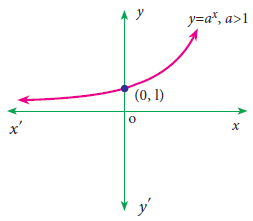
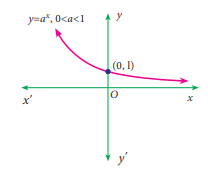
We know that, domain set is R, range set is (0, \(\infty\)) and the curve passing through the point (0, 1)
Case (i) when a > 1
\(y=f(x)=a^x= \begin{cases}<1 & \text { if } x<0 \\ =1 & \text { if } x=0 \\ >1 & \text { if } x>0\end{cases}\)
We noticed that as x increases, y is also increases and y > 0
\(\therefore \) The graph is as shown in the figure.
Case (ii) when 0 < a < 1
\(y=f(x)=a^x= \begin{cases}>1 & \text { if } x>0 \\ =1 & \text { if } x=0 \\ <1 & \text { if } x>0\end{cases}\)
We noticed that as x increases, y decreases and y > 0
\(\therefore \) The graph is as shown in the figure
31.
\(\cos 75^{\circ}+\cos 45^{\circ}=2 \cos \left(\frac{75^{\circ}+45^{\circ}}{2}\right) \cos \left(\frac{75^{\circ}-45^{\circ}}{2}\right)\)
\(=2 \cos \left(\frac{120^{\circ}}{2}\right) \cos \left(\frac{30^{\circ}}{2}\right)\)
\(=2 \cos 60^{\circ} \cos 15^{\circ}\)
\(=2 \times \frac{1}{2} \cos 15^{\circ}=\cos 15^{\circ}\)
32.
Aij = (–1)i+jMij
A11 = (–1)1+1M11 = \(\left| \begin{matrix} 1 & 0 \\ 1 & 0 \end{matrix} \right| \) = 0
A12 = (–1)1+2M12 = \(-\left| \begin{matrix} 0 & 0 \\ -4 & 0 \end{matrix} \right| \) = 0
A13 = (–1)1+3M13 = \(\left| \begin{matrix} 0 & 1 \\ -4 & 1 \end{matrix} \right| \)= 0 - (-4) = 4
A21 = (–1)2+1M21 = \(-\left| \begin{matrix} -2 & -3 \\ 1 & 0 \end{matrix} \right| \)= -(0 - (-3)) = -3
A22 = (–1)2+2M22 = \(\left| \begin{matrix} 1 & -3 \\ -4 & 0 \end{matrix} \right| \) = 0 - 12 = -12
A23 = (–1)2+3M23 = \(-\left| \begin{matrix} 1 & -2 \\ -4 & 1 \end{matrix} \right| \) = -(1-8) = 7
A31 = (–1)3+1M31 = \(\left| \begin{matrix} -2 & -3 \\ 1 & 0 \end{matrix} \right| \) = 0 - (-3) = 3
A32 = (–1)3+2M32 = \(-\left| \begin{matrix} 1 & -3 \\ 0 & 0 \end{matrix} \right| \) = 0 - 0 = 0
A33 = (–1)3+3M33 = \(\left| \begin{matrix} 1 & -2 \\ 0 & 1 \end{matrix} \right| \) = 1 - 0 = 1
\(\left[ { A }_{ ij } \right] =\left[ \begin{matrix} 0 & 0 & 4 \\ -3 & -12 & 7 \\ 3 & 0 & 1 \end{matrix} \right] \)
Adj A = [Aij]T
\(=\left[ \begin{matrix} 0 & -3 & 3 \\ 0 & -12 & 0 \\ 4 & 7 & 1 \end{matrix} \right] \)
33.
Minor of 1 = M11 = 3
Minor of − 2 = M12 = 4
Minor of 4 = M21 = − 2
Minor of 3 = M22 = 1
Cofactor of 1 = A11 = (-1)1+1M11 = 3
Cofactor of -2 = A12 = (-1)1+2M12 = -4
Cofactor of 4 = A21 = (-1)2+1M21 = 2
Cofactor of 3 = A22 = (-1)2+2M22 = 1
34.
Since the decision variables are non-negative, the solution lies in the I quadrant of the plane.
Consider the equations
\({ x }_{ 1 }-{ x }_{ 2 }=-1\)
| \({ x }_{ 1 }\) | 0 | 1 |
| \({ x }_{ 2 }\) | 1 | 2 |
\({ -x }_{ 1 }+{ x }_{ 2 }=0\)
| \({ x }_{ 1 }\) | 2 | 1 |
| \({ x }_{ 2 }\) | 2 | 1 |
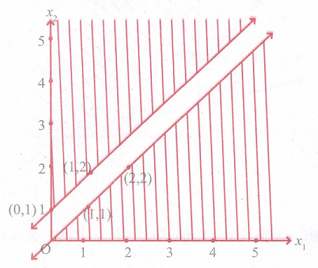
The feasible region is not common. Thus, there is no maximum value of Z.
35.
Given A = Rs.3783,i = 0.05,n = 3
A = \(\cfrac { a }{ i } \left[ \left( 1+i \right) ^{ n }-1 \right] \)
3783 = \(\cfrac { a }{ i } \) [(1.05)3-1]
3783 x 0.05 = a[1.1576-1]
a = \(\cfrac { 189.15 }{ 0.1576 } \) = 1200.19
\(\therefore\) a =Rs.1200
(1.05)3 = 3 log (1.05)
= 3(0.212)
= 0.636
Antilog of 0.636 is 1.1576
36.
The regression co-efficient of X on Y is
bxy= \(\frac { N\sum { XY-(\sum { X)(\sum { Y) } } } }{ N.\sum { { Y }^{ 2 }-(\sum { { Y) }^{ 2 } } } } =\frac { 5(300)-(20)(40) }{ 5(345)-({ 40) }^{ 2 } } \)=5.6
Also, \(\bar {X}\) =\(\frac { \sum { X } }{ N } =\frac { 20 }{ 5 } \)=4
and \(\bar {Y}\)=\(\frac { \sum { Y } }{ N } =\frac { 40 }{ 5 } \)=8
\(\therefore\)The regression equation of X on Y is
X- \(\bar {X}\)=bxy(Y-\(\bar {Y}\) )
X-4=5.6(Y-8)
X-4=5.6Y-44.8
X=5.6Y-40.8
When Y=6, X=5.6(6)-40.8=33.6-40.8
\(\therefore\)X=-7.2
37.
| % Rise | x | log x |
|---|---|---|
| 5 | 105 | 2.0212 |
| 8 | 108 | 2.0334 |
| 77 | 177 | 2.2480 |
| \(\sum logx\) = 6.3026 |
GM = Antilog\(\left( \frac { \sum { logx } }{ n } \right) =Anitlog\left( \frac { 6.3026 }{ 3 } \right) =Antilog(2.1009)\)
GM = 126.2
\(\therefore\) Average increase of the commodity from 2004 to 2007
= 126.1 - 100 = 26.1%
38.
| Weight (x) | f | log x | flog x |
|---|---|---|---|
| 130 | 3 | 2.1139 | 6.3417 |
| 135 | 4 | 2.1303 | 8.5212 |
| 140 | 6 | 2.1461 | 12.8766 |
| 145 | 6 | 2.1614 | 12.9684 |
| 146 | 3 | 2.1644 | 6.4932 |
| 148 | 5 | 2.1703 | 10.8515 |
| 149 | 2 | 2.1732 | 4.3464 |
| 150 | 1 | 2.1761 | 2.1761 |
| 157 | 1 | 2.1959 | 2.1959 |
| N = 31 | \(\sqrt{\sum flogx}\) = 66.771 |
GM = Antilog\(\left( \frac { \sum { f\ log\ x } }{ N } \right) \)
\(=Anitlog\left( \frac { 66.771 }{ 31 } \right) \)
= 142.5 Ibs
39.
In both the series items are in small number. Therefore correlation coefficient can also be calculated without taking deviations from actual means or assumed mean.
| X | Y | X2 | Y2 | XY |
| 12 | 14 | 144 | 196 | 168 |
| 9 | 8 | 81 | 64 | 72 |
| 8 | 6 | 64 | 36 | 48 |
| 10 | 9 | 100 | 81 | 90 |
| 11 | 11 | 121 | 121 | 121 |
| 13 | 12 | 169 | 144 | 156 |
| 7 | 3 | 49 | 9 | 21 |
| ΣX = 70 | ΣY = 63 | ΣX2 = 728 | ΣY2 = 651 | ΣXY = 676 |
r = \(\frac { N\Sigma XY-(\Sigma X)(\Sigma Y) }{ \sqrt { N\Sigma X^{ 2 }-(\Sigma X)^{ 2 }\times \sqrt { N\Sigma { Y }^{ 2 }-(\Sigma Y)^{ 2 } } } } \)
= \(\frac { 7(676)-(70)(63) }{ \sqrt { 7(728)-(70)^{ 2 }\times \sqrt { 7(651)-(63)^{ 2 } } } } \)
= \(\frac { 322 }{ 339.48 } \)
r = +0.95
40.
Given that f(x) = 2x3 + 9x2 + 12x + 1.
f'(x) = 6x2 + 18x + 12
= 6(x2 + 3x + 2)
= 6(x + 2)(x + 1)
f'(x) = 0 \(\Rightarrow\) 6 (x + 2)(x + 1) = 0
\(\Rightarrow\) x + 2 = 0 (or) x + 1 = 0.
x = –2 (or) x = –1
f(x) has stationary points at x = – 2 and x = – 1
Stationary values are obtained by putting x = – 2 and x = – 1
When x = – 2, f(–2) = 2(–8) +9(4) + 12(–2) + 1 = –3
When x = – 1, f(–1) = 2(–1) + 9(1) + 12(–1) + 1 = –4
The stationary points are (–2, –3) and (–1,–4).
41.
(i) Variables: Let x1, x2 and x3 be the number of units of products P1, P2 and P3 to be produced.
(ii) Objective function: Profit on x1 units of the product P1 = 20 x1
Profit on x2 units of the product P2 = 25 x2
Profit on x3 units of the product P3 = 15 x3
Total profit = 20 x1 + 25 x2 + 15 x3
Since the total profit is to be maximized, we have to maximize Z = 20 x1 + 25 x2 + 15 x3
Constraints: 6x1 + 3x2 + 12x3 ≤ 200
2x1 + 5x2 + 4x3 ≤ 350
x1 + 2x2 + x3 ≤ 100
Non-negative restrictions: Since the number of units of the products A, B and C cannot be negative, we have x1, x2, x3 ≥ 0
Thus, we have the following linear programming model.
Maximize Z = 20 x1 + 25 x2 + 15 x3
Subject to 6 x1 + 3 x2 + 12 x3 ≤ 200
2x1 + 5x2 + 4x3 ≤ 350
x1 + 2x2 + x3 ≤ 100
x1, x2, x3 ≥ 0
42.
\(x={P\over p+5}\)
\({dx\over dp}={(p+5)-p\over (p+5)^2}\)
\(={5\over (p+5)^2}\)
Elasticity of supply: \(η_S={p\over x}.{dx\over dp}\)
\(=(p+5){5\over (p+5)^2} = {5\over (p+5)}\)
When p = 20, \(η_S={5\over 20+5}\) = 0.2
Interpretation:
i) If the price increases by 1% from p = Rs. 20, then the quantity of supply increases by 0.2% approximately.
ii) If the price decreases by 1% from p = Rs. 20, then the quantity of supply decreases by 0.2% approximately.
43.
Given equation of pair of lines is
12x2 + 7xy + ky2 + 13x - y + 3 = 0
2h = 7 2g = 13 2f = -1
\(\Rightarrow a=12,\quad h=\frac { 7 }{ 2 } ,b=k,\quad g=\frac { 13 }{ 2 } ,f=\frac { -1 }{ 2 } ,c=3\)
The condition to represent pair of lines is abc + 2fgh - af2 - bg2 - ch2 = 0
\((12)(k)(3)+2\left( \frac { -1 }{ 2 } \right) \left( \frac { 13 }{ 2 } \right) \left( \frac { 7 }{ 2 } \right) -12\left( \frac { 1 }{ 4 } \right) -k\left( \frac { 169 }{ 4 } \right) -3\left( \frac { 49 }{ 4 } \right) =0\)
\(\Rightarrow 36k-\frac { 91 }{ 4 } -3-\frac { 169k }{ 4 } -\frac { 147 }{ 4 } =0\)
\(\Rightarrow \frac { 144k-91-12-169k-147 }{ 4 } =0\)
\(\Rightarrow -25k-250=0\times 4=0\)
\(\Rightarrow -25k=250\)
\(\Rightarrow k=-10\)
44.
\(\left(x-\frac{2}{x^2}\right)^{15}\)
\(t_{r+1}=n C_r x^{n-r} a^r\)
\(=15 C_r(x)^{15-r}\left(\frac{-2}{x^2}\right)^r\)
\(=(-1)^r 15 C_r 2^r x^{15-r}\left(\frac{1}{x^{2 r}}\right)\)
\(=(-1)^r 15 C_r 2^r x^{15-r-2 r}\)
\(=(-1)^r 15 C_r 2^r x^{15-3 r}\)
To find the term independent of x, equate the power of x to 0
15 - 3r = 0
\(3 r=15 \Rightarrow r=\frac{15}{3}=5\)
\(t_{r+1}=(-1)^5 15 C_5 2^5\)
\(=-32\left(15 C_5\right)\)
45.
Let B = \(\begin{vmatrix} 1 &-3 &2 \\4 &-1&2\\3&5&2 \end{vmatrix}\)
Minor of 1 = M11 = \(\begin{vmatrix} -1 & 2 \\ 5 & 2 \end{vmatrix}=-2-10=-12\)
Minor of -3 = M12 = \(\begin{vmatrix}4 &2 \\ 3 & 2 \end{vmatrix}=8-6=2\)
Minor of 2 = M13 = \(\begin{vmatrix} 4 & -1 \\ 3 & 5\end{vmatrix}=20+3=23\)
Minor of 4 = M21 = \(\begin{vmatrix} -3 & 2 \\5 & 2 \end{vmatrix}=-6+10=-16\)
Minor of -1 = M22 = \(\begin{vmatrix}1 & 2 \\ 3 & 2 \end{vmatrix}=2-6=-4\)
Minor of 2 = M23 = \(\begin{vmatrix} 1& -3 \\3 &5 \end{vmatrix}=5+9=14\)
Minor of 3 = M31 = \(\begin{vmatrix} -3 &2 \\ -1 & 2 \end{vmatrix}=-6+2=-4\)
Minor of 3 = M32 = \(\left|\begin{array}{ll} 1 & 2 \\ 4 & 2 \end{array}\right|=2-8=-6\)
Minor of 2 = M33 = \(\begin{vmatrix} 1 & -3 \\4 & -1 \end{vmatrix}=-1+12=11\)
Co-factor of 1 = A11 = (-1)1+1 M11 = -12
Co-factor of -3 = A12 = (-1)1+2 M12 = -2
Co-factor of 2 = A13 = (-1)1+3 M13 = 23
Co-factor of 4 = A21 = (-1)2+1 M21 = 16
Co-factor of -1 = A22 = (-1)2+2 M22 = -4
Co-factor of 2 = A23 = (-1)2+3 M23 = -14
Co-factor of 3 = A31 = (-1)3+1 M31 = -4
Co-factor of 5 = A32 = (-1)3+2 M32 = 6
Co-factor of 2 = A33 = (-1)3+3 M33 = 11
46.
Given y = - x3 + 3x2 + 9x - 27 ...(1)
Differentiating w.r.t. 'x' we get,
\({dy\over dx}=-3x^2 + 6x + 9\)
∴ Slope of the tangent is - 3x2 + 6x + 9
Let M = - 3x2 + 6x + 9
\({dM\over dx}=-6x+6\) ..(2)
Slope is maximum when \({dM\over dx}=0\) and \({d^2M\over dx^2}<0\)
\({dM\over dx}=0⇒-6x+6=0⇒ -6x =- 6⇒x=1\)
\({d^2M\over dx^2}=-6<0\)
∴ Slope is maximum when x = 1
∴ Maximum slope= -3(1)2 + 6(1) + 9 = -3 + 15 = 12 [From (2)]
when x = 1, y = - (1)3 + 3(1)2 + 9(1) - 27
-1+3+9-27=-16 [From (1)]
∴ Maximum slope is 12 and the required point is (1, -16)
47.
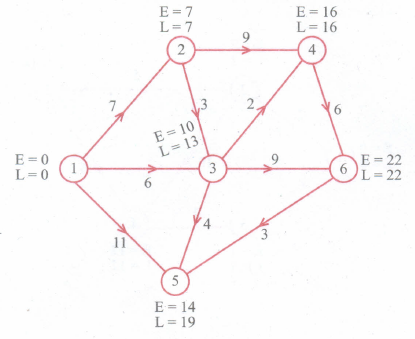
| E1 =0 | L6 =22 |
| E2 = 0+7=7 | L5 =(22 - 3) = 19 |
| E3 =(7 + 3) or (0 + 6) Whichever is maximum = 0 |
L4 =22 - 6 = 16 . |
| E4 =(7 + 9) or (10 + 2) Whichever is maximum=16 |
L3 =(22 - 9) or (16 - 8) Whichever is minimum=13 |
| E5 =(0+ 11)or(10+4) Whichever is maximum=14 |
L2 =16 - 9 = 7 |
| E6 =(16 + 6) or (10 + 9) or (14 + 3) Whichever is maximum = 22 |
L1 =7-7=0 |
| Activity | Duration | EST | EFT=EST+tij | LST | LFT |
|---|---|---|---|---|---|
| 1-2 | 7 | 0 | 7 | 7-7=0 | 7 |
| 1-3 | 6 | 0 | 6 | 13-6=7 | 13 |
| 1-5 | 11 | 0 | 11 | 19-11=8 | 19 |
| 2-3 | 3 | 7 | 10 | 13-3=10 | 13 |
| 2-4 | 9 | 7 | 16 | 16-9=7 | 16 |
| 3-4 | 2 | 13 | 15 | 19-4=15 | 16 |
| 3-5 | 4 | 13 | 17 | 19-4=15 | 19 |
| 3-6 | 9 | 10 | 19 | 22-9=13 | 22 |
| 4-6 | 6 | 16 | 22 | 22-6=16 | 22 |
| 5-6 | 3 | 14 | 17 | 22-3=19 | 22 |
EFT and LFT are same in the activity, 1 - 2, 2 - 4 and 4 - 6.
Hence the critical path is 1 - 2 - 4 - 6 and the project completion time is 22 Weeks.
48.
Let the amount invested in each stock be Rs.x
For 12% Stock
Investment =Rs.x
Purchased Price = 89+1 = 90
Income=\(\frac {\text { Investment} }{ \text {Purchase Price } }\) x Dividend Rate
=\(\frac { x }{ 90 } \times 12=\frac { 2x }{ 15 } \) ...(1)
For 8% Stock
Investment = Rs.x
market Price = 95+1= 96
Dividend Rate = 8%
Income=\(\cfrac { x }{ 96 } \times 8 =\cfrac { x }{ 12 } \) ...(2)
Difference in income = Rs.120
From (1) and (2), \(\cfrac { 2x }{ 15 } -\cfrac { x }{ 12 } \) = 120
\(x\left( \cfrac { 2 }{ 15 } -\cfrac { 1 }{ 12 } \right) \) = 120
\(x\left( \cfrac { 8-5 }{ 60 } \right) \) = 120
\(\cfrac { 3x }{ 60 } \) = 120
\(\Rightarrow\) x = \(\cfrac { 120\times 60 }{ 3 } \) = Rs.2400
Hence, investment in each stock is Rs.2400
49.
Given C =\({1\over5}x^2-6x+100\)
Differentiating w.r.t. 'x' we get,
\({dC\over dx}={1\over5}(2x)-6\)
\({dC\over dx}=0\)
\(\Rightarrow {2x\over 5}-6=0\)
\(\Rightarrow {2x\over 5}=6\)
\(\Rightarrow x={6\times5\over2}=15\)
Now \({d^2C\over dx^2}={2\over5}>0\)
\(\therefore\)Cost function is minimum when x = 15.
50.
Let the events E1, E2, E3 and A be defined as
E1 - Cars in the service station A
E2 - Cars in the service station B
E3 - Cars in the service station C
A is Event of failing to clean the glass
\(P({ E }_{ 1 })=\frac { 50 }{ 100 } ,P({ E }_{ 2 })=\frac { 30 }{ 100 } ,P({ E }_{ 3 })=\frac { 20 }{ 100 } \)
\(P(A/E_{ 1 })=\frac { 5 }{ 100 } ,P(A/{ E }_{ 2 })=\frac { 7 }{ 100 } ,P(A/{ E }_{ 3 })=\frac { 3 }{ 100 } \)
Probability that the glass is not cleaned = P(A)
= P(E1).P(A/E1)+P(E2).P(A/E2)+P(E3).P(A/E3)
\(=\frac { 50 }{ 100 } \times \frac { 5 }{ 100 } +\frac { 30 }{ 100 } \times \frac { 7 }{ 100 } +\frac { 20 }{ 100 } \times \frac { 3 }{ 100 } \)
\(=\frac { 250+210+60 }{ 10,000 } \)
\(=\frac { 520 }{ 10,000 } \)
= 0.052
Probability that glass is cleaned
= P(A') = 1 - P(A)
= 1 - 0.052 = 0.948
51.
Given \(sin\left( { sin }^{ -1 }\frac { 1 }{ 5 } +{ cos }^{ -1 }x \right) =1\)
⇒ \({ sin }^{ -1 }\left( \frac { 1 }{ 5 } \right) +{ cos }^{ -1 }(x)={ sin }^{ -1 }(1)=\frac { \pi }{ 2 } \)
⇒ \({ sin }^{ -1 }\left( \frac { 1 }{ 5 } \right) +{ cos }^{ -1 }(x)=\frac { \pi }{ 2 } \)
⇒ \({ sin }^{ -1 }\left( \frac { 1 }{ 5 } \right) =\frac { \pi }{ 2 } -{ cos }^{ -1 }(x)\)
⇒ \({ sin }^{ -1 }\left( \frac { 1 }{ 5 } \right) =sin^{ -1 }x\) \(\left[ \because { sin }^{ -1 }(x)+{ cos }^{ -1 }(x)=\frac { \pi }{ 2 } \right] \)
⇒ \({ sin }^{ -1 }\left( \frac { 1 }{ 5 } \right) =sin^{ -1 }x\)
⇒ \(x=\frac { 1 }{ 5 } \)
Thus, \(x=\frac { 1 }{ 5 } \) is a root of the given equation.
52.
\(\mathrm{LHS} =\cos 20^{\circ} \cos 40^{\circ} \cos 60^{\circ} \cos 80^{\circ} \)
\(=\cos 20^{\circ} \cos 40^{\circ}\left(\frac{1}{2}\right) \cos 80^{\circ}\)
\(=\frac{1}{2} \cos 20^{\circ}\left(\cos 40^{\circ} \cos 80^{\circ}\right)\)
\(=\frac{1}{2} \cos 20^{\circ}\left(\cos \left(60^{\circ}-20^{\circ}\right) \cos \left(60^{\circ}+20^{\circ}\right)\right)\)
\(=\frac{1}{2} \cos 20^{\circ}\left(\cos ^2 60^{\circ}-\sin ^2 20\right)\)
\(=\frac{1}{2} \cos 20^{\circ}\left(\frac{1}{4}-\left(1-\cos ^2 20^{\circ}\right)\right)\)
\(=\frac{1}{2} \cos 20^{\circ}\left(\frac{1-4+4 \cos ^2 20^{\circ}}{4}\right)\)
\(=\frac{1}{8}\left(4 \cos ^3 20^{\circ}-3 \cos 20^{\circ}\right)\)
\(=\frac{1}{8} \cos 3\left(20^{\circ}\right)=\frac{1}{8} \cos 60^{\circ}\)
\(=\frac{1}{8}\left(\frac{1}{2}\right)=\frac{1}{16}\)
Hence proved.
53.
Let P (n) be the statement. 1.3+2.32+3.3 + ... +n.3n = \({{(2n-1){3}^{n+1}+3}\over{4}} \) for all n \(\in\) N.
Step-1:
Put n = 1 \(\Rightarrow1.3(1){{(2-1){3}^{1+1}+3}\over{4}}={{3^2+3}\over{4}}={{12}\over{4}}\Rightarrow\ 3=3\)
\(\therefore\) P(1) is true.
Step-2:
Let us assume that P(k) is true
\(\therefore\) 1.3 + 2.32 + 3.33 + ... + k.3k = \({{(2k-1){3}^{k+1}+3}\over{4}}\) ....(1)
Step-3:
To prove that P (k + 1) is true i.e. to P.T. 1.3 + 2.32 + 3.33 + ... + k.3k + (k + 1)3k+1
\(={{[2(k+1)-1]{3}^{k+2}+3}\over{4}}={{(2k+1){3}^{k+2}+3}\over{4}}\)
LHS = 1.3 + 2.32 + ... + k.3k + (k+ 1)3k+ 1
\(={{(2k-1){3}^{k+1}+3}\over{4}}+(k+1){3}^{k+1}={{(2k+1){3}^{k+1}+3+(4k+3){3}^{k+1}}\over{4}}\)
\(={{{3}^{k+1}(2k-1+4k+4)+3}\over{4}}={{{3}^{k+1}(6k+3)+3}\over{4}}={{{3}^{k+1}(2k+1)+3}\over{4}}={{{3}^{k+2}(2k+1)+3}\over{4}}\) = RHS
\(\therefore\) P (k + 1) is true whenever P(k) is true.
\(\therefore\) By mathematical induction, P(n) is true for all values n.
54.
Let x and y represent the number of units produced and the cost of production respectively. By the given data.
x1 (500) y1 (6000)
x2 (1000) y2 (9000)
Equation of straight line is
\(\frac { y-{ y }_{ 1 } }{ { y }_{ 2 }-{ y }_{ 1 } } =\frac { x-{ x }_{ 1 } }{ { x }_{ 2 }-{ x }_{ 1 } } \)
\(\Rightarrow \frac { y-6000 }{ 9000-6000 } =\frac { x-500 }{ 1000-500 } \)
\( { y-6000 }{ } =\frac { 3000 }{ 500 } (x - 500)\)
\(\Rightarrow\) y - 6000 = 6(x - 500)
\(\Rightarrow\) y - 6000 = 6x - 3000
\(\Rightarrow\) y = 6x + 3000

11th Standard Syllabus & Materials
11th Standard
TN 11th Tamil பீடு பெற நில் - செய்யுள் - காவடிச்சிந்து Important Questions And Answers Study Material - QB365 Set A
NEW11th Standard
TN 11th Tamil பீடு பெற நில் - உரைநடை - மலை இடப்பெயர்கள் : ஓர் ஆய்வு Important Questions And Answers Study Material - QB365 Set A
NEW11th Standard
TN 11th Tamil மாமழை போற்றுதும் - துணைப்பாடம் - யானை டாக்டர் Important Questions And Answers Study Material - QB365 Set A
NEW11th Standard
TN 11th Tamil மாமழை போற்றுதும் - செய்யுள் - ஐங்குறுநூறு Important Questions And Answers Study Material - QB365 Set A



Tamilnadu Stateboard 11th Standard Subjects

Maths

Commerce

Economics

Biology
Business Maths and Statistics

Accountancy

Computer Science

Physics

Chemistry
Maths
Biology
Economics
Physics
Chemistry

History
Business Maths and Statistics

Computer Science
Accountancy

Computer Applications
History
Computer Technology
Commerce
Computer Applications
Computer Technology

Tamil

English

French
Tamilnadu Stateboard Standards
