
 100% FREE ACCESS
11th Standard Syllabus & Materials
11th Standard
TN 11th Tamil இயற்கை வேளாண்மை,சுற்றுச்சூழல் -செய்யுள் - மனோன்மணீயம் Important Questions And Answers Study Material - QB365 Set A
NEW11th Standard
TN 11th Tamil என்னுயிர் என்பேன் -துணைப்பாடம் - இசைத்தமிழர் இருவர் Important Questions And Answers Study Material - QB365 Set A
NEW11th Standard
TN 11th Tamil மொழி கலை -செய்யுள் - ஒவ்வொரு புல்லையும் Important Questions And Answers Study Material - QB365 Set A
NEW11th Standard
TN 11th Tamil பீடு பெற நில் - இலக்கணம் - பகுபத உறுப்புகள் Important Questions And Answers Study Material - QB365 Set A
NEW11th Standard
TN 11th Tamil பீடு பெற நில் - துணைப்பாடம் - வாடிவாசல் Important Questions And Answers Study Material - QB365 Set A
NEW11th Standard
TN 11th Tamil பீடு பெற நில் - செய்யுள் - குறுந்தொகை Important Questions And Answers Study Material - QB365 Set A

Published on: 19/02/2019
+1 Public Model Exam 2019
Download Tamil Nadu 11th Standard Business Maths and Statistics question papers, model tests, one-mark questions, important questions, and public exam papers in PDF format. Free study materials and answer keys for TN State Board students.
Questions + Answers key
Take MCQ Business Maths and Statistics Test
1.
The probability of obtaining an even prime number on each die, when a pair of dice is rolled is _________.
1/36
0
1/3
1/6
2.
Harmonic mean is better than other means if the data are for _________.
Speed or rates.
Heights or lengths.
Binary values like 0 and 1
Ratios or proportions.
3.
The present value of the perpetual annuity of Rs. 2000 paid monthly at 10 % compound interest is _______.
Rs. 2,40,000
Rs. 6,00,000
Rs. 20,40,000
Rs. 2,00,400
4.
Purchasing price of one share of face value 100 available at a discount of \(9\frac{1}{2}\%\) with brokerage \(\frac{1}{2}\%\) is ________.
Rs. 89
Rs. 90
Rs. 91
Rs. 95
5.
The correlation coefficient from the following data N = 25, ΣX = 125, ΣY = 100, ΣX2 = 650, ΣY2 = 436, ΣXY = 520 ________.
0.667
-0.006
-0.667
0.70
6.
If r(X,Y) = 0 the variables X and Y are said to be ______.
Positive correlation
Negative correlation
No correlation
Perfect positive correlation
7.
If f(x,y) is a homogeneous function of degree n, then \(x\frac { \partial f }{ \partial x } +y\frac { \partial f }{ \partial y } \) is equal to ________.
(n–1)f
n(n–1)f
nf
f
8.
The elasticity of demand for the demand function x = \(\frac { 1 }{ p } \) is______.
0
1
\(-\frac { 1 }{ p } \)
\(\infty \)
9.
Which of the following is not correct?
Objective that we aim to maximize or minimize
Constraints that we need to specify
Decision variables that we need to determine
Decision variables are to be unrestricted
10.
A solution which maximizes or minimizes the given LPP is called ______.
a solution
a feasible solution
an optimal solution
none of these
11.
If y = x and z = \(\frac{1}{x}\) then \(\frac{dy}{dz}=\)________.
x2
1
-x2
\(-\frac{1}{x^2}\)
12.
If the function f(x) is continuous at x = a if \(\lim _{ x\rightarrow a }{ f\left( x \right) } \) is equal to ________.
f(-a)
f\((\frac{1}{a})\)
2f(a)
f(a)
13.
If \(\tan A=\frac{1}{2}\) and \(\tan B=\frac{1}{3}\) then tan(2A + B) is equal to ______.
1
2
3
4
14.
The value of \(cosec^{-1}\left(\frac{2}{\sqrt{3}}\right)\) is ________.
\(\frac{\pi}{4}\)
\(\frac{\pi}{2}\)
\(\frac{\pi}{3}\)
\(\frac{\pi}{6}\)
15.
The locus of the point P which moves such that P is at equidistance from the coordinate axes is _______.
\(y={1\over x}\)
y = -x
y = x
\(y=-{1\over x}\)
16.
The slope of the line 7x + 5y - 8 = 0 is _______.
7/5
-7/5
5/7
-9/7
17.
Number of words with or without meaning that can be formed using letters of the word "EQUATION" , with no repetition of letters is _____.
7!
3!
8!
5!
18.
If nC3 = nC2, then the value of nC4 is _______.
2
3
4
5
19.
Which of the following matrix has no inverse.
\(\begin{pmatrix} -1 & 1 \\ 1 &-4 \end{pmatrix}\)
\(\begin{pmatrix} 2 & -1 \\ -4 &2 \end{pmatrix}\)
\(\begin{pmatrix} cos\ a & sin\ a \\ -sin\ a & cos\ a \end{pmatrix}\)
\(\begin{pmatrix} sin\ a & cos\ a \\ -cos\ a & sin\ a \end{pmatrix}\)
20.
The number of Hawkins-Simon conditions for the viability of an input - output analysis is ________.
1
3
4
2
21.
Verify the existence of the function \(f(x)=\left\{\begin{array}{l} 5 x-4 \text { if } 0< x \leq 1 \\ 4 x^3-3 x \text { if } 1< x< 2 \end{array} \text { at } x=1\right.\)
22.
Convert the following into the product of trigonometric functions cos55o + sin 55o
23.
The technology matrix of an economic system of two industries is \(\left[ \begin{matrix} 0.8 & 0.2 \\ 0.9 & 0.7 \end{matrix} \right] \) Test whether the system is viable as per Hawkins – Simon conditions.
24.
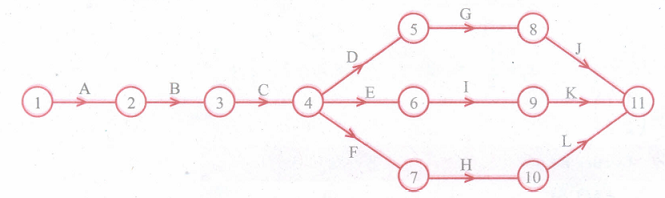
Construct the network for the projects consisting of various activities and their precedence relationships are as given below:
| Immediate Predecessor | A | B | C | D | E | F | G | H | I |
| Activity | B | C | D,E,F | G | I | H | J | K | L |
25.
A man wishes to pay back his depts of Rs.3783 due after 3 years by 3 equal yearly instalments. Find the amount of each instalments,money being worth 5% p.a. compounded annually
26.
Calculate the correlation co-efficient from the below data:
| X | 1 | 2 | 3 | 4 | 5 | 6 | 7 | 8 | 9 |
| Y | 9 | 8 | 10 | 12 | 11 | 13 | 14 | 16 | 5 |
27.
Calculate Quartile deviation and Coefficient of Quartile deviation of the following data.
| Marks: | 0 | 10 | 20 | 30 | 40 | 50 | 60 | 70 |
| No. of students: | 150 | 142 | 130 | 120 | 72 | 30 | 12 | 4 |
28.
The production function for a commodity is P = 10L + 0.1 L2 +15K-0.2K2 +2KL where L is labour and K is Capital.
(i) Calculate the marginal products of two inputs when 10 units of each of labour and Capital are used
(ii) If 10 units of capital are used, what is the upper limit for use of labour which a rational producer will never exceed?
29.
Find the stationary values and stationary points for the function f(x) = 2x3 + 9x2 + 12x + 1
30.
Find the locus of a point such that the sum of its distances from the points (0, 2) and (0, -2) is 6.
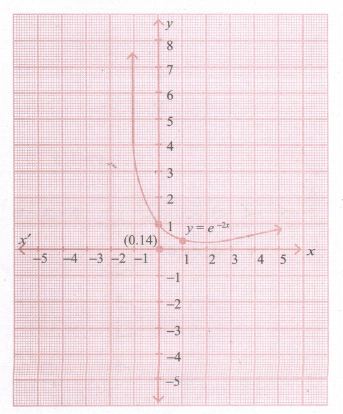
31.
Draw the graph of the following function f(x) = e-2x
32.
If the equation ax2 + 5xy - 6y2 + 12x + 5y + c = 0 represents a pair of perpendicular straight lines, find a and c.
33.
Find the middle terms in the expansion of \({ \left( { 2x }^{ 2 }-\frac { 3 }{ { x }^{ 3 } } \right) }^{ 10 }\)
34.
Evaluate the following using binomial theorem: (101)4
35.
The total revenue (TR) for commodity x is \(TR=12x+{x^2\over2}-{x^3\over 3}\)S.T. at the highest point of average revenue (AR), AR = MR
36.
Reshma wishes to mix two types of food P and Q in such a way that the Vitamin contents of the mixture contain at least 8 units of vitamin A and 11 units of vitamin B. Food P costs Rs.60/kg and Food Q costs Rs.80/kg. Food P contains 3 units 1 kg of vitamin A and 5 units 1 kg of vitamin B while food Q contains 4 units 1 kg of vitamin A and 2 units 1 kg of vitamin B. Determine the minimum cost of the mixture.
37.
a bank pays 8% interest compounded quarterly. Determine the equal deposits to be made at the end of each quarter for 3 years so as to receive Rs.300 at the end of 3 years.
38.
Find the maximum and minimum values of x3-6x2+7
39.
Compute upper Quartiles, lower Quartiles, D4 and P60, P75 from the following data.
| CI | 10-20 | 20-30 | 30-40 | 40-50 | 50-60 | 60-70 | 70-80 |
| Frequency | 12 | 19 | 5 | 10 | 9 | 6 | 6 |
40.
Calculate correlation coefficient for the following data.
| X | 25 | 18 | 21 | 24 | 27 | 30 | 36 | 39 | 42 | 48 |
| Y | 26 | 35 | 48 | 28 | 20 | 36 | 25 | 40 | 43 | 39 |
41.
A project schedule has the following characteristics
| Activity | 1-2 | 1-3 | 2-4 | 3-4 | 3-5 | 4-9 | 5-6 | 5-7 | 6-8 | 7-8 | 8-10 | 9-10 |
| Time | 4 | 1 | 1 | 1 | 6 | 5 | 4 | 8 | 1 | 2 | 5 | 7 |
Construct the network and calculate the earliest start time, earliest finish time, latest start time and latest finish time of each activity and determine the Critical path of the project and duration to complete the project.
42.
Prove that (sin 3x + sin x) sin x + (cos 3x - cos x) cos x = 0.
43.
Using the principle of mathematical induction, prove that 1.3 + 2.32 + 3.33 + ... + n.3n =\(\frac { (2n-1){ 3 }^{ n+1 }+3 }{ 4 } for\ all\ n\in N\)
44.
Prove that \(\frac{\cos4x+\cos3x+\cos2x}{\sin4x+\sin3x+\sin2x}=\cot3x\)
45.
Two commodities A and B are produced such that 0.4 tonne of A and 0.7 tonne of B are required to produce a tonne of A. Similarly 0.1 tonne of A and 0.7 tonne of B are needed to produce a tonne of B. Write down the technology matrix. If 68 tonnes of A and 10.2 tonnes of B are required, find the gross production of both of them.
46.
Resolve into partial fractions for the following : \(\frac{x+2}{(x-1)(x+3)^2}\)
47.
Find \(\frac{dy}{dx}\) if x = at2, y = 2at
48.
Evaluate\(\left| \begin{matrix} 1 & 3 & 4 \\ 102 & 18 & 36 \\ 17 & 3 & 6 \end{matrix} \right| \)
49.
A retired person has Rs. 70,000 to invest and two types of bonds are available in the market for investment. First type of bond yields an annual income of 8% on the amount invested and the second type yields 10% per annum. As per norms, he has to invest a minimum of Rs. 10,000 in the first type and not more than Rs.30,000 in the second type. How should he plan his investment, so as to get maximum returns after one year of investment? Formulate the above as LPP.
50.
A die is thrown twice and the sum of the number appearing is observed to be 6. What is the conditional probability that the number 4 has appeared at least once?
51.
Find the number of shares which will give an annual income of Rs. 3,600 from 12% stock of face value Rs. 100.
52.
From the following data calculate the correlation coefficient Σxy = 120, Σx2 = 90, Σy2 = 640
53.
Evaluate : \(\cos\left[\frac{\pi}{3}-\cos^{-1}\left(\frac{1}{2}\right)\right]\)
54.
Find the acute angle between the lines 2x - y + 3 = 0 and x + y + 2 = 0.
1.
A = {(2, 2)}, n(S) = 36; P(A) = 1/36
2.
(a)
Speed or rates.
3.
\(P =\frac{\frac{a}{i}}{k} \)
\(=\frac{\frac{2000}{0.1}}{12}=2,40,000\)
4.
\(\text { M.V }=100-9 \frac{1}{2}+\frac{1}{2}=Rs.91\)
5.
\(r =\frac{N \Sigma X Y-\Sigma X \Sigma Y}{\sqrt{N \Sigma X^2-(\Sigma X)^2} \sqrt{N \Sigma Y^2-(\Sigma Y)^2}} \)
\(=\frac{25(520)-(125)(100)}{\sqrt{25(650)-(125)^2} \sqrt{25(436)-(100)^2}} \)
= 0.667
6.
(c)
No correlation
7.
(c)
nf
8.
\(\eta_d=-\frac{p}{x} \frac{d x}{d p}=\frac{-p}{\frac{1}{p}}\left(\frac{-1}{p^2}\right)=1\)
9.
(d)
Decision variables are to be unrestricted
10.
(c)
an optimal solution
11.
\(\frac{d y}{d x}=1, \frac{d z}{d x}=\frac{-1}{x^2} \quad \frac{d y}{d z}=-x^2\)
12.
(d)
f(a)
13.
\(\tan 2 A= \frac{2 \tan A}{1-\tan ^2 A}=\frac{2(1 / 2)}{1-1 / 4}=\frac{1}{3 / 4}=4 / 3 \)
\(\tan (2 A+B)= \frac{\tan 2 A+\tan B}{1-\tan 2 A \cdot \tan B}=\frac{\frac{4}{3}+\frac{1}{3}}{1-4 / 9} \)
\(=\frac{5 / 3}{5 / 9}=3 \)
14.
(c)
\(\frac{\pi}{3}\)
15.
(c)
y = x
16.
\(m=\frac{-a}{b}=\frac{-7}{5}\)
17.
(c)
8!
18.
x + y = n
3 + 2 = 5 = n
nC4 = 5C4 = 5C1 = 5
19.
\(\text {Since }|A|=4-4=0\)
20.
(d)
2
21.
\(L\left[ f(x) \right] _{ x=1 }=\underset { x\rightarrow { 1 }^{ - } }{ lim } f\left( x \right) \\ =\underset { h\rightarrow 0 }{ lim } f\left( 1-h \right) ,x=1-h\\ =\underset { h\rightarrow 0 }{ lim } \left[ 5\left( 1-h \right) -4 \right] \\ =\underset { h\rightarrow 0 }{ lim } \left( 1-5h \right) =1\)
\(R\left[ f\left( x \right) \right] _{ x=1 }=\underset { x\rightarrow { 1 }^{ + } }{ lim } f(x)\\ =\underset { h\rightarrow 0 }{ lim } f\left( 1+h \right) ,x=1+h\\ =\underset { h\rightarrow 0 }{ lim } \left[ 4\left( 1+h \right) ^{ 3 }-3\left( 1+h \right) \right] \\ =4\left( 1 \right) ^{ 3 }-3\left( 1 \right) =1\)
Clearly,\(L\left[ f(1) \right] =R\left[ f(1) \right] \)
\(\therefore \underset { x\rightarrow 1 }{ lim } f\left( x \right) \) exists and equal to 1
22.
\(\cos 55^{\circ}+\sin 55^{\circ}=\cos 55^{\circ}+\cos \left(90^{\circ}-55^{\circ}\right)\)
\(=\cos 55^{\circ}+\cos 35^{\circ}\)
\(=2 \cos \left(\frac{55^{\circ}+35^{\circ}}{2}\right) \cos \left(\frac{55^{\circ}-35^{\circ}}{2}\right)\)
\(=2 \cos 45^{\circ} \cos 10^{\circ}=2\left(\frac{1}{\sqrt{2}}\right) \cdot \cos 10^{\circ}\)
\(=\sqrt{2} \cos 10^{\circ}\)
23.
B = \(\left[ \begin{matrix} 0.8 & 0.2 \\ 0.9 & 0.7 \end{matrix} \right] \)
I - B=\(\left[ \begin{matrix} 1 & 0 \\ 0 & 1 \end{matrix} \right] \)-\(\left[ \begin{matrix} 0.8 & 0.2 \\ 0.9 & 0.7 \end{matrix} \right] \)
=\(\left[ \begin{matrix} 0.2 & -0.2 \\ - 0.9 & 0.3 \end{matrix} \right] \)
|I - B|= \(\left[ \begin{matrix} 0.2 & -0.2 \\ - 0.9 & 0.3 \end{matrix} \right] \)
= (0.2)(0.3) - (-0.2)(-0.9)
= 0.06 - 0.18
= 0.12 < 0
Since |I - B| is negative, Hawkins – Simon conditions are not satisfied.
Therefore, the given system is not viable.
24.
25.
Given A = Rs.3783,i = 0.05,n = 3
A = \(\cfrac { a }{ i } \left[ \left( 1+i \right) ^{ n }-1 \right] \)
3783 = \(\cfrac { a }{ i } \) [(1.05)3-1]
3783 x 0.05 = a[1.1576-1]
a = \(\cfrac { 189.15 }{ 0.1576 } \) = 1200.19
\(\therefore\) a =Rs.1200
(1.05)3 = 3 log (1.05)
= 3(0.212)
= 0.636
Antilog of 0.636 is 1.1576
26.
| X | Y | X2 | Y2 | XY |
| 1 | 9 | 1 | 81 | 9 |
| 2 | 8 | 4 | 64 | 16 |
| 3 | 10 | 9 | 100 | 30 |
| 4 | 12 | 16 | 144 | 48 |
| 5 | 11 | 25 | 121 | 55 |
| 6 | 13 | 36 | 169 | 78 |
| 7 | 14 | 49 | 196 | 98 |
| 8 | 16 | 64 | 256 | 128 |
| 9 | 15 | 81 | 225 | 135 |
| 45 | 108 | 285 | 1356 | 597 |
r(x,y) =\(\frac { N\sum { XY-(\sum { X)(\sum { Y) } } } }{ \sqrt { N.{ \sum { X } }^{ 2 }-({ \sum { X) } }^{ 2 } } .\sqrt { N.{ \sum { Y } }^{ 2 }-{ (\sum { Y) } }^{ 2 } } } \)
=\(\frac { 9(597)-45(108) }{ \sqrt { 9(285)-{ (45) }^{ 2 } } .\sqrt { 9(1356)-({ 108) }^{ 2 } } } \)
=0.95
\(\therefore\)X and Y are highly positively correlated.
27.
| x | f | c.f |
| 0 | 150 | 150 |
| 10 | 142 | 292 |
| 20 | 130 | 422 |
| 30 | 120 | 542 |
| 40 | 72 | 614 |
| 50 | 30 | 644 |
| 60 | 12 | 656 |
| 70 | 4 | 660 |
| N = 660 |
Q1 = Size of \({ \left( \frac { N+1 }{ 4 } \right) }^{ th }\) value
= Size of (165.25)th value = 10
Q3 = Size of 3\({ \left( \frac { N+1 }{ 4 } \right) }^{ th }\)value
= size of (495.75)th value = 30
Q.D = \(\frac { 1 }{ 2 } ({ Q }_{ 3 }-{ Q }_{ 1 })=\frac {30-10}{2}=\frac { 20 }{ 2 } =10\)
Co-efficient of Q.D = \(\frac { { Q }_{ 3 }-{ Q }_{ 1 } }{ { Q }_{ 3 }+{ Q }_{ 1 } } =\frac { 20 }{ 40 } =\frac { 1 }{ 2 } \) = 0.5
28.
Given the production is P = 10L - 0.1L2 +15K - 0.2K2 + 2KL
\(\frac { \partial P }{ \partial L } \) = 10 - 0.2L + 2K
\(\frac { \partial P }{ \partial K } \) = 15 - 0.4 k + 2L
When L = K = 10 units,
Marginal productivity of labour
\(\left( \frac { \partial P }{ \partial L } \right) _{ 10,10 }\) = 10 - 2 +20 = 28
Marginal productivity of capital :
\(\left( \frac { \partial P }{ \partial K } \right) _{ 10,10 }\) = 15 - 4 + 20 =31
(ii) Upper limit for use of labour when K=10 is given by \(\left( \frac { \partial P }{ \partial L } \right) \)\(\ge\)0
10 − 0.2L+20 \(\ge\)0
30 \(\ge\) 0.2L
i.e., L \(\le\) 150
Hence the upper limit for the use of labour will be 150 units.
29.
Given that f(x) = 2x3 + 9x2 + 12x + 1.
f'(x) = 6x2 + 18x + 12
= 6(x2 + 3x + 2)
= 6(x + 2)(x + 1)
f'(x) = 0 \(\Rightarrow\) 6 (x + 2)(x + 1) = 0
\(\Rightarrow\) x + 2 = 0 (or) x + 1 = 0.
x = –2 (or) x = –1
f(x) has stationary points at x = – 2 and x = – 1
Stationary values are obtained by putting x = – 2 and x = – 1
When x = – 2, f(–2) = 2(–8) +9(4) + 12(–2) + 1 = –3
When x = – 1, f(–1) = 2(–1) + 9(1) + 12(–1) + 1 = –4
The stationary points are (–2, –3) and (–1,–4).
30.
Let P(x1, y1) be any point on the locus and let A(0, 2) B(0, -2) be the fixed points.
By the given condition, PA + PB =6
\(\Rightarrow \sqrt { { \left( { x }_{ 1 }-0 \right) }^{ 2 }+{ \left( { y }_{ 1 }-2 \right) }^{ 2 } } +\sqrt { { ({ x }_{ 1 }-0 })^{ 2 }+{ ({ y }_{ 1 }+2) }^{ 2 } } =6\)
\(\Rightarrow \sqrt { { x }_{ 1 }^{ 2 }+{ ({ y }_{ 1 }-2) }^{ 2 } } =6-\sqrt { { x }_{ 1 }^{ 2 }+{ ({ y }_{ 1 }+2) }^{ 2 } } \)
Squaring both sides we get,
\({ x }_{ 1 }^{ 2 }+{ ({ y }_{ 1 }-2) }^{ 2 }=36-12\sqrt { { x }_{ 1 }^{ 2 }+({ y }_{ 1 }+2)^{ 2 } } +{ x }_{ 1 }^{ 2 }+{ ({ y }_{ 1 }+2) }^{ 2 }\)
\(\Rightarrow \quad { x }_{ 1 }^{ 2 }+{ y }_{ 1 }^{ 2 }+4-4{ y }_{ 1 }=36-12\sqrt { { x }_{ 1 }^{ 2 }+{ ({ y }_{ 1 }+2) }^{ 2 } } +{ x }_{ 1 }^{ 2 }+{ y }_{ 1 }^{ 2 }+4+4{ y }_{ 1 }\)
\(\Rightarrow \quad { x }_{ 1 }^{ 2 }+{ y }_{ 1 }^{ 2 }+4-4{ y }_{ 1 }-36-{ x }_{ 1 }^{ 2 }-{ y }_{ 1 }^{ 2 }-4-4{ y }_{ 1 }=-12\sqrt { { x }_{ 1 }^{ 2 }+{ ({ y }_{ 1 }+2) }^{ 2 } } \)
= -8y1 - 36 = -12 \(\sqrt { { x }_{ 1 }^{ 2 }+{ ({ y }_{ 1 }+2) }^{ 2 } } \)
= 2y1 + 9 = 3\(\sqrt { { x }_{ 1 }^{ 2 }+{ ({ y }_{ 1 }+2) }^{ 2 } } \)
Squaring again we get,
(2y1+9)2 = 9[\({ x }_{ 1 }^{ 2 }+({ y }_{ 1 }+2)^{ 2 }]\)
\(\Rightarrow 4{ y }_{ 1 }^{ 2 }+81+36{ y }_{ 1 }=9[{ x }_{ 1 }^{ 2 }+{ y }_{ 1 }^{ 2 }+4+4{ y }_{ 1 }]\)
\(\Rightarrow 4{ y }_{ 1 }^{ 2 }+81+36{ y }_{ 1 }-9{ x }_{ 1 }^{ 2 }-9{ y }_{ 1 }^{ 2 }-36-36{ y }_{ 1 }=0\)
\(\Rightarrow -9{ x }_{ 1 }^{ 2 }-5{ y }_{ 1 }^{ 2 }+45=0\)
\(\Rightarrow 9{ x }_{ 1 }^{ 2 }+5{ y }_{ 1 }^{ 2 }=45\)
\(\therefore \) Locus of (x1 , y1) is 9x2 + 5y2 = 45
31.
If x = 0, y = 1. The curve cuts the y axis at (0,1)
The curve will not meet the x axis for all real values of x
32.
Compare the equation ax2 + 5xy - 6y2 + 12x + 5y + c = 0 with
ax2 + 2hxy + by2 + 2gx + 2fy + c = 0
We get a = a, 2h = 5, b = -6, 2g = 12, 2f = 5 c = c
\(h=\frac { 5 }{ 2 } \quad g=6\quad f=\frac { 5 }{ 2 } \)
since the lines are perpendicular
a + b = 0
\(\Rightarrow\) a - 6 = 0
\(\Rightarrow\) a = 6
since it represents a pair of straight lines
\(\left|\begin{array}{lll} a & h & g \\ h & b & f \\ g & f & c \end{array}\right|=0 \Rightarrow\left|\begin{array}{ccc} 6 & \frac{5}{2} & 6 \\ \frac{5}{2} & -6 & \frac{5}{2} \\ 6 & \frac{5}{2} & c \end{array}\right|=0\)
\(6\left(-6 c-\frac{25}{4}\right)-\frac{5}{2}\left(\frac{5 c}{2}-\frac{30}{2}\right)+6\left(\frac{25}{4}+36\right)=0 \)
\(=-36 c-\frac{150}{4}-\frac{25 c}{4}+\frac{150}{4}+\frac{150}{4}+216=0 \)
\(-36 c-\frac{25 c}{4}=\frac{-150}{4}-216 \)
\(\frac{-169 c}{4}=\frac{-1014}{4} \Rightarrow c=6 \)
33.
\(\left(2 x^2-\frac{3}{x^3}\right)^{10}\)
n = 10
middle term is \(t_{\frac{n}{2}+1}=t_{\frac{10}{2}+1}=t_6\)
r = 5
\(t_{r+1}=n C_{r x}^{n-r} a^r\)
\(t_6=10 C_5\left(2 x^2\right)^5\left(\frac{-3}{x^3}\right)^5\)
\(=-10 C_5 \frac{x^{10}}{x^{15}} 2^5 \cdot 3^5\)
\(=-10 C_5 \frac{(6)^5}{x^5}\)
34.
(101)4 = (100 + 1)4
= 4C0 (100)4 + 4C1 (100)3 (1)1 + 4C2 (100)2 (1)2 + 4 C3 (100)1 (1)3 + 4 C4(1)4
= 100,000,000 + 4 (1,000,000) + 6 (10000) + 4 (100) + 1
= 10,40,60,401
35.
Given \(TR=12x+{x^2\over2}-{x^3\over 3}\)
Average Revenue \(AR={TR\over x}={12x+x^2/2-x^3/3\over x}\)
\(AR=12+{x\over2}-{x^2\over3}\) ...(1)
Let y \(=12+{x\over2}-{x^2\over3}\)
\({dy\over dx}={1\over2}-{2x\over 3}\)
Condition for maximum is
\({dy\over dx}=0\ and\ {d^2 y\over dx^2}<0\)
\(∴\ {1\over2}-{2x\over3}=0⇒{1\over2}={2x\over 3}\)
\(x={1\over2}\times{3\over 2}={3\over 4}\)
\({d^2y\over dx^2}={-2\over3}<0\)
∴ AR is maximum at x=3/4
when x=3/4, \(AR=12+{3/4\over2}-{\left(3/4\right)^2\over 3}\) [From )1)]
\(=12+{3\over8}-{9\over 48}=12.1875\) ....(2)
\(MR={{dR\over dx}}={d\over dx}\left(12x+{x^2\over 2}-{x^3\over 3}\right)=12+x-x^2\)
when x = 3/4, \(MR=12+{3\over 4}-\left(3\over4\right)^2=12+{3\over4}-{9\over 16}=12.1875 \) ..(3)
From (2) and (3), at the highest point of AR,
AR = MR = 12.1875
36.
Let Reshma mix x1 kg of food P and x2 kg of food Q to make the mixture.
Let Z be the total cost of mixture
| Food P | Food Q | Minimum requirement | |
|---|---|---|---|
| Vitamin A | 3 | 4 | 8 |
| Vitamin B | 5 | 2 | 11 |
| Cost | Rs.60 | Rs.80 |
Thus, the mathematical formation of the given LPP is minimize Z = 60x1+ 80x2
Subject to the constraints
\(3{ x }_{ 1 }+4{ x }_{ 2 }\ge 8\quad 5{ x }_{ 1 }+2{ x }_{ 2 }\ge 11\quad and\quad { x }_{ 1 },{ x }_{ 2 }\ge 0\)
Consider the equations
\(3{ x }_{ 1 }+4{ x }_{ 2 }=8\)
| \({ x }_{ 1 }\) | 0 | 8/3 |
| \({ x }_{ 2 }\) | 2 | 0 |
\(5{ x }_{ 1 }+2{ x }_{ 2 }=11\)
| \({ x }_{ 1 }\) | 0 | 8/3 |
| \({ x }_{ 2 }\) | 2 | 0 |
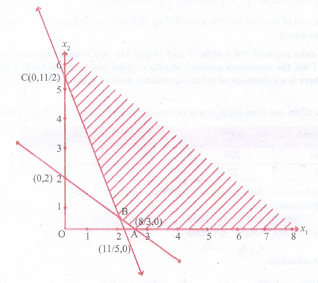
The feasible region is ABC and its co-ordinates are A\(\left( \frac { 8 }{ 3 } ,0 \right) \), C\(\left( 0,\ \frac { \pi }{ 2 } \right) \)and B is the point of intersection of the lines 3x1 + 4x2 = 8 ..... (1) and 5x1 + 2x2 = 11 .... (2)
Verification of B:
\((1) \Rightarrow 3{ x }_{ 1 }+4{ x }_{ 2 }=8\)
\( (-)\quad (-)\quad \quad (-)\)
\((2)\times 2\Rightarrow 10{ x }_{ 1 }+4{ x }_{ 2 }=22\)
\(--------------\)
\( -7x_{ 1 }=-14 \Rightarrow { x }_{ 1 }=2\)
\(From(1), 3(2)+4{ x }_{ 2 }=8\)
\(4{ x }_{ 2 }=8-6=2\Rightarrow { x }_{ 2 }=\frac { 1 }{ 2 } \)
\( \therefore \ B\ is\ \left( 2,\frac { 1 }{ 2 } \right) \)
| Corner Points | Z = 60x1+ 80x2 |
|---|---|
| A(8/3,0) | \(60\times \frac { 8 }{ 3 } =160\) |
| B (2, 1/2) | \(120+80\times \frac { 1 }{ 2 } =160\) |
| C(0,11/2) | \(80\times \frac { 11 }{ 2 } =440\) |
Minimum of Z occurs at \(A\left( \frac { 8 }{ 3 } ,0 \right) and\quad B\left( 2,\frac { 1 }{ 2 } \right) \)
Hence, least cost of mixture is n60 when 8/3 kg of food P and 0 kg of food Q and 2 kg of food P and 112kg of food Q are mixed
37.
Given A = Rs.3000,r =\(\cfrac { 8 }{ 100 } \times \cfrac { 1 }{ 4 } \) = 0.02,n = 3 x 4 =12
A=\(\cfrac { a }{ i } \left[ \left( 1+i \right) ^{ n }-1 \right] \)
3000=\(\cfrac { a }{ 0.02 } \left[ \left( 1.02 \right) ^{ 12 }-1 \right] \)
3000 x 0.02 = a[1.2690-1]
60 = a[0.2690]
a=\(\cfrac { 60 }{ 0.2690 } =223.04\)
a = Rs.223 (app)
(1.02)12 = 12 log (1.02)
= 12 (0.0086)
= 0.1032
Antilog of 0.1032 is 1.2690
38.
Let y=x3-6x2+7
Differentiating w.r.t. 'x' we get,
\({dy\over dx}=3x^2-12x\)
\({dy\over dx}=0\)
\(\Rightarrow3x^2-12x=0\)
\(\Rightarrow3x(x-4)=0\)
\(\Rightarrow x=0 \ or \ x=4\)
\({d^2y\over dx^2}=6x-12\)
when x=0 \({d^2y\over dx^2}=-12<0\)
\(\therefore \) y is maximum at x=0
\(\therefore \) maximum value=03-6(0)2+7=7
when x=4, \({d^2y\over dx^2}=-6(4)-12=12>0\)
\(\therefore \) y is minimum at x=4
\(\therefore \) Minimum value =44-6(4)2+7=64-96+7=-25
Hence maximum value is 7 and minimum value is -25.
39.
| CI | f | cf |
| 10-20 | 12 | 12 |
| 20-30 | 19 | 31 |
| 30-40 | 5 | 36 |
| 40-50 | 10 | 46 |
| 50-60 | 9 | 55 |
| 60-70 | 6 | 61 |
| 70-80 | 6 | N = 67 |
| N = 67 |
Q1 = Size of \(\left( \frac { N }{ 4 } \right) ^{th}\) value = \(\frac{67}{4}\) = 16.75th value.
Thus Q1 lies in the class (20 – 30) and its corresponding values are L = 20;
\(\frac{N}{4}\) = 16.75; pcf =12; f = 19 ; c = 10
Q1 = L + \(\left( \frac { \frac { N }{ 4 } -pcf }{ f } \right) \times c\)
Q1 = 20 +\(\left( \frac { 16.75-12 }{ 19 } \right) \times 10\) = 20 + 2.5 = 22.5
Q3 = Size of \(\left( \frac { 3N }{ 4 } \right) ^{th}\)value = 50.25th value
So Q3 lies in the class (50-60) corresponding values are L = 50,\(\left( \frac { 3N }{ 4 } \right) \)= 50.25;
pcf = 46, f = 9, c = 10
\({ Q }_{ 3 }=L+\left( \frac { \frac { 3N }{ 4 } -pcf }{ f } \right) \times c\)
\({ Q }_{ 3 }=50+\left( \frac { 50.25-25 }{ 9 } \right) \times 10=54.72\)
\({ D }_{ 4 }=L+\left( \frac { \frac { 4N }{ 4 } -pcf }{ f } \right) \times c\)
D4 = Size of \(\left( \frac { 4N }{ 10 } \right) ^{th}\) value = 26.8th value.Thus D4 lies in the class (20 – 30) and its corresponding values are
L = 20,\( \frac { 4N }{ 10 } \) = 26.8; pcf = 12, f = 19, c = 10.
\({ D }_{ 4 }=20+\left( \frac { 26.8-12 }{ 19 } \right) \times 10\) = 27.79
P75 = Size of \(\left( \frac { 75N }{ 100 } \right) ^{th}\) value = 50.25th value.Thus P75 lies in the class ( 50 – 60) and its corresponding values are L = 50; \( \frac { 75N }{ 100 } \) = 50.25 ; pcf = 46, f = 9, c= 10.
\({ P }_{ 75 }=L+\left( \frac { \frac { 75N }{ 100 } -pcf }{ f } \right) \times C\)
\(=50+\left( \frac { 50.25-46 }{ 9 } \right) \times 10\) = 54.72
40.
| X | Y | x2 | y2 | xy |
| 25 | 26 | 625 | 676 | 650 |
| 18 | 35 | 324 | 1225 | 630 |
| 21 | 48 | 441 | 2304 | 1008 |
| 24 | 28 | 576 | 784 | 672 |
| 27 | 20 | 729 | 400 | 540 |
| 30 | 36 | 900 | 1296 | 1080 |
| 36 | 25 | 1296 | 625 | 900 |
| 39 | 40 | 1521 | 1600 | 1560 |
| 42 | 43 | 1764 | 1849 | 1806 |
| 48 | 39 | 2304 | 1521 | 1872 |
| \(\sum\)X = 310 | \(\sum\)Y = 340 | \(\sum\)X2 = 10480 | \(\sum\)Y2 = 12280 | \(\sum\)XY = 10718 |
\(r(x, y)=\frac{N \Sigma X Y-\left(\sum X\right)\left(\sum Y\right)}{\sqrt{N \Sigma X^2-(\Sigma Y)^2} \sqrt{N \Sigma Y^2-(\Sigma Y)^2}} \)
\(=\frac{10(10718)-(310)(340)}{\sqrt{10(10480)-(310)^2} \sqrt{10(12280)-(340)^2}} \)
\(=\frac{107180-105400}{\sqrt{104800-96100} \sqrt{122800-115600}} \)
\(=\frac{1780}{\sqrt{8700 \times 7200}}=\frac{1780}{7914.54}=0.2249\)
41.
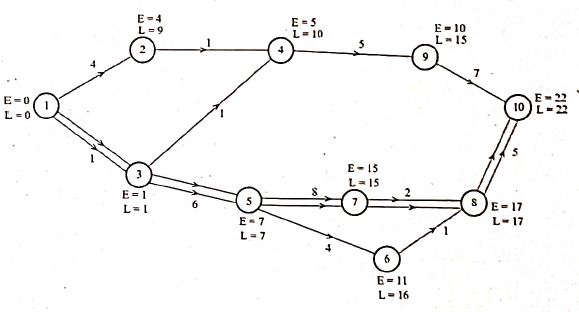
| E1 = 0 | L10 = 22 |
| E2 = 0 + 4 = 4 | L9 = 22 - 7 = 15 |
| E3 = 0 + 1 = 1 | L8 = 22 - 5 = 17 |
| E4 = Max of {4 + 1, 1 + 1} = 5 | L7 = 17 - 2 = 15 |
| E5 = 1 + 6 = 7 | L6 = 17 - 1 = 16 |
| L5 = Min of {16-4, 15-8} = 7 | |
| E6 = 7 + 4 = 11 | L4 = 15 - 5 = 10 |
| E8 = Max of {15 + 2, 11 + 1}= 17 | L3 = Min of {10-1, 7-6] = 1 |
| E9 = 5 + 5 = 10 | L2 = 10 - 1 = 9 |
| E10 = Max of {10 + 7, 17 + 5} = 22 | L1 = 0 |
| Activity | Duration tij | EST | EFT = EST + Tij | LST = LFT - tij | LFT |
|---|---|---|---|---|---|
| 1-2 | 4 | 0 | 4 | 9-4 = 5 | 9 |
| 1-3 | 1 | 0 | 1 | 1-1 = 0 | 1 |
| 2-4 | 1 | 4 | 5 | 10-1 = 9 | 10 |
| 3-4 | 1 | 1 | 2 | 10-1 = 9 | 10 |
| 3-5 | 6 | 1 | 7 | 7-6 = 1 | 7 |
| 4-9 | 5 | 5 | 10 | 15-5 = 10 | 15 |
| 5-6 | 4 | 7 | 11 | 16-4 = 12 | 16 |
| 5-7 | 8 | 7 | 15 | 15-8 = 7 | 15 |
| 6-8 | 1 | 11 | 12 | 17-1 = 16 | 17 |
| 7-8 | 2 | 15 | 17 | 17-2 = 15 | 17 |
| 8-10 | 5 | 17 | 22 | 22-5 = 17 | 22 |
| 9-10 | 7 | 10 | 17 | 22-7 = 15 | 22 |
Since EFT and LFT is same on 1 - 3, 3 - 5, 5 -7 and 7 - 8 and 8 -10 the critical path is 1- 3 - 5 -7 - 8 - 10 and the duration is 22 time units.
42.
LHS = (sin 3x + sin x) sin x + (cos 3x - cos x) cos x
= sin 3x sin x + sin2x + cos 3x cos x - cos2x
= sin 3x sin x + cos 3x cos x - (cos2x - sin2x)
= cos (3x - x) - cos 2x [∴ cosA cosB + sinA sinB = cos(A - B) and cos2A - sin2A = cos2A]
= 0 = RHS. Hence proved
43.
Let P (n) be the statement. 1.3+2.32+3.3 + ... +n.3n = \({{(2n-1){3}^{n+1}+3}\over{4}} \) for all n \(\in\) N.
Step-1:
Put n = 1 \(\Rightarrow1.3(1){{(2-1){3}^{1+1}+3}\over{4}}={{3^2+3}\over{4}}={{12}\over{4}}\Rightarrow\ 3=3\)
\(\therefore\) P(1) is true.
Step-2:
Let us assume that P(k) is true
\(\therefore\) 1.3 + 2.32 + 3.33 + ... + k.3k = \({{(2k-1){3}^{k+1}+3}\over{4}}\) ....(1)
Step-3:
To prove that P (k + 1) is true i.e. to P.T. 1.3 + 2.32 + 3.33 + ... + k.3k + (k + 1)3k+1
\(={{[2(k+1)-1]{3}^{k+2}+3}\over{4}}={{(2k+1){3}^{k+2}+3}\over{4}}\)
LHS = 1.3 + 2.32 + ... + k.3k + (k+ 1)3k+ 1
\(={{(2k-1){3}^{k+1}+3}\over{4}}+(k+1){3}^{k+1}={{(2k+1){3}^{k+1}+3+(4k+3){3}^{k+1}}\over{4}}\)
\(={{{3}^{k+1}(2k-1+4k+4)+3}\over{4}}={{{3}^{k+1}(6k+3)+3}\over{4}}={{{3}^{k+1}(2k+1)+3}\over{4}}={{{3}^{k+2}(2k+1)+3}\over{4}}\) = RHS
\(\therefore\) P (k + 1) is true whenever P(k) is true.
\(\therefore\) By mathematical induction, P(n) is true for all values n.
44.
LHS\(=\frac{\cos4x+\cos2x+\cos3x}{\sin4x+\sin2x+\sin3x}\)
\(=\frac{2\cos\left(\frac{4x+2x}{2}\right).\cos\left(\frac{4x-2x}{2}\right)+\cos3x}{2\sin\left(\frac{4x+2x}{2}\right).\cos\left(\frac{4x-2x}{2}\right)+\sin3x}\)
\(=\frac{2 \cos 3 x \cos x+\cos 3 x}{2 \sin 3 x \cos x+\sin 3 x} \)
\(=\frac{\cos 3 x(2 \cos x+1)}{\sin 3 x(2 \cos x+1)}=\frac{\cos 3 x}{\sin 3 x}=\cot3x=RHS\)
Hence Proved
45.
The technology matrix is given under.
| A | B | Final demand | |
| A | 0.4 | 0.1 | 6.8 |
| B | 0.7 | 0.7 | 10.2 |
B =\(\begin{bmatrix} 0.4 & 0.1 \\ 0.7 & 0.7 \end{bmatrix}\)
I - B =\(\begin{bmatrix} 1 & 0 \\ 0 & 1 \end{bmatrix}-\begin{bmatrix} 0.4 & 0.1 \\ 0.7 & 0.7 \end{bmatrix}=\begin{bmatrix} 0.6 & -0.1 \\ -0.7 & 0.3 \end{bmatrix}\)
|I - B| = \(\begin{bmatrix} 0.6 & -0.1 \\ -0.7 & 0.3 \end{bmatrix}\)
|I - B| = 0.18 - 0.07 = 0.11 > 0
Since the diagonal elements of (I - B) are positive and |I - B| is positive, the system is viable.
\(\therefore \) ( I - B)-1 = \(\frac { 1 }{ |I-B| } adj(I-B)=\frac { 1 }{ 0.11 } \begin{bmatrix} 0.3 & 0.1 \\ 0.7 & 0.6 \end{bmatrix}\)
Now X = (I - B)-1 D where D = \(\left[ \frac { 6.8 }{ 10.2 } \right] \)
X = \(\frac { 1 }{ 0.11 } \begin{bmatrix} 0.3 & 0.1 \\ 0.7 & 0.6 \end{bmatrix}\left[ \frac { 6.8 }{ 10.2 } \right] =\frac { 1 }{ 0.11 } \left[ \frac { 0.3\times6.8+0.1\times10.2 }{ 0.7\times6.8+0.6\times10.2 } \right] \)
=\(\frac { 1 }{ 0.11 } \left[ \frac { 2.04+1.02 }{ 4.76+6.12 } \right] =\frac { 1 }{ 0.11 } \left[ \frac { 3.06 }{ 10.88 } \right] =\left[ \frac { 27.81 tonnes }{ 98.90 } \right] \)
Gross production of commodity A and B are 27.81 tonnes
Gross production of B is 98.91 tonnes
46.
\(\frac{x+2}{(x-1)(x+3)^2}=\frac{A}{(x-1)}+\frac{B}{(x+3)}+\frac{C}{(x+3)^2}\)
\(=\frac{A(x+3)^2+B(x-1)(x+3)+C(x-1)}{(x-1)(x+3)^2}\)
\(\Rightarrow\) x + 2 = A ( x + 3 )2 + B ( x - 1 ) ( x + 3 ) + C( x - 1 ) ....(1)
Putting x = 1 in (1) we get,
\(3=A(4)^2 \Rightarrow A=\frac{3}{16}\)
Putting x = -3 in (1) we get
\(-1=C(-3-1)\)
\(C=\frac{1}{4}\)
Equate co-efficient of x2 on both sides of (1)
\(0 =A+B \Rightarrow B=-A=\frac{-3}{16} \)
\(\frac{x+2}{(x-1)(x+3)^2} =\frac{3}{16(x-1)}-\frac{3}{16(x+3)}+\frac{1}{4(x+3)^2}\)
47.
\(x={ at }^{ 2 }\)
\(\cfrac { dx }{ dt } =2at\)
\(y=2at\)
\( \cfrac { dy }{ dt } =2a\)
\(\therefore \cfrac { dy }{ dx } =\cfrac { \frac { dy }{ dt } }{ \frac { dx }{ dt } } \)
\(=\cfrac { 2a }{ 2at } =\cfrac { 1 }{ t } \)
48.
\(\left| \begin{matrix} 1 & 3 & 4 \\ 102 & 18 & 36 \\ 17 & 3 & 6 \end{matrix} \right| =6\left| \begin{matrix} 1 & 3 & 4 \\ 17 & 3 & 6 \\ 17 & 3 & 6 \end{matrix} \right| \)
= 0 (since R2 ≡ R3)
49.
(i) Variables:
Let x1, x2 represents the first and second type of bonds respectively.
(ii) Objective function:
Let Z be the maximum return
\(\therefore \quad Z=\frac { 8 }{ 100 } { x }_{ 1 }+\frac { 10 }{ 100 } { x }_{ 2 } \Rightarrow Z=0.08{ x }_{ 1 }+0.1{ x }_{ 2 }\)
(iii) Constraints:
\({ x }_{ 1 }+{ x }_{ 2 } \le 70,000\)
\({ x }_{ 1 } \ge 10,000\)
\( { x }_{ 2 } \le 30,000\)
(iv) Non-negative restrictions:
Since the number of first and second type of bonds cannot be negative,x1, x2 ≥ 0.
Hence, the mathematical formulation of the LPP is maximize \(Z=0.08{ x }_{ 1 }+0.1{ x }_{ 2 }\)
Subject to the constraints
\({ x }_{ 1 }+{ x }_{ 2 } \le 70,000\)
\( { x }_{ 1 }\ge 10,000\)
\({ x }_{ 2 }\le 30,000\)
and x1, x2 ≥ 0.
50.
S = {(1, 1) (1, 2) (1,3), ..... (6, 6)}
(2, 1), (2, 2) ...... (2, 6)
(6, 1), (6, 2) ..... (6, 6)}
n(S) = 36
Let B be the event that sum of numbers appearing is 6
B = {(1, 5), (2, 4), (3, 3), (4, 2), (5, 1)}
\(P(B)=\frac{5}{36}\)
Let A be the event that 4 has appeared atleast once
A = {(2, 4), (4, 2)}
\(A\cap B\) = {(2, 4),(4, 2)}
\(P(A\cap B)=\frac{2}{36}\)
\(P(A/B)=\frac { P(A\cap B) }{ P(B) } =\frac { 2/36 }{ 5/36 } =\frac { 2 }{ 5 } \)
51.
Let ‘x’ be the number of shares.
Face Value = Rs. 100
Face value of ‘x’ shares = Rs. 100x
\(\frac{12}{100}\times 100x=Rs. 3600\)
12 x = 3600 \(\Rightarrow\) x = 300
Hence the number of shares = 300
52.
Given Σxy = 120, Σx2 = 90, Σy2 = 640
Then r = \(\frac { \Sigma xy }{ \sqrt { \Sigma { x }^{ 2 }\Sigma { y }^{ 2 } } } =\frac { 120 }{ \sqrt { 90(640) } } =\frac { 120 }{ \sqrt { 57600 } } =\frac { 120 }{ 240 } \) = 0.5
53.
Let \(\cos^{-1}(\frac12)=\theta\)
\(\Rightarrow\frac12=\cos\theta\Rightarrow\cos=\frac{\pi}{3}\cos\theta\)
\(\Rightarrow\theta=\frac{\pi}{3}\)
\(\therefore\cos\left[\frac{\pi}{3}-\cos^{-1}(\frac{1}{2})\right]=\cos\left[\frac{\pi}{3}-\frac{\pi}{3}\right]=\cos(0)=1.\)
54.
Let m1 and m2 be the slopes of 2x - y + 3 = 0 and x + y + 2 = 0
Now m1 = 2, m2 = –1
Let \(\theta \) be the angle between the given lines
tan \(\theta \) =\(\left| \frac { { m }_{ 1 }-{ m }_{ 2 } }{ 1+{ m }_{ 1 }{ m }_{ 2 } } \right| \)
\(tan\quad \theta =\left| \frac { 2-(-1) }{ 1+2(-1) } \right| =3\)
\(\Rightarrow \theta ={ tan }^{ -1 }(3)\)

11th Standard Syllabus & Materials
11th Standard
TN 11th Tamil பீடு பெற நில் - செய்யுள் - காவடிச்சிந்து Important Questions And Answers Study Material - QB365 Set A
NEW11th Standard
TN 11th Tamil பீடு பெற நில் - உரைநடை - மலை இடப்பெயர்கள் : ஓர் ஆய்வு Important Questions And Answers Study Material - QB365 Set A
NEW11th Standard
TN 11th Tamil மாமழை போற்றுதும் - துணைப்பாடம் - யானை டாக்டர் Important Questions And Answers Study Material - QB365 Set A
NEW11th Standard
TN 11th Tamil மாமழை போற்றுதும் - செய்யுள் - ஐங்குறுநூறு Important Questions And Answers Study Material - QB365 Set A



Tamilnadu Stateboard 11th Standard Subjects

Maths

Commerce

Economics

Biology
Business Maths and Statistics

Accountancy

Computer Science

Physics

Chemistry
Maths
Biology
Economics
Physics
Chemistry

History
Business Maths and Statistics

Computer Science
Accountancy

Computer Applications
History
Computer Technology
Commerce
Computer Applications
Computer Technology

Tamil

English

French
Tamilnadu Stateboard Standards
