
 100% FREE ACCESS
11th Standard Syllabus & Materials
11th Standard
TN 11th Tamil இயற்கை வேளாண்மை,சுற்றுச்சூழல் -செய்யுள் - மனோன்மணீயம் Important Questions And Answers Study Material - QB365 Set A
NEW11th Standard
TN 11th Tamil என்னுயிர் என்பேன் -துணைப்பாடம் - இசைத்தமிழர் இருவர் Important Questions And Answers Study Material - QB365 Set A
NEW11th Standard
TN 11th Tamil மொழி கலை -செய்யுள் - ஒவ்வொரு புல்லையும் Important Questions And Answers Study Material - QB365 Set A
NEW11th Standard
TN 11th Tamil பீடு பெற நில் - இலக்கணம் - பகுபத உறுப்புகள் Important Questions And Answers Study Material - QB365 Set A
NEW11th Standard
TN 11th Tamil பீடு பெற நில் - துணைப்பாடம் - வாடிவாசல் Important Questions And Answers Study Material - QB365 Set A
NEW11th Standard
TN 11th Tamil பீடு பெற நில் - செய்யுள் - குறுந்தொகை Important Questions And Answers Study Material - QB365 Set A

Published on: 19/02/2019
11th First Revision Test Question Answer 2019
Download Tamil Nadu 11th Standard Business Maths and Statistics question papers, model tests, one-mark questions, important questions, and public exam papers in PDF format. Free study materials and answer keys for TN State Board students.
Questions + Answers key
Take MCQ Business Maths and Statistics Test
1.
Probability of an impossible event is _________.
1
0
0.2
0.5
2.
Let a sample space of an experiment be S = { E1,E2,....., En} Then \(\sum _{ i=1 }^{ n }{ P({ E }_{ t }) } \) is equal to _________.
0
1
\(\frac { 1 }{ 2 } \)
\(\frac { 1 }{ 3 } \)
3.
The coefficient of correlation describes ________.
the magnitude and direction
only magnitude
only direction
no magnitude and no direction
4.
The present value of the perpetual annuity of Rs. 2000 paid monthly at 10 % compound interest is _______.
Rs. 2,40,000
Rs. 6,00,000
Rs. 20,40,000
Rs. 2,00,400
5.
An annuity in which payments are made at the beginning of each payment period is called _______.
Annuity due
An immediate annuity
perpetual annuity
none of these
6.
Correlation co-efficient lies between ______.
0 to ∞
-1 to +1
-1 to 0
-1 to ∞
7.
If R = 5000 units / year, C1 = 20 paise , C3 = Rs. 20 then EOQ is _______.
5000
100
1000
200
8.
The demand function is always _______.
Increasing function
Decreasing function
Non-decreasing function
Undefined function
9.
Given an L.P.P maximize Z = 2x1 + 3x2 subject to the constrains x1 + x2 ≤ 1, 5x1 + 5x2 ≥ 0 and x1 ≥ 0, x2 ≥ 0 using graphical method, we observe ______.
No feasible solution
unique optimum solution
multiple optimum solution
none of these
10.
In the context of network, which of the following is not correct?
A network is a graphical representation
A project network cannot have multiple initial and final nodes
An arrow diagram is essentially a closed network
An arrow representing an activity may not have a length and shape
11.
\(\frac{d}{dx}(a^x)=\) ________.
\(\frac { 1 }{ x\log e^a}\)
aa
x logea
ax logea
12.
The graph of y = ex intersects the y-axis at _______.
(0,0)
(1,0)
(0,1)
(1,1)
13.
If \(\tan A=\frac{1}{2}\) and \(\tan B=\frac{1}{3}\) then tan(2A + B) is equal to ______.
1
2
3
4
14.
The value of \(\cos(-480^o)\) is ________.
\(\sqrt3\)
\(-\frac{\sqrt3}{2}\)
\(\frac{1}{2}\)
\(\frac{-1}{2}\)
15.
If the circle touches x axis, y axis and the line x = 6 then the length of the diameter of the circle is _______.
6
3
12
4
16.
If kx2 + 3xy - 2y2 = 0 represent a pair of lines which are perpendicular then k is equal to _______.
1/2
-1/2
2
-2
17.
The last term in the expansion of (3 +\(\sqrt{2}\) )8 is ________
81
16
8\(\sqrt{2}\)
27\(\sqrt{3}\)
18.
The value of n, when nP2 = 20 is _______.
3
6
5
4
19.
If A is an invertible matrix of order 2, then det (A-1) be equal to ________.
det (A)
\({{1}\over{det(A)}}\)
1
0
20.
adj (AB) is equal to ________.
adj A adj B
adj AT adj BT
adj B adj A
adj BT adj AT
21.
Find the co-variance and co-efficient of correlation for the following data:
n=10, \(\sum\)x=50, \(\sum\)y=-30, \(\sum\)x2=290, \(\sum\)y2=300 and \(\sum\)xy=-115.
22.
Solve the following LPP graphically. ∴ Maximize Z = 3x1 + 4x2 subject to the constraints x1 + x2 ≤ 4 and x1,x2 ≥ 0.
23.
A sum of Rs.1000 is deposited at the beginning of each quarter in a S.B. account that pays C.I 8% compounded quarterly. Find the account at the end of 3 years.
24.
From the following data compute the value of Harmonic Mean.
| Marks | 10 | 20 | 30 | 40 | 50 |
| No. of students | 20 | 30 | 50 | 15 | 5 |
25.
Calculate the geometric mean of the data given below giving the number of families and the income per head of different classes of people in a village of Kancheepuram District.
| Class of people | No. of Families | Income per head in 1990 (Rs) |
| Landlords | 1 | 1000 |
| Cultivators | 50 | 80 |
| Landless labourers | 25 | 40 |
| Money- lenders | 2 | 750 |
| School teachers | 3 | 100 |
| Shop-keepers | 4 | 150 |
| Carpenters | 3 | 120 |
| Weavers | 5 | 60 |
26.
Find the slope of the lines which make an angle of 45° with the line 3x - y + 5 = 0.
27.
The profit Rs.y accumulated in thousand in x months is given by y = -x2 + 10x - 15. Find the best time to end the project.
28.
Differentiate the following with respect to x : x3 ex
29.
Prove that \(2\sin ^{ 2 }{ \frac { \pi }{ 6 } } +\ cosec ^{ 2 }{ \frac { 7\pi }{ 6 } } \cos ^{ 2 }{ \frac { \pi }{ 3 } } =\frac { 3 }{ 2 } \)
30.
Find the inverse of each of the following matrices \(\left[ \begin{matrix} 1 & 2 & 3 \\ 0 & 2 & 4 \\ 0 & 0 & 5 \end{matrix} \right] \)
31.
Find the term independent of x in the expansion of \({ \left( x-\frac { 2 }{ { x }^{ 2 } } \right) }^{ 15 }\)
32.
Find |AB| if \(A=\begin{bmatrix} 3&-1\\2&1 \end{bmatrix} \) and \(B =\begin{bmatrix} 3&0\\1&-2 \end{bmatrix}\)
33.
If cosA =\(\frac{4}{5}\)and cosB =\(\frac{12}{13}\),
34.
What is the maximum slope of the tangent to the curve y = - x3 + 3x2 + 9x - 27 and at what point is it?
35.
A manufacturer produces two types of steel trunks. He has two machine A and B. For completing, the first type of the trunk requires 3 hours on machine A and 2 hours on machine B, whereas the second type of the trunk requires 3 hours on machine A and 3 hours on machine B. Machines A and B can work at the most for 18 hours and 14 hours per day respectively. He earns a profit of Rs.30 andRs.40 per trunk of the first type and second type respectively. How many trunks of the each type must he make each day to make maximum profit?
36.
a bank pays 8% interest compounded quarterly. Determine the equal deposits to be made at the end of each quarter for 3 years so as to receive Rs.300 at the end of 3 years.
37.
Find the maximum and minimum values of x3-6x2+7
38.
The heights ( in cm.) of a group of fathers and sons are given below
| Heights of fathers: | 158 | 166 | 163 | 165 | 167 | 170 | 167 | 172 | 177 | 181 |
| Heights of Sons: | 163 | 158 | 167 | 170 | 160 | 180 | 170 | 175 | 172 | 175 |
Find the lines of regression and estimate the height of son when the height of the father is 164 cm.
39.
For the production function P = \(4L^{ \frac { 3 }{ 4 } }K^{ \frac { 1 }{ 4 } }\) verify Euler’s theorem.
40.
A monopolist has a demand curve x = 106 – 2p and average cost curve AC = 5 + \(\frac { x }{ 50 } \) where p is the price per unit output and x is the number of units of output. If the total revenue is R = px, determine the most profitable output and the maximum profit.
41.
Prove that \(\frac { 4tan\ x(1-{ tan }^{ 2 }x) }{ 1-6{ tan }^{ 2 } x+{ tan }^{ 4 } x } =tanx\)
42.
Resolve into partial fractions : \(\frac { { x }^{ 2 }+x+1 }{ { x }^{ 2 }+2x+1 } \)
43.
If \(y={ \left( x+\sqrt { 1+{ x }^{ 2 } } \right) }^{ m }\), then show that (1 + x)2 y2 + xy1 - m2 = 0.
44.
By the principle of mathematical induction, prove the following.
4 + 8 + 12 + ...... + 4n = 2n(n + 1), for all \(n\in N\).
45.
Two commodities A and B are produced such that 0.4 tonne of A and 0.7 tonne of B are required to produce a tonne of A. Similarly 0.1 tonne of A and 0.7 tonne of B are needed to produce a tonne of B. Write down the technology matrix. If 68 tonnes of A and 10.2 tonnes of B are required, find the gross production of both of them.
46.
Differentiate the following functions with respect to x, \(x^{\frac{3}{2}}\)
47.
If nPr = 360, find n and r.
48.
Draw a network diagram for the project whose activities and their predecessor relationships are given below
| Activity | A | B | C | D | E | F |
|---|---|---|---|---|---|---|
| Predecessor activity | - | - | D | A | B | C |
49.
A die is thrown twice and the sum of the number appearing is observed to be 6. What is the conditional probability that the number 4 has appeared at least once?
50.
Find the number of shares which will give an annual income of Rs. 3,600 from 12% stock of face value Rs. 100.
51.
From the following data calculate the correlation coefficient Σxy = 120, Σx2 = 90, Σy2 = 640
52.
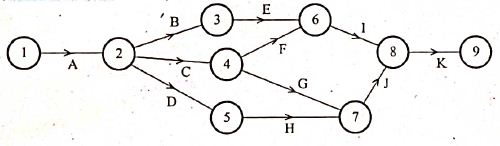
Draw a network diagram for the following activities.
| Activity code | A | B | C | D | E | F | G | H | I | J | K |
| Predecessor activity | - | A | A | A | B | C | C | C,D | E,F | G,H | I,J |
53.
In any quadrilateral ABCD, prove that sin (A + B) + sin (C + D) = 0
54.
Find the acute angle between the lines 2x - y + 3 = 0 and x + y + 2 = 0.
1.
(b)
0
2.
(b)
1
3.
(a)
the magnitude and direction
4.
\(P =\frac{\frac{a}{i}}{k} \)
\(=\frac{\frac{2000}{0.1}}{12}=2,40,000\)
5.
(a)
Annuity due
6.
(b)
-1 to +1
7.
\(E O Q=\sqrt{\frac{2 C_3 R}{C_1}}=\sqrt{\frac{2 \times 20 \times 5000}{20}}=1000\)
8.
(b)
Decreasing function
9.
Since there is no common area between the lines x1 + x2 ≤ 1 and 5x1 + 5x2 ≥ 0
10.
(d)
An arrow representing an activity may not have a length and shape
11.
(d)
ax logea
12.
(c)
(0,1)
13.
\(\tan 2 A= \frac{2 \tan A}{1-\tan ^2 A}=\frac{2(1 / 2)}{1-1 / 4}=\frac{1}{3 / 4}=4 / 3 \)
\(\tan (2 A+B)= \frac{\tan 2 A+\tan B}{1-\tan 2 A \cdot \tan B}=\frac{\frac{4}{3}+\frac{1}{3}}{1-4 / 9} \)
\(=\frac{5 / 3}{5 / 9}=3 \)
14.
\(\cos \left(-480^{\circ}\right) =\cos 480^{\circ}=\cos \left(360^{\circ}+120^{\circ}\right) \)
\(=\cos 120^{\circ}=\cos \left(180^{\circ}-60^{\circ}\right) \)
\(=-\cos 60^{\circ}=-1 / 2 \)
15.
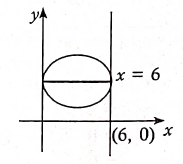
16.
\(a+b=0 \Rightarrow k-2=0\)
17.
\((\sqrt{2})^8=2^4=16\)
18.
nP2 = 20
n(n - 1) = 5 x 4
n = 5
19.
(b)
\({{1}\over{det(A)}}\)
20.
(c)
adj B adj A
21.
cov(x, y)=\(\frac { n\sum { xy } -(\sum { x } )(\sum { y } ) }{ { n }^{ 2 } } =\frac { 10(-115)-50(-30) }{ { 10 }^{ 2 } } \)
=\(\frac { -1150+1500 }{ 100 } =\frac { 350 }{ 100 } \)=3.5
Again, co-efficient correlation
r(x,y)=\(\frac { n\sum { xy } -(\sum { x } )(\sum { y } ) }{ \sqrt { n{ \sum { x } }^{ 2 }-{ (\sum { x } ) }^{ 2 } } \sqrt { n{ \sum { y } }^{ 2 }-{ (\sum { y } ) }^{ 2 } } } \)
=\(\frac { 10(-115)-50(-30) }{ \sqrt { 10(290)-{ (50) }^{ 2 } } .\sqrt { 10(300)-{ (-30) }^{ 2 } } } \)
=\(\frac { -1150+1500 }{ \sqrt { 2900-2500 } .\sqrt { 3000-900 } } =\frac { 350 }{ 20\times 10\sqrt { 21 } } \)=0.3819
∴ r(x,y)=0.3819
22.
Since the decision variables are non-negative, the solution lies in the I quadrant of the plane.
Consider the equation
\({ x }_{ 1 }+{ x }_{ 2 }= 4\)
| \({ x }_{ 1 }\) | 0 | 4 |
| \({ x }_{ 2 }\) | 4 | 0 |
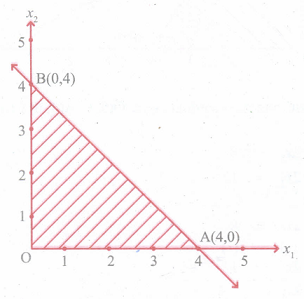
The feasible region is OAB and its co-ordinates are O(0, 0), A(4, 0) and B(0, 4)
| Corner Points | \(Z=3{ x }_{ 1 }+4{ x }_{ 2 }\) |
|---|---|
| O(0,0) | 0 |
| A(4,0) | 12 |
| B(0,4) | 16 |
Maximum of Z occurs at B(0, 4)
Hence, the solution is x1= 0, x2 = 4 and Zmax = 16
23.
Given a = Rs.1000,r = \(\cfrac { 8 }{ 100 } \times \cfrac { 1 }{ 4 } \) = 0.02,n =3 X 4 = 12
A =\(\cfrac { a }{ i } \left( 1+i \right) \left[ \left( 1+i \right) ^{ n }-1 \right] \)
=\(\cfrac { 1000 }{ 0.02 } \left( 1.02 \right) \left[ \left( 1.02 \right) ^{ 12 }-1 \right] \)
= 51,000[1.269-1]
= 51,000[0.269]=Rs.13,719
(1.02)12 = 12log(1.02)
=12(0.0086)
= 0.1032
Antilog of 0.1032 is 1.269
24.
Calculation of Harmonic Mean
| Marks X |
No. of Students f |
\(\frac{f}{x}\) |
| 10 | 20 | 2.000 |
| 20 | 30 | 1.500 |
| 25 | 50 | 2.000 |
| 40 | 15 | 0.375 |
| 50 | 5 | 0.100 |
| N = 120 | \(\sum { \left( \frac { 1 }{ X } \right) } \)= 5.975 |
\(HM=\frac { n }{ \sum { \left( \frac { f }{ X } \right) } } =\frac {120 }{ 5.975 } =20.08\)
25.
Calculation of Geometric Mean
| Class of people | Income per head in 1990 (Rs) X | No of Families f |
log X | f log X |
| Landlords | 1000 | 1 | 3.0000 | 3.0000 |
| Cultivators | 80 | 50 | 1.9031 | 95.1550 |
| Landless labourers | 40 | 25 | 1.6021 | 40.0525 |
| Money- lenders | 750 | 2 | 2.8751 | 5.7502 |
| School teachers | 100 | 3 | 2.0000 | 6.0000 |
| Shop-keepers | 150 | 4 | 2.1761 | 8.7044 |
| Carpenters | 120 | 3 | 2.0792 | 6.2376 |
| Weavers | 60 | 5 | 1.7782 | 8.8910 |
| N = 93 | \(\sum\) = 173.7907 |
GM = Anti \(\log { \left( \frac { \sum { flogX } }{ N } \right) } \)
= Anti \(\log { \left( \frac { 173.7907 }{ 93 } \right) } \)
= Anti log(1.8687)
GM = 73.91
26.
Slope of the line 3x-y+5=0 is
\(\Rightarrow \quad { m }_{ 2 }=-\frac { co-efficient\quad of\quad x }{ co-efficient\quad of\quad y } =\frac { -3 }{ -1 } =3\)
Let m1 = m and \(\theta =45\)
\(\therefore \quad tan\theta =\left| \frac { { m }_{ 1 }-{ m }_{ 2 } }{ 1+{ m }_{ 1 }{ m }_{ 2 } } \right| \)
\(\Rightarrow \quad tan\quad 45=\left| \frac { m-3 }{ 1+3m } \right| \)
\(\Rightarrow \quad 1=\left| \frac { m-3 }{ 1+3m } \right| \)
\(\Rightarrow \quad 1|1+3m|=|m-3|\)
\(\Rightarrow \quad 1+3m=\pm (m-3)\)
\(\Rightarrow \quad 1+3m=m-3\quad or\quad 1+3m=-m+3\)
\(\Rightarrow\) 2m = - 4 or 4m = 2
\(\Rightarrow \) m = - 2 or \(m=\frac { 2 }{ 4 } =\frac { 1 }{ 2 }\)
\(\therefore \) m = - 2 or \(\frac { 1 }{ 2 } \)
27.
Y = -x2 + 10 x - 15
\(\Rightarrow\) x2 - 10x = - y - 15
\(\Rightarrow\) (x- 5)2 = -y - 15 + 25
\(\Rightarrow\) (x- 5)2 = -y + 10
\(\Rightarrow\) (x - 5)2 = (-y - 10)
The best time to end the project is when x = 5 months.
28.
y = x3ex
\(\frac{d y}{d x}=x^x\left(e^x\right)+e^x\left(3 x^2\right)=x^2 e^x(x+3)\)
29.
\(2 \sin ^2 \frac{\pi}{6}+\operatorname{cosec}^2 \frac{7 \pi}{6} \cos ^2 \frac{\pi}{3}=\frac{3}{2} \)
\(\operatorname{cosec}^2 \frac{7 \pi}{6} =\operatorname{cosec}^2\left(\pi+\frac{\pi}{6}\right) \)
\(=\operatorname{cosec}^2 \frac{\pi}{6}=\operatorname{cosec}^2 30^{\circ}=2 \)
\(\text { LHS }= 2 \sin ^2 \frac{\pi}{6}+\operatorname{cosec}^2 \frac{\pi}{6} \cos ^2 \frac{\pi}{3} \)
\(= 2 \sin ^2 30^{\circ}+2^2\left(\cos ^2 60^{\circ}\right) \)
\(= 2\left(\frac{1}{2}\right)^2+4\left(\frac{1}{2}\right)^2 \)
\(= \frac{2}{4}+\frac{4}{4}=\frac{6}{4}=3 / 2=\mathrm{RHS} \)
Hence proved.
30.
\(\left[ \begin{matrix} 1 & 2 & 3 \\ 0 & 2 & 4 \\ 0 & 0 & 5 \end{matrix} \right] \)
\(A=\left(\begin{array}{lll} 1 & 2 & 3 \\ 0 & 2 & 4 \\ 0 & 0 & 5 \end{array}\right)\)
\(|A|=1(10-0)=10 \neq 0(\text {expanding along} \ C_1 )\)
\(\therefore \mathrm{A}^{-1} \text { exists }\)
\(A_{11}=\text {Cofactor of } 1=10-0=10 \)
\(A_{12}=\text {Cofactor of } 2=-(0-0)=0 \)
\(A_{13}=\text {Cofactor of } 3=0-0=0 \)
\(A_{21}=\text {Co-factor of } 0=-(10-0)=-10 \)
\(A_{22}=\text {Co-factor of } 2=5-0=5 \)
\(A_{23}=\text {Co-factor of } 4=-(0-0)=0\)
\(A_{31}=\text {Co-factor of } 0=8-6=2 \)
\(A_{32}=\text {Co-factor of } 0=-(4-0)=-4 \)
\(A_{33}=\text {Co-factor of } 5=2-0=2\)
\(\text {Co-factor matrix }=\left(\begin{array}{ccc} 10 & 0 & 0 \\ -10 & 5 & 0 \\ 2 & -4 & 2 \end{array}\right)\)
\(\mathrm{A}^{-1}=\frac{1}{|A|} \operatorname{adj} A=\frac{1}{10}\left(\begin{array}{ccc} 10 & -10 & 2 \\ 0 & 5 & -4 \\ 0 & 0 & 2 \end{array}\right)\)
31.
\(\left(x-\frac{2}{x^2}\right)^{15}\)
\(t_{r+1}=n C_r x^{n-r} a^r\)
\(=15 C_r(x)^{15-r}\left(\frac{-2}{x^2}\right)^r\)
\(=(-1)^r 15 C_r 2^r x^{15-r}\left(\frac{1}{x^{2 r}}\right)\)
\(=(-1)^r 15 C_r 2^r x^{15-r-2 r}\)
\(=(-1)^r 15 C_r 2^r x^{15-3 r}\)
To find the term independent of x, equate the power of x to 0
15 - 3r = 0
\(3 r=15 \Rightarrow r=\frac{15}{3}=5\)
\(t_{r+1}=(-1)^5 15 C_5 2^5\)
\(=-32\left(15 C_5\right)\)
32.
\(AB=\begin{bmatrix} 3&-1\\2&1 \end{bmatrix}\begin{bmatrix} 3&0\\1&-2 \end{bmatrix}=\begin{bmatrix} 9-1&0+2\\6+1&0-2 \end{bmatrix}=\begin{bmatrix} 8&2\\7&-2 \end{bmatrix}\)
= -16 - 14 = -30
\(\therefore\) |AB| = -30
33.
Since \(\cfrac { 3\pi }{ 2 } <\left( A,B \right) <2\pi \) ,both A and B lie in the fourth quadrant,
\(\therefore \) sinA and sinB are negative
Given \(\cos A=\frac{4}{5} \text { and } \cos B=\frac{12}{13}\)
Therefore, \(\sin A=-\sqrt{1-\cos ^2 A}\)
\(=-\sqrt{1-\frac{16}{25}}\)
\(=-\sqrt{\frac{25-16}{25}}\)
\(=-\frac{3}{5}\)
\(\operatorname{Sin} \mathrm{B}=-\sqrt{1-\cos ^2 B}\)
\(=-\sqrt{1-\frac{144}{169}}\)
\(=-\sqrt{\frac{169-144}{169}}\)
\(=-\frac{5}{13}\)
\( \cos (A+B)= \cos A \cos B- \sin A \sin B \)
\(=\frac{4}{5} \times \frac{12}{13}-\left(\frac{-3}{5}\right) \times\left(\frac{-5}{13}\right)\)
\(=\frac{48}{65}-\frac{15}{65}=\frac{33}{65}\)
34.
Given y = - x3 + 3x2 + 9x - 27 ...(1)
Differentiating w.r.t. 'x' we get,
\({dy\over dx}=-3x^2 + 6x + 9\)
∴ Slope of the tangent is - 3x2 + 6x + 9
Let M = - 3x2 + 6x + 9
\({dM\over dx}=-6x+6\) ..(2)
Slope is maximum when \({dM\over dx}=0\) and \({d^2M\over dx^2}<0\)
\({dM\over dx}=0⇒-6x+6=0⇒ -6x =- 6⇒x=1\)
\({d^2M\over dx^2}=-6<0\)
∴ Slope is maximum when x = 1
∴ Maximum slope= -3(1)2 + 6(1) + 9 = -3 + 15 = 12 [From (2)]
when x = 1, y = - (1)3 + 3(1)2 + 9(1) - 27
-1+3+9-27=-16 [From (1)]
∴ Maximum slope is 12 and the required point is (1, -16)
35.
Let the manufacturer produce x1 trunks of first type and x2 trunks of second type each day.
Let Z be the total profit of the manufacturer.
| Trunk of I Type (hrs) | Trunk of II Type (hrs) | Maximum time available (hrs) | |
|---|---|---|---|
| Machine A | 3 | 3 | 18 |
| Machine B | 2 | 3 | 14 |
| Profit | Rs.30 | Rs.40 |
Thus, the mathematical formulation of the LPP is maximize Z = 30x1+ 40x2
Subject to the constraints
3x1 + 3x2 ≤ 18,2x1 + 3x2 ≤ 14 and x1 + x2 ≥ 0
Consider the equations
\(3{ x }_{ 1 }+3{ x }_{ 2 }= 18\)
| \({ x }_{ 1 }\) | 0 | 6 |
| \({ x }_{2 }\) | 6 | 0 |
\(2{ x }_{ 1 }+3{ x }_{ 2 }=14\)
| \({ x }_{ 1 }\) | 0 | 7 |
| \({ x }_{2 }\) | 14/3 | 0 |
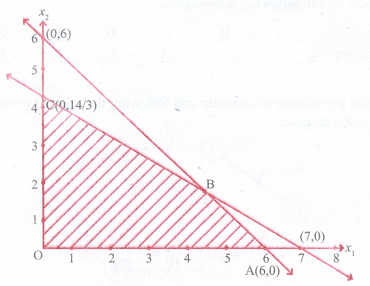
The feasible region is OABC and its co-ordinates are O(0, 0), A(6, 0), c(0, 14/3) and B is the point of intersection of 3x1 + 3x2 = 18 and 2x1 + 3x2 = 14
Verification of B:
\(3{ x }_{ 1 }+3{ x }_{ 2 }=18 ...(1)\)
\( (-)\quad (-)\quad \quad (-)\)
\(2{ x }_{ 1 }+3{ x }_{ 2 }=14...(2)\)
\(-------------\)
x1 = 4
From 2x1 + 3x2 = 14, we get 8 + 3x2 = 14 ⇒ 3x2 = 6 ⇒ x2 = 2
\(\therefore \text {B is} (4,2)\)
| Corner Points | Z=30x1+40x2 |
|---|---|
| O(0,0) | 0 |
| A(6,0) | 180 |
| B (4, 2) | 200 |
| C(0, 14/3) | 40(14/3) = 560/3 |
Maximum of Z occurs at B( 4, 2)
Hence, the solution is x1 = 4, x2 = 2 and Zmax = 200.
36.
Given A = Rs.3000,r =\(\cfrac { 8 }{ 100 } \times \cfrac { 1 }{ 4 } \) = 0.02,n = 3 x 4 =12
A=\(\cfrac { a }{ i } \left[ \left( 1+i \right) ^{ n }-1 \right] \)
3000=\(\cfrac { a }{ 0.02 } \left[ \left( 1.02 \right) ^{ 12 }-1 \right] \)
3000 x 0.02 = a[1.2690-1]
60 = a[0.2690]
a=\(\cfrac { 60 }{ 0.2690 } =223.04\)
a = Rs.223 (app)
(1.02)12 = 12 log (1.02)
= 12 (0.0086)
= 0.1032
Antilog of 0.1032 is 1.2690
37.
Let y=x3-6x2+7
Differentiating w.r.t. 'x' we get,
\({dy\over dx}=3x^2-12x\)
\({dy\over dx}=0\)
\(\Rightarrow3x^2-12x=0\)
\(\Rightarrow3x(x-4)=0\)
\(\Rightarrow x=0 \ or \ x=4\)
\({d^2y\over dx^2}=6x-12\)
when x=0 \({d^2y\over dx^2}=-12<0\)
\(\therefore \) y is maximum at x=0
\(\therefore \) maximum value=03-6(0)2+7=7
when x=4, \({d^2y\over dx^2}=-6(4)-12=12>0\)
\(\therefore \) y is minimum at x=4
\(\therefore \) Minimum value =44-6(4)2+7=64-96+7=-25
Hence maximum value is 7 and minimum value is -25.
38.
| X | Y | dx = X-168 | dy = Y-169 | dx2 | dy2 | dxdy |
|---|---|---|---|---|---|---|
| 158 | 163 | -10 | -6 | 100 | 36 | 60 |
| 166 | 158 | -2 | -11 | 4 | 121 | 22 |
| 163 | 167 | -5 | -2 | 25 | 4 | 10 |
| 165 | 170 | -3 | 1 | 9 | 1 | -3 |
| 167 | 160 | -1 | 9 | 1 | 81 | -9 |
| 170 | 180 | 2 | 11 | 4 | 121 | 22 |
| 167 | 170 | -1 | 1 | 1 | 1 | -1 |
| 172 | 175 | 4 | 6 | 16 | 36 | 24 |
| 177 | 172 | 9 | 3 | 25 | 9 | 27 |
| 181 | 175 | 13 | 6 | 169 | 36 | 78 |
| \(\Sigma X\) = 1686 | \(\Sigma Y\) = 1690 | \(\Sigma dx\) = 6 | \(\Sigma dy\) = 0 | \(\Sigma dx^2\) = 410 | \(\Sigma dy^2\)= 446 | \(\Sigma dxdy\) = 248 |
\(\bar{X} =\frac{\Sigma X}{N}=\frac{1686}{10}=168.6 \)
\(\bar{Y} =\frac{\Sigma Y}{N}=\frac{1690}{10}=169 \)
\(b_{x y} =\frac{N \Sigma d x d y-(\Sigma d x)(\Sigma d x)}{N \Sigma d y^2-(\Sigma d y)^2} \)
\(=\frac{10(248)-0}{10(446)-0}=\frac{248}{446}=0.556 \)
\(b_{y x} =\frac{N \Sigma d x d y-(\Sigma d x)(\Sigma d y)}{N \Sigma d x^2-(\Sigma d x)^2} \)
\(=\frac{2480}{4100-36}=\frac{2480}{4064}=0.6102\)
Regression equation of X on Y
\(X-\bar{X}=b_{x y}(Y-\bar{Y}) \)
X - 168.6 = 0.556(Y - 169)
X = 0.556 Y + 168.6-93.964
X = 0.556 Y + 74.64
Regression equation of Y on X
\(Y-\bar{Y}=b_{y x}(X-\bar{X}) \)
Y - 169 = 0.6102(X - 168.6)
Y = 0.6102 X - 102.8 + 169
Y = 0.6102X + 66.12
If X = 164
Y= 100.07 + 66.12
= 166.19
Height of son is 166.19
39.
\(p = 4L^{ \frac { 3 }{ 4 } }K^{ \frac { 1 }{ 4 } }\) is a homogeneous function of degree 1.
Marginal productivity of labour is
\(\frac { \partial P }{ \partial L } \) = \(4 \times { \frac { 3 }{ 4 } }L^{ \frac { -1 }{ 4 } } K^{ \frac { 1 }{ 4 } }\) = 3 \(\left( \frac { K }{ L } \right) ^{ \frac { 1 }{ 4 } }\)
Marginal productivity of capital is
\(\frac { \partial P }{ \partial L } \) = \(4L^{ \frac { 3 }{ 4 } }\times \frac { 1 }{ 4 } K^{ \frac { -3 }{ 4 } }\) = \(\left( \frac { L }{ K } \right) ^{ \frac { 3 }{ 4 } }\)
\(L\frac { \partial P }{ \partial L } +K\frac { \partial P }{ \partial K } =3L\left( \frac { K }{ L } \right) ^{ \frac { 1 }{ 4 } }+k\left( \frac { L }{ K } \right) ^{ \frac { 3 }{ 4 } }\)
\(= 3L^{ \frac { 3 }{ 4 } }K^{ \frac { 1 }{ 4 } }+L^{ \frac { 3 }{ 4 } }K^{ \frac { 1 }{ 4 } }\)
\(= 4L^{ \frac { 3 }{ 4 } }K^{ \frac { 1 }{ 4 } }\) = P
Hence Euler’s theorem is verified.
40.
Given x = 106 - 2p; 2p = 106 - x
P = \(\frac { 106-x }{ 2 } \)
(R) = px = \(\left( \frac { 106-x }{ 2 } \right) = 56x -\frac { { x }{ 2 } }{ 2 } \)
\(A C=\frac{C}{x} =5+\frac{x}{50} \)
\(C =5 x+\frac{x^2}{50} \)
\(p=R-C =53 x-\frac{x^2}{2}-5 x-\frac{x^2}{50} \)
\(=48 x-\frac{26 x^2}{50} \)
\(\frac{d p}{d x} =48-\frac{52 x}{50} \)
\(\text {For maximum profit } \frac{d P}{d x} =0 \)
\(48-\frac{52 x}{50} =0 \)
\(x =\frac{48 \times 50}{52} \approx 46 \)
\(\frac{d^2 p}{d x^2} =-\frac{52}{50}<0\)
\(\therefore\) At x = 46, Profit is maximum
Maximum profit = 48(46) - \(\frac { 26\left( 46 \right) ^{ 2 } }{ 50 } \) [From (1)]
= 2208 - 1100.32
= Rs.1107.68
P is maximum when x ≈ 46, maximum profit = Rs.1107.68
41.
RHS = tan 4x = tan2(2x)
= \(\frac { 2\quad tan\quad 2x }{ 1-{ tan }^{ 2 }2x } \left[ \because tan2x=\frac { 2\quad tan\quad x }{ 1-{ tan }^{ 2 }x } \right] \)
= \(\frac { 2.\frac { 2\quad tan\quad x }{ 1-{ tan }^{ 2 }x } }{ 1-\left( \frac { 2\quad tan\quad x }{ 1-{ tan }^{ 2 }x } \right) ^{ 2 } } =\frac { \frac { 4\quad tan\quad x }{ 1-{ tan }^{ 2 }x } }{ \frac { (1-{ tan }^{ 2 }x)^{ 2 }-4{ tan }^{ 2 }x }{ (1-{ tan }^{ 2 }x)^{ 2 } } } \)
= \(\frac { 4\quad tan\quad x }{ 1-{ tan }^{ 2 }\quad x } \times \frac { (1-{ tan }^{ 2 }\quad { x })^{ 2 } }{ 1+{ tan }^{ 4 }x-2\quad { tan }^{ 2 }x-4{ tan }^{ 2 }x } \)
= \(\frac { 4 tanx(1-{ tan }^{ 2 }\quad x) }{ 1+{ tan }^{ 4 }x-6\ { tan }^{ 2 }x } \) = LHS
42.
Since the numerator degree is equal to the degree of the denominator, let us divide.
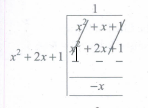
\(\therefore\) \({{x^2+x+1}\over{x^2+2x+1}}=1-{{x}\over{x^2+2x+1}}\) ...(1)
Consider \({{x}\over{x^2+2x+1}}={{x}\over{(x+1)^2}}={{A}\over{x+1}}+{{B}\over{{(x+1)}^{2}}}\)
\(\therefore\ {{x}\over{x^2+2x+11}}={{A(x+1)+B}\over{{(x+1)}^{2}}}\)
\(\Rightarrow\) x = A(x+ 1) + B ..(2)
Putting x = - 1 in (2) we get
-1 = 0 + B \(\Rightarrow\ \ \boxed{B=-1}\)
Putting x = 0 in (2) we get,
0 = A+B \(\Rightarrow\) A - 1 = 0 \(\Rightarrow\) \(\boxed{A=1}\)
\(\therefore\) \({{x}\over{{(x+1)}^{2}}}={{1}\over{x+1}}-{{1}\over{{(x+1)}^{2}}}\) ..(2)
Substituting (2) in (1) we get,
\({{x^2+x+1}\over{x^2+2x+1}}=1-{{1}\over{x+1}}+{{1}\over{{(x+1)}^{2}}}\)
43.
y = \({ \left( x+\sqrt { 1+{ x }^{ 2 } } \right) }^{ m }\)
\(\frac{d y}{d x}=m\left(x+\sqrt{1+x^2}\right)^{m-1}\left(1+\frac{1}{2 \sqrt{1+x^2}}(2 x)\right) \)
\(y_1=m\left(x+\sqrt{1+x^2}\right)^{m-1}\left(\frac{\sqrt{1+x^2}+x}{\sqrt{1+x^2}}\right) \)
\(\sqrt { 1+{ x }^{ 2 } } y_{ 1 } = { m{ \left( x+\sqrt { 1+{ x }^{ 2 } } \right) }^{ m } }\)
\(\Rightarrow \sqrt { 1+{ x }^{ 2 } } y_{ 1 } =my\)
Squaring both sides
\(\left(1+x^2\right) y_1^2=m^2 y^2\)
\(\left(1+x^2\right) 2 y_1 y_2+y_1^2(2 x)=2 m^2 y y_1\)
\(\div 2 y_1 \ \left(1+x^2\right) y_2+x y_1-m^2 y=0\)
44.
Let P (n) denote the statement. 4 + 8 + 12 + ...... + 4n = 2n(n + 1)
Put n = 1
LHS = 4
RHS ⇒ 2(2) = 4
LHS = RHS
∴ P(1) is true.
Let us assume that P(k) is true.
p(k) : 4 + 8 + 12 + ..... + 4 = 2k(k + 1)
To prove that P(k + 1) is true
4 + 8 + .... + 4k + 4(k + 1) = 2(k + 1) = 2(k + 1)(k + 2)
P(k) + 4(k + 1)
= 2k(k + 1) + 4(k + 1)
= (k + 1)(2k + 4) [using (1)]
= 2(k + 1)(k + 2) = RHS
∴ P (k + 1) is true whenever P(k) is true.
∴ p(n) is true for all \(n\in N\).
45.
The technology matrix is given under.
| A | B | Final demand | |
| A | 0.4 | 0.1 | 6.8 |
| B | 0.7 | 0.7 | 10.2 |
B =\(\begin{bmatrix} 0.4 & 0.1 \\ 0.7 & 0.7 \end{bmatrix}\)
I - B =\(\begin{bmatrix} 1 & 0 \\ 0 & 1 \end{bmatrix}-\begin{bmatrix} 0.4 & 0.1 \\ 0.7 & 0.7 \end{bmatrix}=\begin{bmatrix} 0.6 & -0.1 \\ -0.7 & 0.3 \end{bmatrix}\)
|I - B| = \(\begin{bmatrix} 0.6 & -0.1 \\ -0.7 & 0.3 \end{bmatrix}\)
|I - B| = 0.18 - 0.07 = 0.11 > 0
Since the diagonal elements of (I - B) are positive and |I - B| is positive, the system is viable.
\(\therefore \) ( I - B)-1 = \(\frac { 1 }{ |I-B| } adj(I-B)=\frac { 1 }{ 0.11 } \begin{bmatrix} 0.3 & 0.1 \\ 0.7 & 0.6 \end{bmatrix}\)
Now X = (I - B)-1 D where D = \(\left[ \frac { 6.8 }{ 10.2 } \right] \)
X = \(\frac { 1 }{ 0.11 } \begin{bmatrix} 0.3 & 0.1 \\ 0.7 & 0.6 \end{bmatrix}\left[ \frac { 6.8 }{ 10.2 } \right] =\frac { 1 }{ 0.11 } \left[ \frac { 0.3\times6.8+0.1\times10.2 }{ 0.7\times6.8+0.6\times10.2 } \right] \)
=\(\frac { 1 }{ 0.11 } \left[ \frac { 2.04+1.02 }{ 4.76+6.12 } \right] =\frac { 1 }{ 0.11 } \left[ \frac { 3.06 }{ 10.88 } \right] =\left[ \frac { 27.81 tonnes }{ 98.90 } \right] \)
Gross production of commodity A and B are 27.81 tonnes
Gross production of B is 98.91 tonnes
46.
\(\cfrac { d }{ dx } \left( { x }^{ \frac { 3 }{ 2 } } \right) =\cfrac { 3 }{ 2 } { x }^{ \frac { 3 }{ 2 } -1 }\)
\(=\cfrac { 3 }{ 2 } { x }^{ \frac { 1 }{ 2 } }=\cfrac { 3 }{ 2 } \sqrt { x } \)
47.
nP r= 360 = 36 \(\times\) 10
= 3 \(\times\) 3 \(\times\) 4 \(\times\) 5 \(\times\) 2
= 6 \(\times\) 5 \(\times\) 4 \(\times\) 3 = 6P4
Therefore n = 6 and r = 4
48.
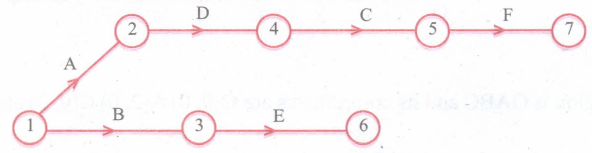
49.
S = {(1, 1) (1, 2) (1,3), ..... (6, 6)}
(2, 1), (2, 2) ...... (2, 6)
(6, 1), (6, 2) ..... (6, 6)}
n(S) = 36
Let B be the event that sum of numbers appearing is 6
B = {(1, 5), (2, 4), (3, 3), (4, 2), (5, 1)}
\(P(B)=\frac{5}{36}\)
Let A be the event that 4 has appeared atleast once
A = {(2, 4), (4, 2)}
\(A\cap B\) = {(2, 4),(4, 2)}
\(P(A\cap B)=\frac{2}{36}\)
\(P(A/B)=\frac { P(A\cap B) }{ P(B) } =\frac { 2/36 }{ 5/36 } =\frac { 2 }{ 5 } \)
50.
Let ‘x’ be the number of shares.
Face Value = Rs. 100
Face value of ‘x’ shares = Rs. 100x
\(\frac{12}{100}\times 100x=Rs. 3600\)
12 x = 3600 \(\Rightarrow\) x = 300
Hence the number of shares = 300
51.
Given Σxy = 120, Σx2 = 90, Σy2 = 640
Then r = \(\frac { \Sigma xy }{ \sqrt { \Sigma { x }^{ 2 }\Sigma { y }^{ 2 } } } =\frac { 120 }{ \sqrt { 90(640) } } =\frac { 120 }{ \sqrt { 57600 } } =\frac { 120 }{ 240 } \) = 0.5
52.
Using the precedence relationships and following the rules of network construction, the required diagram is shown in the following figure.
53.
Since A, B, C, D are angles of a quadrilateral, A + B + C + D =\(2\pi\)
A + B + C + D =\(2\pi\)
\(\Rightarrow A+B=2\pi-(C+D)\)
\(\Rightarrow\sin(A+B)=\sin[2\pi-(C+D)]\)
=-sin(C+D)[\(\therefore2\pi-(C+D)\)is in the IV quadrant]
\(\Rightarrow\sin(A+B)+\sin(C+D)=0\)
54.
Let m1 and m2 be the slopes of 2x - y + 3 = 0 and x + y + 2 = 0
Now m1 = 2, m2 = –1
Let \(\theta \) be the angle between the given lines
tan \(\theta \) =\(\left| \frac { { m }_{ 1 }-{ m }_{ 2 } }{ 1+{ m }_{ 1 }{ m }_{ 2 } } \right| \)
\(tan\quad \theta =\left| \frac { 2-(-1) }{ 1+2(-1) } \right| =3\)
\(\Rightarrow \theta ={ tan }^{ -1 }(3)\)

11th Standard Syllabus & Materials
11th Standard
TN 11th Tamil பீடு பெற நில் - செய்யுள் - காவடிச்சிந்து Important Questions And Answers Study Material - QB365 Set A
NEW11th Standard
TN 11th Tamil பீடு பெற நில் - உரைநடை - மலை இடப்பெயர்கள் : ஓர் ஆய்வு Important Questions And Answers Study Material - QB365 Set A
NEW11th Standard
TN 11th Tamil மாமழை போற்றுதும் - துணைப்பாடம் - யானை டாக்டர் Important Questions And Answers Study Material - QB365 Set A
NEW11th Standard
TN 11th Tamil மாமழை போற்றுதும் - செய்யுள் - ஐங்குறுநூறு Important Questions And Answers Study Material - QB365 Set A



Tamilnadu Stateboard 11th Standard Subjects

Maths

Commerce

Economics

Biology
Business Maths and Statistics

Accountancy

Computer Science

Physics

Chemistry
Maths
Biology
Economics
Physics
Chemistry

History
Business Maths and Statistics

Computer Science
Accountancy

Computer Applications
History
Computer Technology
Commerce
Computer Applications
Computer Technology

Tamil

English

French
Tamilnadu Stateboard Standards
