
 100% FREE ACCESS
11th Standard Syllabus & Materials
11th Standard
TN 11th Tamil இயற்கை வேளாண்மை,சுற்றுச்சூழல் -செய்யுள் - மனோன்மணீயம் Important Questions And Answers Study Material - QB365 Set A
NEW11th Standard
TN 11th Tamil என்னுயிர் என்பேன் -துணைப்பாடம் - இசைத்தமிழர் இருவர் Important Questions And Answers Study Material - QB365 Set A
NEW11th Standard
TN 11th Tamil மொழி கலை -செய்யுள் - ஒவ்வொரு புல்லையும் Important Questions And Answers Study Material - QB365 Set A
NEW11th Standard
TN 11th Tamil பீடு பெற நில் - இலக்கணம் - பகுபத உறுப்புகள் Important Questions And Answers Study Material - QB365 Set A
NEW11th Standard
TN 11th Tamil பீடு பெற நில் - துணைப்பாடம் - வாடிவாசல் Important Questions And Answers Study Material - QB365 Set A
NEW11th Standard
TN 11th Tamil பீடு பெற நில் - செய்யுள் - குறுந்தொகை Important Questions And Answers Study Material - QB365 Set A

Published on: 08/10/2019
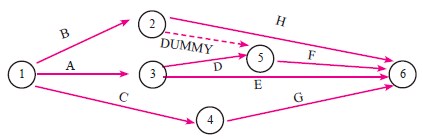
Operations Research
Download Tamil Nadu 11th Standard Business Maths and Statistics question papers, model tests, one-mark questions, important questions, and public exam papers in PDF format. Free study materials and answer keys for TN State Board students.
Questions + Answers key
Take MCQ Business Maths and Statistics Test
1.
Draw the network and calculate the earliest start time, earliest finish time, latest start time and latest finish time of each activity and determine the Critical path of the project and duration to complete the project.
| Jobs | 1-2 | 1-3 | 2-4 | 3-4 | 3-5 | 4-5 | 4-6 | 5-6 |
| Duration | 6 | 5 | 10 | 3 | 4 | 6 | 2 | 9 |
2.
Solve the following linear programming problems by graphical method.
(i) Maximize Z = 6x1 + 8x2 subject to constraints 30x1+20x2≤300; 5x1+10x2≤110; and x1, x2 ≥ 0 .
(ii) Maximize Z = 22x1+ 18x2 subject to constraints 960x1+ 640x2≤15360; x1≥ x≤20 and x1, x2 ≥ 0.
(iii) Minimize Z = 3x1+ 2x1 subject to the constraints 5x1+ x2≥10; x1+x2≥6; x1+ 4, x2 ≥12 and x1, x2 ≥ 0.
(iv) Maximize Z = 40x1+ 50x2 = subject to constraints 30x1+x2≤9; x1+2x2≤8 and x1, x2 ≥ 0
(v) Maximize Z = 20x1 + 30x2 subject to constraints 3x1+3x2≤36; 5x1+2x2≤50; 2x1+6x2≤60 and x1,x2 ≥ 0
(vi) Minimize Z = 20x 1+ 40x2 subject to the constraints 36x1+ 6x2≥108, 3x1+12x2≥36, 20x1+10x2≥100 and x1,x2 ≥ 0.
3.
Maximize Z = 3x1 + 4x2 subject to x1 – x2 ≤ –1; –x1 + x2 ≤ 0 and x1, x2 ≥ 0
4.
5.
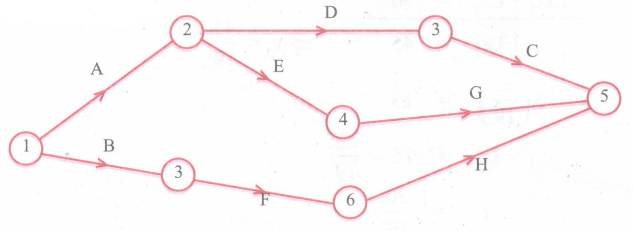
Construct the network for the projects consisting of various activities and their precedence relationships are as given below: A, B can start simultaneously
A < D, E; B < F; E < G, D < C, F < H.
6.
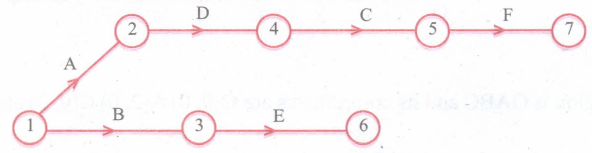
Draw a network diagram for the project whose activities and their predecessor relationships are given below
| Activity | A | B | C | D | E | F |
|---|---|---|---|---|---|---|
| Predecessor activity | - | - | D | A | B | C |
7.
A dealer whises to purchase a number of fans and sewing machines. He has only Rs.5760 to invest and has a space for atmost 20 items. A fan costs him Rs.360 and a sewing machine Rs. 240. His expectation is he can sell a fan at a profit of Rs.22 and a sewing machine at a profit of ns. Formulate this as an LPP to maximize his profit?
8.
A producer has 30 and 17 units of labour and capital respectively which he can use to produce two types of goods X and Y. To produce one unit of X, 2 unit of labour and 3 units of capital are required. Similarly, 3 units of labour and 1 unit of capital is required to produce one unit of Y. If X and Yare priced at HOO and H20 per unit respectively, how should the producer use his resources to maximize the total revenue? Formulate the LPP for the above.
9.
An aeroplane can carry a maximum of 200 passengers. A profit of Rs.1000 is made on each executive class ticket and a profit of Rs. 600 is made on each economy class ticket. The airline reserves at least 20 seats for executive class. However, at least 4 times as many passengers prefer to travel by economy class than by the executive class. Determine how many tickets of each type must be sold in order to maximize the profit for the airline. Formulate the mathematical LPP for the above.
10.
11.
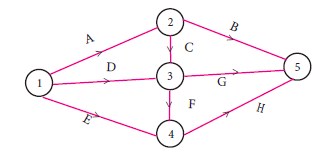
Draw the network for the project whose activities with their relationships are given below:
Activities A, D, E can start simultaneously; B, C > A; G, F > D, C; H > E, F.
12.
Draw the logic network for the following:
Activities C and D both follow A, activity E follows C, activity F follows D, activity E and F precedes B.
13.
Solve the following LPP graphically. Maximize \(Z={ x }_{ 1 }+{ x }_{ 2 }\)
Subject to the constraints \({ x }_{ 1 }-{ x }_{ 2 }\le -1,{ -x }_{ 1 }+{ x }_{ 2 }\le 0\quad and\quad { x }_{ 1 }+{ x }_{ 2 }\ge 0\)
14.
Solve the following LPP graphically. ∴ Maximize Z = 3x1 + 4x2 subject to the constraints x1 + x2 ≤ 4 and x1,x2 ≥ 0.
15.
Construct a network diagram for the following situation:
A < D, E; B, D < F; C < G and B < H.
16.
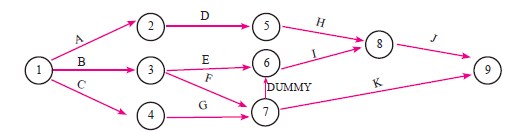
Draw a network diagram for the project whose activities and their predecessor relationships are given below:
| Activity: | A | B | C | D | E | F | G | H | I | J | K |
| Predecessor activity: | - | - | - | A | B | B | C | D | F | H,I | F,G |
17.
Given an L.P.P maximize Z = 2x1 + 3x2 subject to the constrains x1 + x2 ≤ 1, 5x1 + 5x2 ≥ 0 and x1 ≥ 0, x2 ≥ 0 using graphical method, we observe ______.
No feasible solution
unique optimum solution
multiple optimum solution
none of these
18.
Network problems have advantage in terms of project _______.
Scheduling
Planning
Controlling
All the above
19.
Which of the following is not correct?
Objective that we aim to maximize or minimize
Constraints that we need to specify
Decision variables that we need to determine
Decision variables are to be unrestricted
20.
21.
A solution which maximizes or minimizes the given LPP is called ______.
a solution
a feasible solution
an optimal solution
none of these
22.
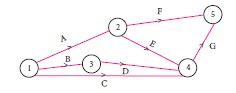
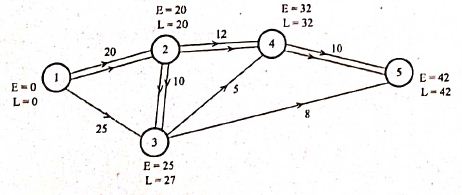
The critical path of the following network is________.
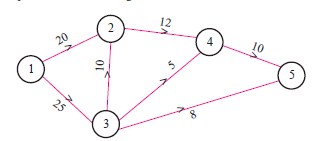
1 – 2 – 4 – 5
1 – 3 – 5
1 – 2 – 3 – 5
1 – 2 – 3 – 4 – 5
1.
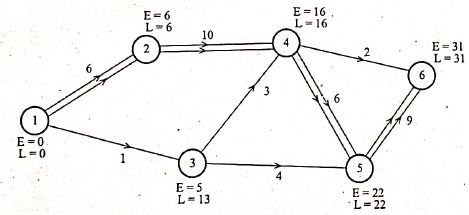
| E1 = 0 | L6 = 31 |
| E2 = 0 + 6 = 6 | L5 = 31 - 9 = 22 |
| E3 = 0 + 5 = 5 | L4 = min of {22- 6, 31-2} = 16 |
| E4 = max of {6 + 10, 5 + 3} | L3 = min of {16- 3, 22- 4} = 13 |
| E4 = 16 | L2 = 16 -10 = 6 |
| E5 = max of { 5 + 4, 16 + 6 } = 22 | L1 = min of { 6 - 6, 13 - 5} = 0 |
| Activity | Duration tji | EST | EFT = EST + tji | LST = LFT - tij | LFT |
|---|---|---|---|---|---|
| 1-2 | 6 | 0 | 6 | 6-6 = 0 | 6 |
| 1-3 | 5 | 0 | 5 | 18-5 = 13 | 13 |
| 2-4 | 10 | 6 | 16 | 16-10 = 6 | 16 |
| 3-4 | 3 | 5 | 8 | 16-3 = 13 | 16 |
| 3-5 | 4 | 5 | 9 | 22-4 = 18 | 22 |
| 4-5 | 6 | 16 | 22 | 22-6 = 16 | 22 |
| 4-6 | 2 | 16 | 18 | 31-2 = 29 | 31 |
| 5-6 | 9 | 22 | 31 | 31-9 = 22 | 31 |
Since EFT and LFT is same on 1 - 2, 2 - 4, 4 - 5 and 5 - 6, the critical path is 1 - 2 - 4 - 5 - 6 and duration time taken is 31 days.
2.
(i) First we have to find the feasible region using the given conditions.
Since both the decision variables x1 and x2 are non-negative, the solution lies in the first quadrant write all the inequalities of the constraints in the form of equations.
\(\therefore\) We have the lines 30x1 + 20x2 ≤ 300;
5x1 + 10x2 ≤ 110
30x1 + 20x2 ≤ 300; is a line passing through the points (0, 15) and (10, 0).
[(0, 15) is obtained by taking x1 = 0 in 30x1 + 20x2 = 300 (10,0) is obtained by taking x2 = 0 in 30x1 + 20x2 = 300]
Any point lying on or below the line 30x1 + 20x2 = 300. Satisfies the constraint 30x1 + 20x2 ≤ 300
We follow the same steps for the following
30x1 + 20x2 = 300
| x1 | 0 | 10 |
| x2 | 15 | 0 |
5x1+10x2=110
| x1 | 0 | 22 |
| x2 | 11 | 0 |
Now we draw the graph
30x1+20x2=300 is a line passing through the points (0,15) and (10,0).
Any point lying on or below the line 30x1+20x2=300 satisfies the constrint 30x1+20x2≤300.
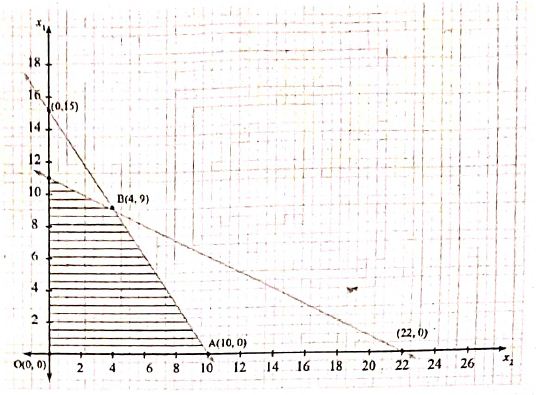
The feasible region satisfying all the conditions is OABC. The co-ordinates of the points are O(0,0), A(10, 0), B(4,9), C(0,11).
The Corner points and corresponding Z value are
| Corner points | Z = 6x1 + 8x2 |
| O(0,0) | 0 |
| A(10,0) | 60 |
| B(4,9) | 24 + 72 = 96 |
| C(0,11) | 88 |
The optimal solution is B(4,9)
\(x_1=4, x_2=9, Z_{\max }=96\)
Verification
\(3 x_1+2 x_2 =30 \)
\(x_1+2 x_2 =22 \)
(-) (-) (-)
__________
2x1 = 8
x1 = 4
4 + 2x2 = 22
2x2 = 18
x2 = 9
(4, 9) is the point of inch
(ii) First we have to find the feasible region using the given conditions.
Since both the decision variables x1 and x2 are non-negative, the solution lies in the first quadrant write all the inequalities of the constraints in the form of equations.
\(\therefore\) We have the lines \(960 x_1+640 \dot{x}_2 \leq 15360; x_1+x_2 \leq 20\)
\(960 x_1+640 x_2=15360\) is a line passing through the points (0,24) and (16,0).
[(0,24) is obtained by taking x1 = 0 in 960 x1 + 640 x2 = 15360, (16,0) is obtained by taking x2 = 0 in \(960 x_1+640 x_2=15360]\)
Any point lying on or below the line \(960 x_1+640 x_2=15360\). Satisfies the constraint \(960 x_1+640 x_2 \leq 15360\).
We follow the same steps for the following
960x1 + 640x2 = 15360
| x1 | 0 | 16 |
| x2 | 24 | 0 |
x1 + x2 = 20
| x1 | 0 | 20 |
| x2 | 20 | 0 |
Now we draw the graph
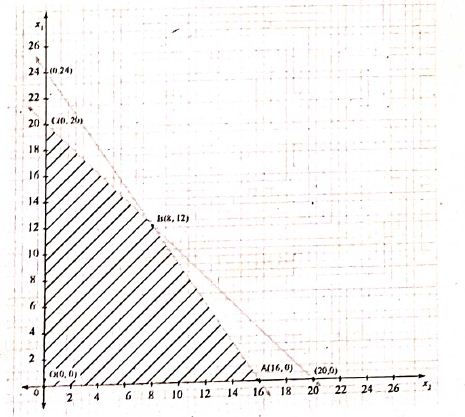
The feasible region satisfying all the conditions is OABC. The co-ordinates of the points are O(0,0), A(16, 0), B(8,12), C(0,20).
| Corner Points | Z = 22x1 + 18x2 |
| O(0,0) | 0 |
| A(16,0) | 352 |
| B(8,12) | 176+216=392 |
| C(0,20) | 360 |
The optimal solution is at B(8,12)
\(x_1=8, x_2=12, Z_{\max }=392\)
Verification
\(960 x_1+640 x_2=15360 \) ...(1)
\(\div 320 \quad 3 x_1+2 x_2=48 \quad 8+x_2=20 \)
\(\text { (2) } \times 2 \frac{2 x_1+2 x_2=40}{x_1=8}\) \( x_2=12\)
\( \therefore B(8,12)\)
(iii) Since both the decision variables x1 and x2 are non-negative, the solution lies in the first quadrant of the plane.
consider the equations \(5 x_1+x_2=10; x_1+x_2=6 \ and \ x_1+4 x_2=12\).
5x1 + x2 = 10 is a line passing through the points (0,10) and (2,0). Any point lying on or above the line 5x1 + x2 = 10. Satisfies the constraint \(5 x_1+x_2 \geq 10.\)
We follow the same steps for the following
5x1 + x2 = 10
| x1 | 0 | 2 |
| x2 | 10 | 0 |
x1 + x2 = 6
| x1 | 0 | 6 |
| x2 | 6 | 0 |
x1 + 4x2 = 12
| x1 | 0 | 12 |
| x2 | 3 | 0 |
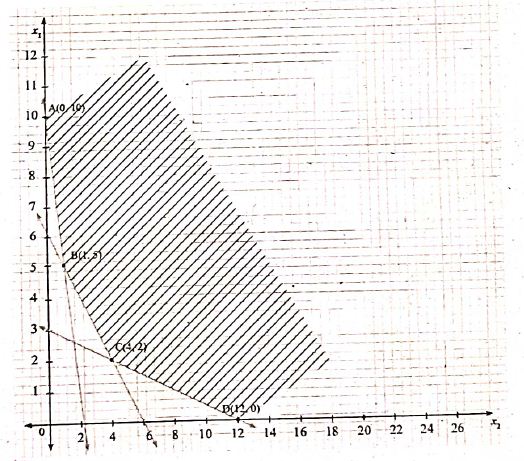
The feasible region is ABCD (since the problem is of minimization type we are 0 moving towards the origin.
| Corner Points | Z = 3x1 + 2x2 |
| A(0,10) | 20 |
| B(1,5) | 3+10=13 |
| C(4,2) | 12+4=16 |
| D(12,0) | 36 |
The minimum value of z occurs at C(4, 2).
Hence the optimal solution is x1 = 4, x2 = 2, Zmin = 13
Verification
| \(5 x_1+x_2=10 \) | \(x_1+4 x_2=12 \) |
\(x_1+x_2=6 \) \(4 x_1=4 \Rightarrow x_1=1 \) \(x_2=6-1=5 \) \(B(1,5) \) |
\(x_1+x_2=6 \) \(3 x_2=6 \) \(x_2=2 \) \(x_1=4 \) C(4,2) |
(iv) First we have to find the feasible region using the given conditions.
Since both the decision variables x1 and x2 are non-negative, the solution lies in the first quadrant write all the inequalities of the constraints in the form of equations.
\(\therefore\) We have the lines \(3 x_1+x_2 \leq 9; x_1+2 x_2 \leq 8\)
3x1 + x2 = 9 is a line passing through the points (0,9) and (3,0).
[(0,9) is obtained by taking x1 = 0 in \(3 x_1+x_2=9,(3,0)\) is obtained by taking \(x_2=0 \ in \ \left.3 x_1+x_2=9\right]\)
Any point lying on or below the line 3x1 + x2 = 9. Satisfies the constraint \(3 x_1+x_2 \leq 9\).
We follow the same steps for the following
3x1 + x2 = 9
| x1 | 0 | 3 |
| x2 | 9 | 0 |
x1 + 2x2 = 8
| x1 | 0 | 8 |
| x2 | 4 | 0 |
Now we draw the graph
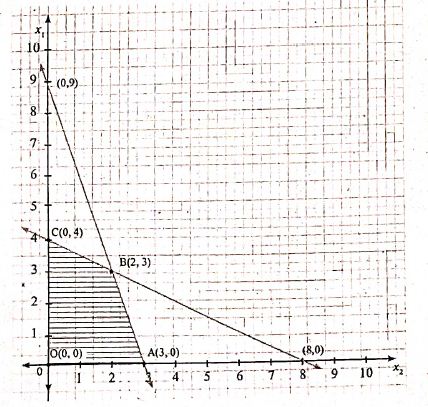
The feasible region satisfying all the conditions is OABC. The co-ordinates of the points are O(0,0), A(3, 0), B(2,3), C(0,4).
| Corner Points | Z = 40x1 + 50x2 |
| O(0,0) | 0 |
| A(3,0) | 120 |
| B(2,3) | 80+150=230 |
| C(0,4) | 200 |
The optimal solution is at B(2,3)
Solution is \(x_1=2, x_2=3, Z_{\max }=230\)
Verification
\(3 x_1+x_2 =9 \) (1)
\(x_1+2 x_2 =8 \) (2)
(1) \(3 x_1+x_2 =9 \)
(2) x (3) \(3 x_1+6 x_2 =24 \)
\(-5 x_2 =-15 \)
\(x_2 =3 \)
\(3 x_1+3 =9 \)
\(3 x_1 =6 \)
\(x_1 =2 \)
(2, 3)
(v) First we have to find the feasible region using the given conditions.
Since both the decision variables x1 and x2 are non-negative, the solution lies in the first quadrant write all the inequalities of the constraints in the form of equations:
\(\therefore\) We have the lines \( 3 x_1+3 x_2 \leq 36; 5 x_1+2 x_2 \leq 50 ; 2 x_1+6 x_2 \leq 60.\)
\(3 x_1+3 x_2=36 \Rightarrow x_1+x_2=12\) is a line passing through the points (0,12) and (12,0).
[(0,12) is obtained by taking \(x_1=0 \ in \ x_1+x_2=12,(12,0)\) is obtained by taking \(x_2=0 \ in \ \left.x_1+\dot{x}_2=12\right]\)
Any point lying on or below. the line 3x1 + 3x2 = 36. Satisfies the constraint \(3 x_1+3 x_2 \leq 36\)
We follow the same steps for the following
3x1 + 3x2 = 36
x1 + x2 = 12
| x1 | 0 | 12 |
| x2 | 12 | 0 |
5x1 + 2x2 = 50
| x1 | 0 | 10 |
| x2 | 25 | 0 |
2x1 + 6x2 = 60; x1 + 3x2 = 30;
| x1 | 0 | 30 |
| x2 | 10 | 0 |
Now we draw the graph
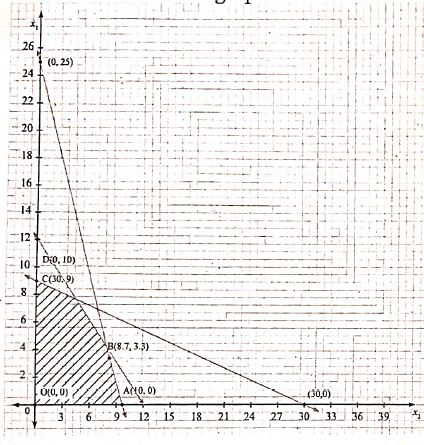
The feasible region satisfying all the conditions is OABC. The co-ordinates of the points are O(0,0), A(10, 0), B(8.7,3.3), C(3, 9), D(0,10)
| Corner Points | Z = 20x1 + 30x2 |
| O(0,0) | 0 |
| A(10,0) | 200 |
| B(8.7, 3.3) | 273 |
| C(3,9) | 330 |
| D(0,10) | 300 |
The optimal solution is at C(3,9)
\(x_1=3, x_2=9, Z_{\max }=330\)
Verification
| \(2 x_1+2 x_2 =24 \) | \(x_1+x_2=12 \) |
| \(5 x_1+2 x_2 =50 \) \(-3 x_1 =-26 \) \(x_1 =8.7 \) \(8.7+x_2 =12 \) \(x_2 =3.3 \) B(8.7,3: 3) |
\(x_1+3 x_2=30 \) \(-2 x_2=-18 \) \(x_2=9 \) \(x_1=3 \) \(C(3,9) \) |
(vi) Since both the decision variables x1 and x2 are non-negative, the solution lies in the first quadrant of the plane.
consider the equations \(36 x_1+6 x_2=108; 3 x_1+12 x_2=36 \ and \ 20 x_1+10 x_2=100. 36 x_1+6 x_2=108 \Rightarrow 6 x_1+x_2=18\) is a line passing through the points (0,18) and (3,0). Any point lying on or above the line \(36 x_1+6 x_2=108\) satisfies the constraint \(36 x_1+6 x_2 \geq 108\).
We follow the same steps for the following
36x1 + 6x2 = 108
6x1 + x2 = 108
| x1 | 0 | 3 |
| x2 | 18 | 0 |
3x1 + 12x2 = 36
x1 + 4x2 = 12
| x1 | 0 | 12 |
| x2 | 3 | 0 |
20x1 + 10x2 = 100;
2x1 + x2 = 10;
| x1 | 0 | 5 |
| x2 | 10 | 0 |
Draw the graph using the constraints
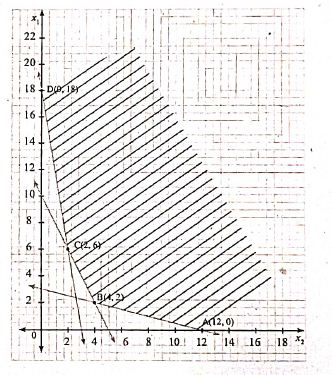
The feasible region is ABCD (since the problem is of minimization type we are moving towards the origin.
| Corner Points | Z = 20x1 + 40x2 |
| A(12,0) | 240 |
| B(4,2) | 160 |
| C(2,6) | 280 |
| D(0,18) | 720 |
The minimum value of Z occurs at B (4, 2).
The optimal solution is \(x_1=4, x_2=2, Z_{\min }=160\)
Verification
| 6x1 + x2 = 18 | x1 +4x2 = 12 |
| 2x1+x2=10 4x1 = 8 x1 = 2 4 + x2 = 10 x2 = 6 C(2, 6) |
2x1+x2=10 2x1+8x2=24 2x1+x2=10 x2= 14 x2= 2 x1= 4 B(4 ,2) |
3.
Since both the decision variables x1, x2 are non-negative, the solution lies in the first quadrant of the plane.
Consider the equations x1 – x2 = –1 and – x1 + x2 = 0
x1 – x2 = –1 is a line passing through the points (0,1) and (–1,0)
–x1 + x2 = 0 is a line passing through the point (0,0)
Now we draw the graph satisfying the conditions x1 – x2 ≤ –1; –x1 + x2 ≤ 0 and x1, x2 ≥ 0
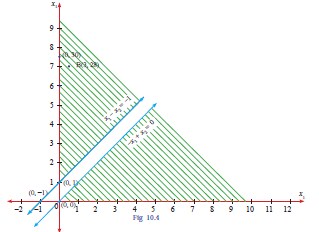
There is no common region(feasible region) satisfying all the given conditions. Hence the given LPP has no solution.
4.
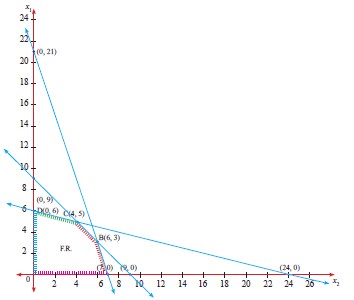
5.
Using the precedence relationship and following the rules of network construction, the required network is shown in the following diagram
6.
7.
(i) Variables:
Let x1 and x2 represent the number of fans and sewing machines.
(ii) Objective functions:
Let Z be the profit of the dealer.
∴ Maximize Z = 22x1 + 18x2 is the objective function.
(iii) Constraints:
\({ x }_{ 1 }+{ x }_{ 2 }\le 20\)
\({ 360x }_{ 1 }+{ 240x }_{ 2 }\le 5760\)
(iv) Non-negative restrictions:
Since the number of fans and sewing machine cannot be negative, we have x1, x2 ≥ 0.
Hence, mathematical formulation of the LPP is
Maximize \(Z=22{ x }_{ 1 }+18{ x }_{ 2 }\)
Subject to the constraints
\({ x }_{ 1 }+{ x }_{ 2 }\le 20\)
\({ 360x }_{ 1 }+{ 240x }_{ 2 }\le 5760\)
and x1, x2 ≥ 0.
8.
(i) Variables:
Let x1, x2 represent the number of units of X and Y.
(ii) Constraints:
| Labour | Capital | |
|---|---|---|
| X | 2 | 3 |
| Y | 3 | 1 |
∴ 2x1 + 3x2 ≤ 30 and 3x1 + x2 ≤ 17
(iii) Non-negative restrictions:
Since the number of units of X and Y cannot be negative,x1, x2 ≥ 0.
Hence, the mathematical formulation of the LPP is maximize \(Z=100{ x }_{ 1 }+120{ x }_{ 2 }\)
Subject to the constraints
\( { 2x }_{ 1 }+3{ x }_{ 2 }\le 30\)
\({ 3x }_{ 1 }+{ x }_{ 2 }\le 17\)
and x1, x2 ≥ 0.
9.
(i) Variables: Let x1be the executive class tickets and x2 be the economy class ticket.
(ii) Objective function: Let Z be the maximum profit
Maximize Z=1000x1+600x2
(iii) Constraints:\({ x }_{ 1 }\ge 20\)
\(\Rightarrow { x }_{ 2 }\ge 4{ x }_{ 1 }\ and\ { x }_{ 1 }+{ x }_{ 2 }\le 200\)
\( \Rightarrow 4{ x }_{ 1 }\le { x }_{ 2}\ and\ { x }_{ 1 }+{ x }_{ 2 }\le 200\)
\(\Rightarrow 4{ x }_{ 1 }-{ x }_{ 2 }\le 0 \ and \ { x }_{ 1 }+{ x }_{ 2 }\le 200\)
(iv) Non-negative restrictions:
Since the number of tickets cannot be negative, \({ x }_{ 1 },{ x }_{ 2 }\ge 0\)
Hence, the mathematical formulation of the LPP is Maximize Z=1000x1+600x2
Subject to the constraints
\({ x }_{ 1 }+{ x }_{ 2 } \le 2000\)
\( { x }_{ 1 } \ge 20\)
\(4{ x }_{ 1 }-{ x }_{ 2 } \le 0 \ and \ { x }_{ 1 },{ x }_{ 2 }\ge 0\)
10.
11.
The required network for the above information.
12.
The required network for the above information.

13.
Since the decision variables are non-negative, the solution lies in the I quadrant of the plane.
Consider the equations
\({ x }_{ 1 }-{ x }_{ 2 }=-1\)
| \({ x }_{ 1 }\) | 0 | 1 |
| \({ x }_{ 2 }\) | 1 | 2 |
\({ -x }_{ 1 }+{ x }_{ 2 }=0\)
| \({ x }_{ 1 }\) | 2 | 1 |
| \({ x }_{ 2 }\) | 2 | 1 |
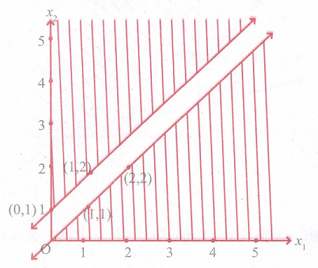
The feasible region is not common. Thus, there is no maximum value of Z.
14.
Since the decision variables are non-negative, the solution lies in the I quadrant of the plane.
Consider the equation
\({ x }_{ 1 }+{ x }_{ 2 }= 4\)
| \({ x }_{ 1 }\) | 0 | 4 |
| \({ x }_{ 2 }\) | 4 | 0 |
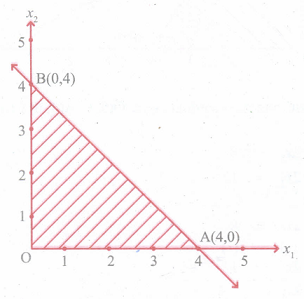
The feasible region is OAB and its co-ordinates are O(0, 0), A(4, 0) and B(0, 4)
| Corner Points | \(Z=3{ x }_{ 1 }+4{ x }_{ 2 }\) |
|---|---|
| O(0,0) | 0 |
| A(4,0) | 12 |
| B(0,4) | 16 |
Maximum of Z occurs at B(0, 4)
Hence, the solution is x1= 0, x2 = 4 and Zmax = 16
15.
Using the precedence relationships and following the rules of network construction, the required network is shown in following figure.
16.
Using the precedence relationships and following the rules of network construction, the required network diagram is shown in following figure.
17.
Since there is no common area between the lines x1 + x2 ≤ 1 and 5x1 + 5x2 ≥ 0
18.
(d)
All the above
19.
(d)
Decision variables are to be unrestricted
20.
(b)
21.
(c)
an optimal solution
22.

11th Standard Syllabus & Materials
11th Standard
TN 11th Tamil பீடு பெற நில் - செய்யுள் - காவடிச்சிந்து Important Questions And Answers Study Material - QB365 Set A
NEW11th Standard
TN 11th Tamil பீடு பெற நில் - உரைநடை - மலை இடப்பெயர்கள் : ஓர் ஆய்வு Important Questions And Answers Study Material - QB365 Set A
NEW11th Standard
TN 11th Tamil மாமழை போற்றுதும் - துணைப்பாடம் - யானை டாக்டர் Important Questions And Answers Study Material - QB365 Set A
NEW11th Standard
TN 11th Tamil மாமழை போற்றுதும் - செய்யுள் - ஐங்குறுநூறு Important Questions And Answers Study Material - QB365 Set A



Tamilnadu Stateboard 11th Standard Subjects

Maths

Commerce

Economics

Biology
Business Maths and Statistics

Accountancy

Computer Science

Physics

Chemistry
Maths
Biology
Economics
Physics
Chemistry

History
Business Maths and Statistics

Computer Science
Accountancy

Computer Applications
History
Computer Technology
Commerce
Computer Applications
Computer Technology

Tamil

English

French
Tamilnadu Stateboard Standards
