
 100% FREE ACCESS
11th Standard Syllabus & Materials
11th Standard
TN 11th Tamil இயற்கை வேளாண்மை,சுற்றுச்சூழல் -செய்யுள் - மனோன்மணீயம் Important Questions And Answers Study Material - QB365 Set A
NEW11th Standard
TN 11th Tamil என்னுயிர் என்பேன் -துணைப்பாடம் - இசைத்தமிழர் இருவர் Important Questions And Answers Study Material - QB365 Set A
NEW11th Standard
TN 11th Tamil மொழி கலை -செய்யுள் - ஒவ்வொரு புல்லையும் Important Questions And Answers Study Material - QB365 Set A
NEW11th Standard
TN 11th Tamil பீடு பெற நில் - இலக்கணம் - பகுபத உறுப்புகள் Important Questions And Answers Study Material - QB365 Set A
NEW11th Standard
TN 11th Tamil பீடு பெற நில் - துணைப்பாடம் - வாடிவாசல் Important Questions And Answers Study Material - QB365 Set A
NEW11th Standard
TN 11th Tamil பீடு பெற நில் - செய்யுள் - குறுந்தொகை Important Questions And Answers Study Material - QB365 Set A

Published on: 16/03/2019
+1 Public Exam March 2019 Important Creative 3 Mark Questions and Answers
Download Tamil Nadu 11th Standard Business Maths and Statistics question papers, model tests, one-mark questions, important questions, and public exam papers in PDF format. Free study materials and answer keys for TN State Board students.
Questions + Answers key
Take MCQ Business Maths and Statistics Test
1.
For the production function P= 5(L)0.7(K)0.3.Find the marginal productivities of Labour (L) and Capital (K) when L = 10, K = 3 [Use (0.3)0·3 = 0.6968; (3.33)0·7 = 2.2322]
2.
Ten students got the following percentage of marks in maths and physics in their second term examinations.
| Maths | 28 | 36 | 99 | 30 | 78 | 85 | 95 | 65 | 68 | 38 |
| Physics | 87 | 54 | 94 | 63 | 71 | 65 | 89 | 61 | 38 | 52 |
Find the co-efficient of rank correlation.
3.
Find the co-variance and co-efficient of correlation for the following data:
n=10, \(\sum\)x=50, \(\sum\)y=-30, \(\sum\)x2=290, \(\sum\)y2=300 and \(\sum\)xy=-115.
4.
Calculate mean deviation about median for the following data:
| Class | 0-10 | 10-20 | 20-30 | 30-40 | 40-50 |
| Frequency | 5 | 8 | 15 | 16 | 6 |
5.
Calculate the harmonic mean for the following data:
| Size of items | 50-60 | 60-70 | 70-80 | 80-90 | 90-100 |
| No.of items | 12 | 15 | 22 | 18 | 10 |
6.
A card from pack 52 cards is lost. From the remaining cards of the pack, two cards are drawn and are found to be hearts. Find the probability of the missing card to be a heart?
7.
Separate the intervals in which the function x3 + 8x2 + 5x - 2 is increasing or decreasing.
8.
Find the stationary points and stationary values of the function f(x) = x3 - 3x2 - 9x + 5.
9.
A bag contains 6 black and 5 red balls. Two balls are drawn at random. What is the probability that they are of the same colour?
10.
Find the geometric mean for the following data
| Value | 10 | 12 | 15 | 20 | 50 |
| Frequency | 2 | 3 | 10 | 8 | 2 |
11.
Find Q2 for 37, 32, 45, 36, 39, 37, 46, 57, 27, 34, 28, 30, 21
12.
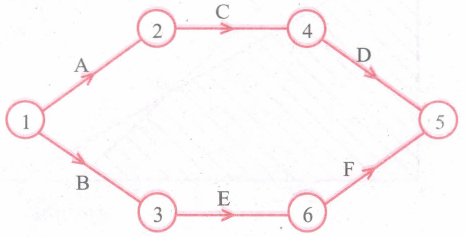
Develop a network based on the following information.
| Activity | A | B | C | D | B | E |
| Immediate Predecessor | - | - | A | C | E | F |
13.
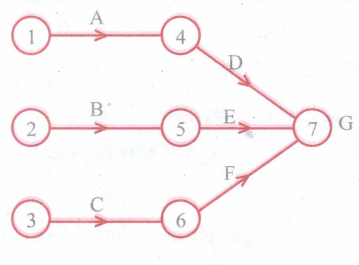
Construct the network for the following:
| Activity | A | B | C | D | E | F |
|---|---|---|---|---|---|---|
| Immediate Predecessor | - | - | - | A | B | C |
14.
Solve the following LPP graphically. Maximize \(Z={ x }_{ 1 }+{ x }_{ 2 }\)
Subject to the constraints \({ x }_{ 1 }-{ x }_{ 2 }\le -1,{ -x }_{ 1 }+{ x }_{ 2 }\le 0\quad and\quad { x }_{ 1 }+{ x }_{ 2 }\ge 0\)
15.
Solve the following LPP graphically. Minimize\(Z=-3{ x }_{ 1 }+4{ x }_{ 2 }\)
Subject to the constraints \({ x }_{ 1 }+2{ x }_{ 2 }\le 8\quad ,{ 3x }_{ 1 }+{ 2x }_{ 2 }\le 12\quad and\quad \quad { x }_{ 1 }\ge 0,{ x }_{ 2 }\ge 2.\)
16.
Solve the following LPP graphically. Maximize Z =−x1 + 2x2
Subject to the constraints −x1 + 3x2 ≤ 10, x1 + x2 ≤ 6,x1 − x2 ≤ 2 and x1,x2 ≥ 0
17.
Solve the following LPP graphically. Maximize Z = 6x1 + 5x2 Subject to the constraints 3x1 + 5x2 ≤ 15, 5x1 + 2x2 ≤ 10 and x1,x2 ≥ 0
18.
Which is the better investment?7% stock at 80(or) stock at 96.
19.
What is the present value of an annuity that pays 250 per month at the end of each month for 5 years assuming money to be worth 6% compounded monthly?
20.
Find the amount of an ordinary annuity of 12 monthly payments of Rs.1000 that earn interset at 12% per year compounded monthly.
21.
Find the yield on 20% stock at 80.
22.
A man wishes to pay back his depts of Rs.3783 due after 3 years by 3 equal yearly instalments. Find the amount of each instalments,money being worth 5% p.a. compounded annually
23.
Find the present value of an annuity due of Rs.200 p.a. payable annually for 2 years at 4%p.a
24.
If I deposit Rs.500 every year for a period of 10 years in a bank which gives C.I. 5% per year, find out the amount I will receive at the end of 10 years.
25.
A person borrows Rs.5000 at 5% p.a.interest compounded half yearly and agrees to pay both the principal and interest at 10 equal instalments at the end of each six months.Find the amount of these instalments.
26.
Find the geometric mean of 3, 6, 24, 48
27.
If two regression co-efficient are 2 and 0.45, what will be the co-efficient of correlation?
28.
Events A and B are such that P(A)=\(\frac { 1 }{ 2 } \), P(B)=\(\frac { 7 }{ 12 }\), and P(not A or not B) = \(\frac { 1 }{ 4 }\), state whether A and B are independent?
29.
Calculate Co-efficient of correlation for the following data:
| X | -3 | -2 | -2 | 0 | 1 | 2 | 3 |
| Y | 9 | 4 | 1 | 0 | 1 | 4 | 9 |
30.
A fair die is rolled. A = {1, 3, 5} B = {2, 3} and C = {2, 3, 4, 5}. Find (i) P(A/B) and P(B/A) (ii) P(A/C) and p(C/A).
31.
For the following observations, find the regression co-efficients byx and bxy and hence find the correlation co-efficient between x and y.(4,2) (2, 3)(3, 2)(4, 4)(2, 4)
32.
prove that the correlation co-efficient is the geometric mean of regression co-efficients.
33.
Calulate the co-efficient of correlation between x and y on the basis of the following observations. \(\sum\)\(\sum\)x=10, \(\sum\)x2=250, \(\sum\)y=70, \(\sum\)y2=300, \(\sum\)xy=75 and n =20
34.
Calculate the covariance of the following pairs of observation of two variates X and Y. (1, 5)(2, 4)(3, 3)(4, 2)(5, 1)
35.
Calculate the correlation co-efficient from the following data:
| X | 12 | 9 | 8 | 10 | 11 | 13 | 7 |
| Y | 14 | 8 | 6 | 9 | 11 | 12 | 3 |
36.
Calculate the correlation co-efficient from the below data:
| X | 1 | 2 | 3 | 4 | 5 | 6 | 7 | 8 | 9 |
| Y | 9 | 8 | 10 | 12 | 11 | 13 | 14 | 16 | 5 |
37.
If tan \(\alpha={{1}\over{7}},\sin\beta{{1}\over{\sqrt{10}}},\) Prove that \(\alpha+2\beta{{\pi}\over4{}}\) where \(0<\alpha<{{\pi}\over{2}}\) and \(0<\beta<{{\pi}\over{}2}.\)
38.
Show that \(\cos^{-1}\left(\frac{3}{5}\cos x+\frac45\sin x\right)=x-\tan^{-1}\left(\frac43\right)\)
39.
Prove that \(\frac{\sin5x-2\sin3x+sinx}{\cos5x-\cos x}=\tan x\)
40.
Prove that \(\frac{\sin(x+y)}{\sin(x-y)}=\frac{\tan x+\tan y}{\tan x-\tan y}\)
41.
Evaluate \(\underset { x\rightarrow 0 }{ lim } \frac { 2sinx-sin2x }{ { x }^{ 3 } } \)
42.
Prove that\(\left\{1+\cot x-\sec\left(\frac{\pi}{2}+x\right)\right\}\left\{1+\cot x+\sec\left(\frac{\pi}{2}+x\right)\right\}=2\cot x\)
43.
Find all other trigonometrical ratios if \(\sin x=\frac{-2\sqrt6}{5}\) and x lies in III quadrant?
44.
If ey (x + 1) = 1, show that \(\frac { { d }^{ 2 }y }{ { dx }^{ 2 } } ={ \left( \frac { dy }{ dx } \right) }^{ 2 }\)
45.
Differentiate: sin2 x + cos2 y = 1.
46.
Find the equation of the tangent lines to the circle x2 + y2 = 9 which are parallel to 2x + y - 3 = 0
47.
Is the function defined by f(x) = x2 -sin x + 5 is continuous at x =\(\pi\)?
48.
Find the combined equation of the straight line through the origin, one of which is parallel to and the other is perpendicular to the straight line 2x + y + 1 = 0
49.
Find the slope of the lines which make an angle of 45° with the line 3x - y + 5 = 0.
50.
Find the condition that the straight lines y=m1x+C1, y=m2x+C2, and y=m3x+C3 may meet at a point?
51.
Find the separate equations of the pair of lines given by 3x2 + 7xy + 2y2 + 5x + 5y + 2 = 0.
52.
If \(y=\sqrt { x } +\frac { 1 }{ \sqrt { x } } \) show that \(2x\frac { dy }{ dx } +y=2\sqrt { x } \).
53.
Find the equation of a circle of radius 5 whose centre lies on X-axis and passes through the point (2, 3).
54.
A point moves so that its distance from the point (-1, 0) is always three times its distance from the point (0, 2). Find its locus.
55.
In how many ways can 12 things be equally divided among 4 persons?
56.
In how many ways can n prizes be given to n boys, when a boy may receive any number of prizes?
57.
How many different numbers between 100 and 1000 can be formed using the digits 0, 1,2,3,4,5, 6 assuming that in any number, the digits are not repeated.
58.
Resolve into partial factors:\(\frac { x+4 }{ ({ x }^{ 2 }-4)(x+1) } \)
59.
If A = \(\begin{bmatrix} 3 & 2 \\ 7 & 5 \end{bmatrix}\) and B = \(\begin{bmatrix} 4 & 6 \\ 3 & 2 \end{bmatrix}\), verify that (AB)-1 = B-1A-1
60.
Using the properties of determinants, show that \(\left| \begin{matrix} 2 & 7 & 65 \\ 3 & 8 & 75 \\ 5 & 9 & 86 \end{matrix} \right| \) = 0
61.
Show that \(\begin{vmatrix}x+a &b&c \\a &x+b&c\\a&b&x+c \end{vmatrix}=x^2(x+a+b+c)\)
62.
Solve: 2x + 5y = 1 and 3x + 2y = 7 using matrix method.
63.
Verify that A(adj A) = (adj A) A = IAI·I for the matrix A = \(\begin{bmatrix}2 & 3 \\-1 & 4\end{bmatrix}\)
64.
if A =\(\left[ \begin{matrix} cos\ \alpha & sin\ \alpha \\ -sin\ \alpha & \ cos\ \alpha \ \end{matrix} \right] \) is such that AT = A-1, find \(\alpha\)
65.
Using matrix method, solve x + 2y + z = 7, x + 3z = 11 and 2x - 3y =1.
66.
Prove that \(\left| \begin{matrix} x & sin\theta & cos\theta \\ -sin\theta & -x & 1 \\ cos\theta & 1 & x \end{matrix} \right| \) is independent of \(\theta\)
1.
Given P= 5(L)0.7(K)0.3
Marginal Productivity of Labour (L) is
\({∂P\over ∂L}=5(0.7)(L)^{0.7-1} (K)^{0.3 }= 3.5(L)^{-o·3} (K)^{0.3} = 3.5\left(K\over L\right)^{0.3}\)
When L = 10 and K = 3,
\(\frac { \partial P }{ \partial L } =3.5\left( \frac { 3 }{ 10 } \right) ^{ 0.3 }=3.5(0.3)^{ 0.3 }=3.5\times 0.6968\)
= 2.438 = 2.44
\({∂P\over ∂L}=5(L)^{0.7} (0.3)(K)^{0.3-1 }= 1.5(L)^{0.7}(K)^-{0.7} = 1.5\left(L\over K\right)^{0.7}\)
When L= 10 and K=3,
\({∂P\over ∂L}=1.5\left(10\over3\right)^{0.7}=1.5(3.33)^{0.7} = 1.5(2.2322) = 3.481 = 3.48\)
2.
| X | Y | RX | RY | d=RX-RY | d2 |
| 28 | 87 | 10 | 3 | 7 | 49 |
| 36 | 54 | 8 | 8 | 0 | 0 |
| 99 | 94 | 1 | 1 | 0 | 0 |
| 30 | 63 | 9 | 6 | 3 | 9 |
| 78 | 71 | 4 | 4 | 0 | 0 |
| 85 | 65 | 3 | 5 | -2 | 4 |
| 95 | 89 | 2 | 2 | 0 | 0 |
| 65 | 61 | 6 | 7 | -1 | 1 |
| 68 | 38 | 5 | 10 | -5 | 25 |
| 38 | 52 | 7 | 9 | -2 | 4 |
| \(\sum\)d2=92 |
Rank correlation \(\rho =1-\frac { 6\sum { { d }^{ 2 } } }{ N({ N }^{ 2 }-1) } =1-\frac { 6\times 92 }{ 10\times 99 } =1-\frac { 92 }{ 165 } \)=1-0.56
\(\rho \) = 0.44
3.
cov(x, y)=\(\frac { n\sum { xy } -(\sum { x } )(\sum { y } ) }{ { n }^{ 2 } } =\frac { 10(-115)-50(-30) }{ { 10 }^{ 2 } } \)
=\(\frac { -1150+1500 }{ 100 } =\frac { 350 }{ 100 } \)=3.5
Again, co-efficient correlation
r(x,y)=\(\frac { n\sum { xy } -(\sum { x } )(\sum { y } ) }{ \sqrt { n{ \sum { x } }^{ 2 }-{ (\sum { x } ) }^{ 2 } } \sqrt { n{ \sum { y } }^{ 2 }-{ (\sum { y } ) }^{ 2 } } } \)
=\(\frac { 10(-115)-50(-30) }{ \sqrt { 10(290)-{ (50) }^{ 2 } } .\sqrt { 10(300)-{ (-30) }^{ 2 } } } \)
=\(\frac { -1150+1500 }{ \sqrt { 2900-2500 } .\sqrt { 3000-900 } } =\frac { 350 }{ 20\times 10\sqrt { 21 } } \)=0.3819
∴ r(x,y)=0.3819
4.
| Class | Mid value x | f | c.f. | D=|x-28| | f|D| |
|---|---|---|---|---|---|
| 0-10 | 5 | 5 | 5 | 23 | 115 |
| 10-20 | 15 | 8 | 13 | 13 | 104 |
| 20-30 | 25 | 15 | 28 | 3 | 45 |
| 30-40 | 35 | 16 | 44 | 7 | 112 |
| 40-50 | 45 | 6 | 50 | 17 | 102 |
| N = 50 | \(\sum { f|D|=478 } \) |
\(\frac { N }{ 2 } =\frac { 50 }{ 2 } =25\)
\(\therefore\) Median lies in the interval (20, -30) and its corresponding values are
L = 20, f = 15, pcf = 13 and c = 10
\(\therefore Median=L+\left( \frac { \frac { N }{ 2 } -pcf }{ f } \right) \times c=20+\frac { 25-13 }{ 15 } \times 10\)
\(=20+\frac { 120 }{ 15 } =20+8=28\)
Now, mean deviation from median
\(=\frac { \sum { f|D| } }{ N } =\frac { 478 }{ 50 } =9.56\)
5.
| Size x | No. of items f | Mid Value x | f/x |
|---|---|---|---|
| 50-60 | 12 | 55 | 0.2182 |
| 60-70 | 15 | 65 | 0.2308 |
| 70-80 | 22 | 75 | 0.2933 |
| 80-90 | 18 | 85 | 0.2118 |
| 90-100 | 10 | 95 | 0.1053 |
| N=77 | \(\sum { f/x=1.0594 } \) |
\(\therefore\) Harmonic mean = \(\frac { N }{ \sum { \left( \frac { f }{ x } \right) } } =\frac { 77 }{ 1.0594 } =72.683\)
\(\therefore\) HM = 72.683
6.
Let E1 = missing card is a heart card
E2 = missing card is a spade card
E3 = missing card is a club card
E4 = missing card is a diamond card
and A = drawing 2 heart cards from the remaining cards.
\(\therefore\) P(E1) = P(E2) = P(E3) = P(E4)
\(=\frac { 13 }{ 52 } =\frac { 1 }{ 4 } \)
P(A/E1) = P(two heart cards given that one heart card is missing)
\(=\frac { 12{ C }_{ 2 } }{ 51{ C }_{ 2 } } =\frac { \frac { 12\times 11 }{ 2\times 1 } }{ \frac { 51\times 50 }{ 2\times 1 } } =\frac { 66 }{ 1275 } \)
P(A/E2) = P(2 heart cards given that one spade card is missing)
\(=\frac { 13{ C }_{ 2 } }{ 51{ C }_{ 2 } } =\frac { \frac { 13\times 12 }{ 2 } }{ \frac { 51\times 50 }{ 2\times 1 } } =\frac { 78 }{ 1275 } \)
Similarly, P(A/E3) = \(\frac { 13{ C }_{ 2 } }{ 51{ C }_{ 2 } } =\frac { 78 }{ 1275 } \)
and P(A/E4) = \(\frac { 13{ C }_{ 2 } }{ 51{ C }_{ 2 } } =\frac { 78 }{ 1275 } \)
\(\therefore\) By Baye's theorem,
\(P({ E }_{ 1 }/A)=\frac { P({ E }_{ 1 }).P\left( A/{ E }_{ 1 } \right) }{ P({ E }_{ 1 }).P\left( A/{ E }_{ 1 } \right) +P({ E }_{ 2 }).P\left( A/{ E }_{ 2 } \right) +P({ E }_{ 3 }).P(A/{ E }_{ 3 }) } \)
\(=\frac { \frac { 1 }{ 4 } \times \frac { 66 }{ 1275 } }{ \frac { 1 }{ 4 } \times \frac { 66 }{ 1275 } +\frac { 1 }{ 4 } \times \frac { 78 }{ 1275 } +\frac { 1 }{ 4 } \times \frac { 78 }{ 1275 } +\frac { 1 }{ 4 } \times \frac { 78 }{ 1275 } } \)
\(=\frac { \frac { 1 }{ 4 } \times \frac { 66 }{ 1275 } }{ \frac { 1 }{ 4 } \left[ \frac { 66 }{ 1275 } +\frac { 78 }{ 1275 } +\frac { 78 }{ 1275 } +\frac { 78 }{ 1275 } \right] } \)
\(=\frac { 66 }{ 1275 } \times \frac { 1275 }{ 66+78+78+78 } \)
\(=\frac { 66 }{ 300 } =\frac { 11 }{ 50 } \)
7.
Let y = x3+8x2+5x-2
Differentiating w.r.t. 'x' we get
\({dy\over dx}=3x^2+16x+5\)
\({dy\over dx}=0⇒3x^2 + 16x + 5=0\)
⇒ (x+5)(3x+1)=0
⇒ x = - 5, -1/3

The possible intervals are (-∞, - 5), (-5, -1/3) and (-1/3, ∞)
| Intervals | Sign of \(dy\over dx\) | Nature of Function |
|---|---|---|
| (-∞, - 5) say x = - 6 | 3(-6)2 + 16(-6) + 5 = 17 (Positive) | Increasing Function |
| (-5, -1/3) say x = -1 | 3(-1)2 + 16(-1) + 5 = - 8 (Negative) | Decreasing Function |
| (-1/3, ∞) say x = 0 | 3(0)2 + 16(0) + 5 = 5 (Positive) | Increasing Function |
Hence the given function is increasing in the intervals (-∞, - 5), (-1/3, ∞) and decreasing in (-5, -1/3).
8.
Given f(x) = x3-3x2-9x+5
Differentiating w.r.t. 'x' we get,
f'(x) = 3x2-6x-9
At stationary points,f'(x) = 0
∴ 3x2 - 6x - 9 = 0
⇒ x2-2x-3 = 0 (Divided by 3)
⇒ (x + 1)(x - 3) = 0
The stationary points are obtained when x = -1, x = 3
when x = -1, f(-1) = (-1)3 - 3(-1)2 - 9(-1) + 5 = 10
when x = 3, f(3) = (3)3 - 3(3)2 - 9(3) + 5 = - 22
∴ The stationary values are 10 and - 22 and the stationary points are (-1, 10) and (3, - 22).
9.
Total number of balls = 6 + 5 = 11
n(S) = 11C2 = \(\frac { 11\times 10 }{ 2\times 1 } =55\)
Let A be the event of getting a black ball and B be the event of getting a red ball.
\(n(A)={6 C }_{ 2 }=\frac { 6\times 5 }{ 2\times 1 } =15\)
\(P(A)=\frac { n(A) }{ n(S) } =\frac { 15 }{ 55 } \)
\(n(B)=5{ C }_{ 2 }=\frac { 5\times 4 }{ 2\times 1 } =10\)
\(P(B)=\frac { n(B) }{ n(S) } =\frac { 10 }{ 55 } \)
Since the two balls must be of same colour \(A\cap B=\phi \)
\(\therefore P(A\cup B)=P(A)+P(B)\)
\(=\frac { 15 }{ 55 } +\frac { 10 }{ 55 } =\frac { 25 }{ 55 } \)
\(=\frac { 5 }{ 11 } \)
10.
| x | f | log x | f log x |
|---|---|---|---|
| 10 | 2 | 1.0000 | 2.0000 |
| 12 | 3 | 1.0792 | 3.2376 |
| 15 | 10 | 1.1761 | 11.7610 |
| 20 | 8 | 1.3010 | 10.4080 |
| 50 | 2 | 1.6990 | 3.3980 |
| N = 25 | \(\sum { f } \) log x = 30.8046 |
Geometric Mean = Antilog\(\left( \frac { \sum { f\ log\ x } }{ N } \right) \)
= Antilog\(\left( \frac { 30.8046 }{ 25 } \right) \)
= Antilog (1.2322)
GM = 17.07
11.
Given data in ascending order are
21, 27, 28, 30, 31, 32, 34, 36, 37, 39, 45, 46, 57 and n = 13
Q2 = size of \({ 2\left( \frac { N+1 }{ 4 } \right) }^{ th }\) value = Size of \(2{ \left( \frac { 13+1 }{ 4 } \right) }^{ th }\) value
= Size of 7th value
Q2 = 34
12.
Using the immediate precedence relationship and following the rules of network construction, the required network is shown in the diagram.
13.
14.
Since the decision variables are non-negative, the solution lies in the I quadrant of the plane.
Consider the equations
\({ x }_{ 1 }-{ x }_{ 2 }=-1\)
| \({ x }_{ 1 }\) | 0 | 1 |
| \({ x }_{ 2 }\) | 1 | 2 |
\({ -x }_{ 1 }+{ x }_{ 2 }=0\)
| \({ x }_{ 1 }\) | 2 | 1 |
| \({ x }_{ 2 }\) | 2 | 1 |
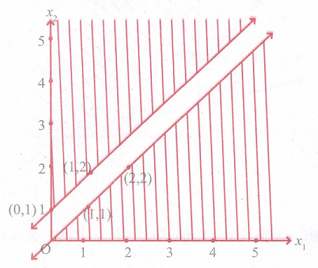
The feasible region is not common. Thus, there is no maximum value of Z.
15.
Since the decision variables are non-negative, the solution lies in the I-quadrant of the plane. Consider the equations
\({ x }_{ 1 }+2{ x }_{ 2 }= 8\)
| \({ x }_{ 1 }\) | 0 | 8 |
| \({ x }_{ 2 }\) | 4 | 0 |
\({ 3x }_{ 1 }+{ 2x }_{ 2 }=12\)
| \({ x }_{ 1 }\) | 0 | 4 |
| \({ x }_{ 2 }\) | 6 | 0 |
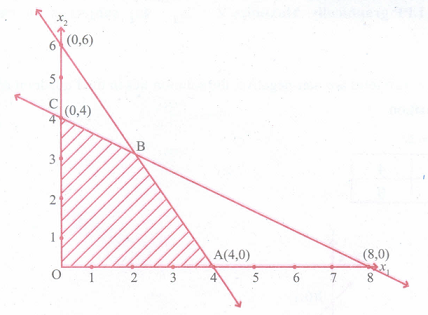
The feasible region is OABC and its co-ordinates are 0(0, 0) A( 4, 0) qo, 4) and B is the point of intersection of the lines
\({ x }_{ 1 }+2{ x }_{ 2 }=8\) ... (1) \(and\quad { 3x }_{ 1 }+{ 2x }_{ 2 }=12\) ...(2)
Verification of B:
\((1)\Rightarrow { x }_{ 1 }+2{ x }_{ 2 }=8\\ \quad \quad (-)\quad (-)\quad \quad (-)\\ (2)\Rightarrow 3{ x }_{ 1 }+2{ x }_{ 2 }=12\\ -----------\\ -2{ x }_{ 1 }=-4 \Rightarrow { x }_{ 1 }=2\)
\(From(1), 2+2{ x }_{ 2 }=8\Rightarrow 2{ x }_{ 2 }=6\Rightarrow { x }_{ 2 }=3\)
∴ B is (2,3)
| Corner Points | \(Z=-3{ x }_{ 1 }+4{ x }_{ 2 }\) |
|---|---|
| O(0,0) | 0 |
| A(4, 0) | -12 |
| B (2, 3) | 6 |
| C(0,4) | 16 |
Minimum of Z occurs at A(4, 0).
Hence, the solution is x1= 4, x2 = 0 and Zmin = - 12.
16.
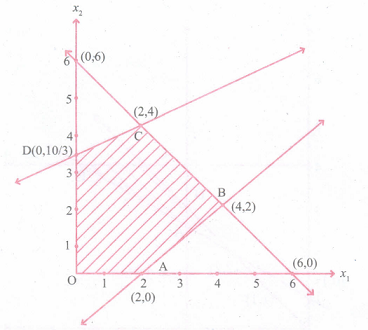
Since the decision variables x1 ,x2 are non-negative, the solution lies in the I quadrant of the plane.
Consider the equations
\(-{ x }_{ 1 }+3{ x }_{ 2 }=10\)
| \({ x }_{ 1 }\) | 0 | 2 |
|---|---|---|
| \({ x }_{ 2 }\) | 10/3 | 4 |
\({ x }_{ 1 }+{ x }_{ 2 }=6\)
| \({ x }_{ 1 }\) | 0 | 6 |
|---|---|---|
| \({ x }_{ 2 }\) | 6 | 6 |
\({ x }_{ 1 }{ -x }_{ 2 }=2\)
| \({ x }_{ 1 }\) | 4 | 2 |
|---|---|---|
| \({ x }_{ 2 }\) | 2 | 0 |
The feasible region is OABCD and its co-ordinates are O(0, 0)A(2, 0) B(4, 2) C(2, 4) and D(0, 10/3)
| Corner Points | \(Z=-{ x }_{ 1 }+2{ x }_{ 2 }\) |
|---|---|
| 0(0,0) | 0 |
| A(2, 0) | -2 |
| B (4, 2) | 0 |
| C(2,4) | 6 |
| D\(\left( 0,\frac { 10 }{ 3 } \right) \) | \(\frac { 20 }{ 3 } \) |
Maximum of Z occurs at\(D\left( 0,\frac { 10 }{ 3 } \right) \). Hence, the solution is \({ x }_{ 1 }=0,{ x }_{ 2 }=\frac { 10 }{ 3 } \quad and\quad { Z }_{ max }=\frac { 20 }{ 3 } \)
17.
Since the decision variables x1,x2 are non-negative, the solution lies in the I quadrant.
Consider the equations
\(3{ x }_{ 1 }+5{ x }_{ 2 }=15\)
| \({ x }_{ 1 }\) | 0 | 5 |
| \({ x }_{ 2 }\) | 3 | 0 |
\(5{ x }_{ 1 }+2{ x }_{ 2 }=10\)
| \({ x }_{ 1 }\) | 0 | 2 |
| \({ x }_{ 2 }\) | 5 | 0 |
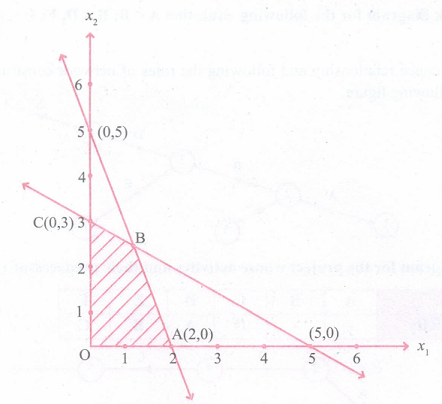
The feasible region is OABC and its co-ordinates are O(0, 0) A(2, 0) C(0, 3) and B is the point of intersection of the lines
\(3{ x }_{ 1 }+5{ x }_{ 2 }=15\) ----(1)
and \(5{ x }_{ 1 }+2{ x }_{ 2 }=10\) ... (2)
Verification of B:
\((1)\times 5\Rightarrow 15{ x }_{ 1 }+25{ x }_{ 2 }=75\\ \quad \quad (-)\quad (-)\quad \quad (-) \\ (2)\times 3\Rightarrow 15{ x }_{ 1 }+6{ x }_{ 2 }=30\\ --------------\\ 19{ x }_{ 2 }=45 \Rightarrow { x }_{ 2 }=\frac { 45 }{ 19 } \)
\(From(1), 3{ x }_{ 1 }+5\left( \frac { 45 }{ 19 } \right) =15\)
\(\Rightarrow 3{ x }_{ 1 }=15-\frac { 225 }{ 19 } \)
\(\Rightarrow { x }_{ 1 }=\frac { 20 }{ 19 } \)
\(\therefore \ B \ is\ \left( \frac { 20 }{ 19 } ,\frac { 45 }{ 19 } \right) \)
| Corner Points | \(Z=6{ x }_{ 1 }+5{ x }_{ 2 }\) |
|---|---|
| O(0,0) | 0 |
| A(2,0) | 12 |
| B\(\left( \frac { 20 }{ 19 } ,\frac { 45 }{ 19 } \right) \) | \(6\times \frac { 20 }{ 19 } +5\times \frac { 45 }{ 19 } =\frac { 345 }{ 19 } \) |
| C(0,3) | 15 |
Maximum of Z occurs at B \(\left( \frac { 20 }{ 19 } ,\frac { 45 }{ 19 } \right) \)
Hence, the solution is \({ x }_{ 1 }=\frac { 20 }{ 19 } ,{ x }_{ 2 }=\frac { 45 }{ 19 } \ and\ { Z }_{ max }=\frac { 345 }{ 19 } \)
18.
Let us assume that the investment in each stock be Rs.(80 x 96)
Case (i) Income from 7% stock
\(=\frac { \text {Investment }}{\text { MV } }\times {\text { Divicend Rate}}\)
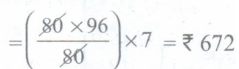
case(ii)
Income from 9% stock at 96
\(=\frac { \text {Investment }}{\text { MV } }\times {\text { Divicend Rate}}\)
=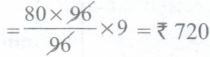
since income from 90% stock at 96 is more than the income from 7% stock at 80,9% stock at 96 is the better investment.
19.
Given a=Rs.250,r=\(\cfrac { 6 }{ 100 } \times \cfrac { 1 }{ 12 } \)=0.005,n =5 x12 = 60
P = \(\cfrac { a }{ i } \left[ \left( 1+i \right) ^{ n }-1 \right] \)
=\(\cfrac { 250 }{ 0.005 } \)[1-(1.005)-60]
= 50,000[1-0.7414]
= 50,000[0.2586]
= Rs.12930
(1.005)60=-60 log (1.005)
= -60(0.00216)
= -0.1299-1+1
= (1-0.1299)-1
=\(\bar { 1 } .8701\)
Antilog of \(\bar { 1 } .8701\) is 0.7414
20.
Given a = Rs.1000,i =\(\cfrac { 12 }{ 12 } \)% = 1% = 0.01,n =12
A = \(\cfrac { a }{ i } \left[ \left( 1+i \right) ^{ n }-1 \right] \)
= \(\cfrac { 1000 }{ 0.01 } \left[ \left( 1.01 \right) ^{ 12 }-1 \right] \)
= 100000[1.127-1]
= Rs.12,700
(1.01)12=12 log (1.01)
=12(0.0043)
= 0.0516
Antilog of 0.0516 is 1.127
21.
FV = 100
Market Price = Rs.80
Dividend Rate = 20
Yield = \(\frac { FV }{ \text {Market Price } }\) x 20
=\(\frac { 100 }{ 80 } \) x 20 = 25%
22.
Given A = Rs.3783,i = 0.05,n = 3
A = \(\cfrac { a }{ i } \left[ \left( 1+i \right) ^{ n }-1 \right] \)
3783 = \(\cfrac { a }{ i } \) [(1.05)3-1]
3783 x 0.05 = a[1.1576-1]
a = \(\cfrac { 189.15 }{ 0.1576 } \) = 1200.19
\(\therefore\) a =Rs.1200
(1.05)3 = 3 log (1.05)
= 3(0.212)
= 0.636
Antilog of 0.636 is 1.1576
23.
Given a = Rs.200, I = 0.04 , n = 2
P = \(\cfrac { a }{ i } \left( 1+i \right) \left[ \left( 1+i \right) ^{ n }-1 \right] \)
=\(\cfrac { 200 }{ 0.04 } \) (1.04)[1-(1.04)-2]
= 5200[1-0.9247]
= 5200(0.09247)
= Rs.391.56
(1.04)-2 = -2log(1.04)
= -2(0.0170)
= -0.340+1-1
Antilog of \(\bar { 1 } .9660\) is 0.9247
24.
Given a = Rs.500,i = 5% = 0.05,n =10
A =\(\cfrac { a }{ i } \left( 1+i \right) \left[ \left( 1+i \right) ^{ n }-1 \right] \)
\(=\frac { 500 }{ 0.05 } (1.05)\left[ (1.05)^{ 10 }-1 \right] \)
\(=10,500[1.629-1]\)
\(=10,500(0.629)\)
\(\therefore\) = Rs. 6604.50
At the end of 10 years, I will receive Rs. 6604.50.
\((1.05)^{ 10 }=10log(1.05)\)
\(=0.2120\)
Antilog of 0.2120 is 1.629
25.
Given P = Rs.5000,r =\(\cfrac { 8 }{ 2 } \) x = 4% = 0.04,n =10
P=\(\cfrac { a }{ i } \left[ 1-\left( 1+i \right) ^{ -n } \right] \)
5000 =\(\cfrac { a }{ 0.04 } \left[ 1-\left( 1.04 \right) ^{ -10 } \right] \)
5000 x 0.04 =a[1-0.6761]
200 = a(0.3239)
a=\(\cfrac { 200 }{ 0.3239 }\)=Rs.617.50
(1.04)-10=-10log (1.04)
= -10(0.0170)
= -0.1700
= 0.1700+(1-1)
= \(\bar { 1 } .\left( 1-0.1700 \right) \)
=\(\bar { 1 } .8300\)
Antilog of 0.8300 is 0.6761
26.
| x | log x |
|---|---|
| 3 | 0.4771 |
| 6 | 0.7782 |
| 24 | 1.3802 |
| 48 | 1.6812 |
\(\sum { log } \) = 4.3167
Geometric Mean = Antilog\(\left( \frac { \sum { log\quad x } }{ N } \right) =Antilog\left( \frac { 4.3167 }{ 4 } \right) \)
= Antilog (1.0791)
GM = 11.99
27.
Given bxy =2 and byx=0.45
We know r= \(\sqrt { { b }_{ xy }.{ b }_{ yx } } =\sqrt { 2(0.45) } =\sqrt { 0.9 } \)=0.949
\(\therefore\)r=0.949
28.
We haveP(not A or not B) = 1/4
\(P(\overline { A } U\overline { B } )=\frac { 1 }{ 4 } \) \(\Rightarrow P(\overline { A\cap B } )=\frac { 1 }{ 4 } \)
\(\Rightarrow 1-P(A\cap B)=\frac { 1 }{ 4 } \) \(\Rightarrow P(A\cap B)=1-\frac { 1 }{ 4 } =\frac { 3 }{ 4 } \)
\(\therefore P(A\cap B)=\frac { 3 }{ 4 } \)
Now, P(A). P(B) = \(\frac { 1 }{ 2 } \times \frac { 7 }{ 12 } =\frac { 7 }{ 24 } \)
\(\therefore P(A\cap B)\neq P(A).P(B)\)
So, A and B are not independent events.
29.
Let 2 and 4 be the assumed means for the X and Y series respectively.
| X | Y | dx=X-2 | dy=Y-4 | dx2 | dy2 | dxdy |
| -3 | 9 | -5 | 5 | 25 | 25 | -25 |
| -2 | 4 | -4 | 0 | 16 | 0 | 0 |
| -1 | 1 | -3 | -3 | 9 | 9 | 9 |
| 0 | 0 | -2 | -4 | 4 | 16 | 8 |
| 1 | 1 | -1 | -3 | 1 | 9 | 3 |
| 2 | 4 | 0 | 0 | 0 | 0 | 0 |
| 3 | 9 | 1 | 5 | 1 | 25 | 5 |
| -14 | 0 | 56 | 84 | 0 |
Correlation Co-efficient
r(X,Y) =\(\frac { N\sum { dXdY-(\sum { dX)(\sum { Y) } d } } }{ \sqrt { n.\sum { d{ x }^{ 2 }-{ (\sum { dx } })^{ 2 } } } \sqrt { n\sum { d{ y }^{ 2 }-(\sum { d{ y) }^{ 2 } } } } } \)
=\(\frac { 7(0)-(-14)(0) }{ \sqrt { 56(7)-({ -14) }^{ 2 } } \sqrt { 84(7)-0 } } \)=0
∴ r(X, Y)=0
30.
Given n(A) = 3, n(B) = 2 and n(C) = 4
A\(\cap \)B = {3}
A\(\cap \)C = {2, 5}
\(\therefore\) n(A\(\cap \)B) = 1
and n(A\(\cap \)C) = 2
(i) P(A/B) = \(\frac { P(A\cap B) }{ P(B) } =\frac { n(A\cap B) }{ n(B) } =\frac { 1 }{ 2 } \)
\(P(B/A)=\frac { P(A\cap B) }{ P(A) } =\frac { n(A\cap B) }{ n(A) } =\frac { 1 }{ 3 } \)
(ii) \(P(A/C)=\frac { P(A\cap C) }{ P(C) } =\frac { n(A\cap C) }{ n(C) } =\frac { 2 }{ 4 } =\frac { 1 }{ 2 } \)
\(P(C/A)=\frac { P(A\cap C) }{ P(A) } =\frac { n(A\cap C) }{ n(A) } =\frac { 2 }{ 3 } \)
31.
| X | Y | X2 | Y2 | XY |
| 4 | 2 | 16 | 4 | 8 |
| 2 | 3 | 4 | 9 | 6 |
| 3 | 2 | 9 | 4 | 6 |
| 4 | 4 | 16 | 16 | 16 |
| 2 | 4 | 4 | 16 | 8 |
| 15 | 15 | 49 | 49 | 44 |
byx=\(\frac { n\sum { XY-(\sum { X)(\sum { Y) } } } }{ n{ \sum { X } }^{ 2 }-\left( \sum { { X }^{ 2 } } \right) } =\frac { 5(44)-(15)(15) }{ 5(49)-({ 15) }^{ 2 } } =\frac { -1 }{ 5 } \)
bxy=\(\frac { n\sum { XY-(\sum { X)(\sum { Y) } } } }{ n{ \sum { Y } }^{ 2 }-\left( \sum { { Y) }^{ 2 } } \right) } =\frac { 5(44)-(15)(15) }{ 5(49)-({ 15) }^{ 2 } } =\frac { -1 }{ 5 } \)
The co-efficient of correlation is
r= \(\sqrt { { b }_{ xy }.{ b }_{ yx } } =\sqrt { \left( -\frac { 1 }{ 5 } \right) \left( -\frac { 1 }{ 5 } \right) } \)=0.2
As bxy and byx are both negative, r=-0.2
32.
The regression co-efficient are given by
bxy= \(r.\frac { { \sigma }_{ x } }{ { \sigma }_{ y } } \)and byx=\(r.\frac { { \sigma }_{ y } }{ { \sigma }_{ x } } \)
where r is the co-efficient of correlation.
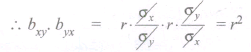
\(r=\sqrt { { b }_{ xy }.{ b }_{ yx } } \)
33.
r(x, y) =\(\frac { n\sum { xy-(\sum { x)(\sum { y) } } } }{ \sqrt { n\sum { { x }^{ 2 }-{ (\sum { x) } }^{ 2 } } } .\sqrt { n\sum { { y }^{ 2 }-{ (\sum { y } }^{ 2 }) } } } \)
=\(\frac { 20(75)-10(70) }{ \sqrt { 20(250)-{ (10) }^{ 2 }.\sqrt { 20(300)-{ (70) }^{ 2 } } } } \)
=\(\frac { 1500-700 }{ \sqrt { 5000-100.\sqrt { 6000-4900 } } } \)
=\(\frac { 800 }{ (70)(33.166) } =\frac { 800 }{ 2321.62 } \)=0.345
34.
| X | Y | XY |
| 1 | 5 | 5 |
| 2 | 4 | 8 |
| 3 | 3 | 9 |
| 4 | 2 | 8 |
| 5 | 1 | 5 |
| 15 | 15 | 35 |
cov(X, Y) =\(\frac { 1 }{ n } \left[ \sum { XY-\frac { 1 }{ n } (\sum { X)(\sum { Y) } } } \right] \)
=\(\frac { 1 }{ 5 } \left[ 35-\frac { 1 }{ 5 } (15)(15) \right] \)
= \(\frac { 1 }{ 5 } [35-45]=\frac { -10 }{ 5 } \)=-2
35.
N=7
| X | Y | x2 | y2 | xy |
| 12 | 14 | 144 | 196 | 168 |
| 9 | 8 | 81 | 64 | 72 |
| 8 | 6 | 64 | 36 | 48 |
| 10 | 9 | 100 | 81 | 90 |
| 11 | 11 | 121 | 121 | 121 |
| 13 | 12 | 169 | 144 | 156 |
| 7 | 3 | 49 | 9 | 21 |
| 70 | 63 | 728 | 651 | 676 |
Karl Pearson correlation co-efficient
r(x, y) =\(\frac { N\sum { XY-(\sum { X)(\sum { Y) } } } }{ \sqrt { N.\sum { { X }^{ 2 }-({ \sum { X) } }^{ 2 } } } .\sqrt { N.{ \sum { Y } }^{ 2 }-({ \sum { Y) } }^{ 2 } } } \)
=\(\frac { 7(676)-(70)(63) }{ \sqrt { 7(728)-{ (70) }^{ 2 } } \sqrt { 7(651)-{ (63) }^{ 2 } } } \)
=\(\frac { 4732-4410 }{ (14)(24.2487) } =\frac { 322 }{ 229.4818 } \)=0.9485
36.
| X | Y | X2 | Y2 | XY |
| 1 | 9 | 1 | 81 | 9 |
| 2 | 8 | 4 | 64 | 16 |
| 3 | 10 | 9 | 100 | 30 |
| 4 | 12 | 16 | 144 | 48 |
| 5 | 11 | 25 | 121 | 55 |
| 6 | 13 | 36 | 169 | 78 |
| 7 | 14 | 49 | 196 | 98 |
| 8 | 16 | 64 | 256 | 128 |
| 9 | 15 | 81 | 225 | 135 |
| 45 | 108 | 285 | 1356 | 597 |
r(x,y) =\(\frac { N\sum { XY-(\sum { X)(\sum { Y) } } } }{ \sqrt { N.{ \sum { X } }^{ 2 }-({ \sum { X) } }^{ 2 } } .\sqrt { N.{ \sum { Y } }^{ 2 }-{ (\sum { Y) } }^{ 2 } } } \)
=\(\frac { 9(597)-45(108) }{ \sqrt { 9(285)-{ (45) }^{ 2 } } .\sqrt { 9(1356)-({ 108) }^{ 2 } } } \)
=0.95
\(\therefore\)X and Y are highly positively correlated.
37.
\(\Rightarrow\) \(\alpha+2\beta={{\pi}\over{4}}\)
38.
LHS\(=\cos^{-1}\left(\frac{3}{5}\cos x+\frac{4}{5}\sin x\right)\)
put \(\frac{3}{5}=\cos\theta\)
\(\therefore\sin\theta=\sqrt{1-\cos^2\theta}=\sqrt{1-\left(\frac35\right)^2}=\sqrt{1-\frac{9}{25}}=\sqrt{\frac{16}{25}}=\frac45\)
Now, \(\tan\theta=\frac{\sin\theta}{\cos\theta}=\frac{\frac45}{\frac35}=\frac43\Rightarrow\theta=\tan^{-1}\left(\frac43\right)\)
\(\therefore\cos^{-1}\left(\frac{3}{5}\cos x+\frac45\sin x\right)\)
= cos-1 (cos \(\theta\) cos x + sin \(\theta\) sin x)
= cos-1 [cos (x - \(\theta\) )] [\(\therefore\) cos (A- B) = cos A cos B + sin A sin B]
= x - \(\theta\)
= \(x-{\tan}^{-1}\left({{4}\over{3}} \right)\) = RHS
Hence proved.
39.
LHS\(=\frac{\sin5x-2\sin3x+\sin x}{\cos 5x-\cos x}\)
\(=\frac{(\sin5x+\sin x)-2\sin3x}{\cos5x-\cos x}\)
\(=\frac{2\sin\left(\frac{5x+x}{2}\right)\cos\left(\frac{5x-x}{2}\right)-2\sin3x}{-2\sin\left(\frac{5x+x}{2}\right)\sin\left(\frac{5x-x}{2}\right)}\)
\(=\frac{2\sin3x\cos2x-2\sin3x}{-2\sin3x.\sin2x}\)
\(\frac{-2\sin3x(1-\cos2x)}{-2\sin3x.\sin2x}=\frac{1-\cos2x}{\sin2x}\)
\(=\frac{2\sin^2x}{2\sin x\cos x}=\frac{\sin x}{\cos x}\tan x=RHS\)
Hence proved.
40.
LHS=\(\frac{\sin(x+y)}{\sin(x-y)}=\frac{\sin x\cos y+\cos x+sin y}{\sin x\cos y-\cos x\sin y}\)
Dividing the numerator and denominator by cos x cos y,
We get LHS,
\(\frac{\frac{\sin x\cos y}{\cos x\cos y}+\frac{\cos x\sin y}{\cos x\cos y}}{\frac{\sin x\cos y}{\cos x\cos y}-\frac{\cos x\sin y}{\cos x\cos y}}=\frac{\tan x+\tan y}{\tan x-\tan y}=RHS\)
Hence proved.
41.
\(\underset { x\rightarrow 0 }{ lim } \frac { 2sinx-sin2x }{ { x }^{ 3 } } \)= \(\underset { x\rightarrow 0 }{ lim } \frac { 2sinx-2sinx\quad cosx }{ { x }^{ 3 } } \)
= \(\underset { x\rightarrow 0 }{ lim } \frac { 2sinx(1-cosx) }{ { x }^{ 3 } } =2.\underset { x\rightarrow 0 }{ lim } \frac { sinx }{ x } \underset { x\rightarrow 0 }{ lim } \frac { { 2sin }^{ 2 }\frac { x }{ 2 } }{ { x }^{ 2 } } \) \(\left[ \therefore 1-cosx=2{ sin }^{ 2 }\frac { x }{ 2 } \right] \)
= \(4(1).\underset { x\rightarrow 0 }{ lim } \frac { { sin }^{ 2 }\frac { x }{ 2 } }{ \left( \frac { x }{ 2 } \right) ^{ 2 } \times \ \ 4 } \left[ \therefore \underset { \phi \rightarrow 0 }{ lim } \quad \frac { sin\phi }{ \phi } =1 \right] \) [Multiplying and dividing by 4 in the denominator]
= \(\frac { 4 }{ 4 } .\underset { x\rightarrow 0 }{ lim } \left( \frac { sin\frac { 2 }{ x } }{ \frac { 2 }{ x } } \right) \)
=1 x 1 = 1
42.
LHS\(=\left\{1+\cot x-\sec\left(\frac{\pi}{2}+x\right)\right\}\left\{1+\cot x+\sec\left(\frac{\pi}{2}+x\right)\right\}\)
=(1 + cot x + cosec x) (1 + cot x - cosec x)
(1 + cot x)2 - (cosec2x) [\(\therefore\)(a + b) (a - b) = a2 - b2]
1 + cot2x + 2 cot x - cosec2x
= cosec2x + 2 cot x - cosec2x [\(\therefore\) 1 + cot2x = cosec2x]
= 2 cot x = RHS. Hence proved.
43.
We know that \(\cos^2x+\sin^2x=1\)
\(\Rightarrow\cos x=\pm\sqrt{1-\sin^2x}\)
In the III quadrant, cos x is negative
\(\therefore\cos x=-\sqrt{1-\sin^2x}=-\sqrt{1-\frac{24}{25}}=-\frac15\left[\because\sin^2x=\frac{4(6)}{25}=\frac{24}{25}\right]\)
In the III quadrant, tan x is positive
\(\therefore\tan x=\frac{\sin x}{\cos x}=\frac{-2\sqrt6}{5}\times\frac{-5}{1}=2\sqrt{6}\)
\(cosec x=\frac{1}{\sin x}=\frac{-5}{2\sqrt6}\)
\(\sec x=\frac{1}{\cos x}=-5\) and
\(\cot x=\frac{1}{\tan x}=\frac{1}{2\sqrt6}\)
44.
Given ey(x+1)=1 ....(1)
Differentiating with respect to 'x' we get,
\({ e }^{ y }(1)+(x+1){ e }^{ y }\frac { dy }{ dx } =0\) [product rule]
\(\Rightarrow { e }^{ y }+(1)\frac { dy }{ dx } =0\quad [using\quad (1)]\)
\(\Rightarrow \frac { dy }{ dx } =-{ e }^{ y }\)...(2)
Differentiating again with respect to 'x' we get,
\(\frac { d }{ dx } \left( \frac { dy }{ dx } \right) =\frac { d }{ dx } \left( -{ e }^{ y } \right) \)
\(\Rightarrow \frac { { d }^{ 2 }y }{ { dx }^{ 2 } } =-{ e }^{ y }.\frac { dy }{ dx } \)
\(=\left( \frac { dy }{ dx } \right) \left( \frac { dy }{ dx } \right) \) [using (2)]
\(={ \left( \frac { dy }{ dx } \right) }^{ 2 }\)
\(\frac { { d }^{ 2 }y }{ { dx }^{ 2 } } ={ \left( \frac { dy }{ dx } \right) }^{ 2 }\)
Hence proved.
45.
Given sin2 x + cos2 y = 1.
Differentiating with respect to 'x' we get,
\(2\sin { x } .\frac { d }{ dx } \left( \sin { x } \right) +2\cos { y } .\frac { d }{ dx } \left( \cos { y } \right) =0\)
\(\Rightarrow 2\sin { x } \cos { x } +2\cos { y } \left( -\sin { y } \right) \frac { dy }{ dx } =0\)
\(\Rightarrow \sin { 2x } -2\sin { y } \cos { y } \left( \frac { dy }{ dx } \right) =0\)
\(\Rightarrow \sin { 2x } -\sin { 2y } \left( \frac { dy }{ dx } \right) =0\)
\(\Rightarrow \sin { 2x } =\sin { 2y } \left( \frac { dy }{ dx } \right) \)
\(\Rightarrow \left( \frac { dy }{ dx } \right) =\frac { \sin { 2x } }{ \sin { 2y } } \)
46.
Let (x1, y1) be the point of contact.
\(\therefore\) Equation of tangent at (x1,y1) to the circle is xx1 + yy1 = 9
Its slope is -\(\frac { { x }_{ 1 } }{ { y }_{ 1 } } \)
Given that the tangent is parallel to 2x + y - 3 = 0
\(\therefore\) Their slopes must be equal
\(\therefore \quad \frac { -{ x }_{ 1 } }{ { y }_{ 1 } } =\frac { -2 }{ 1 } \Rightarrow { x }_{ 1 }=2{ y }_{ 1 }\)
But \({ x }_{ 1 }^{ 2 }+{ y }_{ 1 }^{ 2 }=9\)
\(\Rightarrow { (2{ y }_{ 1 }) }^{ 2 }+{ y }_{ 1 }^{ 2 }=9\Rightarrow 4{ y }_{ 1 }^{ 2 }+{ y }_{ 1 }^{ 2 }=9\)
\(\Rightarrow 5{ y }_{ 1 }^{ 2 }=9\Rightarrow { y }_{ 1 }=\pm \frac { 3 }{ \sqrt { 5 } } \)
\(\therefore x=\frac { 6 }{ \sqrt { 5 } } \)
Hence \(\frac { { 6x }_{ 1 } }{ \sqrt { 5 } } =\frac { 3{ y }_{ 1 } }{ \sqrt { 5 } } =9\Rightarrow 6x+3y=9\sqrt { 5 } \)
\(\Rightarrow 2x+y=3\sqrt { 5 } \)
47.
Given f(x) = x2 -x2 -sin x + 5
\(\underset { x\rightarrow \pi }{ lim } f(x)=\underset { x\rightarrow \pi }{ lim } ({ x }^{ 2 }-sinx+5)\)
\(={ \pi }^{ 2 }-sin\quad \pi +5={ \pi }^{ 2 }-0+5+5=5{ \pi }^{ 2 }\) \([\therefore sin \ \pi=0]\)
Also, f(\(\pi\)) = \({ \pi }^{ 2 }-sin\quad \pi +5=\pi \quad -0+5=\pi +5\)
ஃ \(\underset { x\rightarrow \pi }{ lim } f(x)=f(x)\)
ஃ f(x) is continuous at x = \(\pi\)
48.
The given line is 2x + y = 1
Any line parallel to this is 2x + y + k = 0
Since this passes through (0,0),2(0) + 0 + k = 0 \(\Rightarrow\) k = 0
\(\therefore\) Equation of parallel line is 2x + y = 0 .....(1)
Any line perpendicular to 2x + y = 1 is x - 2y + k1 = 0
Since this passes through (0, 0), k1 = 0
\(\therefore\) Perpendicular line is x - 2y = 0 ......(2)
\(\therefore\) Required combined equation is
(2x + y)(x - 2y) = 0
\(\Rightarrow\) 2x2 - 4xy + xy - 2y2 = 0
\(\Rightarrow\) 2x2 - 3xy - 2y2 = 0.
49.
Slope of the line 3x-y+5=0 is
\(\Rightarrow \quad { m }_{ 2 }=-\frac { co-efficient\quad of\quad x }{ co-efficient\quad of\quad y } =\frac { -3 }{ -1 } =3\)
Let m1 = m and \(\theta =45\)
\(\therefore \quad tan\theta =\left| \frac { { m }_{ 1 }-{ m }_{ 2 } }{ 1+{ m }_{ 1 }{ m }_{ 2 } } \right| \)
\(\Rightarrow \quad tan\quad 45=\left| \frac { m-3 }{ 1+3m } \right| \)
\(\Rightarrow \quad 1=\left| \frac { m-3 }{ 1+3m } \right| \)
\(\Rightarrow \quad 1|1+3m|=|m-3|\)
\(\Rightarrow \quad 1+3m=\pm (m-3)\)
\(\Rightarrow \quad 1+3m=m-3\quad or\quad 1+3m=-m+3\)
\(\Rightarrow\) 2m = - 4 or 4m = 2
\(\Rightarrow \) m = - 2 or \(m=\frac { 2 }{ 4 } =\frac { 1 }{ 2 }\)
\(\therefore \) m = - 2 or \(\frac { 1 }{ 2 } \)
50.
The given lines are
y = m1x + C1 \(\Rightarrow\) m1 x - y + C1 = 0
y = m2x + C2 \(\Rightarrow\) m2x - y + C2 = 0
y = m3x + C3 \(\Rightarrow\) m3x - y + C3 = 0.
The condition for these lines to be concurrent is \(\left| \begin{matrix} { m }_{ 1 } & -1 & { C }_{ 1 } \\ { m }_{ 2 } & -1 & { C }_{ 2 } \\ { m }_{ 3 } & -1 & { C }_{ 3 } \end{matrix} \right| =0\)
Interchanging C2 and C3 we get,
\(\left| \begin{matrix} { m }_{ 1 } & { C }_{ 1 } & 1 \\ { m }_{ 2 } & { C }_{ 2 } & 1 \\ { m }_{ 3 } & { C }_{ 3 } & 1 \end{matrix} \right| =0\) [Taking (-1) common from C3]
Expanding along C1 we get
\({ m }_{ 1 }\left| \begin{matrix} { C }_{ 2 } & 1 \\ { C }_{ 3 } & 1 \end{matrix} \right| -{ m }_{ 2 }\begin{vmatrix} { C }_{ 1 } & 1 \\ { C }_{ 3 } & 1 \end{vmatrix}+{ m }_{ 3 }\begin{vmatrix} { C }_{ 1 } & 1 \\ { C }_{ 2 } & 1 \end{vmatrix}=0\)
\(\Rightarrow\) m1(C2 - C3) - m2(C1 - C3) + m3(C1 - C2) = 0
\(\Rightarrow\) m1(C2 - C3) + m2(C3 - C1) + m3(C1 - C2) = 0
51.
Given equation is
3x2 + 7xy + 2y2 + 5x + 5y + 2 = 0
Factorising 3x2 + 7xy + 2y2 = (x + 2y) (3x + y)
\(\therefore \) 3x2 + 7xy + 2y2 + 5x + 5y + 2 = (x + 2y + l)(3x + y + m)
Equating the x and y Co-ordinates both sides,
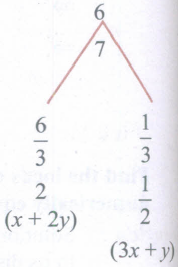
We get 5 = m + 3l ...(1)
5 = 2m + l ....(2)
| (1) \(\times\) (2) \(\rightarrow \) 10 | = 2m + 6l |
| (2) \(\rightarrow \) 5 | = 2m + 1l |
| 5 | = 0 + l \(\Rightarrow \) l = 1 |
Substituting l = 1 in (2) we get,
5 = 2m + 1 \(\Rightarrow \) 2m = 4 \(\Rightarrow \) m = 2.
Hence the separate equations are
x + 2y + 1 = 0 and 3x + y + 2 = 0.
52.
Given \(y=\sqrt { x } +\frac { 1 }{ \sqrt { x } } .\Rightarrow y=\frac { x+1 }{ \sqrt { x } } \) ......(1)
Differentiating with respect to 'x' we get,
\(\frac { dy }{ dx } =\frac { \sqrt { x } .\frac { d }{ dx } (x+1)-(x+1).\frac { d }{ dx } (\sqrt { x } ) }{ { (\sqrt { x } })^{ 2 } } \)
\(=\frac { \sqrt { x } (1)-(x+1).\frac { 1 }{ 2\sqrt { x } } }{ x } =\frac { \frac { 2x-(x+1) }{ 2\sqrt { x } } }{ x } \)
\(\frac { dy }{ dx } =\frac { 2x-x-1 }{ 2x.\sqrt { x } } =\frac { x-1 }{ 2x\sqrt { x } } \)...(2)
LHS=\(2x\left( \frac { dy }{ dx } \right) +y\)
\(=2x\left( \frac { x-1 }{ 2x\sqrt { x } } \right) +\frac { x+1 }{ \sqrt { x } }\)
[From (1) and (2)]
\(=\frac { x-1 }{ \sqrt { x } } +\frac { x+1 }{ \sqrt { x } } =\frac { x-1+x+1 }{ \sqrt { x } } =\frac { 2x }{ \sqrt { x } } =\frac { 2\sqrt { x } .\sqrt { x } }{ \sqrt { x } } =2\sqrt { x } \) = RHS.
Hence proved
53.
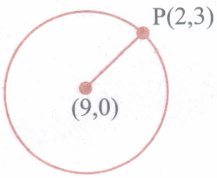
\(\Rightarrow\) Let the coordinates of the centre of the required circle be C(a,0). Since it passes through P(2,3) = 25
CP = radius = 5
\(\Rightarrow \sqrt { ({ a-2) }^{ 2 }+{ (0-3) }^{ 2 } } =5\)
\(\Rightarrow\) (a- 2 )2 + 9 = 25 \(\Rightarrow\) (a - 2)2 = 16
\(\Rightarrow\) (a - 2)2 = (\(\pm \)4)2
\(\Rightarrow\) a - 2 = \(\pm \)4
\(\Rightarrow\) a = \(\pm \) 4 + 2
\(\Rightarrow\) a = 4 + 2 or -4 + 2
\(\Rightarrow\) a = 6 or -2
Thus the coordinates of the centre are (6, 0) or (-2, 0)
Hence the equations of the required circle are
(x - 6)2 + (y - 0)2 = 52 \(\Rightarrow\) x2 + 36 - 12x + y2 = 25
\(\Rightarrow\) x2 + y2 - 12x + 11 = 0 (OR)
(x + 2)2 + (y - 0)2 = 52
\(\Rightarrow\) x2 + 4x +4 + y2 = 25
\(\Rightarrow\) x2 + y2 + 4x - 21 = 0.
54.
Let p(x1,y1) be the point on the locus and A(-1, 0) B(0, 2) are the fixed points
Given pA = 3 pB
\(\Rightarrow\) pA2 = 9 pB2
\(\Rightarrow ({ x }_{ 1 }+1)^{ 2 }+({ y }_{ 1 }-0)^{ 2 }=9[({ x }_{ 1 }-0)^{ 2 }+({ y }_{ 1 }-2)^{ 2 }]\)
\(\Rightarrow { x }_{ 1 }^{ 2 }+2{ x }_{ 1 }+1+{ y }_{ 1 }^{ 2 }=9[{ x }_{ 1 }^{ 2 }+{ y }_{ 1 }^{ 2 }-4{ y }_{ 1 }+4]\)
\(\Rightarrow { x }_{ 1 }^{ 2 }+2{ x }_{ 1 }+1+{ y }_{ 1 }^{ 2 }=9{ x }_{ 1 }^{ 2 }+9{ y }_{ 1 }^{ 2 }-36{ y }_{ 1 }+36\)
\(\Rightarrow 8{ x }_{ 1 }^{ 2 }+8{ y }_{ 1 }^{ 2 }-{ 2x }_{ 1 }-36{ y }_{ 1 }+35=0\)
\(\therefore Locus\quad of\quad (x_{ 1 },{ y }_{ 1 })\quad is\) 8x2 + 8y2 - 2x - 36y + 35 = 0
55.
Here 12 things are to be divided equally among 4 persons, hence the groups are regarded as distinct.
Hence required number of ways = \(\frac { 12! }{ { (3!) }^{ 4 } } \)
\(=\frac { 12\times 11\times 10\times 9\times 8\times 7\times 6\times 5\times 4\times 3\times 2\times 1 }{ 3\times 2\times 3\times 2\times 3\times 2\times 3\times 2 } \)
=3696000
56.
No. of ways of giving I prize = n
No. of ways of giving II prize = n
.............................................
Similarly no. of ways of giving nth prize = n
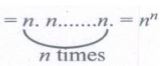
Therefore By fundamental principle of counting, the required number of ways
57.
Any number between 100 and 1000 is a 3 - digit number
1. Hundred place can be filled in 6 ways using the numbers 1,2,3,4,5,6 (excluding 0)
2. Tens place can be filled in 6 ways (including 0)
3. Ones place can be filled in 5 ways.
\(\therefore\) By fundamental principle of counting, total number of 3 digit numbers = 6 x 6 x 5 = 180.
58.
\({{x+4}\over{(x^2-4)(x+1)}}={{x+4}\over{(x+2)(x-2)(x+1)}}={{A}\over{x+2}}+{{B}\over{x-2}}+{{C}\over{x+1}}\)
\(\Rightarrow\) \({{x+4}\over{(x^2-4)(x+1)}}=\frac { { { A(x-2)(x+1)B+(x+2)(x+1)+C(x+2)(x-2) } } }{ (x+2)(x-2)(x+1) } xx\)
\(\Rightarrow\) x + 4 = A (x - 2) (x + 1) + B (x + 2) (x + 1) C (x + 2)(x - 2) ...(1)
Putting x = 2 in (1) we get,
6 = B (4) (3) \(\Rightarrow\boxed{B={{1}\over{2}}}\)
Putting x = -1 in (1) we get,
3 = C (1)(-3) \(\Rightarrow\quad \boxed{C=-1}\)
Putting x = 0 in (1) we get,
4 = - 2A + 2B - 4C
\(\Rightarrow\) \(4=-2A+2\left( {{1}\over{2}} \right)-4(-1)\) \(\left[ \because B={{1}\over{2}},C=-1 \right]\)
\(\Rightarrow\) \(4=-2A+1+4\ \ \Rightarrow\ 4=-2A+5\ \Rightarrow -1\) =-2A
\(\Rightarrow\) \(\boxed{A={{1}\over{2}}}\)
\(\therefore\) \({{x+4}\over{(x^2-4)(x+1)}}={{{{1}\over{2}}}\over{x+2}}+{{{{1}\over{2}}}\over{x-2}}-{{1}\over{}x+1}={{1}\over{2(x+2)}}+{{1}\over{2(2x-2)}}-{{1}\over{x+1}}\)
59.
Given A \(=\begin{bmatrix} 3&2\\7&5 \end{bmatrix}\)
\(|A|=\begin{vmatrix} 3&2\\7&5 \end{vmatrix}=15-14=1\Rightarrow{A}^{-1}\) exists.
A11 = 5, A12 = -7, A21 = -2, A22 = 3
\(\therefore\) adj A \({=\begin{bmatrix} 5&-7 \\ -2 & 3 \end{bmatrix}}^{T}=\begin{bmatrix} 5 & -2 \\-7 & 3 \end{bmatrix}\)
\(\therefore\ {A}^{-1}={{1}\over{|A|}}adj\ A={{1}\over{1}}\begin{bmatrix} 5&-2 \\ -7&3 \end{bmatrix}=\begin{bmatrix} 5&-2 \\ -7&3 \end{bmatrix}\)
Now B \(=\begin{bmatrix} 4&6\\ 3&2 \end{bmatrix}\)
\(|B|=\begin{vmatrix}4 &6 \\ 3 &2 \end{vmatrix}=8-18-10\Rightarrow{B}^{-1}\) exists.
B11 = 2, B12 = -3, B21 = -6, B22 = 4
\(\therefore\ adj\ B={\begin{bmatrix} 2 & -3 \\ -6 &4 \end{bmatrix}}^{T}=\begin{bmatrix} 2&-6 \\ -3 &4 \end{bmatrix}\)
\(\therefore\ {B}^{-1}={{1}\over{|B|}}adj\ B={{1}\over{10}}\begin{bmatrix} 2&-6 \\ -3&4 \end{bmatrix}={{1}\over{10}}\begin{bmatrix} -2&6 \\ 3 &-4 \end{bmatrix}\)
\(\therefore\ {B}^{-1}{A}^{-1}={{1}\over{10}}\begin{bmatrix} -2 & 6 \\3 & -4 \end{bmatrix}\begin{bmatrix} 5 & -2 \\ -7 & 3 \end{bmatrix}={{1}\over{10}}\begin{bmatrix} -10-42& 4+18\\ 15+28 & -6-12 \end{bmatrix}={{1}\over{10}}\begin{bmatrix} -52 & 22 \\ 43 & -18 \end{bmatrix}\)........(1)
\(AB=\begin{bmatrix} 3 & 2 \\ 7 & 5 \end{bmatrix}\begin{bmatrix} 4 & 6 \\ 3 & 2 \end{bmatrix}=\begin{bmatrix} 12+6 & 18+4\\ 28+15 & 42+10\end{bmatrix}=\begin{bmatrix} 18 & 22\\ 43 & 52 \end{bmatrix}\)
\(|AB|=\begin{vmatrix} 18&22 \\ 43 &52 \end{vmatrix}=936-946=-10\Rightarrow{(AB)}^{-1}\) exists.
\(adj\ AB={\begin{bmatrix} 52 &-43 \\ -22& 18 \end{bmatrix}}^{T}=\begin{bmatrix} 52 & -22 \\ -43 & 18 \end{bmatrix}\)
\(\therefore \ {(AB)}^{-1}adj\ (AB)={{-1}\over{10}}\begin{bmatrix} 52&-22 \\-43 & 18 \end{bmatrix}={{1}\over{10}}\begin{bmatrix} -52 & 22 \\ 43 &-18 \end{bmatrix}\)
From (1) and (2), (AB)-1 = B-1 A-1.
Hence proved.
60.
Let A = \(\left| \begin{matrix} 2 & 7 & 65 \\ 3 & 8 & 75 \\ 5 & 9 & 86 \end{matrix} \right| \)
Applying C1➝C1+9C2 we get
A = \(\left| \begin{matrix} 2+63 & 7 & 65 \\ 3+72 & 7 & 65 \\ 5+81 & 9 & 86 \end{matrix} \right| =\left| \begin{matrix} 65 & 7 & 65 \\ 75 & 8 & 75 \\ 86 & 9 & 86 \end{matrix} \right| =0[ \because {C}_{1}\equiv{C}_{3}]\)
61.
LHS = \(\begin{vmatrix}x+a &b&c \\a &x+b&c\\a&b&x+c \end{vmatrix}\)
Applying C1 \(\rightarrow\) C1 + C2 + C3 we get,
LHS = \(\begin{vmatrix}x+a+b+c &b&c \\x+a+b+c &x+b&c\\x+a+b+c&b&x+c \end{vmatrix}\)
Taking (x + a + b + c) common from C1 we get,
= (x + a + b + c) \(\begin{vmatrix}1 &b&c \\1 &x+b&c\\1&b&x+c \end{vmatrix}\)
Applying R2 \(\rightarrow\) R2 - R1 and R3 \(\rightarrow\) R1 we get,
= \((x+a+b+c)\begin{vmatrix}1 &b&c \\0&x&0\\0&0&x\end{vmatrix}\)
Expanding along C1 we get,
\(=(x+a+b+c)\begin{bmatrix} 1\begin{bmatrix} x & 0 \\ 0 & x\end{bmatrix} +0+0\end{bmatrix}\)
= (x + a + b + C)(x2) = RHS
Hence proved.
62.
Given equations are 2x + 5y = 1; 3x + 2y = 7
This system of equations can be written in matrix form as \(\begin{pmatrix}2 & 5 \\3 & 2 \end{pmatrix}\begin{pmatrix} x \\ y \end{pmatrix}=\begin{pmatrix} 1\\7 \end{pmatrix}\Rightarrow Ax=B\)
where A = \(\begin{pmatrix} 2 & 5 \\3 & 2 \end{pmatrix},X=\begin{pmatrix} x\\y \end{pmatrix}\) and B = \(\begin{pmatrix} 1 \\ 7 \end{pmatrix}\)
\(\therefore\) X = A-1 B.
\(|A|=\begin{vmatrix} 2 &5 \\3 & 2 \end{vmatrix}=4-15=-11\)
A11 = 2, A12 = -3, A21 = -5, A22 = 2
\(\therefore\) adj A = \(\begin{bmatrix} 2 & -3 \\ -5 & 2 \end{bmatrix}^{T}=\begin{bmatrix} 2 & -5 \\-3 & 2 \end{bmatrix}\)
\(\therefore\) \({A}^{-1}={{1}\over{|A|}}\) . adj A = \({{-1}\over{11}}\begin{bmatrix} 2 & -5\\ -3& 2 \end{bmatrix}\)
X = A- 1 B \(={{-1}\over{11}}\begin{bmatrix} 2 & -5\\ -3&2 \end{bmatrix}\begin{bmatrix} 1\\7 \end{bmatrix}\)
\(=\frac { 1 }{ 11 } \left[ \begin{matrix} +2-35 \\ -3+14 \end{matrix} \right] ={{-1}\over{11}}\begin{bmatrix} -33\\11 \end{bmatrix}=\begin{bmatrix} 3\\-1 \end{bmatrix}\)
\(\therefore\) x = 3.and y = -1.
63.
Given A \(=\begin{bmatrix} 2&3\\-1&4 \end{bmatrix}\)
\(|A|=\begin{bmatrix} 2&3\\-1&4 \end{bmatrix}=8+3=11\)
Now, A11 = 4, A12 = - (-1) = 1, A21 = 3, A22 = 2
\(\therefore\ adj\ A={\begin{bmatrix} 4&1\\-3&2 \end{bmatrix}}^{T}=\begin{bmatrix} 4&-3\\1&2 \end{bmatrix} \)
\(\therefore\) A (adj A)\(=\begin{bmatrix} 2 & 3 \\ -1 & 4 \end{bmatrix} { }\begin{bmatrix} 4 & -3 \\ 1 & 2 \end{bmatrix}\)
\(=\begin{bmatrix} 8+3&-6+6\\-1+4&3+8 \end{bmatrix}=\begin{bmatrix} 11&0\\0&11 \end{bmatrix}=11\begin{bmatrix} 1&0\\0&1 \end{bmatrix}=|A|I_2\) ...(1)
Also ( adj A ) A = \(\begin{bmatrix} 4&-3\\1&2 \end{bmatrix}\begin{bmatrix} 2&3\\-1&4 \end{bmatrix}\)
\(=\begin{bmatrix} 8+3&12-12\\2-2&3+8 \end{bmatrix}=\begin{bmatrix} 11&0\\0&11 \end{bmatrix}=11\begin{bmatrix}1&0\\0&1 \end{bmatrix}=|A|I_2\) ....(2)
From (1) and (2), A( adj A) = (adj A) A = |A|.I2
64.
Given that AT = A-1
\(\Rightarrow\) AAT = AA-1
\(\Rightarrow\) AAT = I
Now, AAT = \(\left[ \begin{matrix} cos\ \alpha & sin\ \alpha \\ -sin\ \alpha & \ cos\ \alpha \ \end{matrix} \right] \)\(\left[ \begin{matrix} cos\ \alpha & -sin\ \alpha \\ sin\ \alpha & \ cos\ \alpha \ \end{matrix} \right] \)
\(=\left[ \begin{matrix} { cos }^{ 2 }\alpha +{ sin }^{ 2 }\alpha & -sin\alpha cos\alpha +sin\alpha cos\alpha \\ -sin\alpha cos\alpha +sin\alpha cos\alpha & +{ sin }^{ 2 }\alpha +{ cos }^{ 2 }\alpha \end{matrix} \right] =\left[ \begin{matrix} 1 & 0 \\ 0 & 1 \end{matrix} \right] \)[\(\because\) sin2\(\alpha\) + cos2\(\alpha\) = 1]
Thus, AAT = I is true for all \(\alpha\).
Hence \(\alpha\) can take any real value.
65.
The system of equations can be written in the form AX = B where,
\(A=\left[ \begin{matrix} 1 & 2 & 1 \\ 1 & 0 & 3 \\ 2 & -3 & 0 \end{matrix} \right] ,X=\left[ \begin{matrix} x \\ y \\ z \end{matrix} \right] ,B=\left[ \begin{matrix} 7 \\ 11 \\ 1 \end{matrix} \right] \)
Now, |A| = \(\left| \begin{matrix} 1 & 2 & 1 \\ 1 & 0 & 3 \\ 2 & -3 & 0 \end{matrix} \right| =1\left| \begin{matrix} 0 & 3 \\ -3 & 0 \end{matrix} \right| -2\left| \begin{matrix} 1 & 3 \\ 2 & 0 \end{matrix} \right| +1 \left| \begin{matrix} 1 & 0 \\ 2 & -3 \end{matrix} \right| \)
= 1(0 + 9) - 2(0 - 6) + 1(-3 - 0) = 9 + 12 - 3 = 18 \(\neq \) 0
\(\Rightarrow\) A-1 exists.
A11 = 0 + 9 = 9, A12 = -(0 - 6) = 6, A13 = -3 - 0 = -3
A21 = -(0 + 3) = -3, A22 = 0 - 2 = -2, A23 = -(-3 - 4) = 7
A31 = 6 - 0 = 6, A32 = -(3 - 1) = -2, A33 = 0 - 2 = -2
\(\therefore adj\quad A={ \left[ \begin{matrix} 9 & 6 & -3 \\ -3 & -2 & 7 \\ 6 & -2 & -2 \end{matrix} \right] }^{ T }=\left[ \begin{matrix} 9 & -3 & 6 \\ 6 & -2 & -2 \\ -3 & 7 & -2 \end{matrix} \right] \)
\({ A }^{ -1 }=\frac { 1 }{ |A| } adj\quad A=\frac { 1 }{ 18 } \left[ \begin{matrix} 9 & -3 & 6 \\ 6 & -2 & -2 \\ -3 & 7 & -2 \end{matrix} \right] \)
\(\therefore \ X={ A }^{ -1 }B=\frac { 1 }{ 18 } \left[ \begin{matrix} 9 & -3 & 6 \\ 6 & -2 & -2 \\ -3 & 7 & -2 \end{matrix} \right] \left[ \begin{matrix} 7 \\ 11 \\ 1 \end{matrix} \right] \)
\(=\frac { 1 }{ 18 } \left[ \begin{matrix} 63 & -33 & +6 \\ 42 & -22 & -2 \\ -21 & +77 & -2 \end{matrix} \right] =\frac { 1 }{ 18 } \left[ \begin{matrix} 36 \\ 18 \\ 54 \end{matrix} \right] =\left[ \begin{matrix} 2 \\ 1 \\ 3 \end{matrix} \right] \)
\(\therefore\) x = 2, y = 1, and z = 3.
66.
Let A = \(\left| \begin{matrix} x & sin\theta & cos\theta \\ -sin\theta & -x & 1 \\ cos\theta & 1 & x \end{matrix} \right| \)
Expanding along R1 we get
|A| = x\(\left| \begin{matrix} -x & 1 \\ 1 & x \end{matrix} \right| -sin\theta \left| \begin{matrix} -sin\theta & 1 \\ cos\theta & x \end{matrix} \right| +cos\theta \begin{vmatrix} -sin\theta & -x \\ cos\theta & 1 \end{vmatrix}\)
= x(-x2 - 1) - sin \(\theta\) (-x sin \(\theta\) - cos \(\theta\)) + cos \(\theta\) (-sin \(\theta\) + x cos \(\theta\))
\(=-x^{ 3 }-x+xsin^{ 2 }\theta +sin\theta cos\theta +xcos^{ 2 }\theta \)
= -x3 - x + x(sin2\(\theta\) + cos2\(\theta\))
= -x3 - x + x(1) [\(\because\) sin2\(\theta\) + cos2\(\theta\) ] = -1
= -x3 which is independent of \(\theta\)

11th Standard Syllabus & Materials
11th Standard
TN 11th Tamil பீடு பெற நில் - செய்யுள் - காவடிச்சிந்து Important Questions And Answers Study Material - QB365 Set A
NEW11th Standard
TN 11th Tamil பீடு பெற நில் - உரைநடை - மலை இடப்பெயர்கள் : ஓர் ஆய்வு Important Questions And Answers Study Material - QB365 Set A
NEW11th Standard
TN 11th Tamil மாமழை போற்றுதும் - துணைப்பாடம் - யானை டாக்டர் Important Questions And Answers Study Material - QB365 Set A
NEW11th Standard
TN 11th Tamil மாமழை போற்றுதும் - செய்யுள் - ஐங்குறுநூறு Important Questions And Answers Study Material - QB365 Set A



Tamilnadu Stateboard 11th Standard Subjects

Maths

Commerce

Economics

Biology
Business Maths and Statistics

Accountancy

Computer Science

Physics

Chemistry
Maths
Biology
Economics
Physics
Chemistry

History
Business Maths and Statistics

Computer Science
Accountancy

Computer Applications
History
Computer Technology
Commerce
Computer Applications
Computer Technology

Tamil

English

French
Tamilnadu Stateboard Standards
