
 100% FREE ACCESS
11th Standard Syllabus & Materials
11th Standard
TN 11th Tamil இயற்கை வேளாண்மை,சுற்றுச்சூழல் -செய்யுள் - மனோன்மணீயம் Important Questions And Answers Study Material - QB365 Set A
NEW11th Standard
TN 11th Tamil என்னுயிர் என்பேன் -துணைப்பாடம் - இசைத்தமிழர் இருவர் Important Questions And Answers Study Material - QB365 Set A
NEW11th Standard
TN 11th Tamil மொழி கலை -செய்யுள் - ஒவ்வொரு புல்லையும் Important Questions And Answers Study Material - QB365 Set A
NEW11th Standard
TN 11th Tamil பீடு பெற நில் - இலக்கணம் - பகுபத உறுப்புகள் Important Questions And Answers Study Material - QB365 Set A
NEW11th Standard
TN 11th Tamil பீடு பெற நில் - துணைப்பாடம் - வாடிவாசல் Important Questions And Answers Study Material - QB365 Set A
NEW11th Standard
TN 11th Tamil பீடு பெற நில் - செய்யுள் - குறுந்தொகை Important Questions And Answers Study Material - QB365 Set A

Published on: 16/03/2019
11th Public Exam March 2019 Important One Mark Test
Download Tamil Nadu 11th Standard Business Maths and Statistics question papers, model tests, one-mark questions, important questions, and public exam papers in PDF format. Free study materials and answer keys for TN State Board students.
Questions + Answers key
Take MCQ Business Maths and Statistics Test
1.
Probability that at least one of the events A, B occur is _________.
\(P(A\cup B)\)
\(P(A\cap B)\)
P(A/B)
\((A\cup B)\)
2.
The probability of obtaining an even prime number on each die, when a pair of dice is rolled is _________.
1/36
0
1/3
1/6
3.
If the outcome of one event does not influence another event then the two events are _________.
Mutually exclusive
Dependent
Not disjoint
Independent
4.
If two events A and B are dependent then the conditional probability of P(B/A) is _________.
\(P(A)P(B/A)\)
\(\frac { P(A\cap B) }{ P(B) } \)
\(\frac { P(A\cap B) }{ P(A) } \)
\(P(A)P(A/B)\)
5.
The two events A and B are mutually exclusive if _________.
\(P\left( A\cap B \right) =0\)
\(P\left( A\cap B \right) =1\)
\(P\left( A\cup B \right) =0\)
\(P\left( AUB \right) =1\)
6.
7.
The first quartile is also known as _________.
median
lower quartile
mode
third decile
8.
If the mean of 1,2,3,.......n is\(\frac { 6n }{ 11 } \), then the value of n is _________.
10
12
11
13
9.
The median of 10,14,11,9,8,12,6 is _________.
10
12
14
9
10.
11.
The geometric mean of two numbers 8 and 18 shall be _________.
12
13
15
11.08
12.
The harmonic mean of the numbers 2,3,4 is _________.
\(\frac { 12 }{ 13 } \)
2
\(\frac { 36 }{ 13 } \)
\(\frac { 13 }{ 36 } \)
13.
The best measure of central tendency is _________.
Arithmetic mean
Harmonic mean
Geometric mean
Median
14.
When calculating the average growth of economy, the correct mean to use is?
Weighted mean
Arithmetic mean
Geometric mean
Harmonic mean
15.
Which of the following is positional measure?
Range
Mode
Mean deviation
Percentiles
16.
If Cov(x, y) = –16.5, \({ \sigma }_{ x }^{ 2 }=2.89,{ \sigma }_{ y }^{ 2 }\) = 100. Find correlation coefficient ________.
-0.12
0.001
-1
-0.97
17.
The coefficient of correlation describes ________.
the magnitude and direction
only magnitude
only direction
no magnitude and no direction
18.
19.
The person suggested a mathematical method for measuring the magnitude of linear relationship between two variables say X and Y is ________.
Karl Pearson
Spearman
Croxton and Cowden
Ya Lun Chou
20.
If two variables moves in decreasing direction then the correlation is ________.
positive
negative
perfect negative
no correlation
21.
Scatter diagram of the variate values (X,Y) give the idea about ________.
functional relationship
regression model
distribution of errors
no relation
22.
If X and Y are two variates, there can be atmost ________.
One regression line
two regression lines
three regression lines
more regression lines
23.
24.
The regression coefficient of X on Y ________.
bxy = \(\frac { N\Sigma dxdy-(\Sigma dx)(\Sigma dy) }{ N\Sigma dy^{ 2 }-(\Sigma dy)^{ 2 } } \)
byx = \(\frac { N\Sigma dxdy-(\Sigma dx)(\Sigma dy) }{ N\Sigma dy^{ 2 }-(\Sigma dy)^{ 2 } } \)
bxy = \(\frac { N\Sigma dxdy-(\Sigma dx)(\Sigma dy) }{ N\Sigma dx^{ 2 }-(\Sigma dx)^{ 2 } } \)
by =\(\frac { N\Sigma xy-(\Sigma x)(\Sigma y) }{ \sqrt { N\Sigma { x }^{ 2 }-(\Sigma x)^{ 2 }\times \sqrt { N\Sigma y^{ 2 }-(\Sigma y)^{ 2 } } } } \)
25.
The correlation coefficient ________.
r = ±\(\sqrt { { b }_{ xy }\times { b }_{ yx } } \)
r = \(\frac { 1 }{ { b }_{ xy }\times { b }_{ yx } } \)
r = bxy x byx
r = ±\(\sqrt { \frac { 1 }{ { b }_{ xy }\times { b }_{ yx } } } \)
26.
The present value of the perpetual annuity of Rs. 2000 paid monthly at 10 % compound interest is _______.
Rs. 2,40,000
Rs. 6,00,000
Rs. 20,40,000
Rs. 2,00,400
27.
An annuity in which payments are made at the beginning of each payment period is called _______.
Annuity due
An immediate annuity
perpetual annuity
none of these
28.
If ‘a’ is the annual payment, ‘n’ is the number of periods and ‘i’ is compound interest for Rs. 1 then future amount of the annuity is _______.
A = \(\frac{a}{i}(1+i)(1+i)^n-1]\)
A = \(\frac{a}{i}[(1+i)^n-1]\)
P = \(\frac{a}{i}\)
P = \(\frac{a}{i}(1+i)[1-(1+i)^{-n}]\)
29.
The annual income on 500 shares of face value Rs.100 at 15% is _______.
Rs. 7,500
Rs. 5,000
Rs. 8,000
Rs. 8,500
30.
A person brought 100 shares of 9% stock of face value Rs. 100, at a discount of 10%, then the stock purchased is _______.
Rs. 9000
Rs. 6000
Rs. 5000
Rs. 4000
31.
The brokerage paid by a person on the sale of 400 shares of face value Rs.100 at 1% brokerage ________.
Rs. 600
Rs. 500
Rs. 200
Rs. 400
32.
If a man received a total dividend of Rs. 25,000 at 10% dividend rate on a stock of face value Rs.100, then the number of shares purchased.
3500
4500
2500
300
33.
The dividend received on 200 shares of face value Rs.100 at 8% is ________.
Rs. 1600
Rs. 1000
Rs. 1500
Rs. 800
34.
The variable whose value is influenced (or) is to be predicted is called ________.
dependent variable
independent variable
regressor
explanatory variable
35.
The correlation coefficient is ________.
r(X, Y) = \(\frac { { \sigma }_{ x }{ \sigma }_{ y } }{ cov(x,y) } \)
r(X, Y) = \(\frac { cov(x,y) }{ { \sigma }_{ x }{ \sigma }_{ y } } \)
r(X, Y) = \(\frac { cov(x,y) }{ { \sigma }_{ y } } \)
r(X, Y) = \(\frac { cov(x,y) }{ { \sigma }_{ x } } \)
36.
The correlation coefficient from the following data N = 25, ΣX = 125, ΣY = 100, ΣX2 = 650, ΣY2 = 436, ΣXY = 520 ________.
0.667
-0.006
-0.667
0.70
37.
If r(X,Y) = 0 the variables X and Y are said to be ______.
Positive correlation
Negative correlation
No correlation
Perfect positive correlation
38.
If the values of two variables move in opposite direction then the correlation is said to be ______.
Negative
Positive
Perfect positive
No correlation
39.
Example for positive correlation is______.
Income and expenditure
Price and demand
Repayment period and EMI
Weight and Income
40.
If R = 5000 units / year, C1 = 20 paise , C3 = Rs. 20 then EOQ is _______.
5000
100
1000
200
41.
if q = 1000 + 8p1 - p2 then, \(\frac { \partial q }{ \partial { p }_{ 1 } } \) is _______.
-1
8
1000
1000 - p2
42.
The demand function is always _______.
Increasing function
Decreasing function
Non-decreasing function
Undefined function
43.
A company begins to earn profit at _______.
Maximum point
Breakeven point
Stationary point
Even point
44.
45.
If f(x,y) is a homogeneous function of degree n, then \(x\frac { \partial f }{ \partial x } +y\frac { \partial f }{ \partial y } \) is equal to ________.
(n–1)f
n(n–1)f
nf
f
46.
The maximum value of f(x) = sinx is ________.
1
\(\frac { \sqrt { 3 } }{ 2 } \)
\(\frac { 1 }{ \sqrt { 2 } } \)
\(-\frac { 1 }{ \sqrt { 2 } } \)
47.
Profit P(x) is maximum when ________.
MR = MC
MR = 0
MC = AC
TR = AC
48.
Instantaneous rate of change of y = 2x2 + 5x with respect to x at x = 2 is _________.
4
5
13
9
49.
Relationship among MR, AR and ηd is ______.
\({ n }_{ d }=\frac { AR }{ AR-MR } \)
ηd = AR - MR
MR = AR = ηd
\(AR=\frac { MR }{ {ηd } } \)
50.
The elasticity of demand for the demand function x = \(\frac { 1 }{ p } \) is______.
0
1
\(-\frac { 1 }{ p } \)
\(\infty \)
51.
If the demand function is said to be inelastic, then _______.
|ηd| > 1
|ηd| = 1
|ηd| < 1
|ηd| = 0
52.
Marginal revenue of the demand function p = 20–3x is _______.
20–6x
20–3x
20+6x
20+3x
53.
Average fixed cost of the cost function C(x) = 2x3 +5x2 - 14x +21 is _______.
\(\frac { 2 }{ 3 } \)
\(\frac { 5}{ x } \)
\(\frac { 14 }{ x } \)
\(\frac { 21 }{ x } \)
54.
Given an L.P.P maximize Z = 2x1 + 3x2 subject to the constrains x1 + x2 ≤ 1, 5x1 + 5x2 ≥ 0 and x1 ≥ 0, x2 ≥ 0 using graphical method, we observe ______.
No feasible solution
unique optimum solution
multiple optimum solution
none of these
55.
In critical path analysis, the word CPM mean ______.
Critical path method
Crash project management
Critical project management
Critical path management
56.
Network problems have advantage in terms of project _______.
Scheduling
Planning
Controlling
All the above
57.
The objective of network analysis is to ________.
Minimize total project cost
Minimize total project duration
Minimize production delays, interruption and conflicts
All the above
58.
In the context of network, which of the following is not correct?
A network is a graphical representation
A project network cannot have multiple initial and final nodes
An arrow diagram is essentially a closed network
An arrow representing an activity may not have a length and shape
59.
60.
A solution which maximizes or minimizes the given LPP is called ______.
a solution
a feasible solution
an optimal solution
none of these
61.
Maximize: z = 3x1 + 4x2 subject to 2x1 + x2 ≤ 40, 2x1+ 5x2 ≤ 180, x1, x2 ≥ 0. In the LPP, which one of the following is feasible corner point?
x1 = 18, x2 = 24
x1 = 15, x2 = 30
x1 = 2.5, x2 = 35
x1 = 20.5, x2 = 19
62.
The critical path of the following network is________.
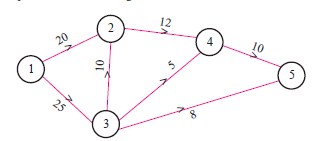
1 – 2 – 4 – 5
1 – 3 – 5
1 – 2 – 3 – 5
1 – 2 – 3 – 4 – 5
63.
\(\frac{d}{dx}(a^x)=\) ________.
\(\frac { 1 }{ x\log e^a}\)
aa
x logea
ax logea
64.
If y = x and z = \(\frac{1}{x}\) then \(\frac{dy}{dz}=\)________.
x2
1
-x2
\(-\frac{1}{x^2}\)
65.
\(\frac{d}{dx}(\frac{1}{x})\) is equal to ________.
\(-\frac{1}{x^2}\)
\(-\frac{1}{x}\)
log x
\(\frac{1}{x^2}\)
66.
For what value of x, f(x) = \(\frac{x+2}{x-1}\) is not continuous?
-2
1
2
-1
67.
\(\lim _{ x\rightarrow \infty }{ \frac { \tan { \theta } }{ \theta } } =\)________.
1
\(\infty\)
\(-\infty\)
\(\theta\)
68.
The range of f(x) = |x|, for all \(x\in R\), is ________.
(0, \(\infty \))
(0, \(\infty \))
(-\(\infty \), \(\infty \))
(1, \(\infty \))
69.
If f(x) = 2x and let g(x) = \(\frac{1}{2^x}\) then (fg)(x) is ________.
1
0
4x
\(\frac{1}{4^x}\)
70.
The graph of y = 2x2 is passing through _______.
(0,0)
(2,1)
(2,0)
(0,2)
71.
If f(x) = \(\frac{1-x}{1+x}\) then f(-x) is equal to _______.
-f(x)
\(\frac{1}{f(x)}\)
\(-\frac{1}{f(x)}\)
f(x)
72.
If f(x) = x2 - x + 1, then f (x + 1) is _______.
x2
x
1
x2 + x + 1
73.
\(\left(\frac{\cos x}{cosec x}\right)-\sqrt{1-\sin^2x}\sqrt{1-\cos^2x}\) is _______.
cos2x-sin2x
sin2x-cos2x
1
0
74.
\(\sin\left(\cos^{-1}\frac{3}{5}\right)\) is _____.
\(\frac{3}{5}\)
\(\frac{5}{3}\)
\(\frac{4}{5}\)
\(\frac{5}{4}\)
75.
\(\tan\left(\frac{\pi}{4}-x\right)\) is _______.
\(\left(\frac{1+\tan x}{1-\tan x}\right)\)
\(\left(\frac{1-\tan x}{1+\tan x}\right)\)
1-tan x
1+tan x
76.
If \(\alpha\) and \(\beta\) be between 0 and \(\frac{\pi}{2}\) and if \(\cos(\alpha+\beta)=\frac{12}{13}\) and \(\sin(\alpha-\beta)=\frac{3}{5}\) then \(\sin2\alpha\) is _____.
\(\frac{16}{15}\)
0
\(\frac{56}{65}\)
\(\frac{64}{65}\)
77.
The value of \(\frac{3 \tan 10^{\circ}-\tan ^3 10^{\circ}}{1-3 \tan ^2 10^{\circ}}\) is _______?
\(\frac{1}{\sqrt3}\)
\(\frac{1}{2}\)
\(\frac{\sqrt3}2\)
\(\frac{1}{\sqrt2}\)
78.
The value of \(\frac{2\tan30^o}{1+tan^230}\) is _____.
\(\frac12\)
\(\frac{1}{\sqrt3}\)
\(\frac{\sqrt{3}}{2}\)
\(\sqrt3\)
79.
The value of 1 - 2sin245o is _______.
1
\(\frac{1}{2}\)
\(\frac14\)
0
80.
The value of cos245o - sin245o is _______.
\(\frac{\sqrt3}{2}\)
\(\frac{1}{2}\)
0
\(\frac{1}{\sqrt{2}}\)
81.
The value of sin 15o cos 15o is ______.
1
\(\frac{1}{2}\)
\(\frac{\sqrt3}{2}\)
\(\frac{1}{4}\)
82.
The value of \(\sin(-420^o)\) is _______.
\(\frac{\sqrt3}{2}\)
\(-\frac{\sqrt3}{2}\)
\(\frac{1}{2}\)
\(\frac{-1}{2}\)
83.
If \(\tan\theta=\frac{1}{\sqrt5}\) and \(\theta\) lies in the first quadrant, then \(\cos\theta\) is _______.
\(\frac{1}{\sqrt6}\)
\(\frac{-1}{\sqrt6}\)
\(\frac{\sqrt5}{\sqrt6}\)
\(\frac{-\sqrt5}{\sqrt6}\)
84.
The degree measure of \(\frac{\pi}{8}\) is ______.
20o60'
22o30'
20o60'
20o30'
85.
The distance between directrix and focus of a parabola y2 = 4ax is _______.
a
2a
4a
3a
86.
The eccentricity of the parabola is _______.
3
2
0
1
87.
The equation of the circle with centre (3,-4) and touches the x-axis is _______.
(x - 3)2 +(y - 4)2 = 4
(x - 3)2 +(y + 4)2 = 16
(x-3)2 + (y- 4)2 = 16
x2+y2 = 16
88.
ax2 + 4xy + 2y2 = 0 represents a pair of parallel lines then 'a' is _______.
2
-2
4
-4
89.
If the centre of the circle is (-a, -b) and radius is \(\sqrt{a^2-b^2}\), then the equation of circle is _______.
x2+y2+2ax+2by+2b2 = 0
x2+y2+2ax + 2by-2b2 = 0
x2 +y2 - 2ax - 2by - 2b2 = 0
x2 + y - 2ax - 2by + 2b2 = 0
90.
The centre of the circle x2 + y - 2x + 2y - 9 = 0 is _______.
(1,1)
(-1,-1)
(-1,1)
(1, -1)
91.
The focus of the parabola x2 = 16y is _______.
(4,0)
(-4,0)
(0,4)
(0,-4)
92.
If kx2 + 3xy - 2y2 = 0 represent a pair of lines which are perpendicular then k is equal to _______.
1/2
-1/2
2
-2
93.
The locus of the point P which moves such that P is at equidistance from the coordinate axes is _______.
\(y={1\over x}\)
y = -x
y = x
\(y=-{1\over x}\)
94.
If the lines 2x - 3y - 5 = 0 and 3x - 4y - 7 = 0 are the diameters of a circle, then its centre is _______.
(-1, 1)
(1,1)
(1, -1 )
(-1, -1)
95.
96.
The number of permutations of n different things taken r at a time, when the repetition is allowed is ________.
rn
nr
\(\frac { n! }{ (n-r)! } \)
\(\frac { n! }{ (n+r)! } \)
97.
Number of words with or without meaning that can be formed using letters of the word "EQUATION" , with no repetition of letters is _____.
7!
3!
8!
5!
98.
The total number of 9-digit numbers which have all different digits is ________.
10!
9!
9\(\times\)9!
10\(\times\)10!
99.
The number of parallelograms that can be formed from a set of four parallel lines intersecting another set of three parallel lines is _________.
18
12
9
6
100.
If \(\frac { kx }{ (x+4)(2x-1) } =\frac { 4 }{ x+4 } +\frac { 1 }{ 2x-1 } \) then k is equal to _______.
9
11
5
7
101.
The constant term in the expansion of \({ \left( x+\frac { 2 }{ x } \right) }^{ 6 }\) is _______
156
165
162
160
102.
For all n > 0, nC1 + nC2 + nC3 + ... +nCn is equal to _______
2n
2n- 1
n2
n2 - 1
103.
The greatest positive integer which divides n(n + 1) (n + 2) (n + 3) for n \(\in\) N is ________.
2
6
20
24
104.
The number of ways of selecting 4 players out of 5 is _______.
4!
20
25
5
105.
If nC3 = nC2, then the value of nC4 is _______.
2
3
4
5
106.
If \(\begin{vmatrix} 4 & 3 \\ 3 & 1 \end{vmatrix}=-5\) then value of \(\begin{vmatrix} 20 & 15 \\ 15 & 5 \end{vmatrix}\) is ________.
-5
-125
-25
0
107.
If \(\triangle=\begin{vmatrix} {a}_{11} & {a}_{12} & {a}_{13} \\ {a}_{21} & {a}_{22} & {a}_{23} \\ {a}_{31} & {a}_{32} & {a}_{33} \end{vmatrix}\) and Aij is cofactor of aij, then value of \(\triangle\) is given by ________.
a11 A31 + a12 A32 + a13 A33
a11 A11 + a12 A21 + a13 A31
a21 A11 + a22 A12 + a23 A13
a11 A11 + a21 A21 + a31 A31
108.
If A = \(\begin{vmatrix}cos \theta & sin \theta \\ -sin \theta&cons\theta \end{vmatrix},\) then |2A| is equal to ________.
4 cos 2 \(\theta\)
4
2
1
109.
If A is a square matrix of order 3 and |A| = 3 then | adj A| is equal to ________.
81
27
3
9
110.
If A is 3 \(\times\) 3 matrix and |A| = 4, then |A-1| is equal to ________.
\({{1}\over{4}}\)
\({{1}\over{16}}\)
2
4
111.
If A is an invertible matrix of order 2, then det (A-1) be equal to ________.
det (A)
\({{1}\over{det(A)}}\)
1
0
112.
If A \(=\begin{pmatrix} -1 & 2 \\ 1 & -4 \end{pmatrix}\) then A (adj A) is ________.
\(\begin{pmatrix} -4 & -2 \\ -1 & -1 \end{pmatrix}\)
\(\begin{pmatrix} 4 & -2 \\ -1 & 1 \end{pmatrix}\)
\(\begin{pmatrix} 2 & 0 \\ 0 & 2 \end{pmatrix}\)
\(\begin{pmatrix} 0 & 2 \\ 2 & 0 \end{pmatrix}\)
113.
Which of the following matrix has no inverse.
\(\begin{pmatrix} -1 & 1 \\ 1 &-4 \end{pmatrix}\)
\(\begin{pmatrix} 2 & -1 \\ -4 &2 \end{pmatrix}\)
\(\begin{pmatrix} cos\ a & sin\ a \\ -sin\ a & cos\ a \end{pmatrix}\)
\(\begin{pmatrix} sin\ a & cos\ a \\ -cos\ a & sin\ a \end{pmatrix}\)
114.
The inventor of input-output analysis is ________.
Sir Francis Galton
Fisher
Prof. Wassily W. Leontief
Arthur Cayley
115.
The number of Hawkins-Simon conditions for the viability of an input - output analysis is ________.
1
3
4
2
116.
The inverse matrix of \(\begin{pmatrix} \frac { 1 }{ 5 } & \frac { 5 }{ 25 } \\ \frac { 2 }{ 5 } & \frac { 1 }{ 2 } \end{pmatrix}\) is ________.
\({{7}\over{30}}\begin{pmatrix} \frac { 1 }{ 2 } & \frac { 5 }{ 12 } \\ \frac { 2 }{ 5 } & \frac { 4 }{ 5 } \end{pmatrix}\)
\({{7}\over{30}}\begin{pmatrix} \frac { 1 }{ 2 } & \frac { -5 }{ 12 } \\ \frac { -2 }{ 5 } & \frac { 1 }{ 5 } \end{pmatrix}\)
\({{30}\over{7}}\begin{pmatrix} \frac { 1 }{ 2 } & \frac { 5 }{ 12 } \\ \frac { 2 }{ 5 } & \frac { 4 }{ 5 } \end{pmatrix}\)
\({{30}\over{7}}\begin{pmatrix} \frac { 1 }{ 2 } & \frac { -5 }{ 12 } \\ \frac { -2 }{ 5 } & \frac { 4 }{ 5 } \end{pmatrix}\)
117.
adj (AB) is equal to ________.
adj A adj B
adj AT adj BT
adj B adj A
adj BT adj AT
118.
The value of the determinant \({\begin{vmatrix} a & 0 & 0 \\ 0 & a & 0 \\ 0 & 0 & c \end{vmatrix}}^{2}\)is ________.
abc
0
a2b2c2
-abc
119.
If \(\triangle=\begin{vmatrix} 1 & 2 & 3 \\ 3 & 1 & 2 \\ 2 & 3 & 1 \end{vmatrix}\) then \(\begin{vmatrix} 3 & 1 & 2 \\ 1 & 2 & 3 \\ 2 & 3 & 1 \end{vmatrix}\) is ________.
\(\triangle\)
-\(\triangle\)
3\(\triangle\)
-3\(\triangle\)
120.
The value of \(\begin{vmatrix} 2x+y & x & y \\ 2y+z & y & z \\ 2z+x & z & x \end{vmatrix}\) is ________.
xyz
x+y+z
2x+2y+2z
0
1.
(a)
\(P(A\cup B)\)
2.
A = {(2, 2)}, n(S) = 36; P(A) = 1/36
3.
(d)
Independent
4.
(c)
\(\frac { P(A\cap B) }{ P(A) } \)
5.
(b)
\(P\left( A\cap B \right) =1\)
6.
(d)
7.
(b)
lower quartile
8.
\(\bar{x}=\frac{1+2+3+.....n}{n}\)
\(\frac{6n}{11}=\frac{n(n+)}{2n}\)
2 x 6n = 11n x 11
12n - 11n = 11 \(\Rightarrow\) n = 11
9.
6, 8, 9, 10, 11, 12, 14
\(\therefore \) Median = 10
10.
(d)
11.
GM = \(\sqrt{8 \times 18} = \sqrt{144} = 12\)
12.
\(H.M=\frac{n}{ \frac { 1 }{ a }+ \frac { 1 }{ b }+\frac { 1 }{ a }}=\frac{3}{ \frac { 1 }{ 2 }+ \frac { 1 }{ 3 }+\frac { 1 }{ 4 }}\)
\(=\frac{3}{ \frac {6+4+3}{2}}=\frac{3}{ \frac {13}{12}}=\frac{36}{13}\)
13.
(a)
Arithmetic mean
14.
(c)
Geometric mean
15.
(d)
Percentiles
16.
\(r =\frac{\operatorname{cov}(x, y)}{\sigma_x \sigma_y} \)
\(=\frac{-16.5}{\sqrt{2.89 \times 100}}=\frac{-16.5}{17}=-0.97\)
17.
(a)
the magnitude and direction
18.
(b)
19.
(a)
Karl Pearson
20.
(a)
positive
21.
(a)
functional relationship
22.
(b)
two regression lines
23.
(a)
24.
(a)
bxy = \(\frac { N\Sigma dxdy-(\Sigma dx)(\Sigma dy) }{ N\Sigma dy^{ 2 }-(\Sigma dy)^{ 2 } } \)
25.
(a)
r = ±\(\sqrt { { b }_{ xy }\times { b }_{ yx } } \)
26.
\(P =\frac{\frac{a}{i}}{k} \)
\(=\frac{\frac{2000}{0.1}}{12}=2,40,000\)
27.
(a)
Annuity due
28.
(b)
A = \(\frac{a}{i}[(1+i)^n-1]\)
29.
Income \(=500 \times 100 \times \frac{15}{100}=7,500\)
30.
If F.V = 100, Investment = 90
FV 10,000,
Investment \(= \frac{ 90 \times 10,000}{100} = 9000\)
31.
Brokerage = 100 x 400 x \(\frac{1}{100}=400\)
32.
\(25,000=\frac{x\times 100\times10}{100}\Rightarrow x=2500\)
33.
Investment = 200 x 100 x \(\frac{8}{100}\)= Rs. 1600
34.
(a)
dependent variable
35.
(b)
r(X, Y) = \(\frac { cov(x,y) }{ { \sigma }_{ x }{ \sigma }_{ y } } \)
36.
\(r =\frac{N \Sigma X Y-\Sigma X \Sigma Y}{\sqrt{N \Sigma X^2-(\Sigma X)^2} \sqrt{N \Sigma Y^2-(\Sigma Y)^2}} \)
\(=\frac{25(520)-(125)(100)}{\sqrt{25(650)-(125)^2} \sqrt{25(436)-(100)^2}} \)
= 0.667
37.
(c)
No correlation
38.
(a)
Negative
39.
(a)
Income and expenditure
40.
\(E O Q=\sqrt{\frac{2 C_3 R}{C_1}}=\sqrt{\frac{2 \times 20 \times 5000}{20}}=1000\)
41.
(b)
8
42.
(b)
Decreasing function
43.
(b)
Breakeven point
44.
(a)
45.
(c)
nf
46.
(a)
1
47.
(a)
MR = MC
48.
dy/dx = 4x + 5
At x = 2, dy/dx = 13
49.
(a)
\({ n }_{ d }=\frac { AR }{ AR-MR } \)
50.
\(\eta_d=-\frac{p}{x} \frac{d x}{d p}=\frac{-p}{\frac{1}{p}}\left(\frac{-1}{p^2}\right)=1\)
51.
(a)
|ηd| > 1
52.
R = px = 20x- 3x2
M.R = dR/dx = 20 - 6x
53.
(d)
\(\frac { 21 }{ x } \)
54.
Since there is no common area between the lines x1 + x2 ≤ 1 and 5x1 + 5x2 ≥ 0
55.
(a)
Critical path method
56.
(d)
All the above
57.
(b)
Minimize total project duration
58.
(d)
An arrow representing an activity may not have a length and shape
59.
(b)
60.
(c)
an optimal solution
61.
Since x1 = 2.5, x2 = 35 satisfies all the Constraints
62.
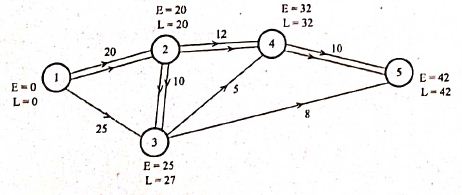
63.
(d)
ax logea
64.
\(\frac{d y}{d x}=1, \frac{d z}{d x}=\frac{-1}{x^2} \quad \frac{d y}{d z}=-x^2\)
65.
(a)
\(-\frac{1}{x^2}\)
66.
(b)
1
67.
(a)
1
68.
(b)
(0, \(\infty \))
69.
\((f g) x=2^x \frac{1}{2^x}=1\)
70.
(a)
(0,0)
71.
\(f(x) = \)\(\frac{1-x}{1+x} = \frac {1} {f(x)}\)
72.
\(f(x+1) =(x+1)^2-(x+1)+1 \)
\(=x^2+2 x+1-x-1+1 \)
\(=x^2+x+1 \)
73.
cos x sin x - cos x sin x = 0
74.
\(\sin \left(\cos ^{-1} \frac{3}{5}\right)=\sin \left(\sin ^{-1} \frac{4}{5}\right)=4 / 5\)
75.
\(\tan (\pi / 4-x)=\frac{\tan \pi / 4-\tan x}{1+\tan \pi / 4 \tan x}=\frac{1-\tan x}{1+\tan x}\)
76.
\(\cos (\alpha+\beta)=\frac{12}{13} \Rightarrow \sin (\alpha+\beta)=\frac{5}{13} \)
\(\sin (\alpha-\beta)=3 / 5 \Rightarrow \cos (\alpha-\beta)=4 / 5 \)
\(\sin 2 \alpha=\sin ((\alpha+\beta)+(\alpha-\beta)) \)
\(= \sin (\alpha+\beta) \cos (\alpha-\beta) +\cos (\alpha+\beta) \sin (\alpha-\beta) \)
\(= \frac{5}{13} \cdot \frac{4}{5}+\frac{3}{5} \cdot \frac{12}{13}=\frac{56}{65}\)
77.
\(\frac{3 \tan 10^{\circ}-\tan ^3 10^{\circ}}{1-3 \tan ^2 10^{\circ}} =\tan 3(10) =\tan 30^{\circ}=\frac{1}{\sqrt{3}} \)
78.
\(\frac{2 \tan 30^{\circ}}{1+\tan ^2 30^{\circ}} =\sin 2\left(30^{\circ}\right)=\sin 60^{\circ}=\frac{\sqrt{3}}{2} \)
79.
1 - 2sin245o = cos 2(45o)
= cos 90o = 0
80.
cos245o - sin245o = cos 2(45o)
= cos 90o = 0
81.
\(\frac{1}{2}\left(2 \sin 15^{\circ} \cos 15^{\circ}\right) =\frac{1}{2} \sin 2\left(15^{\circ}\right)=\frac{1}{2} \sin 30^{\circ} =\frac{1}{2} \times \frac{1}{2}=\frac{1}{4}\)
82.
\(\sin \left(-420^{\circ}\right) =-\sin 420^{\circ}=-\sin (360+60) =-\sin 60^{\circ}=\frac{-\sqrt{3}}{2} \)
83.
\(\sec \theta =\sqrt{1+\tan ^2 \theta}=\sqrt{1+\frac{1}{5}}=\sqrt{\frac{6}{5}} \)
84.
\(\frac{\pi}{8}=\frac{180^{\circ}}{8}=22 \frac{1}{2}^{\circ}=22^{\circ} 30^{\prime}\)
85.
(b)
2a
86.
(d)
1
87.
(b)
(x - 3)2 +(y + 4)2 = 16
88.
\(h^2-a b=0\)
\(4-2 a=0 \Rightarrow a=2\)
89.
\((x+a)^2+(y+b)^2=a^2-b^2\)
\(x^2+a^2+2 a x+y^2+b^2+2 b y=a^2-b^2\)
90.
C(-g, -f)
91.
(0, a), a = 4
92.
\(a+b=0 \Rightarrow k-2=0\)
93.
(c)
y = x
94.
(c)
(1, -1 )
95.
(c)
96.
(b)
nr
97.
(c)
8!
98.
The ninth digit cannot be filled with zero
Ninth place can be filled in 9 ways
Eighth place can be filled in 9 ways
Seventh place can be filled in 8 ways and so on No. of ways
= 9 x 9 x 8 x 7 x 6 x 5 x 4 x 3 x 2
= 9 x 9!
99.
The number of parallelograms = 4C2 x 3C2
100.
Equating coefficients of x in the numerator
kx = 4 (2n) + 1 (x)
kx = 9x
101.
\(t_{r+1} =6 C_r n^{6-r}\left(\frac{2^r}{x^r}\right) \)
\(=6 C_r x^{6-2 r} 2^r \)
\(6-2 r =0 = r =3 \)
\(t_{r+1} =6 C_3 2^3=160 \)
102.
nC0 + nC1 + nC2 + nC3 + ... +nCn = 2n and nC0 = 1
103.
Since if n = 1 then (1) (2) (3) (4) = 24 is divisible by = 24
104.
No. of ways = 5C4 = 5C1 = 5
105.
x + y = n
3 + 2 = 5 = n
nC4 = 5C4 = 5C1 = 5
106.
\(\left|\begin{array}{cc} 20 & 15 \\ 15 & 5 \end{array}\right|=5 \times 5\left|\begin{array}{ll} 4 & 3 \\ 3 & 1 \end{array}\right|\)
\(=5 \times 5 \times-5\)
\(=-125\)
107.
(Corresponding co-factor)
108.
\(|A|=\cos ^2 \theta+\sin ^2 \theta=1\)
\(|2 A|=2^2(1)=4\)
109.
(Since \(|\operatorname{adj} A|=|A|^{n-1} n=3\) ))
\(=|3|^2=9\)
110.
(Since \(\left|A^{-1}\right|=\frac{1}{|A|}\))
111.
(b)
\({{1}\over{det(A)}}\)
112.
\(|A|=4-2=2\)
\(A(\operatorname{adj} A)=|A| I=\left(\begin{array}{ll} 2 & 0 \\ 0 & 2 \end{array}\right)\)
113.
\(\text {Since }|A|=4-4=0\)
114.
(c)
Prof. Wassily W. Leontief
115.
(d)
2
116.
\(A=\left(\begin{array}{cc} \frac{4}{5} & \frac{-5}{12} \\ \frac{-2}{5} & \frac{1}{2} \end{array}\right)\)
\(|A|=\frac{2}{5}-\frac{1}{6}=\frac{12-5}{30}=\frac{7}{30}\)
\(A^{-1}=\frac{1}{|A|} \text { adjA }=\frac{30}{7}\left(\begin{array}{ll} \frac{1}{2} & \frac{5}{12} \\ \frac{2}{5} & \frac{4}{5} \end{array}\right)\)
117.
(c)
adj B adj A
118.
(c)
a2b2c2
119.
(b)
-\(\triangle\)
120.
\(\left|\begin{array}{ccc} 2 x+y & x & y \\ 2 y+z & y & z \\ 2 z+x & z & x \end{array}\right| \quad c_1 \rightarrow c_1-c_3\)
\(\left|\begin{array}{ccc} 2 x & x & y \\ 2 y & y & z \\ 2 z & z & x \end{array}\right|=0 \ \text {Since } c_1 \sim c_3\)

11th Standard Syllabus & Materials
11th Standard
TN 11th Tamil பீடு பெற நில் - செய்யுள் - காவடிச்சிந்து Important Questions And Answers Study Material - QB365 Set A
NEW11th Standard
TN 11th Tamil பீடு பெற நில் - உரைநடை - மலை இடப்பெயர்கள் : ஓர் ஆய்வு Important Questions And Answers Study Material - QB365 Set A
NEW11th Standard
TN 11th Tamil மாமழை போற்றுதும் - துணைப்பாடம் - யானை டாக்டர் Important Questions And Answers Study Material - QB365 Set A
NEW11th Standard
TN 11th Tamil மாமழை போற்றுதும் - செய்யுள் - ஐங்குறுநூறு Important Questions And Answers Study Material - QB365 Set A



Tamilnadu Stateboard 11th Standard Subjects

Maths

Commerce

Economics

Biology
Business Maths and Statistics

Accountancy

Computer Science

Physics

Chemistry
Maths
Biology
Economics
Physics
Chemistry

History
Business Maths and Statistics

Computer Science
Accountancy

Computer Applications
History
Computer Technology
Commerce
Computer Applications
Computer Technology

Tamil

English

French
Tamilnadu Stateboard Standards
