
 100% FREE ACCESS
11th Standard Syllabus & Materials
11th Standard
TN 11th Tamil இயற்கை வேளாண்மை,சுற்றுச்சூழல் -செய்யுள் - மனோன்மணீயம் Important Questions And Answers Study Material - QB365 Set A
NEW11th Standard
TN 11th Tamil என்னுயிர் என்பேன் -துணைப்பாடம் - இசைத்தமிழர் இருவர் Important Questions And Answers Study Material - QB365 Set A
NEW11th Standard
TN 11th Tamil மொழி கலை -செய்யுள் - ஒவ்வொரு புல்லையும் Important Questions And Answers Study Material - QB365 Set A
NEW11th Standard
TN 11th Tamil பீடு பெற நில் - இலக்கணம் - பகுபத உறுப்புகள் Important Questions And Answers Study Material - QB365 Set A
NEW11th Standard
TN 11th Tamil பீடு பெற நில் - துணைப்பாடம் - வாடிவாசல் Important Questions And Answers Study Material - QB365 Set A
NEW11th Standard
TN 11th Tamil பீடு பெற நில் - செய்யுள் - குறுந்தொகை Important Questions And Answers Study Material - QB365 Set A

Published on: 04/03/2019
11th Public Exam March 2019 Model Test
Download Tamil Nadu 11th Standard Business Maths and Statistics question papers, model tests, one-mark questions, important questions, and public exam papers in PDF format. Free study materials and answer keys for TN State Board students.
Questions + Answers key
Take MCQ Business Maths and Statistics Test
1.
Show that \(\underset { x\rightarrow 0 }{ lim } \frac { \log { \left( 1+{ x }^{ 2 } \right) } }{ \sin ^{ 3 }{ x } } =1\)
2.
Compute the co-efficient of correlation batween the variates x and y from the given data:
No. of pairs of x and y series=8.x-series A.M.=74.5, x-series assumed mean =69, x-series S.D=13.07, y-series S.D=15.85, sum of products of corresponding deviations of x and y series =2176.
3.
Solve the following LPP graphically. Maximize Z =−x1 + 2x2
Subject to the constraints −x1 + 3x2 ≤ 10, x1 + x2 ≤ 6,x1 − x2 ≤ 2 and x1,x2 ≥ 0
4.
Find the yield on 20% stock at 80.
5.
Suppose one person is selected at random from a group of 100 persons are given in the following
| Title | Psychologist | Socialist | Democrate | Total |
| Men | 15 | 25 | 10 | 50 |
| Women | 20 | 15 | 15 | 50 |
| Total | 35 | 40 | 25 | 100 |
What is the probability that the man selected is a Psychologist?
6.
An unbiased die is thrown twice. Let the event A be odd number on the first throw and B the event odd number on the second throw. Check whether A and B events are independent.
7.
Calculate GM for the following table gives the weight of 31 persons in sample survey.
| Weight (lbs): | 130 | 135 | 140 | 145 | 146 | 148 | 149 | 150 | 157 |
|---|---|---|---|---|---|---|---|---|---|
| Frequency | 3 | 4 | 6 | 6 | 3 | 5 | 2 | 1 | 1 |
8.
A cash prize of Rs. 1,500 is given to the student standing first in examination of Business Mathematics by a person every year. Find out the sum that the person has to deposit to meet this expense. Rate of interest is 12% p.a
9.
Find the equation of the parabola whose focus is (-3, 2) and the directrix is x + y = 4.
10.
Find the center and radius of the circle 5x2 + 5y2 + 4x - 8y - 16 = 0
11.
If A \(= \begin{bmatrix} 1 & -1 \\2 & 3 \end{bmatrix}\) show that A2 - 4A + 5I2 = 0 and also find A-1.
12.
Find the 5th term in the expansion of (x - 2y)13.
13.
Evaluate the following using binomial theorem: (999)5
14.
When calculating the average growth of economy, the correct mean to use is?
Weighted mean
Arithmetic mean
Geometric mean
Harmonic mean
15.
Which of the following is positional measure?
Range
Mode
Mean deviation
Percentiles
16.
Scatter diagram of the variate values (X,Y) give the idea about ________.
functional relationship
regression model
distribution of errors
no relation
17.
18.
The present value of the perpetual annuity of Rs. 2000 paid monthly at 10 % compound interest is _______.
Rs. 2,40,000
Rs. 6,00,000
Rs. 20,40,000
Rs. 2,00,400
19.
Example for positive correlation is______.
Income and expenditure
Price and demand
Repayment period and EMI
Weight and Income
20.
If R = 5000 units / year, C1 = 20 paise , C3 = Rs. 20 then EOQ is _______.
5000
100
1000
200
21.
Profit P(x) is maximum when ________.
MR = MC
MR = 0
MC = AC
TR = AC
22.
In critical path analysis, the word CPM mean ______.
Critical path method
Crash project management
Critical project management
Critical path management
23.
The minimum value of the objective function Z = x + 3y subject to the constraints 2x + y ≤ 20, x + 2y ≤ 20, x > 0 and y > 0 is ______.
10
20
0
5
24.
\(\lim _{ x\rightarrow 0 }{ \frac { { e }^{ x }-1 }{ x } } =\)________.
e
nx(n-1)
1
0
25.
f(x) = - 5 , for all \(x\in R\), is a ________.
an identity function
modulus function
exponential function
constant function
26.
The value of \(\frac{2\tan30^o}{1+tan^230}\) is _____.
\(\frac12\)
\(\frac{1}{\sqrt3}\)
\(\frac{\sqrt{3}}{2}\)
\(\sqrt3\)
27.
The value of \(\sin15^o\) is ______.
\(\frac{\sqrt{3}+1}{2\sqrt{2}}\)
\(\frac{\sqrt{3}-1}{2\sqrt{2}}\)
\(\frac{\sqrt3}{\sqrt2}\)
\(\frac{\sqrt3}{2\sqrt2}\)
28.
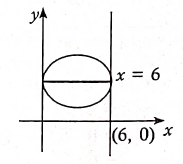
If the circle touches x axis, y axis and the line x = 6 then the length of the diameter of the circle is _______.
6
3
12
4
29.
The focus of the parabola x2 = 16y is _______.
(4,0)
(-4,0)
(0,4)
(0,-4)
30.
If \(\frac { kx }{ (x+4)(2x-1) } =\frac { 4 }{ x+4 } +\frac { 1 }{ 2x-1 } \) then k is equal to _______.
9
11
5
7
31.
The term containing x3 in the expansion of (x - 2y)7 is _________.
3rd
4th
5th
6th
32.
If any three rows or columns of a determinant are identical then the value of the determinant is ________.
0
2
1
3
33.
If A and B are non-singular matrix then, which of the following is incorrect?
A2 = I implies A-1 = A
I-1 = I
If AX = B, then X = B-1 A
If A is square matrix of order 3 then |adj A|= |A|2
34.
Differentiate the following functions with respect to x, \(x^{\frac{3}{2}}\)
35.
A toy company manufactures two types of dolls A and B. Market tests and available resources have indicated that the combined production level should not exceed 1200 dolls per week and the demand for dolls of type B is atmost half of that for dolls of type A. Further, the production level of dolls of type A can exceed three times the production of dolls of other type by at most 600 units. If the company makes profit of n2 and n6 per doll, how many of each should be produced weekly in order to maximize the profit. Formulate the above as mathematical LPP.
36.
37.
If the demand law is given by p = 10e\(-\frac { x }{ 2 } \) then find the elasticity of demand.
38.
Evaluate \(\cot\left(\frac{-15\pi}{4}\right)\)
39.
Find the values of the following sin (-105)°
40.
The technology matrix of an economic system of two industries is\(\begin{bmatrix} 0.50 & 0.30 \\ 0.41 & 0.33 \end{bmatrix}\). Test whether the system is viable as per Hawkins-Simon conditions.
41.
Show that \( f(x)= \begin{cases}5 x-4, & \text { if } 0< x \leq 1 \\ 4 x^3-3 x, & \text { if } 1< x< 2\end{cases}\)
42.
If cosA = \(\frac{4}{5}\)and cosB = \(\frac{12}{13}\),\(\frac{3\pi}{3}<(A, B)<2 \pi,\)
43.
Resolve into partial fraction \(\frac{9}{(x-1)(x+2^2)}\)
44.
Solve graphically: Minimize Z = 20x1 + 40x2.
Subject to the constraints 36x1 + 6x2 ≥ 108,3x1 + 12x2 ≥ 36,20x1 + 10x2 ≥ 100 and x1,x2≥0
45.
Find the marginal productivities for Capital (K) and Labour (L) if P = 10K-K2 + KL when K = 2 and L = 6.
46.
Rani sold Rs.8000 worth 7% stock at 96 and invested the amount realised in the shares of FV Rs.100 os a 10% stock by which her income increased by Rs.80. Find the purchase price of 10% stock.
47.
Find the maximum and minimum values of x3-6x2+7
48.
Find out the coefficient of correlation in the following case and interpret.
| Height of father (in inches) | 65 | 66 | 67 | 67 | 68 | 69 | 71 | 73 |
| Height of son (in inches) | 67 | 68 | 64 | 68 | 72 | 70 | 69 | 70 |
49.
Calculate the earliest start time, earliest finish time, latest start time and latest finish time of each activity of the project given below and determine the Critical path of the project and duration to complete the project.
| Activity | 1-2 | 1-3 | 1-5 | 2-3 | 2-4 | 3-4 | 3-5 | 3-6 | 4-6 | 5-6 |
| Duration ( in week) | 8 | 7 | 12 | 4 | 10 | 3 | 5 | 10 | 7 | 4 |
50.
Find the absolute (global) maximum and absolute minimum of the function
f(x) = 3x5 – 25x3 + 60x + 1 in the interval [–2,1]
51.
Prove that \(\frac { 4tan\ x(1-{ tan }^{ 2 }x) }{ 1-6{ tan }^{ 2 } x+{ tan }^{ 4 } x } =tanx\)
52.
If 22Pr+1:20Pr+2=11: 52, find r.
53.
Show that the equation 12x2 - 10xy + 2y2 + 14x - 5y + 2 = 0 represents a pair of straight lines and also find the separate equations of the straight lines.
54.
Suppose the inter-industry flow of the product of two industries are given as under.
| Production sector | Consumption sector | Domestic demand | Total output | |
| X | Y | |||
| X | 30 | 40 | 50 | 120 |
| Y | 20 | 10 | 30 | 60 |
Determine the technology matrix and test Hawkin's -Simon conditions for the viability of the system. If the domestic demand changes to 80 and 40 units respectively, what should be the gross output of each sector in order to meet the new demands.
1.
\(\underset { x\rightarrow 0 }{ lim } \cfrac { log\left( 1+{ x }^{ 3 } \right) }{ { sin }^{ 3 }x } \)
\(=\underset { x\rightarrow 0 }{ lim } \left\{ \cfrac { log\left( 1+{ x }^{ 3 } \right) }{ { x }^{ 3 } } \times \cfrac { { x }^{ 3 } }{ { sin }^{ 3 }x } \right\} \)
\(=\lim _{x \rightarrow 0} \frac{\log \left(1+x^3\right)}{x^3} \times \frac{1}{\lim _{x \rightarrow 0}\left(\frac{\sin x}{x}\right)^3}\)
\(=1\times \cfrac { 1 }{ 1 } =1\)
2.
Let A=69, B=112, dx=x-69, dy=y-112.
Given \(\sum\)dxdy=2176, \(\bar{X}\)=74.5, \(\bar{Y}\)=125.5
\({ \sigma }_{ x }\)=13.07, \({ \sigma }_{ y }\)=15.85, n=8, A=69, B=112
we know, \(\bar{x}\)=A+\(\frac { \sum { dx } }{ n } \)
\(\Rightarrow\)74.5=69+\(\frac { \sum { dx } }{ 8 } \) \(\sum\)dx=(74.5-69)(8)
\(\Rightarrow\)\(\sum\)dx =(5.5)(8)=4
Also, \(\bar{y}\)=B+\(\frac { \sum { dy } }{ n } \)
\(\Rightarrow\)125.5=112+\(\frac { \sum { dy } }{ 8 } \)
\(\Rightarrow\)(125.5-112)8=\(\sum\)dy
\(\Rightarrow\)\(\sum\)dy=108
The correlation co-efficient between x and y
r(x, y)=\(\frac { n\sum { dxdy } -(\sum { dx } )(\sum { dy } ) }{ \sqrt { n\sum { d{ x }^{ 2 } } }-(\Sigma dx)^{ 2 } \sqrt { n\sum { d{ y }^{ 2 }-{ (\sum { dy } ) }^{ 2 } } } } \) ...(1)
\({ \sigma }_{ x }=\sqrt { \frac { { \sum { dx } }^{ 2 } }{ n } -{ \left( \frac { \sum { dx } }{ n } \right) }^{ 2 } } =\sqrt { \frac { { \sum { dx } }^{ 2 } }{ n } -\frac { { (\sum { dx } ) }^{ 2 } }{ { n }^{ 2 } } } \)
13.07= \(\frac { \sqrt { n\sum { d{ x }^{ 2 }-{ (\sum { dx } ) }^{ 2 } } } }{ n } \)
13.07(8)=\(\sqrt { n\sum { { dx }^{ 2 }-({ \sum { dx } ) }^{ 2 } } } \)
\(\sqrt { n\sum { { dx }^{ 2 }-({ \sum { dx } ) }^{ 2 } } } \)=104.56 .....(2)
SImilarly, \(\sqrt { n\sum { { dy }^{ 2 }-({ \sum { dy } ) }^{ 2 } } } \)=8(15.85)-126.8 ..(3)
Substuting (2) and (3) in (1) we get,
r=\(\frac { 8(2176)-44(108) }{ (104.56)(126.8) } =\frac { 12656 }{ 13258.208 } \)
=0.9545
3.
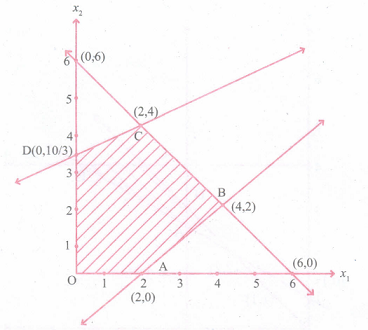
Since the decision variables x1 ,x2 are non-negative, the solution lies in the I quadrant of the plane.
Consider the equations
\(-{ x }_{ 1 }+3{ x }_{ 2 }=10\)
| \({ x }_{ 1 }\) | 0 | 2 |
|---|---|---|
| \({ x }_{ 2 }\) | 10/3 | 4 |
\({ x }_{ 1 }+{ x }_{ 2 }=6\)
| \({ x }_{ 1 }\) | 0 | 6 |
|---|---|---|
| \({ x }_{ 2 }\) | 6 | 6 |
\({ x }_{ 1 }{ -x }_{ 2 }=2\)
| \({ x }_{ 1 }\) | 4 | 2 |
|---|---|---|
| \({ x }_{ 2 }\) | 2 | 0 |
The feasible region is OABCD and its co-ordinates are O(0, 0)A(2, 0) B(4, 2) C(2, 4) and D(0, 10/3)
| Corner Points | \(Z=-{ x }_{ 1 }+2{ x }_{ 2 }\) |
|---|---|
| 0(0,0) | 0 |
| A(2, 0) | -2 |
| B (4, 2) | 0 |
| C(2,4) | 6 |
| D\(\left( 0,\frac { 10 }{ 3 } \right) \) | \(\frac { 20 }{ 3 } \) |
Maximum of Z occurs at\(D\left( 0,\frac { 10 }{ 3 } \right) \). Hence, the solution is \({ x }_{ 1 }=0,{ x }_{ 2 }=\frac { 10 }{ 3 } \quad and\quad { Z }_{ max }=\frac { 20 }{ 3 } \)
4.
FV = 100
Market Price = Rs.80
Dividend Rate = 20
Yield = \(\frac { FV }{ \text {Market Price } }\) x 20
=\(\frac { 100 }{ 80 } \) x 20 = 25%
5.
Let n(s) denote the number of men psychologist.
\(\therefore\) n(s) = 50
Let n(A) denote the number of men psychologist
n(A) = 15
P(A) = \(\frac { 15 }{ 50 } =\frac { 3 }{ 10 } \)
6.
S = {(1, 1), (1, 2) ....... (1, 6)
(2, 1). (2, 2) ........ (2, 6)
(6, 1), (6, 2) ....... (6, 6)}
\(\therefore\) n(S) = 36
A = {(1, 1),(1, 2) .. (1, 6)
(3, 1),(3, 2) ........ (3, 6)
(5, 1), (5, 2) ....... (5, 6)}
\(P(A) =\frac { 18 }{ 36 } =\frac { 1 }{ 2 } \)
B = {(1, 1),(2, 1) ....... (6, 1)
(1, 3),(2, 3) ....... (6, 3)
(1, 5), (2, 5) ... (6, 5)}
\(P(B)=\frac { 18 }{ 36 } =\frac { 1 }{ 2 } \)
(A\(\cap \) B) = {(1, 1) (1, 3) ...... (1, 5)
(3, 1) (3, 3) ...... (3, 5)
(5, 1) (5, 3) ....... (5, 5)}
\(P(A\cap B)=\frac { 9 }{ 36 } =\frac { 1 }{ 4 } \)
\(P(A).P(B)=\frac { 1 }{ 2 } . \frac { 1 }{ 2 } =\frac { 1 }{ 4 } =P(A\cap B)\)
\(\therefore\) A and B are independent events.
7.
| Weight (x) | f | log x | flog x |
|---|---|---|---|
| 130 | 3 | 2.1139 | 6.3417 |
| 135 | 4 | 2.1303 | 8.5212 |
| 140 | 6 | 2.1461 | 12.8766 |
| 145 | 6 | 2.1614 | 12.9684 |
| 146 | 3 | 2.1644 | 6.4932 |
| 148 | 5 | 2.1703 | 10.8515 |
| 149 | 2 | 2.1732 | 4.3464 |
| 150 | 1 | 2.1761 | 2.1761 |
| 157 | 1 | 2.1959 | 2.1959 |
| N = 31 | \(\sqrt{\sum flogx}\) = 66.771 |
GM = Antilog\(\left( \frac { \sum { f\ log\ x } }{ N } \right) \)
\(=Anitlog\left( \frac { 66.771 }{ 31 } \right) \)
= 142.5 Ibs
8.
a = Rs.1500; i = 12/100 = 0.12
P = \(\frac { a }{ i } =\frac { 1500 }{ 0.12 } \) = Rs.12,500
The person has to deposit Rs.12,500 to meet this expense.
9.
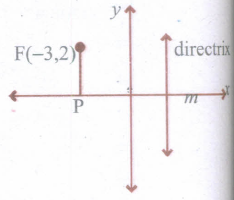
Let p(x,y) be any point on the parabola whose focus is F(-3, 2) and the directrix is x + y - 4 = 0.
Draw PM perpendicular to x + y - 4 = 0
Then FP = PM \(\Rightarrow\) FP2 = pm2
\(\Rightarrow { (x+3) }^{ 2 }+{( y-2) }^{ 2 }={ \left[ \frac { x+y-4 }{ \sqrt { 1+1 } } \right] }^{ 2 }\)
\(\Rightarrow { x }^{ 2 }+6x+9+{ y }^{ 2 }-4y+4=\frac { { x }^{ 2 }+{ y }^{ 2 }+16+2xy-8x-8y }{ 2 } \)
\(\Rightarrow\) 2(x2 + y2 + 6x - 4y + 13) = x2 + y2 + 2y - 8x - 8y + 16
\(\Rightarrow\) x2 + y2 - 2xy + 20x + 10 = 0.
10.
5x2 + 5y2 +4x - 8y - 16 = 0
[Divide by 5]
x2 + y2 + \(\frac { 4 }{ 5 } x-\frac { 8 }{ 5 } y-\frac { 16 }{ 5 } =0\)
Here 2g = \(\frac { 4 }{ 5 } \) \(\Rightarrow\) \(g=+\frac { 2 }{ 5 } \)
2f = \(-\frac { 8 }{ 5 } \) \(\Rightarrow\) \(f=-\frac { 4 }{ 5 } \)
and c = \(-\frac { 16 }{ 5 } \)
Center of the circle is (-g, -f) \(\Rightarrow \) \(\left( -\frac { 2 }{ 5 } ,\frac { 4 }{ 5 } \right) \)
Radius of the circle is \(\sqrt { { g }^{ 2 }+{ f }^{ 2 }-c } \)
\(\Rightarrow\) r = \(\sqrt { \frac { 4 }{ 25 } +\frac { 16 }{ 25 } +\frac { 16 }{ 5 } } =\sqrt { \frac { 20 }{ 25 }+ { \frac { 16 }{ 5 }} } \)
\(\Rightarrow\) \(r=\sqrt { \frac { 20 }{ 5 } } \) = \(\sqrt { 4 } \) = 2 units
11.
\(A^{-1}=\left(\begin{array}{cc} 1 & -1 \\ 2 & 3 \end{array}\right)\)
\(A^2=\left(\begin{array}{cc} 1 & -1 \\ 2 & 3 \end{array}\right)\left(\begin{array}{cc} 1 & -1 \\ 2 & 3 \end{array}\right)\)
\(=\left(\begin{array}{ll} 1-2 & -1-3 \\ 2+6 & -2+9 \end{array}\right)=\left(\begin{array}{cc} -1 & -4 \\ 8 & 7 \end{array}\right)\)
\(\mathrm{LHS}=A^2-4 A+5 l_2\)
\(=\left(\begin{array}{cc} -1 & -4 \\ 8 & 7 \end{array}\right)-4\left(\begin{array}{cc} 1 & -1 \\ 2 & 3 \end{array}\right)+5\left(\begin{array}{ll} 1 & 0 \\ 0 & 1 \end{array}\right)\)
\(=\left(\begin{array}{cc} -1 & -4 \\ 8 & 7 \end{array}\right)-\left(\begin{array}{cc} 4 & -4 \\ 8 & 12 \end{array}\right)+\left(\begin{array}{ll} 5 & 0 \\ 0 & 5 \end{array}\right)\)
\(=\left(\begin{array}{cc} -1 & -4 \\ 8 & 7 \end{array}\right)+\left(\begin{array}{cc} 1 & 4 \\ -8 & -7 \end{array}\right)=\left(\begin{array}{ll} 0 & 0 \\ 0 & 0 \end{array}\right)\)
\(=O=R H S\)
\(\mathrm{A}^{-1}=\frac{1}{|A|} \operatorname{adj} A\)
\(|A|=3+2=5 \neq 0\)
\(A^{-1}=\frac{1}{5}\left(\begin{array}{cc} 3 & 1 \\ -2 & 1 \end{array}\right)\)
12.
\((x-2 y)^{13}\)
\(T_{r+1}=n C_r x^{n-r} a^r\)
\(n=13, r=4\)
\(t_{r+1}=13 C_r x^{13-r}(-2 y)^r\)
\(t_5=13 C_4 x^{13-4}(-2 y)^4\)
\(=\frac{13 \times 12 \times 11 \times 10}{4 \times 3 \times 2 \times 1} x^9(16) y^4\)
\(=11440 x^9 y^4\)
13.
(999)5 = (1000 - 1)5
\(=5 C_0(1000)^5-5 C_1(1000)^4+5 C_2(1000)^3 -5 C_3(1000)^2+5 C_4(1000)-5 C_5\)
= 1000,000,000,000,000 - 5 (1,000,000,000,000) + 10 (1,000,000,000) -10 (1000,000) + 5 (1000)-1
= 1000000000000000 - 5000000000000 + 10000000000 - 10000000+ 5000 1
= 99 500 999 000 4999
14.
(c)
Geometric mean
15.
(d)
Percentiles
16.
(a)
functional relationship
17.
(b)
18.
\(P =\frac{\frac{a}{i}}{k} \)
\(=\frac{\frac{2000}{0.1}}{12}=2,40,000\)
19.
(a)
Income and expenditure
20.
\(E O Q=\sqrt{\frac{2 C_3 R}{C_1}}=\sqrt{\frac{2 \times 20 \times 5000}{20}}=1000\)
21.
(a)
MR = MC
22.
(a)
Critical path method
23.
| 2x | + | y | = | 20 | x | + | y | = | 20 | |
| x | 0 | 10 | x | 0 | 20 | |||||
| y | 20 | 0 | y | 20 | 0 |
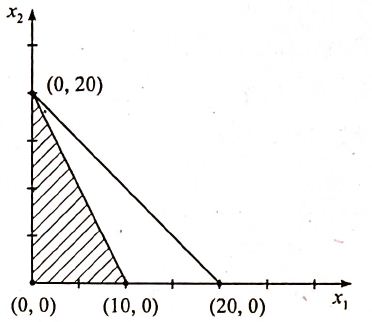
| Corner points | Z = x + 3y |
| (0, 0) | 0 |
| (0, 20) | 60 |
| (10, 0) | 10 |
24.
(c)
1
25.
(d)
constant function
26.
\(\frac{2 \tan 30^{\circ}}{1+\tan ^2 30^{\circ}} =\sin 2\left(30^{\circ}\right)=\sin 60^{\circ}=\frac{\sqrt{3}}{2} \)
27.
\(\sin15^o = \sin(45^o - 30^o) = \sin45^o \cos 30^o - \cos 45^o \sin 30^o\)
\(= \frac{\sqrt{3}}{2\sqrt{2}} - \frac{1}{2\sqrt{2}}\)
28.
29.
(0, a), a = 4
30.
Equating coefficients of x in the numerator
kx = 4 (2n) + 1 (x)
kx = 9x
31.
(c)
5th
32.
(a)
0
33.
(Since \(\mathrm{X}=\mathrm{A}^{-1} \mathrm{~B}\) is the correct answer)
34.
\(\cfrac { d }{ dx } \left( { x }^{ \frac { 3 }{ 2 } } \right) =\cfrac { 3 }{ 2 } { x }^{ \frac { 3 }{ 2 } -1 }\)
\(=\cfrac { 3 }{ 2 } { x }^{ \frac { 1 }{ 2 } }=\cfrac { 3 }{ 2 } \sqrt { x } \)
35.
(i) Variables:
Let x1, x2 represent the dolls of A and B produced in a week.
(ii) Objective function:
Let Z be the total profit in a week.
\(\therefore Z={ 12x }_{ 1 }+16{ x }_{ 2 }\)
Since we have to maximize the profit, we have maximize \(Z={ 12x }_{ 1 }+16{ x }_{ 2 }\)
(iii) Constraints:
\({ x }_{ 1 }+{ x }_{ 2 } \le 2000\)
\({ x }_{ 1 }-{ 2x }_{ 2 }\ge 0\)
\( { x }_{ 1 }-{ 3x }_{ 2 }\le 600\)
(iv) Non-negative restictions:
Since the number of dolls on type A and B cannot be negative, we have \({ x }_{ 1 },{ x }_{ 2 }\ge 0\)
Hence, the mathematical formation of LPP is
Maximize \(Z={ 12x }_{ 1 }+16{ x }_{ 2 }\)
Subject to the constraints
\({ x }_{ 1 }+{ x }_{ 2 } \le 2000\)
\({ x }_{ 1 }-{ 2x }_{ 2 }\ge 0\)
\( { x }_{ 1 }-{ 3x }_{ 2 }\le 600\)
and x1, x2 ≥ 0.
36.
37.
Given p = 10e\(\frac { -x }{ 2 } \)
\({dp\over dx}=10e^{-x/2}(-1/2)=-5e^{-x\over 2}\)
Elasticity of demand \((\eta_d)\)=\({-p\over x}.{dx\over dp}\)
\(\eta_d=\frac{-10 e^{-\frac{x}{2}}}{x} \cdot \frac{1}{-5 e^{-\frac{x}{2}}}=\frac{2}{x}\)
38.
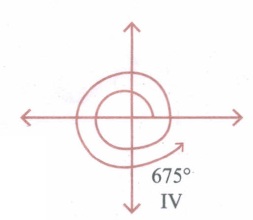
\(\frac{15\pi}{4}=15\times45^o=675^o\)
\(\cot\left(\frac{-15\pi}{4}\right)=\)cot (-675°)= - cot 675° = - cot (720 -45°) = -cot (2 x 360° - 45°)
= -(-cot 45°)(\(\therefore\) 675° is in the IV quadrant) =-(-1) = 1.
39.
sin (-105)° = - sin (105°)
= - sin (60° + 45°)
= - [sin 60° cos 45° + cos 60° sin 45°]
= \(-\left[ \frac { \sqrt { 3 } }{ 2 } .\frac { 1 }{ \sqrt { 2 } } +\frac { 1 }{ 2 } .\frac { 1 }{ \sqrt { 2 } } \right] \)
= \(-\left[ \frac { \sqrt { 3 } +1 }{ 2\sqrt { 2 } } \right] \)
40.
B \(=\begin{bmatrix} 0.50 & 0.30 \\ 0.41 & 0.33 \end{bmatrix}\)
I - B = \(\begin{bmatrix} 1 & 0 \\ 0 & 1 \end{bmatrix}-\begin{bmatrix} 0.50 & 0.30 \\ 0.41 & 0.33 \end{bmatrix}=\begin{bmatrix} 0.50 & -0.30 \\ -0.41 & 0.67 \end{bmatrix}\)
= (0.50) (0.67) - (0.30) (0.41)
\(|I-B|\) = 0.335 - 0.123 = 0.212 > 0
Since the main diagonal elements of I - B are positive and |I-B| is positive. Hawkins-Simon conditions are satisfied. Therefore the given system is viable
41.
\(L\left| f(x) \right| _{ x=1 }=\underset { x\rightarrow { 1 }^{ - } }{ lim } f(x)\\ =\underset { h\rightarrow 0 }{ lim } f\left( 1-h \right) ,x=1-h\\ =\underset { h\rightarrow 0 }{ lim } \left[ 5\left( 1-h \right) -4 \right] \\ =5(1)-4=1\)
\(R\left[ f\left( x \right) \right] _{ x=-1 }=\underset { x\rightarrow { 1 }^{ + } }{ lim } f(x)\\ =\underset { h\rightarrow 0 }{ lim } f\left( 1+h \right) ,x=1+h\\ =\underset { h\rightarrow 0 }{ lim } \left[ 4(1+h)^{ 2 }-3\left( 1+h \right) \right] \\ =4\left( 1 \right) ^{ 3 }-3(1)\\ =4-3=1\)
Now.\(f(1)=5(1)-4=5-4=1\)
\(\therefore \underset { x\rightarrow { 1 }^{ - } }{ lim } f(x)=\underset { x\rightarrow { 1 }^{ + } }{ lim } f(x)=f\left( 1 \right) \)
f(x) is continuous at x = 1
42.
Since \(\cfrac { 3\pi }{ 2 } <\left( A,B \right) <2\pi \), both A and B lie in the fourth quadrant,
\(\therefore \) sinA and sinB are negative
Given \(cosA=\cfrac { 4 }{ 5 } \ cosB=\cfrac { 12 }{ 13 } \)
Therefore \(\sin A=-\sqrt{1-\cos ^2 A}\)
\(=-\sqrt{1-\frac{16}{25}}\)
\(=-\sqrt{\frac{25-16}{25}}\)
\(=-\frac{3}{5}\)
\(\operatorname{Sin} B =-\sqrt{1-\cos ^2 B} \)
\(=-\sqrt{1-\frac{144}{169}} \)
\(=-\sqrt{\frac{169-144}{169}} \)
\(=-\frac{5}{13}\)
\(sin(A-B)=sinAcosB-cosAsinB\\ =\left( \cfrac { -3 }{ 5 } \right) \left( \cfrac { 12 }{ 13 } \right) -\left( \cfrac { 4 }{ 5 } \right) \left( \cfrac { -5 }{ 13 } \right) \\ =\cfrac { -36 }{ 65 } +\cfrac { 20 }{ 65 } =\cfrac { -6 }{ 65 } \)
43.
\(\frac{9}{(x-1)(x+2)^2} =\frac{A}{(x-1)}+\frac{B}{(x+2)}+\frac{C}{(x+2)^2} \) ...(1)
Multiplying both sides by \((x-1)(x+2)^{ 2 }\)
\(\therefore 9=A(x+2)^{ 2 }+B\left( x-1 \right) (x+2)+C(x-1)\) ..(2)
Put x = –2 in (2)
\(\\ 9=A(0)+B(0)+C(-2-1)\)
\(\therefore C=-3\)
Put x = 1 in (2)
\(9=A\left( 3 \right) ^{ 2 }+B(0)+C(0)\\ \therefore A=1\)
Equating the coefficient of x2 on both the sides of (2), we get
\(0=A+b\\ B=-A\\ \therefore B=-1\)
Substituting the values of A, B and C in (1), we get
\(\cfrac { 9 }{ (x-1)(x+2)^{ 2 } } =\cfrac { 1 }{ x-1 } -\cfrac { 1 }{ x+2 } -\cfrac { 3 }{ \left( x+2 \right) ^{ 2 } } \)
44.
Consider the equations
\(36{ x }_{ 1 }+6{ x }_{ 2 }= 108\)
| \({ x }_{ 1 }\) | 0 | 3 |
| \({ x }_{ 2 }\) | 18 | 0 |
\(3{ x }_{ 1 }+12{ x }_{ 2 }= 36\)
| \({ x }_{ 1 }\) | 0 | 12 |
| \({ x }_{ 2 }\) | 3 | 0 |
\(20{ x }_{ 1 }+10{ x }_{ 2 }= 100\)
| \({ x }_{ 1 }\) | 0 | 5 |
| \({ x }_{ 2 }\) | 10 | 0 |
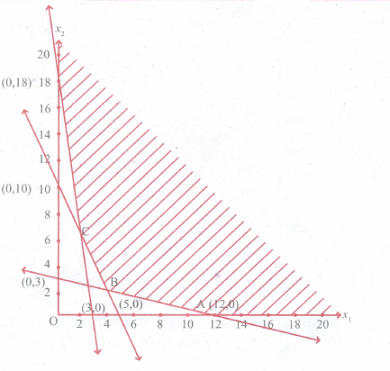
The feasible region is ABCD and its co-ordinates are A(12, 0), D(0, 18), B is the point of intersection of the lines
Verification of B:
\(3{ x }_{ 1 }+12{ x }_{ 2 }=36 \Rightarrow { x }_{ 1 }+4{ x }_{ 2 }=12 ...(1)\)
\(20{ x }_{ 1 }+10{ x }_{ 2 }=100 \Rightarrow { 2x }_{ 1 }+{ x }_{ 2 }=10...(2)\)
\( (1)\times 2\Rightarrow 2{ x }_{ 1 }+8{ x }_{ 2 }=24\)
\( (-)\quad (-)\quad \quad (-)\)
\((2)\Rightarrow 2{ x }_{ 1 }+{ x }_{ 2 }=10\)
\(--------------\)
\(7{ x }_{ 2 }=14 \Rightarrow { x }_{ 2 }=2\)
\(From(1), { x }_{ 1 }+8=12 \Rightarrow { x }_{ 1 }=4\)
∴ B is (4,2)
Also C is the point of intersection of the lines
Verification for C:
\(3{ 6x }_{ 1 }+6{ x }_{ 2 }=108\Rightarrow 6{ x }_{ 1 }+{ x }_{ 2 }=18 ...(3)\)
\( (-)\quad (-)\quad \quad (-)\)
\(20{ x }_{ 1 }+10{ x }_{ 2 }=100\Rightarrow 2{ x }_{ 1 }+{ x }_{ 2 }=10 ...(4)\)
\( --------------\)
\(4{ x }_{ 1 }=8 \Rightarrow { x }_{ 1 }=2\)
\( From(4), 4+{ x }_{ 2 }=10 \Rightarrow { x }_{ 2 }=6\)
∴ C is (2,6)
| Corner Points | z = 20x1+ 40x2 |
|---|---|
| A(12,0) | 240 |
| B(4,2) | 160 |
| C (2, 6) | 280 |
| D(0, 18) | 720 |
Minimum of B occurs at B(4, 2)
Hence, the solution is x1 = 4, x2 = 2 and Zmin = 160.
45.
Given P = 10K - K2 + KL
Differentiating partially w.r.t. 'K' we get,
\({\partial P\over \partial K}=10(1)-2K+L(1)\)
=10-2K+L
When K = 2 and L = 6.
Marginal Productivity of Capital
\({\partial P\over \partial K}=10 - 2(2) + 6 = 10 - 4 + 6 = 12\)
Differentiating 'P' partially w.r.t. 'L' we get,
\({\partial P\over \partial L}=0-0+K=K\)
When K = 2 and L = 6,
Marginal Productivity of Labour
\({\partial P\over \partial L}=2\)
46.
Stock = Rs.8000
FV = Rs.100
Dividend Rate = 7%
Income = \(\frac { Stock }{ FV } \times Dividend \ Rate=\frac { 8000 }{ 100 } \times 7\) = Rs.560 ....(1)
Selling price of one share=Rs.96
Sale proceeds = \(\frac { Stock }{ FV } \)x S.P of one share = \(\frac { 8000 }{ 100 } \) x 96 = Rs.7680
Given that the income on 10% stock
= 560+80 = 640
FV = Rs.10
Income = \(\frac { \text {Investment }}{ \text {Purchase Price } }\) x Dividend Rate
640 = \(\frac { 7680 }{\text { Purchase Price } }\) x 10
Purchase Price = \(\frac { 7680 }{ 640 } \) x 10 = Rs.120
Hence, purchase price of 10% stock=Rs.120
47.
Let y=x3-6x2+7
Differentiating w.r.t. 'x' we get,
\({dy\over dx}=3x^2-12x\)
\({dy\over dx}=0\)
\(\Rightarrow3x^2-12x=0\)
\(\Rightarrow3x(x-4)=0\)
\(\Rightarrow x=0 \ or \ x=4\)
\({d^2y\over dx^2}=6x-12\)
when x=0 \({d^2y\over dx^2}=-12<0\)
\(\therefore \) y is maximum at x=0
\(\therefore \) maximum value=03-6(0)2+7=7
when x=4, \({d^2y\over dx^2}=-6(4)-12=12>0\)
\(\therefore \) y is minimum at x=4
\(\therefore \) Minimum value =44-6(4)2+7=64-96+7=-25
Hence maximum value is 7 and minimum value is -25.
48.
Let us consider Height of father (in inches) is represented as X and Height of son (in inches) is represented as Y
| X | dx = (X-67) | dx2 | Y | dy = (Y-68) | dy2 | dxdy |
| 65 | -2 | 4 | 67 | -1 | 1 | 2 |
| 66 | -1 | 1 | 68 | 0 | 0 | 0 |
| 67 | 0 | 0 | 64 | -4 | 16 | 0 |
| 67 | 0 | 0 | 68 | 0 | 0 | 0 |
| 68 | 1 | 1 | 72 | 4 | 16 | 4 |
| 69 | 2 | 4 | 70 | 2 | 4 | 4 |
| 71 | 4 | 16 | 69 | 1 | 1 | 4 |
| 73 | 6 | 36 | 70 | 2 | 4 | 12 |
| ΣX = 546 | Σdx = 10 | Σdx2 = 62 | ΣY = 548 | Σdy = 4 | Σdy2 = 42 | Σdxdy = 26 |
r = \(\frac { N\Sigma dxdy-(\Sigma dx)(\Sigma dy) }{ \sqrt { N\Sigma dx^{ 2 }-(\Sigma dx)^{ 2 }\times \sqrt { N\Sigma dy^{ 2 }-(\Sigma dy)^{ 2 } } } } \)
Here Σdx = 10, Σdx2 = 62, Σdy = 4, Σdy2 = 42 and Σdxdy = 26
r = \(\frac { (8\times 26)-(10\times 4) }{ \sqrt { (8\times 62)-(10)^{ 2 }\times \sqrt { (8\times 42)-(4)^{ 2 } } } } \)
r = \(\frac { 168 }{ \sqrt { 396 } \times \sqrt { 320 } } \)
r = \(\frac { 168 }{ { 355.98 } } \) =0.472
i.e., r = +0.472
Heights of fathers and their respective sons are positively correlated.
49.
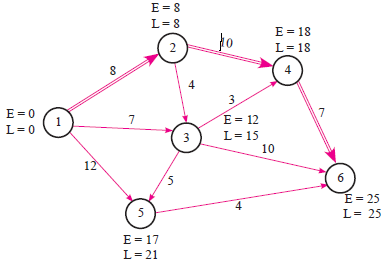
| Activity | Duration (in week) | EST | EFT | LST | LFT |
| 1-2 | 8 | 0 | 8 | 0 | 8 |
| 1-3 | 7 | 0 | 7 | 8 | 15 |
| 1-5 | 12 | 0 | 12 | 9 | 21 |
| 2-3 | 4 | 8 | 12 | 11 | 15 |
| 2-4 | 10 | 8 | 18 | 8 | 18 |
| 3-4 | 3 | 12 | 15 | 15 | 18 |
| 3-5 | 5 | 12 | 17 | 16 | 21 |
| 3-6 | 10 | 12 | 22 | 15 | 25 |
| 4-6 | 7 | 18 | 25 | 18 | 25 |
| 5-6 | 4 | 17 | 21 | 21 | 25 |
Here the critical path is 1–2–4–6
The project completion time is 25 weeks.
50.
f(x) = 3x5 - 25x3 + 60x + 1 … (1)
f ' (x) = 15x4 – 75x2 + 60 = 15(x4 – 5x2 + 4)
f '(x) = 0 \(\Rightarrow\) 15(x4 – 5x2 + 4) = 0
\(\Rightarrow\) (x2 – 4)(x2 – 1) = 0
x = \(\pm\)2 (or) x = \(\pm\)1
of these four points −2,\(\pm\) ∈ |-2,1| and 2∉[−2,1]
From (1)
f(-2) = 3(-2)5 - 25(-2)3+60(-2)+1 =-15
When x = 1
f(1) = 3(1)5 -25(1)3+ 60(1) +1 = 39
when x = -1
f(–1) = 3(-1)5 - 25(-1)3 + 60(-1) +1 =-37
Absolute maximum is 39 and
Absolute minimum is - 37.
51.
RHS = tan 4x = tan2(2x)
= \(\frac { 2\quad tan\quad 2x }{ 1-{ tan }^{ 2 }2x } \left[ \because tan2x=\frac { 2\quad tan\quad x }{ 1-{ tan }^{ 2 }x } \right] \)
= \(\frac { 2.\frac { 2\quad tan\quad x }{ 1-{ tan }^{ 2 }x } }{ 1-\left( \frac { 2\quad tan\quad x }{ 1-{ tan }^{ 2 }x } \right) ^{ 2 } } =\frac { \frac { 4\quad tan\quad x }{ 1-{ tan }^{ 2 }x } }{ \frac { (1-{ tan }^{ 2 }x)^{ 2 }-4{ tan }^{ 2 }x }{ (1-{ tan }^{ 2 }x)^{ 2 } } } \)
= \(\frac { 4\quad tan\quad x }{ 1-{ tan }^{ 2 }\quad x } \times \frac { (1-{ tan }^{ 2 }\quad { x })^{ 2 } }{ 1+{ tan }^{ 4 }x-2\quad { tan }^{ 2 }x-4{ tan }^{ 2 }x } \)
= \(\frac { 4 tanx(1-{ tan }^{ 2 }\quad x) }{ 1+{ tan }^{ 4 }x-6\ { tan }^{ 2 }x } \) = LHS
52.
Given 22 Pr + 1 :20 Pr+ 2 = 11 : 52
\(\Rightarrow\)52.22Pr+1 = 11.20 Pr+2
\(\Rightarrow\) \(52.\frac { 22! }{ (22-r-1)! } =11.\frac { 20! }{ (20-r)-2! } \quad \left[ \therefore npr=\frac { n! }{ n-r! } \right] \)
\(\Rightarrow\) \(\frac { 52\times 2\times 21 }{ (21-r)! } =11.\frac { 20! }{ (18-r)! } \)
\(\Rightarrow\) \(\frac { 52\times 2\times 21 }{ (21-r)(20-r)(19-r)(18-r)! } =\frac { 1 }{ (18-)! } \)
\(\Rightarrow\) 52 x 2 x 21 = (21- r) (20 - r) (19- r)
\(\Rightarrow\) 2 x 3 x 7 x 4 x 13 = (21- r) (20 - r) (19- r)
\(\Rightarrow\) 12 x 13 x 14 = (21- r)(20 - r)(19- r)
\(\Rightarrow\) 12 x 13 x 14 = (19- r) (20 - r) (21- r)
\(\Rightarrow\) 19-r=12
\(\Rightarrow\)r= 19-12
∴ r =7
53.
Compare the equation
12x2 - 10xy + 2y2 + 14x - 5y + 2 = 0 with
ax2 + 2hxy + by2 + 2gx + 2fy + c = 0
We get a = 12, 2h = -10, b = 2, 2g = 14, 2f = -5
\(h=-5\quad g=7\quad f=-\frac { 5 }{ 2 } ,c=2\)
\(\left|\begin{array}{lll} a & h & g \\ h & b & f \\ g & f & c \end{array}\right|=\left|\begin{array}{ccc} 12 & -5 & 7 \\ -5 & 2 & \frac{-5}{2} \\ 7 & \frac{-5}{2} & 2 \end{array}\right|\)
\(=12\left(4-\frac{25}{4}\right)+5\left(-10+\frac{35}{2}\right)+7\left(\frac{25}{2}-14\right)\)
\(=48-75-50+\frac{175}{2}+\frac{175}{2}-98\)
= -175 + 175 = 0
Hence the given equations represent a pair of straight lines.
To find separate equation
\(12 x^2-10 x y+2 y^2 =12 x^2-6 x y-4 x y+2 y^2 \)
\(=6 x(2 x-y)-2 y(2 x-y) \)
\(=(6 x-2 y)(2 x-y)\)
\(12 x^2-10 x y+2 y^2+ 14 x-5 y+2 =(6 x-2 y+l)(2 x-y+\mathrm{m})\)
Comparing the coefficient of x and y
14 = 6m + 2l
divided by 2
7 = 3m + l .........(1)
-5 = -2m - l .......(2)
Solving (1) and (2) we get m = 2, 1 = 1
The separate equations are
6x - 2y + 1 = 0
2x - y + 2 = 0
54.
a11 = 30, a12 = 40, x1 = 120
a21 = 20, a22 = 10, x2 = 60
\({b}_{11}={{{a}_{11}}\over{x_1}}={{30}\over{120}}={{1}\over{4}}\)
\({b}_{12}={{{a}_{12}}\over{{x}_{2}}}={{40}\over{60}}={{2}\over{3}}\)
\({b}_{21}={{{a}_{21}}\over{x_1}}={{20}\over{120}}={{1}\over{6}}\)
\({b}_{22}={{{a}_{22}}\over{{x}_{1}}}={{10}\over{60}}={{1}\over{6}}\)
The technology matrix is B = \(\begin{bmatrix}{{1}\over{4}}&{{2}\over{3}}\\ {{1}\over{6}}&{{1}\over{6}} \end{bmatrix}\)
I - B = \(\begin{bmatrix} 0&0\\0&1 \end{bmatrix}-\begin{bmatrix} {{1}\over{4}} &{{2}\over{3}}\\{{1}\over{6}}&{{1}\over{6}} \end{bmatrix}=\begin{bmatrix} {{3}\over{4}}&{{-2}\over{3}}\\ {{-1}\over{6}}&{{5}\over{6}} \end{bmatrix}\)
\(|I-B|=\frac{3}{4} \times \frac{5}{6}-\frac{2}{3} \times \frac{1}{6}=\frac{5}{8}-\frac{1}{9}=\frac{37}{72}=0\)
Since diagonals of I - B are positive and | I - B | is positive, the system is viable
\({(I-B)}^{-1}={{1}\over{|I-B|}}adj\ (I-B)={{72}\over{37}}\begin{bmatrix}{{5}\over{6}}&{{2}\over{3}}\\{{1}\over{6}}&{{3}\over{4}} \end{bmatrix}\)
X = (I - B)-1 D where D = \(\begin{bmatrix} 80\\40 \end{bmatrix}\)
\(={{72}\over{37}}\begin{bmatrix}{{5}\over{6}}&{{2}\over{3}}\\{{1}\over{6}}&{{3}\over{4}} \end{bmatrix}\begin{bmatrix} 80 \\ 40 \end{bmatrix}\)
\(=\frac{72}{37}\left(\begin{array}{cc} 66.67 & +26.67 \\ 13.33 & +30 \end{array}\right)=\frac{72}{37}\left(\begin{array}{l} 93.34 \\ 43.33 \end{array}\right)\)
\(=\left(\begin{array}{c} 181.63 \\ 84.32 \end{array}\right)\)
The output for production sector X and Y are 181.63 and 84.32 respectively.

11th Standard Syllabus & Materials
11th Standard
TN 11th Tamil பீடு பெற நில் - செய்யுள் - காவடிச்சிந்து Important Questions And Answers Study Material - QB365 Set A
NEW11th Standard
TN 11th Tamil பீடு பெற நில் - உரைநடை - மலை இடப்பெயர்கள் : ஓர் ஆய்வு Important Questions And Answers Study Material - QB365 Set A
NEW11th Standard
TN 11th Tamil மாமழை போற்றுதும் - துணைப்பாடம் - யானை டாக்டர் Important Questions And Answers Study Material - QB365 Set A
NEW11th Standard
TN 11th Tamil மாமழை போற்றுதும் - செய்யுள் - ஐங்குறுநூறு Important Questions And Answers Study Material - QB365 Set A



Tamilnadu Stateboard 11th Standard Subjects

Maths

Commerce

Economics

Biology
Business Maths and Statistics

Accountancy

Computer Science

Physics

Chemistry
Maths
Biology
Economics
Physics
Chemistry

History
Business Maths and Statistics

Computer Science
Accountancy

Computer Applications
History
Computer Technology
Commerce
Computer Applications
Computer Technology

Tamil

English

French
Tamilnadu Stateboard Standards
