
 100% FREE ACCESS
11th Standard Syllabus & Materials
11th Standard
TN 11th Tamil இயற்கை வேளாண்மை,சுற்றுச்சூழல் -செய்யுள் - மனோன்மணீயம் Important Questions And Answers Study Material - QB365 Set A
NEW11th Standard
TN 11th Tamil என்னுயிர் என்பேன் -துணைப்பாடம் - இசைத்தமிழர் இருவர் Important Questions And Answers Study Material - QB365 Set A
NEW11th Standard
TN 11th Tamil மொழி கலை -செய்யுள் - ஒவ்வொரு புல்லையும் Important Questions And Answers Study Material - QB365 Set A
NEW11th Standard
TN 11th Tamil பீடு பெற நில் - இலக்கணம் - பகுபத உறுப்புகள் Important Questions And Answers Study Material - QB365 Set A
NEW11th Standard
TN 11th Tamil பீடு பெற நில் - துணைப்பாடம் - வாடிவாசல் Important Questions And Answers Study Material - QB365 Set A
NEW11th Standard
TN 11th Tamil பீடு பெற நில் - செய்யுள் - குறுந்தொகை Important Questions And Answers Study Material - QB365 Set A

Published on: 26/02/2019
11-Std 3rd Revision Test
Download Tamil Nadu 11th Standard Chemistry question papers, model tests, one-mark questions, important questions, and public exam papers in PDF format. Free study materials and answer keys for TN State Board students.
Questions + Answers key
Take MCQ Chemistry Test
1.
For the reaction \(A+3B\rightleftharpoons 2C+D\) initial mole of A is twice that of B.1f at equilibrium moles of B and C are equal, then percent of B reacted is ____________
10%
20%
40%
60%
2.
How many stereoisomers does the molecules have? CH3CH=CHCH2CHBrCH3
2
4
6
8
3.
In which of the following bond angle is maximum?
NH3
PCI3
\({ NH }_{ 4 }^{ + }\)
SCl2
4.
The order of correct bond energy of C - X bond is
C - C I > C - I > C - Br
C - CI > C - Br > C - I
C - I > C - CI > C - Br
C -I > C - Br > C - CI
5.
Bhopal Gas Tragedy is a case of _____________.
thermal pollution
air pollution
nuclear pollution
land pollution
6.
Heterolytic fission of C-C bond results in the formation of _____________.
free radical
Carbanion
Carbocation
Carbanion and Carbocation
7.
A sample of 0.5g of an organic compound was treated according to Kjeldahl’s method. The ammonia evolved was absorbed in 50mL of 0.5M H2SO4. The remaining acid after neutralisation by ammonia consumed 80mL of 0.5 MNaOH, The percentage of nitrogen in the organic compound is __________
14%
28%
42%
56%
8.
The correct equation for the degree of an associating solute, 'n' molecules of which undergoes association in solution, is _____________
\(\alpha=\frac{n(i-1)}{n-1}\)
\(\alpha^2=\frac{n(1-i)}{(n-1)}\)
\(\alpha=\frac{n(i-1)}{1-\mathrm{n}}\)
\(\alpha=\frac{n(1-i)}{n(1-i)}\)
9.
Which of the following statement is incorrect?
The ionization potential of nitrogen is greater than that of oxygen
The electron affinity of F is greater than that of Cl.
The ionization potential of Mg is greater than aluminium.
The electronegativity of F is greater than that of Cl.
10.
Change in internal energy, when 4 kJ of work is done on the system and 1 kJ of heat is given out by the system is ______________
+1 kJ
- 5 kJ
+3 kJ
- 3 kJ
11.
The suspension of slaked lime in water is known as ___________
lime water
quick lime
milk of lime
aqueous solution of slaked lime
12.
The total number of orbitals associated with the principal quantum number n = 3 is _________
9
8
5
7
13.
Zeolite used to soften hardness of water is hydrated _____________
Sodium aluminium silicate
Calcium aluminium silicate
Zinc aluminium borate
Lithium aluminium hydride
14.
Write a short note on the following.
(i) Aromatisation
(ii) Pyrolysis
15.
Write a note on cis-trans isomerism in oximes and azo compounds.
16.
Even though the use of pesticides increases the crop production, they adversely affect the living organisms. Explain the function and the adverse effects of the pesticides.
17.
Describe optical isomerism with suitable example.
18.
How much volume of chlorine is required to form 11.2 L of HCI at 273 K and 1 atm pressure?
19.
Define the Molar Heat of Fusion
20.
State the findings of modern periodic law.
21.
State Boyle's law.
22.
Consider the structures I to VII and answer the following questions (i) to (v)
(i) CH3-CH2-CH2-CH2-OH
(ii) \({ CH }_{ 3 }-{ CH }_{ 2 }-\underset { \overset { | }{ OH } }{ CH } -{ CH }_{ 3 }\)
(iii) \({ CH }_{ 3 }-\overset { \underset { | }{ { CH }_{ 3 } } }{ \underset { \overset { | }{ { CH }_{ 3 } } }{ C } } -{ CH }_{ 3 }\)
(iv) \({ CH }_{ 3 }-\underset { \overset { | }{ { CH }_{ 3 } } }{ { CH }_{ 3 } } -{ CH }_{ 2 }-OH\)
(v) CH3 -CH2 -O-CH2 -CH3
(vi) CH3 - O - CH2 - CH2 - CH3
(vii) \({ CH }_{ 3 }-O-\underset { \overset { | }{ { CH }_{ 3 } } }{ { CH } } -{ CH }_{ 3 }\)
(i) Which of the above compounds form pairs of metamers?
(ii) Identify the pairs of compounds which are functional isomers.
(iii) Identify the pairs of compounds that represent position isomerism.
(iv) Identify the pairs of compounds that represent chain isomerism.
(v) Does any of these compounds possess geometrical isomerism? If yes identify them. If no, give reason.
23.
Give a detailed account on the different mechanisms followed in elimination reaction.
24.
Differentiate the following
(i) BOD and COD
(ii) Viable and non-viable particulate pollutants
25.
The observed depression in freezing point of water for a particular solution is 0.093o C. Calculate the concentration of the solution in molality. Given that molal depression constant for water is 1.86 K Kg mol-1.
26.
The equilibrium constant at 298 K for a reaction is 100.
A + B \(\rightleftharpoons \) C + D
If the initial concentration of all the four species is 1 M, the equilibrium concentration of D (in mol lit-1) will be
27.
Write the steps to be followed for writing empirical formula.
28.
Explain (i) intermolecular hydrogen bond and
(ii) intramolecular hydrogen bond.
29.
An atom of an element contains 35 electrons and 45 neutrons. Deduce
(i) the number of protons
(ii) the electronic configuration for the element
(iii) All the four quantum numbers for the last electron
30.
A tank of oxygen has a volume of 2.5 L at a pressure of 5.0 atm. What would be the volume of oxygen at 1.01 atm?
31.
Calculate the entropy change in the system, and surroundings, and the total entropy change in the universe during a process in which 245 J of heat flow out of the system at 77°C to the surrounding at 33°C.
32.
Alkaline earth metal (A), belongs to 3rd period reacts with oxygen and nitrogen to form compound (B) and (C) respectively. It undergo metal displacement reaction with AgNO3 solution to form compound (D).
33.
What is screening effect? Briefly give the basis for pauling's scale of electronegativity.
34.
Assertion: The number of oxygen atoms in 16g of oxygen and 16g of ozone is the same
Reason Each of the species represent 1g atom of oxygen
Codes:
(a) Both assertion and reason are correct and the reason is the correct explanation for an assertion
(b) Both assertion and reason are correct but a reason is not the correct explanation for assertion
(c) Assertion is true but reason is false.
(d) Both assertion and reason is false.
Both assertion and reason are correct and the reason is the correct explanation for an assertion
Both assertion and reason are correct but a reason is not the correct explanation for assertion
Assertion is true but reason are false.
Both assertion and reason are false
35.
Identify the magnetic nature of the anion of Na2O2.
36.
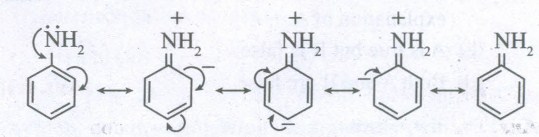
Draw the resonating structure of C6H5NH2 .
37.
Why chlorination of methane is not possible in dark?
38.
How much volume of Carbon dioxide is produced when 25 g of calcium carbonate is heated completely under standard conditions?
39.
State Mendeleev's periodic law.
40.
What are isobar and isochores?
41.
Do you think that heavy water can be used for drinking purposes?
1.
(d)
60%
2.
(b)
4
3.
(c)
\({ NH }_{ 4 }^{ + }\)
4.
(b)
C - CI > C - Br > C - I
5.
(b)
air pollution
6.
(d)
Carbanion and Carbocation
7.
(b)
28%
8.
(c)
\(\alpha=\frac{n(i-1)}{1-\mathrm{n}}\)
9.
(b)
The electron affinity of F is greater than that of Cl.
10.
(c)
+3 kJ
11.
(c)
milk of lime
12.
(a)
9
13.
(a)
Sodium aluminium silicate
14.
(i) Aromatisation:
Alkanes with six to ten carbon atoms are converted into homologous of benzene at high temperature and in the presence of catalyst. This process is known as aromatization. It occurs by simultaneous cyclisation followed by dehydrogenation of alkanes n-Hexane passed over Cr2O3 supported on alumina at 873 K gives benzene.
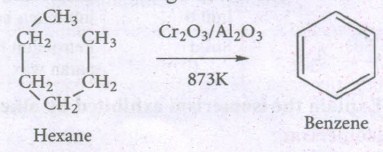
(ii) Pyrolysis:
Pyrolysis is dened as the thermal decomposition of organic compound into smaller fragments in the absence of air through the application of heat. 'Pyro' means 'fire' and 'lysis' means 'separating'. Pyrolysis of alkanes also named as cracking.
In the absence of air, when alkane vapours are passed through red-hot metal it breaks down into simpler hydrocarbons.
1) CH3-CH2-CH3
\(\downarrow 773K\)
\({ CH }_{ 3 }-CH={ CH }_{ 2 }+{ CH }_{ 2 }={ CH }_{ 2 }+{ H }_{ 2 }+{ CH }_{ 4 }\)
2) 2CH3-CH3 \(\overset { 773K }{ \longrightarrow } \) CH2 = CH2 + 2CH4
The products depends upon the nature of alkane, temperature, pressure and presence or absence of catalyst. The ease of cracking in alkanes increases with increase in molecular weight and branching in alkanes. Cracking plays an, important role in petroleum industry.
15.
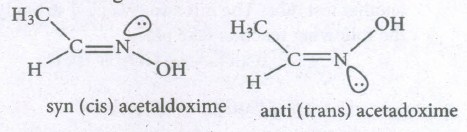
Restricted rotation around C=N (oximes) gives rise· to geometrical isomerism in oximes. Here 'syn' and 'anti' are used instead of cis and trans respectively. In the syn isomer the H atom of a doubly bonded carbon and -OH group of doubly bonded nitrogen lie on the same side of the double bond, while in the anti isomer, they lie on the opposite side of the double bond. For Eg:
16.
Pesticides are the chemicals that are used to kill or stop the growth of unwanted organisms. But these pesticides can affect the health of human beings. These are further classified as
a. Insecticides:
Insecticides like DDT ,BHC ,aldrin etc. can stay in soil for long period of time and are absorbed by soil . Th.y contaminate root crops like carrot, raddish, etc.
b. Fungicide :
Organo mercury compeunds are used as most common fungicide. They dissociate in soil to produce mercury which is highly toxic.
c. Herbicides :
Herbicides are the chemical compounds used to control unwanted plants. They are otherwise known as weed killers. Example sodium chlorate (NaClO3) and sodium arsenite (Na3 As O3). Most of the herbicides are toxic to mammals.
17.
Optical isomerism:
Compounds having same physical and chemical property but differ only in the rotation of plane of the polarized light are known as optical isomers and the phenomenon is known as optical isomerism.
Some organic compounds such as glucose have the ability to rotate the plane of the plane polarized light and they are said to be optically active compounds and this property of a compound is called optical activity. The optical isomer, which rotates the plane of
the plane polarised light to the right or in cloclauisl direction is said to be dextrorotary (dexter means right) denoted by the sign (+), whereas the compound which rotates to the left or anticloclanrise is said to be leavo rotatory (leanues mean left) denoted by sign(-).
Dextrorotatory compounds are represented as 'd' or by sign (+) and lavorotatory compounds are ( - ) represented as 'l' or by sign (-).
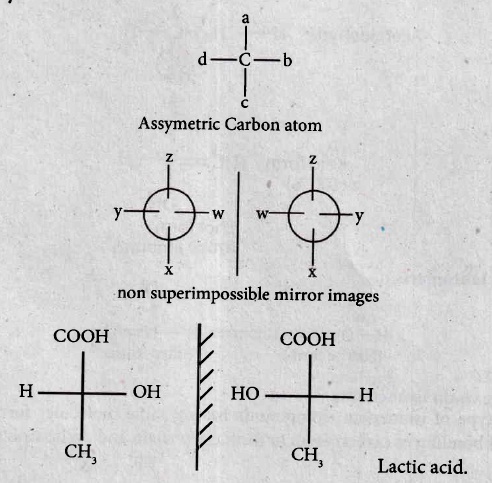
Enantiomerism and optical activity: An optically active substance may exist in two or more isomeric forms which have same physical and chemical properties but differ in terms of direction of rotation of plane polarized light, such optical isomers which rotate the plane of polarized light with equal angle but in opposite direction are known as enantiomers and the phenomenon is knovrrn as enantiomerism. Isomers which are non-super impossible mirror images of each other are called enantiomers.
conditions for enantiomerism or optical isomerism:
A carbon atom whose tetra vaiency is satisfied by four different substituents (atoms or groups) is called a symmetric carbon or chiral carbon. It is indicated by an asterisk as C*. A molecule Possessing chiral carbon atom and non-super impossible to its own mirror image is said to be a chiral molecule or asymmetric, and the pioperty is called chirality or dissymmetry.
18.
The balanced equation for the formation of HCI is,
H2(g) + CI2(g) \(\rightarrow\) 2 HCI (g)
As per the stoichiometric equation, under given conditions,
To produce 2 moles of HCI, 1 mole of chlorine gas is required.
To produce 44.8 litres of HCI, 22.4 litres of chlorine gas are required.
\(\therefore\) To produce 11.2 litres of HCI,
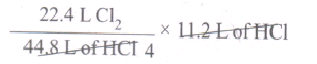
= 5.6 litres of chlorine are required.
19.
Molar Heat of Fusion: The molar heat of fusion is defined as "The change in enthalpy when one mole of a solid substance is converted into the liquid state at its melting point". For example heat of fusion of ice can be represented as
H2O(s) \(\overset { 273k }{ \rightarrow } \) H2O(l) ΔHfusion = + 5.98 KJ
20.
(i) The number of electrons increases by the same number as the increase in the atomic number.
(ii) As the number of electrons increases, the electronic structure of the atom changes.
(iii) Electrons in the outermost shell of an atom (valence electrons) determine the chemical properties of the elements.
21.
At a given temperature the volume occupied by a fixed mass of a gas is inversely proportional to its pressure.
\(V\alpha \frac { 1 }{ P }\) at constant T& n.
Mathematical form: P1V1 = P2 V2 = K
22.
(i) V and VI, VI and VII form a pair of metamers. Metamers are compounds which differ in the number of carbon atoms.
(ii) Functional isomers are compounds having same molecular formula, but different functional group; 1 and V, I and VI, I and VII, II and V, II and VI, II and VII, III and V, III and VI, III and VII, IV and V, IV and VI and IV and VII are functional isomers.
(iii) I and II, III and IV, VI and VII are position isomers. Compound that possess same molecular formula, carbon skeleton but differ in the position of functional group are called position isomers.
(iv) Compounds having same molecular formula but different carbon skeleton are called chain isomers. I and II, I and IV, II and III, II and IV are chain isomers.
(vi) None of these compounds exhibit geometrical isomerism, because to get geometrical isomers, restricted rotation about C = C is mandatary.
23.
Elimination reactions may proceed through two different mechanisms namely E1 and E2
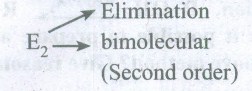
(i) The rate of E2 reaction depends on the concentration of alkyl halide and base Rate = k [alkyl halide] [base]
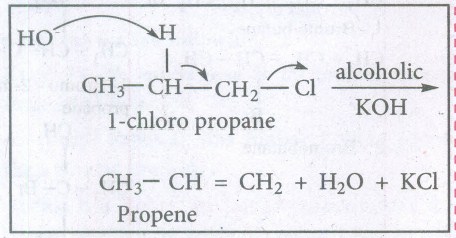
(ii) It is therefore, a second order reaction. Generally primary alkyl halide undergoes this reaction in the presence of alcoholic KOH. It is a one step process in which the abstraction of the proton from the . p carbon and expulsion of halide from the a carbon occur simultaneously. The mechanism is shown below.
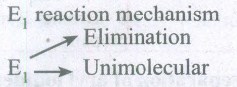
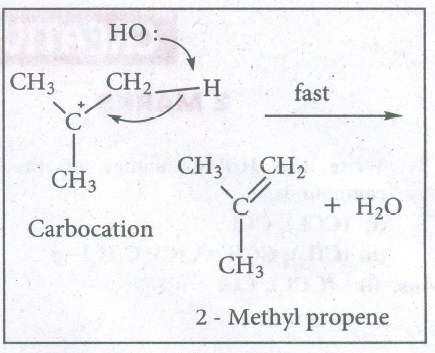
(iii) Generally, tertiary alkyl halide which undergoes elimination reaction by this mechanism in the presence of alcoholic KOH. It follows first order kinetics. Let us. consider the following elimination reaction.
Step - 1: Heterolytic fission to yield a carbocation
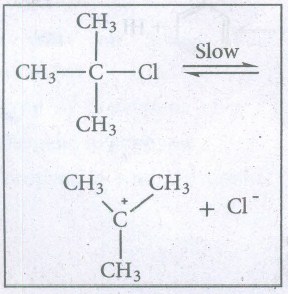
Step - 2 Elimination of a proton from the \(\beta\)- carbon to produce an alkene.
24.
(i) BOD and COD
| No | BOD | COD |
| 1 | This is Bio chemical oxygen demand | This is chemical oxygen demand |
| 2 | The total amount of oxygen in milligrams consumed by microorganisms in decomposing the waste in one litre of water at 20o for a period of 5 days is called biochemical oxygen demand (BOD) |
Chemical oxygen demand (COD) is defined as the amount of oxygen required by the organic matter in a sample of water for its oxidation by strong oxidising agent like K2Cr2O7 in acid medium for a Period of 2 hrs. |
| 3 | It is expressed in ppm | It is expressed in mg/L |
| 4 | It is a measure of consumed oxygen | It isa measurement of requirement of dissolved oxygen. |
| 5 | In waste streams BOD levels are less than COD. | In waste streams COD levels are higher than than BOD. |
| 6 | BOD measurements takes 5 days | COD measurements takes 2 hrs only. |
(ii) Viable and non-viable particulate pollutants
| No | Viable particulates | Non - Viable Particulates |
| 1 | These are small sized living organisms which are dispersed in air. Eg : bacteria, fungi, moulds, algae, etc. |
These are small solid particles and liquid droplets suspended in air. Eg : Smoke, Dust, Mists, Fumes, etc. |
| 2 | Fungi causes allergy in humans and diseases in Plants. | Causes long cancer, asthma, affects mattuation of RBC, affects Photosynthesis, etc. |
| 3 | They do not help in the transportation of Particulates. | They help in transportation of viable particulates |
25.
\(\Delta T_f=0.093^oC=0.093K\)
m = ?
Kf = 1.86K Kg mol-1
\(\Delta T_f=K_f.m\)
\(\therefore m={\Delta T_f\over K_f}\)
\(={0.093K\over 1.86\ K\ Kg\ mol^{-1}}\)
= 0.05 mol Kg-1
= 0.05 m.
26.
Given data:
[A] = [B] = [C]= [D] =1 M
Kc = 100
[D]eq = ?
Solution:
Let x be the no moles of reactants reacted
| A | B | C | D | |
|---|---|---|---|---|
| Initial concentration | 1 | 1 | 1 | 1 |
| At equilibrium (as per reaction stoichiometry) |
1-x | 1-x | 1-x | 1-x |
\(K_c={[C][D]\over [A][B]}\)
\(100={(1+x)(1+x)\over (1-x)(1-x)}\)
\(\sqrt{100}=\sqrt{{(1+x)(1+x)\over (1-x)(1-x)}}\)
\(10={1+x\over 1-x}\)
10(1 - x) = 1 + x
10 - 10x - 1 - x = 0
9 - 11x = 0
11x = 9
\(x={9\over 11}=0.818\)
[D]eq = 1+x = 1 + 0.818 = 1.818M.
27.
Empirical formula shows the ratio of number of atoms of different elements in one molecule of the compound.
Steps for finding the Empirical formula:
The percentage of the elements in the compound is determined by suitable methods and from the data collected; the empirical formula is determined by the following steps.
(i) Divide the percentage of each element by its atomic mass. This will give the relative, number of atoms of various elements present in the compound.
(ii) Divide the atom value obtained in the above step by the smallest of them so as to get a simple ratio of atoms of various elements.
(iii) Multiply the figures so obtained, by a suitable integer if necessary in order to obtain whole number ratio.
(iv) Finally write down the symbols of the various elements side by side and put. the above numbers as the subscripts to the lower right hand of each symbol. This will represent the empirical formula of the compound,
(v) Percentage of Oxygen = 100 - Sum of the percentage masses of all the given elements.
28.
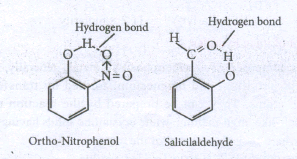
(i) Intermolecular hydrogen bonds occur between two separate molecules. They can occur between any numbersof like or unlike molecules as long as hydrogen donors and acceptorsare present in positions which enable the hydrogen bonding interactions. For example, intermolecular hydrogen bonds can occur between ammonia molecule themselves or between.water molecules themselves or between ammonia and water.
(ii) Intramolecular hydrogen bonds are those which occur within a single molecule.
29.
(i) no. of electrons: 35 (given)
no. of protons : 35
(ii) Electronic configuration
1s2 2S2 2p6 3s2 3p6 4s2 3d10 4p5
(iii) Last electron:
| \(\downharpoonleft\upharpoonright\) | \(\upharpoonleft\downharpoonright\) | \(\upharpoonleft\) |
4Px 4Py 4pz
last electron present in 4Py orbital y
n = 4, l = 1 m1 = either + 1 or -1 and s = -1/2
30.
Volume of oxygen V1 = 2.5 L
at a pressure P1 = 5.0 atm
At pressure P2 = 1.01 atm
Volume of oxygen V2 = ?
According to Boyle's law
P1 V1 = P2 V2
5 \(\times\) 25 = V2 \(\times\) 1.01
\({ V }_{ 2 }=\frac { 12.5 }{ 1.01 } =12.37\quad L\)
Volume of oxygen at a pressure of 1.01 atm
= 12.37 l
31.
Tsys=77°C = (77 + 273) = 350 K
Tsurr=33°C = (33 + 273) = 306 K
q=245 J
ΔSsys=\(\frac{q}{T_{sys}}=\frac{-245}{350}=-0.7JK^{-1}\)
ΔSsurr=\(\frac{q}{T_{sys}}=\frac{+245}{350}=0.8JK^{-1}\)
ΔSuniv=ΔSsys+ΔSsurr
ΔSuniv=-0.7 JK-1+ 0.8 JK-1
ΔSuniv=0.1 JK-1.
32.
(i) Alkaline earth metal (A) belonging to 3rd period is magnesium.
(ii) So A is Magnesium. Magnesium reacts with oxygen and nitrogen as follows.
\(2Mg+O_2⟶\underset{(B)}{2MgO}\)
\(3Mg+N_2⟶\underset{(C)}{Mg_3N_2}\)
So B is Magnesium oxide and C is magnesium nitride.
(iii) Magnesium undergoes metal displacement reaction with AgNO3 as follow to give D as follows :
\(Mg+2AgNO_3⟶\underset{D}{Mg(NO_3)_2}+2Ag\)
So D is Magnesium nitrate.
Result :
| Compound or Element | Symbol or Formula | Name |
|---|---|---|
| A | Mg | Magnesium |
| B | MgO | Magnesium oxide |
| C | Mg3N2 | Magnesium nitride |
| D | Mg(NO3)2 | Magnesium nitrate |
33.
Screening effect: The repulsive force between the inner shell electrons and the valence electrons leads to a decrease in the electrostatic attractive forces acting on the valence electrons by the nucleus. Thus, the inner shell electrons act as a shield between the nucleus and the valence electrons. This effect is called shielding effect.
Pauling's scale: Pauling, he assigned arbitrary value of electronegativities for hydrogen and fluorine as 2.2 and 4.0 respectively. Based on this the electronegativity values for other elements can be calculated using the following expression.
\(({ X }_{ A }-{ X }_{ B })=0.182\sqrt { E_{ AB } } -({ E }_{ AA }*{ E }_{ BB })^{ 1/2 }\)
Where EAB' EAA and EBB are the bond dissociation energies of AB, A2 and B2 molecules respectively. The electronegativity of any given element is not a constant and its value depends on the element to which it is covalently bound. The electronegativity values play an important role in predicting the nature of the bond.
34.
(a) Both assertion and reason are correct and the reason is the correct explanation for an assertion
35.
The anion of Na2O2 isO2-2 (peroxide ion).
No. of electrons in O2-2: 8 + 8 + 2 = 18 e-
Electronic configuration: \((\sigma_{1s})^2 (\sigma^*_{1s})^2(\sigma^s_{2})^2(\sigma^{s*}_{2})\)\((\sigma_2p_z)^2(\pi_2p_x)^2(\pi_2p_y)^2(\pi^*_2p_x)^2(\pi^*_2p_y)^2\)
Bond order: \({1\over2}(N_b-N_a)={1\over2}(10-8)=1\)
Magnetic Nature: Has no unpaired electrons. Hence diamagnetic.
36.
37.
The Chlorination of methane is carried out by free radical mechanism. The initiation step to form free radical needs high energy which is supplied by light energy.
\(\mathrm{Cl}-\mathrm{Cl} \stackrel{h \nu}{\longrightarrow} 2 \mathrm{Cl}\)
So this reaction is not possible in dark.
38.
CaCO3(s) \(\rightarrow\) CaO(s) + CO(g)
100g 22.4L
100 g of CaCO3 produces 22.4 L of CO2.
\(\therefore\) 25 g of CaCO3 will purchase = \(\frac { 22.4 }{ 100 } \times 25\)
= 5.6 L of CO2.
39.
This law states that "The physical and chemical properties of elements are a periodic function of their atomic weights."
40.
Isobars are the plot of volume Vs temperature at constant pressure and isochores are plot of pressure verses temperature at constant volume.
41.
Heavy water is toxic when taken in large quantities. Heavy water is not radioactive. The deuterium in it is stable; it does not decay. Nobody will be in danger at all from radiation. It is heavier than plain water. D2O performs little different from H2O in chemical reactions. One has to drink a lot of D2O to kill him.

11th Standard Syllabus & Materials
11th Standard
TN 11th Tamil பீடு பெற நில் - செய்யுள் - காவடிச்சிந்து Important Questions And Answers Study Material - QB365 Set A
NEW11th Standard
TN 11th Tamil பீடு பெற நில் - உரைநடை - மலை இடப்பெயர்கள் : ஓர் ஆய்வு Important Questions And Answers Study Material - QB365 Set A
NEW11th Standard
TN 11th Tamil மாமழை போற்றுதும் - துணைப்பாடம் - யானை டாக்டர் Important Questions And Answers Study Material - QB365 Set A
NEW11th Standard
TN 11th Tamil மாமழை போற்றுதும் - செய்யுள் - ஐங்குறுநூறு Important Questions And Answers Study Material - QB365 Set A



Tamilnadu Stateboard 11th Standard Subjects

Maths

Commerce

Economics

Biology

Business Maths and Statistics

Accountancy

Computer Science

Physics
Chemistry
Maths
Biology
Economics
Physics
Chemistry

History
Business Maths and Statistics

Computer Science
Accountancy

Computer Applications
History
Computer Technology
Commerce
Computer Applications
Computer Technology

Tamil

English

French
Tamilnadu Stateboard Standards
