
 100% FREE ACCESS
11th Standard Syllabus & Materials
11th Standard
TN 11th Tamil இயற்கை வேளாண்மை,சுற்றுச்சூழல் -செய்யுள் - மனோன்மணீயம் Important Questions And Answers Study Material - QB365 Set A
NEW11th Standard
TN 11th Tamil என்னுயிர் என்பேன் -துணைப்பாடம் - இசைத்தமிழர் இருவர் Important Questions And Answers Study Material - QB365 Set A
NEW11th Standard
TN 11th Tamil மொழி கலை -செய்யுள் - ஒவ்வொரு புல்லையும் Important Questions And Answers Study Material - QB365 Set A
NEW11th Standard
TN 11th Tamil பீடு பெற நில் - இலக்கணம் - பகுபத உறுப்புகள் Important Questions And Answers Study Material - QB365 Set A
NEW11th Standard
TN 11th Tamil பீடு பெற நில் - துணைப்பாடம் - வாடிவாசல் Important Questions And Answers Study Material - QB365 Set A
NEW11th Standard
TN 11th Tamil பீடு பெற நில் - செய்யுள் - குறுந்தொகை Important Questions And Answers Study Material - QB365 Set A

Published on: 31/12/2022
QB365 provides a detailed and simple solution for every Possible Questions in Class 11 Chemistry Subject - Important 2 Mark English Medium. It will help Students to get more practice questions, Students can Practice these question papers in addition to score best marks.
Download Tamil Nadu 11th Standard Chemistry question papers, model tests, one-mark questions, important questions, and public exam papers in PDF format. Free study materials and answer keys for TN State Board students.
Questions + Answers key
Take MCQ Chemistry Test
1.
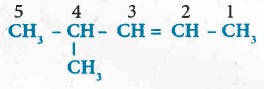
Draw the structures for the following alkenes.
4 – Methyl – 2 pentene
2.
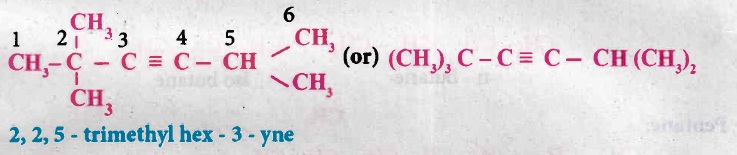
Give IUPAC names for the following compound
(CH3)3 C – C ≡ C – CH (CH3)2
3.
Consider the following reactions,
CaCO3 (s) ⇌ CaO (s) + CO2(g)
In the above reaction find out whether you have to increase (or) decrease the volume to increase the yield of the product.
4.
Give two examples for each of the following type of organic compounds.
aliphatic open chain.
5.
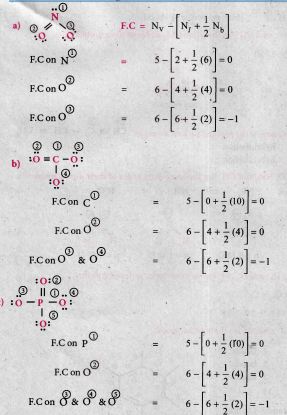
Calculate the formal charge of the atoms (numbered) in the following:
6.
Write the IUPAC names for the following alkenes.
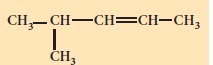
7.
Classify the following compounds based on the structure
\(\text { i) } \mathrm{CH} \equiv \mathrm{C}-\mathrm{CH}_{2}-\mathrm{C} \equiv \mathrm{CH}\)
\(\text { ii) } \mathrm{CH}_{3}-\mathrm{CH}_{2}-\mathrm{CH}_{2}-\mathrm{CH}_{2}-\mathrm{CH}_{3}\)
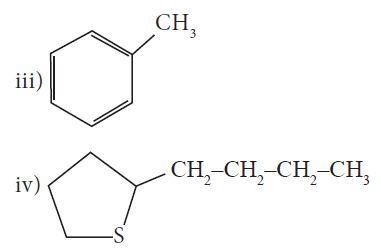
8.
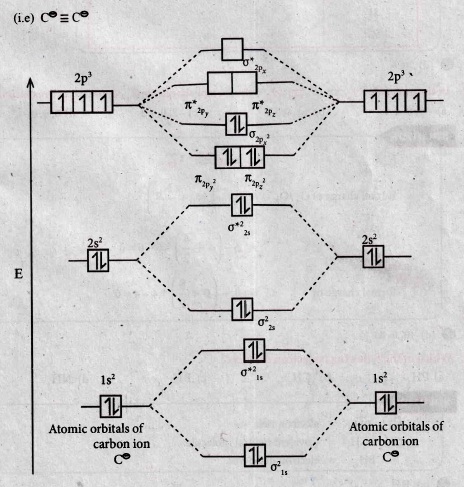
Draw the MO diagram for acetylide ion C22– and calculate its bond order.
9.
Write the equilibrium constant (KC) expression for the following reactions
(i) Cu2+(aq) + 2Ag (s) ⇌ Cu(s) + 2Ag+ (aq)
(ii) 4HCl(g) + O2g ⇌ 2Cl2(g) + 2H2O(g)
10.
How will you control photochemical smog?
11.
Draw the lewis structure for
Phosphoric acid
12.
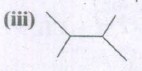
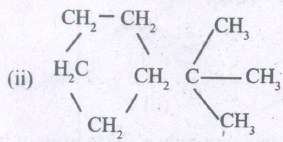
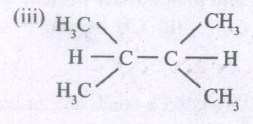
Expand the structure.
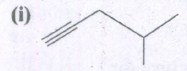
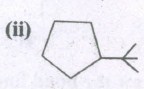
13.
How does the polarizing power of cations affect the covalent character imparted into the ionic bond ?
14.
State Henry's law.
15.
Discuss the aromatic nucleophilic substitutions reaction of chlorobenzene.
16.
How will you prepare propane from a sodium salt of fatty acid?
17.
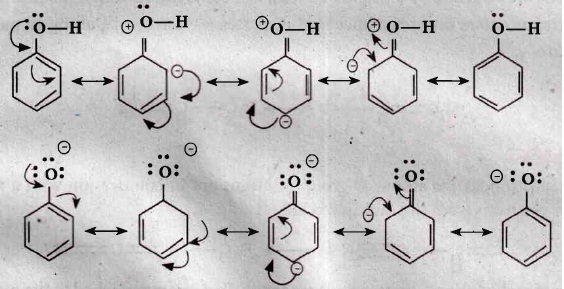
Write short notes on Resonance.
18.
Define the term ‘isotonic solution’.
19.
If 5.6 g of KOH is present in
(a) 500 mL and
(b) 1 litre of solution
Calculate the molarity of each of these solutions.
20.
Consider the following reactions,
H2(g) + I2(g) ⇌ 2 HI(g)
In each of the above reaction find out whether you have to increase (or) decrease the volume to increase the yield of the product.
21.
Calculate ΔHr0 for the reaction CO2(g) + H2(g) ⟶ CO(g) + H2O (g) given that ΔHf0 for CO2 (g), CO (g) and H2O (g) are - 393.5, - 111.31 and - 242 kJ mol-1 respectively.
22.
The first ionisation energy (lE1) and second ionisation energy (lE2) of elements X, Y and Z are given below.
| Element | IE1(kJ mol-1) | IE2(kJ mol-1) |
| X | 2370 | 5250 |
| Y | 522 | 7298 |
| Z | 1680 | 3381 |
Which one of the above elements is the most reactive metal, the least reactive metal and a noble gas?
23.
Which ion has the stable electronic configuration? Ni2+ or Fe3+.
24.
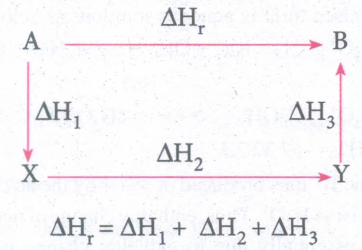
Define Hess's law of constant heat summation.
25.
Why sodium hydroxide is much more water soluble than chloride ion ?
26.
Consider the following electronic arrangements for the d5 configuration.
(a)
| \(\upharpoonleft \downharpoonright \) | \(\upharpoonleft \downharpoonright \) | \(\upharpoonleft \) |
(b)
| \(\upharpoonleft \) | \(\upharpoonleft \) | \(\upharpoonleft \) | \(\upharpoonleft \downharpoonright \) |
(c)
| \(\upharpoonleft \) | \(\upharpoonleft \) | \(\upharpoonleft \) | \(\upharpoonleft \) | \(\upharpoonleft \) |
which of these represents the ground state
27.
Give suitable explanation for the following facts about gases.
Gases don't settle at the bottom of a container.
28.
Calculate the average atomic mass of naturally occurring magnesium using the following data.
| Isotope | Isotopic atomic mass | Abundance (%) |
|---|---|---|
| Mg24 | 23.99 | 78.99 |
| Mg25 | 24.99 | 10.00 |
| Mg26 | 25.98 | 11.01 |
29.
30.
What are isoelectronic ions? Give examples.
1.
2.
3.
\(\underset{(\mathrm{L} x)}{\mathrm{CaCO}_3} \rightleftharpoons \underset{(x)}{\rightleftharpoons} \mathrm{CaO}_{(\mathrm{s})}+\underset{(x)}{\mathrm{CO}_{2(\mathrm{~g})}}\)
Kc = [CO2]
\(K_c=\frac{x}{V}\)
So, \(K_c \propto \frac{1}{V}\) If V increases Kc wil decrease; As Kc is a constant x will increase and hence the yield of the product will increase. Similarly if V decreases the yield of the product will also decrease.
4.
aliphatic open chain.
Propane - \(\mathrm{CH}_3-\mathrm{CH}_2-\mathrm{CH}_3\)
Propylene - \(\mathrm{CH}_3-\mathrm{CH}=\mathrm{CH}_2\)
5.
6.
4-methyl - 2-pentene
7.
(i) Unsaturated open chain compound
(ii) saturated open chain compound
(iii) aromatic benzenoid compound
(iv) alicyclic compound
8.
No of eo in C2 2- : 6 + 6 + 2 = 14 eo
Electronic configuration of C2 2- ion is:
σ1s2, σ*1s2 ,σ2s2 , σ2s2 ,π2py2 = π2px2 , π2py2
Bond order = 1/2 (Nb - Na)
= 1/2(10 - 4) = 3
9.
(i) \(log\cfrac { { K }_{ 2 } }{ { K }_{ 1 } } =\cfrac { \Delta { H }^{ o } }{ 2.303R } \left[ \cfrac { { T }_{ 2 }{ T }_{ 1 } }{ { T }_{ 2 }{ T }_{ 1 } } \right] \)
(ii) \({ K }_{ C }=\cfrac { \left[ { Cl }_{ 2 }\left( g \right) \right] ^{ 2 }\left[ { H }_{ 21 }O(g) \right] ^{ 2 } }{ \left[ HCl(g) \right] ^{ 4 } } \)
10.
The formation of photochemical smog can be suppressed by preventing the release of nitrogen oxide and hydrocarbons into the atmosphere from the motor vehicles by using catalytic convertors in engines. Plantation of certain trees like Pinus, Pyrus Querus vitus and Juniparus can metabolise nitrogen oxide.
11.
.jpg)
12.
(i) \(H-C\equiv C-CH_{ 2 }-\underset { \underset { OH }{ | } }{ CH } -{ CH }_{ 3 }\)
13.
Greater the polarization effect, greater will be covalent character imported into the ionic bond. The general trend in the polarizing power of cations is Li+ > Na+ > K+ > Rb+> Cs+
\(\therefore\)Their covalent charter: LiCI > NaCl > KCl > RbCl > CsCl
14.
According to him, "the partial pressure of the gas in vapour phase (vapour pressure of the solute) is directly proportional to the mole fraction(x) of the gaseous solute in the solution at low concentrations". is statement is known as Henry's law.
psolute \(\infty \)Xsolute in solution
psolute = KHxsolute in solution
Here, Psolute represents the partial pressure of the gas in vapour state which is commonly called as vapour pressure.
15.
Halo arenes do not undergo nucleophilic substitution reaction readily is due to C-X bond in aryl halide is short and strong and also the aromatic ring isa centre of high electron density.
The halogen of haloarenes can be substituted by OH-, NH2-, or CN- with appropriate nucleophilic reagents at high temperature and pressure.
16.
CH3CH2CH2COONa + NaOH \(\overset { CaO }{ \underset { \Delta }{ \rightarrow } } \)CH3CH2 - CH3+Na2CO3
Sodium salt of butanaic acid Propane
Heating sodium salt of butanoic acid (Sodium butanoate) with soda lime gives propane.
17.
The resonance is a chemical phenomenon which is observed in certain organic compounds possessing double bonds at a suitable position. Certain organic compounds can be represented by more than one structure and they differ only in the position of
bonding and lone pair of electrons. Such structures are called resonance structures (canonical structures) and this phenomenon is called resonance. This phenomenon is also called mesomerism or mesomeric effect.
For example, the structure of aromatic compounds such as benzene and conjugated systems tike 1,3 - butadiene cannot be represented by a single structure, and their observed properties can be explained on the basis of a resonance hybrid.
In 1, 3 buta diene, it is expected that the bond between C1 - C2 and C3 - C4 should be shorter than that of C2 - C3, but the observed bond lengths are of same. This property cannot be explained by a simple structure in which two \(\pi\) bonds localised between C1 - C2 and C3 - C4 . Actually the \(\pi\) electrons are delocalised

These resonating structures are called canonical forms and the actual structure lies between these three resonating strucfures, and is called a resonance hybrid. The resonance hybrid is represented
Similar to the other electron displacement effect, mesomeric effect is also classified into positive mesomeric effect (+M or +R) and negative mesomeric effect (-M of -R) based on the nature of the functional group present adjacent to the multiple bond.
Positive Mesomeric Effect :
Positive resonance effect occurs, when the electrons move away from substituent attached to the conjugated system. It occurs, if the electron releasing substituents are attached to the conjugated system. In such cases, the attached group has a tendency to release electrons through resonance. These electron releasing groups are usually denoted as +R or +M groups.
Examples : -OH, -SH, -OR, -SR, -NH2, -O- etc...
Negative Mesomeric Effect :
Negative resonance effect occurs, when the electrons move towards the substituent attached to the conjugated system. It occurs if the electron withdrawing substituents are attached to the conjugated system.
In such cases, the attached group has a tendency to withdraw electrons through resonance. These electron withdrawing groups are usually denoted as -R or -M groups.
Examples : NO2, > C = O, -COOH, -C = N etc......
Resonance is useful in explaining certain properties such as acidity oi phenol. The phenoxide ion is more stabilised than phenol by resonance effect (+M effect) and hencp resonance tavours ionisation of phenol to form H+ and shows acidity.
The structures shows that there is a charge separation in the resonance structure of phenol which needs energy, where as there is no such hybrid structures in the case of phenoxide ion. This increased stability accounts for the acidic character of phenol.
18.
Two solutions having same osmotic pressure at a given temperature are called isotonic solutions.
19.
No.of moles ; n = \(\frac{\mathrm{m}}{\mathrm{M}}=\frac{5.6}{56}=0.1 \mathrm{~mol}\)
(i) V = 500 ml = \(\frac{500}{1000}=0.5 \mathrm{~L} \)
Molarity = \(\frac{\mathrm{n}}{\mathrm{v}}=\frac{0.1}{0.5}=0.2 \mathrm{M} \)
(ii) V = IL
Molarity = \(\frac{\mathrm{n}}{\mathrm{v}}=\frac{0.1}{1}=0.1 \mathrm{M} \)
20.
\( \mathrm{H}_{2(\mathrm{~g})}+\mathrm{I}_{2(\mathrm{~g})} \rightleftharpoons 2 \mathrm{HI}_{(\mathrm{g})} \)
\(\mathrm{K}_{\mathrm{c}}=\frac{4 x^{2}}{(a-x)(b-x)}\)
This expression doesn't involve, V. So, increase or decrease of volume will not affect the equilibrium and hence the yield of the product.
21.
ΔHf0 CO2 = -393.5 kJ mol-1
ΔHf0 CO = -111.31 kJ mol-1
ΔHf0 (H2O) = - 242 kJ mol-1
CO2(g) + H2(g) - CO(g) + H2O(g)
ΔHf0 = ?
ΔHf0 = Σ(ΔHf0)products-Σ(ΔHf0)reactions
ΔHf0 = [ΔHf0(CO) + ΔHf0(H2O)] - [ΔHf0(CO2) + ΔHf0(H2)]
ΔHf0 = [-111.31 + (-242)] - [-393.5 + (0)]
ΔHf0 = [-353.31] + 393.5
ΔHf0 = 40.19
ΔHf0 = +40.19 kJ mol-1.
22.
Noble gases: Ioniation energy ranging from 2372 KJmol-1 to 1037 kJ mol-1.
For element X, the IE1 value is in the range of noble gas, moreover for this element both IE1 and IE2 are higher and hence X is the noble gas.
For Y, the first ionisation energy is low and second ionisation energy is very high and hence Y is most reactive metal. For Z, both IE1 and IE2 are higher and hence it is least reactive.
23.
Electronic configuration of Fe3+ : 1s2 2s2 2p6 3s2 3p6 4s0 3d5
Electronic configuration of Ni2+ : 1s2 2s2 2p6 3s2 3p6 4s0 3d8
Fe3+ has stable 3d5 half filled configuration.
24.
The enthalpy change of a reaction either at constant volume or constant pressure is the same whether it takes place in a single or multiple steps provided the initial and final states are same.
25.
The solubility product of NaCl is lower than that of NaOH. The more soluble a substance is, the higher the Ksp value it has In aqueous solution NaOH gives OH- ions. It can be solvated by establishing H-bonds with water molecules. So it is more water soluble.
26.
(i) ground state :
| \(\upharpoonleft \) | \(\upharpoonleft \) | \(\upharpoonleft \) | \(\upharpoonleft \) | \(\upharpoonleft \) |
This type of electronic configuration have ten possible arrangements (i.e. Half filled configuration is More).
27.
Gases are very less denser. They have negligible intermolecular forces of attraction between the molecules. They are in continuous kinetic motion. So they won't settle at the bottom due to gravitational forces. The material that is most dense will sink to the bottom; the less denser will go up.
28.
Average atomic mass
= \(\frac { (78.99\times 23.99)+(10\times 24.99)+(11.01\times 25.98) }{ 100 } \)
= \(\frac { 2430.9 }{ 100 } \)
= 24.31 u
29.
30.
Ions of different elements having the same number of electrons are called isoelectronic ions.
| Ions of different elements | Na+ | Mg+2 | Al+3 | F- | O2- | N3- |
| No. of electrons | 10 | 10 | 10 | 10 | 10 | 10 |

11th Standard Syllabus & Materials
11th Standard
TN 11th Tamil பீடு பெற நில் - செய்யுள் - காவடிச்சிந்து Important Questions And Answers Study Material - QB365 Set A
NEW11th Standard
TN 11th Tamil பீடு பெற நில் - உரைநடை - மலை இடப்பெயர்கள் : ஓர் ஆய்வு Important Questions And Answers Study Material - QB365 Set A
NEW11th Standard
TN 11th Tamil மாமழை போற்றுதும் - துணைப்பாடம் - யானை டாக்டர் Important Questions And Answers Study Material - QB365 Set A
NEW11th Standard
TN 11th Tamil மாமழை போற்றுதும் - செய்யுள் - ஐங்குறுநூறு Important Questions And Answers Study Material - QB365 Set A



Tamilnadu Stateboard 11th Standard Subjects

Maths

Commerce

Economics

Biology

Business Maths and Statistics

Accountancy

Computer Science

Physics
Chemistry
Maths
Biology
Economics
Physics
Chemistry

History
Business Maths and Statistics

Computer Science
Accountancy

Computer Applications
History
Computer Technology
Commerce
Computer Applications
Computer Technology

Tamil

English

French
Tamilnadu Stateboard Standards
