
 100% FREE ACCESS
11th Standard Syllabus & Materials
11th Standard
TN 11th Tamil இயற்கை வேளாண்மை,சுற்றுச்சூழல் -செய்யுள் - மனோன்மணீயம் Important Questions And Answers Study Material - QB365 Set A
NEW11th Standard
TN 11th Tamil என்னுயிர் என்பேன் -துணைப்பாடம் - இசைத்தமிழர் இருவர் Important Questions And Answers Study Material - QB365 Set A
NEW11th Standard
TN 11th Tamil மொழி கலை -செய்யுள் - ஒவ்வொரு புல்லையும் Important Questions And Answers Study Material - QB365 Set A
NEW11th Standard
TN 11th Tamil பீடு பெற நில் - இலக்கணம் - பகுபத உறுப்புகள் Important Questions And Answers Study Material - QB365 Set A
NEW11th Standard
TN 11th Tamil பீடு பெற நில் - துணைப்பாடம் - வாடிவாசல் Important Questions And Answers Study Material - QB365 Set A
NEW11th Standard
TN 11th Tamil பீடு பெற நில் - செய்யுள் - குறுந்தொகை Important Questions And Answers Study Material - QB365 Set A

Published on: 27/01/2019
+1 FIRST REVISION TEST
Download Tamil Nadu 11th Standard Chemistry question papers, model tests, one-mark questions, important questions, and public exam papers in PDF format. Free study materials and answer keys for TN State Board students.
Questions + Answers key
Take MCQ Chemistry Test
1.
Cause of eutrophication is ____________
Increase of oxygen in water bodies
Increase in number of aquatic organisms
Nutrient enrichment of water bodies
All ofthese
2.
For the homogeneous gas reaction at 600K \(4NH_{ 3\left( g \right) }+5{ O }_{ 2\left( g \right) }\rightleftharpoons 4NO_{ \left( g \right) }+6{ H }_{ 2 }{ O }_{ \left( g \right) }\) The unit of equilibrium constant K" is
(mol dm-3)-1
(mol dm-3)
(mol dm-3)10
(mol dm-3)9
3.
During change of \({ O }_{ 2 }\) to \({ O }_{ 2 }^{ - }\) ion, the electron adds on which one of the following orbitals?
\(\pi\) orbitals
\(\sigma -\)orbitals
\(\pi^*\) orbitals
\(\sigma ^*\)orbitals
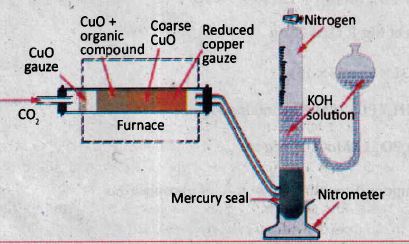
4.
The most stable carbocation is ____________
\(C{ H }_{ 3 }-\overset { + }{ C } { H }_{ 2 }\)
\(C{ H }_{ 3 }-\overset { + }{ C } H-C{ H }_{ 3 }\)
\(C{ H }_{ 2 }=CH-\overset { + }{ C } { H }_{ 2 }\)
\(\overset { + }{ C } { H }_{ 3 }\)
5.
Which one of the following is true about metallic character when we move from left to right in a period and top to bottom in a group?
Decreases in a period and increases along the group
Increases in a period and decreases in a group
Increases both in the period and the group
Decreases both in the period and in the group
6.
7.
In which of the following molecules, all atoms are co-planar ___________

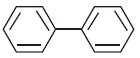
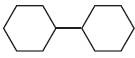
both (a) and (b)
8.
The IUPAC name of the Compound is _____________
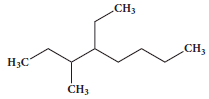
2,3 - Diemethylheptane
3- Methyl -4- ethyloctane
5-ethyl -6-methyloctane
4-Ethyl -3 - methyloctane
9.
Normality of 1.25M sulphuric acid is ___________
1.25 N
3.75 N
2.5 N
2.25 N
10.
Which of the following provides the experimental justification of magnetic quantum number?
Zeeman effect
Stark effect
Uncertainty principle
Quantum condition
11.
Identify the correct mathematical expression of Graham's law of diffusion __________
\(\frac { { r }_{ 2 } }{ { r }_{ 1 } } =\sqrt { \frac { { M }_{ 2 } }{ { M }_{ 1 } } } \)
\({ r }_{ 1 }r_{ 2 }=\sqrt { \frac { { M }_{ 2 } }{ { M }_{ 1 } } } \)
\(\frac { { r }_{ 1 } }{ { r }_{ 2 } } =\sqrt { \frac { { M }_{ 2 } }{ { M }_{ 1 } } } \)
\(\frac { { r }_{ 1 } }{ { r }_{ 2 } } ={ \left[ \frac { { M }_{ 2 } }{ { M }_{ 1 } } \right] }^{ 2 }\)
12.
Which pair are not hydrogen isotopes?
Ortho and para hydrogen
Protium and deuterium
Deuterium and tritium
Tritium and protium
13.
If one mole of ammonia and one mole of hydrogen chloride are mixed in a closed container to form ammonium chloride gas, then _____________
ΔH > ΔU
ΔH - ΔU = 0
ΔH + ΔU = 0
ΔH < ΔU
14.
Which of the following has the highest tendency to give the reaction \(M_{g}^{+}\xrightarrow[Medium]{Aqueous}M_{aq}^{+}\)
Na
Li
Rb
K
15.
7.5 g of a gas occupies a volume of 5.6 litres at 0° C and 1 atm pressure. The gas is ________.
NO
N2O
CO
CO2
16.
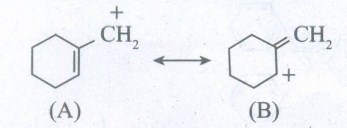
Which of the following ions is more stable ? Use resonance to explain your answer.
17.
What are the non-aqueous solution ? Give example
18.
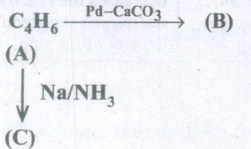
Identify A, Band C from the following equation
19.
What is green chemistry ?
20.
Give a brief description of the principles of
Fractional distillation
21.
Consider the following reaction
Fe3+(aq) + SCN–(aq) ⇌ [Fe(SCN)]2+(aq)
A solution is made with initial Fe3+, SCN- concentration of 1 x 10⁻³ M and 8 x 10⁻⁴ M respectively. At equilibrium [Fe(SCN)]2+ concentration is 2 x 10⁻⁴ M. Calculate the value of equilibrium constant.
22.
Calculate the equivalent masses of the following - Oxalic acid H2C2O4
23.
Lithium iodide is covalent. Explain why?
24.
Do you think that heavy water can be used for drinking purposes?
25.
Define the calorific value of food. What is the unit of calorific value?
26.
Give the systematic names for the following
Milk of magnesia
27.
Magnesium loses electrons successively to form Mg+, Mg2+ and Mg3+ ions. Which step will have the highest ionisation energy and why?
28.
What happens when the' concentration of H2 and I2 are increased in the reaction \({ H }_{ 2 }+{ I }_{ 2 }\rightleftharpoons 2HI?\)
29.
Carry over the following reaction mechanisms.
(i) Bromination of alkene
(ii) Addition of HCN to CH3CHO
(iii) Formation of alkyl bromide with benzoyl peroxide as radical initiator.
30.
0.40 g of an iodo-substituted organic compound gave 0.235 g of AgI by carius method. Calculate the percentage of iodine in the compound. (Ag = 108, I = 127)
31.
For the reaction
SrCO3 (s) ⇌ SrO (s) + CO2(g),
the value of equilibrium constant KP = 2.2 x 10⁻⁴ at 1002 K. Calculate KC for the reaction.
32.
Mention any two biological effects of D2O.
33.
The Li2+ ion is a hydrogen like ion that can be described by the Bohr model. Calculate the Bohr radius of the third orbit and calculate the energy of an electron in 4th orbit.
34.
Calculate the uncertainty in position of an electron, if Δv = 0.1% and \(\upsilon \) = 2.2 x 10⁶ ms-1.
35.
Which of the following gases would you expect to deviate from ideal behaviour under conditions of low temperature F2, Cl2 or Br2? Explain.
36.
What is the molarity of the solutions prepared by diluting 25.0 mL of 0.312M MgCl2 solution to each of the following volumes (a) 40 mL
(b) 100mL
(c) 350mL?
37.
How is nitrogen estimated by Dumas method?
38.
Predict the product:
(i) Chloroform + O2 ⟶?
(ii) CCl4 + H2O ⟶?
(iv) 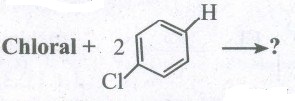
(iv) \({ CH }_{ 3 }-CH{ Cl }_{ 2 }+KOH\overset { { C }_{ 2 }{ H }_{ 5 }{ OH }_{ 3 } }{ \longrightarrow } \)?
(v) Ethylene glycol + 2PCI5 ⟶?
39.
How is acid rain formed ? Explain its effect
40.
Define hydrogen bond and its types.
41.
List out and compare the chemical properties of metals and non-metals.
42.
A Compound on analysis gave Na = 14.31% S = 9.97% H = 6.22% and 0 = 69.5%.
Calculate the molecular formula of the compound if all the hydrogen in the compound is present in combination with oxygen as a water of crystallization. (molecular mass of the compound is 322).
43.
Alkaline earth metal (A), belongs to 3rd period reacts with oxygen and nitrogen to form compound (B) and (C) respectively. It undergo metal displacement reaction with AgNO3 solution to form compound (D).
1.
(c)
Nutrient enrichment of water bodies
2.
(b)
(mol dm-3)
3.
(c)
\(\pi^*\) orbitals
4.
(c)
\(C{ H }_{ 2 }=CH-\overset { + }{ C } { H }_{ 2 }\)
5.
(a)
Decreases in a period and increases along the group
6.
(c)
7.
(d)
both (a) and (b)
8.
(d)
4-Ethyl -3 - methyloctane
9.
(c)
2.5 N
10.
(a)
Zeeman effect
11.
(c)
\(\frac { { r }_{ 1 } }{ { r }_{ 2 } } =\sqrt { \frac { { M }_{ 2 } }{ { M }_{ 1 } } } \)
12.
(a)
Ortho and para hydrogen
13.
(d)
ΔH < ΔU
14.
(b)
Li
15.
(a)
NO
16.
(i) (A) is more stable than (B).
(ii) Carbocation (A) is more planar and is stabilised by resonance.
(iii) Carbocation (B) is non-planar and does not undergo resonance.
(iv) Double bond inside the ring is more stable than outside the ring.
17.
If the water is not the solvent, the solution is non- aqueous solution. (Benzene, CCI4, ether etc., act as solvent in these solutions).
18.
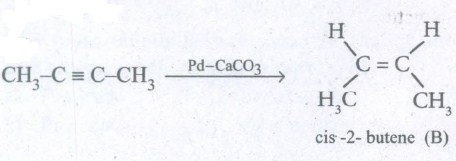
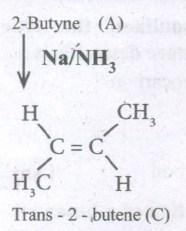
19.
(i) Green chemistry is a chemical philosophy encouraging the design of products and Processes that reduce or eliminate the use and generation of hazardous substances.
(ii) For this, scientist are trying to develop methods to produce eco-friendly compounds. This can be best understood by considering the following example in which styrene is produced both by traditional and greener routes. To avoid carcinogenic benzene, greener route is to start with cheaper and environmentally safer xylenes.
(iii) Green chemistry means science of environmentally favourable chemical synthesis.
20.
This is one method to purify and separate liquids present in the mixture having their boiling point close to each other. In the fractional distillation, a fractionating column is fitted with distillation ask and a condenser. A thermometer is fitted in the fractionating column near the mouth of the condenser. This will enable to record the temperature of vapour passing over the condenser. The process of separation of the components in a liquid mixture I at their respective boiling points in the form of vapours and the subsequent condensation of those vapours is called fractional distillation. The process of fractional distillation is repeated. This method finds remarkable application in distillation of petroleum, coal-tar and crude oil.
21.
| Fe3+ | SCN- | [Fe(SCN)2+ | |
| Initial concentration (M) | 1x 10⁻³ (10 x 10-4) | 8 x 10⁻⁴ | - |
| Reacted | 2 x 10⁻⁴ | 2 x 10⁻⁴ | - |
| Equilibrium concentration | 8 x 10⁻⁴ | 6 x 10⁻⁴ | 2 x 10⁻⁴ |
\(K_{eq}={[Fe(SCN)]^{2+}\over [Fe^{3+}][SCN^-]}\)
\(={2\times 10^{-4}M\over 8\times 10^{-4}M\times 6\times 10^{-4}M}\)
= 0.0416 x 10⁴
Keq = 41.6 x 10² M-1
22.
Molar mass of oxalic acid (H2C2O4) = 2 x 1 + 2 x 12 + 4 x 16 = 90
Basicity of oxalic acid = 2
Equivalent Mass = \(\frac { 90 }{ 2 } =45g\) eq-1
23.
Lithium iodide shows covalent character, as Li+ ion, being smaller exerts high polarising power on the iodide anion. Alternatively, the iodide ion being the largest can be polarised to a greater extent by Li+ ion. Hence, lithium iodide is covalent.
24.
Heavy water is toxic when taken in large quantities. Heavy water is not radioactive. The deuterium in it is stable; it does not decay. Nobody will be in danger at all from radiation. It is heavier than plain water. D2O performs little different from H2O in chemical reactions. One has to drink a lot of D2O to kill him.
25.
The calorific value is defined as "The amount of heat produced in calories (or joules) when one gram of the substance is completely burnt." The SI unit of calorific value is J kg-1. It is usually expressed in cal g -1.
26.
Mg (OH)2 ; Magnesium hydroxide.
27.
Mg + I.E1 ⟶ Mg+ +1e- .....(i)
Mg+ + I.E2 ⟶ Mg2+ + 1e- ....(ii)
Mg2+ + I.E3 ⟶ Mg3+ + 1e- ....(iii)
(i) The step (iii) which involves the formation of Mg3+ requires higher ionisation energy.
(ii) Mg2+ consist of 10 electrons (2, 8) attaining the stable noble gas configuration of argon (Z = 10).
(iii) Since the valence orbital is completely filled, more energy will be required to remove electrons.
28.
According to Le Chatelier's principle, the effect of increase in concentration of a substance is to shift the equilibrium in a direction that consumes the added substance.
Let us consider the reaction
\({ H }_{ 2 }\left( g \right) +{ I }_{ 2 }\left( g \right) \rightleftharpoons 2HI\left( g \right) \)
The addition of H2 or I2to the equilibrium mixture, disturbs the equilibrium. In order to minimize the stress, the system shifts the reaction in a direction where H2 and I2 are consumed i.e., the formation of additional HI would balance the effect of added reactant. Hence, the equilibrium this to the right (forward direction) i.e. the forward reaction takes place until the equilibrium is re established. Similarly, removal of HI (product) also favours the forward reaction.
29.
(i) Brominatin of alkene to give bromo alkane.
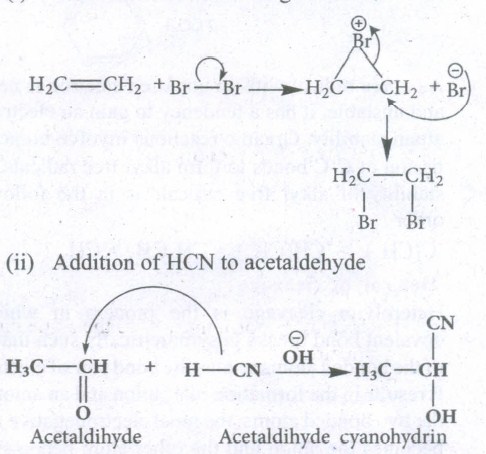
(iii) In this reaction, benzoyl peroxide acts as a radical initiator. The mechanism involves free radicals.
\({ H }_{ 2 }C=CH+H-Br\overset { \overset { Benzoyl }{ Peroxide } }{ \longrightarrow } C{ H }_{ 3 }-C{ H }_{ 2 }-Br\)
30.
(w) = 0.33 g
(c) = 0.397 g
\(\% I=\frac{127}{235} \times \frac{c}{w} \times 100=\frac{127}{235} \times \frac{0.235}{0.40} \times 100=31.75 \%\)
31.
for the reaction,
SrCO3 (S) ⇌ SrO(S) + CO2(S)
Δng = 1 – 0 = 1
\(\therefore\) KP = KC (RT)
2.2 x 10–24 = KC (0.0821) (1002)
\(K_c={2.2\times 10^{-4}\over 0.0821\times 1002}\)
KC = 2.674 x 10⁻⁶
32.
(a) D2O retards the growth of living organisms like plants and animals.
(b) Pure heavy water kills small fishes, tadpoles and mice when fed upon it.
33.
\({ r_{n} }=\frac{(0.529)n^2}{z}\mathring{A}\ \ { E_{n} }=\frac{-13.6(z)^2}{(n)^2}ev atom^{-1}\)
for Li2+ z = 3
Bohr radius for the third orbit (r3)
= \(\frac { (0.529){ (3) }^{ 2 } }{ 3 } \)
= 0.529\(\times\)3
=1.587 \(\mathring{A}\)
Energy of an electron in the fourth orbit
\(({E}_{6})=\frac { -13.6{ (3) }^{ 2 } }{ { (4) }^{ 2 } } \)
=-7.65eV atom-1
34.
\(\triangle x.\triangle p\ge \frac { h }{ 4\pi } \)
\(\triangle x.\triangle p\ge 5.28 \times{ 10 }^{ -35 }Kg{ m }^{ 2 }{ s }^{ -1 }\)
\(\triangle x.(m\triangle v)\ge 5.28 \times{ 10 }^{ -35 }Kg{ m }^{ 2 }{ s }^{ -1 }\)
Given \(\triangle\)v = 0.1%
v = 2.2 x 10⁶ ms-1
m = 9.1 x 10⁻³¹Kg
\(\triangle\)v = \(\frac{0.1}{100}\times2.2\times{10}^{6}ms^{-1}\)
= \(2.2\times{10}^{6}ms^{-1}\)
\(\therefore \triangle x\ge \frac { { 5.28\times 10 }^{ -35 }{ Kgm }^{ 2 }{ s }^{ -1 } }{ 9.1\times { 10 }^{ -31 }Kg\times 2.2\times { 10 }^{ 3 }m{ s }^{ -1 } } \)
\(\\ \triangle x\ge 2.64\times { 10 }^{ -8 }m\)
35.
The larger the size of the molecule, the greater will be Van der Waals' attraction. Therefore greater the deviation from ideal behaviour. So bromine will deviate more from ideal behaviour because it has bigger atoms.
36.
(a) Given V1 = 25 ml V2 = 40 ml
M1 = 0.312m M2 = ?
V1M1 = V2M2
250 x 0.312 = 40 x M2
M2 = \(\frac { 25\times 0.312 }{ 40 } \)
M2 = 0.195M
(b) Given V1 = 25 ml V2 = 100 ml
M1 = 0.312m M2 = ?
V1M1 = V2M2
250 x 0.312 = 100 x M2
M2 = \(\frac { 25\times 0.312 }{ 40 } \)
M2 = 0.078M
Given V1 = 25 ml V2 = 100 ml
M1 = 0.312m M2 = ?
V1M1 = V2M2
M2 = \(\frac { 25\times 0.321 }{ 350 } \)
= 0.022M
37.
This method is based upon the fact that nitrogenous compound when heated with cupric oxide in an atmosphere of CO2 yields free nitrogen. Thus
\({ C }_{ x }{ H }_{ y }{ N }_{ z }+\left( 2x+\frac { y }{ 2 } \right) CuO\longrightarrow xCO_{ 2 }+\frac { y }{ 2 } H_{ 2 }O+\frac { Z }{ 2 } { N }_{ 2 }+\left( 2x+\frac { y }{ 2 } \right) Cu\)
Traces of oxide of nitrogen, which may be formed in some cases, are reduced to elemental nitrogen by passing over heated copper spiral. The apparatus used in Dumas method consists of CO2 generator, combustion tube, Schiffs nitrometer.
CO2 generator:
CO2 needed in this process is prepared by heating magnetite or sodium bicarbonate contained in a hard glass tube or by the action of dil. HCI on marble in a Kipps apparatus. The gas is passed through the combustion tube after being dried-by bubbling through cone. H2SO4,
Combustion Tube:
The combustion tube is heated in a furnace is charged with a) a roll of oxidized copper gauze to prevent the back diffusion of the products of combustion and to heat the organic substance mixed with CuO by radiation b) a weighed amount of the organic substance mixed with excess of CuO, c) a layer of course CuO packed in about 2/3 of the entire length of the tube and kept in position by loose asbestos plug on either side; this oxidizes the organic vapors passing through it, and d) a reduced copper spiral which reduces any oxides of nitrogen formed during combustion to nitrogen.
Schiff's nitro meter:
The nitrogen gas obtained by the decomposition of the substance in the combustion tube is mixed with considerable excess of CO2 It is estimated by passing nitrometer when CO2 is absorbed by KOH and the nitrogen gets collected in the upper part of graduated tube.
Procedure:
To start with the tap of nitrometer is left open CO2 is passed through the combustion tube to expel the air in it. When the gas bubbles risin through, the potash solution fails to reach the top of it and is completely absorbed it shows that only CO2 is coming and that all air has been expelled from the combustion tube. The nitrometer is then and the tap is closed. The combustion tube is now heated in the furnace and the temperature rises gradually. The nitrogen set free from the compound collects in the nitrometer. When the combustion is complete a strong current of CO2 is sent through, the apparatus in order to sweep the last trace of nitrogen from it. The volume of the gas gets collected is noted after adjusting the reservoir so that the solution in it and the graduated tube is the same. The atmospheric pressure and the temperature are also recorded.
Calulations:
Weight of the substance taken = wg
Volume of nitrogen = V1L
Room temperature =T1K
Atmospheric pressure = P mm of Hg
Agueen tension at
room temperature = p1 mm ofHg
Pressure of dry nitrogen = (P - p1) = PI mm of Hg.
Let Po Vo and To be the pressure, Volume and temperature respectively of dry nitrogen at STP,
Then, \(\frac { { P }_{ 0 }{ V }_{ 0 } }{ { T }_{ 0 } } =\frac { { P }_{ 1 }{ V }_{ 1 } }{ { T }_{ 1 } } \)
\(\therefore { V }_{ 0 }=\frac { { P }_{ 1 }{ V }_{ 1 } }{ { T }_{ 1 } } \times \frac { { T }_{ 0 } }{ { P }_{ 0 } } \)
\({ V }_{ 0 }=\left( \frac { { P }_{ 1 }{ V }_{ 1 } }{ { T }_{ 1 } } \times \frac { 273K }{ 760 } \right) \)
Calculation of percentage of nitrogen. 22.4 L of N2 at STP weigh 28g of N2
\(\therefore \) V0 L of N2 at S.T.P weigh \(\frac { 28 }{ 22.4 } \times { V }_{ 0 }\)
wg of organic compound contain \(\left( \frac { 28 }{ 22.4 } \times \frac { { V }_{ 0 } }{ W } \right) \)
\(\therefore \) Percentage of nitrogen= \(\left( \frac { 28 }{ 22.4 } \times \frac { { V }_{ 0 } }{ W } \right) \times 100\)
38.
(i) \(\underset { chloroform }{ CH{ Cl }_{ 3 } } +\frac { 1 }{ 2 } { O }_{ 2 }\overset { Air }{ \underset { Light }{ \longrightarrow } } \underset { Phosgene }{ CO{ Cl }_{ 2 }+HCl } \)
(ii) \(\underset { carbonTetraChloride }{ C{ Cl }_{ 4 } } +{ H }_{ 2 }O\overset { \triangle }{ \underset { Light }{ \longrightarrow } } \underset { Phosgene }{ CO{ Cl }_{ 2 } } +2{ H }_{ 2 }O\)
(iii) 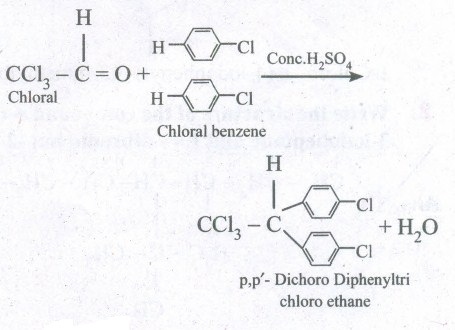
(iv)\(H-\overset { \underset { | }{ H } }{ \underset { \overset { | }{ H } }{ C } } -\overset { \underset { | }{ H } }{ \underset { \overset { | }{ H } }{ C } } -H+2KOH\overset { { C }_{ 2 }{ H }_{ 5 }OH }{ \underset { \triangle }{ \longrightarrow } } HC\equiv \underset { Acetylene }{ CH } +2KCl+{ H }_{ 2 }O\)
Ethylidene dichloride
(v) \(\underset { \overset { | }{ OH } }{ { CH }_{ 2 } } -\underset { \overset { | }{ OH } }{ { CH }_{ 2 } } +2PC{ l }_{ 5 }\longrightarrow \underset { \overset { | }{ Cl } }{ { CH }_{ 2 } } -\underset { \overset { | }{ Cl } }{ { CH }_{ 2 } } +2POC{ l }_{ 3 }+2HCl\)
Ethylene Glycol Ethylene dichloride
39.
Rain water normally has a pH of 5.6 due to dissolution of atmospheric CO2 into it. Oxides of sulphur and nitrogen in the atmosphere may be absorbed by droplets of frater that make up clouds and get chemically converted into sulphuric acid and nitric acid respectively as a results of pH of rain water drops below the level 5.6, hence it is called acid rain. Acid rain is a by-product of a variety of sulphur and nitrogen oxides in the atmosphere. Burning of fossil fuels (coal and oil) in power stations, furnaces and petrol, diesel in motor engines produce sulphur dioxide and nitrogen oxides The main contributors of acid rain are SO2 and NO2.They are converted into sulphuric acid and nitric acid respectively by the reaction with oxygen and water.
2SO2 + O2 + 2H2O ⟶ 2H2SO4
4NO2 + O2 + 2H2O ⟶ 4HNO3
Harmful effects of acid rain
Some harmful effects are discussed below :
(i) Acid rain causes extensive damage to buildings and structural materials of marbles. This attack on marble is termed as Stone leprosy.
CaCO3 + H2SO4 ⟶ CaSO4 + H2O +CO2 ↑
(ii) Acid rain affects plants and animal life in aquatic ecosystem.
(iii) It is harmful for agriculture, trees and plants as it dissolves and removes the nutrients needed for their growth.
(iv) It corrodes water pipes resulting in the leaching of heavy metals such as iron, lead and copper into the drinking water which have toxic effects.
(v) It causes respiratory ailment in humans and animals.
40.
(i) Hydrogen bond :
When a hydrogen atom (H) is covalently bonded to a highly electronegative atom (F or °or N), the bond is polarized in such a way that the hydrogen atom is able to form a weak bond (electrostatic attraction) between the hydrogen atom of a molecule and the electronegative atom of a second molecule. The bond thus formed is called a hydrogen bond.
(ii) Intermolecular Hydrogen:
Intermolecular hydrogen bonds occur between two separate molecules.
They can occur between any numbers of like or unlike molecules as long as hydrogen donors and acceptors are present and in positions in which they can interact. Eg: Water, HF, etc,
(iii) Intramolecular Hydrogen:
This type of bond is formed between hydrogen atom and N, O or F atom of the same molecule.
This type of hydrogen bonding is commonly called chelation and is more frequently found in organic compounds. Eg: o-nitro phenol, salicylic acid, etc.
41.
| Chemical Properties | Metals | Non-Metals |
|---|---|---|
| Oxidising and Reducing Action | Generally good reducing agents | Generally good oxidising agents |
| Nature of oxides | Metallic oxides are basic in nature | Non-metallic oxides are acidic in nature |
| Nature of Hydrides | Form unstable hydride | Form stable hydrides |
| Action with acid | Dissolve in mineral acid to form salt. | Do not react with mineral acids |
| Arrangement of valence electrons | They have one, two or three valence electrons. | They have 4,5,6, 7 valence electrons |
42.
| Element | % | Relative number of atoms | Simple Ratio |
| Na | 14.31 | \(\frac { 14.31 }{ 23 } =0.62\) | \(\frac { 0.62 }{ 0.31 } =2\) |
| S | 9.97 | \(\frac { 9.97 }{ 32 } =0.31\) | \(\frac { 0.31 }{ 0.31 } =1\) |
| H | 6.22 | \(\frac { 6.22 }{ 1 } =6.22\) | \(\frac { 6.22 }{ 0.31 } =20\) |
| O | 69.5 | \(\frac { 69.5 }{ 16 } =4.34\) | \(\frac { 4.34 }{ 0.31 } =14\) |
Empirical formula = Na2 SH20 O14
\(\left[ \begin{matrix} { Na }_{ 2 }{ SH }_{ 20 }{ O }_{ 14 } \\ =(2\times 23)+(1\times 32)+(20\times 1)+14(16) \\ =46+32+20+234 \\ =322 \end{matrix} \right] \)
n = \(\frac { molar\quad mass }{ caluclated\quad empirical\quad formula\quad mass } =\frac { 322 }{ 322 } =1\)
Molecular formula = Na2 SH20O14
Since all the hydrogen in the compound are present as water
\(\therefore \) The molecular formula is Na2 SO4 10H2O.
43.
(i) Alkaline earth metal (A) belonging to 3rd period is magnesium.
(ii) So A is Magnesium. Magnesium reacts with oxygen and nitrogen as follows.
\(2Mg+O_2⟶\underset{(B)}{2MgO}\)
\(3Mg+N_2⟶\underset{(C)}{Mg_3N_2}\)
So B is Magnesium oxide and C is magnesium nitride.
(iii) Magnesium undergoes metal displacement reaction with AgNO3 as follow to give D as follows :
\(Mg+2AgNO_3⟶\underset{D}{Mg(NO_3)_2}+2Ag\)
So D is Magnesium nitrate.
Result :
| Compound or Element | Symbol or Formula | Name |
|---|---|---|
| A | Mg | Magnesium |
| B | MgO | Magnesium oxide |
| C | Mg3N2 | Magnesium nitride |
| D | Mg(NO3)2 | Magnesium nitrate |

11th Standard Syllabus & Materials
11th Standard
TN 11th Tamil பீடு பெற நில் - செய்யுள் - காவடிச்சிந்து Important Questions And Answers Study Material - QB365 Set A
NEW11th Standard
TN 11th Tamil பீடு பெற நில் - உரைநடை - மலை இடப்பெயர்கள் : ஓர் ஆய்வு Important Questions And Answers Study Material - QB365 Set A
NEW11th Standard
TN 11th Tamil மாமழை போற்றுதும் - துணைப்பாடம் - யானை டாக்டர் Important Questions And Answers Study Material - QB365 Set A
NEW11th Standard
TN 11th Tamil மாமழை போற்றுதும் - செய்யுள் - ஐங்குறுநூறு Important Questions And Answers Study Material - QB365 Set A



Tamilnadu Stateboard 11th Standard Subjects

Maths

Commerce

Economics

Biology

Business Maths and Statistics

Accountancy

Computer Science

Physics
Chemistry
Maths
Biology
Economics
Physics
Chemistry

History
Business Maths and Statistics

Computer Science
Accountancy

Computer Applications
History
Computer Technology
Commerce
Computer Applications
Computer Technology

Tamil

English

French
Tamilnadu Stateboard Standards
