
 100% FREE ACCESS
11th Standard Syllabus & Materials
11th Standard
TN 11th Tamil இயற்கை வேளாண்மை,சுற்றுச்சூழல் -செய்யுள் - மனோன்மணீயம் Important Questions And Answers Study Material - QB365 Set A
NEW11th Standard
TN 11th Tamil என்னுயிர் என்பேன் -துணைப்பாடம் - இசைத்தமிழர் இருவர் Important Questions And Answers Study Material - QB365 Set A
NEW11th Standard
TN 11th Tamil மொழி கலை -செய்யுள் - ஒவ்வொரு புல்லையும் Important Questions And Answers Study Material - QB365 Set A
NEW11th Standard
TN 11th Tamil பீடு பெற நில் - இலக்கணம் - பகுபத உறுப்புகள் Important Questions And Answers Study Material - QB365 Set A
NEW11th Standard
TN 11th Tamil பீடு பெற நில் - துணைப்பாடம் - வாடிவாசல் Important Questions And Answers Study Material - QB365 Set A
NEW11th Standard
TN 11th Tamil பீடு பெற நில் - செய்யுள் - குறுந்தொகை Important Questions And Answers Study Material - QB365 Set A

Published on: 27/05/2020
11th Standard Chemistry English Medium Model Question Paper Part I
Download Tamil Nadu 11th Standard Chemistry question papers, model tests, one-mark questions, important questions, and public exam papers in PDF format. Free study materials and answer keys for TN State Board students.
Questions + Answers key
Take MCQ Chemistry Test
1.
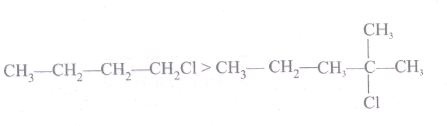
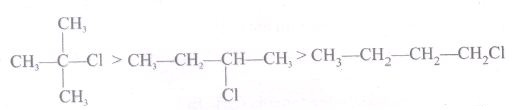
Identify the correct order of boiling point of halo alkanes?
CH3-CH2-CH2-CH2CI>(CH3)3C-CI > CH3-CH2-\(\underset { \overset { | }{ Cl } }{ CH } \)-CH3
CH3-CH2-CH2-CH2CI>CH3-CH2-\(\underset { \overset { | }{ Cl } }{ CH } \)-CH3< (CH3)3C-CI
2.
Which one of the following is positively charged electrophiles ?
CO2
AlCl3
BF3
RX
3.
In which of the following geometrical isomerism is possible?
CH3CH = C(CH3)2
C6H5N = NC6H5
CH3CH = CH2
All of these
4.
Which molecule among the following has both polar and non-polar covalent bond?
\({ NH }_{ 4 }^{ + }\)
H2O2
HCI
CH4
5.
The isomer of ethanol is ____________
acetaldehyde
dimethylether
acetone
methyl carbinol
6.
At same temperature, which pair of the following solutions are isotonic ?
0.2 M BaCl2 and 0.2M urea
0.1 M glucose and 0.2 M urea
0.1 M NaCl and 0.1 M K2SO4
0.1 M Ba (NO3)2 and 0.1 M Na2 SO4
7.
[Co(H2O)6]2+ (aq) (pink) + 4Cl– (aq) ⇌ [CoCl4]2– (aq) (blue) + 6 H2O (l)
In the above reaction at equilibrium, the reaction mixture is blue in colour at room temperature. On cooling this mixture, it becomes pink in colour. On the basis of this information, which one of the following is true?
ΔH > 0 for the forward reaction
ΔH = 0 for the reverse reaction
ΔH < 0 for the forward reaction
Sign of the ΔH cannot be predicted based on this information
8.
Match the list-I and list-Il using the correct code given below the list.
| List-I | List-II | ||
|---|---|---|---|
| A | Manufacture of soap | 1 | Na2CO3.10H2O |
| B | Mild antiseptic | 2 | Liquid Na metal |
| C | Softening of hard water | 3 | NaOH |
| D | Coolant in nuclear reactor | 4 | NaHCO3 |
| A | B | C | D |
|---|---|---|---|
| 4 | 3 | 2 | 1 |
| A | B | C | D |
|---|---|---|---|
| 3 | 4 | 1 | 2 |
| A | B | C | D |
|---|---|---|---|
| 2 | 1 | 3 | 4 |
| A | B | C | D |
|---|---|---|---|
| 1 | 2 | 4 | 3 |
9.
Electronegativity of the following elements increases in the order
C, N, Si, P
N, Si, C, P
Si, P, C, N
P,Si, N, C
10.
12 g of carbon-12 contains_____carbon atoms
6.022\(\times\)1023
6
12
12.022\(\times\)10-23 kg
11.
The unit of pressure is _____________
Pascal
Torr
Bar
all the above
12.
The bond dissociation energy of methane and ethane are 360 kJ mol-1 and 620 kJ mol-1 respectively. Then, the bond dissociation energy of C-C bond is ______________.
170 kJ mol-1
50 kJ mol-1
80 kJ mol-1
220 kJ mol-1
13.
A macroscopic particle of mass 100 g and moving at a velocity of 100 cm S-1 will have a de Broglie wavelength of ___________
6.6 x 10⁻²⁹ cm
6.6 x 10⁻³⁰ cm
6.6 x 10⁻³¹ cm
6.6 x 10⁻³² cm
14.
Non-stoichiometric hydrides are formed by _____________
palladium, vanadium
carbon, nickel
manganese, lithium
nitrogen, chlorine
15.
Which of the following compounds will not exist as resonance hybrid? Give reason for your answer.
(i) CH3 - OH
(ii) R-CONH2
(iii) CH3-CH = CH-CH2NH2
16.
Vapour pressure of a pure liquid A is 10.0 torr at 27°C. The vapour pressure is lowered to 9.0 torr on dissolving one gram of B in 20 g of A. If the molar mass of A is 200 then calculate the molar mass of B.
17.
Predict which of the following hydrides is a gas on a solid
(a) HCI
(b) NaH
Give your reason.
18.
8 g of methane is placed in a 5 litre container at 27° C. Find Boyle's constant.
19.
Find out the value of equilibrium constant for the following reaction at 298K; 2NH3(g)+ CO2(g) \(\rightleftharpoons \) NH2CONH2(aq) + H2O(l) Standard Gibbs energy change, \(\Delta { G }_{ r }^{ 0 }\) at the given temperature is -13.6 kJ mol-1.
20.
Calculate the oxidation number of underlined atoms \(H_{ 4 }\underline { { P }_{ 2 } } { O }_{ 7 }\)
21.
Why alkaline earth metals are harder than alkali metals.
22.
How fast must a 54g tennis ball travel in order to have a de Broglie wavelength that is equal to that of a photon of green light 5400\(\overset { 0 }{ A } \) ?
23.
Explain briefly the time independent schrodinger wave equation?
24.
Justify that the fifth period of the periodic table should have 18 elements on the basis of quantum numbers.
25.
An organic compound Ⓐ of molecular formula C2H6O reacts with thionyl chloride in the presence of pyridine gives Ⓑ C2H5Cl. Ⓑ on reaction with alcoholic KOH gives ©, C2H4. ©️ on treatment with Cl2 gives C2H4Cl2 as Ⓓ. Identify Ⓐ,Ⓑ,Ⓒ,Ⓓ and explain the reaction.
26.
(i) What is meant by covalent bond ?
(ii) Explain the covalent bonding in H2, O2,Nr
27.
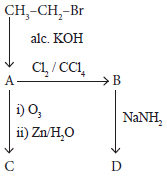
Identify the compound A, B, C and D in the following series of reactions
28.
Write a balanced chemical equation for equilibrium reaction for which the equilibrium constant is given by expression
\(K_c={[NH_3]^4[O_2]^5\over [NO]^4[H_2O]^6}\)
29.
Balancing of the molecular equation in alkaline medium.
MnO2 + O2 + KOH\(\rightarrow\)K2MnO4 + H2O
30.
(a) Define atomic radius.
(b) What are the difficulties in determining atomic radius?
31.
Derive de-Broglie wave length.
32.
An element A belonging to group 2 and period 2 reacts with chlorine at an elevated temperature to give compound (B) compound B combines with LiAlH4 to form compound (C). Which is an hydride identify A, B, and C?
33.
Show that the reaction \(CO+\frac { 1 }{ 2 } { O }_{ 2 }\longrightarrow { CO }_{ 2 }\) at 300K is spontaneous. The standard Gibbs free energies of formation of CO2 and CO are -394.4 and -137.2 KJ mole-1 respectively.
34.
An isotope of hydrogen (A) reacts with diatomic molecule of element which occupies group number 16 and period number 2 to give compound (B) is used as a moderator in nuclear reaction. (A) adds on to a compound ( C), which has the molecular formula C3H6 to give (D). Identify A, B, C and D.
35.
Which would you expect to have a higher melting point magnesium oxide or magnesium fluoride ? Explain your reasoning.
36.
Write the favourable factors for the formation of ionic bond.
37.
How does classical smog differ from photochemical smog ?
38.
Starting from CH3MgI, How will you prepare the following?
i) Acetic acid
ii) Acetone
iii) Ethyl acetate
iv) Iso propyl alcohol
v) Methyl cyanide.
39.
Give a brief description of the principles of
Fractional distillation
40.
Define molar heat of sublimation.
41.
What are the applications of Charles' law?
42.
Calculate the oxidation number of underlined atoms of the following:
NO3-
43.
Assertion (A) : Oxygen plays a key role in the troposphere
Reason (R) : Troposphere is not responsible for all biological activities
i) Both (A) and R are correct and (R) is the correct explanation of (A)
ii) Both (A) and R are correct and (R) is not the correct explanation of (A)
iii) Both (A) and R are not correct
iv) (A) is correct but( R) is not correct
Both (A) and R are correct and (R) is the correct explanation of (A)
Both (A) and R are correct and (R) is not the correct explanation of (A)
Both (A) and R are not correct
(A) is correct but( R) is not correct
1.
(c)
2.
(d)
RX
3.
(b)
C6H5N = NC6H5
4.
(b)
H2O2
5.
(b)
dimethylether
6.
(d)
0.1 M Ba (NO3)2 and 0.1 M Na2 SO4
7.
(a)
ΔH > 0 for the forward reaction
8.
(b)
| A | B | C | D |
|---|---|---|---|
| 3 | 4 | 1 | 2 |
9.
(c)
Si, P, C, N
10.
(a)
6.022\(\times\)1023
11.
(d)
all the above
12.
(c)
80 kJ mol-1
13.
(c)
6.6 x 10⁻³¹ cm
14.
(a)
palladium, vanadium
15.
(i) CH3 - OH : Does not exist as resonance hybrid due to absence of π-electrons.
(ii) R-CO NH2 : Can exist as resonance hybrid due to the presence of non-bonding electrons on N and n-electrons on C = O bond.
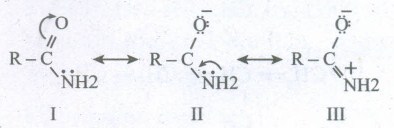
(iii) CH3-CH = CH-CH2NH2: Does not exist as resonance hybrid, because the lone pair on N-atom is not conjugated with n-electrons of the double bond
16.
\(P_A^o\) = 10 torr, Psolution = 9 torr
WA = 20 g WB = 1 g
MA = 200 g mol-1 MB = ?
\({\Delta P\over P_A^o}={W_B\times M_A\over M_B\times W_A}\)
\({10-9\over 10}={1\times 200\over M_B\times 20}\)
\(M_B={200\over 20}\times 10=100\ g\ mol^{-1}\)
17.
(i) At room temperature, HCI is a colourless gas and the solution of HCI in water is called hydrochloric acid and it is in liquid state.
(ii) Sodium hydride NaH is an ionic compound and it is made of sodium cations (Na+) and hydride (H-) anions. It has the octahedral crystal structure. It is an alkali metal hydride.
18.
PV = Boyle's constant.
But \(PV=nRT=\frac{w}{M}\times RT\)
=\(\frac{8}{10} mol \times0.0821 L atm K^{-1} mol^{-1}\times 300 K \)
= 12.315 L atm.
Hence Boyle's constant is 12.315 L atm.
19.
T=298K
\(\Delta { G }_{ r }^{ 0 }\)=- 13.6 kJ mol-1
=-13600 J mol-1
ΔG0=- 2.303 RT log Keq
log Keq=\(\frac { 13.6kJmol^{ -1 } }{ 2.303\times 8.314\times { 10 }^{ -3 }JK^{ -1 }mol^{ -1 }\times 298K } \)
log Keq = 2.38
Keq = antilog (2.38)
Keq = 239.88.
20.
4(1) + 2x + 7(-2) = 0
4 + 2x - 14 = 0
2x - 10 = 0
2x = 10
x = 5
Oxidation number of P in H4P2O7 is +5.
21.
Alkali metals have one eo in their outer most shell. Alkaline earth metals have 2 eo in their outer most shell. More valence electrons and more positively charged nucleii leads to greater opportunity for metallic bonding.
22.
De Broglie wavelength of the tennis ball equal to 5400 \(\overset { 0 }{ A } \).
m = 54 g
V = ?
\(\lambda=\frac{h}{mV}\)
\(V=\frac{h}{m\lambda}\)
\(\mathrm{v}=\frac{6.626 \times 10^{-34} \mathrm{JS}}{54 \times 10^{-3} \mathrm{~kg} \times 5400 \times 10^{-10} \mathrm{~m}}=2.27 \times 10^{-26} \mathrm{~ms}^{-1}\)
23.
Erwin Schrodinger expressed the wave nature of electron in terms of a differential equation. This equation determines the change of wave function in space depending on the field of force in which the electron moves. The time independent Schrodinger equation can be expressed as,
\(\overset { \wedge }{ H } \psi =E\psi \) .........(1)
Where \(\overset { \wedge }{ H } \) is called Hamiltonian operator, \(\psi \) is the wave function and is a function of position coordinates of the particle and is denoted as \(\psi \) (x, y, z) E is the energy of the system
\(\overset { \wedge }{ H } =\left[ \frac { { -h }^{ 2 } }{ 8{ \pi }^{ 2 } } \left( \frac { { \partial }^{ 2 }\psi }{ { \partial x }^{ 2 } } +\frac { { \partial }^{ 2 }\psi }{ { \partial y }^{ 2 } } +\frac { { \partial }^{ 2 }\psi }{ { \partial z }^{ 2 } } \right) +V \right] \)
can be written as
\(\left[ \frac { { -h }^{ 2 } }{ 8{ \pi }^{ 2 }m } \left( \frac { { \partial }^{ 2 }\psi }{ { \partial x }^{ 2 } } +\frac { { \partial }^{ 2 }\psi }{ { \partial y }^{ 2 } } +\frac { { \partial }^{ 2 }\psi }{ { \partial z }^{ 2 } } \right) +V\Psi \right] =E\Psi \)
Multiply by \(\frac { 8{ \pi }^{ 2 }m}{ { -h }^{ 2 } } \)and rearranging
\(\frac { { \partial }^{ 2 }\psi }{ { \partial x }^{ 2 } } +\frac { { \partial }^{ 2 }\psi }{ { \partial y }^{ 2 } } +\frac { { \partial }^{ 2 }\psi }{ { \partial z }^{ 2 } } +\frac { 8{ \pi }^{ 2 }m }{ { -h }^{ 2 } } (E-V)\Psi =0\) ........(2)
The above Schrodinger wave equation does not contain time as a variable and is referred to as time independent Schrodinger wave equation. This equation can be solved only for certain values of E, the total energy. i.e. the energy of the system is quantised. The permitted total energy values are called eigen values and corresponding wave functions represent the atomic orbitals.
24.
(i) According to aufbau's principle 5th period has nine orbital (one 5s, five 4d and three 6p) to be filled.
(ii) Nine orbitals can accommodate a maximum of 18 electrons. Hence fifth period of the periodic table should has 18 elements from rubidium (2 = 37) to Xenon (Z = 54).
25.
(i) An organic compound ®of molecular formula C2H60 is Ethanol CH3-CH2OH.
(ii) Ethanol reacts with thionyl chloride in the presence of pyridine to give CH3-CH2Cl Ⓑ as product

(iii) Ethyl chloride on treatment with alcoholic KOH, undergoes dehydrohalogenation to give C2H4, ethylene © as the product.

(iv) Ethylene on reaction with Cl2 yield ethylene dichloride as Ⓓ as the product.
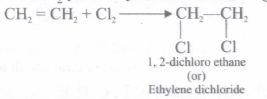
| A. | CH3-CH3OH | Ethanol |
| B. | CH3-CH2Cl | Ethyl chloride |
| C. | CH2 =CH2 | Ethylene |
| D | \({ \underset { \overset { | }{ Cl } }{ C } }{ H }_{ 2 }-\underset { \overset { | }{ Cl } }{ C } { H }\) | Ethylene dichloride |
26.
(i) Mutual sharing of one or more pair of electrons between two combining atoms results in the formation of a chemical bond called a covalent bond
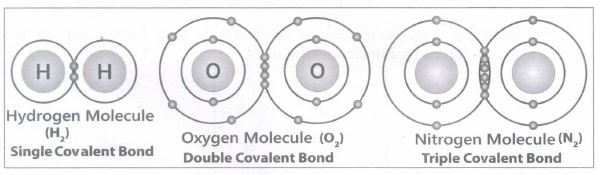
(ii) If two atoms share just one pair of electron, a single covalent bond is formed as in the case of hydrogen molecule (H2).
(iii) If two or three electron pairs are shared between the two combining atoms, then the covalent bond is called double bond and triple bond respectively, as in the case of O2 and N2 molecules respectively.
27.
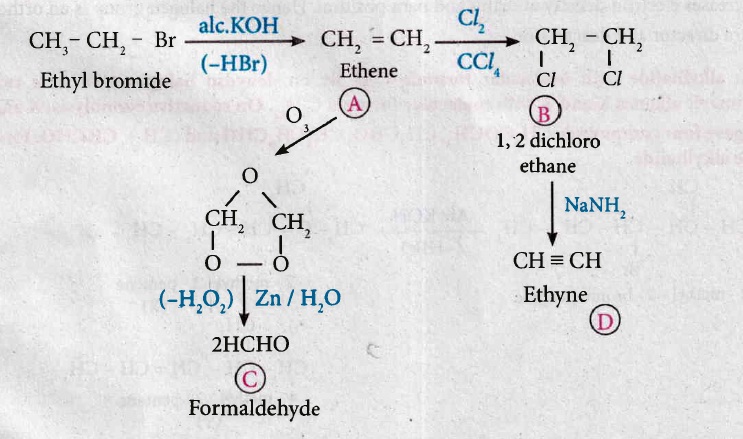
| compound | Structural formula | Name |
| A | CH2 = CH2 | Ethene |
| B | 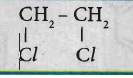 |
1,2 - dichloroethane |
| C | HCHO | Methanal |
| D | \(\mathrm{CH} \equiv \mathrm{CH}\) | Ethyne |
28.
\(K_c={[NH_3]^4[O_2]^5\over [NO]^4[H_2O]^6}\)
\(4 \mathrm{NO}_{(\mathrm{g})}+6 \mathrm{H}_{2} \mathrm{O}_{(\mathrm{g})} \rightleftharpoons 4 \mathrm{NH}_{3(\mathrm{~g})}+5 \mathrm{O}_{2(\mathrm{~g})}\)
29.
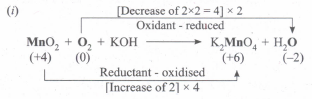
(ii) Balance the changes in O, N, by multiplying the oxidant and reductant by suitable numbers.
4MnO2 + 2O2 + KOH\(\rightarrow\)K2MnO4 + H2O
(iii) Balance the equation atomically (except O and H).
4MnO2 + 2O2 + KOH\(\rightarrow\) 4K2MnO4 + H2O
(iv) Balance oxygen and hydrogen atoms by multiplying H2O by 4.
4MnO2 + 2O2 + 8KOH \(\rightarrow\) 4K2MnO4 + 4H2O
30.
(a) Atomic radius is the distance between the centre of its nucleus and the outermost shell containing the electron.
(b) Difficulties in determining atomic radius
(i) The size of an atom is very small (~1.2\(\mathring A\) i.e 1.2 x 10 -10)
(ii) The atom is not a rigid sphere; it is more like a spherical cotton ball rather than like a cricket ball.
(iii) It is not possible to isolate an atom and measure its radius.
(iv) The size of an atom depends upon the type of atoms in its neighborhood and also the nature of bonding between them.
31.
Louis de Broglie proposed that all forms of matter showed dual character. To quantify this relation, he Jerived an equation for the wavelength of a matter wave. He combined the following two equations of energy of which one represents wave character (hu) and the other represents the particle nature (mc2).
Planck's quantum hypothesis:
E = hv ....(1)
Einsteins mass-energy relationship:
E = mc2 .... (2)
From (1) and (2)
hv = mc2
hc/\(\lambda\) = mc2
\(\therefore \lambda ={h\over mc}\) ...(3)
The equation (3) represents the wavelength of photons whose momentum is given by mc. (Photons have zero rest mass).
For a particle of matter with mass m and moving with a velocity v, the equation (3) can be written as
\(\lambda ={h\over mv}\) ....(4)
This is valid only when the particle travels at speed much less than the speed of Light.
32.
(i) An element A belonging to II group and II period is beryllium (A)
(ii) Beryllium reacts with chlorine to form beryllium chloride (B)
Be +Cl2 \(\longrightarrow \) BeCl2
(B)
(iii) Beryllium chloride on treatment with LialH Forms beryllium hydride (c)
2BeCl2 + LiA1H4 \(\longrightarrow \) 2BeH2 + LiCl + AlCl3
(C)
| A | Be | Beryllium |
| B | Becl2 | Beryllium Chloride |
| C | BeH2 | Beryllium Hydride |
33.
\(CO+\frac { 1 }{ 2 } { O }_{ 2 }\longrightarrow { CO }_{ 2 }\)
\({ \triangle }G_{ (reaction) }^{ 0 }={ \sum { G } }_{ f(products) }^{ 0 }-{ \sum { G } }_{ f(reactants) }^{ 0 }\)
\({ \triangle G }_{ (reaction) }^{ 0 }=\left[ { G }_{ { CO }_{ 2 } }^{ 0 } \right] -\left[ { G }_{ CO }^{ 0 }+\frac { 1 }{ 2 } { G }_{ { O }_{ 2 } }^{ 0 } \right] \)
\({ \triangle G }_{ (reaction) }^{ 0 }\) =-394.4+[137.2+0]
\({ \triangle G }_{ (reaction) }^{ 0 }\) =-257.2 kJ mol-1
\({ \triangle G }_{ (reaction) }^{ 0 }\) of a reaction at a given temperature is negative hence the reaction is spontaneous.
34.
The element which occupies group number (16) and period number (2) is oxygen. (B) is D2O which is used as a moderator in nuclear reactions.
So (A) must be deuterium, which is an isotope of hydrogen
\(2\underset { (A) }{ { D }_{ 2 } } +{ O }_{ 2 }\rightarrow 2\underset { (B) }{ { D }_{ 2 }O } \)
So (B) is D2O
(A) adds to (C) as follows :
\(3 \mathrm{D}_{2}+\mathrm{C}_{3} \mathrm{H}_{6} \rightarrow \mathrm{CH}_{3}-\mathrm{CH}-\mathrm{CH}_{2}\)
So (D) is 1,2 - dideutero propane.
| A | D2 | Deuterium |
| B | D2O | Heavy water or deuterium oxide |
| C | CH3-CH = CH2 | Propene |
| D | CH3 - CHD - CH2D | Propane deuteride |
35.
Magnesium oxide in having higher melting point. The lattice energy of MgO & MgF2 are 3938 and 2957 respectively.
MgO has +2, -2 charges, MgF2 has +2, -1 charges. When the two charges are multiplied together, MgO results in larger amount of lattice energy since it has a higher charge, The strong attraction cause most ionic material to be hard and brittle and have high melting points.
36.
(i) Low ionisation enthalpy of metal atoms.
(ii) High electron gain enthalpy of non-metal atoms.
(iii) High lattice enthalpy of compound formed.
37.
| S.No | Classical somg (london smog) | Photochemical smog (Los Angels smog) |
|---|---|---|
| 1 | It was first observed in London in Dec. 1952 | It was first observed in Los Angels in 1950. |
| 2 | It occurs in cool, humid climate | It occurs in warm, dry and sunn climate |
| 3 | It consists of coal smoke and fog | It is formed by the combination of smoke dust and fog with air pollutants like N2 and hydrocarbons in presence of light. |
| 4 | It generally occurs in the morning and becomes worse when the sunshines | It forms when the sunshines and becomes worse in the afternoon. |
| 5 | This is mainly due to the induced oxidation of SO2 to SO3, which reacts with water yielding sulphuric acid aerosol. | This is mainly due to the induced oxidation of N2 to NO, NO2 and [O] + O2 to O3 NO and O3 are strong oxidising agents and can react with unburnt hydrocarbons in polluted air to form HCHO, Acrolein and PAN. |
| 6 | Chemically it is reducing in nature because of high concentration of SO2. | Chemically it is oxidising in nature because of high concentrations of oxidising agents like NO2 and O2 |
| 7 | It is called reducing smog | It is called oxidising smog |
| 8 | Responsible for acid rain, causes poor visibility, affects air and road transport and causes bronchial irritation. | Causes irritation to nose, throat, eyes, skin and lungs, increases asthma, causes chest pain, uncomfortable breathing, PAN attacks young leaves, causes corrosion of metals, stones painted surfaces, etc., |
38.
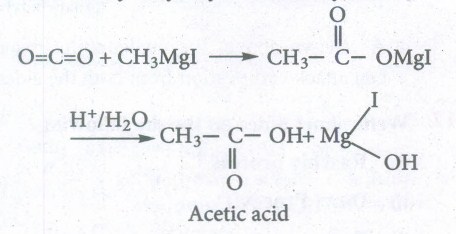
i) Acetic acid: Solid carbon dioxide reacts with Grignard reagent to form addition product which on hydrolysis yields carboxylic acids.
ii) Acetone :
\(\underset { Iodomethane }{ { CH }_{ 3 }-I+Mg } \overset { dryether }{ \longrightarrow } \underset { Methyl \ magnesium \ iodide }{ { CH }_{ 3 }MgI } \)
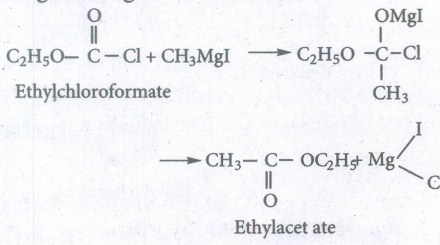
iii) Ethyl acetate: Ethy1chloroformate reacts with Grignard reagent to form esters.
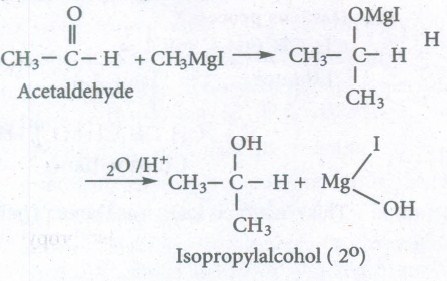
iv) Iso propyl alcohol : Aldehydes other than formaldehyde, react with Grignard reagent to give addition product which on hydrolysis yields secondary alcohol.
v) Methyl cyanide : Grignard reagent reacts with cyanogen chloride to from alkyl cyanide

39.
This is one method to purify and separate liquids present in the mixture having their boiling point close to each other. In the fractional distillation, a fractionating column is fitted with distillation ask and a condenser. A thermometer is fitted in the fractionating column near the mouth of the condenser. This will enable to record the temperature of vapour passing over the condenser. The process of separation of the components in a liquid mixture I at their respective boiling points in the form of vapours and the subsequent condensation of those vapours is called fractional distillation. The process of fractional distillation is repeated. This method finds remarkable application in distillation of petroleum, coal-tar and crude oil.
40.
Molar heat of sublimation is defined as the change in enthalpy when one mole of a solid is directly converted into the gaseous state at its sublimation temperature.
41.
(i) A hot air inside the balloon rises because of its decreased density and causes the balloon to float.
(ii) If you take a helium balloon outside on a chilly day, the balloon will crumble. Once you get back into warm area, the balloon will return to its original shape. This is because, in accordance with Charles' law, a gas like helium takes up more space when it is warm.
42.
NO3- (N in NO3-)
Oxidation number of nitrogen = x
Oxidation number of oxygen = - 2
x + 3 (- 2) = - 1
x - 6 = -1
x = + 5
Hence, the oxidation number of nitrogen in NO3- is + 5.
43.
iv) (A) is correct but( R) is not correct

11th Standard Syllabus & Materials
11th Standard
TN 11th Tamil பீடு பெற நில் - செய்யுள் - காவடிச்சிந்து Important Questions And Answers Study Material - QB365 Set A
NEW11th Standard
TN 11th Tamil பீடு பெற நில் - உரைநடை - மலை இடப்பெயர்கள் : ஓர் ஆய்வு Important Questions And Answers Study Material - QB365 Set A
NEW11th Standard
TN 11th Tamil மாமழை போற்றுதும் - துணைப்பாடம் - யானை டாக்டர் Important Questions And Answers Study Material - QB365 Set A
NEW11th Standard
TN 11th Tamil மாமழை போற்றுதும் - செய்யுள் - ஐங்குறுநூறு Important Questions And Answers Study Material - QB365 Set A



Tamilnadu Stateboard 11th Standard Subjects

Maths

Commerce

Economics

Biology

Business Maths and Statistics

Accountancy

Computer Science

Physics
Chemistry
Maths
Biology
Economics
Physics
Chemistry

History
Business Maths and Statistics

Computer Science
Accountancy

Computer Applications
History
Computer Technology
Commerce
Computer Applications
Computer Technology

Tamil

English

French
Tamilnadu Stateboard Standards
