
 100% FREE ACCESS
11th Standard Syllabus & Materials
11th Standard
TN 11th Tamil இயற்கை வேளாண்மை,சுற்றுச்சூழல் -செய்யுள் - மனோன்மணீயம் Important Questions And Answers Study Material - QB365 Set A
NEW11th Standard
TN 11th Tamil என்னுயிர் என்பேன் -துணைப்பாடம் - இசைத்தமிழர் இருவர் Important Questions And Answers Study Material - QB365 Set A
NEW11th Standard
TN 11th Tamil மொழி கலை -செய்யுள் - ஒவ்வொரு புல்லையும் Important Questions And Answers Study Material - QB365 Set A
NEW11th Standard
TN 11th Tamil பீடு பெற நில் - இலக்கணம் - பகுபத உறுப்புகள் Important Questions And Answers Study Material - QB365 Set A
NEW11th Standard
TN 11th Tamil பீடு பெற நில் - துணைப்பாடம் - வாடிவாசல் Important Questions And Answers Study Material - QB365 Set A
NEW11th Standard
TN 11th Tamil பீடு பெற நில் - செய்யுள் - குறுந்தொகை Important Questions And Answers Study Material - QB365 Set A

Published on: 27/05/2020
11th Standard Chemistry English Medium Model Question Paper Part IV
Download Tamil Nadu 11th Standard Chemistry question papers, model tests, one-mark questions, important questions, and public exam papers in PDF format. Free study materials and answer keys for TN State Board students.
Questions + Answers key
Take MCQ Chemistry Test
1.
What are the salient features of molecular orbital theory (MOT)?
2.
Explain the mechanism involved in bimolecular nucleophilic substitution reaction.
3.
Balance the following equation by oxidation number method.
KMnO4 + HCI \(\rightarrow\) KCl + MnCl2 + H2O + Cl2
4.
Explain about the general characteristics of periods.
5.
The boiling point of water at a pressure of 50 atm is 538 K. Compare the theoretical efficiencies of a steam engine operating between the boiling point of water at
(i) 1atm pressure
(ii) 50 atm pressure, assuming the temperature of the sink to be 350°C in each case.
6.
Which would you expect to have a higher melting point magnesium oxide or magnesium fluoride ? Explain your reasoning.
7.
State and explain pauli exclusion principle.
8.
By applying Bohr's postulates, arrive at the radius of nth orbit for hydrogen like atom
9.
Which one following mechanism will be followed when Tartiary butyl chloride is treated with alcoholic KOH?
SN1 mechanism
E1 mechanism
SN2 mechanism
E2 mechanism
10.
Which one of the following electrophile used for nitration of benzene ?
Br⊕
NO2⊕
-NH2
NOӨ
11.
Which one of the following has linear shape?
I3-
ICI4-
BrF5
IOF5
12.
C- C- C bond angle in benzene is ___________
120°
60°
45°
135°
13.
In an organic compound, phosphorus is estimated as ____________
Mg2P2O7
Mg3(PO4)2
H3PO4
P2O5
14.
15.
The values of KP1 and KP2 for the reactions
X ⇌ Y + Z
A ⇌ 2B are in the ratio 9 : 1 if degree of dissociation and initial concentration of X and A be equal then total pressure at equilibrium P1 and P2 are in the ratio __________
36 : 1
1 : 1
3 : 1
1 : 9
16.
Which of the following are stored under oil?
Alkali metals
Coinage metals
Noble metals
Phosphorous
17.
Equivalent mass of KMnO4 in acidic medium, concentrated alkaline medium and dilute basic medium respectively are \(M\over5\) , M, M. Reduced products can be __________
Mn02, MnO42-, Mn2+
Mn02, Mn2+,MnO42-
Mn2+,Mn02,MnO42-
Mn2+,MnO42-,Mn02
18.
Gadolinium belong to 4f series. Its atomic number is 64. Which of the following is the correct electronic configuration of gadolinium?
[Xe]4f95s1
[Xe]4f75d16s2
[Xe]4f65d26s2
[Xe]4f8d2
19.
Match the list - I with List - II and select the correct answer using the code given below the lists.
| List-I | List-II |
| A. \(\frac { { r }_{ 1 } }{ { r }_{ 2 } } =\sqrt { \frac { { M }_{ 2 } }{ { M }_{ 1 } } } \) | 1. Boyle's law |
| B. PV = constant | 2. Graham's law |
| C. \(\frac { V }{ T } =constant\) | 3. Ideal gas |
| D. PV=nRt | 4. Charles' law |
| A | B | C | D |
| 1 | 2 | 3 | 4 |
| A | B | C | D |
| 4 | 3 | 2 | 1 |
| A | B | C | D |
| 2 | 1 | 4 | 3 |
| A | B | C | D |
| 1 | 3 | 4 | 2 |
20.
Heat of combustion is always ____________
positive
negative
zero
either positive or negative
21.
Which of the following pairs of d-orbitals will have electron density along the axes ?
dz2, dxz
dxz, dyZ
dz2, dx2-y2
dxy ,dx2-y2
22.
Water is a ___________
basic oxide
acidic oxide
amphoteric oxide
none of these
23.
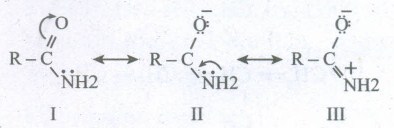
Which of the following compounds will not exist as resonance hybrid? Give reason for your answer.
(i) CH3 - OH
(ii) R-CONH2
(iii) CH3-CH = CH-CH2NH2
24.
Mention the standards prescribed by BIS for quality of drinking water.
25.
What is the effect of added inert gas on the reaction at equilibrium at constant volume.
26.
Explain graphical representation of Gay Lussac's law.
27.
How is temporary hardness removed?
28.
Define stoichiometry.
29.
Cyanamide (NH2CN) is completely burnt in excess oxygen in a bomb calorimeter, ΔU was found to be -742.4 kJ mol-1 calculate the enthalpy change of the reaction at 298K. NH2CN(S) +\(\frac{3}{2}\)O2(g)⟶ N2(g)+ CO2(g)+ H2O(i) ΔH= ?
30.
List out the uses of alkali metals
31.
Explain preparation of hydrogen using electrolysis.
32.
How is plaster of paris prepared ?
33.
In what period and group will an element with Z = 118 will be present?
34.
What do you mean by metallic bond ?
35.
In an experiment ethyliodide in ether is allowed to stand over magnesium pieces. Magnesium dissolves and product is formed
a) Name the product and write the equation for the reaction.
b) Why all the reagents used in the reaction should be dry? Explain
c) How is acetone prepared from the product obtained in the experiment.
36.
Give IUPAC names for the following compounds
CH3 – CH = CH – CH = CH – C ≡ C – CH3
37.
Give a brief description of the principles of
Fractional distillation
38.
2.82 g of glucose is dissolved in 30 g of water. Calculate the mole fraction of glucose and water.
39.
What will be the mass of one 12C atom in g?
40.
The equilibrium constant for the reaction is 10. Calculate the value of \(\Delta { G }^{ \ominus }\); Given R = 8.314 JK-1 mol-1; T = 300 K.
41.
Give an expression for the rates of diffusion of two different gases and their molecular weighs.
42.
How many orbitals are possible for n = 4?
43.
Assertion (A) : Excessive use of chlorinated pesticide causes soil and water pollution.
Reason (R) : Such pesticides are non-biodegradable.
i) Both (A) and R are correct and (R) is the correct explanation of (A)
ii) Both (A) and R are correct and (R) is not the correct explanation of (A)
iii) Both (A) and R are not correct
iv) (A) is correct but( R) is not correct
Both (A) and R are correct and (R) is the correct explanation of (A)
Both (A) and R are correct and (R) is not the correct explanation of (A)
Both (A) and R are not correct
(A) is correct but( R) is not correct
1.
(i) When atoms combines to form molecules, their individual atomic orbitals lose their identity and forms new orbitals called molecular orbitals.
(ii) The shapes of molecular orbitals depend upon the shapes of combining atomic orbitals.
(iii) The number of molecular orbitals formed is the same as the number of combining atomic orbitals. Half the number of molecular orbitals formed will have lower energy than the corresponding atomic orbital, while the remaining molecular orbitals will have higher energy. The molecular orbital with lower energy is called bonding molecular orbital and the one with higher energy is called anti-bonding molecular orbital. The bonding molecular orbitals are represented as \(\sigma\) (Sigma), \(\pi\) (Pi), \(\delta\) (delta) and the corresponding antibonding orbitals are denoted as \(\sigma\)*, \(\pi\)* and \(\delta\)*.
(iv) The electrons in a molecule are accommodated in the newly formed molecular orbitals. The Filling of electrons in these orbitals follows Aufbau's principle, Pauli's exclusion principle and Hund's rule as in the case of filling of electrons in atomic orbitals.
(v) Bond order gives the number of covalent bonds between the two combining atoms. The bond order of a molecule can be calculated using the following equation.
Bond order\(={N_b-N_a\over 2}\)
Where, Nb = Total number of electrons present in the bonding molecular orbitals
Na = Total number of electrons present in the antibonding molecular orbitals and A bond order of zero value indicates that the molecule doesn't exist.
2.
SN2 Mechanism :
(i) The rate of SN2 reaction depends upon the . concentration of both alkyl halide and the nucleophile.
(ii) Rate of reaction = is [alkylhalide] [nucleophile]. It follows second order kinetics and occurs in one step.
(iii) This reaction involves the formation of a transition state in which both the reactant molecules are partially bonded to each other. The attack of nucleophile occurs from the back side (i.e opposite to the side in which the halogen is attacked).
(iv) The carbon at which substitution occurs has inverted configuration during the course of reaction just as an umbrella has tendency to invert in a wind stonri. is inversion of configuration is called Walden inversion; after paul walden who 1st discovered the inversion of configuration of a compound in SN2reaction.
(v) SN2reaction of an optically active haloalkane . is always accompanied by inversion of configuration at the asymmetric centre.
(vi) When 2 - Bromooctane is heated with sodium hydroxide, 2 - octanol is formed with invesion of configuration. (-) - 2 - Bromo octane is heated with sodium hydroxide (+) - 2 - Octanol is formed in which - OR group occupies a position opposite to what bromine had occupied,
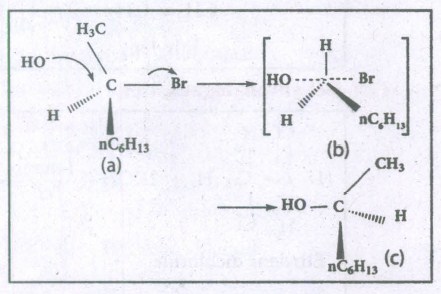
(a) (-).2 - Bromo octane
(b) Transition State
(c) (+) 2 - Octanol (product)
3.
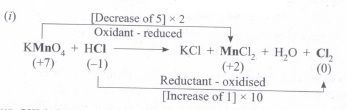
(ii) 2KMnO4 + 10 HCI \(\rightarrow\) KCl + MnCl2 + H2O + Cl2
(iii) Balance the equation atomically (except O and H).
2KMnO4 + 10 HCI \(\rightarrow\) 2KCl + 2MnCl2 + H2O + Cl2
(iv) Balance chlorine atoms by adding HCI and multiplying Cl2 by 5.
2KMnO4 + 16HCI \(\rightarrow\) 2KCl + 2MnCl2 + H2O + 5Cl2
(v) To balance O and H, H2O is multiplied by 8.
2KMnO4 + 16HCI \(\rightarrow\) 2KCl + 2MnCl2 + 8 H2O + 5Cl2
4.
(i) Number of electrons in outermost shell: The number of electrons present in the outermost shell increases from 1 to 8 as we proceed in a period.
(ii) Number of shells: As we move from left to right in a period the shells remains the same. The number of shells present in the elements corresponds to the period number. For example all the elements of 2nd period have on 2 shells (K, L)
(iii) Valency: The valency of the elements increases from left to right in a period. With respect to hydrogen, the valency of period elements increases from 1 to 4 and then falls to one. With respect to oxygen, the valency increases from 1 to 7.
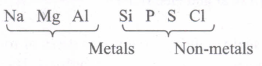
(iv) Metallic character: The metallic character of the elements decreases across a period.
For example: 3rd period
5.
(i) T1= 265 + 273 = 538 K
T2 = 100 + 273 = 373 K
\(\eta =\left( \frac { { T }_{ 1 }-{ T }_{ 2 } }{ { T }_{ 1 } } \right) \times 100\)
\(=\left( \frac { 538-373 }{ 538 } \right) \times 100\)
\(=\frac { 165 }{ 538 } \times 100\)
\(\eta =42.75%\)%
(ii) T1 = 265 + 273 = 538 K
T2 = 35 + 273 = 308 K
\(\eta =\left( \frac { { T }_{ 1 }-{ T }_{ 2 } }{ { T }_{ 1 } } \right) \times 100\)
\( =\left( \frac { 538-308 }{ 538 } \right) \times 100\)
\(=\frac { 230 }{ 538 } \times 100\)
\(\eta =42.75%\)%.
6.
Magnesium oxide in having higher melting point. The lattice energy of MgO & MgF2 are 3938 and 2957 respectively.
MgO has +2, -2 charges, MgF2 has +2, -1 charges. When the two charges are multiplied together, MgO results in larger amount of lattice energy since it has a higher charge, The strong attraction cause most ionic material to be hard and brittle and have high melting points.
7.
Statement : "No two electrons in an atom can have the same set of values of all four quantum numbers"
Explanation : It means that, each electron must have unique values for the four quantum numbers (n, l, m and s).
For the lone electron present in hydrogen atom, the four quantum numbers are: n = 1; l = 0; m = 0 and s = +1/2. For the two electrons present in helium, one electron has the quantum numbers same as the electron of hydrogen atom, n = 1.
l = 0, m = 0 and s = +1/2. For other electron, the fourth quantum number is different i.e., n = 1, l = 0, m = 0 and s = -1/2.
As we know that the spin quantum number can have only two values +1/2 and - 1/2, only two electrons can be accommodated in a given orbital in accordance with pauli exclusion principle.
| Atom | e- | n | l | m | s |
| Helium | First | 1 | 0 | 0 | +1/2 |
| Second | 1 | 0 | 0 | +1/2 |
8.
Applying Bohr's postulates to a hydrogen like atom (one electron species such as H, He+ and Li2+ etc...)the radius of the nth orbit and the energy of the electron revolving in the nth orbit were derived. The results are as follows:
rn = \(\frac { (0.529){ n }^{ 2 } }{ x } \mathring { A } \) ...(1)
En = \(\frac { -13.6({ z }^{ 2 }) }{ { n }^{ 2 } } ev\quad { atom }^{ -1 }\) or ... (2) or
En = \(\frac { (-1312.8){ z }^{ 2 } }{ { n }^{ 2 } } kJ\quad { mol }^{ -1 }\) .....(3)
9.
(b)
E1 mechanism
10.
(b)
NO2⊕
11.
(a)
I3-
12.
(a)
120°
13.
(a)
Mg2P2O7
14.
(d)
15.
(a)
36 : 1
16.
(a)
Alkali metals
17.
(d)
Mn2+,MnO42-,Mn02
18.
(b)
[Xe]4f75d16s2
19.
(c)
| A | B | C | D |
| 2 | 1 | 4 | 3 |
20.
(b)
negative
21.
(c)
dz2, dx2-y2
22.
(c)
amphoteric oxide
23.
(i) CH3 - OH : Does not exist as resonance hybrid due to absence of π-electrons.
(ii) R-CO NH2 : Can exist as resonance hybrid due to the presence of non-bonding electrons on N and n-electrons on C = O bond.
(iii) CH3-CH = CH-CH2NH2: Does not exist as resonance hybrid, because the lone pair on N-atom is not conjugated with n-electrons of the double bond
24.
Standard characteristics of drinking water.
| S.No | Characteristics | Desirable limit |
|---|---|---|
| I | Physico-chemical Characteristics | |
| i) | pH | 6.5 to 8.5 |
| ii) | Total Dissolved Solids (TDS) | 500ppm |
| iii) | Total Hardness (as CaCO3) | 300 ppm |
| iv) | Nitrate | 45ppm |
| v) | Chloride | 250ppm |
| vi) | Sulphate | 200ppm |
| vii) | Fluoride | 1 ppm |
| II | Biological Characteristics | |
| i) | Escherichia Coli (E.Coil) | Not at all |
| ii) | Coliforms | Not to exceed 10 (In 100 ml water sample) |
25.
Addition of an inert gas to a reaction at equilibrium, at constant volume has no effect.
26.
Gay Lussac's law:
At constant volume, the pressure of a fixed mass of a gas is directly proportional .to temperature.
\(P\propto T\) (or) \(P\over T\) = Constant
It can be graphically represented as shown here:
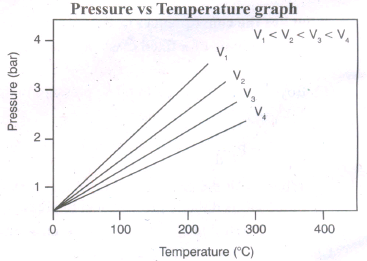
Lines in the pressure vs temperature graph are known as isochores ( constant volume) of a gas.
27.
This can be removed by boiling the hard water followed by filtration. Upon boiling, these salts decompose into insoluble carbonate which leads to their precipitation. The magnesium carbonate thus formed further hydrolysed to give insoluble magnesium hydroxide.
\(Ca(HCO_3)_2\rightarrow CaCO_3+H_2O+CO_2\)
Mg(HCO3)2 \(\rightarrow\) MgCO3 + H2O + CO2
MgCO3 + H2O \(\rightarrow\)Mg(OH)2 + CO2
The resulting precipitates can be removed by filtration
28.
Stoichiometry is the quantitative relationship between reactants and products in a balanced chemical equation in moles.
29.
T = 298K ; ΔU= - 742.4 kJ mol-1
ΔH=?
ΔH=ΔU+ΔngRT
ΔH=ΔU+(np-nr)RT
ΔH=-742.4 +\((2-\frac{3}{2})\)\(\times\)8.314 \(\times\) 10-3 \(\times\) 298
=-742.4 + (0.5 \(\times\) 8.314 \(\times\)10-3 \(\times\)298)
=-742.4 + 1.24
=-741.16 kJ mol-1
30.
(i) Lithium metal is used to make useful alloys. For example with lead it is used to make 'white metal' bearings for motor engines, with aluminium to make aircraft parts, and with magnesium to make armour plates. It is used in thermonuclear reactions.
(ii) Lithium is also used to make electrochemical cells.
(iii) Lithium carbonate is used in medicines
(iv) Sodium is used to make Na/Pb alloy.
(v) Liquid sodium metal is used as a coolant in fast breeder nuclear reactors.
(vi) Potassium chloride is used as a fertilizer. Potassium hydroxide is used in the manufacture of soft soap. It is also used as an excellent absorbent of carbon dioxide.
(vii) Caesium is used in devising photoelectric cells.
31.
High purity hydrogen (> 99.9%) is obtained by the electrolysis of water containing traces of acid or alkali or the electrolysis of aqueous solution of sodium hydroxide or potassium hydroxide using a nickel anode and iron cathode. However, this process is not economical for large-scale production.
At anode: 2OH- ➝ H2O + 1/2O2 + 2e-
At cathode: 2H2O + 2e- ➝ 2OH- + H2
Overall reaction: H2O ➝ H2 + 1/2O2
32.
Calcium Sulphate (plaster of paris), CaSO4. 1/2H2O :
It is a hemihydrate of calcium sulphate. It is obtained when gypsum, CaSO4 .2H2O,is heated to 393 K
2(CaSO4.2H2O) ⟶ 2CaSO4,H2O + 3H2O
Above 393 K, no water of crystallisation is left and anhydrous calcium sulphate, CaSO4 is formed. This is a known 'dead burnt plaster'.
It has a remarkable property of setting with water. on mixing with an adequate quantity of water it forms a plastic mass that gets into hard solid in 5 to 15 minutes.
33.
Z = 118; [86Rn] 5f14 6d10 7s2 7p6
In the periodic table the element with Z = 118 is located in p-block,
Period no = 7 (as n = 7 for valence shell)
Group no. = 18 (group no = 10+ ns electrons + np electrons) (n - outer most shell)
34.
The forces that keep the atoms of the metal so closely in a metallic crystal constitute what is generally known as the metallic bond.
35.
a) The product formed is ethylmagnesium iodide (Grignard reagent)
\({ C }_{ 2 }{ H }_{ 5 }+Mg\overset { dryether }{ \rightarrow } { { C }_{ 2 }H }_{ 5 }Mgl\)
Ethyl magnesium iodide
b) The Grignard carbon is highly basic and reacts with acidic protons of polar solvents like water to form an alkani so all reagents should be pure and dry.

36.

37.
This is one method to purify and separate liquids present in the mixture having their boiling point close to each other. In the fractional distillation, a fractionating column is fitted with distillation ask and a condenser. A thermometer is fitted in the fractionating column near the mouth of the condenser. This will enable to record the temperature of vapour passing over the condenser. The process of separation of the components in a liquid mixture I at their respective boiling points in the form of vapours and the subsequent condensation of those vapours is called fractional distillation. The process of fractional distillation is repeated. This method finds remarkable application in distillation of petroleum, coal-tar and crude oil.
38.
No. of, moles of glucose ; n2 = \(\frac{\mathrm{m}}{\mathrm{M}}=\frac{2.82}{180}=0.016 \mathrm{~mol} \)
No. of. moles of water ; n1 = \(\frac{30}{18}=1.67 \mathrm{~mol} \)
\(\mathrm{X}_{1}=\frac{\mathrm{n}_{1}}{\mathrm{n}_{1}+\mathrm{n}_{2}}=\frac{1.67}{1.67+0.016}=0.99\)
\(\mathrm{X}_{1}+\mathrm{X}_{2}=1 \)
\(\therefore \mathrm{X}_{2}=1-\mathrm{X}_{1}=1-0.99=0.01 \).
39.
Molar mass of 12C = 12.00 g mol-1.
Mass of 6.023\(\times\)1023 carbon atom = 12.0 g
\(\therefore\) Mass of 1 carbon atom \(={12\over6.023\times{10}^{23}}\)
= 1.992\(\times\)10-23 g.
40.
\(\Delta { G }^{ \ominus }\) = -RT ln K = -2.303 RT log K.
R = 8.314 JK-1 mol-1;T = 300 K; K=10
\(\Delta { G }^{ \ominus }=-2.303 \times 8.314 \) JK-1 mol-1 x (300 K) x log 10
= -5527 J mol-1= -5.527 kJ mol-1
41.
\(\frac{r_A}{r_B}=\sqrt{\frac{M_B}{M_A}}\)
rA and rB rates of diffusion of gases A and B and the MA and MB are their molecular weighs.
42.
| n | l | m | orbitals | Total no of orbitals |
| 0 | 0 | 1 | (1- 4s +3 - 4P orbital +5 - 4d orbital +7 - 4f orbital) =16 |
|
| 4 | 1 | -1 0 +1 |
3 | |
| 2 |
-2 |
5 | ||
| 3 |
-3 |
7 |
43.
i) Both (A) and R are correct and (R) is the correct explanation of (A)

11th Standard Syllabus & Materials
11th Standard
TN 11th Tamil பீடு பெற நில் - செய்யுள் - காவடிச்சிந்து Important Questions And Answers Study Material - QB365 Set A
NEW11th Standard
TN 11th Tamil பீடு பெற நில் - உரைநடை - மலை இடப்பெயர்கள் : ஓர் ஆய்வு Important Questions And Answers Study Material - QB365 Set A
NEW11th Standard
TN 11th Tamil மாமழை போற்றுதும் - துணைப்பாடம் - யானை டாக்டர் Important Questions And Answers Study Material - QB365 Set A
NEW11th Standard
TN 11th Tamil மாமழை போற்றுதும் - செய்யுள் - ஐங்குறுநூறு Important Questions And Answers Study Material - QB365 Set A



Tamilnadu Stateboard 11th Standard Subjects

Maths

Commerce

Economics

Biology

Business Maths and Statistics

Accountancy

Computer Science

Physics
Chemistry
Maths
Biology
Economics
Physics
Chemistry

History
Business Maths and Statistics

Computer Science
Accountancy

Computer Applications
History
Computer Technology
Commerce
Computer Applications
Computer Technology

Tamil

English

French
Tamilnadu Stateboard Standards
