
 100% FREE ACCESS
11th Standard Syllabus & Materials
11th Standard
TN 11th Tamil இயற்கை வேளாண்மை,சுற்றுச்சூழல் -செய்யுள் - மனோன்மணீயம் Important Questions And Answers Study Material - QB365 Set A
NEW11th Standard
TN 11th Tamil என்னுயிர் என்பேன் -துணைப்பாடம் - இசைத்தமிழர் இருவர் Important Questions And Answers Study Material - QB365 Set A
NEW11th Standard
TN 11th Tamil மொழி கலை -செய்யுள் - ஒவ்வொரு புல்லையும் Important Questions And Answers Study Material - QB365 Set A
NEW11th Standard
TN 11th Tamil பீடு பெற நில் - இலக்கணம் - பகுபத உறுப்புகள் Important Questions And Answers Study Material - QB365 Set A
NEW11th Standard
TN 11th Tamil பீடு பெற நில் - துணைப்பாடம் - வாடிவாசல் Important Questions And Answers Study Material - QB365 Set A
NEW11th Standard
TN 11th Tamil பீடு பெற நில் - செய்யுள் - குறுந்தொகை Important Questions And Answers Study Material - QB365 Set A

Published on: 27/05/2020
11th Standard Chemistry English Medium Model Question Paper Part V
Download Tamil Nadu 11th Standard Chemistry question papers, model tests, one-mark questions, important questions, and public exam papers in PDF format. Free study materials and answer keys for TN State Board students.
Questions + Answers key
Take MCQ Chemistry Test
1.
Which one of the following is used as a metal cleaning solvent?
Isopropylidene chloride
Methylene chloride
Chloroform
Iodoform
2.
Statement - I : n - butane and iso - butane are isomers.
Statement - II : Because they are having same molecular formula but differs only in the structural formula.
Statement -I and I! are correct and statement - I! is correct explanation of statement - I.
Statement - Iand II are correct but statement - II is not correct explanation of statement - I
Statement - I is correct but statement - II is wrong
Statement - I is wrong but statement - II is correct
3.
Which of the following compound can show resonance ?
CH2 = CH - CH = CH2
CH2 = CH - CHO
CH2 = CH - NH2
All of these
4.
Identify the incorrect statement with respect to hybridisation.
Hybridisation is intermixing of orbitals of nearly equal energies.
Shape of molecule depends upon type of hybridisation only.
Hybrid orbitals are identical in all aspects.
Hybrid orbitals can form \(\sigma\) and \(\pi\) bond
5.
6.
The IUPAC name of the compound \({ H }_{ 3 }C-\overset { \underset { | }{ { CH }_{ 3 } } }{ \underset { \overset { | }{ { CH }_{ 3 } } }{ C } } -CH=C{ \left( { CH }_{ 3 } \right) }_{ 2 }\) is _____________
2,4,4 – Trimethylpent -2-ene
2,4,4 – Trimethylpent -3-ene
2,2,4 – Trimethylpent -3-ene
2,2,4 – Trimethylpent -2-ene
7.
At 100o C the vapour pressure of a solution containing 6.5g a solute in 100g water is 732mm. If Kb = 0.52, the boiling point of this solution will be __________
102oC
100oC
101oC
100.52oC
8.
For the reaction AB (g) ⇌ A(g) + B(g), at equilibrium, AB is 20% dissociated at a total pressure of P, The equilibrium constant KP is related to the total pressure by the expression __________
P = 24 KP
P = 8 KP
24 P = KP
none of these
9.
Mathematical expression of Boyle's law is ____________.
P1V1 = P2V2
\(\frac{P}{V}=Constant\)
\(\frac{V}{T}=Constant\)
\(\frac{P}{T}=Constant\)
10.
Match the list-I and list-II using the correct code given below the list.
| List-I | List-II | ||
| A. | Li | 1. | 2,8,8,1 |
| B. | Na | 2. | 2,1 |
| C. | K | 3. | 2,8,18,18,8,1 |
| D. | Cs | 4. | 2,8,1 |
| A | B | C | D |
| 3 | 4 | 1 | 2 |
| A | B | C | D |
| 2 | 4 | 1 | 3 |
| A | B | C | D |
| 1 | 3 | 2 | 4 |
| A | B | C | D |
| 4 | 2 | 1 | 3 |
11.
Plaster of Paris is obtained by heating gypsum to ______
293K
100 K
393 K
273K
12.
What will be the basicity of H3BO3, which is not a protic acid?
One
Two
Three
Four
13.
All the naturally occurring processes proceed spontaneously in a direction which leads to _______________
decrease in entropy
increase in enthalpy
increase in free energy
decrease in free energy
14.
The energy of an electron in the 3rd orbit of hydrogen atom is -E. The energy of an electron in the first orbit will be ___________
-3E
\(\frac{-E}{3}\)
\(\frac{-E}{9}\)
-9E
15.
Water gas is _____.
H2O(g)
CO + H2O
CO + H2
CO + N2
16.
Which of the following compounds will not exist as resonance hybrid? Give reason for your answer.
(i) CH3 - OH
(ii) R-CONH2
(iii) CH3-CH = CH-CH2NH2
17.
Write down the possible isomers of C5H11Br and give their IUPAC and common names.
18.
Describe optical isomerism with suitable example.
19.
Ethylene glycol (C2H6O2) can be at used as an antifreeze in the radiator of a car. Calculate the temperature when ice will begin to separate from a mixture with 20 mass percent of glycol in water used in the car radiator. Kf for water = 1.86 K Kg mol-1 and molar mass of ethylene glycol is 62 g mol-1.
20.
When the numerical value of the reaction quotient (Q) is greater than the equilibrium constant (K), in which direction does the reaction proceed to reach equilibrium?
21.
What are metallic hydrides? Explain about it.
22.
What is inversion temperature? How is it related to Vander Waals constants?
23.
Calculate the oxidation number of underlined atoms \(\\ { Na }_{ 2 }[\underline { F } e{ (CN) }_{ 6 }]\)
24.
What are state and path functions? Give two examples
25.
Justify the position of hydrogen in the periodic table?
26.
Write balanced chemical equation for each of the following chemical reactions.
Lithium metal with nitrogen gas.
27.
Explain briefly the time independent schrodinger wave equation?
28.
Elements a, b, c and d have the following electronic configurations:
a: 1s2, 2s2, 2p6
b: 1s2, 2s2, 2p6, 3s2, 3p1
c: 1s2, 2s2, 2p6, 3s2, 3p6
d: 1s2, 2s2, 2p1
Which elements among these will belong to the same group of periodic table.
29.
Consider the molecules NH2-, NH3, NH4+. Arrange them in the decreasing order of bond angles and give reason for your arrangement.
30.
Give IUPAC names for the following compounds
CH3 – CH = CH – CH = CH – C ≡ C – CH3
31.
For the equilibrium PCI5(s) ⇌ PCl3(g) + CI2(g) at 25°C kc = 1.8 x 10⁻⁷ R = 8.314 Jk-1 mol-1 Calculate ΔGo for the reaction.
32.
State the following laws:
(i) Avogadro's law
(ii) Gay-Lussac's law.
33.
Write balanced chemical equation for the following processes
Heating calcium in oxygen
34.
The simplest aromatic hydrocarbon C6H6 reactsⒷ on treatment with sodium hydroxide will (C6H5OH), Phenol, © as the product. Also Cl2 to giveⒶ which on reaction with sodium hydroxide gives Ⓑ.Ⓑ of molecular formula C6H6O. @ on treatment with ammonia will give C6H7N as @. Identify Ⓐ, Ⓑ, ©, and explain the reactions involved.
35.
What type of bond is formed between K+ and CI -? Explain the bond formation.
36.
Differentiate the following
(i) BOD and COD
(ii) Viable and non-viable particulate pollutants
37.
Write the steps to be followed while balancing redox equation by oxidation number method.
38.
Explain about the factors that influence the ionization enthalpy.
39.
An atom of an element contains 35 electrons and 45 neutrons. Deduce
(i) the number of protons
(ii) the electronic configuration for the element
(iii) All the four quantum numbers for the last electron
40.
1 mole of an ideal gas is maintained at 4.1 atm and at a certain temperature absorbs 3710J heat and expands to 2 litres. Calculate the entropy change in expansion process.
41.
Balance the following equations by ion electron method.
\({ Na }_{ 2 }{ S }_{ 2 }{ O }_{ 3 }+{ I }_{ 2 }\longrightarrow { Na }_{ 2 }{ S }_{ 4 }{ O }_{ 6 }+NaI\)
42.
How are peroxides and superoxides formed by alkali metals?
43.
The quantum numbers of six electrons are given below. Arrange them in order of increasing energies. If any of these combination(s) has/have the same energy lists.
(i) n = 4, l = 2, m1 = -2, ms = - \(\frac { 1 }{ 2 } \)
(ii) n = 3, l = 2, m1 = 1, ms = +\(\frac { 1 }{ 2 } \)
(iii) n = 3, l = 1, m1 = 0, ms = +\(\frac { 1 }{ 2 } \)
(iv) n = 3, l = 2, m1 = -2, ms = - \(\frac { 1 }{ 2 } \)
(v) n = 3, l = 1, m1 = -1, ms = + \(\frac { 1 }{ 2 } \)
(vi) n = 4, l = 1, m1 = 0, ms = +\(\frac { 1 }{ 2 } \)
1.
(b)
Methylene chloride
2.
(a)
Statement -I and I! are correct and statement - I! is correct explanation of statement - I.
3.
(a)
CH2 = CH - CH = CH2
4.
(d)
Hybrid orbitals can form \(\sigma\) and \(\pi\) bond
5.
(c)
6.
(a)
2,4,4 – Trimethylpent -2-ene
7.
(c)
101oC
8.
(a)
P = 24 KP
9.
(a)
P1V1 = P2V2
10.
(b)
| A | B | C | D |
| 2 | 4 | 1 | 3 |
11.
(c)
393 K
12.
(a)
One
13.
(d)
decrease in free energy
14.
(d)
-9E
15.
(c)
CO + H2
16.
(i) CH3 - OH : Does not exist as resonance hybrid due to absence of π-electrons.
(ii) R-CO NH2 : Can exist as resonance hybrid due to the presence of non-bonding electrons on N and n-electrons on C = O bond.
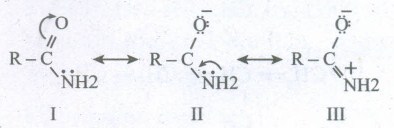
(iii) CH3-CH = CH-CH2NH2: Does not exist as resonance hybrid, because the lone pair on N-atom is not conjugated with n-electrons of the double bond
17.
| Isomer | IUPAC name | common name |
| \({ }^5 \mathrm{CH}_3{ }^4 \mathrm{CH}_2{ }^3 \mathrm{CH}_2{ }^2 \mathrm{CH}_2{ }^1 \mathrm{CH}_2 \mathrm{Br}\) | 1 - bromopentane | n - pentyl bromide (or) n - amyl bromide |
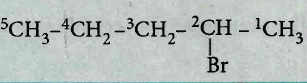 |
2 - bromopentane | Sec - pentyl bromide (or) Sec - amyl bromide |
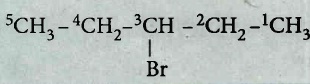 |
3 - bromopentane | - |
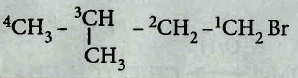 |
1 -bromo- 3 -methylbutane | Isopentyl bromide (or) Iso amylbromide |
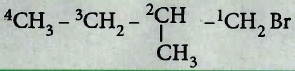 |
1 -bromo- 2-methylbutane | - |
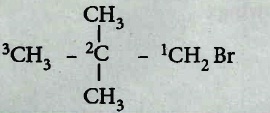 |
l-bromo -2,2-dimethyl propane |
Neopenryl bromide (or) Neo amyl bromide |
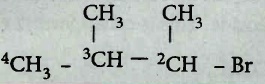 |
2-bromo- 3 -methylbutane | - |
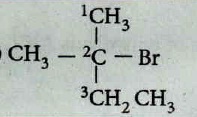 |
2-bromo- 2 -methylbutane | t - pentyl bromide (or) t - amyl bromide |
18.
Optical isomerism:
Compounds having same physical and chemical property but differ only in the rotation of plane of the polarized light are known as optical isomers and the phenomenon is known as optical isomerism.
Some organic compounds such as glucose have the ability to rotate the plane of the plane polarized light and they are said to be optically active compounds and this property of a compound is called optical activity. The optical isomer, which rotates the plane of
the plane polarised light to the right or in cloclauisl direction is said to be dextrorotary (dexter means right) denoted by the sign (+), whereas the compound which rotates to the left or anticloclanrise is said to be leavo rotatory (leanues mean left) denoted by sign(-).
Dextrorotatory compounds are represented as 'd' or by sign (+) and lavorotatory compounds are ( - ) represented as 'l' or by sign (-).
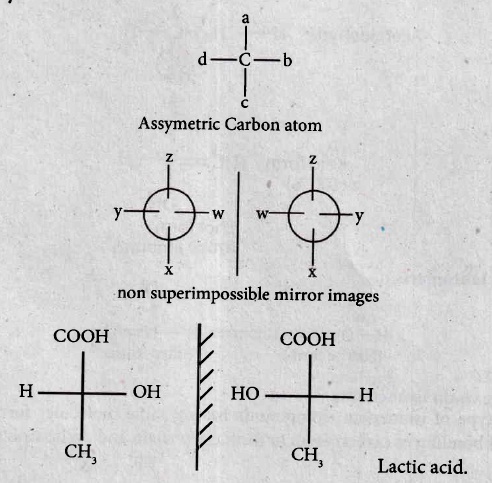
Enantiomerism and optical activity: An optically active substance may exist in two or more isomeric forms which have same physical and chemical properties but differ in terms of direction of rotation of plane polarized light, such optical isomers which rotate the plane of polarized light with equal angle but in opposite direction are known as enantiomers and the phenomenon is knovrrn as enantiomerism. Isomers which are non-super impossible mirror images of each other are called enantiomers.
conditions for enantiomerism or optical isomerism:
A carbon atom whose tetra vaiency is satisfied by four different substituents (atoms or groups) is called a symmetric carbon or chiral carbon. It is indicated by an asterisk as C*. A molecule Possessing chiral carbon atom and non-super impossible to its own mirror image is said to be a chiral molecule or asymmetric, and the pioperty is called chirality or dissymmetry.
19.
Weight of solute (W2) = 20 mass percent of solution means 20 g of ethylene glycol
Weight of solvent (water) W1 = 100 - 20 = 80 g
ΔTf = Kf m
\(={K_f\times W_2\times 1000\over M_2\times W_1}\)
\(={1.86\times 20\times 1000\over 62\times 80}\)
= 7.5 K
The temperature at which the ice will begin to separate is the freezing of water after the addition of solute i.e 7.5 K lower than the normal freezing point of water (273 - 7.5K) = 265.5 K
20.
If Q > Kc; the reaction will proceed in the reverse direction (ie) formation of reactants to proceed to reach equilibrium.
21.
(i) Metallic hydrides are obtained by hydrogenation of metals and alloys in which hydrogen occupies the interstitial sites (voids). Hence, they are called interstitial hydrides.
(ii) The hydrides show properties similar to parent metals and hence they are also known as metallic hydrides.
(iii) They are mostly non-stoichiometric with variable composition (TiH1.5-1.8 and PdH0.6-0.8)
(iv) Some are relatively light, inexpensive and thermally unstable which makes them useful for hydrogen storage applications. Example, TiH2, ZrH2, ZnH2.
22.
This temperature below which a gas obey Joule Thomson effect is called inversion temperature (Ti).At the inversion temperature, no rise or fall in temperature of a gas occurs while expanding. But above the inversion temperature, the gas gets heated up when allowed to expand through a hole. It is related to Vander Waals equation by
\({ T }_{ i }=\frac { 2a }{ Rb } \)
23.
2(1) + x + 6(-1) = 0
2 + x - 6 = 0
x - 4 = 0
x = 4
Oxidation number of Fe in Na2[Fe(CN)6 ] is +4
24.
(i) State function: A state function is a thermodynamic property of a system, which has a specific value for a given state and does not depend on the path (or manner) by which the particular state is reached.
Example: Pressure (P), Volume (V), Temperature(T)
(ii) Path functions: A path function is a thermodynamic property of the system whose value depends on the path by which the system changes from its initial to final states.
Example: Work (w), Heat (q).
25.
(i) Hydrogen has the electronic configuration of 1s1 which resembles with ns1 general valence shell configuration of alkali metals and shows similarity with them as follows:
1. It forms unipositive ion (H+) like alkali metals (Na+,K+,Cs+)
2. It forms halides (HX), oxides (H2O), peroxides (H2O2) and sulphides (H2S) like alkali metals (NaX, Na2O, Na2O2, Na2S)
3. It also acts as a reducing agent.
4. lt is an electro positive element
However, unlike alkali metals which have ionization energy ranging from 377 to 520 kJ mol-1, the hydrogen has 1.314 kJ mol-1 which is much higher than alkali metals.
Like the formation of halides (X -) from halogens, hydrogen also has a tendency to gain one electron to form hydride ion(H+) whose electronic configuration is similar to the noble gas, helium. However, the electron affinity of hydrogen is much less than that of halogen atoms. Hence, the tendency of hydrogen to form hydride ion is low compared to that of halogens to form the halide ions as evident from the following reactions:
\(
1 / 2 \mathrm{H}_{2}+\mathrm{e}^{-} \rightarrow \mathrm{H}^{-} \Delta \mathrm{H}=+36 \mathrm{kcal} \mathrm{mol}^{-1}
\)
\(1 / 2 \mathrm{Br}_{2}+\mathrm{e}^{-} \rightarrow \mathrm{Br}^{-} \Delta \mathrm{H}=-55 \mathrm{kcal} \mathrm{mol}^{-1}\)
Since, hydrogen has similarities with alkali metals as well as the halogens; it is difficult to find the right position in the periodic table. However, in most of its compounds hydrogen exists in +1 oxidation state. Therefore, it is reasonable to place the hydrogen in group 1 along with alkali metals as shown in the latest periodic table published by IUPAC.
26.
6Li + N2 ⟶ 2Li3 N
27.
Erwin Schrodinger expressed the wave nature of electron in terms of a differential equation. This equation determines the change of wave function in space depending on the field of force in which the electron moves. The time independent Schrodinger equation can be expressed as,
\(\overset { \wedge }{ H } \psi =E\psi \) .........(1)
Where \(\overset { \wedge }{ H } \) is called Hamiltonian operator, \(\psi \) is the wave function and is a function of position coordinates of the particle and is denoted as \(\psi \) (x, y, z) E is the energy of the system
\(\overset { \wedge }{ H } =\left[ \frac { { -h }^{ 2 } }{ 8{ \pi }^{ 2 } } \left( \frac { { \partial }^{ 2 }\psi }{ { \partial x }^{ 2 } } +\frac { { \partial }^{ 2 }\psi }{ { \partial y }^{ 2 } } +\frac { { \partial }^{ 2 }\psi }{ { \partial z }^{ 2 } } \right) +V \right] \)
can be written as
\(\left[ \frac { { -h }^{ 2 } }{ 8{ \pi }^{ 2 }m } \left( \frac { { \partial }^{ 2 }\psi }{ { \partial x }^{ 2 } } +\frac { { \partial }^{ 2 }\psi }{ { \partial y }^{ 2 } } +\frac { { \partial }^{ 2 }\psi }{ { \partial z }^{ 2 } } \right) +V\Psi \right] =E\Psi \)
Multiply by \(\frac { 8{ \pi }^{ 2 }m}{ { -h }^{ 2 } } \)and rearranging
\(\frac { { \partial }^{ 2 }\psi }{ { \partial x }^{ 2 } } +\frac { { \partial }^{ 2 }\psi }{ { \partial y }^{ 2 } } +\frac { { \partial }^{ 2 }\psi }{ { \partial z }^{ 2 } } +\frac { 8{ \pi }^{ 2 }m }{ { -h }^{ 2 } } (E-V)\Psi =0\) ........(2)
The above Schrodinger wave equation does not contain time as a variable and is referred to as time independent Schrodinger wave equation. This equation can be solved only for certain values of E, the total energy. i.e. the energy of the system is quantised. The permitted total energy values are called eigen values and corresponding wave functions represent the atomic orbitals.
28.
In the periodic table vertical columns are called groups.
Elements in the same vertical column possess similar number of electrons in the outer orbitals.
∴ Elements a and c belongs to group 18
Elements b and d belongs to group 13
29.
(i) The decreasing order of bond angles is: NH4+ > NH3>NH2-
(ii) The N-atoms in all the three molecules are sp3 hybridised
(iii) The number of lone-pair of electrons present on nitrogen of NH4+, NH3 and NH2- are 0, 1 and 2.
(iv) Greater the number of lone pairs, greater is the repulsion and lesser is the bond angle.
30.

31.
ΔG0 = - 2.303 RT log kc
= - 2.303 x 8.314 x 298 log (1.8 x 10⁻⁷)
= - 38484 J mol-1
= - 38.484 kJ mol-1
32.
(i) Avogadro's law
Equal volumes of all the gases under the same conditions of temperature and pressure contain equal number of molecules.
V \(\infty \) n (at constant P and T)
(ii) Gay-Lussac's law.
At constant volume, the pressure of a fixed amount of a gas is directly proportional to the temperature. P \(\infty \) T (constant V)
33.
2Ca + O2 ⟶ 2CaO
34.
(i) The aromatic hydrocarbon Ⓐ is Benzene, C6H6.
(ii) Benzene reacts. with Cl2 to give chlorobenzene (C6H5CI), as Ⓑ as the product.

(iii) Chlorobenzene Ⓑ acts with sodium hydroxide to give (C6HsOH) phenol, © as the product.

(iv) Chlorobenzene reacts with ammonia to give Aniline, C6H5NH2Ⓓ as the product.

35.
Ionic bond is formed between K+ and CI - When the electronegativity difference between the two combining atoms is large, the least electronegative atom completely transfers one or more of its valence electrons to the other combining atom so that both atoms can attain the nearest inert gas electronic configuration. The complete transfer of electron leads to the formation of a cation and an anion. Both these ions are held together by the electrostatic attractive force which is known as ionic bond.
Let us consider the formation potassium chloride. The electronic configuration of potassium and chlorine are
Potassium (K) : [Ar] 4s1
Chlorine (CI) : [Ne]3s2, 3p5
Potassium has one electron in its valence shell and chlorine has seven electron in its valence shell. By loosing one electron potassium attains the inert gas electronic configuration of argon and becomes a unpositive cation (K+) and chlorine accepts this electron to become unnegative chloride ion (Cl-) there by attaining the stable electronic conguration of argon. These two ions combine to form an ionic crystal in which they are held together by electrostatic attractive force. The energy required for the formation of one mole of K+ is 418.81 kJ (ionization energy) and the energy released during the formation of one mole of Cl- is -348.56 kJ (electron gain enthalpy). The sum of these two energies is positive. (70.25 kJ). However, during the formation of one mole potassium chloride crystal from its constituent ions, 718 kJ energy is released. This favours the formation of KCI and it stabilises.
36.
(i) BOD and COD
| No | BOD | COD |
| 1 | This is Bio chemical oxygen demand | This is chemical oxygen demand |
| 2 | The total amount of oxygen in milligrams consumed by microorganisms in decomposing the waste in one litre of water at 20o for a period of 5 days is called biochemical oxygen demand (BOD) |
Chemical oxygen demand (COD) is defined as the amount of oxygen required by the organic matter in a sample of water for its oxidation by strong oxidising agent like K2Cr2O7 in acid medium for a Period of 2 hrs. |
| 3 | It is expressed in ppm | It is expressed in mg/L |
| 4 | It is a measure of consumed oxygen | It isa measurement of requirement of dissolved oxygen. |
| 5 | In waste streams BOD levels are less than COD. | In waste streams COD levels are higher than than BOD. |
| 6 | BOD measurements takes 5 days | COD measurements takes 2 hrs only. |
(ii) Viable and non-viable particulate pollutants
| No | Viable particulates | Non - Viable Particulates |
| 1 | These are small sized living organisms which are dispersed in air. Eg : bacteria, fungi, moulds, algae, etc. |
These are small solid particles and liquid droplets suspended in air. Eg : Smoke, Dust, Mists, Fumes, etc. |
| 2 | Fungi causes allergy in humans and diseases in Plants. | Causes long cancer, asthma, affects mattuation of RBC, affects Photosynthesis, etc. |
| 3 | They do not help in the transportation of Particulates. | They help in transportation of viable particulates |
37.
Oxidation number method:
This method is based on the fact that
Number of electrons lost by atoms = Number of electrons gained by atoms
Steps to be followed while balancing Redox reactions by Oxidation Number method:
1. Write skeleton equation representing redox reaction
2. Write the oxidation number of atoms undergoing oxidation and reduction.
3. Calculate the increase or decrease in oxidation numbers per atom.
4, Make increase in oxidation number equal to decrease in oxidation number by multiplying the formula of oxidant and reductant by suitable numbers.
5. Balance the equation atomically on both sides except O and H atoms.
6. Balance oxygen atoms by adding required number of water molecules to the side deficient in oxygen atoms.
7. Add required number of H+ ions to the side deficient in hydrogen atom if the reaction is in acidic medium.
8. For reactions in basic medium, add H2O molecules to the side deficient in hydrogen atoms and simultaneously add equal number of OH- ions on the other side of the equation.
9. Finally, balance the equation by cancelling common species present on both sides of the equation.
38.
Factors influencing ionization enthalpy:
(i) Size of the atom:
If the size of an atom is larger, the outermost electron shell from the nucleus is also larger and hence the outermost electrons experience lesser force of attraction. Hence it would be more easy to remove an electron from the outermost shell. Thus, ionization energy decreases with increasing atomic sizes.
Ionization enthalpy \(\infty{1\over Atomic \ size}\)
(ii) Magnitude of nuclear charge:
As the nuclear charge increases, the force of attraction between the nucleus and valence electrons also increases. So, more energy is required to remove a valence electron. Hence I.E increases with increase in nuclear charge.
Ionization enthalpy \(\alpha \ nuclear \ charge\)
(iii) Screening or shielding effect of the inner electrons:
The electrons of inner shells form a cloud of negative charge and this shields the outer electron from the nucleus. This screen reduces the coulombic attraction between the positive nucleus and the negative outer electrons. If screening effect increases, ionization energy decreases.
Ionization enthalpy \(\infty{1\over Screening\ effects}\)
(iv) Penetrating power of subshells s, p, d, and f:
The s-orbital penetrate more closely to the nucleus as compared to p-orbitals. Thus, electrons in s-orbitals are more tightly held by the nucleus than electrons in p-orbitals. Due to this, more energy is required to remove a electron from an s-orbital as compared to a p-orbital. For the same value of 'n', the penetration power decreases in a given shell in the order.
s>p>d>f.
(v) Electronic configuration:
If the atoms of elements have either completely filled or exactly half filled electronic configuration, then the ionization energy increases.
39.
(i) no. of electrons: 35 (given)
no. of protons : 35
(ii) Electronic configuration
1s2 2S2 2p6 3s2 3p6 4s2 3d10 4p5
(iii) Last electron:
| \(\downharpoonleft\upharpoonright\) | \(\upharpoonleft\downharpoonright\) | \(\upharpoonleft\) |
4Px 4Py 4pz
last electron present in 4Py orbital y
n = 4, l = 1 m1 = either + 1 or -1 and s = -1/2
40.
For 1 mole of an ideal gas,
PV=RT
P=4.1 atm
V=2lt.
PV=RT
T=\(\frac{PV}{R}=\frac{4.1atm\times2lit\times1mole}{0.082 lit atm K^{-1}mol^{-1}}\)
=100 K
\(\Delta S=\frac{q}{T}\)
\(\Delta S=\frac{3710J}{100K}=37.1 JK^{-1}\)
ΔS of expansion = 37.1 JK-1.
41.
half reaction \(\Rightarrow \) \({ S }_{ 2 }{ O }_{ 3 }^{ 2- }\longrightarrow { S }_{ 4 }{ O }_{ 6 }^{ 2- }\)
\({ I }_{ 2 }\longrightarrow { I }^{ - }\)
.png)
42.
i) The fact that a small cation can stabilize a small anion and a large cation can stabilize a large anion explains the formation and stability of these oxides.
(ii) The Na+ ion is a larger cation and has a weak positive field around it and thus can stabilize a bigger peroxide ion, O22- or [-O-O-]2- which is also surrounded by a weak negative field.
(iii) Similarly, the other ions K+, Rb+, Cs+ are still larger, having very weak positive field·
(iv) Thus these ions can stabilize a bigger superoxide O2- anion and form super oxides·
43.
| Quantum number | Subshell notation | n+1 | |
| (i) | n = 4, l = 2 m1 = -2,ms = -\(\frac { 1 }{ 2 } \) | 4d | 4 + 2 = 6 |
| (ii) | n = 3, l = 2, m1 = 1,ms = +\(\frac { 1 }{ 2 } \) | 3d | 3 + 2 = 5 |
| (iii) | n = 3, l = 1,m1 = 0 ms = +\(\frac { 1 }{ 2 } \) | 4p | 4 + 1 = 5 |
| (iv) | n = 3, l = 2,m1 = -2, ms = -\(\frac { 1 }{ 2 } \) | 3d | 3 + 2 = 5 |
| (v) | n = 3, l = 1,m1 = -1,,ms = + \(\frac { 1 }{ 2 } \) | 3p | 3 + 1 = 4 |
| (vi) | n = 4, l = 1,m1 = 0, ms = +\(\frac { 1 }{ 2 } \) | 4p | 4 + 1 = 5 |
∵ (V) < (ii) = (iv) < (iii) = (vi) < (i)
∴ 3p < 3d = 3d < 4p = 4p <4d

11th Standard Syllabus & Materials
11th Standard
TN 11th Tamil பீடு பெற நில் - செய்யுள் - காவடிச்சிந்து Important Questions And Answers Study Material - QB365 Set A
NEW11th Standard
TN 11th Tamil பீடு பெற நில் - உரைநடை - மலை இடப்பெயர்கள் : ஓர் ஆய்வு Important Questions And Answers Study Material - QB365 Set A
NEW11th Standard
TN 11th Tamil மாமழை போற்றுதும் - துணைப்பாடம் - யானை டாக்டர் Important Questions And Answers Study Material - QB365 Set A
NEW11th Standard
TN 11th Tamil மாமழை போற்றுதும் - செய்யுள் - ஐங்குறுநூறு Important Questions And Answers Study Material - QB365 Set A



Tamilnadu Stateboard 11th Standard Subjects

Maths

Commerce

Economics

Biology

Business Maths and Statistics

Accountancy

Computer Science

Physics
Chemistry
Maths
Biology
Economics
Physics
Chemistry

History
Business Maths and Statistics

Computer Science
Accountancy

Computer Applications
History
Computer Technology
Commerce
Computer Applications
Computer Technology

Tamil

English

French
Tamilnadu Stateboard Standards
