
 100% FREE ACCESS
11th Standard Syllabus & Materials
11th Standard
TN 11th Tamil இயற்கை வேளாண்மை,சுற்றுச்சூழல் -செய்யுள் - மனோன்மணீயம் Important Questions And Answers Study Material - QB365 Set A
NEW11th Standard
TN 11th Tamil என்னுயிர் என்பேன் -துணைப்பாடம் - இசைத்தமிழர் இருவர் Important Questions And Answers Study Material - QB365 Set A
NEW11th Standard
TN 11th Tamil மொழி கலை -செய்யுள் - ஒவ்வொரு புல்லையும் Important Questions And Answers Study Material - QB365 Set A
NEW11th Standard
TN 11th Tamil பீடு பெற நில் - இலக்கணம் - பகுபத உறுப்புகள் Important Questions And Answers Study Material - QB365 Set A
NEW11th Standard
TN 11th Tamil பீடு பெற நில் - துணைப்பாடம் - வாடிவாசல் Important Questions And Answers Study Material - QB365 Set A
NEW11th Standard
TN 11th Tamil பீடு பெற நில் - செய்யுள் - குறுந்தொகை Important Questions And Answers Study Material - QB365 Set A

Published on: 26/05/2020
11th Standard Chemistry English Medium Public Exam Model Question Paper June 2020
Download Tamil Nadu 11th Standard Chemistry question papers, model tests, one-mark questions, important questions, and public exam papers in PDF format. Free study materials and answer keys for TN State Board students.
Questions + Answers key
Take MCQ Chemistry Test
1.
Which one of the following is used as an insecticide and as a soil sterilising agent?
Chloroform
Chloral
Chloropicrin
Tetrachloromethane
2.
Which one of the following has least acidic character ?
HCOOH
CH3COOH
CH2CICOOH
CCl3COOH
3.
During the formation of a chemical bond ________.
energy decreases
energy increases
energy remains zero
energy remains constant
4.
The most stable conformation of Butane is
Gauche-form
Partially eclipsed form
Anti-form
Eclipsed form
5.
The IUPAC name of the compound \({ H }_{ 3 }C-\overset { \underset { | }{ { CH }_{ 3 } } }{ \underset { \overset { | }{ { CH }_{ 3 } } }{ C } } -CH=C{ \left( { CH }_{ 3 } \right) }_{ 2 }\) is _____________
2,4,4 – Trimethylpent -2-ene
2,4,4 – Trimethylpent -3-ene
2,2,4 – Trimethylpent -3-ene
2,2,4 – Trimethylpent -2-ene
6.
Phenol dimerises in benzene having van't Hoff factor 0.54. What is the degree of association ?
0.46
92
46
0.92
7.
The equilibrium constant for a reaction at room temperature is K1 and that at 700 K is K2. If K1 > K2, then _____________
The forward reaction is exothermic
The forward reaction is endothermic
The reaction does not attain equilibrium
The reverse reaction is exothermic
8.
The SI unit of pressure is __________.
Nm-2 Kg-1
Pascal
bar
atmosphere
9.
Which of the following N3-, O2-, F- is largest in size?
N3-
O2-
F-
All of these
10.
Identify the incorrect statement about a compound.
A molecule cannot be separated into its constituent elements by physical methods of separation
A molecule of a compound has atoms of different elements
A compound retains the physical properties of its constituent element
The ratio of atoms of different elements in a compound is fixed
11.
Half life of francium is _______
12.3 years
12.3 mins
21 years
21 mins
12.
An ideal gas expands from the volume of 1 x 10⁻³ m3 to 1 x 10⁻² m3 at 300 K against a constant pressure at 1 x 10⁵ Nm-2. The work done is ______________
- 900 J
900 kJ
270 kJ
-900 kJ
13.
The ratio of de Broglie wavelengths of a deuterium atom to that of an \(\alpha\) - particle, when the velocity of the former is five times greater than that of later, is ____________
4
0.2
2.5
0.4
14.
Non-stoichiometric hydrides are formed by _____________
palladium, vanadium
carbon, nickel
manganese, lithium
nitrogen, chlorine
15.
Deduce the Vant Hoff equation.
16.
What is meant by Boyle temperature (or) Boyle point? How is it related with compression point?
17.
Give a brief account of metallic (interstitial) hydrides.
18.
Describe an experiment to show that V \(\alpha \) T
19.
Identify the type of redox reaction taking place in the following
\(\overset { 0 }{ { Ca }_{ (s) } } +\overset { +1 }{ 2 } \overset { -2 }{ { H }_{ 2 }O_{ (l) } } \longrightarrow \overset { +2 }{ Ca } \overset { -2+1 }{ { (0H) }_{ 2(aq) } } +\overset { 0 }{ H } _{ 2(g) }\)
20.
What are state and path functions? Give two examples
21.
Explain preparation of hydrogen using electrolysis.
22.
For each of the following, give the sub level designation, the allowable m values and the number of orbitals
(i) n = 4, l = 2
(ii) n = 5, l = 3
(iii) n = 7, l = 0
23.
Substantiate lithium fluoride has the lowest solubility among group one metal fluorides.
24.
Write balanced chemical equation for each of the following chemical reactions.
Lithium metal with nitrogen gas.
25.
Energy of an electron in the ground state of the hydrogen atom is -2.8 x 10⁻¹⁸ J. Calculate the ionisation enthalpy of atomic hydrogen in terms of kJ mol-1.
26.
Explain about metallic bonding
27.
Illustrate with examples, the three types of electron movement in organic reaction.
28.
Explain the mechanism involved in bimolecular nucleophilic substitution reaction.
29.
Describe the reactions involved in the detection of nitrogen in an organic compound by Lassaigne method.
30.
What are thermochemical equation? What are the conventions adopted in writing thermochemical equation?
31.
Distinguish between alkali metals and alkaline earth metals.
32.
Balance the following equation by ion electron method.
Zn + NO3- ⟶ Zn + NH4+2
33.
Give the characteristics of p-block elements.
34.
A neutral atom of an element has 2K, 8L and 5M electrons. Find out the following.
(i) Atomic number of the element
(ii) Total number of s-electrons
(iii) Total number of p-electrons
(iv) Number of protons in the nucleus
(v) Valency of the element
35.
State and explain pauli exclusion principle.
36.
Calculate the formal charge on the carbon atom and oxygen atom in the structure:\(\overset { .. }{ \underset { .. }{ O } } =C=\overset { .. }{ \underset { .. }{ O } } \)\(\)
37.
What are particulate pollutants ? Explain any three.
38.
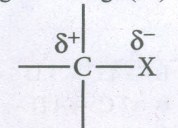
Give reasons for polarity of C-X bond in halo alkane.
39.
Give IUPAC names for the following compounds
CH3 – CH = CH – CH = CH – C ≡ C – CH3
40.
2.82 g of glucose is dissolved in 30 g of water. Calculate the mole fraction of glucose and water.
41.
What are spontaneous reaction? Give three examples for spontaneous reaction.
42.
Define - Empirical formula of a compound
43.
Assertion (A) : Excessive use of chlorinated pesticide causes soil and water pollution.
Reason (R) : Such pesticides are non-biodegradable.
i) Both (A) and R are correct and (R) is the correct explanation of (A)
ii) Both (A) and R are correct and (R) is not the correct explanation of (A)
iii) Both (A) and R are not correct
iv) (A) is correct but( R) is not correct
Both (A) and R are correct and (R) is the correct explanation of (A)
Both (A) and R are correct and (R) is not the correct explanation of (A)
Both (A) and R are not correct
(A) is correct but( R) is not correct
1.
(c)
Chloropicrin
2.
(b)
CH3COOH
3.
(a)
energy decreases
4.
(c)
Anti-form
5.
(a)
2,4,4 – Trimethylpent -2-ene
6.
(d)
0.92
7.
(a)
The forward reaction is exothermic
8.
(b)
Pascal
9.
(a)
N3-
10.
(c)
A compound retains the physical properties of its constituent element
11.
(d)
21 mins
12.
(a)
- 900 J
13.
(d)
0.4
14.
(a)
palladium, vanadium
15.
This equation gives the quantitative temperature dependence of equilibrium constant (K). The relation between standard free energy change (\(\triangle\)GO) and equilibrium constant is
\(\Delta { G }^{ 0 }=-RTln\ K\) ...(1)
We know that
\(\Delta { G }^{ 0 }=\Delta { H }^{ 0 }-T\Delta { S }^{ 0 }\)
Substituting (1) in equation (2)
\(-RTln\ K\ =\Delta { H }^{ 0 }-T\Delta { s }^{ 0 }\)
Rearranging
In \(K=\cfrac { -\Delta H^{ 0 } }{ RT } +\cfrac { { \Delta S }^{ 0 } }{ R } \) ...(3)
Differentiating equation (3) with respect to temperature
\(\cfrac { d\left( In\quad K \right) }{ dT } =\cfrac { \Delta { H }^{ 0 } }{ { RT }^{ 2 } } \) ...(4)
Equation 4 is known as differential form of Van't Hoff equation.
On integrating the equation 4, between T1 and T2 with their respective equilibrium constants K1 and K2.
\(\int _{ { k }_{ 1 } }^{ { K }_{ 2 } }{ d\left( In\ K \right) =\cfrac { \Delta { H }^{ 0 } }{ R } \int _{ { T }_{ 2 } }^{ { { T }_{ 2 } } }{ \cfrac { dT }{ { T }^{ 2 } } } } \)
\(\left[ In\quad K \right] _{ { K }_{ 1 } }^{ { K }_{ 2 } }=\cfrac { \Delta { H }^{ 0 } }{ R } \left[ -\cfrac { 1 }{ T } \right] ^{ { T }_{ 2 } }_{ { T }_{ 1 } }\)
\(In\quad { K }_{ 2 }-In\quad { K }_{ 1 }=\cfrac { \Delta { H }^{ 0 } }{ R } -\left[ \cfrac { 1 }{ { T }_{ 2 } } +\cfrac { 1 }{ { T }_{ 2 } } \right] \)
\(In\quad \cfrac { { K }_{ 2 } }{ { K }_{ 1 } } =\cfrac { \Delta { H }^{ 0 } }{ R } \left[ \cfrac { { T }_{ 2 }-{ T }_{ 1 } }{ { T }_{ 2 }{ T }_{ 1 } } \right] \)
\(log\quad \cfrac { { K }_{ 2 } }{ { K }_{ 1 } } =\cfrac { \Delta { H }^{ 0 } }{ 2.303R } \left[ \cfrac { { T }_{ 2 }-{ T }_{ 1 } }{ { T }_{ 2 }{ T }_{ 1 } } \right] \) ...(5)
Equation (5) is known as integrated form of Van't Hoff equation.
16.
(i) Over a range of low pressures, the real gases can behave ideally at a particular temperature called as Boyle temperature or Boyle point.
(ii) The Boyle point varies with the nature of the gas.
(iii) Above the Boyle point, the compression point Z > 1 for real gases i.e. real gases show positive deviation.
(iv) Below the Boyle point, the real gases first show a decrease for Z, reaches a minimum and then increase with increase in pressure. So, it is clear that at low pressure and at high temperature, the real gases behave as ideal gases.
(v) Hence, \(Z=\frac{PV_{real}}{nRT}\)
\(PV_{ideal}=\frac{nRT}{P}\)
So, \(Z=\frac{V_{real}}{V_{ideal}}\)
17.
In metallic hydrides hydrogen occupies the interstitial sites (voids) of their crystal lattice. Hence,they are called interstitial hydrides; these hydrides show properties similar to parent metals andhence they are also known as metallic hydrides. Most of the hydrides are non-stoichiometric with variable composition (TiH1.5_ 1.8 and PdHO.6_0.8) Some are relatively light, inexpensive and the thermally unstable which make them useful for hydrogen storage applications. Electropositive metals and some other metals form hydrides with the stoichiometry MH or sometimes MH2(M = Ti, Zr, Hf, V, Zn)
18.
For example, if a balloon is moved from an ice cold water bath to a boiling water bath, the temperature of the gas increases. As a result, the gas molecules inside the balloon move faster and gas expands. Hence, the volume increases.
19.
Metal displacement reaction
20.
(i) State function: A state function is a thermodynamic property of a system, which has a specific value for a given state and does not depend on the path (or manner) by which the particular state is reached.
Example: Pressure (P), Volume (V), Temperature(T)
(ii) Path functions: A path function is a thermodynamic property of the system whose value depends on the path by which the system changes from its initial to final states.
Example: Work (w), Heat (q).
21.
High purity hydrogen (> 99.9%) is obtained by the electrolysis of water containing traces of acid or alkali or the electrolysis of aqueous solution of sodium hydroxide or potassium hydroxide using a nickel anode and iron cathode. However, this process is not economical for large-scale production.
At anode: 2OH- ➝ H2O + 1/2O2 + 2e-
At cathode: 2H2O + 2e- ➝ 2OH- + H2
Overall reaction: H2O ➝ H2 + 1/2O2
22.
| n | 1 | Sub Energy | m1values | Number of orbitals |
| 4 | 2 | 4d | -2,-1,0+1,+2 | Five 4d orbitals |
| 5 | 3 | 5f | -3,-2,-1,0,+1,+2,+3, | seven 5f orbitals |
| 7 | 0 | 7s | 0 | one 7s orbitals |
23.
The lattice energy of LiF is higher due to the smaller size of Li+ and F-. So LiF has lower solubility.
24.
6Li + N2 ⟶ 2Li3 N
25.
Ionisation energy is the amount of energy required to remove the electron from the ground state (EI) to excited state (E∞)
E1=-2.18 x 10⁻¹⁸ J; E∞=0
ΔE=E∞-E1
=0-(-2.18 x 10⁻¹⁸ J)=2.18 x 10⁻¹⁸ J
I.E per hydrogen atom = 2.18 x 10⁻¹⁸ J
I.E per mole of H-atom =2.18 x 10-18 J x 6.023 x 1023
=13.13 x 10⁵ J mol-1
26.
(i) The forces that keep the atoms of the metal so closely in a metallic crystal constitute what is known as metallic bond.
(ii) According to Drude and Lorentz, metallic crystal is an assemblage of positive ions immersed in a gas of free electrons. The free electrons are due to ionisation of the valence electrons of the atoms of the metal.
(iii) As the valence electrons of the atoms are freely shared by all the ions in the crystal, the metallic bonding is referred to as electronic bonding.
(iv) The electrostatic attraction between the metal ions and the free electrons yield a three dimensional close packed crystal with a large number of nearest metal ions. So metals have high density.
(v) As the close packed structure contains many slip planes along which movement can occur during mechanical loading, metal acquires ductility.
(vi) As metal ion is surrounded by electron cloud in all directions, the metallic bonding has no directional properties.
(vii) As the electrons are free to more around the positive ions, the metals exhibit high electrical and thermal conductivity.
(viii) The metallic lustre is due to the reflection of light by the electron cloud.
(ix) As the metallic bond is strong enough, the metal atoms are reluctant to break apart into a liquid or gas, so the metals have high melting and boiling points.
(x) High thermal conductivity of metals is due to thermal excitation of many electrons from the valence bond to the conduction band.
27.
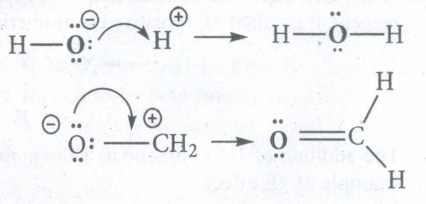
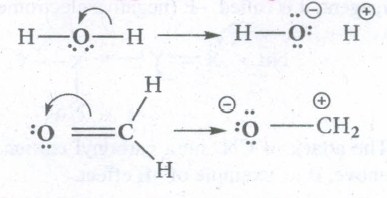
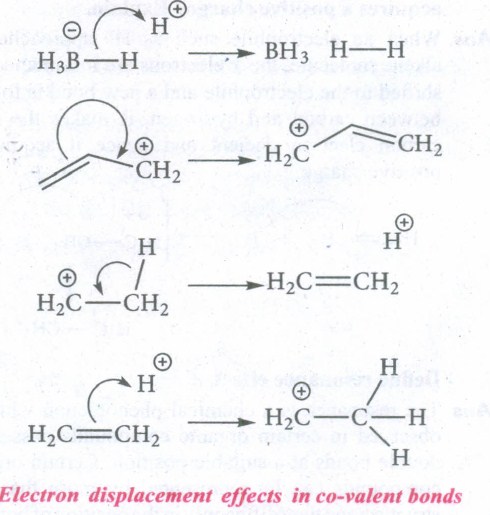
There are three types of electron movement viz.,
1. lone pair becomes a bonding pair.
2. bonding pair becomes a lone pair
3. a bond breaks and becomes another bond
Type 1: A lone pair to a bonding pair
Type 2: A bonding pair to a lone pair
Type 3: A bonding pair to an another bonding pair
28.
SN2 Mechanism :
(i) The rate of SN2 reaction depends upon the . concentration of both alkyl halide and the nucleophile.
(ii) Rate of reaction = is [alkylhalide] [nucleophile]. It follows second order kinetics and occurs in one step.
(iii) This reaction involves the formation of a transition state in which both the reactant molecules are partially bonded to each other. The attack of nucleophile occurs from the back side (i.e opposite to the side in which the halogen is attacked).
(iv) The carbon at which substitution occurs has inverted configuration during the course of reaction just as an umbrella has tendency to invert in a wind stonri. is inversion of configuration is called Walden inversion; after paul walden who 1st discovered the inversion of configuration of a compound in SN2reaction.
(v) SN2reaction of an optically active haloalkane . is always accompanied by inversion of configuration at the asymmetric centre.
(vi) When 2 - Bromooctane is heated with sodium hydroxide, 2 - octanol is formed with invesion of configuration. (-) - 2 - Bromo octane is heated with sodium hydroxide (+) - 2 - Octanol is formed in which - OR group occupies a position opposite to what bromine had occupied,
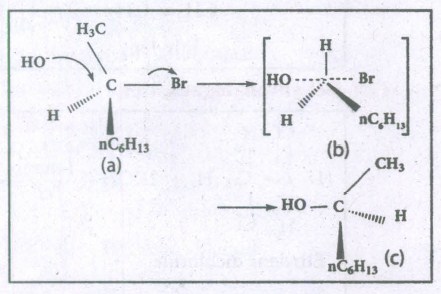
(a) (-).2 - Bromo octane
(b) Transition State
(c) (+) 2 - Octanol (product)
29.
A small piece of Na dried by pressing between the folds of a filter Paper is taken in a fusion tube and it is gently heated.
When it melts to a shining globule, put a pinch of the organic compound on it. Heat the tube till reaction ceases and becomes red hot. Plunge it in about 50 mL of distilled water taken in a china dish and break the bottom of the tube by striking against the dish. Boil the contents of the dish for about 10 mts and filter. This filtrate is known as lassaignes extract or sodium fusion extract and it used for detection of nitrogen, sulfur and halogens present in organic compounds.
If nitrogen is present it gets converted to sodium cyanide which reacts with freshly prepared furro,sulphate and feiric ion followed by conc. HCI and gives a Prussian blue color or green color precipitate. It confirms the presence of nitrogen. HCI is added to dissolve the lreenish precipitate of ferrous hydrbxide iroduced by the excess of NaOH on Feson which would otherwise markthe Prussian blue piecipitate. The following reaction takes part in the formation of Prussian blue.

from organic compounds
\(FeSo_{ 4 }+2NaOH\longrightarrow Fe(OH)_{ 2 }+Na_{ 2 }{ SO }_{ 4 }\)
from organic compounds
\(6FeCN+Fe(OH)_{ 2 }\longrightarrow Na_{ 4 }[Fe(CN)]_{ 6 }+2NaOH\)
Sod.ferrocyanide
\(3Na_{ 4 }[Fe(CN)_{ 6 }]+FeC1_{ 3 }\longrightarrow Fe_{ 4 }[Fe(CN)]_{ 3 }+12NaCI\)
ferric ferrocyanidePrussian blue or greenppt
Incase if both N & S are present, a blood red color is obtained due to the following reactions.
\(\mathrm{Na}+\mathrm{C}+\mathrm{N}+\mathrm{S} \stackrel{\text { Heat }}{\longrightarrow} \mathrm{NaCNS}\)
sodium sulphocyanide
\(3 \mathrm{NaCNS}+\mathrm{FeCl}_3 \longrightarrow \mathrm{Fe}(\mathrm{CNS})_3+3 \mathrm{NaCl}\)
ferric sulphocyanide
(Blood red colour).
30.
A ther mochemical equation is a balanced stoichiometric chemical equation that includes the enthalpy change (\(\Delta\)H).
Conventions adopted in thermochemical equations:
(i) The coefficients in a balanced thermochemical equation refer to number of moles of reactants and products involved in the reaction.
(ii) The enthalpy change of the reaction \(\Delta\)H has unit kJ.
(iii) When the chemical reaction is reversed, the value of H is reversed in sign with the same magnitude.
(iv) Physical states (gas, liquid, aqueous and solid) of all species is important and must be specified in a thermochemical reaction since H depends on the phases of reactants and products.
(v) If the thermochemical equation is multiplied throughout by a number, the enthalpy change is also be multiplied by the same number value.
(vi) The negative sign \(\Delta H_r^o\) of indicates the reaction to be an exothermic and the positive sign of \(\Delta H_r^o\) indicates an endothermic type of reaction.
31.
| Alkali Metals | Alkaline earth metals | |
|---|---|---|
| 1. | Alkali metals are soft | Alkaline earth metals are hard |
| 2. | They have a single electron in the valence shell and their electronic configuration is [noble gas] ns1. | They have two electrons in the valence shell and their electronic configuration is [noble gas] ns2 |
| 3. | They have low melting points | They have relatively high melting points |
| 4. | Hydroxides are strongly basic. | Hydroxides are less basic |
| 5. | Carbonates do not decompose | Carbonates decompose to form oxide, when heated to high temperatures. |
| 6. | Nitrates give corresponding nitrites and oxygen as products. | Nitrates give corresponding oxides nitrogen dioxide and oxygen as products. |
| 7. | They show + 1 oxidation states. | They show +2 oxidation states |
| 8. | Their carbonates are soluble in water except Li2CO3. | Their carbonates are insoluble in water. |
| 9. | Except Li, alkali metals do not form complex compounds. | They can form complex compounds. |
32.
Zn + NO3- ⟶ Zn + NH4+2 in basic medium
Zn ⟶ Zn+2 + 2e (oxidation) NO3- ⟶ NH4+ (Reduction)
Step-1: Balance all atoms other than hydrogen and oxygen.
Zn ⟶ Zn+2 NO3- ⟶ NH4+
Step-2: For balancing oxygen atom in alkaline medium, add H20 molecules on the side deficient of oxygen atom.
Then balance hydrogen atom, add H20 molecule to the side deficient in hydrogen and equal number of OH- on the other side.
Zn ⟶ Zn+2 NO3- ⟶ NH4-+3H2O
NO3- + 10H2O ⟶ NH4+ + 3H2O
NO3- + 10H2O ⟶ NH4+ + 3H2O + 10OH-
Step-3: Add electrons to balance charge
Zn ⟶ Zn+2 +2e
NO3- + 7H2O + 8e ⟶ NH4+ +10OH-
Zn ⟶ Zn+2 + 2e x 8
NO3- + 7H2O + 8e ⟶ NH4+ + 10OH-
___________________________________
8Zn + NO3- + 7H2O ⟶ 8Zn+2 + NH4+ + 10OH-
This is the balanced equation.
33.
Characteristics of p-block elements:
(i) General electronic configuration is ns2np1-6 (Group 13 to 18).
(ii) They are generally non-metals but some metals and metalloids are present.
(iii) They have high electron affinity and ionization enthalpy.
(iv) Oxidising character.
(v) s-block and p-block elements are collectively called representative elements.
34.
The electronic configuration of the element with 2K, 8L and 5M electrons will be
1s2 2s2 2px2 2py2 2pz2 3s2 3px1 3py1 3pz1
(i) Total number of electrons = 2 + 8 + 5 = 15
∴ Atomic number of the element = 15
(ii) Total number of s-electrons = 2 + 2 + 2 = 6
(iii) Total number of p-electrons = 6 + 3 = 9
(iv) Since, the atom is neutral
∴ Number of protons = Number of electrons = Atomic number = 15
(v) valency of the element = 3
35.
Statement : "No two electrons in an atom can have the same set of values of all four quantum numbers"
Explanation : It means that, each electron must have unique values for the four quantum numbers (n, l, m and s).
For the lone electron present in hydrogen atom, the four quantum numbers are: n = 1; l = 0; m = 0 and s = +1/2. For the two electrons present in helium, one electron has the quantum numbers same as the electron of hydrogen atom, n = 1.
l = 0, m = 0 and s = +1/2. For other electron, the fourth quantum number is different i.e., n = 1, l = 0, m = 0 and s = -1/2.
As we know that the spin quantum number can have only two values +1/2 and - 1/2, only two electrons can be accommodated in a given orbital in accordance with pauli exclusion principle.
| Atom | e- | n | l | m | s |
| Helium | First | 1 | 0 | 0 | +1/2 |
| Second | 1 | 0 | 0 | +1/2 |
36.
In \(\overset { .. }{ \underset { .. }{ O } } =C=\overset { .. }{ \underset { .. }{ O } } \)
Formal charge on carbon = \({ N }_{ v }-\left[ { N }_{ 1 }+\cfrac { { N }_{ b } }{ 2 } \right] =4-\left[ 0+\cfrac { 8 }{ 2 } \right] =4-4=0\)
Formal charge on oxygen = \({ N }_{ V }-\left[ { N }_{ 1 }+\cfrac { { N }_{ 2 } }{ 2 } \right] =6-\left[ 4+\cfrac { 4 }{ 2 } \right] =6-6=0\)
37.
Particulate pollutants are small solid particles and liquid droplets suspended in air. Many of particulate pollutants are hazardous.
Examples : dust, pollen, smoke, soot and liquid droplets (aerosols) etc,.
They are blown into the atmosphere by volcanic eruption, blowing of dust, incomplete combustion of fossil fuels induces soot. Combustion of high ash fossil fuels creates fly ash and finishing of metals throws metallic particles into the atmosphere.
The non- viable particulates are small solid particles and liquid droplets suspended in air. They help in the transportation of viable particles. There are four types of non-viable particulates in the atmosphere. They are classified according to their nature and size as follows.
(i) Smoke : Smoke particulate consists of solid particles (or) mixture of solid and liquid particles formed by combustion of organic matter.
For example, cigarette smoke, oil smoke, smokes from burning of fossil fuel, garbage and dry leaves.
(ii) Dust: Dust composed of fine solid particles produced during crushing and grinding of solid materials.
For example, sand from sand blasting, saw dust from wood works, cement dust from cement factories and fly ash from power generating units.
(iii) Mists : They are formed by particles of spray liquids and condensation of vapours in air.
For example, sulphuric acid mist, herbicides and insecticides sprays can form mists.
(iv) Fumes : Fumes are obtained by condensation of vapours released during sublimation, distillation, boiling and calcination and by several other chemical reactions.
For example : organic solvents, metals and metallic oxides form fume particles.
38.
Carbon halogen bond is a polar bond as halogens are more electro negative than carbon. The carbon atom exhibits a partial positive charge (\(\delta \)+) and halogen atom a partial negative charge (\(\delta \)-)
The C -X bond is formed by overlap of sp3 orbital of carbon atom I with half filled p-orbitat of the halogen atom. The atomic size of halogen increases from fluorine to iodine, which increases the C - X bond length. Larger the size, greater is the bond length, and weaker is the bond formed. The bond strength of C - X decreases from C - F to C - I in CH3X
39.

40.
No. of, moles of glucose ; n2 = \(\frac{\mathrm{m}}{\mathrm{M}}=\frac{2.82}{180}=0.016 \mathrm{~mol} \)
No. of. moles of water ; n1 = \(\frac{30}{18}=1.67 \mathrm{~mol} \)
\(\mathrm{X}_{1}=\frac{\mathrm{n}_{1}}{\mathrm{n}_{1}+\mathrm{n}_{2}}=\frac{1.67}{1.67+0.016}=0.99\)
\(\mathrm{X}_{1}+\mathrm{X}_{2}=1 \)
\(\therefore \mathrm{X}_{2}=1-\mathrm{X}_{1}=1-0.99=0.01 \).
41.
A reaction that does occur under the given set of conditions is called a spontaneous reaction.
Example:
1. A waterfall runs downhill, but never up, spontaneously.
2. Heat flows from hotter object to a colder one.
3. Ageing process.
42.
Empirical formula : It is the simplest formula of a compound which gives the ratio of the number of different atoms present in one molecule of the compound.
43.
i) Both (A) and R are correct and (R) is the correct explanation of (A)

11th Standard Syllabus & Materials
11th Standard
TN 11th Tamil பீடு பெற நில் - செய்யுள் - காவடிச்சிந்து Important Questions And Answers Study Material - QB365 Set A
NEW11th Standard
TN 11th Tamil பீடு பெற நில் - உரைநடை - மலை இடப்பெயர்கள் : ஓர் ஆய்வு Important Questions And Answers Study Material - QB365 Set A
NEW11th Standard
TN 11th Tamil மாமழை போற்றுதும் - துணைப்பாடம் - யானை டாக்டர் Important Questions And Answers Study Material - QB365 Set A
NEW11th Standard
TN 11th Tamil மாமழை போற்றுதும் - செய்யுள் - ஐங்குறுநூறு Important Questions And Answers Study Material - QB365 Set A



Tamilnadu Stateboard 11th Standard Subjects

Maths

Commerce

Economics

Biology

Business Maths and Statistics

Accountancy

Computer Science

Physics
Chemistry
Maths
Biology
Economics
Physics
Chemistry

History
Business Maths and Statistics

Computer Science
Accountancy

Computer Applications
History
Computer Technology
Commerce
Computer Applications
Computer Technology

Tamil

English

French
Tamilnadu Stateboard Standards
