
 100% FREE ACCESS
11th Standard Syllabus & Materials
11th Standard
TN 11th Tamil இயற்கை வேளாண்மை,சுற்றுச்சூழல் -செய்யுள் - மனோன்மணீயம் Important Questions And Answers Study Material - QB365 Set A
NEW11th Standard
TN 11th Tamil என்னுயிர் என்பேன் -துணைப்பாடம் - இசைத்தமிழர் இருவர் Important Questions And Answers Study Material - QB365 Set A
NEW11th Standard
TN 11th Tamil மொழி கலை -செய்யுள் - ஒவ்வொரு புல்லையும் Important Questions And Answers Study Material - QB365 Set A
NEW11th Standard
TN 11th Tamil பீடு பெற நில் - இலக்கணம் - பகுபத உறுப்புகள் Important Questions And Answers Study Material - QB365 Set A
NEW11th Standard
TN 11th Tamil பீடு பெற நில் - துணைப்பாடம் - வாடிவாசல் Important Questions And Answers Study Material - QB365 Set A
NEW11th Standard
TN 11th Tamil பீடு பெற நில் - செய்யுள் - குறுந்தொகை Important Questions And Answers Study Material - QB365 Set A

Published on: 12/10/2019
Environmental Chemistry
Download Tamil Nadu 11th Standard Chemistry question papers, model tests, one-mark questions, important questions, and public exam papers in PDF format. Free study materials and answer keys for TN State Board students.
Questions + Answers key
Take MCQ Chemistry Test
1.
Which among the following is a green house gas ?
H2
CH4
O3
All of these
2.
Biochemical oxygen Demand value less than 5 ppm indicates a water sample to be ______.
highly polluted
poor in dissolved oxygen
rich in dissolved oxygen
low COD
3.
Release of oxides of nitrogen and hydrocarbons into the atmosphere by motor vehicles is prevented by using __________.
grit chamber
scrubbers
trickling filters
catalytic convertors
4.
The pH of normal rain water is ________
6.5
7.5
5.6
4.6
5.
Which of the following is natural and human disturbance in ecology ?
Forest fire
Floods
Acid rain
Green house effect
6.
Write about Bhopal gas tragedy.
7.
Explain how does greenhouse effect cause global warming.
8.
Dissolved oxygen in water is responsible for aquatic life. What processes are responsible for the reduction in dissolved oxygen in water ?
9.
Define particulate pollutants.
10.
What is green house effect ?
11.
What are particulate pollutants ? Explain any three.
12.
What is green chemistry ?
13.
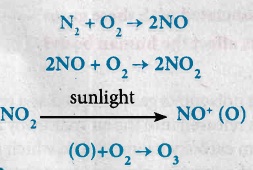
From where does ozone come in the photo chemical smog ?
14.
What are degradable and nondegradable pollutants ?
15.
16.
What are the various methods you suggest to protect our environment from pollution ?
17.
Explain how oxygen deficiency is caused by carbon monoxide in our blood ? Give its effect
18.
Differentiate the following
(i) BOD and COD
(ii) Viable and non-viable particulate pollutants
19.
Lead in water
20.
Lead
21.
Acid rain
22.
CO
23.
Earth's average surface temperature would be only about ................
24.
................. binds with hemoglobin and reduce the oxygen-carrying capacity of blood.
25.
.............. gas is used in the process of photosynthesis.
26.
An example for biodegradable pollutant is ..............
1.
(b)
CH4
2.
(c)
rich in dissolved oxygen
3.
(c)
trickling filters
4.
(c)
5.6
5.
(a)
Forest fire
6.
(i) On 3rd Decembers, 1984 at Bhopal city in India, by the early morning, an explosion at Union carbide pesticide plant released a cloud of toxic gas (Methyl isocyanate) CH3NCO into the air.
(ii) Since the gas is twice as heavy as air, it did not drift away but formed a blanket over the surrounding area.
(iii) It attacked people's lungs and affect their breathing staying there or in the nearby areas. Thousands of people died and lives of many were ruined. The lungs, brain, eyes, muscles as well as the gastrointestinal, neurological and immune system of those people who survived were severely affected.
7.
(i) Thus Greenhouse effect may be defined as the heating up of the earth surface due to trapping of infrared radiations reflected by earth's surface by CO2 layer in the atmosphere.
(ii) The heating up of earth through the greenhouse effect is called global warming.
(iii) Without the heating caused by the greenhouse effect, Earth's average surface temperature would be only about -18 oC (0 oF). Although the greenhouse effect is a naturally occurring phenomenon, it is intensified by the continuous ernission of greenhouse gases into the atmosphere.
(iv) During the past 100 years, the amount of carbon dioxide in the atmosphere increased by roughly 30 percent and the amount of methane more than doubled. If these trends continue, the average global temperature will increase which can lead to melting of polar ice caps and flooding of low lying areas. This will increase incidence of infectious diseases like dengue, malaria, etc.
8.
a) The growth of algae in extreme abundance covers the water surface and reduces the oxygen concentration in water. Thus, bloom-infested water inhibits the growth of other living organisms in the water body. This process in which the nutrient rich water bodies support a dense plant population, kills animal life by depriving it of orygen and results in loss of biodiversity is known as eutrophication.
b) Chemicals from industries
c) Toxic pesticides
d) Detergents and oil floats
e) Acids from mine drianage and salts from various sources.
9.
Particulate pollutants are small solid particles and liquid droplets suspended in air. Many of particulate pollutants are hazardous.
Examples : dust, pollen, smoke, soot and liquid droplets (aerosols) etc,.
10.
Thus Greenhouse effect may be denned as the heating up of the earth surface due to trapping of infrared radiations reflected by earth's surface by CO2 layer in the atmosphere.
11.
Particulate pollutants are small solid particles and liquid droplets suspended in air. Many of particulate pollutants are hazardous.
Examples : dust, pollen, smoke, soot and liquid droplets (aerosols) etc,.
They are blown into the atmosphere by volcanic eruption, blowing of dust, incomplete combustion of fossil fuels induces soot. Combustion of high ash fossil fuels creates fly ash and finishing of metals throws metallic particles into the atmosphere.
The non- viable particulates are small solid particles and liquid droplets suspended in air. They help in the transportation of viable particles. There are four types of non-viable particulates in the atmosphere. They are classified according to their nature and size as follows.
(i) Smoke : Smoke particulate consists of solid particles (or) mixture of solid and liquid particles formed by combustion of organic matter.
For example, cigarette smoke, oil smoke, smokes from burning of fossil fuel, garbage and dry leaves.
(ii) Dust: Dust composed of fine solid particles produced during crushing and grinding of solid materials.
For example, sand from sand blasting, saw dust from wood works, cement dust from cement factories and fly ash from power generating units.
(iii) Mists : They are formed by particles of spray liquids and condensation of vapours in air.
For example, sulphuric acid mist, herbicides and insecticides sprays can form mists.
(iv) Fumes : Fumes are obtained by condensation of vapours released during sublimation, distillation, boiling and calcination and by several other chemical reactions.
For example : organic solvents, metals and metallic oxides form fume particles.
12.
(i) Green chemistry is a chemical philosophy encouraging the design of products and Processes that reduce or eliminate the use and generation of hazardous substances.
(ii) For this, scientist are trying to develop methods to produce eco-friendly compounds. This can be best understood by considering the following example in which styrene is produced both by traditional and greener routes. To avoid carcinogenic benzene, greener route is to start with cheaper and environmentally safer xylenes.
(iii) Green chemistry means science of environmentally favourable chemical synthesis.
13.
Ozone is formed by a series of reactions that occur from the sun shines
14.
i. Bio-degradable pollutants :
The pollutants which can be easily decomposed by the natural biological processes are called bio-degradable pollutants.
Examples: plant wastes, animal wastes, etc.
ii. Non bio-degradable pollutants :
The pollutants which cannot be decomposed by the natural biological processes are called Non bio-degradable pollutants.
Examples : metal wastes (mainly Hg and Pb), D.D.T, plastics, nuclear wastes, etc., These pollutants are harmful to living organisms even in low concentration. As they are not degraded naturally,it is difficult to eliminate them from our environment.
15.
16.
1. Waste management : Environmental pollution can be controlled by proper disposal of wastes.
2. Recycling : a large amount of disposed waste material can be reused by recycling the waste, thus it reduces the land fill and converts waste into useful forms.
3. Substitution of less toxic solvents for highly toxic ones used in certain industrial processes.
4. Use of fuels with lower sulphur content (e.g., washed coal)
5. Growing more trees
6. Control measures in vehicle emissions are adequate.
7. Green chemistry philosophy can be followed.
8. Eco-friendly compounds should be developed.
g. Greener routes should be followed in our day to day life.
10. For dry cleaning liquified CO2 or H2O2 may be used.
11. Paper may be bleached by H2O2.
12. Methanol maybe used instead of petrol.
13. Neem based pesticides may be used.
14. Awareness among students and public may be created by using slogans like "Save water; Water will save You".
17.
It binds with haemoglobin and form carboxy haemoglobin which impairs normal oxygen transport by blood and hence the oxygen carrying capacity of blood is reduced. This oxygen deficiency results in headache, dizziness, tension, Loss of consciousness, blurring of eye sight and cardiac arrest.
18.
(i) BOD and COD
| No | BOD | COD |
| 1 | This is Bio chemical oxygen demand | This is chemical oxygen demand |
| 2 | The total amount of oxygen in milligrams consumed by microorganisms in decomposing the waste in one litre of water at 20o for a period of 5 days is called biochemical oxygen demand (BOD) |
Chemical oxygen demand (COD) is defined as the amount of oxygen required by the organic matter in a sample of water for its oxidation by strong oxidising agent like K2Cr2O7 in acid medium for a Period of 2 hrs. |
| 3 | It is expressed in ppm | It is expressed in mg/L |
| 4 | It is a measure of consumed oxygen | It isa measurement of requirement of dissolved oxygen. |
| 5 | In waste streams BOD levels are less than COD. | In waste streams COD levels are higher than than BOD. |
| 6 | BOD measurements takes 5 days | COD measurements takes 2 hrs only. |
(ii) Viable and non-viable particulate pollutants
| No | Viable particulates | Non - Viable Particulates |
| 1 | These are small sized living organisms which are dispersed in air. Eg : bacteria, fungi, moulds, algae, etc. |
These are small solid particles and liquid droplets suspended in air. Eg : Smoke, Dust, Mists, Fumes, etc. |
| 2 | Fungi causes allergy in humans and diseases in Plants. | Causes long cancer, asthma, affects mattuation of RBC, affects Photosynthesis, etc. |
| 3 | They do not help in the transportation of Particulates. | They help in transportation of viable particulates |
19.
Kidney damage
20.
affect central nervous system
21.
Stone leprosy
22.
Cardiac arrest
23.
()
-18°C
24.
()
CO
25.
()
CO2
26.
()
plant waste

11th Standard Syllabus & Materials
11th Standard
TN 11th Tamil பீடு பெற நில் - செய்யுள் - காவடிச்சிந்து Important Questions And Answers Study Material - QB365 Set A
NEW11th Standard
TN 11th Tamil பீடு பெற நில் - உரைநடை - மலை இடப்பெயர்கள் : ஓர் ஆய்வு Important Questions And Answers Study Material - QB365 Set A
NEW11th Standard
TN 11th Tamil மாமழை போற்றுதும் - துணைப்பாடம் - யானை டாக்டர் Important Questions And Answers Study Material - QB365 Set A
NEW11th Standard
TN 11th Tamil மாமழை போற்றுதும் - செய்யுள் - ஐங்குறுநூறு Important Questions And Answers Study Material - QB365 Set A



Tamilnadu Stateboard 11th Standard Subjects

Maths

Commerce

Economics

Biology

Business Maths and Statistics

Accountancy

Computer Science

Physics
Chemistry
Maths
Biology
Economics
Physics
Chemistry

History
Business Maths and Statistics

Computer Science
Accountancy

Computer Applications
History
Computer Technology
Commerce
Computer Applications
Computer Technology

Tamil

English

French
Tamilnadu Stateboard Standards
