
 100% FREE ACCESS
11th Standard Syllabus & Materials
11th Standard
TN 11th Tamil இயற்கை வேளாண்மை,சுற்றுச்சூழல் -செய்யுள் - மனோன்மணீயம் Important Questions And Answers Study Material - QB365 Set A
NEW11th Standard
TN 11th Tamil என்னுயிர் என்பேன் -துணைப்பாடம் - இசைத்தமிழர் இருவர் Important Questions And Answers Study Material - QB365 Set A
NEW11th Standard
TN 11th Tamil மொழி கலை -செய்யுள் - ஒவ்வொரு புல்லையும் Important Questions And Answers Study Material - QB365 Set A
NEW11th Standard
TN 11th Tamil பீடு பெற நில் - இலக்கணம் - பகுபத உறுப்புகள் Important Questions And Answers Study Material - QB365 Set A
NEW11th Standard
TN 11th Tamil பீடு பெற நில் - துணைப்பாடம் - வாடிவாசல் Important Questions And Answers Study Material - QB365 Set A
NEW11th Standard
TN 11th Tamil பீடு பெற நில் - செய்யுள் - குறுந்தொகை Important Questions And Answers Study Material - QB365 Set A

Published on: 12/10/2019
Haloalkanes and Haloarenes
Download Tamil Nadu 11th Standard Chemistry question papers, model tests, one-mark questions, important questions, and public exam papers in PDF format. Free study materials and answer keys for TN State Board students.
Questions + Answers key
Take MCQ Chemistry Test
1.
The order of correct bond energy of C - X bond is
C - C I > C - I > C - Br
C - CI > C - Br > C - I
C - I > C - CI > C - Br
C -I > C - Br > C - CI
2.
The raw material for Rasching process _________
chloro benzene
phenol
benzene
anisole
3.
The carbo cation formed in SN1 reaction of alkyl halide in the slow step is ________
sp3 hybridised
sp2 hybridised
sp hybridised
none of these
4.
Freon-12 is manufactured from tetrachloro methane by ____________
Wurtz reaction
Swarts reaction
Haloform reaction
Gattermann reaction
5.
Benzene reacts with Cl2 in the presence of FeCl3 and in absence of sunlight to form ________
Chlorobenzene
Benzyl chloride
Benzal chloride
Benzene hexachloride
6.
What should be the correct IUPAC name of diethyl chloromethane?
3 – Chloro pentane
1-Chloropentane
1-Chloro-1, 1, diethyl methane
1 –Chloro-1-ethyl propane
7.
With respect to the position of – Cl in the compound CH3 – CH = CH – CH2 – Cl, it is classified as __________
Vinyl
Allyl
Secondary
Aralkyl
8.
Define Walden inversion
9.
Explain the preparation of the following compounds
i) DDT
ii) Chloroform
iii) Biphenyl
iv) Chloropicrin
v) Freon-12
10.
What are Freons? Discuss their uses and environmental effects
11.
Mention any three methods of preparation of haloalkanes from alcohols.
12.
Give reasons for polarity of C-X bond in halo alkane.
13.
Why chlorination of methane is not possible in dark?
14.
Enlist the applications of haloalkanes.
15.
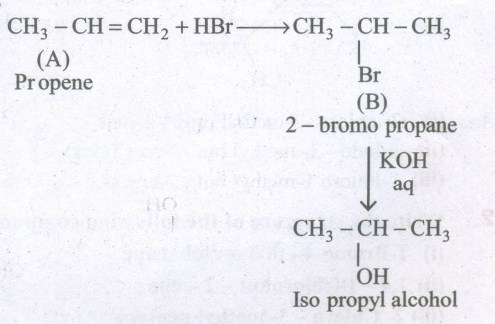
A hydrocarbon C3H6 (A) reacts with HBr to form compound (B). Compound (B) reacts with aqueous potassium hydroxide to give (C) of molecular formula C3H6O.what are (A) (B) and (C). Explain the reactions.
16.
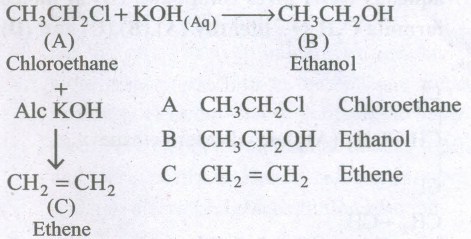
An organic compound (A) with molecular formula C2H5Cl reacts with KOH gives compounds (B) and with alcoholic KOH gives compound (C). Identify (A),(B), and (C)
17.
Arrange the following alkyl halide in increasing order of bond enthalpy of RX
CH3Br, CH3F, CH3Cl, CH3I
18.
Explain SN2 mechanism with suitable examples.
19.
Explain the mechanism involved in bimolecular nucleophilic substitution reaction.
20.
CH2Cl2
21.
CF2Cl2
22.
Iodoform
23.
Methane
24.
CH3Br + Aqueous KOH
25.
Haloalkane reacts with alcoholic solution of KOH to form_______
26.
In Swarts reaction, chloroalkane is converted to___________
27.
The IUPAC name of CH2=CHCI is__________
28.
_________is used as an anesthetic.
29.
________is used in the treatment of typhoid
1.
(b)
C - CI > C - Br > C - I
2.
(c)
benzene
3.
(b)
sp2 hybridised
4.
(b)
Swarts reaction
5.
(a)
Chlorobenzene
6.
(a)
3 – Chloro pentane
7.
(b)
Allyl
8.
The attack of nucleophile occurs from the back side (i.e opposite to the side in which the halogen is attacked). The carbon at which substitution occurs has inverted configuration during the course of reaction just as an umbrella has tendency to invert in a wind storm. This inversion of configuration is called Walden inversion.
9.
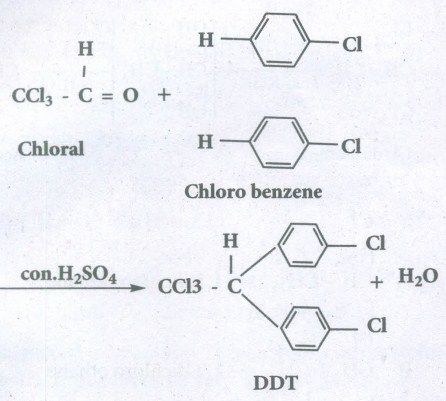
i) DDT: DDT can be prepared by heating a mixture of chlorobenzene with chloral (Trichloro acetaldehyde) in the presence of con. H2SO4,
ii) Chloroform :The reaction of methane with excess of chlorine in the presence of sunlight will give carbon tetrachloride as the major product.
\(\underset { Methane }{ { CH }_{ 4 }+4C{ l }_{ 2 }\overset { h\gamma }{ \longrightarrow } } +\underset { Carbon \ tetrachloride }{ 4HCl } \)
iii) Bipheenyl :
\(\underset { Chlorobenzene }{ { C }_{ 6 }{ H }_{ 5 }Cl } +2Na+Cl-{ C }_{ 6 }{ H }_{ 5 }\overset { Ether }{ \longrightarrow } \underset { Biphenyl }{ { C }_{ 6 }{ H }_{ 5 }-{ C }_{ 6 }{ H }_{ 5 }+2NaCl } \)
iv) Chloropicrin : Chloroform reacts with nitric acid to form chloropicrin.(Trichloro nitro methane)
\(\underset { Chloroform }{ { CH }_{ 3 }+HN{ O }_{ 3 }\overset { \triangle }{ \longrightarrow } } \underset { Chloropicrin }{ C{ Cl }_{ 3 }N{ O }_{ 2 }+{ H }_{ 2 }O } \)
v) Freon-12 :Freon - 12 is prepared by the action of hydrogen fluoride on carbon tetrachloride in . the presence of catalylic amount of antimony pentachloride. is is called swartz reaction
\(\underset { Carbontetrachloridew }{ { CCl }_{ 3 }+2HF\overset { SbC{ l }_{ 5 } }{ \longrightarrow } } \underset { Freon-12 }{ 2HC{ l }+CCl_{ 2 }F_{ 2 } } \)
10.
Freons (CFC): The chloro uoro derivatives of methane and ethane are called freons.
Uses:
(i) Freons are a used as refrigerants in refrigerators and air conditioners.
(ii) It is used as a propellant for aerosols and foams
(iii) It is used as propellant for foams to spray out deodorants, shaving creams, and insecticides
11.
Alcoholscanbeconvertedintohaloalkenesbyreactingit withanyoneofthefollowingreagent
1.hydrogen halide
2. Phosphorous halides
3. Thionyl chloride
a) Reaction with hydrogen halide:
\(\underset { Ethanol }{ { CH }_{ 3 }{ CH }_{ 2 }OH+HCl } \overset { Anhydrous\\ ZN{ Cl }_{ 2 } }{ \underset { \triangle }{ \longrightarrow } } \underset { Chloroethane }{ { CH }_{ 3 }{ CH }_{ 2 }Cl+{ H }_{ 2 }O } \)
Mixture of con.HCI and anhydrous ZnCl2 is called Lucas reagent
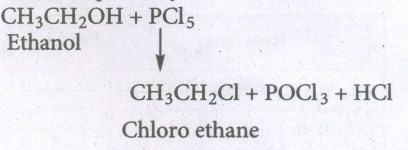
b) Reaction with phosphorous halides :
Alcohols react with PX5 or PX3 to form haloalkane. PBr3 and PI3 are usually generated in situ (produced in the reaction mixture) by the reaction of red phosphorus with bromine and iodine, respectively.
c)Reaction with thionyl chloride :
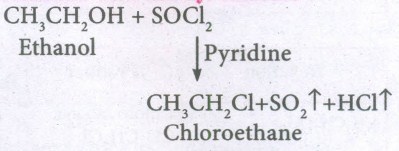
This reaction is known as Darzen's halogenation
12.
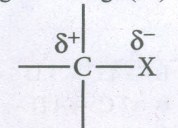
Carbon halogen bond is a polar bond as halogens are more electro negative than carbon. The carbon atom exhibits a partial positive charge (\(\delta \)+) and halogen atom a partial negative charge (\(\delta \)-)
The C -X bond is formed by overlap of sp3 orbital of carbon atom I with half filled p-orbitat of the halogen atom. The atomic size of halogen increases from fluorine to iodine, which increases the C - X bond length. Larger the size, greater is the bond length, and weaker is the bond formed. The bond strength of C - X decreases from C - F to C - I in CH3X
13.
The Chlorination of methane is carried out by free radical mechanism. The initiation step to form free radical needs high energy which is supplied by light energy.
\(\mathrm{Cl}-\mathrm{Cl} \stackrel{h \nu}{\longrightarrow} 2 \mathrm{Cl}\)
So this reaction is not possible in dark.
14.
Uses of haloalkane :
Chloroform : As a solvent in pharmaceutical industry and for producing pesticides and drugs As an anaesthetic.
As a preservative for anatomical specimens.
Iodoform : Iodoform is used as an antiseptic for dressing wounds.
Carbon tetrachloride : Carbon tetrachloride is used as dry cleaning agent. It is used as a solvent for oils, fats and waxes. As the vapour of CCl4 is non - combustible, it is used under the name pyrene for extinguishing the fire in oil or petrol.
15.
16.
17.
CH3I < CH3Br < CH3CI < CH3F
18.
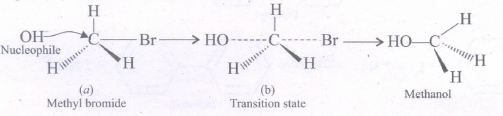
(i) SN2 reaction means bimolecular nucleophilic substitution reaction of second order.
(ii) The rate of SN2 reaction depends upon the concentration of both alkyl halides and the nucleophile.
(iii) This reaction involves the formation of a transition state in which both the reactant molecules are partially bonded to each other. The attack of nucleophile occurs from the back side.
(iv) The carbon at which substitution occurs has inverted configuration during the course of reaction just as an umbrella has the tendency to invert in a wind-storm. This inversion of configuration is called walden inversion.
19.
SN2 Mechanism :
(i) The rate of SN2 reaction depends upon the . concentration of both alkyl halide and the nucleophile.
(ii) Rate of reaction = is [alkylhalide] [nucleophile]. It follows second order kinetics and occurs in one step.
(iii) This reaction involves the formation of a transition state in which both the reactant molecules are partially bonded to each other. The attack of nucleophile occurs from the back side (i.e opposite to the side in which the halogen is attacked).
(iv) The carbon at which substitution occurs has inverted configuration during the course of reaction just as an umbrella has tendency to invert in a wind stonri. is inversion of configuration is called Walden inversion; after paul walden who 1st discovered the inversion of configuration of a compound in SN2reaction.
(v) SN2reaction of an optically active haloalkane . is always accompanied by inversion of configuration at the asymmetric centre.
(vi) When 2 - Bromooctane is heated with sodium hydroxide, 2 - octanol is formed with invesion of configuration. (-) - 2 - Bromo octane is heated with sodium hydroxide (+) - 2 - Octanol is formed in which - OR group occupies a position opposite to what bromine had occupied,
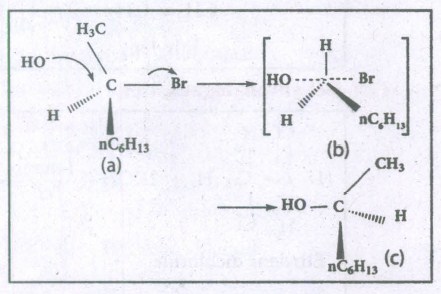
(a) (-).2 - Bromo octane
(b) Transition State
(c) (+) 2 - Octanol (product)
20.
Solvent in paint remover
21.
Refrigent in refrigerator
22.
Antiseptic
23.
CH3MgI + H2O
24.
SN2 mechanism
25.
()
Alkene
26.
()
Fluoroalkane
27.
()
Chloroethene
28.
()
Halothane
29.
()
chloramphenicol

11th Standard Syllabus & Materials
11th Standard
TN 11th Tamil பீடு பெற நில் - செய்யுள் - காவடிச்சிந்து Important Questions And Answers Study Material - QB365 Set A
NEW11th Standard
TN 11th Tamil பீடு பெற நில் - உரைநடை - மலை இடப்பெயர்கள் : ஓர் ஆய்வு Important Questions And Answers Study Material - QB365 Set A
NEW11th Standard
TN 11th Tamil மாமழை போற்றுதும் - துணைப்பாடம் - யானை டாக்டர் Important Questions And Answers Study Material - QB365 Set A
NEW11th Standard
TN 11th Tamil மாமழை போற்றுதும் - செய்யுள் - ஐங்குறுநூறு Important Questions And Answers Study Material - QB365 Set A



Tamilnadu Stateboard 11th Standard Subjects

Maths

Commerce

Economics

Biology

Business Maths and Statistics

Accountancy

Computer Science

Physics
Chemistry
Maths
Biology
Economics
Physics
Chemistry

History
Business Maths and Statistics

Computer Science
Accountancy

Computer Applications
History
Computer Technology
Commerce
Computer Applications
Computer Technology

Tamil

English

French
Tamilnadu Stateboard Standards
