
 100% FREE ACCESS
11th Standard Syllabus & Materials
11th Standard
TN 11th Tamil இயற்கை வேளாண்மை,சுற்றுச்சூழல் -செய்யுள் - மனோன்மணீயம் Important Questions And Answers Study Material - QB365 Set A
NEW11th Standard
TN 11th Tamil என்னுயிர் என்பேன் -துணைப்பாடம் - இசைத்தமிழர் இருவர் Important Questions And Answers Study Material - QB365 Set A
NEW11th Standard
TN 11th Tamil மொழி கலை -செய்யுள் - ஒவ்வொரு புல்லையும் Important Questions And Answers Study Material - QB365 Set A
NEW11th Standard
TN 11th Tamil பீடு பெற நில் - இலக்கணம் - பகுபத உறுப்புகள் Important Questions And Answers Study Material - QB365 Set A
NEW11th Standard
TN 11th Tamil பீடு பெற நில் - துணைப்பாடம் - வாடிவாசல் Important Questions And Answers Study Material - QB365 Set A
NEW11th Standard
TN 11th Tamil பீடு பெற நில் - செய்யுள் - குறுந்தொகை Important Questions And Answers Study Material - QB365 Set A

Published on: 09/10/2019
Hydrocarbons
Download Tamil Nadu 11th Standard Chemistry question papers, model tests, one-mark questions, important questions, and public exam papers in PDF format. Free study materials and answer keys for TN State Board students.
Questions + Answers key
Take MCQ Chemistry Test
1.
An alkane is obtained by decarboxylation of sodium propionate. Same alkane can be prepared by __________
Catalytic hydrogenation of propene
action of sodium metal on iodomethane
reduction of 1 – chloro propane
reduction of bromomethane
2.
Some meta-directing substituents in aromatic substitution are given. Which one is most deactivating?
– COOH
– NO2
– C ≡ N
– SO3H
3.
The major product formed when 2 – bromo – 2 – methyl butane is refluxed with ethanolic KOH is ___________
2 – methylbut – 2 – ene
2 – methyl butan – 1 – ol
2 – methyl but – 1 – ene
2 – methyl butan – 2 – ol
4.
The compound that will react most readily with gaseous bromine has the formula (NEET)_____________
C3H6
C2H2
C4H10
C2H4
5.
Which of the following is optically active _________
2 – methyl pentane
citric acid
Glycerol
none of these
6.
How are alkynes prepared from the following?
(i) Alkenes
(ii) Gem dihalides
(iii) Potassium maleate
(iv) Calcium carbide
7.
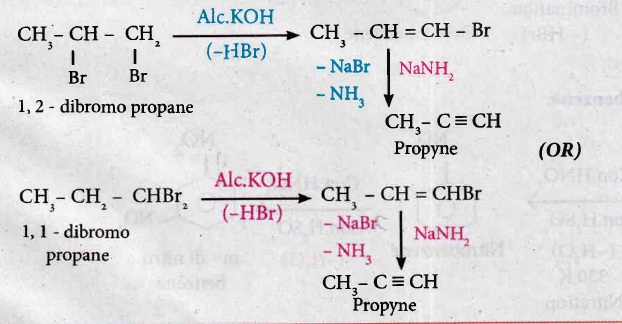
How is propyne prepared from an alkyene dihalide?
8.
Identify the compound A, B, C and D in the following series of reactions
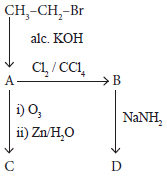
9.
How to write the possible isomers of C5H12?
10.
State Huckel's rule of aromaticity and explain it interms of cyclopentadiene, cycloxtateraene and cyclopropenylcation.
11.
Write a brief note on polymerisation of alkenes.
12.
Listout the uses of alkanes.
13.
What happens when isobutylene is treated with acidified potassium permanganate?
14.
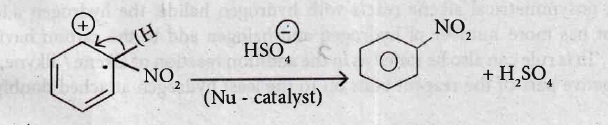
Describe the mechanism of Nitration of benzene.
15.
How will you prepare propane from a sodium salt of fatty acid?
16.
Write the structures of folowing alkanes.
1) 2, 3 – Dimethyl – 6 – (2 – methyl propyl) decane
2) 5 – (2 – Ethyl butyl) – 3, 3 – dimethyldecane
3) 5 – (1, 2 – Dimethyl propyl) – 2 – methylnonane.
17.
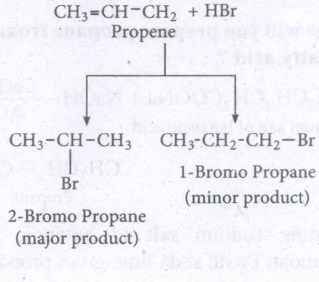
Explain Markow nikoff's rule with suitable example.
18.
Describe the conformers of n - butane.
19.
HDPE
20.
C3H4
21.
C4H10
22.
Alkyne
23.
Alkane
24.
Benzene contains_____ σ bonds and π bonds
25.
Addition of hydrohalides to alkene is an example for________
26.
The potential energy difference between the staggered and eclipsed conformation of ethane is_________
27.
Sodalime is the mixture of_______
1.
(b)
action of sodium metal on iodomethane
2.
(b)
– NO2
3.
(a)
2 – methylbut – 2 – ene
4.
(a)
C3H6
5.
(d)
none of these
6.
1. Preparation of alkynes from alkenes :
This process involves two steps:
(i) Halogenation of alkenes to form vicinal dihalides
(ii) Dehalogenation of vicinal dihalides to form alkynes.
\({ CH }_{ 2 }={ CH }_{ 2 }+{ Br }_{ 2 }\rightarrow \overset { { CH }_{ 2 } }{ \underset { Br }{ | } } \overset { -{ CH }_{ 2 } }{ \underset { Br }{ | } } \overset { Alcoholic\quad KOH }{ \longrightarrow } \overset { CH={ CH }_{ 2 } }{ \underset { Br }{ | } } \overset { Na{ NH }_{ 2 } }{ \underset { \underset { -{ NH }_{ 3 } }{ -NaBr } }{ \longrightarrow } } CH\equiv CH\)
1,2-Dibromoethane Bromoethane Acetylene
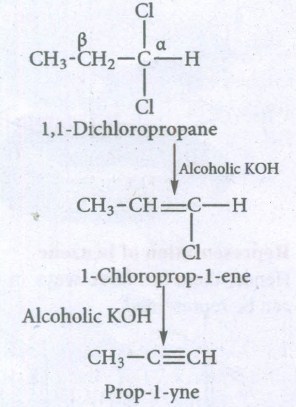
2. Preparation of alkene from gem dihalides:
A compound containing two halogen atoms on the same carbon atom is called gem dihalide (Latin word 'Gemini' means twins). On heating with alcoholic KOH, gem dihalides give alkynes.
3. Preparation of alkenes from electrolysis of salts of Unsaturated Dicarboxylic Acids. (Kolbe's Electrolytic Method)
Electrolysis of sodium or potassium salt of maleic or fumaric acid yields alkynes.
\(\overset { CHCOOK }{ \underset { CHCOOK }{ | } } \overset { Eletrolysis }{ \longrightarrow } \overset { { CHCOO }^{ - } }{ \underset { { CHCOO }^{ - } }{ || } } +{ 2K }^{ + }\)
Potassium maleate
\(\overset { { CHCOO }^{ - } }{ \underset { CH{ COO }^{ - } }{ || } } \longrightarrow \overset { CH }{ \underset { CH }{ ||| } } +2{ CO }_{ 2 }+{ 2e }^{ - }\)
Acetylene
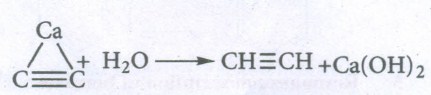
4. Industrial preparation of ethyne:
Ethyne can be manufactured in large scale by action of calcium carbide with water.
7.
8.
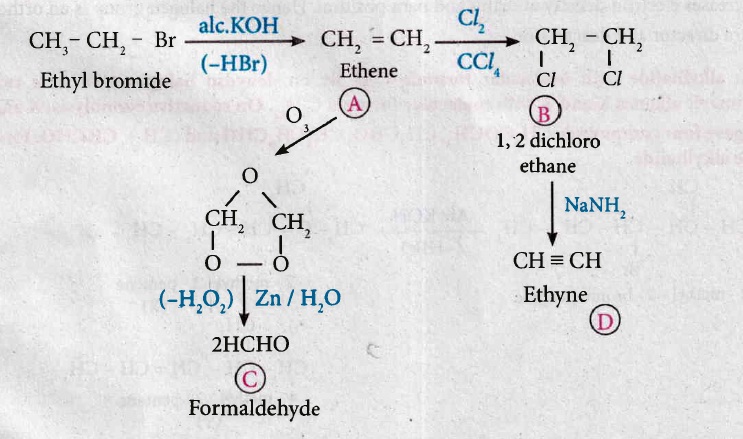
| compound | Structural formula | Name |
| A | CH2 = CH2 | Ethene |
| B | 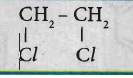 |
1,2 - dichloroethane |
| C | HCHO | Methanal |
| D | \(\mathrm{CH} \equiv \mathrm{CH}\) | Ethyne |
9.
(i) To begin draw the carbon backbone of the straight chain isomer
C-C-C-C-C
(ii) To determine the carbon backbone structure of the other isomers, arrange the carbon atoms in the other way:
(a) \(C-\underset { \overset { | }{ C } }{ C } -C-C\)
(b) \(C-\overset { \underset { | }{ C } }{ \underset { \overset { | }{ C } }{ C } } -C\)
(iii) Fill in all the hydrogen atoms so that each carbon forms four bonds
(a) CH3-CH2-CH2-CH2-CH2
(b) \({ CH }_{ 3 }-\underset { \overset { | }{ { CH }_{ 3 } } }{ C } H-{ CH }_{ 2 }-{ CH }_{ 3 }\)
(c) \(CH_{ 3 }-\overset { \underset { | }{ { CH }_{ 3 } } }{ \underset { \overset { | }{ { CH }_{ 3 } } }{ C } } -{ CH }_{ 3 }\)
10.
Huckel proposed that aromaticity is a function of electronic structure. A compound may be aromatic, if it obeys the following rules
(i) The molecule must be co-planar
(ii) Complete delocalization of \(\pi\) electron in the ring
(iii) Presence of (4n+2) \(\pi\) electrons in the ring where n is an integer (n=0,1,2 .... ) is known as Huckle's rule.
| 1. | 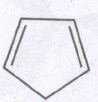 Cyclo penta diene |
(i) It has a planar Structure (ii) It has four \(\pi\) electron but the elecron are not delocalised and hence it is not an aromatic compound. |
| 2. | 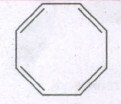 Cyclooctatetraene |
Molecule is non-planar and hence it is not an aromatic compound. |
| 3. | 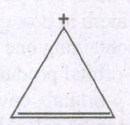 Cyclopropenylcation |
(i) Cyclopropenyl cation has planar structure. (ii) It has 2 delocalised \(\pi\) electron. (iii) 4n + 2 = 2 4n = 0 n = 0 (an interger) and hence it is aromatic compount. |
11.
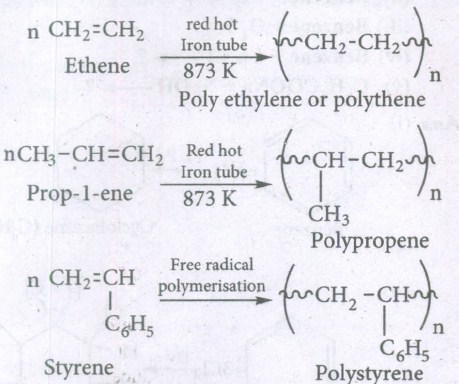
Polymerisatlon:
A polymer is a large molecule formed by the combination of larger number of small molecules. The process in known as polymerisation. Alkenes undergo polyrnerisation at high temperature and pressure, in the presence of a catalyst.
12.
The exothermic nature of alkane combustion reaction explains the extensive use of alkanes as fuels. Methane present in natural gas is used in home heating. Mixture of propane and butane are known, as LPG gas which is used for domestic cooking purpose. GASOLINE is a complex mixture of many hydrocarbons used as a fuel for internal-combustion engines.
Carbon black is used in the manufacture of ink, printer ink and black pigments. .It is also used as fillers.
| No of Carbon Atoms | State at room temperature | Major uses |
|---|---|---|
| 1-4 | Gas | Heating fuel, Cooking fuel |
| 5-7 | Low boiling liquid | Solvents, Gasoline |
| 6-12 | Liquid | Gasoline |
| 12-24 | Liquid | Jet fuel- portable stove fuel |
| 18-50 | High boiling liquid | Diesel fuel, lubricant, heating oil |
| 50+ | Solid | Petroleum jelly and paran wax |
13.
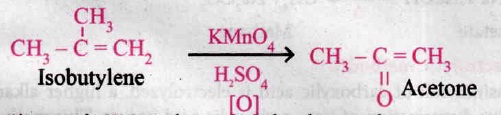
The purple KMnO4 becomes colourless producing acetone.
14.
Benzene undergoes nitration reaction becasuse it is an elecron - rich system due to delocalised \(\pi\) electron. So it is easily attacked by electrophiles and gives substituted products.

Mechanism:
Step - I : Formafion of the electrophile:

Step - II : Formation of carbocation intermediate:
The electrophile attacks the aromatic ring to form a carbocation intermediate which is stabilised by resonance.

Step - III: Formation of nitro benzene:
The electrophile attacks the artomatic ring to fo
15.
CH3CH2CH2COONa + NaOH \(\overset { CaO }{ \underset { \Delta }{ \rightarrow } } \)CH3CH2 - CH3+Na2CO3
Sodium salt of butanaic acid Propane
Heating sodium salt of butanoic acid (Sodium butanoate) with soda lime gives propane.
16.
(i)\({ CH }_{ 3 }-\overset { \overset { { CH }_{ 3 } }{ | } }{ { CH }-\underset { \overset { | }{ { CH }_{ 3 } } }{ CH } - } CH_{ 2 }-{ CH }_{ 2 }-\overset { \overset { { CH }_{ 2 }-\overset { \underset { | }{ { CH }_{ 3 } } }{ CH } -{ CH }_{ 3 } }{ | } }{ CH- } { CH }_{ 2 }-{ CH }_{ 2 }-{ CH }_{ 2 }-{ CH }_{ 3 }\)
(ii) 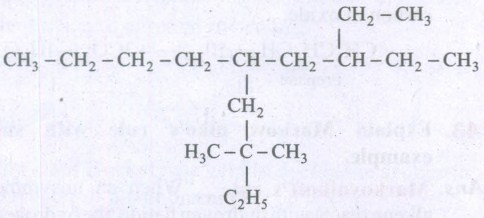
(iii) \({ CH }_{ 3 }-\underset { \underset { { CH }_{ 3 } }{ | } }{ CH } -{ CH }_{ 2 }-{ CH }_{ 2 }-\underset { \overset { | }{ \overset { CH-CH_{ 3 } }{ \overset { | }{ { H }_{ 3 }C-CH-{ CH }_{ 3 } } } } }{ CH } -{ CH }_{ 2 }-{ CH }_{ 2 }-{ CH }_{ 2 }-{ CH }_{ 3 }\)
17.
Markovnikoff's rule: "When an unsymmetrical alkene reacts with hydrogen halide, the hydrogen adds to the carbon that has more number of hydrogen and halogen add to the carbon having fewer hydrogen".
Eg: Addition HBr to unsymmetrical alkene: In the addition of hydrogen halide to an unsymmetrical alkene, two products are obtained.
18.
Conformations of n-Butane: n-Butane may be considered as a derivative of ethane, as one hydrogen on each carbon is replaced by a methyl group
Eclipsed conformation: In this conformation, the distance between the two methyl group is minimum. So there is maximum repulsion between them and it is the least stable conformer.
Anti or staggered form: In this conformation, the distance between the two methyl groups is maximum and so there is minimum repulsion between them. And it is the most stable conformer.
19.
Juice containers
20.
1
21.
2
22.
CnH2n-2
23.
CnH2n+2
24.
()
12,3
25.
()
Electrophilic addition
26.
()
12.5 kJ/mol
27.
()
NaOH + CaO

11th Standard Syllabus & Materials
11th Standard
TN 11th Tamil பீடு பெற நில் - செய்யுள் - காவடிச்சிந்து Important Questions And Answers Study Material - QB365 Set A
NEW11th Standard
TN 11th Tamil பீடு பெற நில் - உரைநடை - மலை இடப்பெயர்கள் : ஓர் ஆய்வு Important Questions And Answers Study Material - QB365 Set A
NEW11th Standard
TN 11th Tamil மாமழை போற்றுதும் - துணைப்பாடம் - யானை டாக்டர் Important Questions And Answers Study Material - QB365 Set A
NEW11th Standard
TN 11th Tamil மாமழை போற்றுதும் - செய்யுள் - ஐங்குறுநூறு Important Questions And Answers Study Material - QB365 Set A



Tamilnadu Stateboard 11th Standard Subjects

Maths

Commerce

Economics

Biology

Business Maths and Statistics

Accountancy

Computer Science

Physics
Chemistry
Maths
Biology
Economics
Physics
Chemistry

History
Business Maths and Statistics

Computer Science
Accountancy

Computer Applications
History
Computer Technology
Commerce
Computer Applications
Computer Technology

Tamil

English

French
Tamilnadu Stateboard Standards
