
 100% FREE ACCESS
11th Standard Syllabus & Materials
11th Standard
TN 11th Tamil இயற்கை வேளாண்மை,சுற்றுச்சூழல் -செய்யுள் - மனோன்மணீயம் Important Questions And Answers Study Material - QB365 Set A
NEW11th Standard
TN 11th Tamil என்னுயிர் என்பேன் -துணைப்பாடம் - இசைத்தமிழர் இருவர் Important Questions And Answers Study Material - QB365 Set A
NEW11th Standard
TN 11th Tamil மொழி கலை -செய்யுள் - ஒவ்வொரு புல்லையும் Important Questions And Answers Study Material - QB365 Set A
NEW11th Standard
TN 11th Tamil பீடு பெற நில் - இலக்கணம் - பகுபத உறுப்புகள் Important Questions And Answers Study Material - QB365 Set A
NEW11th Standard
TN 11th Tamil பீடு பெற நில் - துணைப்பாடம் - வாடிவாசல் Important Questions And Answers Study Material - QB365 Set A
NEW11th Standard
TN 11th Tamil பீடு பெற நில் - செய்யுள் - குறுந்தொகை Important Questions And Answers Study Material - QB365 Set A

Published on: 23/10/2018
OCTOBER MONTHLY TEST
Download Tamil Nadu 11th Standard Chemistry question papers, model tests, one-mark questions, important questions, and public exam papers in PDF format. Free study materials and answer keys for TN State Board students.
Questions + Answers key
Take MCQ Chemistry Test
1.
Quicklime is _________
CaCO3
CaO
Ca(OH)2
CaSiO3
2.
Match the list I with List II and select the correct answer using. the code given below the lists.
| List I | List II | ||
|---|---|---|---|
| A | Ba | 1 | Crimson red |
| B | Ca | 2 | Lilac |
| C | Sr | 3 | Apple green |
| D | K | 4 | Brick red |
| A | B | C | D |
| 1 | 3 | 2 | 4 |
| A | B | C | D |
| 4 | 3 | 1 | 2 |
| A | B | C | D |
| 3 | 4 | 1 | 2 |
| A | B | C | D |
| 2 | 1 | 4 | 3 |
3.
Which of the following oxides is the most basic in nature?
Na2O
BeO
Li2O
H2O
4.
The correct increasing order of density of alkali metal is _____________
Li < K < Na < Rb < Cs
Li < Na > K < Rb < Cs
K < Li < Rb < Na
Cs < Rb < K < Na < Li
5.
The order of decreasing ionisation enthalpy in alkali metals is _____________
Na > Li > K > Rb
Rb < Na < K < Li
Li > Na > K > Rb
K < Li < Na < Rb
6.
The hydration enthalpies of alkali metal ions decreases in ______ order.
Li+ > Na+ > K+ > Rb+ > Cs+
Cs+ > Rb+ > K+ > Na+ > Li+
Li+ > Rb+ > K+ > Na+ > Cs+
Rb+ > Cs+ > K+ > Na+ > Li+
7.
Half life of francium is _______
12.3 years
12.3 mins
21 years
21 mins
8.
Among the following the least thermally stable is ___________
K2CO3
Na2CO3
BaCO3
Li2CO3
9.
Match the flame colours of the alkali and alkaline earth metal salts in the bunsen burner
| (P) Sodium | (1) Brick red |
| (q) Calcium | (2) Yellow |
| (r) Barium | (3) Violet |
| (s) Strontium | (4) Apple green |
| (t) Cesium | (5) Crimsonred |
| (u) Potassium | (6) Blue |
p - 2, q - 1, r - 4, s - 5, t - 6, u - 3
p - 1, q - 2, r - 4, s - 5, t - 6, u - 3
p - 4, q - 1, r - 2, s - 3, t - 5, u - 6
p - 6, q - 1, r - 2, s - 3, t - 5, u - 4
10.
11.
Which of the following has the highest tendency to give the reaction \(M_{g}^{+}\xrightarrow[Medium]{Aqueous}M_{aq}^{+}\)
Na
Li
Rb
K
12.
Which of the following compounds will not evolve H2 gas on reaction with alkali metals ?
ethanoic acid
ethanol
phenol
none of these
13.
Which of the following statements is in correct ?
Li+ has minimum degree of hydration among alkali metal cations
The oxidation state of K in KO2 is +1
Sodium is used to make Na / Pb alloy
MgSO4 is readily soluble in water
14.
For alkali metals, which one of the following trends is incorrect ?
Hydration energy: Li > Na > K > Rb
Ionisation energy: Li > Na > K > Rb
Density: Li < Na < K < Rb
Atomic size: Li < Na < K < Rb
15.
Assertion : BeSO4 is soluble in water while BaSO4 is not
Reason : Hydration energy decreases down the group from Be to Ba and lattice energy remains almost constant.
(a) both assertion and reason are true and reason is the correct explanation of assertion
(b) both assertion and reason are true but reason is not the correct explanation of assertion
(c) both assertion and reason are false.
(d) Both assertion and reason are false
both assertion and reason are true and reason is the correct explanation of assertion
both assertion and reason are true but reason is not the correct explanation of assertion
assertion is true but reason is false
both assertion and reason are false.
16.
What is the effect of heat on the following compounds (Give equations for the reactions)?
(i) CaCO3
(ii) CaSO4.2H2O
17.
Beryllium and magnesium do not give colour to flame whereas other alkaline earth metals do so. Why?
18.
Mention the uses of quick lime
19.
What is 'dead burnt plaster'? What is use?
20.
Explain the term 'desert rose'.
21.
What is slaked lime? How is it produced?
22.
Give equations for the reaction of CaO with
(i) H2O
(ii) CO2
(iii) SiO2
(iv) P4O10.
23.
Arrange the following as indicated.
(i) BeSO4, MgSO4 CaSO4, SrSO4 and BaSO4 in the increasing order of solubility.
(ii) Be (NO3)2, Mg(NO3)2 , Ca(NO3)2 , Sr(NO3)2 , Ba(NO3)2 < Ba(NO3)2 in decreasing order of forming hydrated salts.
24.
How does (i) solubility, (ii) thermal stability, (iii) basic character hydroxides of group 2 elements very down the group.
25.
What is the cause for diagonal relationship between beryllium and aluminium?
26.
Discuss the biological importance of sodium and potassium.
27.
How is sodium bicarbonate prepared?
28.
Write the chemical equations for the reactions involved in solvay process of preparation of sodium carbonate.
29.
Why sodium hydroxide is much more water soluble than chloride ?
30.
Write balanced chemical equation for the following processes
Heating calcium in oxygen
31.
Give the systematic names for the following
Milk of magnesia
32.
Explain what is meant by efflorescence.
33.
Draw the structure of BeCl2 in different physical state
34.
Be(OH)2 is amphoteric in nature. Prove it
35.
Explain the action of ammonia on alkali metals (or) AtAi metals dissolve in liquid ammonia to give deep blue solution. Why?
36.
Although IE1 values of alkaline earth metals are higher than that of alkali metals the IE2 values of alkaline earth metals are much smaller than alkali metals. Explain.
37.
Explain the Castner-Kellner process of manufacturing sodium hydroxide.
38.
Explain the solvay process of manufacturing sodium carbonate.
39.
Explain why?
(i) The ionic character of hydrides of alkali metals increase from Li to Cs.
(ii) The stability of hydrides decrease down the group.
(iii) Hydrides behave as strong reducing agents.
40.
How would you explain the following observation? BeO is almost insoluble but BeSO4 is soluble in water.
41.
How is bleaching powder prepared ?
42.
Complete and balance the following equations for the reactions given between
(i) Slaked lime + CO2 + H2O
(ii) Quick lime + CO2
(iii) Slaked lime + CO2
(iv) Be(OH)2 + HCl + H2O
43.
Compare the properties of beryllium with other elements of the same group.
44.
Be and Mg do not give colour to flame whereas other alkaline earth metals do so. Why?
45.
Why is the behaviour of beryllium is different from the other elements of the same group?
46.
What is meant by 'diagonal relationship' in periodic table? Why is it so?
47.
List down the uses of washing soda
48.
Alkali metals have low melting and boiling point. Density of alkali metals is very low. Give reason.
49.
Why alkaline earth metals are harder than alkali metals.
50.
An alkali metal (x) forms a hydrated sulphate, X2SO4 • 10 H2O. Is the metal more likely to be sodium (or) potassium.
51.
Give the uses of gypsum.
52.
How is plaster of paris prepared ?
53.
Beryllium halides are Covalent whereas magnesium halides are ionic why ?
54.
Mention the uses of plaster of paris
55.
Substantiate lithium fluoride has the lowest solubility among group one metal fluorides.
56.
Distinguish between alkali metals and alkaline earth metals.
57.
Describe the biological importance of sodium and potassium.
58.
Discuss the anomalous behaviour of beryllium.
59.
An element A belonging to group 2 and period 2 reacts with chlorine at an elevated temperature to give compound (B) compound B combines with LiAlH4 to form compound (C). Which is an hydride identify A, B, and C?
60.
An element belongs to group 1 and period 3 reacts with chlorine gas to form A. (A) reacts with ammonium bicarbonate to give compounds (B) and (C). Compound (B) is then heated to give compound (D). Identify A, B, C and D and write the respective equations.
61.
62.
Explain the important common features of Group 2 elements.
63.
Alkaline earth metal (A), belongs to 3rd period reacts with oxygen and nitrogen to form compound (B) and (C) respectively. It undergo metal displacement reaction with AgNO3 solution to form compound (D).
64.
Discuss briefly the similarities between beryllium and aluminium.
65.
Which would you expect to have a higher melting point magnesium oxide or magnesium fluoride ? Explain your reasoning.
1.
(b)
CaO
2.
(c)
| A | B | C | D |
| 3 | 4 | 1 | 2 |
3.
(a)
Na2O
4.
(a)
Li < K < Na < Rb < Cs
5.
(c)
Li > Na > K > Rb
6.
(a)
Li+ > Na+ > K+ > Rb+ > Cs+
7.
(d)
21 mins
8.
(d)
Li2CO3
9.
(a)
p - 2, q - 1, r - 4, s - 5, t - 6, u - 3
10.
(c)
11.
(b)
Li
12.
(d)
none of these
13.
(a)
Li+ has minimum degree of hydration among alkali metal cations
14.
(c)
Density: Li < Na < K < Rb
15.
(a) both assertion and reason are true and reason is the correct explanation of assertion
16.
(i) \(CaCO_3\xrightarrow{heat}CaO+CO_2\)
(ii) \(CaSO_4.2H_2O\xrightarrow{heat}\underset{Dead\ burnt\ plaster}{CaSO_4}+2H_2O\)
17.
Due to small size, the ionization enthalpies of Be and Mg are much higher than those of other alkaline earth metals. Therefore, a large amount of energy is needed to excite their valence electron and that's why they do not impart colour to the flame.
18.
Calcium oxide (quick lime) is used
(i) to manufacture cement, mortar and glass.
(ii) in the manufacture of sodium carbonate and slaked lime.
(iii) in the purification of sugar.
(iv) as drying agent
19.
Anhydrous calcium sulphate formed by heating plaster of Paris above 393 K is known a dead burnt plaster. It has a remarkable property of setting with water. On mixing adequate quantity of water, it forms a plastic mass that gets into a hard solid in 5 to 15 minutes.
20.
Gypsum crystals are sometimes found to occur in a form that resembles the petals of a flower. This type of formation is referred to as 'desert rose' , as they mostly occur in arid areas or desert terrains.
21.
Calcium hydroxide (Ca(OH)2) is called slaked lime. It is formed by the addition of limited amount of water as quick lime.
CaO + H2O ⟶ Ca(OH)2
22.
(i) CaO + H2O ⟶ Ca(OH)2 (Calcium hydroxide)
(ii) CaO + CO2 ⟶ CaCO3 (Calcium carbonate)
(iii) CaO + SiO2 ⟶ CaSiO3 (Calcium silicate)
(iv) 6CaO + P4O10 ⟶ 2Ca3(PO)4 (Calcium phosphate)
23.
(i) BeSO4 > MgSO4 > CaSO4 > SrSO4 > BaSO4.
(ii) Be(NO3)2 < Mg(NO3)2 < Ca(NO3)2 < Sr(NO3)2 < Ba(NO3)2 < Ba(NO3)2
[due to increase in size of M+2 ions]
24.
All the properties increase down the group.
Be(OH)2 < Mg(OH)2 < Ca(OH)2 < Sr(OH)2 < Ba(OH)2
25.
Beryllium (the first member of group 2) shows a diagonal relationship with aluminium. In this case,the size of these ions (rBe2+= 0.45Å and rAl3+ = 0.54 Å) is not as Close. However, their charge per unit area is closer (Be2+ = 2.36 and Al3+ = 2.50). They also have same electronegativity values (Be = 1.5; Al = 1.5).
26.
(i) Sodium and potassium ions maintain the ion balance and nerve impulse conduction.
(ii) Transport of sugar and amino acids into cells.
(iii) Potassium ions activate many enzymes, participate in the oxidation of glucose to produce ATP.
(iv) With sodium, potassium ion is responsible for the transmission of nerve signals.
(v) Sodium and potassium pump play an important role in transmitting nerve signals.
27.
This compound is prepared by saturating a solution of sodium carbonate with carbon dioxide. The white crystalline powder of sodium bicarbonate, being less soluble, precipitated out.
28.
2NH3 + H2O + CO2 ⟶ (NH4)2 CO3
(NH4)2 CO3 + H2O + CO2 ⟶ 2NH4 HCO3
2NH4HCO3 + NaCl ⟶ NH4Cl + NaHCO3
2NaH CO3 ⟶ Na2 CO3 + CO2 + H2O.
29.
The solubility product of NaCl is lower than that of NaOH. The more soluble a substance is, the higher the Ksp value it has In aqueous solution NaOH gives OH- ions. It can be solvated by establishing H-bonds with water molecules. So it is more water soluble.
30.
2Ca + O2 ⟶ 2CaO
31.
Mg (OH)2 ; Magnesium hydroxide.
32.
Efflorescence is the spontaneous loss of water by a hydrated salt, which occurs when the aqueous vapor pressure of the hydrate is greater than the partial pressure of the water vapour in the air. This is the property of salts
Ex: Glauber's salt- Na2SO4·10H2O
Epsom salt - MgSO4·7H2O
33.
(i) In solid state
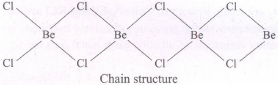
(ii) In vapour state
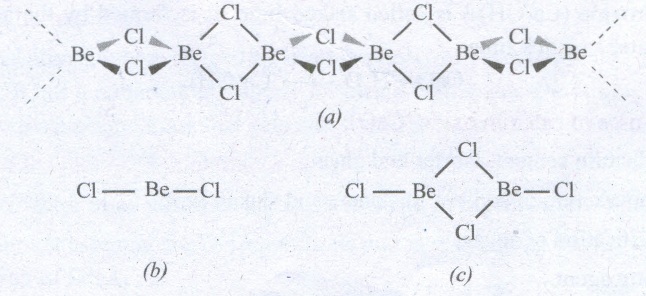
(iii) At high temperature
\(\underset{Linear\ monomer}{Cl-Be-Cl}\)
34.
Be(OH)2 is amphoteric in nature as it reacts with both acid and alkali
Be(OH)2 + 2NaOH ⟶ Na2BeO2 + 2H2O
Acidic
Be(OH)2 + 2HCI ⟶ BeCl2 + 2H2O
Basic
35.
(i) Alkali metals dissolve in liquid ammonia to give deep blue solutions that are conducting in nature.
(ii) This happens because the alkali metal atom readily loses the valence electron in ammonia solution.
(iii) Both the cation and the electron combine with ammonia to form ammoniated cation and ammoniated electron
M + (x +y)NH3 ⟶ [M(NH3)x]+ + [e(NH3)y]-
36.
This is because in alkali metals the second electron is to be removed from a cation, which has already acquired a noble gas configuration. In the case of alkaline earth metals, the second electron is to be removed from a monovalent cation, which still has one electron in the outermost shell. Thus, the second electron can be removed more easily in the case of group 2 elements than in group 1 elements.
37.
Sodium hydroxide is prepared commercially by the electrolysis of brine solution in Castner-Kellner cell using a mercury cathode and a carbon anode. Sodium metal is discharged at the cathode and combines with mercury to form sodium amalgam. Chlorine gas is evolved at the anode. The sodium amalgam thus obtained is treated with water to give sodium hydroxide.
At cathode: Na+ + e- ⟶ Na(amalgam)
At anode: Cl- ⟶ 1/2Cl2 ↑ + e-
2Na(amalgam) + 2H2O ⟶ 2NaOH + 2Hg + H2↑
38.
In this process, ammonia is converted into ammonium carbonate which then converted to ammonium bicarbonate by passing excess carbon dioxide in a sodium chloride solution saturated with ammonia. The ammonium bicarbonate thus formed reacts with the sodium chloride to give sodium bicarbonate and ammonium chloride. As sodium bicarbonatehas poor solubility, it gets precipitated. The sodium bicarbonate is isolated and is heated to give sodium carbonate. The equations involved in this process are,
2NH3 + H2O + CO2 ⟶ (NH4)2CO3
(NH4)2CO3 + H2O + CO2 ⟶ 2NH4HCO3
2NH4HCO3 + NaCl ⟶ NH4Cl + NaHCO3
2NaHCO3 ⟶ Na2CO3 + CO2 + H2O
The ammonia used in this process can be recovered by treating the resultant ammonium chloride solution with calcium hydroxide. Calcium chloride is formed as a by-product..
39.
(i) The electropositive character increases from Li to Cs. Hence their ionic character increases down the group.
(a) The stability of the hydrides decreases down the group, as the size of the metal ion increases. The M - H bond distance increases with increase in size of metal ion and it can be readily broken. i.e., the metal hydride is least stable.
(iii) They are powerful reducing agents as M - H bond is weaker and it can be readily broken.
40.
(l) BeO is almost insoluble in water because Be2+ is a small cation with high polarising power and O2- is small anion.
∴ the lattice energy very high.
When BeO is dissolved in water, the hydration energy of its ions is not sufficient to overcome high lattice energy.
(ii) On the other hand, Be2+ is a small cation and is a large anion. Hence Be2+ can easily polarize, \(SO_4^{2-}\) ions, making BeSO4 unstable the lattice energy of BeSO4 is not very high and so it is soluble in water.
41.
Milk of lime reacts with chlorine to form hypochlorite, a constituent of bleaching powder.
2Ca (OH)2 + 2Cl2 ⟶ CaCl2 + Ca(OCI)2 + 2H2O
42.
(i) Slaked lime + CO2 + H2O ⟶\(\underset{Calcium\ bicarbonate}{Ca(HCO_3)_2}\)
(ii) Quick lime + CO2 ⟶ \(\underset{Calcium\ bicarbonate}{CaCO_3}\)
(iii) Slaked lime + CO2 ⟶\(\underset{Calcium\ bicarbonate}{CaCO_3+H_2O}\)
(iv) Be(OH)2 + HCl + H2O ⟶\(\underset{Tetra\ hydroxy\ beryllium\ chloride}{[Be(OH)_4]CI_2}\)
43.
| Beryllium | Other elements of the family |
|---|---|
| Forms covalent compounds | Other members form of the group form ionic bonds |
| High melting and boiling point | Low melting and boiling point |
| Does not react with water even at elevated temperature | React with water |
| Does not combine directly with hydrogen | Combine directly with hydrogen |
| Does not combine directly with halogens | Combine directly with halogens |
| Halides are covalent | Halides are electrovalent |
| Hydroxide and oxides of beryllium are amphoteric in nature | Basic in nature |
| It is not readily attacked by acids because of the presence of an oxide film | Readily attacked by acids |
44.
i) Be and Mg atoms are smaller and their electrons being strongly bound to the nucleus are not excited to higher energy level.
ii) Therefore they do not give colour in the flame test
45.
The anomalous properties of beryllium is mainly due to its,
(i) small size,
(ii) high electronegativity,
(iii) high ionization energy and
(iv) high polarizing power compared to. the other elements in the block
46.
The similarity in properties of the first element of each group with the elements to the lower right of the next period ie, diagonally opposite element is known as diagonal relationship.
It is due to
i) similarity in the size of ions
ii) similarity in polarizing power
iii) similarity in electropositive character
47.
(i) Sodium carbonate known as washing soda is used for laundering
(ii) It is an important laboratory reagent used in the qualitative analysis and in volumetric analysis.
(iii) It is also used in water treatment to convert the hard water to soft water
(iv) It is used in the manufacture of glass, paper, paint etc
48.
It is due to weak metallic bonds and large atomic size.
49.
Alkali metals have one eo in their outer most shell. Alkaline earth metals have 2 eo in their outer most shell. More valence electrons and more positively charged nucleii leads to greater opportunity for metallic bonding.
50.
In Na2 SO4.10 H2O. So the metal will be Na (sodium). The salt is washing soda.
51.
1. Gypsum is used in making drywalls or plaster boards.
2. Another important use of gypsum is the production of plaster of Paris. Gypsum is heated to about 300 degree Fahrenheit to produce plaster of paris, which is also known as gypsum plaster. It is mainly used as a sculpting material.
3. Gypsum is used in making surgical and orthopedic casts, such as surgical splints and casting moulds.
4. Gypsum plays an important role in agriculture as a soil additive, conditioner, and fertilizer. It helps loosen up compact or clay soil, and provides calcium and sulphur, which are essential for the healthy growth of a plant.
5. Gypsum is used in toothpastes, shampoos, and hair products.
6. Gypsum is a component of portland cement, where it acts as a hardening retarder to control the speed at which concrete sets.
52.
Calcium Sulphate (plaster of paris), CaSO4. 1/2H2O :
It is a hemihydrate of calcium sulphate. It is obtained when gypsum, CaSO4 .2H2O,is heated to 393 K
2(CaSO4.2H2O) ⟶ 2CaSO4,H2O + 3H2O
Above 393 K, no water of crystallisation is left and anhydrous calcium sulphate, CaSO4 is formed. This is a known 'dead burnt plaster'.
It has a remarkable property of setting with water. on mixing with an adequate quantity of water it forms a plastic mass that gets into hard solid in 5 to 15 minutes.
53.
This is due to the smaller size and relatively high charge as Be2+ ion. Moreover Beryllium is a non - metal. But Magnesium is a metal. In the case of beryllium the ionisation energy and electronegativity of the halides are almost similar; but there is a vast difference in IE and electronegativity between Mg and halides.
54.
The largest use of plaster of paris is in the building industry as well as plasters. It is used for immobilising the affected part of organ where there is a bone fracture or sprain. It is also employed in dentistry, in ornamental work and for making casts of statues and busts.
55.
The lattice energy of LiF is higher due to the smaller size of Li+ and F-. So LiF has lower solubility.
56.
| Alkali Metals | Alkaline earth metals | |
|---|---|---|
| 1. | Alkali metals are soft | Alkaline earth metals are hard |
| 2. | They have a single electron in the valence shell and their electronic configuration is [noble gas] ns1. | They have two electrons in the valence shell and their electronic configuration is [noble gas] ns2 |
| 3. | They have low melting points | They have relatively high melting points |
| 4. | Hydroxides are strongly basic. | Hydroxides are less basic |
| 5. | Carbonates do not decompose | Carbonates decompose to form oxide, when heated to high temperatures. |
| 6. | Nitrates give corresponding nitrites and oxygen as products. | Nitrates give corresponding oxides nitrogen dioxide and oxygen as products. |
| 7. | They show + 1 oxidation states. | They show +2 oxidation states |
| 8. | Their carbonates are soluble in water except Li2CO3. | Their carbonates are insoluble in water. |
| 9. | Except Li, alkali metals do not form complex compounds. | They can form complex compounds. |
57.
(i) Monovalent sodium and potassium ions are found in large proportions in biological fluids.
(ii) These ions perform important biological functions such as maintenance of ion balance and nerve impulse conduction.
(iii) Sodium - Potassium play an important role in transmitting nerve signals.
(iv) A typical 70 kg man has 90 g of Na and 170 g of K.
(v) Sodium ions are found on the outside of cells, being located in blood plasma and in the interstitial fluid which surrounds the cells. These ions .participate in the transmission of nerve signals, in regulating the flow of water across cell membranes and in the transport of sugars and amino acids into cells.
(vi) Potassium ions are the most abundant cations within cell fluids, where they activate many enzymes, participate in the oxidation of glucose to produce ATP and with sodium, are responsible for the transmission of nerve signals.
58.
The anomalous properties of beryllium is mainly due to its small size, high electro negativity, high ionisation energy and high polarising power compared to the other elements in the group. The anomalous properties of beryllium compared to other elements of the group are mentioned in table.
| Beryllium | Other elements of the family |
| Forms covalent compounds | Form ionic compounds |
| High melting and boiling point | Low melting and boiling point. |
| Does not react with water even at elevated temperature. |
React with water. |
| Does not combine directly with hydrogen. | Combine directly with hydrogen. |
| Does not combine directly with halogens Halides are covalent. |
Combine directly with halogens. Halides are electrovalent. |
| Hydroxide and oxides of beryllium are amphoteric in nature. |
Basic in nature. |
| It is not readily attacked by acids because of the presence of an oxide film. |
Readily attacked by acids. |
| Beryllium carbide evolves methane with water | evolve acetylene with water. |
| Salts of Be are extensively hydrolysed. | Hydrolysed. |
59.
(i) An element A belonging to II group and II period is beryllium (A)
(ii) Beryllium reacts with chlorine to form beryllium chloride (B)
Be +Cl2 \(\longrightarrow \) BeCl2
(B)
(iii) Beryllium chloride on treatment with LialH Forms beryllium hydride (c)
2BeCl2 + LiA1H4 \(\longrightarrow \) 2BeH2 + LiCl + AlCl3
(C)
| A | Be | Beryllium |
| B | Becl2 | Beryllium Chloride |
| C | BeH2 | Beryllium Hydride |
60.
(i) An element belonging to group number I and period number 3 is Sodium
(ii) Sodium, on reaction with a halogen (Cl2) forms Sodium Chloride (D)
2Na + Cl2 \(\longrightarrow \) 2NaCl
(iii) Sodium Chloride Reacts with ammonium bicarbonate to give Sodium Bicarbonate and ammonium chloride (c)
2NH4HCO3 + NaCl \(\longrightarrow \) NH4Cl + NaHCO3
(iv) Sodium bicarbonate on heating forms sodium carbonate (D)
2NaHCO3 \(\longrightarrow \) Na2CO2 + CO2 + H2O
| A | NaCl | Sodium chloride |
| B | NaHCO3 | Sodium bicarbonate |
| C | NH4Cl | Ammonium Chloride |
| D | Na2CO3 | Sodium carbonate |
61.
62.
1. This group contains Be, Mg, Ca, Sr, Ba & Ra.
2. Except Be all these elements are called as alkaline earth metals because their oxides and hydroxides are alkaline in nature.
3. Beryllium is the rare element and Radium is the rarest (10% rocks) ; Their Occurrence: Be- Beryl; Mg - carnallite; Dolomite Ca - Fluorapatite; Sr - Celestite Ba - Barytes.
4. Radium is radioactive.
5. The general electronic configuration is :
[Noble gas] ns2 eg. Be - [He] 2s2
6. On moving down the group the radii increase. Their atomic radii are smaller than alkali metals.
7. They exhibit +2 oxidation state.
8. The ionisation enthalpies are less than p - block elements due to large size. Down the group the ionisation enthalpy decreases.
9. The IE1 of group 2 elements are greater than group 1 elements.
10. The IE2 values are higher than that of alkali metals.
11. They are less electro Positive elements than alkali metals.
12. The hydration enthalpy decreases with increase in ionic radii.
13. MgCl2 form MgCI2 .6H2O and CaCl2 form CaCl2.6H2O
14. The electronegativity value decreases down the group.
15. With concentrated HCl They impart flame colour. Ca - Brick Red ; Sr - Crimson red and Barium - Apple Green.
16. All form metallic halides at elevated temperatures. M + X2 + MX2
17. All elements except Beryllium combine with hydrogen to form hydrides of formula MH2.
63.
(i) Alkaline earth metal (A) belonging to 3rd period is magnesium.
(ii) So A is Magnesium. Magnesium reacts with oxygen and nitrogen as follows.
\(2Mg+O_2⟶\underset{(B)}{2MgO}\)
\(3Mg+N_2⟶\underset{(C)}{Mg_3N_2}\)
So B is Magnesium oxide and C is magnesium nitride.
(iii) Magnesium undergoes metal displacement reaction with AgNO3 as follow to give D as follows :
\(Mg+2AgNO_3⟶\underset{D}{Mg(NO_3)_2}+2Ag\)
So D is Magnesium nitrate.
Result :
| Compound or Element | Symbol or Formula | Name |
|---|---|---|
| A | Mg | Magnesium |
| B | MgO | Magnesium oxide |
| C | Mg3N2 | Magnesium nitride |
| D | Mg(NO3)2 | Magnesium nitrate |
64.
| S.No | Properties |
|---|---|
| 1 | Beryllium chloride forms a dimeric structure like aluminium chloride with chloride bridges. Beryllium chloride also forms polymeric chain structure In addition to dimer. Both are soluble in organic solvents and are strong lewis acids. |
| 2 | Beryllium hydroxide dissolves in excess of alkali and gives beryllate ion and [Be(OH)2]2- and hydrogen as aluminium hydroxide which gives aluminate ion, [Al(OH)4]- |
| 3 | Beryllium and aluminum ions have strong tendency to form complexes, \(BeF_4^{2-} AIFt{_6^{3-}}\) |
| 4 | Both beryllium and aluminium hydroxides are amphoteric in nature. |
| 5 | Carbides of beryllium (Be2C) like aluminum carbide (Al4C3) give methane on hydrolysis |
| 6 | Both beryllium and aluminium are rendered passive by nitric acid. |
65.
Magnesium oxide in having higher melting point. The lattice energy of MgO & MgF2 are 3938 and 2957 respectively.
MgO has +2, -2 charges, MgF2 has +2, -1 charges. When the two charges are multiplied together, MgO results in larger amount of lattice energy since it has a higher charge, The strong attraction cause most ionic material to be hard and brittle and have high melting points.

11th Standard Syllabus & Materials
11th Standard
TN 11th Tamil பீடு பெற நில் - செய்யுள் - காவடிச்சிந்து Important Questions And Answers Study Material - QB365 Set A
NEW11th Standard
TN 11th Tamil பீடு பெற நில் - உரைநடை - மலை இடப்பெயர்கள் : ஓர் ஆய்வு Important Questions And Answers Study Material - QB365 Set A
NEW11th Standard
TN 11th Tamil மாமழை போற்றுதும் - துணைப்பாடம் - யானை டாக்டர் Important Questions And Answers Study Material - QB365 Set A
NEW11th Standard
TN 11th Tamil மாமழை போற்றுதும் - செய்யுள் - ஐங்குறுநூறு Important Questions And Answers Study Material - QB365 Set A



Tamilnadu Stateboard 11th Standard Subjects

Maths

Commerce

Economics

Biology

Business Maths and Statistics

Accountancy

Computer Science

Physics
Chemistry
Maths
Biology
Economics
Physics
Chemistry

History
Business Maths and Statistics

Computer Science
Accountancy

Computer Applications
History
Computer Technology
Commerce
Computer Applications
Computer Technology

Tamil

English

French
Tamilnadu Stateboard Standards
