
 100% FREE ACCESS
11th Standard Syllabus & Materials
11th Standard
TN 11th Tamil இயற்கை வேளாண்மை,சுற்றுச்சூழல் -செய்யுள் - மனோன்மணீயம் Important Questions And Answers Study Material - QB365 Set A
NEW11th Standard
TN 11th Tamil என்னுயிர் என்பேன் -துணைப்பாடம் - இசைத்தமிழர் இருவர் Important Questions And Answers Study Material - QB365 Set A
NEW11th Standard
TN 11th Tamil மொழி கலை -செய்யுள் - ஒவ்வொரு புல்லையும் Important Questions And Answers Study Material - QB365 Set A
NEW11th Standard
TN 11th Tamil பீடு பெற நில் - இலக்கணம் - பகுபத உறுப்புகள் Important Questions And Answers Study Material - QB365 Set A
NEW11th Standard
TN 11th Tamil பீடு பெற நில் - துணைப்பாடம் - வாடிவாசல் Important Questions And Answers Study Material - QB365 Set A
NEW11th Standard
TN 11th Tamil பீடு பெற நில் - செய்யுள் - குறுந்தொகை Important Questions And Answers Study Material - QB365 Set A

Published on: 13/03/2019
11th Public Exam March 2019 Important 5 Marks Questions
Download Tamil Nadu 11th Standard Chemistry question papers, model tests, one-mark questions, important questions, and public exam papers in PDF format. Free study materials and answer keys for TN State Board students.
Questions + Answers key
Take MCQ Chemistry Test
1.
How would you estimate the percentage of sulphur in an organic compound by Carius method?
2.
List down the characteristics possessed by the organic compounds.
3.
What are non-viable particulates ? How are they classified ? Explain.
4.
Give a detailed account on homolytic and heterolytic cleavage.
5.
How are bonding and anti-bonding molecular orbitals formed? Represent the constructive and destructive interaction in the 1s orbitals.
6.
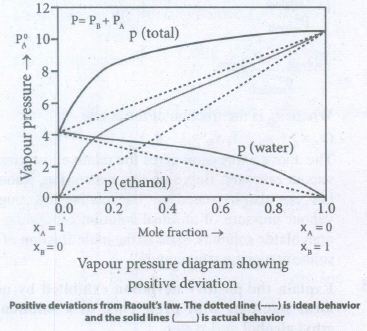
Explain the nature of non - ideal solution with positive deviation from Raoult,s law.
7.
Explain the various steps to draw the lewis structure of Nitirc acid.
8.
Identify the compound A, B, C and D in the following series of reactions
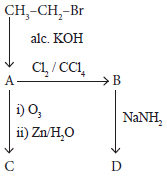
9.
0.26g of an organic compound gave 0.039 g of water and 0.245 g of carbon dioxide on combustion. Calculate the percentage of C & H.
10.
Describe the method of electrolysis of brine solution?
11.
Derive the various mathematical statements of the first law.
12.
A laboratory analysis of an organic compound gives the following mass percentage composition: C = 60%, H = 4.48% and remaining oxygen.
13.
Balance the following equation by ion-electron method In acidic medium.
\(Sb^{3+}{MnO}_4^{-} \rightarrow Sb^{5+}+Mn^{2+}\)
14.
Explain about the anomalies of Mendeleev's periodic table.
15.
Derive de-Broglie wave length.
16.
Balance the following equations by oxidation number method.
NH3 + F2 ⟶ HF + N2
17.
Explain the term competitive electron transfer reaction with an example.
18.
Calculate the de Broglie wavelength of an electron that has been accelerated from rest through 1potential differences of 1 KV.
19.
Calculate the total pressure in a mixture of 8 g of oxygen and 4 g of hydrogen confined in a vessel of 1 dm3 at 27° C. [R = 0.083 bar dm3 K-1 mol-1.]
20.
Explain the action of water on
1) Na
2) Ba
3) Fe
4) Pb & Cu
5) Ag, Au,& Hg & Pt
6) C, S, & P
21.
From the following data,
CH4+2O2 ➝ CO2+2H2O ΔHo= -890 KJ mol-1
H2O(l) ➝ H2O(g) ΔHo= 44 KJ mol-1 at 298 K
Calculate the enthalpy of the reaction
CH4+2O2 ➝ CO2+2H2O ΔHo=?
22.
In the reaction N2(g) + O2(g) ⟶ 2NO(g), ΔH0 reaction is 179.9 KJ mol-1 and ΔS0reaction=78.09 JK-1mol-1. Calculate ΔG0reaction at 300 K.
23.
Explain the preparation and uses of the following compounds of calcium.
24.
At sea level a balloon has volume of 785 x10-3dm3 What will be its volume, if it taken to a place where the pressure is 0052 atm. Less than the atmospheric pressure of 1 atm.
25.
Balance the following equations by oxidation number method
i) \({ K }_{ 2 }{ Cr }_{ 2 }{ O }_{ 7 }+KI+{ H }_{ 2 }SO_{ 4 }\longrightarrow { K }_{ 2 }{ SO }_{ 4 }+{ Cr }_{ 2 }({ SO }_{ 4 })+{ I }_{ 2 }+{ H }_{ 2 }O\)
ii) \({ K }Mno_{ 4 }+{ Na }_{ 2 }{ So }_{ 3 }\longrightarrow { MnO }_{ 2 }+{ Na }_{ 2 }{ So }_{ 4 }+KOH\)
iii) \(Cu+{ HNO }_{ 3 }\longrightarrow Cu\left( { No }_{ 3 } \right) _{ 2 }+{ No }_{ 2 }+{ H }_{ 2 }O\)
iv) \({ KMn }O_{ 4 }+{ H }_{ 2 }{ C }_{ 2 }{ O }_{ 4 }+{ H }_{ 2 }{ SO }_{ 4 }\longrightarrow { K }_{ 2 }{ SO }_{ 4 }+{ MnSO }_{ 4 }+{ CO }_{ 2 }+{ H }_{ 2 }O\)
26.
Find the ratio of effusion rates of hydrogen and krypton gas.
27.
Calculate the standard entropy change for the following reaction (Δsf0), given the standard entropies of CO2(g) , C(s) 'O2(g) as 213.6, 5.740, and 205 JK-1 respectively.
28.
A gas mixture of 3.67 lit of ethylene and methane on complete combustion at 25°C and at 1 atm pressure produce 6.11 lit of carbon dioxide . Find out the amount of heat evolved in kJ, during this combustion. (ΔHc(CH4)= - 890 kJ mol-1 and (ΔHc(C2H4) = -1423 kJ mol-1
29.
The Van der Waals' constants a = 2.095 lit2 atm mol-1 and b = 0.0189 lit mol-1 respectively. Calculate the inversion temperature.
30.
What are the factors influencing ionization enthalpy.
31.
Define hydrogen bond and its types.
32.
What are the factors which influence the electron gain enthalpy?
33.
Using Dalton's law how will you determine the pressure of a dry gas.
34.
For the reaction Ag2O(s) ⟶2Ag(s) + \(\frac{1}{2}\)O2(g) : ΔH =30.56 kJ mol-1 and &DeltaS = 6.66JK-1 mol-1 (at 1 atm). Calculate the temperature at which ΔG is equal to zero. Also predict the direction of the reaction (i) at this temperature and (ii) below this temperature.
35.
Calculate the entropy change in the system, and surroundings, and the total entropy change in the universe during a process in which 245 J of heat flow out of the system at 77°C to the surrounding at 33°C.
36.
How do you classify elements into blocks? Give their electronic configuration.
37.
Explain the exchange reactions of heavy water
38.
How are peroxides and superoxides formed by alkali metals?
39.
Derive the ideal gas equation by combining the empirical gas laws.
40.
The uncertainty in the position and velocity of a particle are 10-2 m and \(5.27\times { 10 }^{ -24 }{ ms }^{ -1 }\) respectively. Calculate the mass of the particle
41.
Conc. H2SO4 cannot be used for drying hydrogen gas. Why?
42.
Write note on decomposition reaction
43.
Define the following terms
(a) isothermal process (b) adiabatic process
(c) isobaric process (d) isochoric process
44.
Explain the important common features of Group 2 elements.
45.
The reaction between aluminium and ferric oxide can generate temperatures up to 3273 K and is used in welding metals. (Atomic mass of Al = 27 u atomic mass of O = 16 u )
2Al + Fe2O3 \(\longrightarrow \) Al2O3 + 2Fe; If in this process, 324 g of aluminum is allowed to react with 1.12 kg of ferric oxide
i) Calculate the mass of Al2O3 formed
ii) How much of the excess reagent is left at the end of the reaction ?
46.
By using paulings method calculate the ionic radii of K+ and CI- ions in the potassium chloride crystal. Given that dk+-cl-=3.14 Å.
47.
A group-1 metal (A) which is present in common salt reacts with (B) to give compound (C) in which hydrogen is present in –1 oxidation state. (B) on reaction with a gas (C) to give universal solvent (D). The compound (D) on reacts with (A) to give (E), a strong base. Identify A, B, C, D and E. Explain the reactions.
48.
Explain the periodic trend of ionisation potential.
49.
Derive an equation for the wavelength of a matter wave.
50.
Enlist the postulates of Bohr's atom model.
51.
The atmospheric oxidation of NO
2NO(g) + O2(g) ⇌ 2NO2(g)
was studied with initial pressure of 1 atm of NO and 1 atm of O2. At equilibrium, partial pressure of oxygen is 0.52 atm calculate Kp of the reaction.
52.
Calculate the uncertainty in the position of an electron, if the uncertainty in its velocity is 5.7 x 10⁵ ms-1.
53.
A tank contains a mixture of 52.5 g of Oxygen and 65.1 g of CO2 at 300 K the total pressure in the tanks is 9.21 atm. calculate the partial pressure (in atm.) of each gas in the mixture.
54.
Explain whether a gas approaches ideal behavior or deviates from ideal behaviour if
it is compressed to a smaller volume at constant temperature.
55.
Calculate the molar mass of the following compounds.
i) urea [CO(NH2)2]
ii) Acetone [CH3 COCH3]
iii) Boric Acid [H3 BO3]
iv) Sulphuric Acid [H2 SO4]
56.
Ethane burns completely in air to give CO2, while in a limited supply of air gives CO. The same gases are found in automobile exhaust. Both CO and CO2 are atmospheric pollutants
i) What is the danger associated with these gases
ii) How do the pollutants affect the human body ?
57.
2.56 g of Sulphur is dissolved in 100g of carbon disulphide. The solution boils at 319. 692 K. What is the molecular formula of Sulphur in solution The boiling point of CS2 is 319. 450K. Given that Kb for CS2 = 2.42 K Kg mol-1.
58.
The partial pressure of carbon dioxide in the reaction
CaCO3 (s) ⇌ CaO (s) + CO2(g) is 1.017 × 10⁻³ atm at 5000C. Calculate Kp at 6000C for the reaction. ΔH for the reaction is 181 KJ mol–1 and does not change in the given range of temperature.
59.
Suppose that the uncertainty in determining the position of an electron in an orbit is 0.6 \(\mathring{A}\) . What is the uncertainty in its momentum
60.
The Li2+ ion is a hydrogen like ion that can be described by the Bohr model. Calculate the Bohr radius of the third orbit and calculate the energy of an electron in 4th orbit.
1.
Carius method: A known mass of the organic substance is heated strongly with fuming HN03. C & H get oxidized to CO2& H2O while sulphur is oxidized to sulphuric acid as per the following reaction.
\(C\overset { fum.HN{ O }_{ 3 } }{ \longrightarrow } { CO }_{ 2 }\)
\(2H\overset { fum.HN{ O }_{ 3 } }{ \longrightarrow } { H }_{ 2 }O\)
\(\\ S\longrightarrow { SO }_{ 2 }\overset { O+{ H }_{ 2 }O }{ \longrightarrow } { H }_{ 2 }SO_{ 4 }\)
The resulting solution is treated with excess of BaCI2 solution H2SO4 present in the solution in quantitatively converted into BaSO4, from the mass of BaSO4, the mass of sulphur and hence the percentage of sulphur in the compound can be calculated.
Procedure:
A known mass of the organic compound is taken in clean carius tube and added a few mL of fuming HNO3. The tube is the sealed. It is then placed in an iron tube and heated for about 5 hours. The tube is allowed to cool to temperature and a small hole is made to allow gases produced inside to escape. The carius tube is broken and the content collected in a beaker. Excess of BaCl2 is added to the beaker H2SO4 acid formed as a result of the reaction is converted to BaSO4. The precipitate of BaSO4 is filtered, washed, dried and weighed. From the mass of BaSO4, percentage of S is found.
Mass of the organic compound = w g
Mass of the BaSO4 formed = x g
233g of BaSO4 contains 32 g of sulphur
\(\therefore \) x g of BaSO4 contain \(\left( \frac { 32 }{ 233 } \times \frac { x }{ w } \right) \)
Percentage of sulphur = \(\left( \frac { 32 }{ 233 } \times \frac { x }{ w } \times 100 \right) \)%
2.
(i) They are covalent compounds of carbon and generally insoluble in water and readily soluble in organic solvent such as benzene, toluene, ether, chloroform, etc ...
(ii) Many of the organic compounds are inflammable (except CCI4).They possess low boiling and melting points due to their covalent nature.
(iii) Organic compounds are characterised by functional groups. A functional group is an atom or a specific combination of bonded atoms that react in a characteristic way, irrespective of the organic molecule in which it is present. In
almost all the cases, the reaction of an organic compound takes place at the functional group. They exhibit isomerism which is a unique phenomenon.
(iv) Homologous series: A series of organic compounds each containing a characteristic functional group and the successive members differ from each other in molecular formula by a CH2 group is called homologous series.
Alkanes: Methane (CH4) Ethane (C2H6) Propane (C3H8) etc.
3.
Non-viable particulates: The non- viable particulates are small solid particles and liquid droplets suspended in air. They help in the transportation of viable particles. There are four types of non-viable particulates in the atmosphere. They are classified according to their nature and size as follows.
(i) Smoke : Smoke particulate consists of solid particles (or) mixture of solid and liquid particles formed by combustion of organic matter
Example: cigarette smoke, oil smoke, smokes from burning of fossil fuel, garbage and dry leaves.
(ii) Dust : Dust composed of fine solid particles produced during crushing and grinding of solid materials.
Example : sand from sand blasting, saw dust from wood works, cement dust from cement factories and fly ash from power generating units.
(iii) Mists: They are formed by particles of spray liquids and condensation of vapours in air.
Example: sulphuric acid mist, herbicides and insecticides sprays can form mists.
(iv) Fumes : Fumes are obtained by condensation of vapours released during sublimation, distillation, boiling and calcination and by several other chemical reactions.
Example : organic solvents, metals and metallic oxides form fume particles.
4.
Homolytic cleavage:
Homolytic cleavage is the process in which a covalent bond breaks symmetrically in such way that each of the bonded atoms retains one electron. It is denoted by a half headed arrow (fish hook arrow). This type of cleavage occurs under high temperature or in the presence of UV light in a compound containing non-polar covalent bond formed between atoms of similar electronegativity, In such molecules, the cleavage of bonds results into free radicals. They are short lived and are highly reactive. The type of reagents that promote holmolytic cleavage in substrate are called as free radical initiators, For example Azobisisobutyronitile (AIBN) and peroxides such as benzoyl peroxide are used as free radical initiators in polymerisation reactions.
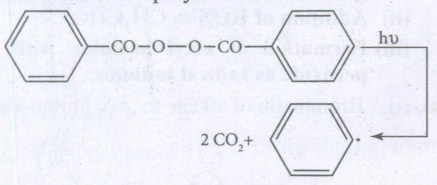
As a free radical with an unpaired electron is neutral and unstable, it has a tendency to gain an electron to attain stability. Organic reactions involve homolytic fission of C-C bonds to form alkyl free radicals. The stability of alkyl free radicals is in the following order
\(^{ . }C{ \left( C{ H }_{ 3 } \right) }_{ 3 }>^{ . }CH{ \left( C{ H }_{ 3 } \right) }_{ 2 }>^{ . }C{ H }_{ 2 }C{ H }_{ 3 }>^{ . }C{ H }_{ 3 }\)
Heterolytic cleavage:
Heterolytic cleavage is the process in which a covalent bond breaks unsymmetrically such that one of the bonded atoms retains the bond pair of electrons. It results in the formation of a cation and an anion. Of the two bonded atoms, the most electronegative atom becomes the anion and the other atom becomes the cation. The cleavage is denoted by a curved arrow pointing towards the more electronegative atom. For example, in tert-butyl bromide, the C-Br bond is polar as bromine is more electronegative than carbon. The bonding electrons of the C-Br bond are attracted more by bromine than carbon. Hence, the C-Br undergoes heterolytic cleavage to form a tertbutyl cation during hydrolysis.
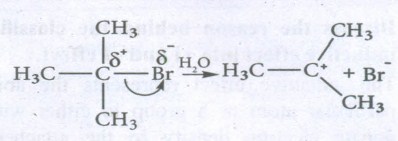
Let us consider the cleavage in a carbon-hydrogen (C-H) bond of aldehydes or ketones. We know that the carbon is more electronegative than hydrogen and hence the heterolytic cleavage of C-H bonds results in the formation of carbanion (carbon bears a negative charge). For example in aldol condensation the OH- ion abstracts a -hydrogen from the aldehyde which leads to the formation of the below mentioned carbanion.
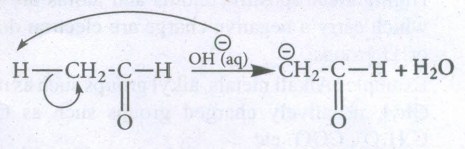
5.
The wave function A and B with comparable energy, combines to form two molecular orbitals.One is bonding molecular orbital (\(\Psi \)bonding) and the other is antibonding molecular orbital (\(\Psi \)antibondin ). The wave functions for these two molecular orgitals can be obtained by the linear combination of the atomic orbitals \(\Psi _A\) and \(\Psi _B\) as beIow.
\(\Psi _{bonding}=\Psi _A+\Psi _B\\ \Psi _{antibonding}=\Psi _A-\Psi _B\)
The formation of bonding molecular orbital can be considered as the result of constructive interference of the atomic orbitals and the formation of antibonding molecular orbital can be the result of the destructive interference of the atomic orbitals. The formation of the two molecular orbitals from two 1s orbitals is shown below.
Constructive interaction :
The two 1s orbitals are in phase and have the same sign.
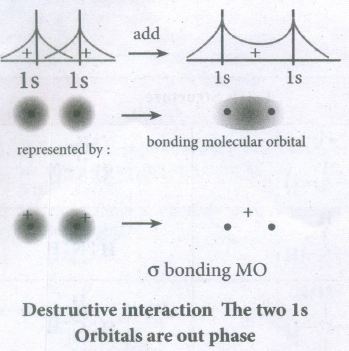
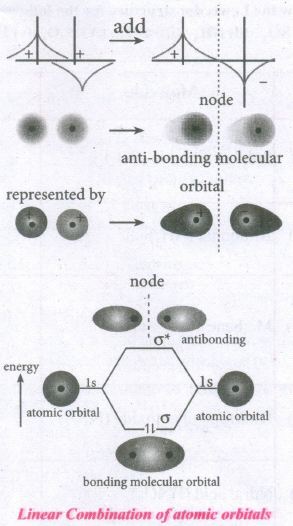
6.
The nature of the deviation from the Rauolt's law can be explained in terms of the intermolecular interactions between solute (A) and solvent (B). Consider a case in which the intermolecular attractive forces between A and B are weaker than those between the molecules of A (A - A) and molecules of B (B - B). The molecules present in such a solution have a greater tendency to escape from the solution when compared to the ideal solution formed by A and B, in which the intermolecular attractive forces (A - A, B - B, A - B) are almost similar. Consequently, the vapour pressure of such non-ideal solution increases and it is greater than the sum of the vapour pressure of A and B as predicted by the Raoult's law. This type of deviation is called positive deviation.
Here, \({ p }_{ A }>{ p }_{ A }^{ 0 }{ x }_{ A }\) and \({ p }_{ B }>{ p }_{ A }{ x }_{ B }\)
Hence \({ p }_{ total }>{ p }_{ A }^{ 0 }{ x }_{ A }+{ p }_{ B }^{ 0 }{ x }_{ B }\)
Letus understand the positive deviation by considering a solution of ethyl alcohol and water. In this solution the hydrogen bonding interaction between ethanol and water is weaker than those hydrogen bonding interactions amongst themselves (ethyl alcohol-ethyl alcohol and water-water interactions). This results in the increased evaporation of both components from the aqueous solution of ethanol. Consequently, the vapour pressure of the solution is greater than the vapour pressure predicted by Raoult's law. Here, the mixing process is endothermic i.e. \(\triangle\)Hmixing > 0 and there will be a slight increase in volume (\(\triangle\)Vmixing > 0).
Examples for non - ideal solutions showing postive deviations:
Ethyl alcohol & cyclohexane, Benzene & acetone, Carbon tetrachloride & chloroform, Acetone & ethyl alcohol, Ethyl alcohol & water.
7.
1. Skeletal structure
\(H\quad O\quad \underset { O }{ N } \quad O\)
2. Total number of valence electrons in HNO3
= [1 x 1 (hydrogen)] + [1 + 5 (nitrogen)] + [3 x 6 (oxygen)] = 1 + 5 + 18 = 24
3. Draw single bonds between atoms. Four bonds can be drawn as shown in the figure for HNO3 which account for eight electrons (4 bond pairs).
\(H-O-\underset { \overset { | }{ O } }{ N } -O\)
4. Distribute the remaining sixteen (24 - 8= 16) electrons as eight lone pairs starting from most electronegative atom, the oxygen. Six lone pairs are distributed to the two terminal oxygens (three each) to satisfy their octet and two pairs are distributed to the oxygen that is connected to hydrogen to satisfy its octet.
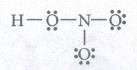
5. Verify wheather all the atoms have octet conguration. In the above distribution, the nitrogen has one pair short for octet. Therefore, move one of the lone pair from the terminal oxygen to form another bond with nitrogen. The Lewis structure of nitric acid is given as
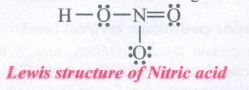
8.
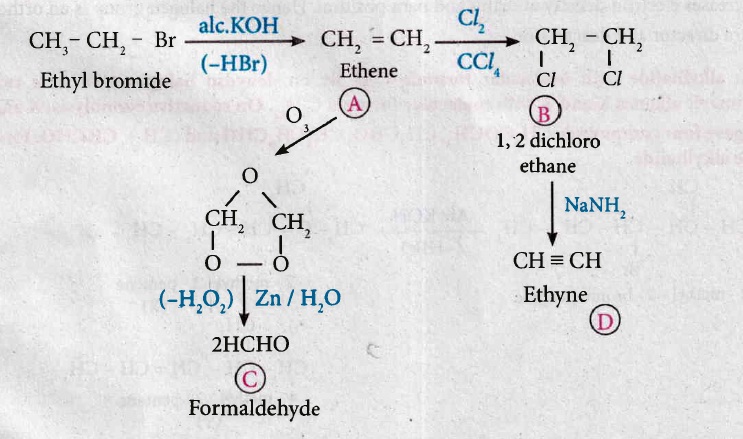
| compound | Structural formula | Name |
| A | CH2 = CH2 | Ethene |
| B | 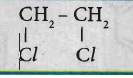 |
1,2 - dichloroethane |
| C | HCHO | Methanal |
| D | \(\mathrm{CH} \equiv \mathrm{CH}\) | Ethyne |
9.
Weight of organic compound = 0.26g
Weight of water = 0.039g
Weight of CO2 = 0.245g
Percentage of hydrogen
\(
\% =\frac{2}{18} \times \frac{x}{\mathrm{w}} \times 100
\)
\(=\frac{2}{18} \times \frac{0.039}{0.26} \times 100
\)
\(=1.66 \%\)
Percentage of carbon
\(\% \mathrm{C} =\frac{12}{44} \times \frac{\mathrm{y}}{\mathrm{w}} \times 100
\)
\(=\frac{12}{44} \times \frac{0.245}{0.26} \times 100=25.69 \%
\)
10.
(a) Sodium hydroxide is prepared commercially by the electrolysis of brine solution in Castner- Kellner cell using a mercury cathode and a carbon anode.
(b) Sodium metal is discharged at the cathode and combines with mercury to form sodium amalgam.
(c) Chlorine gas is evolved at the cathode.
(d) The sodium amalgam thus obtained is treated with water to give sodium hydroxide.
At cathode: Na+ + e- ⟶ Na (amalgam)
At anode: Cl- ⟶ 1/2Cl2↑ + e-
2Na (amalgam) + 2H2O ⟶ 2\(\underset{Sodium\ hydroxide}{NaOH + 2Hg + H_2↑}\)
11.
Mathematical statement of the First law of Thermodynamics is
\(\Delta\)U = q + w
Case 1: For a cyclic process involving isothermal expansion of an ideal gas
\(\Delta\)U = 0
\(\therefore\) q = -w
In other words, during a cyclic process, the amount of heat absorbed by the system is equal to work done by the system.
Case 2: For an isochoric process (no change in volume) there is no work of expansion.
V = 0
w = 0
\(\Delta\)U = qv
In other words, during isochoric process, the amount of heat supplied to the system is converted to its internal energy.
Case 3: For an adiabatic process there is no change in heat .i.e., q = 0. Hence
q = 0
\(\Delta\)U = w
In other words, in an adiabatic process, the decrease in internal energy is exactly equal to the work done by the system on its surroundings.
Case 4: For an isobaric process. There is no change in the pressure. P remains constant. Hence
\(\Delta\)U = q + w
\(\Delta\)U = q - P\(\Delta\)V
In other words, in an isobaric process, a part of heat absorbed by the system is used for PV expansion work and the remaining is added to the internal energy of the system.
12.
| Element | Percentage | Atomic mass | Relative No. of atoms | Simple ratio of atoms | Simplest whole number ratio |
|---|---|---|---|---|---|
| C | 60% | 12 | \(\frac{60}{12}=4.99\) | \(\frac{4.99}{2.22}=2.25\times\frac{9}{4}\) | 9 |
| H | 4.48% | 1 | \(\frac{4.48}{1}=4.48\) | \(\frac{4.48}{2.22}=2.02\times 4\) | 8 |
| O | 35.53% | 16 | \(\frac{35.53}{16}=2.22\) | \(\frac{2.22}{2.22}=1\times 4\) | 4 |
\(\therefore\) The empirical formula is C9H8O4.
13.
\(Sb^{3+}{MnO}_4^{-} \rightarrow Sb^{5+}+Mn^{2+}\)
Oxidation half reaction:
\(Sb^{3+}\rightarrow Sb^{5+}+2e^-\).....(1)
Reduction half reaction
\(\underset{(+7)}{Mn{O}_4^-}+5e^-\rightarrow Mn^{2+}\).............(2)
In equation (2), H2O is added on LHS to balance oxygen atom.
\(Mn{O}_4^-+5e^-\rightarrow Mn^{2+}+4H_2O\)......(3)
To balance Hydrogen atoms, H+ is added on RHS.
\(Mn{O}_4^-+5e^-+8H^+\rightarrow Mn^{2+}+4H_2O\).....(4)
Equation (4) is multiplied by 2 and equation (1) is multiplied by 5 to equalise the electrons gained and electrons lost.
(1) \(\Rightarrow\) \(5Sb^{3+}\rightarrow 5Sb^{5+}+10e^-\)......(5)
(4) \(\Rightarrow\) \({{2MnO_4^{-}+10e^-+16H^+\rightarrow 2mn^{2+}+8H_2O}\over{5Sb^{3+}+2MnO_4^{-}+16{H}^{+}\rightarrow 5Sb^{5+}}+2Mn^{2+}+8H_2O}\) ......(6) Add (5) and (6)
14.
Anomalies of Mendeleev's periodic table
(i) Some elements with similar properties were placed in different groups whereas some elements having dissimilar properties were placed in same group, but iodine (127) was placed in VII group.
Example: Tellurium (127.6) was placed in VI group.
(ii) Some elements with higher atomic weights were placed before lower atomic masses in order to maintain the similar chemical nature of elements. This concept was called inverted pair of elements concept.
Example: 5927Co and 58.7 28Ni
(iii) Isotopes did not find any place in Mendeleev's periodic table.
(iv) Position of hydrogen could not be made clear.
(v) He did not leave any space for lanthanides and actinides which were discovered later on.
(vi) Elements with different nature were placed in one group, Example: Alkali metals and coinage metals were placed together:
(vii) Diagonal and horizontal relationships were not explained.
15.
Louis de Broglie proposed that all forms of matter showed dual character. To quantify this relation, he Jerived an equation for the wavelength of a matter wave. He combined the following two equations of energy of which one represents wave character (hu) and the other represents the particle nature (mc2).
Planck's quantum hypothesis:
E = hv ....(1)
Einsteins mass-energy relationship:
E = mc2 .... (2)
From (1) and (2)
hv = mc2
hc/\(\lambda\) = mc2
\(\therefore \lambda ={h\over mc}\) ...(3)
The equation (3) represents the wavelength of photons whose momentum is given by mc. (Photons have zero rest mass).
For a particle of matter with mass m and moving with a velocity v, the equation (3) can be written as
\(\lambda ={h\over mv}\) ....(4)
This is valid only when the particle travels at speed much less than the speed of Light.
16.
Step - 1 : To find atoms undergoing change in O.N.
\(\overset { +3 }{ { NH }_{ 3 } } +\overset { 0 }{ { F }_{ 2 } } \rightarrow \overset { -1 }{ HF } +\overset { 0 }{ { N }_{ 2 } } \).
Step - 2 : To find the total increase and decrease in O.N.
NH3 ⟶ N2 (decrease of 3 units per atom)
F2 ⟶ HF (increase in 1 unit per atom)
Total decrease = 6 units (3 x 2)
Total increase =6 units (2 x 3)
Step-3: To balance the increase and decrease in O.N, multiply NH3 by 2 and F2 by 3.
2NH3 + 3F2 ⟶ HF + N2
Step-4: To balance all atoms other than oxygen
2NH3 + 3F2 ⟶ 6HF + N2
Hydrogen atom balanced by themselves.
Hence, the balanced equation is 2N3 + 3F2 ⟶ 6HF + N2.
17.
When a strip of metallic copper in sliver nitrate solution ~aken in a beaker and after some time, the solution slowly turns blue. This is due to the formation of Cu2+ ions, i.e. copper replaces silver from silver nitrate. The reaction is,
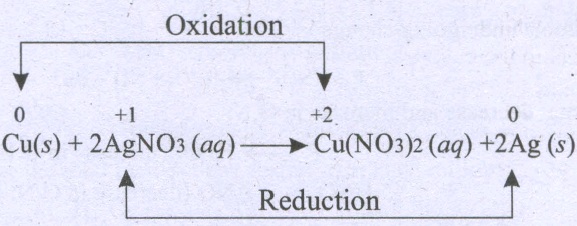
It indicates that between copper and silver, copper has the tendency to release electrons and silver to accept electrons. This type of metal displacement reactions are known as competitive electron transfer reactions.
18.
Energy acquired by the electron (as kinetic energy) after being accelerated by a potential difference of 1 KV
i.e., 1000 volts = 1000 eV
= 1000 x 1.602 x 10-19 J
= 1.602 x 10⁻¹⁶ J (1 eV = 1.602 x 10⁻¹⁹ J)
Energy in Joules = charge on the electron in coulombs x potential difference in volts
i.e., Kinetic Energy (KE) = \(\frac{1}{2}\) mv2
= 1.602 x 10⁻¹⁶ J or \(\frac{1}{2}\) x 9.1 x 10⁻³¹ v2
v2 = 3.521 x 10¹⁴ or v = 1.88 x 10⁻¹ ms-1
\(\therefore \lambda=\frac{h}{mv}=\frac{6.626\times 10^{-34}kgm^2 s{-1}}{9.1\times 10^{-31}kg\times 1.88\times 10^{-1}ms^{-1}}\)
= 3.87 x 10⁻¹¹ m.
19.
Molar mass of O2, = 32 g mol-1
∴ 8 g of O2=\(\frac{8}{32}\)mol = 0.25 mol
molar mass of H2 = 2 g mol-1
∴ 4 g of H2=\(\frac{4}{42}\)mol = 2 mol
Total number of mol (n) = 0.25 + 2 = 2.25
Volume (V) = 1 dm3; Temperature (T) = 27° C = 300K
R = 0.083 bar dm3K-1mol-1
PV = nRT (or) \(P=\frac{nRT}{V}\)
(or) \(P=\frac{(2.25 mol)(0.083 bar dm^{3}K^{-1}mol^{-1})(300 K)}{1 dm^{3}}\)
= 56.025 bar
20.
Water reacts with metals, non-metals and other compounds differently. The most reactive metals are the alkali metals. They decompose water even in cold with the evolution of hydrogen leaving an alkali solution.
2Na + 2 H2O \(\rightarrow\) 2 NaOH + H2
The group 2 metals (except beryllium) react in a similar way but less violently. The hydroxides are less soluble than those of Group 1.
Ba + 2H2O \(\rightarrow\) Ba(OH)2 + H2
Some transition metals react with hot water or steam to form the corresponding oxides.
For example, steam passed over red hot iron results in the formation of iron oxide with the release of hydrogen.
3Fe + 4H2O\(\rightarrow\) Fe3O4 + H2
Lead and copper decompose water only at a white heat. Silver, gold, mercury and platinum do not have any effect on water. In the elemental form, the non-metals such as carbon, sulphur and phosphorus normally do not react with water. However, carbon will react with steam when it is red (or white) hot to give water gas.
21.
CH4+2O2 ➝ CO2(g)+2H2O(l) ΔHo= -890 KJ mol-1
H2O(l) ➝ H2O(g) ΔHo= 44 KJ mol-1 at 298 K
ΔHo for CH4+2O2(g) ➝ CO2(g)+2H2O(g)
=-890+44=-846 KJ mol-1
22.
Given: ΔH0 reaction=179.9 KJ mol-1=179900 J mol-1, ΔS0reaction=78.09 JK-1 mol-1, Temperature, T=300K, T=250C=298 K
ΔG0=ΔH0-TΔS0
=179900-300(78.09)J mol-1
=179900-23,427 J mol-1
=156473 J mol-1
ΔS0reaction=156.473 KJ mol-1
23.
(i) Quick lime :
Preparation :
It is produced on a commercial scale by heating limestone in a lime kiln at 1173K (1070-1270).
\(CaCO_3\leftrightharpoons CaO + CO_2\)
Uses: Calcium oxide is used
(i) to manufacture cement, mortar and glass.
(ii) in the manufacture of sodium carbonate and slaked lime.
(iii) in the purification of sugar.
(iv) as drying agent
(ii) Slaked lime :
Preparation: Calcium hydroxide is prepared by adding water to quick lime, CaO.
CaO + H2O ⟶ Ca(OH)2
Uses: Calcium hydroxide is used
(I) in the preparation of mortar, a building material.
(ii) in white wash due to its disinfectant nature.
(iii) in glass making, in tanning industry, for the preparation of bleaching powder and for purification of sugar
24.
At sea level pressure P1 = 1 atm
Volume occupied at sea level V1 = 785 \(\times\) 10-3 dm3
If the pressure P2 = 0.052 atm
the volume of the balloon V2 = ?
According to Boyle's law
P1 V1 = P2 V2
1 \(\times\) 785 \(\times\) 10-3 = 0.052 \(\times\) V2
\({ V }_{ 2 }=\frac { 1\times 785\times { 10 }^{ -3 } }{ 0.052 } \)
= 15096.15 \(\times\) 10-3 dm3
25.
(i) \({ K }_{ 2 }\overset { +6 }{ \underset { \underset { 2\times { 3e }^{ - } }{ \uparrow } }{ Cr_{ 2 } } } { O }_{ 7 }+K\overset { -1 }{ \underset { { 1e }^{ - } }{ \underset { \downarrow }{ I } } } +{ H }_{ 2 }{ SO }_{ 4 }\longrightarrow { K }_{ 2 }{ SO }_{ 4 }+{ \overset { +3 }{ Cr } }_{ 2 }({ SO }_{ 4 })_{ 3 }+\overset { 0 }{ I } _{ 2 }+{ H }_{ 2 }O\)
K2Cr2O7 + 6KI + H2SO4 \(\longrightarrow \) K2SO4 + Cr2(SO4)3 + I2 + H2O
K2Cr2O7 + 6KI + H2SO4 \(\longrightarrow \) K2SO4 + Cr2(SO4)3 + 3I2 + H2O
K2Cr2O7 + 6KI + 7H2SO4 \(\longrightarrow \) 4k2SO4 + Cr2(SO4)3 + 3I2 + 7H2
ii) \({ K }Mno_{ 4 }+{ Na }_{ 2 }{ So }_{ 3 }\longrightarrow { MnO }_{ 2 }+{ Na }_{ 2 }{ So }_{ 4 }+KOH\)
\({ K }\overset { +7 }{ \underset { \underset { 3e^{ - } }{ \uparrow } }{ M } } n{ O }_{ 4 }+{ Na }_{ 2 }\overset { +4 }{ \underset { { 2e }^{ - } }{ \underset { \downarrow }{ S } } } { O }_{ 3 }\longrightarrow \overset { +4 }{ M } { nO }_{ 2 }+{ Na }_{ 2 }\overset { +6 }{ s } { O }_{ 4 }+KOH\)
\(\Rightarrow\) 2KMnO4 + 3Na2SO3 \(\longrightarrow \) MnO2 + Na2 SO4 + KOH
\(\Rightarrow\) 2KMnO4 + 3Na2SO3 \(\longrightarrow \) 2MnO2 + 3Na2SO4 + KOH
\(\Rightarrow\) 2KMNO4 + 3NaSO3 + H2O \(\longrightarrow \) 2MnO2 + 3Na2 SO4 + 2KOH
iii) \(Cu+{ HNO }_{ 3 }\longrightarrow Cu\left( { No }_{ 3 } \right) _{ 2 }+{ No }_{ 2 }+{ H }_{ 2 }O\)
\(\overset { 0 }{ \underset { \underset { 2e^{ - } }{ \downarrow } }{ Cu } } { O }_{ 7 }+H\overset { +5 }{ \underset { { 1e }^{ - } }{ \underset { \uparrow }{ N } } } { O }_{ 3 }\longrightarrow \overset { +2 }{ Cu } \left( { No }_{ 3 } \right) _{ 2 }+\overset { +4 }{ N } { O }_{ 2 }+{ H }_{ 2 }O\)
Cu +2HNO3 \(\longrightarrow \) Cu(NO3)2 + NO2 + H2O
Cu + 2HNO3 + 2HNO3 \(\longrightarrow \) Cu(NO3)2 + 2NO2 + 2H2O
Cu + 4HNO3 \(\longrightarrow \) Cu (NO3)2 + 2No2 + 2H2O
iv) \({ KMn }O_{ 4 }+{ H }_{ 2 }{ C }_{ 2 }{ O }_{ 4 }+{ H }_{ 2 }{ SO }_{ 4 }\longrightarrow { K }_{ 2 }{ SO }_{ 4 }+{ MnSO }_{ 4 }+{ CO }_{ 2 }+{ H }_{ 2 }O\)
\({ K }\overset { +7 }{ \underset { \underset { 2\times { 3e }^{ - } }{ \downarrow } }{ M } } n{ O }_{ 4 }+{ H }_{ 2 }\overset { -1 }{ \underset { { 1e }^{ - } }{ \underset { \uparrow }{ C_{ 2 } } } } { O }_{ 4 }+{ H }_{ 2 }{ SO }_{ 4 }\longrightarrow { K }_{ 2 }{ SO }_{ 4 }+\overset { +2 }{ M } n{ SO }_{ 4 }+\overset { +4 }{ C } { O }_{ 2 }+{ H }_{ 2 }O\)
2KMnO4 + 5 H2C2O4 + H2S04 \(\longrightarrow \) Mn02 + Na2S04 + KOH
2KMnO4+ 5 H2C2O4 + H2S04 \(\longrightarrow \) K2SO4 + 2MnSO4 + 10CO2 + H2O
2KMnO4 + 5 H2C2O4 + 3H2S04 \(\longrightarrow \) K2S04 + 2MnS04 + 10C02 + 8 H20
26.
According to Graham's law of diffusion
\(\frac { { r }_{ H_{ 2 } } }{ { r }_{ K_{ r } } } =\sqrt { \frac { { M }_{ Kr } }{ { M }_{ { H }_{ 2 } } } } \)
\(\frac { { r }_{ { H }_{ 2 } } }{ { r }_{ { K }_{ r } } } =\sqrt { 42 } \)
\(\frac { { r }_{ { H }_{ 2 } } }{ { r }_{ Kr } } =6.480\)
\({ r }_{ { H }_{ 2 } }=6.480\quad { r }_{ Kr }\)
1 : 6480 is ratio of H2 : Kr
27.
C(g) + O2(g) ⟶ CO2(g)
ΔSr0 = \({ \sum { S } }_{ (Products) }^{ 0 }-{ \sum { S } }_{ (reactants) }^{ 0 }\)
ΔSr0 = \(\left\{ { S }_{ CO2 }^{ 0 } \right\} -\left\{ { S }_{ C }^{ 0 }+{ S }_{ O2 }^{ 0 } \right\} \)
ΔSr0 = 213.6 - [5.74+205]
ΔSr0 = 213.6 - [210.74]
ΔSr0 = 2.86 JK-1
28.
ΔHc(CH4)= - 890 kJ mol-1
ΔHc(C2H4) = -1423 kJ mol-1
ΔHc=-203.87 kJ mol-1
Let the mixture contain x lit of CH4 and (3.67 - x)
lit of ethylene
CH4+2O2\(\rightarrow \)2CO2+2H2O
XLit
C2H4+3O2\(\rightarrow \)2CO2+2H2O
(3.67-X)Lit 2(3.67-X)Lit
Volume of Carbondioxide formed
=x + 2 (3.67 - x) = 6.11 lit
X+7.34-2X=6.11
7.34-X=6.11
X=1.23Lit
Given mixture contains 1.23 lit of methane and 2.44 lit of ethylene, hence
\(\triangle { H }_{ C }=\left[ \frac { \triangle { H }_{ C }\left( { CH }_{ 4 } \right) }{ 22.4Lit } \times \left( X \right) lit \right] +\left[ \frac { \triangle { H }_{ C }\left( { C }_{ 2 }{ H }_{ 4 } \right) }{ 22.4lit } \times \left( 3.67-X \right) lit \right] \)
\(\triangle { H }_{ C }=\left[ \frac { -890KJ{ mol }^{ -1 } }{ 22.4Lit } \times 1.23lit \right] +\left[ \frac { -1423 }{ 22.4lit } \times \left( 3.67-1.23 \right) lit \right] \)
ΔHc =[-48.87kJ mol-1]+[-155kJ mol-1]
ΔHc =-203.87kJ mol-1 .
29.
a = 2.095 lit2 atm mol-1; R = 0.0821 dm3 atm lit K-1 mol-1
b = 0.0189 lit mol-1
\({ T }_{ i }=\frac { 2a }{ Rb } \)
\(=\frac { 2\times 2.095 }{ 0.0821\times 0.0189 } =2700.28\quad K\)
Ti = 2700.28 K
30.
Factors influencing ionization enthalpy:
(i) Size of the atom:
(ii) Magnitude of nuclear charge:
(iii) Screening or shielding effect of the inner electrons:
Ionization enthalpy decreases when the shielding effect of inner electrons increases. This is because when the inner electron shells increases, the attraction between the nucleus and the outermost electron decreases.
(iv) Penetrating power of subshells s, p, d & f:
The penetration power of the electrons in various orbitals decreases in a given shell in the order: s > p > d > f.
(v) Electronic configuration:
If an atom has half-filled or completely filled sub-levels, its ionization enthalpy is higher. This is because such atoms have extra stability and hence it is difficult to remove electrons from these stable configuration.
31.
(i) Hydrogen bond :
When a hydrogen atom (H) is covalently bonded to a highly electronegative atom (F or °or N), the bond is polarized in such a way that the hydrogen atom is able to form a weak bond (electrostatic attraction) between the hydrogen atom of a molecule and the electronegative atom of a second molecule. The bond thus formed is called a hydrogen bond.
(ii) Intermolecular Hydrogen:
Intermolecular hydrogen bonds occur between two separate molecules.
They can occur between any numbers of like or unlike molecules as long as hydrogen donors and acceptors are present and in positions in which they can interact. Eg: Water, HF, etc,
(iii) Intramolecular Hydrogen:
This type of bond is formed between hydrogen atom and N, O or F atom of the same molecule.
This type of hydrogen bonding is commonly called chelation and is more frequently found in organic compounds. Eg: o-nitro phenol, salicylic acid, etc.
32.
Factors influencing electron gain enthalpy:
(i) Size of the atom : Electron affinity is inversely proportional to the size of the atom. As the size of atom increases, the effective nuclear charge decreases or the nuclear attraction for adding electron decreases.
(ii) Nuclear charge: Electron affinity is directly proportional to effective nuclear charge. Greater the nuclear charge more will be the tendency to accept electrons so E.A is more.
(iii) Electronic configuration: An atom with stable electronic configuration has no tendency to gain an electron. Such atoms have zero or almost zero electron gain enthalpy.
(iv) Shielding effect: Electron affinity is inversely proportional to shielding effect. Electronic energy state, lying between nucleus and outermost state hinder the nuclear attraction for incoming electron. Therefore, greater the number of inner lying states, less will be the electron affinity.
33.
The pressure of dry vapor can be calculated using Dalton's law
\({ P }_{ dry\ gas\ collected }={ P }_{ total }-{ P }_{ water\ vapour }\)
Pwater vapour is generally referred as aqueous tension and its values are available for air at various temperatures.
Let us understand Dalton's law by solving this problem. A mixture of gases contains 4.76 mole of Ne, 0.74 mole of Ar and 2.5 mole of Xe. Calculate the partial pressure of gases, if the total pressure is 2 atm. at a fixed temperature.
34.
ΔH =30.56 kJ mol-1
= 30560 J mol-1
ΔS=6.66 \(\times\) 10-3 kJK-1 mol-1
T=? at which ΔG=0
ΔG=ΔH-TΔS
0=ΔH-TΔS
T=\(\frac { \Delta H }{ \Delta S } \)
T=\(\frac { 30.56kJ\quad mol^{ -1 } }{ 6.66\times { 10 }^{ -3 }kJK^{ -1 }mol^{ -1 } } \)
T = 4589K
(i) At 4589K; ΔG= 0 the reaction is in equilibrium.
(ii) at temperature below 4598 K, ΔH>TΔS
ΔG=ΔH- TΔS > 0, the reaction in the forward direction, is non-spontaneous. In other words the reaction occurs in the backward direction.
35.
Tsys=77°C = (77 + 273) = 350 K
Tsurr=33°C = (33 + 273) = 306 K
q=245 J
ΔSsys=\(\frac{q}{T_{sys}}=\frac{-245}{350}=-0.7JK^{-1}\)
ΔSsurr=\(\frac{q}{T_{sys}}=\frac{+245}{350}=0.8JK^{-1}\)
ΔSuniv=ΔSsys+ΔSsurr
ΔSuniv=-0.7 JK-1+ 0.8 JK-1
ΔSuniv=0.1 JK-1.
36.
| Elements | Belonging to Groups | Electronic Configuration | Reason for their Name |
|---|---|---|---|
| s-block | 1 and 2 | ns1 and ns2 | Valence electron enters the s-orbital |
| p-block | 13 to 18 | ns2np1 to ns2np6 | Valence electron enters the p-orbital |
| d-block | 3 to 12 | (n-1)d1-10ns(0-2) | Valence electron enters the d-orbital |
| f-block | lanthanides and Actinoids | (n-2)f1-14(n-1)d0-1ns2 | Valence electron enters the f-orbital |
37.
When compounds containing hydrogen are treated with D2O, hydrogen undergoes an exchange with deuterium
2NaOH + D2O ➝ 2NaOD + HOD
HCl + D2O ➝ DCl + HOD
NH4Cl + 4D2O ➝ ND4Cl + 4HOD
These exchange reactions are useful in determining the number of ionic hydrogens present in a given compound.
For example, when D2O is treated with of hypophosphorous acid only one hydrogen atom is exchanged with deuterium. It indicates that, it is a monobasic acid.
H3PO2 + D2O ➝ H2DPO2 + HDO
38.
i) The fact that a small cation can stabilize a small anion and a large cation can stabilize a large anion explains the formation and stability of these oxides.
(ii) The Na+ ion is a larger cation and has a weak positive field around it and thus can stabilize a bigger peroxide ion, O22- or [-O-O-]2- which is also surrounded by a weak negative field.
(iii) Similarly, the other ions K+, Rb+, Cs+ are still larger, having very weak positive field·
(iv) Thus these ions can stabilize a bigger superoxide O2- anion and form super oxides·
39.
The gaseous state is described completely using the following four variables T,P, V and n and their relationships were governed by the gas laws studied so far.
Boyle's law \(\mathrm{V} \propto \frac{1}{\mathrm{P}}\)
Charles law \(\mathrm{V} \propto T\)
Avogadro's law \(\mathrm{V} \propto n\)
We can combine these equations into the following general equation that describes the physical behaviour of all gases.
\(
\mathrm{V} \propto \frac{\mathrm{nT}}{\mathrm{P}}
\)
\(\mathrm{V}=\frac{\mathrm{nRT}}{\mathrm{P}}\)
Where, R is the proportionality constant called universal gas constant. The above equation can be rearranged to give the ideal gas equation
PV = nRT
40.
h = \(6.626\times { 10 }^{ -34 }kg{ \quad m }^{ 2 }{ s }^{ -1 }\)
\(\Delta v =5.27\times { 10 }^{ -24 }{ ms }^{ -1 };\Delta x={ 10 }^{ -2 }m\)
Mass of the particle,
\(m=\frac { h }{ 4\pi \Delta x\Delta v } kg\)
= \(\frac { 6.626\times { 10 }^{ -34 }kg{ m }^{ 2 }{ s }^{ -1 } }{ 4\times 3.143\times { 10 }^{ -2 }m\times 5.27\times { 10 }^{ -24 }{ ms }^{ -1 } } \)
= \(1\times { 10 }^{ -9 }kg\)
\(\boxed{m = 1\times { 10 }^{ -9 }kg}\)
41.
When conc. H2SO4 absorbs H2O from moist H2 it produces so much of heat since its highly exothermic and so it may catch fire.
42.
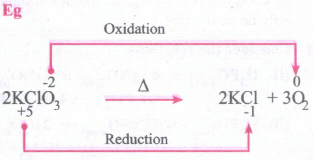
Decomposition reaction: Redox reactions in which a compound breaks down into two or more components are called decomposition reactions. These reactions are opposite to combination reactions. In these reactions, the oxidation number of the different elements in the same substance is changed.
43.
(a) Isothermal process: An isothermal process is defined as one in which the temperature of the system remains constant, during the change from its initial to final state. The system exchanges heat with its surroundings and the temperature of the system remains constant.
For an isothermal process dT = 0
(b) Adiabatic process: An adiabatic process is defined as one in which there is no exchange of heat (q) between the system and surrounding during the process. For an adiabatic process q = 0
(c) Isobaric process: An isobaric process is defined as one in which the pressure of the system remains constant during its change from the initial to final state. For an isobaric process dP = 0 .
(d) Isochoric process: An isochoric process IS defined as the one in which the volume of system remains constant during its change from initial to final state. For an isochoric process, dV= 0.
44.
1. This group contains Be, Mg, Ca, Sr, Ba & Ra.
2. Except Be all these elements are called as alkaline earth metals because their oxides and hydroxides are alkaline in nature.
3. Beryllium is the rare element and Radium is the rarest (10% rocks) ; Their Occurrence: Be- Beryl; Mg - carnallite; Dolomite Ca - Fluorapatite; Sr - Celestite Ba - Barytes.
4. Radium is radioactive.
5. The general electronic configuration is :
[Noble gas] ns2 eg. Be - [He] 2s2
6. On moving down the group the radii increase. Their atomic radii are smaller than alkali metals.
7. They exhibit +2 oxidation state.
8. The ionisation enthalpies are less than p - block elements due to large size. Down the group the ionisation enthalpy decreases.
9. The IE1 of group 2 elements are greater than group 1 elements.
10. The IE2 values are higher than that of alkali metals.
11. They are less electro Positive elements than alkali metals.
12. The hydration enthalpy decreases with increase in ionic radii.
13. MgCl2 form MgCI2 .6H2O and CaCl2 form CaCl2.6H2O
14. The electronegativity value decreases down the group.
15. With concentrated HCl They impart flame colour. Ca - Brick Red ; Sr - Crimson red and Barium - Apple Green.
16. All form metallic halides at elevated temperatures. M + X2 + MX2
17. All elements except Beryllium combine with hydrogen to form hydrides of formula MH2.
45.
2Al + Fe2O3 \(\longrightarrow \) Al2O3 + 2Fe
| Reactants | Products | |||
| Al | Fe2O3 | Al2O3 | Fe | |
| Amount of reactant allowed to react | 324 g | 1.12 kg | - | - |
| Number of moles allowed to react | \(\frac { 324 }{ 27 } =12mol\) | \(\frac { 1.12\times { 10 }^{ 3 } }{ 160 } =7mol\) | - | - |
| Stoichiometric Co-efficient | 2 | 1 | 1 | 2 |
| Number of moles consumed during reaction | 12 mol | 6 mol | - | - |
| Number of moles of reactant unreacted and number of moles of product formed | - | 1 mol | 6 mol | 12 mol |
Molar mass of Al2O3 format = 6 mol x 102 g mol-1 = 612 g
[ Al2O3 : (2 x 27) + 3(16) = 54 + 48 = 102] = 612 g
Excess reagent = Fe2O3
Amount of excess reagent left at the end of the reaction = 1 mol x 160 g mol-1
= 160g [ Fe2O3 : (2 x 56) + (3 x 16) = 112 + 48 = 160] = 160 g
46.
r(K+)+r(Cl-) = d(K+-Cl-) = 3.14 Å.
The effective nuclear charge for K+ and CI- can be calculated as follows.
K+ = (1s2) (2s22p6) (3s23p6)
inner shell (n-1)th shell nth shell
Z*(K-) = Z-S
= 19 - [(0.35 x 7) + (0.85 x 8) + (1 x 2)]
= 19 - 11.25 = 7.75
Z*(Cl-) = 17- [(0.35 x 7) + (0.85 x 8) + (1 x 2)]
= 17-11.25 = 5.75
∴ \(\frac { r({ K }^{ + }) }{ r(Cl^{ - }) } =\frac { Z*(Cl^{ - }) }{ Z*(K^{ + }) } =\frac { 5.75 }{ 7.75 } \)=0.74
∴ r(K+) = 0.74 r(Cl-)
Substitute (2) in (1)
0.74 r(Cl-) + r(Cl-) = 3.14 Å.
1.74 r(Cl-) = 3.14 Å
r(Cl-) = \(\frac { 3.14\overset { 0 }{ A } }{ 1.74 } \)=1.81.Å.
47.
The group metal - 1 which is present in common salt is sodium.
So (A) is sodium
Sodium reacts with hydrogen (B) to give, sodium hydride (C). In sodium hydride the hydrogen is present in -1 oxidation state.
\(2\underset { (A) }{ Na } +\underset { (B) }{ { H }_{ 2 } } \rightarrow 2\underset { (C) }{ NaH } \)
So (B) hydrogen and (C) is sodium hydride
H2 reacts with oxygen gas (D) to give an universal solvent, water (E) follows:
\(2\underset { (B) }{ { H }_{ 2 } } +{ O }_{ 2 }\rightarrow 2\underset { (D) }{ { H }_{ 2 }O } \)
So (E) is water. Water is the universal solvent
Water (E) reacts with sodium (A) follow to give (F), which is a strong base.
\(2\underset { (E) }{ { H }_{ 2 }O } +\underset { (A) }{ 2Na } \rightarrow 2\underset { (F) }{ NaOH } +{ { H }_{ 2 } } \)
So (F) is sodium hydroxide.
| Element / Compound | Symbol / Formula | Name |
| A | Na | Sodium |
| B | H2 | Hydrogen |
| C | NaH | Sodium hydride |
| D | H2O | Water |
| E | NaOH | Sodium hydroxide |
48.
Variation along a period: Ionisation energy usually increases along a period. This is due to increase of nuclear charge and decrease in size as we move from left to right in a period.
Periodic variation in group: Ionisation energy decreases down a group. As we move down a group, the valence electron occupies new shells, the distance between the nucleus and the valence electron increases. So, the nuclear forces of attraction on valence electron decreases and hence ionisation energy also decreases down a group.
49.
de-Broglie combined the following two equations of energy of which one represents wave character (hu) and the other represents the particle nature(mc2).(i) Planck's quantum hypothesis: E = hv
(ii) Einstein's mass - energy relationship :
E = mc2
From (i) and (ii)
hv = mc2
hc/λ =mc2
λ = h/mc
(a) The equation represents the wavelength of photons whose momentum is given by mv (photons have zero rest mass)
(b) For a particle of matter with mass m and moving with a velocity v, the equation can be written as λ = h/mv
(c) This is valid only when the particle travels at speeds much less than the speed of light
50.
Bohr's atom is based on the following assumptions:
(a) The energies of electrons are quantised
(b) The electron is revolving around the nucleus in a certain fixed circular path called stationary orbit.
(c) Electron can revolve, only in those orbits in which the angular momentum (mvr) of the electron must be equal to an integral multiple of h/2π i.e mvr =nh/2π
where n = 1,2,3 ...etc...
As long as an electron revolves in the fixed stationary orbit, it doesn't lose its energy.
However, when an electron jumps from higher energy state (E2)to a lower energy state (E1)the excess energy is emitted as radiation. The frequency of the emitted radiation is
E2 = E1 = hv and
\(v=\frac { ({ E }_{ 2 }-{ E }_{ 1 }) }{ h } \)
Conversely, when suitable energy is supplied to an electron, it will jump from lower energy orbit to a higher energy orbit.
51.
2 NO(g) + O2 (g) ⇌ 2NO2(g)
| NO2 | O2 | NO2 | |
| Initila Partial Pressure | 1 | 1 | - |
| Reacted | 0.96 | 0.96 | - |
| Equilibrium Partial Pressure | 0.04 | 0.52 | 0.96 |
\(K_p={P^2_{NO_2}\over P^2_{NO_2}.Po_2}\)
\(={0.96\times 0.96\over 0.04\times 0.04\times 0.52}\)
= 11.07 x 10² (atm)-1
Keq = 41.6 x 10² M-1.
52.
Given \(\triangle\)v = 5.7 x 10⁵ ms-1. \(\triangle\)x = ?
According to Heisenbergs uncertainty principle \(\Delta x \cdot \Delta p \geq \frac{\mathrm{h}}{4 \pi}\)
\(
\frac{\mathrm{h}}{4 \pi}=\frac{6.626 \times 10^{-34}}{4 \times 3.14} \mathrm{kgm}^{2} \mathrm{~s}^{-1}=5.28 \times 10^{-35}
\)
\(\Delta x \cdot \Delta \mathrm{p} \geq 5.28 \times 10^{-35}
\)
\(\Delta x . \mathrm{m} \Delta \mathrm{v} \geq 5.28 \times 10^{-35}
\)
\(\Rightarrow \Delta x \geq \frac{5.28 \times 10^{-35} \mathrm{kgm}^{2} \mathrm{~s}^{-1}}{9.1 \times 10^{-31} \mathrm{~kg} \times 5.7 \times 10^{5} \mathrm{~ms}^{-1}} \Rightarrow \Delta x \geq 1.017 \times 10^{-10} \mathrm{~m}\)
53.
No. of moles of Oxygen =\(\frac { Mass }{ Molar Mass }\) =\(\frac { 52.5}{ 32 }\)
= 1.640 moles
No. of moles of CO2 = \(\frac { Mass }{ Molar Mass }\)=\(\frac { 65.1 }{ 44} \)
= 1.480 moles
Partial pressure = Mole fraction x Total Pressure
\(\therefore \mathrm{P}_{\mathrm{o}_{2}}=\left(\frac{1.641}{1.641+1.480}\right) 9.21=\frac{1.641}{3.121} \times 9.21\)
= 4.842 atm.
\(\mathrm{P}_{\mathrm{CO}_{2}}=\left(\frac{1.480}{1.641+1.480}\right) 9.21=\frac{1.480 \times 9.21}{3.121}\)
= 4.367 atm.
54.
The gas deviates from ideal gas behaviour and will be a real gas only. In the compressed state, the inter molecular forces will be very high as the molecules are very close.
55.
i) urea [CO(NH2)2]
Mol.mass = 1 (C) + 2(N) + 4(H) + 1(0)
= 1(12) + 2(14) + 4(1) + 1(16)
= 12 + 28 + 4 + 16 = 60
ii) Acetone [CH3 COCH3]
Mol.mass = 3(C) + 6(H) + 1(0)
= 3(12) + 6(1) + 1(16)
= 36 + 6 + 16 = 58
iii) Boric Acid [H3 BO3]
Mol.mass = 3(H) + 1(B) + 3(0)
= 3(1) + 1(11) + 3(16)
= 3 + 11 + 48 = 62
iv) Sulphuric Acid [H2 SO4]
Mol.mass = 2(H) + 1(S) + 4(0)
= 2(1) + 1(32) + 4(16)
= 2 + 32 + 64 = 98
56.
(i) (a) Carbon Monoxide:
Carbon monoxide is a poisonous gas produced as a result of incomplete combustion of coal are firewood. It is released into the air mainly by automobile exhaust. It binds with haemoglobin and form carboxy haemoglobin which impairs normal oxygen transport by blood and hence the oxygen carrying capacity of blood is reduced. This oxygen deficiency results in headache, dizziness, tension, Loss of consciousness, blurring of eye sight and cardiac arrest.
(b) Carbon dioxide:
Carbon dioxide is released into the atmosphere mainly by the process of respiration, burning of fossil fuels, forest fire, decomposition of limestone in cement industry etc.Green plants can convert CO2 gas in the atmosphere into carbohydrate and oxygen through a process called photosynthesis. The increased CO2 level in the atmosphere is responsible for global warming. It causes headache and nausea.
ii) a) Carbon Monoxide :
It binds with haemoglobin and form carbory haemoglobin which impairs normal oxygen transport by blood and hence the oxygen carrying capacity of blood is reduced. This oxygen deficiency results in headache, dizziness, tension, Loss of consciousness, blurring of eye sight and cardiac arrest.
b) Carbon dioxide :
It causes headache and nausea.
57.
W2 = 2.56 g
W1 = 100 g
T = 319.692 K
Kb = 2.42 K Kg mol–1
\(\Delta\)Tb = (319.692 – 319.450) K = 0.242 K
\(M_2={K_b\times W_2\times 100\over \Delta T_b\times W_1}\)
\(={2.42\times 2.56\times 1000\over 0.242\times 100}\)
M2 = 256 g mol-1
Molecular mass of sulphur in solution = 256 g mol–1
atomic mass of one mole of sulphur atom = 32
No. of atoms in a molecule of sulphur = \({256\over 32}=8\)
Hence molecular formula of sulphur is S8.
58.
\(P_{CO_2}\) = 1.017 x 10⁻³ atm T = 500oC
Kp = \(P_{CO_2}\)
\(\therefore K_{P_1}\) = 1.017 x 10⁻³ T = 500 + 273 = 773 K
\(K_{P_2}\) = ? T = 600 + 273 = 873 K
\(\Delta H^o=181\ KJ\ mol^{-1}\)
\(\log({K_{P_1}\over K_{P_1}})={\Delta H^o\over 2.303\ R}({T_2-T_1\over T_1T_2})\)
\(\log({K_{P_2}\over 1.017\times 10^{-3}})={181\times 10^3\over 2.303\times 8.314}({873-773\over 873\times 773})\)
\(\log({K_{P_2}\over 1.017\times 10^{-3}})={181\times 10^3\times 100\over 2.303\times 8.314\times 873\times 773}\)
\({K_{P_2}\over 1.017\times 10^{-3}}=\) anti log of (1.40)
\({K_{P_2}\over 1.017\times 10^{-3}}=25.12\)
\(\Rightarrow K_{P_2}=\) 25.12 x 1.017 x 10-3
\(K_{P_2}=\) 25.54 x 10⁻³.
59.
\(\triangle\)x = 0.6\(\mathring{A}\) = 0.6 x 10⁻¹⁰m
\(\triangle p\) = ?
\(\triangle x.\triangle p\ge\frac{h}{4\pi}\)
\(\triangle x.\triangle p\ge5.28\times10^{-35}kgm^{2}s^{-1}\)
\((0.6 \times10^{-10}) \triangle p \ge5.28\times10^{-35}\)
\(\Rightarrow \triangle \ge \frac{5.28\times10^{-35}kgm^{2}s^{-1}}{0.6510^{-1}m}\)
\(\triangle p \ge8.8\times10^{-25}kgms^{-1}\)
60.
\({ r_{n} }=\frac{(0.529)n^2}{z}\mathring{A}\ \ { E_{n} }=\frac{-13.6(z)^2}{(n)^2}ev atom^{-1}\)
for Li2+ z = 3
Bohr radius for the third orbit (r3)
= \(\frac { (0.529){ (3) }^{ 2 } }{ 3 } \)
= 0.529\(\times\)3
=1.587 \(\mathring{A}\)
Energy of an electron in the fourth orbit
\(({E}_{6})=\frac { -13.6{ (3) }^{ 2 } }{ { (4) }^{ 2 } } \)
=-7.65eV atom-1

11th Standard Syllabus & Materials
11th Standard
TN 11th Tamil பீடு பெற நில் - செய்யுள் - காவடிச்சிந்து Important Questions And Answers Study Material - QB365 Set A
NEW11th Standard
TN 11th Tamil பீடு பெற நில் - உரைநடை - மலை இடப்பெயர்கள் : ஓர் ஆய்வு Important Questions And Answers Study Material - QB365 Set A
NEW11th Standard
TN 11th Tamil மாமழை போற்றுதும் - துணைப்பாடம் - யானை டாக்டர் Important Questions And Answers Study Material - QB365 Set A
NEW11th Standard
TN 11th Tamil மாமழை போற்றுதும் - செய்யுள் - ஐங்குறுநூறு Important Questions And Answers Study Material - QB365 Set A



Tamilnadu Stateboard 11th Standard Subjects

Maths

Commerce

Economics

Biology

Business Maths and Statistics

Accountancy

Computer Science

Physics
Chemistry
Maths
Biology
Economics
Physics
Chemistry

History
Business Maths and Statistics

Computer Science
Accountancy

Computer Applications
History
Computer Technology
Commerce
Computer Applications
Computer Technology

Tamil

English

French
Tamilnadu Stateboard Standards
